
Category hub · Saw blades
Saw blades: types, sizes and how to choose the right one
A saw blade fits through one interface, and it differs by saw. Circular, miter and table saw blades mount on an arbor through a centre bore, jigsaw blades use a T-shank or U-shank, reciprocating blades use a universal shank, and band saw blades are welded loops whose length is set by the machine. Once the mount fits, the material decides the rest: tooth count and grind on round blades, teeth per inch (TPI) on straight and band blades. This hub sets out each family's interface and links to the guide that covers it in full.
On this page
- What types of saw blades are there?
- What arbor does a circular saw blade use?
- Which blades fit a miter saw?
- What blade fits a table saw?
- Do T-shank and U-shank jigsaw blades interchange?
- Do reciprocating saw blades fit every brand of saw?
- How do you find the right band saw blade length?
- How do you choose a saw blade for the material?
- How do you replace a saw blade, and what holds it in the saw?
- When does a saw blade that fits still fail?
What types of saw blades are there?
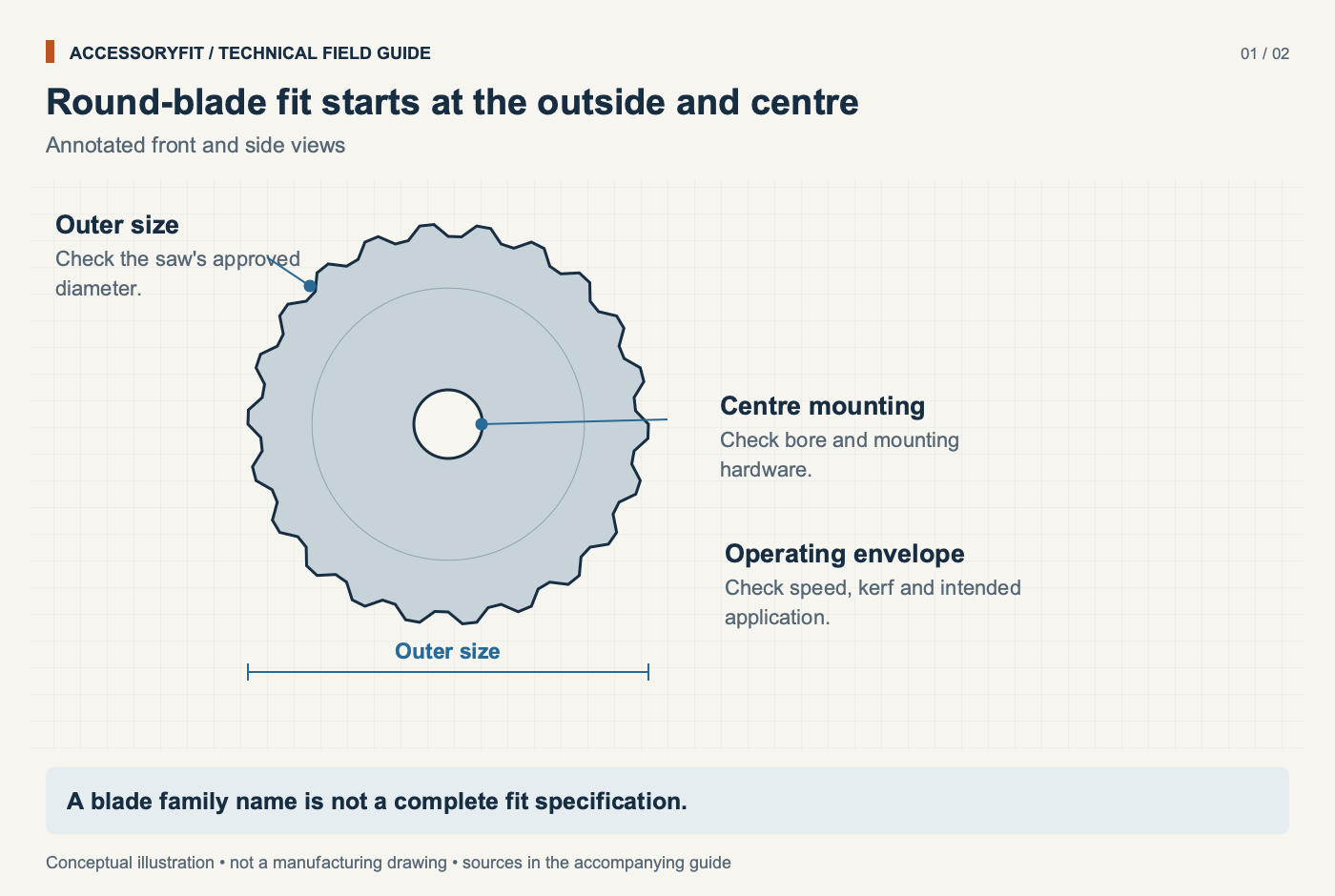
Saw blades fall into six families by the saw they fit: circular, miter, table, jigsaw, reciprocating and band saw blades. The first three are round carbide-tipped blades that mount on a spindle, and they differ mainly in diameter, bore and tooth design. Jigsaw and reciprocating blades are straight blades held by a shank clamp. Band saw blades are continuous loops. A blade from one family never fits a saw from another, so the first step is always to identify the saw, then its interface, then the material.
The range on sale is wide. US imports of handsaws and saw blades of all kinds came to $826 million in 2025, down from $885 million the year before, according to US data reported to UN Comtrade, and they are spread across many makers and countries of origin. With that much choice, the saw's own interface is a more reliable filter than brand. Country-by-country figures are in the saw blade and bit import data.
The table below gives the interface and the size that decides fit for each family. The sections after it explain each one, with US and European sizes and the limits saw makers set.
| Saw | How the blade mounts | Size that decides fit |
|---|---|---|
| Circular saw | Round arbor, or diamond arbor on worm-drive saws, through the blade bore | 5/8 in arbor on 7-1/4 in saws (US); 30 mm bore common in Europe |
| Miter saw | Arbor through the blade bore, held by clamps and bolt | 5/8 in for 10 in blades; 1 in for 12 in blades; 30 mm in Europe |
| Table saw | Threaded arbor between inner flange and arbor nut | 5/8 in (US); 30 mm (Europe); dado width set by the saw |
| Jigsaw | T-shank or U-shank blade clamp | Shank type; most blades 2-3/4 to 5-1/4 in (70 to 133 mm) long |
| Reciprocating saw | Universal (S) shank clamp | Blade length: 4, 6, 8, 9, 10, 12 in (102, 152, 203, 229, 254, 305 mm) |
| Band saw | Welded loop running on the saw's wheels | Loop length for that model, for example 44-7/8 in on portable deep-cut saws |
What arbor does a circular saw blade use?
A US circular saw blade uses a 5/8 in arbor hole on the common 7-1/4 in size, and the same hole on most 6-1/2 in and 8-1/4 in blades. Small trim-saw blades are the exception with a 10 mm arbor, and track saws often use a metric bore: Makita's SP6000J lists 20 mm. Worm-drive saws such as the SKILSAW SPT77WML use a diamond arbor, so the blade's diamond knockout must be removed before fitting.
European saws use metric bores: 30 mm is common on full-size hand-held saws, and 20 mm on smaller track and plunge saws, with some models sold in either bore depending on the country. The bore must match in size and shape. A blade on the wrong arbor runs off-centre, and saw makers forbid spacers to make a blade fit; only the maker's own ring or flange side is allowed. The blade diameter must also be the one marked on the saw, and the blade's marked speed must be equal to or higher than the saw's no-load speed. For example, Diablo marks its wood blades of this size 8000 rpm, above the 5800 rpm no-load speed Makita lists for its 5007F.
The full list of sizes is in the guide to circular saw arbor sizes. On a handheld circular saw the blade goes on with the teeth up at front, matching the arrow on the guard.
| Blade diameter | Arbor | Example blade max RPM (marked) | Example saw no-load RPM |
|---|---|---|---|
| 5-3/8 in | 10 mm | 12,000 (Diablo D0524X) | 3,600 (Milwaukee 2530) |
| 6-1/2 in (165 mm) | 5/8 in (15.9 mm); track saws 20 mm | 8,000 (Diablo D0624A); 10,000 (Diablo D0660A) | 3,700 (Makita XSS02Z) |
| 7-1/4 in (184 mm) | 5/8 in round; diamond on worm-drive saws | 8,000 (Diablo D0740A) | 5,800 (Makita 5007MG, Milwaukee 2732) |
| 8-1/4 in | 5/8 in | 8,000 (Diablo D0824X) | 6,300 (Milwaukee 2736 table saw) |
| 10 in (254 mm) | 5/8 in | 6,000 (Diablo D1040X) | 3,200 (Makita LS1019L); 4,600 (Makita LS1040) |
| 12 in (305 mm) | 1 in (25.4 mm) | 5,000 (Diablo D1244X) | 3,200 (Makita LS1219L) |
Max RPM values are for the named blades only; always read the marking on your blade. Exceptions exist: Diablo D0640X is a 6 in blade with a 1/2 in arbor for the Porter-Cable Saw Boss; Diablo D1632X 16-5/16 in uses 1 in. DeWalt's DWS780 12 in saw has a 5/8 in spindle and a 1 in blade adapter.
Which blades fit a miter saw?
Miter saws take crosscut blades of the diameter marked on the saw, with a 5/8 in hole on US 10 in saws and a 1 in hole on US 12 in saws. DeWalt's DWS780 also accepts the smaller hole, because its spindle is that size and it uses an adapter for the larger bore. European mitre saws use a 30 mm bore.
Saw makers also limit the tooth design. DeWalt tells owners of its DWS713 and DWS780 to use crosscut blades only, not rip or combination blades, and not blades with a hook angle above 7 degrees. Freud's sliding miter blades use a hook of -5 degrees, which Freud says keeps the blade from climbing and pushes the work toward the fence. Diablo lists some positive-hook blades as suitable for miter saws, so the sources conflict; the saw maker's manual is the one to follow. Speed ratings matter here too: DeWalt requires blades rated at least 5500 rpm on the DWS713 and 4800 rpm on the DWS780.
For aluminum and other non-ferrous metal, DeWalt specifies TCG blades made for that purpose, and Diablo's aluminum blades for miter saws use that grind with a negative hook. The guide to miter saw blade sizes and arbors compares the two common diameters, including crosscut capacity.
What blade fits a table saw?
A US table saw takes blades with a 5/8 in bore on the common 10 in size, and compact jobsite saws such as the Milwaukee 2736 also use 5/8 in. Larger blades for big table and miter saws have a 1 in bore, and European table saws use 30 mm.
The diameter range is set per saw. The Makita 2705X1 accepts blades of 250–255 mm, while the DeWalt DWE7491 is for one diameter only, and DeWalt requires blades rated at least 5000 rpm on it. The riving knife adds a thickness limit: DeWalt's DWE7491 manual states the blade limits for its riving knife as kerf >= 0.094 in; body <= 0.079 in. Dado stacks are limited by arbor length; DeWalt's DWE7491 and Makita's 2705X1 both cap stack width at 13/16 in, and both need the saw's dado insert. On a table saw the blade is mounted with the teeth down at front.
Those limits keep the riving knife and guard working, and the cost of failure is lopsided. The economic analysis in CPSC's 2023 table saw proposal, since withdrawn in September 2025 and still the most recent cost estimate of its kind, found that amputations accounted for 55.3% of the cost of medically treated table saw blade-contact injuries, although they are a small minority of the injuries. How small a minority shows in CPSC's NEISS emergency department data for 2024: by AccessoryFit's estimate, about 10.9% of injuries involving bench or table saws that year were diagnosed as amputations. The wider NEISS breakdown, by year and body part, is in the table saw injury numbers.
The guide to which blades fit your table saw lists bores, speeds and dado limits by saw.
Do T-shank and U-shank jigsaw blades interchange?
No. A jigsaw takes only the shank its clamp is built for: a T-shank saw takes T-shank blades only, and U-shank blades are labelled to fit U-shank saws only. The T-shank, created by Bosch, is the industry-standard type today. One naming trap catches buyers in Europe: Bosch's European catalogue calls the T-shank the single lug shank and calls the U-shank the universal shank, so a blade marked universal there is a U-shank blade, not one that fits every saw.
Once the shank matches, choose by length and TPI. Most blades are 2-3/4 to 5-1/4 in (70 to 133 mm) long, and Lenox sizes the minimum length as material thickness + 2 to 2-3/4 in. Wood blades are typically 6–10 TPI, and metal blades run 14–36 TPI, finer for thinner sheet. Reverse-tooth blades cut on the down stroke for a clean top face. DeWalt says metal and hardwood should never be cut with orbital action, which is meant for soft materials.
The guide to T-shank and U-shank jigsaw blades covers the shanks; the article on how to pick a jigsaw blade covers TPI, blade material and bent blades; and the buyer guide to jigsaw blades for metal compares blades for steel, aluminum and sheet.
Do reciprocating saw blades fit every brand of saw?
Almost always, yes. Reciprocating blades use a universal shank that Bosch describes as a 1/2 in (12.7 mm) universal shank and that Diablo says fits all corded and cordless reciprocating saws. Brand matters far less than length, TPI and blade thickness.
Blades come in 4, 6, 8, 9, 10, 12 in (102, 152, 203, 229, 254, 305 mm). Lenox sizes the length as material width + 3 in (76 mm), and advises keeping 2–3 teeth in the material at all times. For wood with nails and demolition, blades are typically 5–7 TPI; thin sheet metal needs about 18–24 TPI, and thick metal 8–14 TPI. Demolition blades are made thicker and taller so they resist bending; Lenox's are .062 in (1.6 mm) thick. Lenox and Diablo both claim carbide-tipped blades last up to 50x vs. standard bi-metal (manufacturer claims).
The guide to the universal reciprocating blade shank explains the fit in detail, the buyer guide to demolition recip blades compares nail-embedded-wood blades, and the article on making recip blades last covers why blades snap.
How do you find the right band saw blade length?
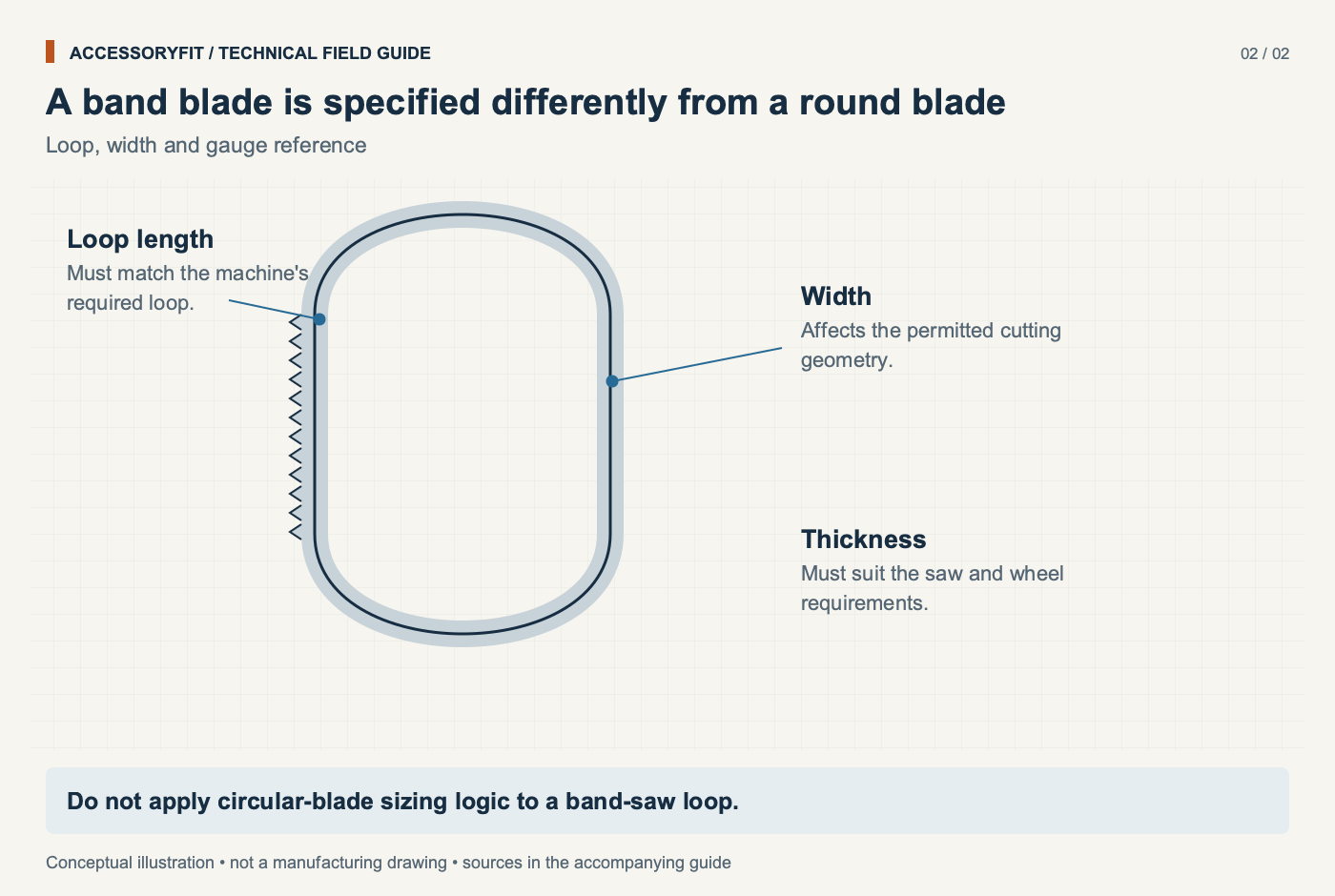
Take it from the saw's manual or a blade maker's fit chart for that exact model: band saw blade length is machine-specific, not a function of wheel size alone. Classic cast-iron saws such as the JET JWBS-14CS take a 93-1/2 in blade, many two-wheel benchtop saws take 59-1/2 in, and portable deep-cut saws such as the DeWalt DWM120 take 44-7/8 in.
The common belief that every band saw of the same wheel size takes the same blade is wrong. The Rikon 10-326, Laguna LT14 and Laguna LT14SUV are sold in the same wheel class as the JET, and all three need longer blades. If the manual is lost, Olson gives a formula from the wheel radii and the distance between wheel centres: (R1 x 3.1416) + (R2 x 3.1416) + (2 x C), measured with the wheels in working position.
Width and pitch come next. For straight cuts use the widest blade the saw allows, and for curves the widest that clears the radius. Keep at least 3 teeth in the workpiece; coarse 2–3 TPI blades suit resawing, and fine 18–32 TPI blades suit thin metal and plastic. The guide to band saw blade length and width lists lengths by machine.
| Machine | Wheel / class | Blade length | Blade width range | Source |
|---|---|---|---|---|
| JET JWBS-14CS | 14 in | 93-1/2 in (2375 mm) | 1/8 to 3/4 in | s4, s2 |
| Rikon 10-320 | 14 in | 93-1/2 in (2375 mm) | 1/8 to 3/4 in | s2 |
| Rikon 10-326 Deluxe | 14 in | 111 in (2819 mm) | 3/16 to 3/4 in | s10 |
| Rikon 10-325 Deluxe | 14 in | 111 in (2819 mm) | 1/8 to 3/4 in | s2 |
| Laguna LT14 | 14 in | 104-1/2 in (2654 mm) | 1/8 to 1 in | s2 |
| Laguna LT14SUV | 14 in | 125 in (3175 mm) | 1/8 to 1 in | s2 |
| Powermatic PWBS-14CS | 14 in | 93-1/2 in (2375 mm) | 1/8 to 3/4 in | s2 |
| Rikon 10-305 | 10 in | 70-1/2 in (1791 mm) | 1/8 to 1/2 in | s2 |
| WEN BA3962 | 10 in | 72 in (1829 mm) | 1/8 to 1/2 in | s5b |
| WEN BA3959 | 9 in benchtop | 59-1/2 in (1511 mm) | 1/8 to 3/8 in | s5 |
| Ryobi BS900 / BS901, Delta 28-150 | 9 in two-wheel benchtop | 59-1/2 in (1511 mm) | not listed | s2 |
| Skil 3104, Grizzly G8976 | 12 in three-wheel benchtop | 62 in (1575 mm) | not listed | s2 |
| Delta 28-180 / 28-185 | 8 in | 56-1/8 in (1426 mm) | not listed | s2 |
| DeWalt DWM120 | portable deep cut | 44-7/8 in (1140 mm), 1/2 in wide, .020 in thick | 1/2 in (supplied) | s6 |
| Milwaukee standard / deep-cut portable | portable | 44-7/8 in (1140 mm) | not listed | s7, s8 |
Each row is the length published for that model. Do not apply a row to a different model, even with the same wheel size. Metric values are conversions.
How do you choose a saw blade for the material?
Choose round blades by tooth count, grind and hook angle, and straight or band blades by TPI and blade material. On a 10 in blade, rip blades have as few as 24 teeth, general-purpose and combination blades 40 to 50 teeth, and crosscut blades 60 to 80 teeth.
The grind sets what the tooth does. ATB teeth are bevelled alternately left and right to slice across the grain, steeper Hi-ATB teeth of 30–40 degrees give chip-free cuts in melamine and veneered plywood, FTG teeth are square-topped for ripping, and TCG teeth alternate a chamfered tooth with a flat raker for laminate, plastics and non-ferrous metal. Positive hooks of 10 to 22 degrees feed fast for ripping; negative hooks of -2 to -6 degrees reduce climbing on sliding miter saws and in laminate and aluminum.
For cutting metal, the blade type follows the saw. Non-ferrous metal such as aluminum on a miter or circular saw calls for a TCG blade made for it. Steel needs a carbide or cermet blade made for ferrous metal: for medium-gauge steel on a 7-1/4 in circular saw, Diablo and Milwaukee both list blades with 48 teeth, Diablo's thin-sheet versions have 56 to 70 teeth, and dry-cut metal saws take blades with 72 teeth on a 1 in arbor. Check the saw's manual first, because some wood-cutting circular saw manuals, such as DeWalt's DWE575, rule out metal. Metal-cutting jigsaw, reciprocating and band saw blades use the finer TPI ranges above. Kerf matters on table saws: full-kerf blades cut about 1/8 in, thin-kerf blades .087-.098 in, and a thin-kerf blade can bind on a riving knife made for a standard blade.
The guide to ATB, FTG and TCG tooth grinds covers this in depth, the buyer guide to plywood blade picks applies it to sheet goods, and the tool to pick a blade by material suggests a tooth count and grind from your saw and material.
| Task | Typical teeth | Grind | Hook angle | Manufacturer example |
|---|---|---|---|---|
| Ripping solid wood | 24 | FTG (Freud); ATB (Diablo) | +20 deg (Freud); +15 deg (Diablo) | Freud LU87R010; Diablo D1024X |
| General purpose | 40 | Hi-ATB (Freud); ATB (Diablo) | +13 deg (Freud); +15 deg (Diablo) | Freud LU72R010; Diablo D1040X |
| Combination (rip + crosscut) | 50 | ATB + flat raker (Freud COMB); listed as ATB (Diablo) | +10 deg (Freud); +15 deg (Diablo) | Freud LU84R011; Diablo D1050X |
| Crosscut / fine finish | 60 | Hi-ATB 38 deg (Freud LU73); ATB (Freud LU88, Diablo D1060S); Hi-ATB (Diablo D1060X) | +10 deg (LU73); +15 deg (LU88, D1060X); +7 deg (D1060S) | Freud LU73R010, LU88R010; Diablo D1060X, D1060S |
| Sliding miter / radial arm crosscut | 60 | ATB | -5 deg | Freud LU91R010 |
| Veneered plywood and melamine | 80 | Hi-ATB | +2 deg (Freud); +15 deg (Diablo) | Freud LU79R010, LU80R010; Diablo D1080X |
| Double-sided laminate / melamine | 80 | TCG | -3 deg | Freud LU97R010 |
Values come from each manufacturer's published specs. The tooth-count bands (24 rip, 40-50 general, 60-80 crosscut) agree with Rockler's guide. Hook angles vary by maker for the same task, so check the blade's own spec.
How do you replace a saw blade, and what holds it in the saw?
Replace a saw blade with one that matches the saw's marked diameter, bore and speed, mounted in the saw's own holder: the flanges and arbor bolt on a round-blade saw, or the shank clamp on a jigsaw or reciprocating saw. Disconnect the power first. On a circular saw, the new blade goes on with the teeth up at front; on a table saw, with the teeth down at front. Makita's manuals say never to use damaged or incorrect blade washers or bolts, because they are designed for that saw.
Straight blades are held differently. T-shank jigsaw blades lock into the tool-free quick-change clamps of most modern jigsaws, while U-shank blades belong to older saws and usually need a tool to change. Reciprocating saws hold the universal shank described above.
Before replacing a round blade that burns or feeds hard, clean it: baked-on pitch often causes those symptoms while the teeth underneath are still sharp. Makita names gum and pitch remover, hot water or kerosene for the job, never gasoline. Keep spare blades so their carbide teeth do not touch other blades, because carbide is brittle and chips if knocked or dropped.
When does a saw blade that fits still fail?
A blade that fits the arbor or shank still fails when it is the wrong diameter, speed rating, tooth design or thickness for the saw, or when it is dirty or misused. The common cases each trace back to a manufacturer limit covered above.
- Burning on wood is often baked-on pitch rather than dull teeth, so clean the blade before replacing it; fence or riving-knife misalignment, feed rate and stock condition also cause burning. Makers warn against oven cleaner, which can damage the coating and weaken the cobalt binding the carbide.
- Thin-kerf blades are not an upgrade for every table saw; Rockler says they bring no significant advantage on contractor and cabinet saws, whose standard riving knives can be too thick for them.
- Jigsaw blades bend or wander when the saw is forced or run with orbital action in metal or hardwood.
- Reciprocating blades snap when the shoe is not held against the work or the blade is forced in metal; DeWalt ties forcing the blade to shortened life and breakage.
- Band saw blades crack when too thick for the wheel diameter, and overheat and break early when the pitch is too fine for the work.
Clean a burning blade and check the saw's alignment before deciding the blade needs replacing; if it still burns once clean on an aligned saw, the teeth are the remaining cause. Carbide teeth are brittle, so store blades so their teeth do not touch other blades, and do not drop them. The article on why saw blades burn wood works through the burning causes one by one.
Saw blade guides on AccessoryFit
- Circular saw blade arbor size guideArbor and bore by blade diameter, US and metric
- Miter saw blade sizes and arbor fitThe two common diameters, bores and capacities
- Table saw blade arbor sizesBores, speed ratings, riving knives and dado limits
- Jigsaw blade shank typesT-shank against U-shank, and the European names
- Reciprocating saw blade compatibilityThe universal shank and blade lengths
- Band saw blade sizes by machineLength, width and TPI for named saws
- How to choose a circular saw bladeTeeth, grind, hook angle and kerf
- How to pick a jigsaw bladeTPI, material and stopping bent blades
- Circular saw blades for plywoodBlades compared on published specs
- Jigsaw blades for cutting metalSteel, aluminum and sheet
- Reciprocating saw blades for demolitionNail-embedded wood and mixed materials
- Why a circular saw blade burns woodCauses and fixes
- Reciprocating saw blades breakingCauses and prevention
- Circular saw blade selectorMaterial, teeth and size
Questions readers ask
Can a 7-1/4 in blade go on a 6-1/2 in circular saw?
No. Both sizes use a 5/8 in arbor in the US, so the larger blade will physically go on, but saw makers allow only the blade diameter marked on the saw, because a larger blade may not be guarded properly.
Are circular saw blades universal?
Within one size and bore, largely yes: blades fit by diameter, arbor hole and speed rating rather than by brand. Across sizes and regions they are not. US blades of the common sizes use a 5/8 in or 1 in hole, European blades a 30 mm or 20 mm bore, and worm-drive saws need the diamond knockout removed.
What saw blade cuts aluminum?
On a miter or circular saw, use a TCG blade made for non-ferrous metal, as DeWalt specifies; Diablo's aluminum blades for miter saws pair that grind with a negative hook. On a jigsaw or reciprocating saw, use a metal-cutting blade with a TPI matched to the thickness.
Can I use a table saw blade on a miter saw?
Not if it is a rip or combination blade. DeWalt says to use crosscut blades only on its miter saws and rules out rip blades, combination blades and hook angles over 7 degrees. The diameter, bore and speed rating must also match the miter saw.
Do jigsaw blades fit all jigsaws?
No. T-shank blades fit T-shank saws and U-shank blades fit U-shank saws. All five jigsaws in the accessory finder take T-shank blades, but check the clamp on your own saw before buying.
Where to go next
- Circular saw blade arbor sizesThe full arbor and bore table, including metric saws.
- How to choose a circular saw bladeTooth count, grind and kerf for each kind of cut.
- Accessory finderSee the blade size, arbor and speed your saw's maker states.
References 183 documents, 35 publishers
- Acme Tools: JET 708115K JWBS-14CS 14 in Closed Stand Bandsaw specifications
- Australian Competition and Consumer Commission: Lithium-ion Batteries Issues Paper; Lithium-ion batteries and consumer product safety (Report, October 2023)
- BG BAU - Berufsgenossenschaft der Bauwirtschaft (Germany): Baustellenkreissaegen, Handkreissaegen - Baustein B 265
- Bosch: GKS 190 Professional Hand-Held Circular Saw - technical data; GCM12SD 12 In. Dual-Bevel Glide Miter Saw product page; GCM12SD operating/safety instructions 2610051827; GCM 12 SDE Professional Mitre Saw - technical data; GTS 254 Professional Table Saw - technical data; U-Shank Jig Saw Blades Pro for Metal; T-Shank Jig Saw Blades Pro for All Purpose; Bosch Accessories catalogue: Jigsawing, sabre sawing, multi-cutters, holesawing (1619A00Y1X, GB edition, 2016); T-Shank Jig Saw Blade Sets; U-Shank Jig Saw Blades Pro for Wood; U-Shank Jig Saw Blades Basic for Metal; T-Shank Jig Saw Blades for Wood; T 101 BR Clean for Wood Jigsaw Blade; T 118 A Basic for Metal Jigsaw Blade; U 234 X Progressor for Wood Jigsaw Blades; T-Shank Jig Saw Blades Pro for Plastic (set 43925); EXPERT Thick Tough Metal S1155CHC Blade; EXPERT Thin Tough Metal S922EHM Blade; Reciprocating Saw Blades (category page)
- Crescent Electric Supply (retailer): Milwaukee 2829-20 compact band saw listing (35-3/8 in L blade)
- DeWalt: DWA271424 7-1/4 in 24T Circular Saw Blade; DWE575 7-1/4 in Circular Saw instruction manual (N786997); DWS713 10 in Compound Miter Saw instruction manual (NA379757); DWS780 12 in Double Bevel Sliding Compound Miter Saw instruction manual (N466020); DWE7491RS 10 in Job Site Table Saw instruction manual (N531890); DWM120 Deep Cut Band Saw; DW3508 6-1/2 in x 1/8 in x 5/8 in Diamond Drive Metal Cutting Blade; DWS535B 7-1/4 in Worm Drive Circular Saw instruction manual (N512189); DWA110CMB 10 in (254 mm) 40T and 60T saw blades 2-pack; DWS713 15 Amp 10 in Single-Bevel Compound Miter Saw - product page; DWS780 12 in Double-Bevel Sliding Compound Miter Saw - product page; DWS779 12 in Double-Bevel Sliding Compound Miter Saw - product page; DWE7491RS 10-In. Jobsite Table Saw and Rolling Stand product page; DWE7491RS product page, related accessory DWA11260 12 in (305 mm) 60T blade with 1 in arbor; DCS334/DCS335 20V MAX cordless jig saw instruction manual (N577652); DWE305 12 Amp Corded Reciprocating Saw; DWE305 reciprocating saw instruction manual (N392518); DCS389B 60V MAX Brushless Cordless Reciprocating Saw; DWAW71440 Elite Series 7-1/4 in 40T circular saw blade; DWA271460 7-1/4 in (184 mm) 60T circular saw blade; DWA261240 6-1/2 in 40T circular saw blade; DWA3193PCD 7-1/4 in laminate / fiber cement saw blade
- European Parliament and Council of the European Union (EUR-Lex): Regulation (EU) 2023/1542 concerning batteries and waste batteries
- Freud and Diablo: D0740A 7-1/4 in x 40T Finish Saw Blade - tech specs; D12100X 12 in x 100T Wood Demon Ultimate Polished Finish Saw Blade - specs; D1040X 10 in x 40T General Purpose Saw Blade - tech specs; LU84R011 10 in Combination Blade (product specs); D0524X 5-3/8 in x 24T Framing Saw Blade - tech specs; D0624A 6-1/2 in x 24T Framing Saw Blade - tech specs; D0660A 6-1/2 in x 60T Ultra Finish Saw Blade - tech specs; D0824X 8-1/4 in x 24T Framing Saw Blade - tech specs; D1244X 12 in x 44T General Purpose Saw Blade - tech specs; D0724A product page (framing family listing incl. D0620X 6 in); D1472CF 14 in x 72T Steel Demon Cermet II - tech specs; LU91R010 10 in Thin Kerf Sliding Compound Miter Saw Blade - specs; LU91R012 12 in Thin Kerf Sliding Compound Miter Saw Blade - specs; D1090X 10 in x 90T Wood Demon Ultimate Polished Finish Saw Blade - specs; D1060X 10 in x 60T Fine Finish Saw Blade - specs; D1280X 12 in x 80T Fine Finish Saw Blade - specs; D1296N 12 in x 96T Saw Blade for Medium Aluminum - specs; D1272N 12 in x 72T Saw Blade for Thick Aluminum - specs; LU79R012 12 in Thin Kerf Ultimate Plywood & Melamine Blade - specs; LU85R012 12 in Ultimate Cut-Off blade - tech specs; SD206 6 in Pro Dado Set - specs; SD208S 8 in Pro Dado Set - specs and description; DS0908CF 9 in 8 TPI Steel Demon Carbide Teeth Reciprocating Saw Blade for Thick Metal; DS0614BF 6 in 14/18 TPI Bi-Metal Reciprocating Saw Blade for Medium Metal; DS0914BF 9 in 14/18 TPI Bi-Metal Reciprocating Saw Blade for Medium Metal; DS0610CF 6 in 10 TPI Steel Demon Carbide Teeth Reciprocating Saw Blade for Medium Metal; DS0606CWS 6 in 5/7 TPI Demo Demon Carbide Teeth Reciprocating Saw Blade for Nail-Embedded Wood; DS0903CP product page (pruning/clean wood carbide family incl. DS0603CP, DS1203CP); LU87R010 10 in Thin Kerf Rip Blade (product specs); D1024X 10 in x 24T Ripping Saw Blade (product specs); LU72R010 10 in General Purpose Blade (product specs); D1050X 10 in x 50T Combination Saw Blade (product specs); LU73R010 10 in Cabinetmaker's Crosscut Blade (product specs); D1080X 10 in x 80T Ultra Finish Saw Blade (product specs); Frequently Asked Questions; LU97R010 10 in Double Sided Laminate/Melamine Blade (product specs); LU79R010 10 in Thin Kerf Ultimate Plywood and Melamine Blade (product specs); LU80R010 10 in Ultimate Plywood and Melamine Blade (product specs); LU88R010 10 in Thin Kerf Fine Finish Crosscut Blade (product specs); D1060S 10 in x 60T Fine Finish Saw Blade (product specs); D0760A product page (ultra finish family listing incl. D0660A); D0770F product page (thin metal family listing incl. D0756F, D1490CF); LM72R012 12 in Heavy-Duty Rip Blade - tech specs; LU84R012 12 in Combination Blade - tech specs; D0704DH 7-1/4 in x 4T HardieBlade for fiber cement - tech specs (fiber cement family listing)
- Grizzly Industrial: G0605X 12 in Extreme Series table saw product page (specifications); G0605X/G0606X owner's manual with Important Update (arbor change)
- Hand (N Y): Traumatic Finger Amputations: Epidemiology and Mechanism of Injury, 2010-2019; Trends in Upper Extremity Saw Injuries From 2003 to 2022
- Health and Safety Executive (UK): Circular saw benches - Safe working practices, Woodworking Information Sheet No 16 (Revision 2)
- James Hardie: Good, Better, Best Cutting Practices; Working Safely with Silica
- Joint Center for Housing Studies of Harvard University: Improving America's Housing 2025
- Journal of Clinical Orthopaedics and Trauma: Patients admitted for treatment of traumatic finger amputations: Characteristics, causes, and prevention
- Laguna Tools: Bandsaw Blade Education
- Makita: 5007MG 7-1/4 in Magnesium Circular Saw - specs; 5007F 7-1/4" Circular Saw product page; 5007F/5008F instruction manual; HS7611 190 mm Circular Saw - specification; LS1019/LS1019L Slide Compound Miter Saw instruction manual; LS1040 10 in Compound Miter Saw - specs; LS1019L 10 in Dual-Bevel Sliding Compound Miter Saw - specs; LS1219L 12 in Dual-Bevel Sliding Compound Miter Saw - specs; LS1019L 260 mm Slide Compound Mitre Saw - specification; LS1219 305 mm Slide Compound Mitre Saw - specification; 2705X1 10 in Contractor Table Saw instruction manual; 2704N 260 mm Table Saw - specification; MLT100N 260 mm Table Saw - specification; XSH03Z 18V LXT Brushless 6-1/2" Circular Saw (tool only) product page; XSH03 instruction manual; SP6000J 6-1/2 in Plunge Circular Saw - specs; SP6000J product flyer; XSS02Z 18V LXT 6-1/2 in Circular Saw - specs; XPS01Z 36V (18V X2) 6-1/2 in Plunge Circular Saw - specs; 5007MG/5007MGA Circular Saw instruction manual; 5377MG 7-1/4 in Hypoid Saw instruction manual; HS7611 Circular Saw instruction manual (EU); HS6601 165 mm Circular Saw - specification; LS0815FL 216 mm Slide Compound Mitre Saw - specification; 5903R 235 mm Circular Saw - specification; LS1040 260 mm Mitre Saw - specification; 5007F product flyer; JR3070CT reciprocating saw instruction manual (EU)
- Mallory Safety and Supply (retailer): Milwaukee 48-40-4505 14 in 72T blade listing
- Milwaukee Tool: M18 FUEL 7-1/4 in Circular Saw 2732-20 - specifications; 48-00-5027 12 in 5 TPI AX SAWZALL Blade for Wood with Nails; 49-22-1129 SAWZALL 12PC Demolition Blade Set; 48-39-0560 44-7/8 in 14/18 TPI Standard / Deep Cut Band Saw Blade; 48-39-0510 44-7/8 in 14 TPI Standard / Deep Cut Band Saw Blade; M18 FUEL 8-1/4 in Table Saw 2736-20 - specifications; Operator's manual 58-14-0089D4 (Cat. No. 2736-20); M12 FUEL 5-3/8 in Circular Saw 2530-20 - specifications; 48-40-4505 14 in metal cutting circular saw blade; M18 FUEL 10 in Dual Bevel Sliding Compound Miter Saw 2734-20 - specifications; M18 FUEL 12 in Dual Bevel Sliding Compound Miter Saw 2739-20 - specifications; 2821-20 M18 FUEL SAWZALL Recip Saw; 48-00-1301 9 in 5 TPI Pruning SAWZALL blade (5 pk); 48-00-5332 9 in 3 TPI AX carbide pruning SAWZALL blade; 48-00-1303 12 in 5 TPI Pruning SAWZALL blade (5 pk); 2829-20 M18 FUEL Compact Band Saw product page; 48-40-4235 7-1/4 in 48T metal cutting circular saw blade
- NIOSH: Reducing Hazardous Dust Exposure When Cutting Fiber-Cement Siding (WP Solutions 2015-185)
- Olson Saw: Olson catalogue January 2025 (fit charts pp.12-14; How-To's for all Band Saw Blades pp.15-16); FAQs: What size blade does my band saw or scroll saw take?
- OSHA: 29 CFR 1910.213 Woodworking machinery requirements; 29 CFR 1910.243 Guarding of portable powered tools; 29 CFR 1926.1153 Respirable crystalline silica, Table 1
- Phoenix Fire Department, Fire Investigations Task Force: Lithium-Ion Battery Fire Investigations, December 2025 (Public Release Summary)
- Rockler: Table Saw Blades: A Complete Guide; Saw Blade Glossary; How to Clean and Maintain Your Saw Blades
- SKIL: 7-1/4 in Lightweight Worm Drive SKILSAW SPT77WML-01
- Stanley Black & Decker (IRWIN, LENOX): LENOX Tool Catalog 2024: Power Tool Accessories, Hand Tools; Reciprocating Saw Blades (product range page)
- Starrett: Starrett Band Saw Blades catalogue (Choosing the Correct Blade, pp.14-15; installation guidelines)
- ToolsToday: Jigsaw Blades - Not So Scary; Saw Blade Tooth Geometry: The Secret to a Perfect Cut
- U.S. Consumer Product Safety Commission: Safety Standard Addressing Blade-Contact Injuries on Table Saws: Supplemental Notice of Proposed Rulemaking (November 1, 2023); NEISS 2024 data file (neiss2024.xlsx), with NEISS_FMT code formats; The 2017 NEISS Table Saw Special Study (staff briefing package, including Table Saw Blade-Contact Injuries Special Study Report, 2017); Proposed Rule: Safety Standard Addressing Blade-Contact Injuries on Table Saws (staff briefing package, January 17, 2017); Injuries Associated with Stationary Power Saws, 2001; 2019 NEISS Coding Manual; Withdrawal of Proposed Regulatory Actions (September 29, 2025)
- United Nations Statistics Division, UN Comtrade (US-reported data): UN Comtrade Database: United States imports, 2025, HS 6804, 6805, 8202, 820231, 820239, 8207, 820750; UN Comtrade Database: United States imports, 2024, HS 6804, 6805, 8202, 820231, 820239, 8207, 820750
- US Environmental Protection Agency, Office of Resource Conservation and Recovery: An Analysis of Lithium-ion Battery Fires in Waste Management and Recycling (EPA 530-R-21-002)
- US International Trade Commission: Diamond Sawblades and Parts Thereof from China, Inv. No. 731-TA-1092 (Second Review), Publication 5176
- WEN Products: WEN BA3959 2.8-Amp 9-Inch Benchtop Band Saw; WEN BA3962 3.5-Amp 10-Inch Two-Speed Band Saw
- Wikipedia: Jigsaw (tool)
- Woodcraft: RIKON 14 in Deluxe Bandsaw Model 10-326; Timber Wolf Bandsaw Blade 111 x 3/16 in x 10 TPI Raker; Timber Wolf Bandsaw Blade 82 x 3/16 in x 10 TPI Raker; Burn-Free Table Saw Cuts (Robert J. Settich)
- Woodworker's Journal: Bosch Jigsaws, Then and Now (Chris Marshall, 2010)
Accessed .