
Fit guide · Miter saws
Miter saw blade sizes: 10 in vs 12 in, arbors and what fits
A US 10 in miter saw takes 10 in blades with a 5/8 in arbor hole, and a 12 in saw takes 12 in blades with a 1 in hole. European mitre saws use a 30 mm bore. Diameter must match the saw exactly, the blade's marked speed must meet or beat the saw's, and saw makers such as DeWalt limit miter saws to crosscut blades with a modest hook angle. A blade that slides onto the arbor can still fail any of those checks.
By AccessoryFit editors · Checked
On this page
- What blade sizes do miter saws take?
- What arbor size does a 10 in or 12 in miter blade need?
- Which blades fit popular miter saws?
- What speed rating does a miter saw blade need?
- Can you put a rip or combination blade on a miter saw?
- How many teeth should a miter saw blade have?
- Does a 12 in miter saw cut wider boards than a 10 in?
- Which way does a miter saw blade go on, and how thick can it be?
- How do US miter blades compare with European mitre saw blades?
- When does a miter saw blade not fit, even if it slides on?
- Which other saws use bores and blade sizes like these?
What blade sizes do miter saws take?
Miter saws in the US are built around two blade diameters, 10 in and 12 in, and each saw takes only the diameter marked on it. In Europe the same two classes are sold with metric blades, and the saw's plate gives the millimetre diameter and bore. Miter saw blades are crosscut blades; the saw pulls or pushes the blade down and across the work, which is why makers restrict the blade's bore, speed rating and hook angle in their manuals.
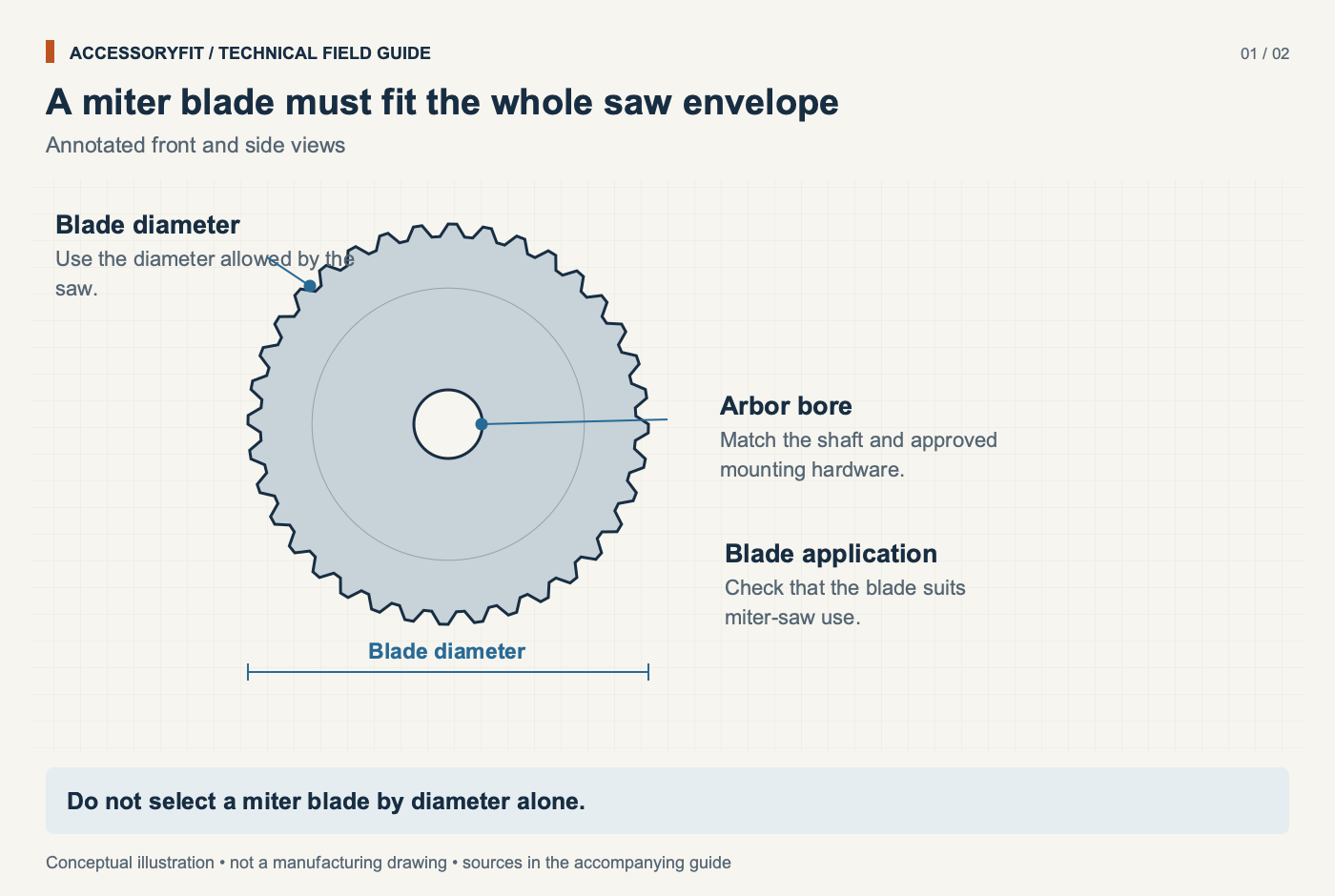
Diameter is the first fit check. DeWalt's DWS713 and DWS780 manuals and Makita's LS1019 manual all say never to fit a blade smaller than the saw is made for, because it will not be guarded properly. A larger blade will not clear the guard at all. The three remaining checks are bore, speed rating and blade type, covered in order below.
What arbor size does a 10 in or 12 in miter blade need?
A 10 in miter blade needs a 5/8 in arbor hole, and a 12 in blade normally needs a 1 in hole. DeWalt's DWS713 manual and Makita's LS1019 manual give the smaller figure; Makita's LS1219L, Diablo's D12100X and DeWalt's DWS780 manual give the larger one.
The DWS780 is the exception worth knowing. Its spindle is 5/8 in, and DeWalt supplies its own adapter so that it can take 12 in blades with the larger 1 in bore. DeWalt's manual says to use that adapter only with blades of that bore, so a blade with a 5/8 in hole goes straight onto the spindle without it. Other 12 in saws in the table below do not list this option, so read your own manual before assuming a second bore is allowed.
The same bore pattern carries across the rest of the bench-saw family, which is why a blade can often move between a table saw and a miter saw of the same diameter on fit alone. The guide to table saw blade bores and adapters covers the table-saw side, and the guide to arbor and bore sizes for circular saws covers the hand-held sizes below these. Fit is not the same as suitability, though: the blade-type rules further down rule out many table saw blades on a miter saw.
Which blades fit popular miter saws?
Each saw maker states the diameter, arbor and no-load speed, and the table collects those figures for the miter saws in the AccessoryFit tool database. Where a figure comes from one manufacturer document only, the table says so. The Makita LS1019L and Milwaukee 2734-20 are both 10 in sliding saws on a 5/8 in arbor, while the DeWalt DWS780 and Bosch GCM12SD are 12 in saws. The same data, searchable by model, sits behind the accessory finder for any tool model.
| Tool | Blade diameter | Arbor | No-load speed |
|---|---|---|---|
| Bosch GCM12SD | 12 in | 1 in one source | 4000 rpm one source |
| DeWalt DWS713 | 10 in | 5/8 in one source | 5000 rpm |
| DeWalt DWS780 | 12 in | 1 or 5/8 in one source | 3800 rpm |
| Makita LS1019L | 10 in | 5/8 in | 3200 rpm |
| Milwaukee 2734-20 | 10 in | 5/8 in one source | 4000 rpm |
Values marked one source appear in a single manufacturer document; check the tool's manual or rating plate before buying.
What speed rating does a miter saw blade need?
The blade's marked speed must equal or exceed the speed marked on the saw, and some makers set a higher floor than the motor speed. Makita's LS1019 manual gives the general rule; DeWalt goes further and names a minimum blade rating for each saw.
DeWalt's DWS713 runs at 5000 rpm, yet its manual asks for blades rated at least 5500 rpm. The DWS780 runs at 3800 rpm and asks for at least 4800 rpm. Both minimums sit above the motor speed, so a blade that merely matches the motor figure does not meet DeWalt's requirement. The gap matters when a blade borrowed from another saw carries a lower marking than expected.
The larger blade class generally carries lower marked maximums than the 10 in class. In the blade table further down, Diablo's 12 in blades are marked lower than its 10 in blade, and Freud's sliding-miter blades have no maximum speed in the specs read, so the marking on the blade itself has to be checked before use.
Can you put a rip or combination blade on a miter saw?
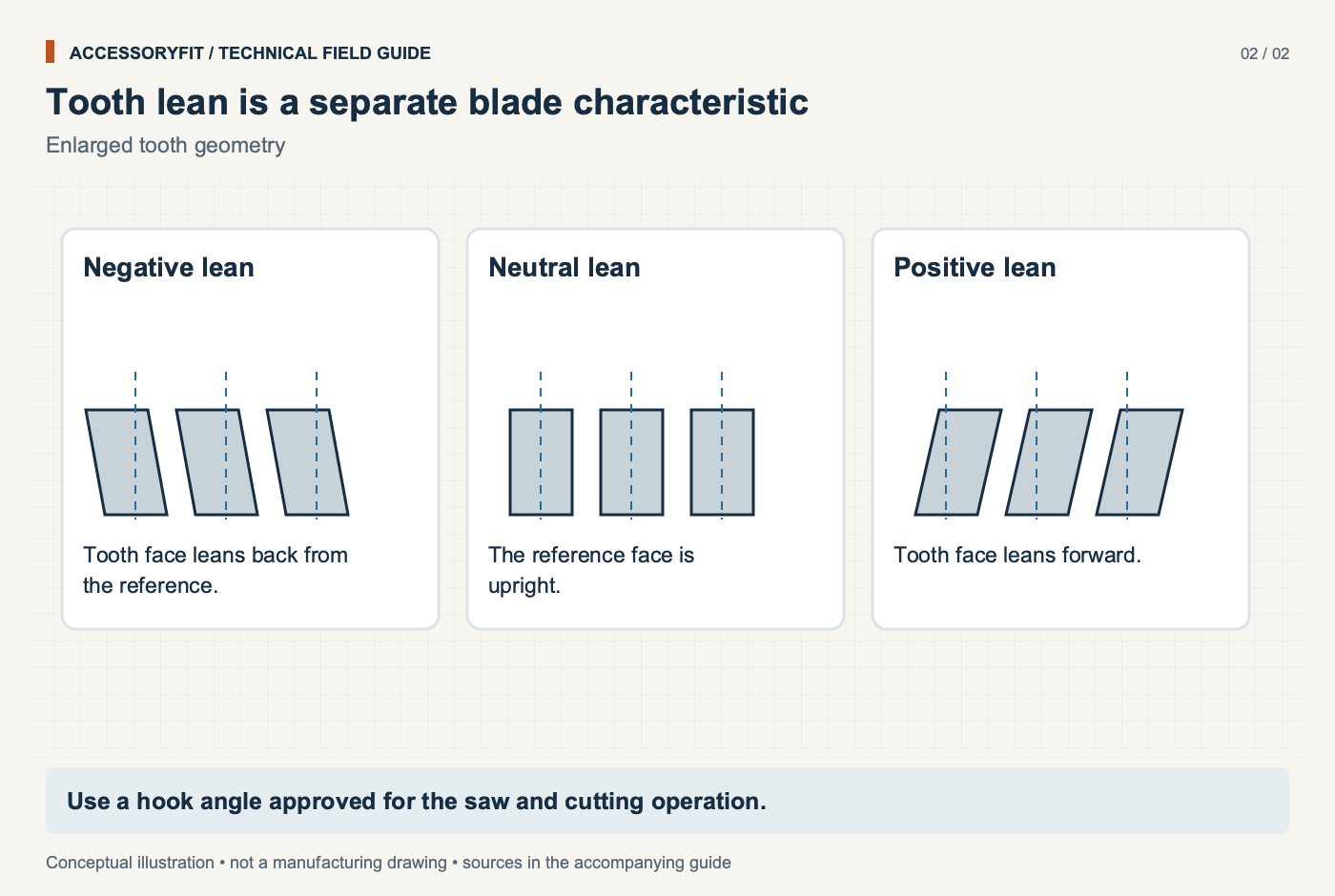
Not on a DeWalt miter saw: DeWalt tells owners of the DWS713 and DWS780 to use crosscut blades only and rules out rip blades, combination blades and any blade with a hook angle over 7 degrees. It is a common belief that any table saw blade of the right diameter will do; DeWalt's manuals add that blades with deep gullets can deflect and hit the guard.
Blade makers aimed at sliding saws go the other way on hook. Freud's LU91R010 and LU91R012 sliding compound miter blades use a -5 degrees hook, which Freud says keeps the blade from being too aggressive, limits climbing and pushes the work down and toward the fence.
Climbing matters on these saws because the head itself moves. CPSC's investigation of US stationary saw injuries in 2001, still the most recent breakdown of its kind, found kickback behind about 25% of blade-contact injuries, and noted that on miter and radial arm saws the moving saw head can be what kicks back. The same report estimated 7,640 injuries from miter saws treated in US emergency departments in 2001, still the latest national estimate; the US injury surveillance system has no separate product code for miter saws, which is why that count has not been updated. A low-hook crosscut blade is the blade-side answer to that risk.
Sources disagree on the upper limit. Diablo lists some positive-hook blades for miter and slide miter saws, including one in the table below with a hook above DeWalt's 7 degrees cap. Both statements come from the makers, so the practical rule is to follow the limit in your own saw's manual; where the manual sets one, it overrides a blade maker's general listing.
| Blade | Diameter | Arbor | Teeth / grind | Hook angle | Max RPM |
|---|---|---|---|---|---|
| Freud LU91R010 | 10 in | 5/8 in | 60 ATB | -5 deg | not listed |
| Freud LU91R012 | 12 in | 1 in | 72 ATB | -5 deg | not listed |
| Diablo D1090X | 10 in | 5/8 in | 90 ASFG | +10 deg | 6,000 |
| Diablo D12100X | 12 in | 1 in | 100 ASFG | +7 deg | 5,000 |
| Diablo D1280X | 12 in | 1 in | 80 Hi-ATB | +7 deg | 5,000 |
| Diablo D1296N (medium aluminum) | 12 in | 1 in | 96 TCG | -5 deg | 5,000 |
| Diablo D1272N (thick aluminum) | 12 in | 1 in | 72 | -5 deg | 5,000 |
Diablo lists D1090X, D12100X and D1280X for miter and slide miter saws. Check the hook-angle limit in your own saw manual (see conflicts).
How many teeth should a miter saw blade have?
DeWalt's manuals recommend tooth counts by job, rising from general construction blades to fine woodworking and non-ferrous metal blades, with the 12 in column slightly higher than the 10 in one for some tasks. The table reproduces DeWalt's guidance.
Blade makers' own ranges follow the same pattern. Freud's LU91 thin-kerf sliding compound miter blades step through 48 / 60 / 72 teeth as the diameter rises from the smallest size in the range to the 10 in and 12 in blades, all ATB with the same negative hook. Across Freud and Diablo's 12 in blades, tooth counts in the maker examples run 30 rip / 44–60 general / 80–100 fine, from ripping to fine crosscuts, which places DeWalt's construction and woodworking recommendations inside the same bands. Those are typical maker steps rather than hard limits, and a rip-tooth blade from that range is still ruled out on a DeWalt miter saw by the blade-type rule above.
Metal is a special case. For non-ferrous metal such as aluminium, DeWalt specifies TCG (triple chip grind) blades made for that purpose, and Diablo's aluminium blades for miter saws are TCG with a -5 degrees hook. A wood blade is not a substitute. Ferrous metal is outside what these miter saw manuals cover; steel tube and angle are usually cut with other tools, such as a jigsaw running bi-metal blades for steel and aluminium. More on tooth geometry in general is in the guide on choosing teeth, grind and hook on a saw blade.
| Application | 10 in (254 mm) teeth | 12 in (305 mm) teeth |
|---|---|---|
| General purpose (construction, thin kerf) | 32/40 | 40 |
| Fine crosscuts (construction) | 60 | 60 |
| Fine crosscuts (woodworking) | 80 | 80 |
| Non-ferrous metals (TCG only) | 80 | 96 |
From the Blade Descriptions tables in the DWS713 (10 in) and DWS780 (12 in) manuals.
Does a 12 in miter saw cut wider boards than a 10 in?
Not necessarily; whether the saw slides matters more than blade diameter. Makita's 10 in sliding LS1019L crosscuts wider stock than its non-sliding LS1040 of the same diameter, and the step from the sliding 10 in to the sliding 12 in Makita adds less than the step from fixed to sliding. Makita gives maximum crosscut widths of 12 vs 15 in for its two sliding saws.
Milwaukee's figures show the same pattern in lumber sizes: its sliding 2734 and 2739 crosscut 2x12 vs 2x14 at a square cut. The larger blade buys extra depth and a little extra width; a slide buys most of the width. The table lists the capacities as each maker states them.
Blade sharing is a second factor in the choice. The smaller class shares its diameter and 5/8 in bore with most US jobsite table saws, so a fine crosscut blade can in principle serve both tools, provided it meets the miter saw maker's blade-type, hook and speed rules. The larger class shares nothing with those table saws, so a 12 in miter saw needs its own set of blades.
| Saw | Blade | Type | Crosscut at 90 deg | No-load RPM |
|---|---|---|---|---|
| Makita LS1040 | 10 in | non-sliding compound | 2-3/4 x 5-1/8 in | 4,600 |
| Makita LS1019L | 10 in | dual-bevel sliding | 2-13/16 x 12 in | 3,200 |
| Makita LS1219L | 12 in | dual-bevel sliding | 3-5/8 x 15 in | 3,200 |
| Milwaukee 2734 | 10 in | dual-bevel sliding | 2x12 | 4,000 |
| Milwaukee 2739 | 12 in | dual-bevel sliding | 2x14 | 3,500 |
| DeWalt DWS779 | 12 in | double-bevel sliding | 2x14 (2x10 at 45 deg) | 3,800 |
Whether the saw slides affects crosscut width more than blade diameter does. Milwaukee 2739 RPM was read from the specification block on its product page.
Which way does a miter saw blade go on, and how thick can it be?
The teeth at the bottom of the blade point toward the back of the saw, so the arrow on the blade matches the rotation arrow on the guard. That wording is DeWalt's, from its miter saw manuals; Makita's manuals state only the arrow-matching rule, which gives the same result. A blade mounted backwards still slides onto the arbor, which is why the arrow check belongs in every blade change, after removing the battery or plug and before refitting the guard and blade clamp.
Thickness has a limit too. Makita's LS1019 lists a maximum blade kerf of 1/8 in, so a blade can match the diameter, bore and speed rating and still be too thick for that saw. Full-kerf table saw blades cut about 1/8 in, right at that limit, while thin-kerf blades such as Freud's LU91 range sit well inside it. Other saw manuals in the fact base do not state a kerf limit, so check your own manual's specifications before fitting a blade borrowed from a table saw.
How do US miter blades compare with European mitre saw blades?
US miter blades are sized in inches on inch arbors, while European mitre saws in both classes use metric blades on a 30 mm bore. Makita UK's LS1019L and LS1219 and Bosch's GCM 12 SDE all list that bore. A metric-bore blade sits loose on either US arbor, so a blade bought in Europe is not a drop-in for a US saw.
The same model number can take different blades in each market. Makita's US LS1019L takes a 10 in blade on a 5/8 in arbor, while the European LS1019L is sold as a metric saw with a slightly larger blade and the 30 mm bore. Metric equivalents of the US size also vary by maker: DeWalt and Makita give slightly different millimetre figures for the same inch blade. Read the plate on the saw rather than converting the model's headline size.
When does a miter saw blade not fit, even if it slides on?
A blade fails to fit whenever it misses on diameter, bore, speed rating or type. These are the cases the miter saw manuals call out:
- Diameter below the saw's rating. The guard will not cover it properly.
- Metric bore on an inch arbor. The blade runs off-centre.
- Larger bore without the maker's adapter. Only the DWS780 in this data lists one, and only for the matching bore.
- Speed marking below the saw's figure. On DeWalt saws, below the named minimum.
- Rip or combination blade. DeWalt rules both out on its miter saws.
- Hook angle above the manual's limit. DeWalt sets 7 degrees.
- Wood blade on non-ferrous metal. DeWalt requires a TCG blade made for the job.
A fitting blade can still be the wrong tool for rough work. Tearing out nail-filled framing is a job for a reciprocating saw, and the guide to recip blades for nail-embedded demolition covers that work.
How do you check blade fit on a miter saw not listed here?
Five checks against the saw's plate, its manual and the blade's own markings confirm fit on any miter saw.
- Remove the power source. Unplug the saw or take out its battery before touching the blade, guard or blade clamp.
- Read the saw's diameter, bore and speed. The nameplate and the manual's specifications give all three, plus any adapter the maker supplies.
- Look for a minimum blade rating. Some manuals, such as DeWalt's, name a minimum blade speed above the motor's own speed.
- Check blade type and hook. Confirm the blade is a crosscut blade and that its hook angle is within the limit in the manual.
- Compare the blade's markings. Diameter must match, bore must match the arbor or the maker's adapter, and the marked speed must meet the saw's figure or the manual's minimum.
Which other saws use bores and blade sizes like these?
Most stationary and hand-held rotary saws share the logic on this page, but band saws and grinders use different fit systems. Band saw blades are sized by length, width and teeth per inch rather than diameter, as set out in the guide to band saw blade length, width and TPI. Angle grinders mount discs on a threaded spindle with a flange, covered in the guide to grinder spindle threads and disc bores.
Every saw blade guide on the site is collected under blades for every saw type, and fit rules for bits, discs, pads and batteries sit alongside this page in the compatibility section.
Questions readers ask
Can a 10 in blade go on a 12 in miter saw?
No. DeWalt and Makita manuals say never to use a blade smaller than the saw's rated diameter, because it will not be guarded properly.
Does a 12 in miter blade always have a 1 in arbor?
US blades of that class normally use 1 in. DeWalt's DWS780 has a 5/8 in spindle and its own adapter for the larger bore, and European saws use 30 mm.
Is a negative hook blade required on a sliding miter saw?
Not universally. Freud's sliding miter blades use -5 degrees to limit climbing, DeWalt caps hook at 7 degrees, and Diablo lists some positive-hook blades for miter saws. Follow your saw's manual.
Why does DeWalt ask for a blade rated faster than the saw runs?
DeWalt's manuals set a minimum blade rating of 5500 rpm on the DWS713, which runs at 5000 rpm, giving a margin above the motor speed. The rating marked on the blade is what counts.
Can a miter saw cut aluminium?
DeWalt allows non-ferrous metal only with TCG blades made for that purpose, and Diablo sells such blades for miter saws. A wood blade should not be used.
Where to go next
- Table saw blade arbor sizesThe same bores on the bench saw.
- Circular saw blade arbor sizeHand-held sizes and diamond arbors.
- How to choose a saw bladeTeeth, grind and hook explained.
References 85 documents, 15 publishers
- BG BAU - Berufsgenossenschaft der Bauwirtschaft (Germany): Baustellenkreissaegen, Handkreissaegen - Baustein B 265
- Bosch: GCM 12 SDE Professional Mitre Saw - technical data; GCM12SD 12 In. Dual-Bevel Glide Miter Saw product page; GCM12SD operating/safety instructions 2610051827; 1617/1618 router operating/safety instructions (2610051825)
- DeWalt: DWS713 10 in Compound Miter Saw instruction manual (NA379757); DWS780 12 in Double Bevel Sliding Compound Miter Saw instruction manual (N466020); DWS713 15A 10 in. Single-Bevel Compound Miter Saw product page; DWS780 12 in. Double-Bevel Sliding Compound Miter Saw product page; DWS713 15 Amp 10 in Single-Bevel Compound Miter Saw - product page; DWS780 12 in Double-Bevel Sliding Compound Miter Saw - product page; DWS779 12 in Double-Bevel Sliding Compound Miter Saw - product page; DWE575 circular saw instruction manual (Recommended Blade Types); DWS535B worm drive saw instruction manual (blade table); DWA271424 7-1/4 in 24T circular saw blade; DWAW71440 Elite Series 7-1/4 in 40T circular saw blade; DWA271460 7-1/4 in (184 mm) 60T circular saw blade; DWA261240 6-1/2 in 40T circular saw blade
- Freud and Diablo: D12100X 12 in x 100T Wood Demon Ultimate Polished Finish Saw Blade - specs; LU91R010 10 in Thin Kerf Sliding Compound Miter Saw Blade - specs; LU91R012 12 in Thin Kerf Sliding Compound Miter Saw Blade - specs; D1090X 10 in x 90T Wood Demon Ultimate Polished Finish Saw Blade - specs; D1060X 10 in x 60T Fine Finish Saw Blade - specs; D1280X 12 in x 80T Fine Finish Saw Blade - specs; D1296N 12 in x 96T Saw Blade for Medium Aluminum - specs; D1272N 12 in x 72T Saw Blade for Thick Aluminum - specs; Get the most out of your Freud bits by routing at ideal feed rates and speeds; D1244X 12 in x 44T General Purpose blade - tech specs; LM72R012 12 in Heavy-Duty Rip Blade - tech specs; LU84R012 12 in Combination Blade - tech specs; LU85R012 12 in Ultimate Cut-Off blade - tech specs; Frequently Asked Questions; LU87R010 10 in Thin Kerf Rip Blade (product specs); LU97R010 10 in Double Sided Laminate/Melamine Blade (product specs); LU72R010 10 in General Purpose Blade (product specs); LU84R011 10 in Combination Blade (product specs); LU79R010 10 in Thin Kerf Ultimate Plywood and Melamine Blade (product specs); LU80R010 10 in Ultimate Plywood and Melamine Blade (product specs); LU73R010 10 in Cabinetmaker's Crosscut Blade (product specs); LU88R010 10 in Thin Kerf Fine Finish Crosscut Blade (product specs); D1024X 10 in x 24T Ripping Saw Blade (product specs); D1040X 10 in x 40T General Purpose Saw Blade (product specs); D1050X 10 in x 50T Combination Saw Blade (product specs); D1060S 10 in x 60T Fine Finish Saw Blade (product specs); D1080X 10 in x 80T Ultra Finish Saw Blade (product specs); D0724A product page (framing family listing incl. D0624A, D0620X, D0824X); D0740A product page (finish family listing incl. D0641A, D0840X); D0760A product page (ultra finish family listing incl. D0660A); D0770F product page (thin metal family listing incl. D0756F, D1490CF); D1472CF product page (medium metal family listing incl. D0748CFA)
- Hand (N Y): Traumatic Finger Amputations: Epidemiology and Mechanism of Injury, 2010-2019; Trends in Upper Extremity Saw Injuries From 2003 to 2022
- Health and Safety Executive (UK): Circular saw benches - Safe working practices, Woodworking Information Sheet No 16 (Revision 2)
- Journal of Clinical Orthopaedics and Trauma: Patients admitted for treatment of traumatic finger amputations: Characteristics, causes, and prevention
- Makita: LS1019/LS1019L Slide Compound Miter Saw instruction manual; LS1040 10 in Compound Miter Saw - specs; LS1219L 12 in Dual-Bevel Sliding Compound Miter Saw - specs; LS1019L 260 mm Slide Compound Mitre Saw - specification; LS1219 305 mm Slide Compound Mitre Saw - specification; LS1019L 10 in Dual-Bevel Sliding Compound Miter Saw - specs; 9557PB angle grinder instruction manual; 5007F 7-1/4 in circular saw instruction manual
- Mallory Safety and Supply (retailer): Milwaukee 48-40-4505 14 in 72T blade listing
- Milwaukee Tool: M18 FUEL 10 in Dual Bevel Sliding Compound Miter Saw 2734-20 - specifications; M18 FUEL 12 in Dual Bevel Sliding Compound Miter Saw 2739-20 - specifications; Operator's manual 58-14-0004d4 (Cat. No. 2734-20); M18 FUEL oscillating multi-tool 2836-20 operator's manual (58-14-0217d1); 48-40-4235 7-1/4 in 48T metal cutting circular saw blade; 48-40-4505 14 in 72T metal cutting circular saw blade
- OSHA: 29 CFR 1910.215 Abrasive wheel machinery; 29 CFR 1910.243 Guarding of portable powered tools; 29 CFR 1926.303 Abrasive wheels and tools; 29 CFR 1926.300 General requirements (Tools, hand and power); 29 CFR 1926.304 Woodworking tools
- Rockler: Saw Blade Glossary; Table Saw Blades: A Complete Guide; How to Clean and Maintain Your Saw Blades
- ToolsToday: Saw Blade Tooth Geometry: The Secret to a Perfect Cut
- U.S. Consumer Product Safety Commission: Injuries Associated with Stationary Power Saws, 2001; 2019 NEISS Coding Manual; Safety Standard Addressing Blade-Contact Injuries on Table Saws: Supplemental Notice of Proposed Rulemaking (November 1, 2023); The 2017 NEISS Table Saw Special Study (staff briefing package, including Table Saw Blade-Contact Injuries Special Study Report, 2017); Proposed Rule: Safety Standard Addressing Blade-Contact Injuries on Table Saws (staff briefing package, January 17, 2017); Withdrawal of Proposed Regulatory Actions (September 29, 2025)
- Woodcraft: Burn-Free Table Saw Cuts (Robert J. Settich)
Accessed .