
About the site · Methodology
How AccessoryFit sources, checks and presents information
Every size, speed, thread and rating on AccessoryFit is taken from a published document: a manufacturer's spec page or manual, a standard, regulator guidance such as OSHA rules, or an established engineering reference. Safety values need two independent sources or are labelled as coming from one. Where sources conflict, both figures are shown. Buyer guides list real products matched by model number, compared on published specs only, with no prices, ratings, scores or testing claims. This page sets out each rule.
On this page
- Which sources are used?
- How are facts recorded?
- Is AI used to write the pages?
- What is the two-source rule?
- How are conflicting sources shown?
- How are products chosen for the buyer guides?
- How are safety notes written?
- How are pages dated and updated?
- How are corrections handled?
- Does affiliate income affect any of this?
Which sources are used?
In order of preference: the tool or accessory maker's own documents, then standards and regulators, then established trade and engineering references. Manufacturer documents include product spec pages, operator manuals, catalogues and safety sheets. Standards and regulators include OSHA's rules for abrasive wheels and hand and power tools, read from the US federal regulations, Cal/OSHA where it adds detail, and European standards named by manufacturers. Trade and engineering references include blade, bit and abrasive makers' published charts, and reference tables such as engineering handbooks and university charts.
Amazon product titles are not used as a source for specs. Where a retailer catalogue or an encyclopaedia entry was the only place a value could be found, the value is either left out or used as a single-source value with that source named. Forums, video comments and unsourced blog posts are not used. The same sourcing rules apply to the datasets on the research and data pages.
What the site covers, and who it is written for, is set out on the about page.
How are facts recorded?
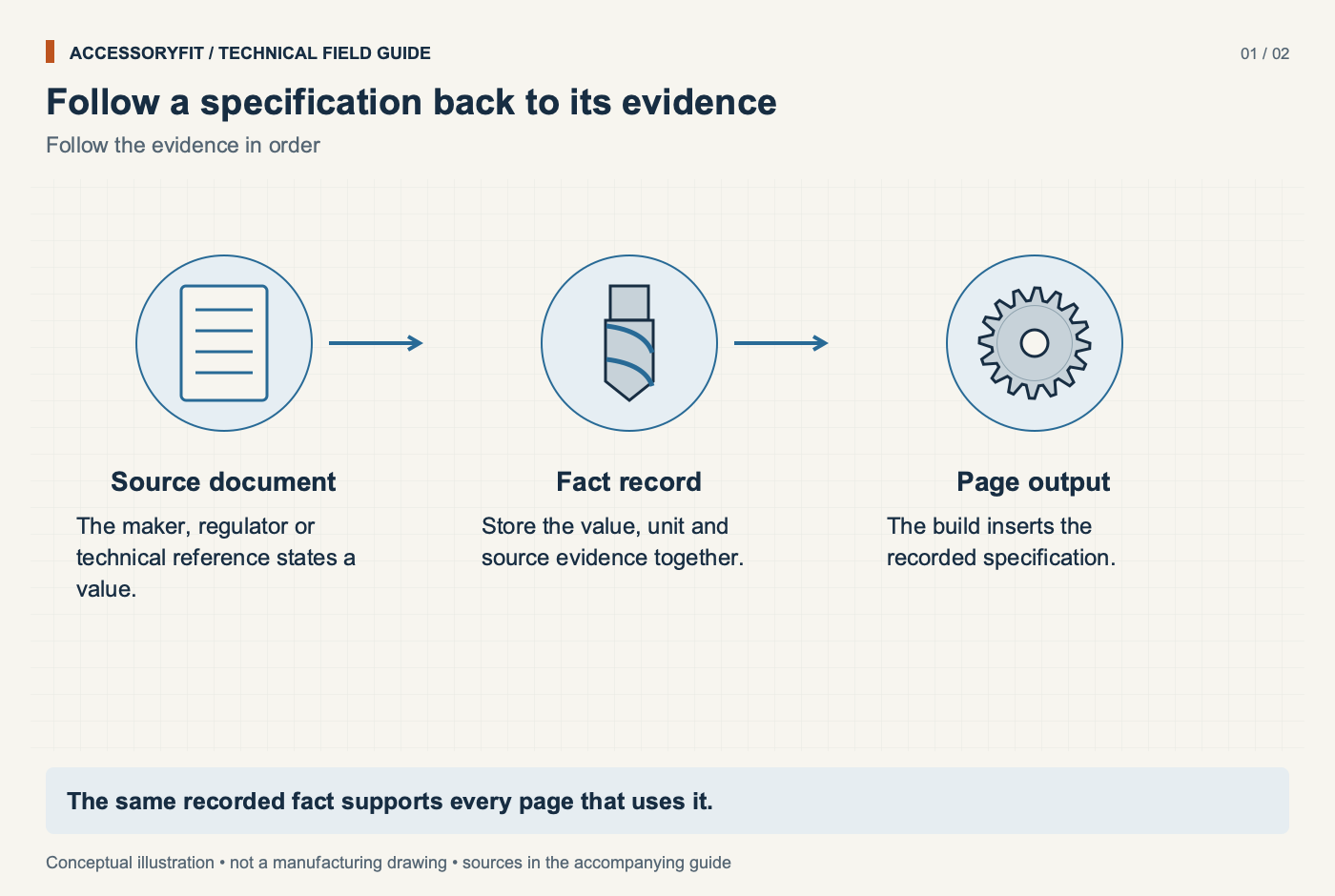
Each fact is recorded once, in a shared fact base, with its value, its unit, the documents that support it, a short note of what each document says, and the date it was checked. Pages pull their numbers from that fact base rather than retyping them, so the same value appears the same way on every page that uses it, and a correction made once reaches every page.
Each page's References section lists the documents behind the facts on that page, grouped by publisher, with the date they were accessed. References are given as plain text, not links, because manufacturer pages move often.
Is AI used to write the pages?
Yes. Page drafts are written with AI writing assistance, working from the fact base rather than from memory. Every size, speed, thread and grit on a page is inserted from that fact base when the site is built, never typed into the text, so each figure traces back to the documents listed in the page's References.
Automated checks then run on every page before it is published: each figure must resolve to a recorded fact, links must point to pages that exist, product links must be correct, and wording that claims product testing, or gives ratings or prices, is rejected. The editorial team decides what the site covers, which sources count, and how facts are recorded, and it handles corrections. AI assistance does not change the sourcing rules on this page: a value that is not in the fact base does not appear on the site.
What is the two-source rule?
A value is treated as verified when two independent documents agree on it, for example a maker's spec page and its manual, or a standard and a maker's safety sheet. The rule is applied strictly to safety values: speed ratings, guard requirements, arbor and spindle fit, adapter rules and similar figures where a wrong number could hurt someone.
Where only one document supports a value, the value can still be used if the source is reliable, but the page names the source in the sentence, for example by saying that a particular maker's manual gives the figure. In the accessory finder, such values carry a one source label next to them. Values that could not be confirmed in any fetched document are not presented as fact; they are left out, and the gap is recorded for later research.
How are conflicting sources shown?
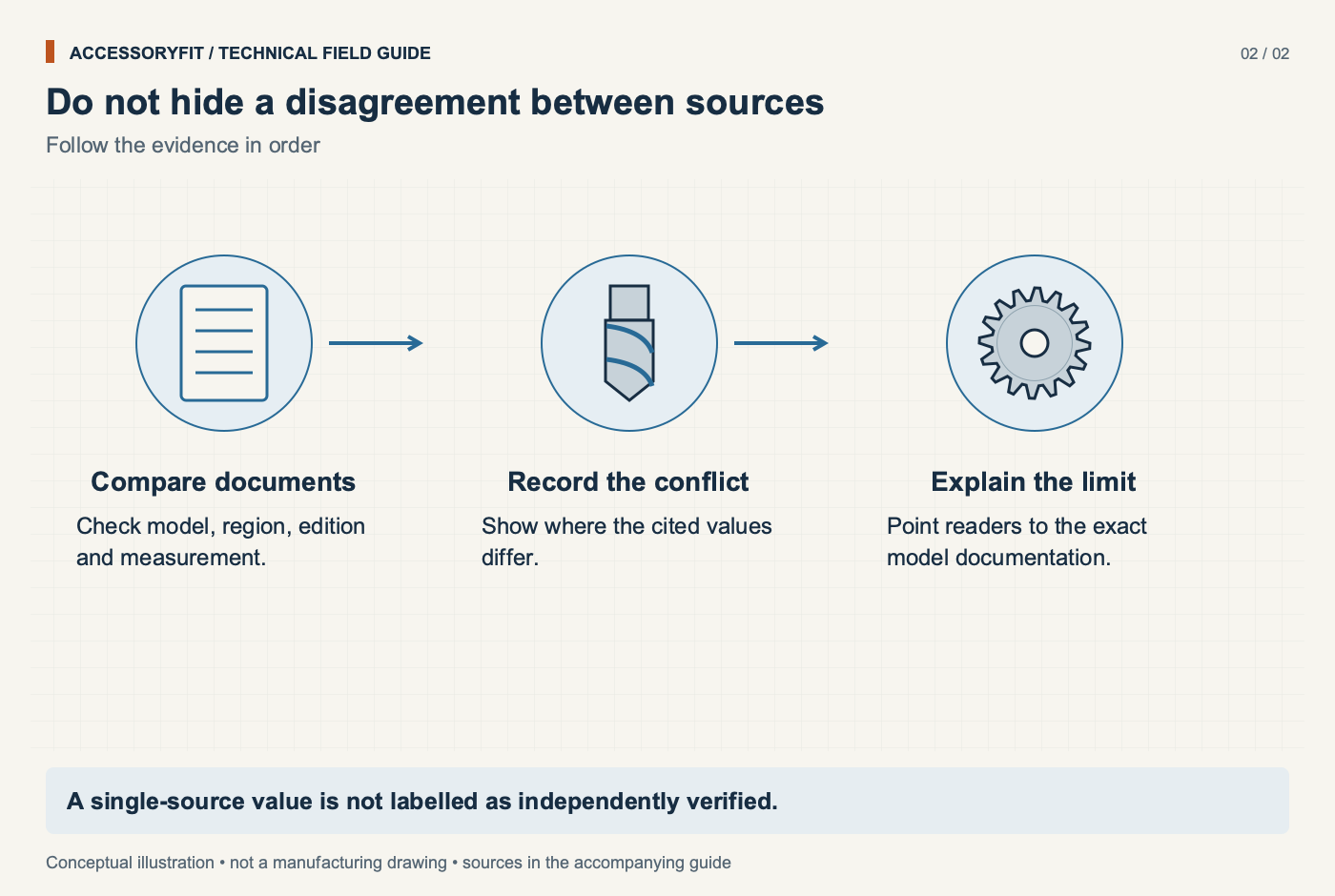
Both figures are given, with each source named, and the page says which one the site uses elsewhere and why. Common reasons are rounding, regional versions of a product, or a document that appears to contain an error. For example, pilot hole charts from different publishers give different sizes for the same screw, so the pilot hole chart shows both charts rather than choosing one silently. Where a maker's own page and its manual disagree, both are reported and the reader is pointed to the manual for the exact model in hand.
How are products chosen for the buyer guides?
Products are chosen on their published specifications against the requirements of one job, and nothing else. Each buyer guide first sets out what an accessory for that job should have, such as a tooth count, grind, TPI range, shank type, grain or hole pattern, drawn from the fact base. Candidate products are real, current products from established makers, each with its own spec record built from the maker's documents. A product is listed when its published specs meet the job's requirements.
Products are matched to Amazon US listings by brand and model number. A listing is used only when it is for that exact model; listings for different pack sizes or bundles are rejected, and where the only listing is a multi-pack the guide says so. Where an Amazon listing title gives a figure that conflicts with the maker's own data, the maker's figure is used. If no matching listing exists, the product stays in the guide, marked as not currently listed on Amazon US.
The guides do not show prices, star ratings, review scores, rankings or labels such as best overall. Each product entry gives the specs that bear on the job, who it suits, when to choose something else, and pros and cons drawn only from the maker's specs and stated applications. Nothing in a buyer guide was bought, used or tested by the site, and the guides do not imply otherwise. The same rules apply where a how-to or troubleshooting page suggests products for its job.
How are safety notes written?
Safety notes appear wherever a mismatch could cause injury, such as a disc rated below the grinder's speed, the wrong guard for a wheel type, a forbidden arbor adapter or an SDS bit in a standard chuck. Each note summarises what the manufacturer or regulator says and cites it. Notes never suggest exceeding a rated speed or removing a guard, and they do not replace the tool's manual.
How are pages dated and updated?
Each guide shows the date its facts were last checked. When a fact changes in the fact base, every page that uses it changes with it at the next build, and the page's checked date is updated when its content is reviewed. Source documents carry their own access dates in each page's References.
How are corrections handled?
Corrections are welcome and are checked against the source documents. A report is most useful when it names the page, the value in question and the document that gives a different figure. If the report is right, the fact base is corrected, every page using the value is rebuilt, and the checked date is updated. If the sources genuinely conflict, both figures are shown. Corrections can be sent through the contact page.
Does affiliate income affect any of this?
No. Products are chosen on specs before any link is added, and a product without an Amazon listing stays in a guide. The site earns a commission on qualifying Amazon purchases, as set out in the affiliate disclosure, and the editorial team page explains who applies these rules.
Where to go next
- Affiliate disclosureHow product links work and how the site is funded.
- Editorial teamWho researches the facts and how pages are made.
- Buyer guidesSee the product rules applied.