
Category hub · Abrasives
Sanding and grinding accessories: discs, grits, wheels and pads
Sanding and grinding accessories fit by size and mount first, then by grit and grain. A random orbital disc must match the pad's diameter, hole pattern and attachment; a grinder wheel must match the spindle, carry a speed rating at or above the grinder's, and sit under the right guard; a multi-tool pad must match the tool's interface. Grit then sets how coarse the scratch is, and the abrasive grain sets what the disc cuts best. This hub covers each accessory type and links to the guide that explains it in full.
On this page
- What types of sanding and grinding accessories are there?
- Which sanding discs fit your random orbital sander?
- Which grit should you use, and do US and European grits match?
- Which abrasive grain cuts which material?
- Which pads fit detail sanders and multi-tools?
- Which discs fit an angle grinder?
- When does a sanding or grinding accessory fail?
What types of sanding and grinding accessories are there?
The category splits by tool: hook-and-loop or adhesive discs for random orbital sanders, pointed pads and sheets for detail sanders and multi-tools, and bonded wheels, cut-off wheels, flap discs, diamond blades and wire brushes for angle grinders. The two halves work differently. A sanding disc is a coated abrasive, a single layer of grain glued to paper, film or mesh, and it removes material slowly with a fine scratch. A grinder wheel is a bonded abrasive, grain held in a resin body, and it removes metal or cuts it at very high rim speeds, which is why grinder accessories carry speed limits and guard rules that sanding discs do not.
Flap discs sit between the two: overlapping flaps of coated abrasive on a backing plate, mounted on a grinder. They grind and finish metal in one pass, and they follow grinder rules on speed and guards. The table below lists each accessory, the tool it fits and the interface that decides fit.
| Accessory | Tool | What decides fit |
|---|---|---|
| Random orbital disc | Random orbital sander | Diameter (125 mm or 150 mm in Europe), hole pattern, hook-and-loop or PSA |
| Detail or delta pad and sheet | Detail sander, multi-tool | Pad shape and size for that tool, hook-and-loop, hole pattern |
| Multi-tool sanding pad | Oscillating multi-tool | Blade interface (OIS, Starlock, universal fit) |
| Grinding wheel (Type 27) | Angle grinder | 7/8 in hole or threaded hub, speed rating, open grinding guard |
| Cut-off wheel (Type 1/41) | Angle grinder | Same hole and speed rules, closed cutting guard |
| Flap disc (Type 27 or 29) | Angle grinder | Hole or threaded hub, speed rating, working angle |
| Diamond blade | Angle grinder or saw | 7/8 in arbor for grinders, closed cutting guard |
Which sanding discs fit your random orbital sander?
A disc fits when its diameter, hole pattern and attachment match the sander's pad. The two common sizes are sold in Europe as 125 mm and 150 mm and in the US under their nearest inch sizes. The DeWalt DWE6423 lists a 5 in pad with 8 holes and hook-and-loop attachment, which matches the common 8-hole pattern for that size.
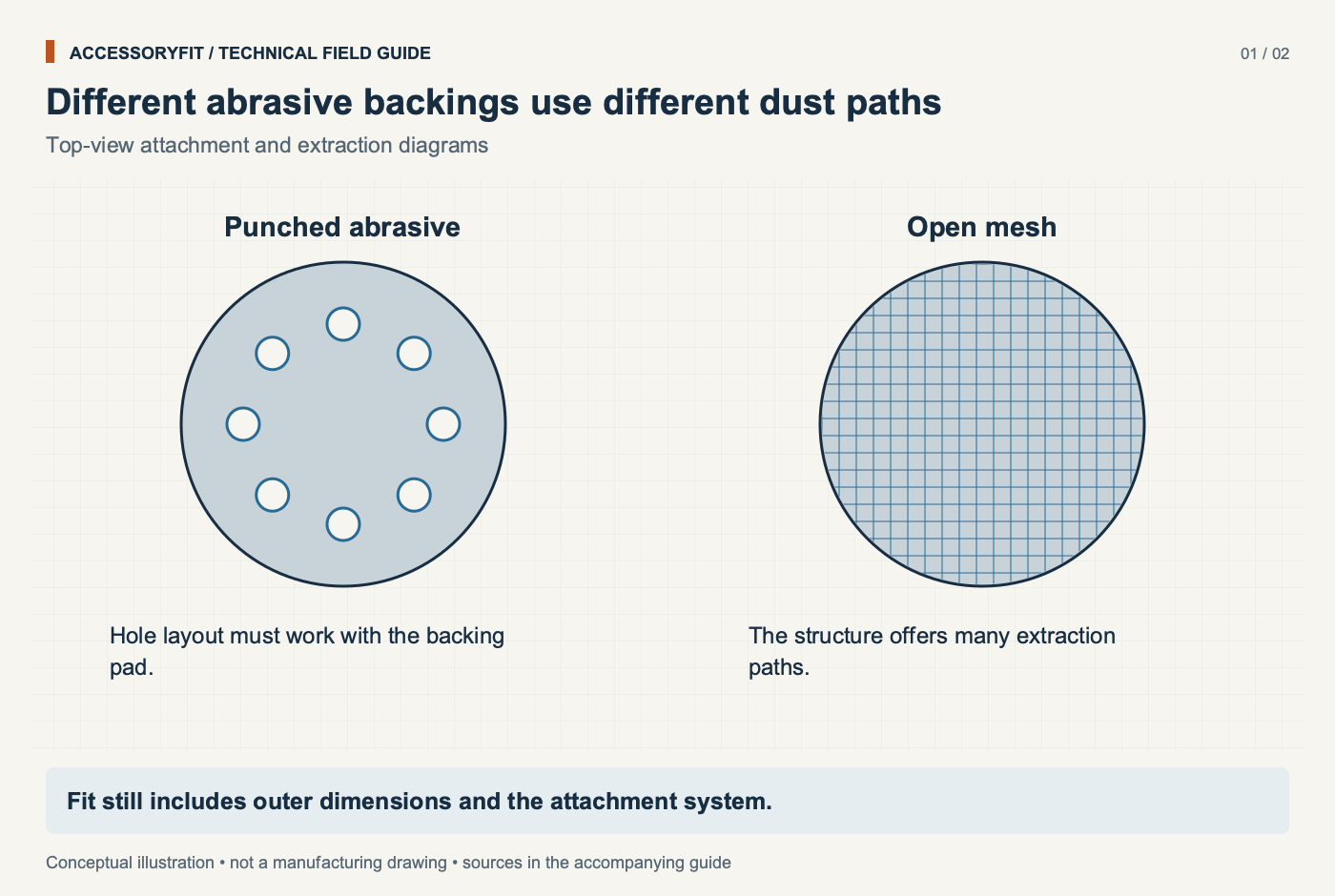
The larger size has several competing patterns. Klingspor lists a 6-hole and an 8-hole pattern for 150 mm discs, and Festool's MULTI-JETSTREAM 2 discs carry a 48-hole pattern made for Festool sanders. Mesh discs such as Mirka Abranet avoid the problem by extracting through the whole face. The holes matter more than many buyers assume: they must line up with the pad's ports for extraction to work, and with matching holes and extraction the abrasive lasts considerably longer.
Extraction is a health point too, not only a disc-life one. The National Toxicology Program's Report on Carcinogens (15th edition, 2021) lists wood dust as a known human carcinogen, and cites NIOSH's recommended limit for it of 1 mg/m³, far stricter than OSHA's older total-dust limit. UK HSE's 2024 research report on wood dust in woodworking manufacturing, based on site surveys from 2014 to 2017, found sanding gave the highest exposures of any activity it measured: hand-held power sanding came out at 3.2 mg/m³ median over an 8-hour day, against Great Britain's hardwood dust limit of 3 mg/m³ in HSE's EH40 (2020 edition, still current), and that was at sites judged to follow good practice. Matching the disc's holes to the pad and connecting a vacuum is the practical answer. Grinding concrete or stone adds crystalline silica to the dust, covered in the silica figures for masonry work.
Attachment is the second choice. Hook-and-loop discs come off and go back on several times, which suits stepping through grits. Pressure-sensitive adhesive (PSA) discs are usually cheaper and their stiffer bond suits levelling flat surfaces, but they are normally discarded once removed. Discs that will not stay on usually point to worn or crushed hooks, dust on the pad or worn loop backing; clean the hook face first, then replace the pad if clean discs still fly off. The guide to hook-and-loop versus PSA discs covers patterns by brand, and the buyer guide to orbital sander disc picks compares disc packs on published specs.
Which grit should you use, and do US and European grits match?
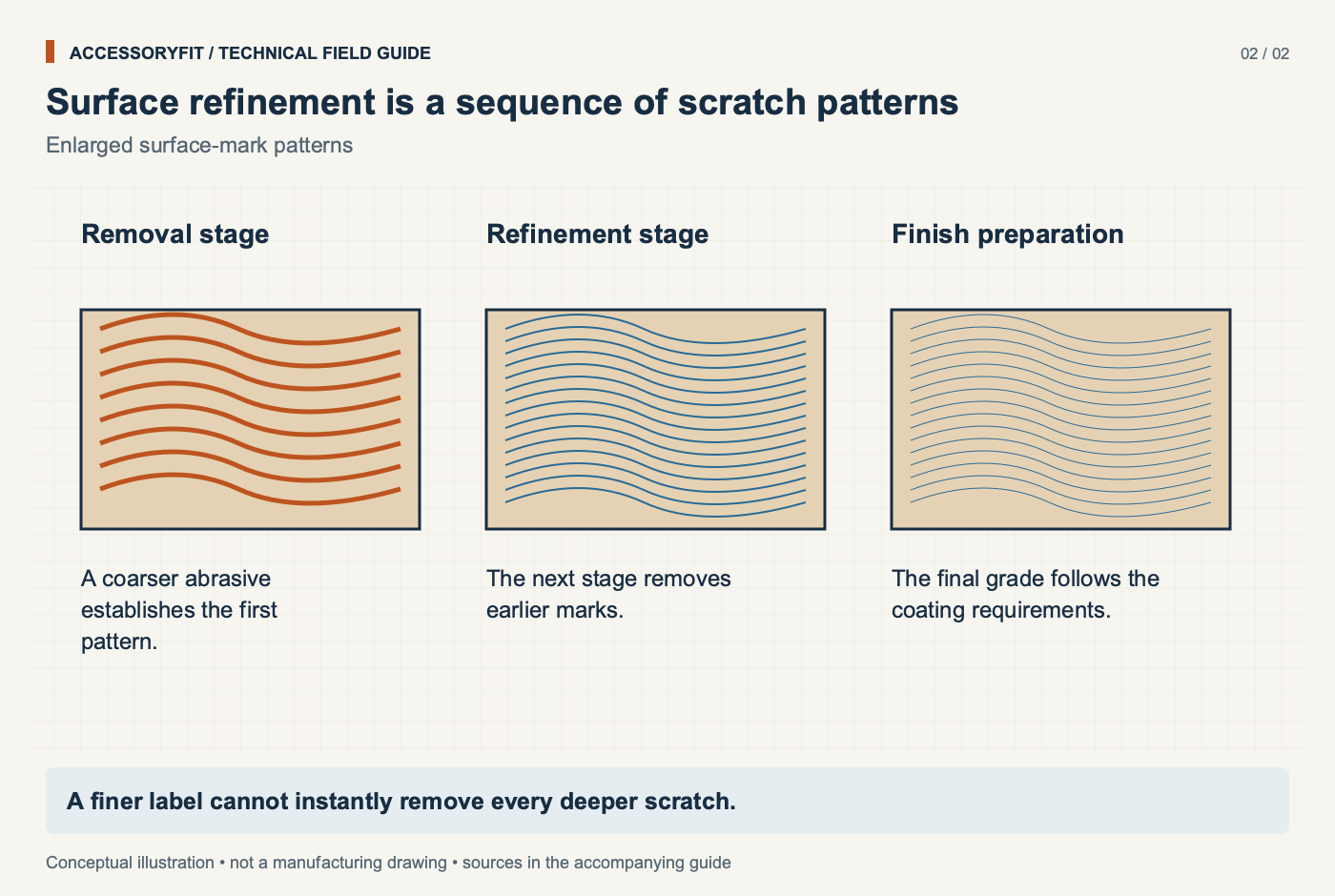
Start with the finest grit that removes the defect, then work up without skipping more than one step; stop at about 180–220 grit before staining bare wood. Woodcraft gives the standard wood sequence as 60, 80, 100, 120, 150, 180, 220 grit, working through every grit, while Klingspor's rule is to skip no more than one. Sanding far finer than that closes the wood's pores, so stain soaks in unevenly, which corrects the common belief that a finer final grit always gives a better finish.
Grit numbers come in two scales. The US CAMI scale uses plain numbers; the European FEPA scale puts a P before the number. The two match closely up to about 220 grit, and above that they part company, so a fine CAMI grade matches a P grade with a much higher number, as the table below shows. Check for the P prefix before treating two fine sheets as the same grade. Sanding pads and sponges add a third trap: General Finishes says its pads are labelled on their own scale, so a pad grit does not equal the same sandpaper grit.
The sandpaper grit chart gives the particle size behind every CAMI and FEPA grade, and the article on which grit to use sets out progressions for bare wood, finishes and metal.
| CAMI grade | CAMI avg (um) | Nearest FEPA grade | FEPA avg (um) |
|---|---|---|---|
| 60 | 268 | P60 | 260 |
| 80 | 192 | P80 | 197 |
| 100 | 141 | P100/P120 | 156/127 |
| 120 | 116 | P120 | 127 |
| 150 | 93 | P150 | 97 |
| 180 | 78 | P180 | 78 |
| 220 | 66 | P220 | 65 |
| 240 | 53.5 | P280 | 52.5 |
| 320 | 36 | P400 | 35.0 |
| 360 | 28.8 | P500 | 30.2 |
| 400 | 23.6 | P600/P800 | 25.75/21.8 |
| 500 | 19.7 | P1000 | 18.3 |
| 600 | 16.0 | P1200 | 15.3 |
| 800 | 12.3 | P1500 | 12.3 |
| 1000 | 9.5 | P2000 | 9.5 |
Pairs are matched by closest micron value from the Klingspor table. They are approximate, especially above 220. Where two FEPA grades bracket a CAMI value, both are shown.
Which abrasive grain cuts which material?
Aluminium oxide is the general-purpose grain for bare wood and most metals, silicon carbide suits finishing, paint, plastics, glass and stone, and zirconia and ceramic suit heavy stock removal on metal. Coated abrasives use these 4 grain types, and the natural grain garnet is still used for final wood finishing.
The engineered grains behave differently from what their hardness suggests. Silicon carbide is very hard but brittle and wears out quickly. Zirconia and ceramic are tougher and self-sharpening, but only under machine pressure; run with too little pressure they glaze and their life drops. Klingspor says zirconia gives the best value in the coarse removal grits, 24–60 grit. Grain colour is not a reliable guide, because makers dye the coating, so read the grain on the label.
Two coatings change how a disc behaves without changing the grain. Stearate is an anti-loading layer, not an abrasive; it stops clogging on paint, finishes and resinous softwood. Open coat leaves space between grains so dust clears, while closed coat packs grain tightly for harder materials. The guide to aluminium oxide, zirconia and ceramic pairs each grain with the jobs it suits.
Metal discs for angle grinders follow the same grain logic at higher pressure. Zirconia suits aggressive stock removal on steel and stainless, ceramic grain suits stainless and hard-to-grind alloys because it cuts cooler and lasts longest, and a grinding-aid top coat reduces heat and loading on heat-sensitive metals. Resin fibre discs need a backing pad and clamp nut on the grinder, while flap discs mount without one. Those discs are compared in the buyer guide to grinder discs for steel and stainless.
| Material | Rough grinding | Intermediate / finishing |
|---|---|---|
| Carbon steel | Zirconia alumina or aluminium oxide | Zirconia alumina or aluminium oxide |
| Stainless steel | Zirconia alumina or aluminium oxide | Silicon carbide sometimes for a more consistent final scratch |
| Aluminium | Zirconia alumina | Aluminium oxide; silicon carbide in some machining and deburring |
| Cast iron | Zirconia alumina | Aluminium oxide; silicon carbide for chilled or grey iron |
| Titanium | Zirconia alumina | Silicon carbide; aluminium oxide may react chemically with titanium |
| Paint | Zirconia alumina for rough stripping | Silicon carbide usually recommended |
| Plastic | Zirconia alumina sometimes, usually wet | Silicon carbide almost exclusively |
| Glass | Silicon carbide (zirconia occasionally on flat stock) | Silicon carbide, usually ground wet |
| Stone / granite | Silicon carbide, ground wet | Silicon carbide |
Taken from Klingspor's 'Specific Material Recommendations' page. Wood is not covered there; for bare wood Klingspor's basics page recommends aluminium oxide.
Which pads fit detail sanders and multi-tools?
Detail and multi-tool pads fit by the tool's own pad shape and mount, and sizes differ by brand, so a pointed pad from one maker rarely fits another's sander. Festool's delta pad measures 100 x 150 mm, and Milwaukee's OPEN-LOK triangle pad is 3-1/2 in, while DeWalt sells its multi-tool triangle paper at 3-1/8 in. Most current pads hold the paper with hook-and-loop.
On a multi-tool, the blade interface decides whether the pad goes on at all. Base-class Starlock accessories fit older Bosch OIS tools and OIS-compatible tools from several other makers, but universal-fit blades and pads do not fit Starlock-only tools, and StarlockPlus and StarlockMax accessories need a tool of that class. The guides to detail sander pad shapes and oscillating tool blade compatibility cover both, and the buyer guide to Starlock blade sets compares blade sets for each mount.
Which discs fit an angle grinder?
A grinder disc fits when its centre hole or thread matches the spindle, its diameter matches the guard, and its maximum speed is at or above the grinder's no-load speed. Plain-hole discs share a 7/8 in centre hole in the US, the same as the 22.23 mm European bore. Threaded accessories differ by region: US grinders use a 5/8–11 UNC spindle and European grinders use M14, so threaded cups and hubbed wheels do not cross over. The DeWalt DWE402 lists a 5/8–11 spindle, the Makita GA5030R an M14 spindle.
Speed ratings fall as diameter rises: reinforced wheels of the smallest common size are typically rated 13,300 RPM, and the next size up 12,200 RPM. A larger wheel forced onto a smaller, faster grinder can exceed its rating. The wheel's type number decides the guard. Flat Type 1/41 cut-off and diamond wheels need a closed cutting guard, while depressed-centre Type 27 grinding wheels use the open guard. Flap discs come in two shapes: flat Type 27 discs work at 0–15 degrees for finishing, and conical Type 29 discs at 15–25 degrees for heavier removal.
The guide to angle grinder disc sizes lists sizes, holes and ratings, the article on choosing cut-off wheels explains the type numbers and thicknesses, the buyer guide to flap disc picks compares flap discs for metal, and the buyer guide to diamond blades for concrete covers masonry cutting. For hearing protection, the power tool noise levels page gives sound figures by tool type.
| Type | Shape | Use | Guard | Working angle |
|---|---|---|---|---|
| Type 1 / Type 41 | Flat (straight) | Cutting only, on the rim; maximum depth of cut | Closed Type 1 cutting guard, ≥180° both sides and rim | 90° to work |
| Type 27 / Type 42 (cutting) | Depressed centre, thin | Cutting; allows flush cuts, nut recessed | Type 1/41 guard per FLEX guide | 90° to work |
| Type 27 (grinding) | Depressed centre, flat rim | Side grinding; notching | Type 27 guard | about 30° |
| Type 28 | Depressed centre, saucer-shaped | Grinding large flat surfaces | Type 27-style guard with lip (HAZET) | about 15° |
| Type 29 (flap / flexible) | Conical | Stock removal, contours, edges | Type 27-style guard with lip (HAZET) | 15-25° (flap discs) |
| Type 27 (flap) | Flat | Finishing, blending, flat surfaces | Type 27 guard | 0-15° |
| Type 6 / 11 | Straight / flaring cup | Rim grinding | Cup guard with adjustable skirt | n/a |
Angles: UA wheel-label proper-use icons (Type 27 ~30°, Type 28 ~15°, cutting 90°); flap angles UA catalog p.60 and Surface Prep. Type 28 saucer shape: Cal/OSHA §3575(b)(C).
When does a sanding or grinding accessory fail?
Sanding discs fail by clogging, swirling or falling off, and grinder wheels fail by vibrating, glazing or, in the worst case, breaking. Most failures come back to the wrong grain, the wrong pressure or a mismatch with the tool.
- Swirl marks on a random orbital sander come mostly from technique: moving faster than about 1 in per second, pressing harder than about 2–4 lb, or leaving loose coarse grit on the work between grits.
- Pressing harder does not speed up a random orbital sander. Extra pressure slows the pad's rotation and causes swirls and dished areas.
- Zirconia and ceramic discs glaze under light pressure, the opposite of the usual advice for sandpaper.
- A cut-off wheel used flat to clean up a burr can break, because cutting wheels are made for rim cutting only.
- Resin-bonded wheels carry an expiry date, and warm, damp storage can weaken them; a dropped wheel should be discarded.
A new wheel should be inspected, ring-tested and run for at least 1 minute at operating speed with the guard on, standing out of line with it, before it touches work. The troubleshooting guides on fixing orbital sander swirls and grinder wobble safety checks work through each cause.
Sanding and grinding guides on AccessoryFit
- Sanding disc sizes and hole patternsHook-and-loop vs PSA, patterns by brand
- Detail sander pad shapesWhich pad fits your sander
- Oscillating multi-tool blade fitStarlock vs universal
- Angle grinder disc sizesHoles, threads and speed ratings
- Sandpaper grit chartCAMI against FEPA P-grades
- Sandpaper grit guideProgressions by project and abrasive type
- Cut-off wheel typesType 1, Type 27 and Type 41
- Sanding discs for random orbital sandersDisc packs compared on specs
- Flap discs for metalZirconia and ceramic discs
- Diamond blades for concreteMasonry cutting blades
- Oscillating multi-tool blade setsSets by mount type
- Why a sander leaves swirl marksGrit, speed and pad fixes
- Angle grinder disc vibrationCauses and safety checks
Questions readers ask
Do metric sanding discs fit US random orbital sanders?
Yes, by size: 125 mm and 150 mm are the European sizes that correspond to the two common US disc sizes. Check the hole pattern as well, because several patterns are used at that size.
Are P-grades the same as US grit numbers?
In the coarse and medium range, close enough to treat as the same. CAMI and FEPA grades match closely up to about 220 grit. Above that the scales diverge, and fine CAMI grades match higher P numbers.
Which abrasives in this section are tied to the grinder's spindle thread?
Only the hubbed ones. Hubbed wheels, hubbed flap discs and wire cups screw straight onto the spindle, so they must match 5/8–11 UNC on US grinders or M14 on European ones. Unthreaded wheels mount over a 7/8 in centre hole with the flange nut, and sanding discs depend on pad size and hole pattern, not on the spindle.
Can a cut-off wheel be used for grinding?
No. Cut-off wheels cut with their rim only; side grinding or deburring with them is prohibited because it can make the wheel fail. Use a grinding wheel or flap disc instead.
What does stearate on sandpaper do?
Stearate is an anti-loading coating over the grain, not an abrasive. It stops the disc clogging when sanding paint, finishes, resinous softwood and soft metals.
Where to go next
- Sanding disc sizes and hole patternsMatch a disc to your sander's pad.
- Sandpaper grit guideGrit progressions for wood, finishes and metal.
- Angle grinder disc sizesHoles, threads, speed ratings and guards.
References 144 documents, 56 publishers
- Axminster Tools: Festool Multi-Jetstream2 Pad for ETS150 Sander; Mirka Interface Pad 125mm 953284; Festool DTS/DS 400 Sander Pad 100 x 150 (493723); Bosch AVZ 93 G Delta Sanding Pad (Starlock); Starlock by Bosch
- Benchmark Abrasives: Sanding Discs Buying Guide: PSA vs Hook & Loop vs Fiber
- Bosch: GWS 12-125 angle grinder (UK); PRO Stainless Steel and Metal Bonded Cutting Disc, bore 22.23 mm (2 608 600 549); PRO Metal Bonded Cutting Disc for Chop Saws, bore 25.4 mm (2 608 600 543); GWS 12-125 / GWS 12-125 S original instructions 1 609 92A D3M (21.10.2025); Premium Turbo Rim Diamond Abrasive Blades; EXPERT Hard Ceramic Diamond Cutting Disc (X-LOCK); X-LOCK system page (GB); Bosch X-LOCK - The ultimate changing system for grinders (news); EXPERT C470 Sandpaper with 8 holes for Random Orbital Sanders; ROS20VSC 5 in Random Orbit Sander product page; PSM 100 A multi-sander; PRO AVZ 93 G multitool accessory, 93 mm (2 608 669 125); Sanding plate 2 608 000 211 for delta sanders; Bosch Starlock Professional Interface System for Multi-Tool Accessories (press release, 28 Jan 2016); Neue Multi-Cutter von Bosch für Profis (press release, 2016); Starlock oscillating multi-tool accessories sets; Starlock oscillating multi-tool Curved-Tec carbide plunge cut blades (OSL114CC, OSL134CC)
- California DIR (Cal/OSHA): Title 8 §3575 Scope and Definitions (abrasive wheels)
- Carbatec: Festool Granat Abrasive Disc 150mm 48 Hole P80
- Colorado State University and Montana Technological University, Annals of Work Exposures and Health 67(5): The Evaluation of Worker Exposure to Airborne Silica Dust During Five OSHA Table I Construction Tasks
- DeWalt: DWE402 4-1/2 in (115 mm) paddle switch small angle grinder; DW402G angle grinder instruction manual; DW8062 High Performance 4-1/2 in x .045 in x 7/8 in Metal Cut-Off Wheel; DW4719 7 x 1/4 x 7/8 in High Performance Metal Grinding Wheel; DW8080 HP 4-1/2 in x 3/32 in x 7/8 in T1 Cutting/Notching Wheel (Stainless); DWE402/DWE402N/DWE402G/DWE4222N Instruction Manual NA190466; DWE6423 5 in variable speed random orbit sander with hook and loop pad; DWE6420/DWE6421/DWE6423 Random Orbit Palm Sanders instruction manual N412818; DWE6423 5 in Variable-Speed Random Orbit Sander product page; DWASPTRI3 12-piece 3-1/8 in hook and loop sanding paper set, oscillating tool; DCS356 20V MAX XR oscillating multi-tool instruction manual (N682755); DCS356B 20V MAX XR 3-speed oscillating multitool (tool only); DWE575 circular saw instruction manual (N786997), general power tool safety
- Dexis: Bosch delta sanding pad hook and loop for GDA/PDA 2608000211
- DGUV Institute for Occupational Safety and Health (IFA): Ageing of resinoid bonded grinding wheels (project BIA 6055)
- European Parliament, Legislative Observatory (procedure 2016/0130(COD), final act summary): Protection of workers from exposure to carcinogens or mutagens at work: exposure limit values - Directive (EU) 2017/2398, final act
- Family Handyman: 10 Tips for Mastering the Random Orbit Sander
- Fein: New FEIN Tools and Accessories with Starlock (March 2016)
- Festool: ETS EC 150/3 EQ and ETS EC 150/5 EQ original instructions (PDF); Sanding pad SSH-STF DELTA/9 (577530); Sanding pad SSH-STF-80x130/12 (489252)
- Fine Woodworking (Taunton Press): True Grit, by Mark Schofield (Fine Woodworking #176); Full Grit Chart (English), PDF
- FLEX (Chervon North America): Safety Warnings and Guidelines for Users of Portable Grinding, Cutting and Flap-Disc Wheels (10/2023)
- Freud and Diablo: DOU200RBD universal fit bi-metal oscillating blade for drywall
- General Finishes: What Grit Should I Use for Prep Sanding Raw Wood?; Exterior 450 Instructions, PDF; What is the best sandpaper or abrasive to use for finish sanding?
- Hardwood Floors magazine (NWFA): Abrasive Grain Technology
- HAZET: User information for grinding wheels, cut-off wheels, flap discs (multilingual safety leaflet)
- Health and Safety Executive (UK): Wood dust exposures in manufacturing industries; EH40/2005 Workplace exposure limits (Fourth Edition 2020)
- Hemlock Hardware (Diablo listing): Diablo 6 In. 60-Grit 6-Hole Pattern Vented Sanding Disc with Hook and Lock Backing
- HookandLoop.com: Replacing sanding discs with hook and loop
- IMC Clains (specialist retailer): Stone, Belt, Paper, Film and Compound Grit Comparison, PDF
- ITS: Festool 489252 80mm x 130mm Sanding Pad; Fein MultiMaster/SuperCut adaptor with QuickIN 63733005010
- Klingspor: Klingspor Kronenflex A 60 Extra cut-off wheel 125 x 22.23 x 1 mm, 12200 RPM; Klingspor Kronenflex A 46 TZ Special cutting disc 115 x 1.6 x 22.23 mm; Klingspor Kronenflex A 24 Extra cutting disc 150 x 2.5 x 22.23 mm, depressed; Klingspor Kronenflex A 36 TZ Special cutting disc 180 x 2 x 22.23 mm; Klingspor Kronenflex A 46 TZ Special cutting disc 230 x 1.9 x 22.23 mm; Maximum operating speed (Lowdown on grinding); Hole pattern for abrasives (Lowdown on grinding); Self-fastening disc (Lowdown on grinding); Coated Abrasives Basics; Finishing column, April 2022: skipping grits in the sanding sequence; Grit Grading Systems (Coated Abrasives Basics); Grain types (Lowdown on grinding); Specific Material Recommendations
- Klium: Bosch 2608000211 sanding pad for PDA 180, PDA 180 E and PDA 240 E
- Makita: GA5030R 125 mm angle grinder; Diamond Blades new accessory overview (PDF); T-03903 X-LOCK 4-1/2 in 60 Grit Type 29 Flap Disc product page; BO6050 Random Orbit Sander instruction manual; BO6050J 6 in Random Orbit Sander product page; BO5041 5 in Random Orbit Sander product page; BO4565 Finishing Sander leaflet (PDF); XMT04 cordless multi tool instruction manual (885866-944); XMT04Z 18V LXT brushless StarlockMax oscillating multi-tool; B-67197 5 pc. Starlock oscillating blade set; GA5030R Angle Grinder product page; GA4030R/GA4530R/GA5030R instruction manual (EU)
- McMaster-Carr: Grinders: manufacturer model number DWE402; Cutoff wheels catalogue page (contaminant-free wheels for stainless steel)
- Milwaukee Tool: Guard for Type 1 Grinding Discs 4-1/2 in (49-12-0361); M18 FUEL 4-1/2 in / 5 in Braking Grinder, Paddle Switch No-Lock (2880-20); 6 in x .045 in x 7/8 in Metal Cut Off Wheel - Type 1 (49-94-0023); 9 in x 1/4 in x 5/8-11 Grinding Wheel (Type 27) 49-94-9735 (discontinued listing); 7 in x 1/16 in x 7/8 in Metal Cut Off Wheel - Type 1 (49-94-0033); 49-25-2001 3-1/2 in OPEN-LOK Triangle Sanding Pad; 49-25-2009 3-1/2 in OPEN-LOK Sanding Pad & Paper Set; OPEN-LOK 1-3/8" carbide teeth metal universal fit multi-tool blade 49-25-1501; Multi-Tool Blades | Starlock Blades; M18 FUEL oscillating multi-tool 2836-20 operator's manual (58-14-0217d1); M18 FUEL oscillating multi-tool 2836-20 product page; 3 pc. high carbon steel wood universal fit multi-tool blade set 49-10-9004; MILWAUKEE OPEN-LOK 1-3/8 in carbide teeth metal multi-tool blade 49-25-1509
- Mirka: Get the most out of your abrasives with Mirka's problem-solving abrasives; Galaxy abrasive leaflet (English), PDF
- National Toxicology Program, US Department of Health and Human Services: Report on Carcinogens, Fifteenth Edition: Wood Dust
- NIOSH: Comprehensive Report: Laboratory Evaluation of Saw Blades for Cutting Fiber-Cement Siding; Hazard Controls: Control of Wood Dust from Random Orbital Hand Sanders and Orbital Hand Sanders
- OSHA: 29 CFR 1910.215 Abrasive wheel machinery; 29 CFR 1926.303 Abrasive wheels and tools; Occupational Exposure to Respirable Crystalline Silica; Final Rule (29 CFR Parts 1910, 1915, and 1926)
- PACE Technologies: Grit Size Converter (Common Abrasive Types)
- PFERD: Safety notes, fine grinding and polishing tools (PDF, v1.0 14.01.2026); Ceramic oxide grain fibre disc dia. 125 mm CO-COOL80 for cool grinding on stainless steel, PDF
- Popular Woodworking: Random-Orbit Sanders
- Purdue University, Journal of Occupational and Environmental Hygiene: Evaluation of Cut-Off Saw Exposure Control Methods for Respirable Dust and Crystalline Silica in Roadway Construction
- Ryobi: 9 PC. 5-1/2 in Corner Cat Sander Sand Paper
- Saint-Gobain Abrasives (Norton): NOVIPRO thin cutting discs Technical Data Sheet (03.11.2022)
- Stanley Black & Decker (IRWIN, LENOX): BLACK+DECKER Orbital Sander, Compact Detail - BDEMS600
- Surface Prep: Flap Discs: The Differences Between Type 27 and Type 29
- Technical University in Zvolen, MM Science Journal: Effect of Selected Factors on Mass Concentration of Airborne Dust During Wood Sanding
- Timbecon: Festool StickFix Delta Backing Pad 100mm x 150mm
- Tool Nut: Festool 202458 Multi JetStream2 150mm Soft Pad for ETS/ETSC 150; Diablo DCD060100H10G 6 in Sandpaper Hook & Loop; Festool 203348 6 in StickFix Multi Jetstream2 Interface Pad 150mm; Mirka Abranet 5 in 150 Grit Mesh Sanding Disc 9A-232-150; Mirka Abranet 6 in P150 Hook and Loop Sanding Discs 9A-241-150RP; Festool 577530 DTS 400 StickFix Replacement Sanding Pad
- United Abrasives / SAIT: 2025-2026 Product Catalog (English); How to Read a Wheel Label & Safety Icon Library; The Ultimate Cut product family page
- University of California, Berkeley, Journal of Occupational and Environmental Hygiene 16(5): Effect of hollow bit local exhaust ventilation on respirable quartz dust concentrations during concrete drilling
- University of Illinois Library, Engineering standards list: ANSI B74.12 entry
- University of Massachusetts Lowell, Journal of Occupational and Environmental Hygiene: Reducing Silica and Dust Exposures in Construction During Use of Powered Concrete-Cutting Hand Tools: Efficacy of Local Exhaust Ventilation on Hammer Drills
- US Government Publishing Office, Electronic Code of Federal Regulations: 29 CFR 1926.1153 Respirable crystalline silica (current eCFR text)
- Virginia Tech, Annals of Work Exposures and Health 69(3): Silica exposure controls usage in masonry and concrete trades: before and after enactment of the OSHA Silica Construction Rule (1926.1153)
- Weiler Abrasives: Flap Disc Brochure WC117 (2026)
- Wikipedia: Sandpaper
- Woodcraft: Sanding Basics
- Woodshop News: New Starlock accessories from Fein (10 Feb 2016)
- Woodsmith: Secrets for Smooth Surfaces
- Woodworker's Journal: What Ruined My Sander's Hook-and-loop Pad?; Pointers on Sanding Discs?
Accessed .