
Section hub · Reference charts
Size charts and references for drilling and sanding
Five reference charts answer the size questions that come up most when drilling, tapping, fastening and sanding: which drill matches a size in another system, which drill to use before a tap, which pilot hole suits a wood screw, which European grit matches a US grit, and which hole saw clears a pipe, conduit or lockset. Each chart gives inch and metric values, names its sources, and shows both figures where sources disagree. This page explains what each chart answers and how to read it.
On this page
- What does each reference chart answer?
- How do drill sizes convert between systems?
- Which drill do you use before tapping a thread?
- What size pilot hole does a wood screw need?
- How do US and European grit numbers compare?
- Which hole saw clears a pipe, conduit or lock?
- Where do the chart values come from, and what if sources disagree?
What does each reference chart answer?
Each chart answers one conversion or lookup that a buyer or maker needs before drilling or sanding. The table below names the question, the value people look up most, and the chart that holds the full set. All values on the site come from one fact base, so a size quoted in a buyer guide or a how-to guide is the same figure that appears in the chart.
The charts sit alongside the drill bit hub and the sanding and grinding hub, which explain the accessories the charts size. Most of them can also be downloaded as PDFs, in US Letter and A4, from the free PDF chart downloads page.
| Chart | Answers | Commonly looked-up value |
|---|---|---|
| Drill bit size chart | Fractional, metric, number and letter equivalents | Letter E = 0.250 in |
| Tap drill size chart | Drill before tapping UNC, UNF and metric threads | #7 drill (0.201 in); 6.8 mm for the common metric thread |
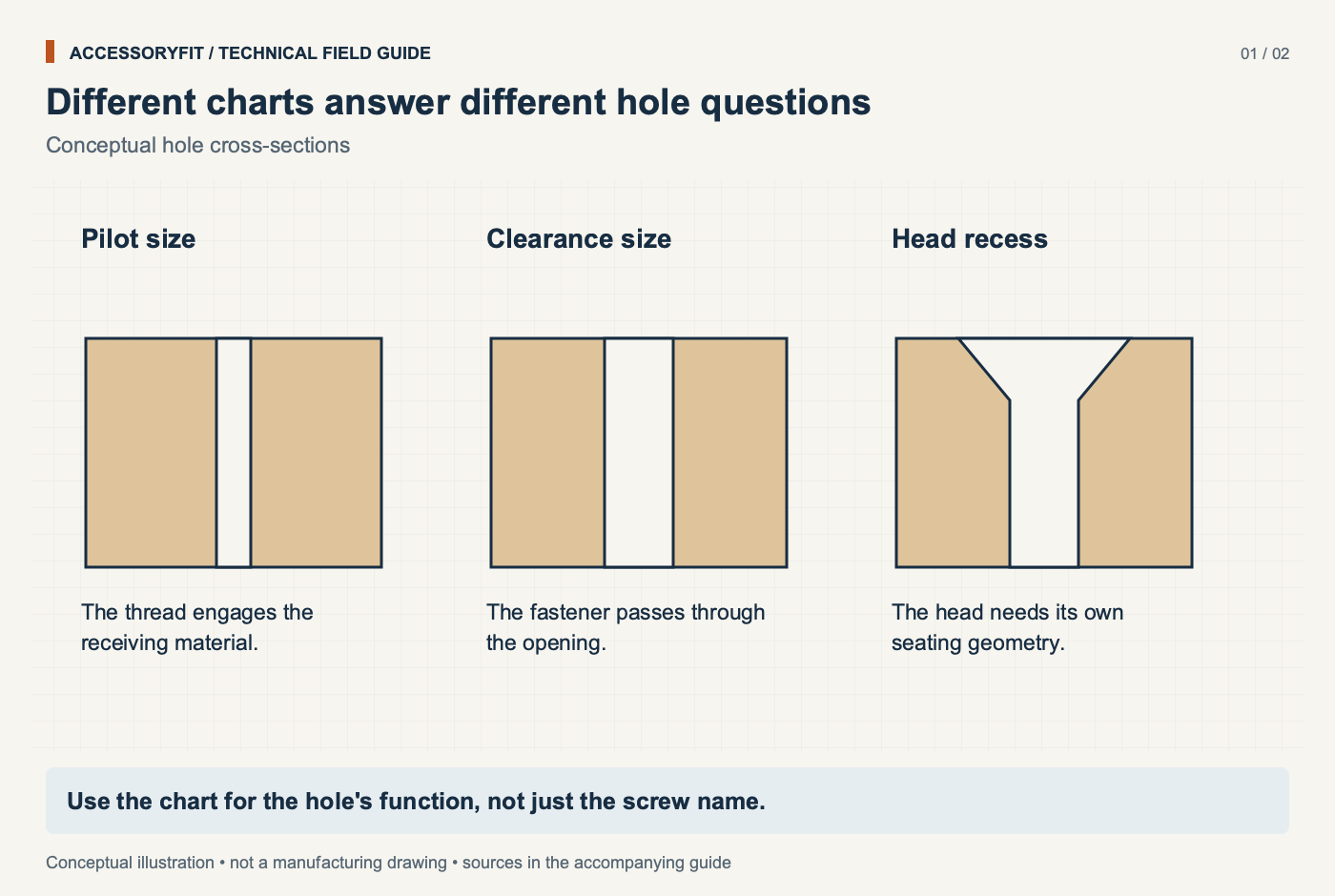
| Screw pilot hole chart | Pilot, clearance and countersink holes for wood screws | Larger pilot in hardwood than softwood |
| Sandpaper grit chart | CAMI against FEPA P-grades by particle size | Scales match up to about 220 grit |
| Hole saw size chart | Hole saw for pipe, conduit and door hardware | Lockset bore 2-1/8 in |
How do drill sizes convert between systems?
Fractional sizes step by 1/64 in, metric sizes by millimetre fractions, and number and letter sizes fill the gaps in between, so every size can be written as a decimal inch or millimetre value and compared directly. The number series runs from 0.0135 in up to 0.228 in, backwards by number, and the letter series carries on from 0.234 in to 0.413 in.
The drill size conversion chart lists every number, letter and fractional size with decimal inch and millimetre values, plus common metric jobber drills. Where Little Machine Shop rounds a handful of number sizes to three decimals, the chart uses the four-decimal values from AmesWeb and other references and says so. The guide on reading a drill size chart explains the series for anyone meeting them for the first time.
Which drill do you use before tapping a thread?
The tap drill listed for that thread at standard engagement, or a slightly larger drill for less engagement in hard materials. Little Machine Shop lists drills for 75% / 50% thread, the first for aluminum, brass and plastics and the second for steel, stainless and iron, because the larger hole is easier to tap. Using a drill as small as the screw's minor diameter for maximum strength is a common mistake; charts deliberately leave room for the tap.
The inch values are well settled. The standard-engagement inch tap drills from Little Machine Shop and the University of Pennsylvania chart agree for all the threads both list, a result recorded as 21 of 21 match. Metric values agree less: for a few sizes the University of Pennsylvania and Engineering ToolBox differ slightly, and the chart shows both. The chart for the drill size for a 1/4-20 tap and every other UNC, UNF and metric coarse thread lists both engagement levels.
| Thread | Tap drill (UPenn 75% value where listed) | Tap drill, 50% thread (UPenn) | Source agreement |
|---|---|---|---|
| M2 x 0.4 | 1.60 mm (0.0630 in) | 1.75 mm | UPenn + ETB |
| M2.5 x 0.45 | 2.05 mm (0.0807 in) | 2.20 mm | UPenn (ETB differs) |
| M3 x 0.5 | 2.50 mm (0.0984 in) | 2.70 mm | UPenn + ETB |
| M3.5 x 0.6 | 2.90 mm (0.1142 in) | not listed | ETB only |
| M4 x 0.7 | 3.30 mm (0.1299 in) | 3.50 mm | UPenn + ETB |
| M5 x 0.8 | 4.20 mm (0.1654 in) | 4.50 mm | UPenn + ETB |
| M6 x 1 | 5.00 mm (0.1969 in) | 5.40 mm | UPenn + ETB |
| M8 x 1.25 | 6.80 mm (0.2677 in) | 7.20 mm | UPenn + ETB |
| M10 x 1.5 | 8.50 mm (0.3346 in) | 9.00 mm | UPenn + ETB |
| M12 x 1.75 | 10.30 mm (0.4055 in) | 10.90 mm | UPenn (ETB differs) |
| M14 x 2 | 12.10 mm (0.4764 in) | 12.70 mm | UPenn (ETB differs) |
| M16 x 2 | 14.00 mm (0.5512 in) | not listed | ETB only |
| M20 x 2.5 | 17.50 mm (0.6890 in) | not listed | ETB only |
| M22 x 2.5 | 19.50 mm (0.7677 in) | not listed | ETB only |
| M24 x 3 | 21.00 mm (0.8268 in) | not listed | ETB only |
UPenn gives 75% and 50% values up to M14; Engineering ToolBox (ISO 724 coarse) gives one tap drill value up to M68 without stating a thread percentage. M18 is not listed by either source. Inch values are conversions.
What size pilot hole does a wood screw need?
A pilot hole sized to the screw gauge and the wood: larger in hardwood than in softwood for the same screw, in every chart consulted. For one of the most common traditional screw gauges, WOOD Magazine's chart gives a hardwood pilot of 7/64 in and a softwood pilot of 3/32 in, with a 5/32 in clearance hole in the top board.
Pilot charts disagree more than any other reference here. MISUMI's chart gives larger pilots than WOOD Magazine's for the same screw and separates tapered bits from straight ones, so the site shows WOOD Magazine's values with MISUMI's as an alternative rather than picking one. Screw makers add a third view for their own fasteners: Rotho Blaas specifies a 4.0 mm pre-drill for one of its HBS softwood screws, and its data covers driving with and without pre-drilling. Pilot holes are not always needed, which corrects a common belief that every screw needs one; they matter most in dense woods such as oak. The chart of pilot hole sizes for screws sets the charts side by side by gauge.
How do US and European grit numbers compare?
They match up to about 220 grit and then diverge, because the two standards size particles by different methods. CAMI, the US scale, uses plain numbers; FEPA, the European scale behind ISO 6344, puts a P before the number. In the medium range, a P grade and the CAMI grade with the same number average nearly the same particle size, so they are the same grade in practice.
Above that point, comparing by particle size is the only reliable method. CAMI's fine grades match P grades with much higher numbers, and sources list slightly different micron values for the same grade, which the chart shows by source. At the very fine end many abrasives skip grit numbers altogether and are graded directly in microns. Foam sanding pads follow their own labels again: General Finishes gives the equivalence for its own pads as 220 pad = 400 paper, so a pad's grit cannot be read across to paper. The CAMI to FEPA grit conversion gives every grade's average particle size and its nearest equivalent.
Which hole saw clears a pipe, conduit or lock?
Size the hole from the fitting's real outside diameter or the hardware maker's bore, never from its nominal name. A door lockset needs a 2-1/8 in bore through the face and a 1 in latch hole in the edge. Conduit and pipe are named by trade size, which is not their outside diameter, so Klein's knockout chart lists a hole for each trade size that is larger than the name suggests.
The arbor must fit too. Small hole saws up to 9/16 to 1-3/16 in use a 1/2–20 thread, and saws from 1-1/4 and larger in need a large-thread arbor. Door preparation has two more figures worth checking before you buy a lockset jig: Kwikset sets its jigs for a 2-3/8 or 2-3/4 in backset, and Schlage's standard knob and lever preparation fits doors 1-3/8 to 1-3/4 in thick. Depth matters on thick stock as well; standard bi-metal hole saws cut about 1-5/8 in deep, and Starrett's deep-cut versions about 2 in, which need an arbor with a longer pilot drill. The hole saw size chart lists conduit knockouts, steel pipe outside diameters and hole saw speeds by material.
Where do the chart values come from, and what if sources disagree?
From published standards, manufacturer charts and engineering references, each named under the chart. Where two sources give different figures for the same entry, the chart shows both and says which one the site uses elsewhere, rather than averaging them or hiding the difference. Values that only one source supports are marked as such. The methodology page explains the sourcing rules in full.
Charts are references, not instructions for a specific tool or fastener. Where a screw, tap or hole saw maker publishes its own figure for its own product, that figure takes priority over a general chart.
All charts and references
- Drill bit size chartFractional, metric, number and letter
- Tap drill size chartUNC, UNF and metric threads
- Screw pilot hole chartBy gauge and wood type
- Sandpaper grit chartCAMI vs FEPA P-grades
- Hole saw size chartPipe, conduit and fittings
Questions readers ask
What drill size is letter E?
Letter E is 0.250 in, the same as the quarter-inch fractional size.
Should I use a different tap drill in steel?
Often, yes. Little Machine Shop lists the larger, lower-engagement drill for steel, stainless and iron because it is easier to tap, and the standard drill for aluminum, brass and plastics.
Why do pilot hole charts give different sizes?
Charts are built for different screws and drill bits. MISUMI separates tapered and straight bits and gives larger pilots than WOOD Magazine for the same gauge, so the site shows both.
Are fine P-grades the same as US grits with the same number?
No. Above about 220 grit the scales diverge, and a P-graded sheet is coarser than the CAMI sheet with the same number. Check for the P prefix and compare by particle size.
Where to go next
- Drill bit size chartThe most-used conversion table on the site.
- Drill bits hubTypes, shanks and which bit to use.
- How-to guidesHow to apply the charts when choosing accessories.
References 38 documents, 23 publishers
- AmesWeb: Decimal Equivalents of Fractional, Wire and Letter Drill Sizes; Metric tap drill chart (ISO 68-1 basic profile)
- Engineering ToolBox: ISO Metric Threads (coarse and fine) with tap and clearance drills; Steel Pipe Dimensions (ANSI schedule 40 and 80); ASTM B88 seamless copper water tubes - dimensions; ASTM D1785 and ASTM F441 - PVC and CPVC pipes schedule 40 and 80
- Fine Woodworking (Taunton Press): True Grit, by Mark Schofield (Fine Woodworking #176); Full Grit Chart (English), PDF
- Finolex Industries: ASTM PVC-U pipes schedule 40 (ASTM D1785)
- General Finishes: What is the best sandpaper or abrasive to use for finish sanding?
- Hoffmann Group (GARANT): GARANT hand tap set DIN 352, M18 (130150)
- IMC Clains (specialist retailer): Stone, Belt, Paper, Film and Compound Grit Comparison, PDF
- Klein Tools: 53828 1.115-Inch Knockout Die for 3/4-Inch Conduit (with related knockout punch/die listings)
- Klingspor: Grit Grading Systems (Coated Abrasives Basics)
- Kwikset: 138 Installation Kit instructions (door boring jig)
- Little Machine Shop: Tap and clearance drill sizes (with major diameters); Number Drill Sizes; Letter Drill Sizes
- Milwaukee Tool: HOLE DOZER Door Lock Installation Hole Saw Kit 49-22-4063; Small Thread Arbor 3/8 in Shank 49-56-7010; Large Thread Quick Change Arbor 7/16 in Shank 49-56-7240; 5PC 3/8 in QUIK-LOK Arbor Set 49-56-7545; Hole saw arbor assembly instructions (49-56-9100, 49-56-7250, 49-56-7010, 49-56-6560); 2019 Accessory Catalog
- MISUMI USA: Pilot Hole Sizes for Wood Screws
- PACE Technologies: Grit Size Converter
- Rotho Blaas: HBS Softwood screw technical data sheet (EN 05-19)
- RS Components: Wood Screws Guide
- Schlage (Allegion): Generic door prep, knob/lever, no holes (115799)
- SPAX: SPAX Drill 2 Step
- Starrett: Saws & Hand Tools Catalogue 71E (hole saws, arbors, drill bits)
- University of Illinois Library, Engineering standards list: ANSI B74.12 entry
- University of Pennsylvania, MEAM Design: Creating Threaded Holes (tap drill chart)
- Wikipedia: Drill bit sizes; Drill bit; Unified Thread Standard (numbered sizes); Sandpaper
- WOOD Magazine: Wood Screw Chart: head-bore, shank-hole and pilot-hole sizes
Accessed .