
Category hub · Drill and driver bits
Drill bits: types, shanks, sizes and how to choose one
Choosing a drill bit comes down to three checks: the shank must fit the tool, the point and steel must suit the material, and the diameter must match the hole the job calls for. A jawed chuck takes round or flatted shanks up to its rated size, an impact driver takes 1/4 in hex shanks only, and a rotary hammer takes SDS bits. Twist bits cover metal and general work, brad-point and Forstner bits cover clean holes in wood, and carbide-tipped bits cover masonry. This hub explains each choice and links to the guide that covers it in full.
On this page
- What types of drill bits are there?
- Which drill bit should you use for each material?
- Which drill bits fit your drill, driver or hammer?
- How are drill bit sizes named?
- Which bit makes a large hole in wood or metal?
- How fast should a drill bit spin?
- When does a drill bit that fits still fail?
- Which drill attachments and add-ons go in a drill chuck?
- How does a drill bit depth stop collar work?
- Which add-ons turn a drill bit set into a driver kit?
- Do drill bits need cutting oil, and which brushes fit a drill?
What types of drill bits are there?
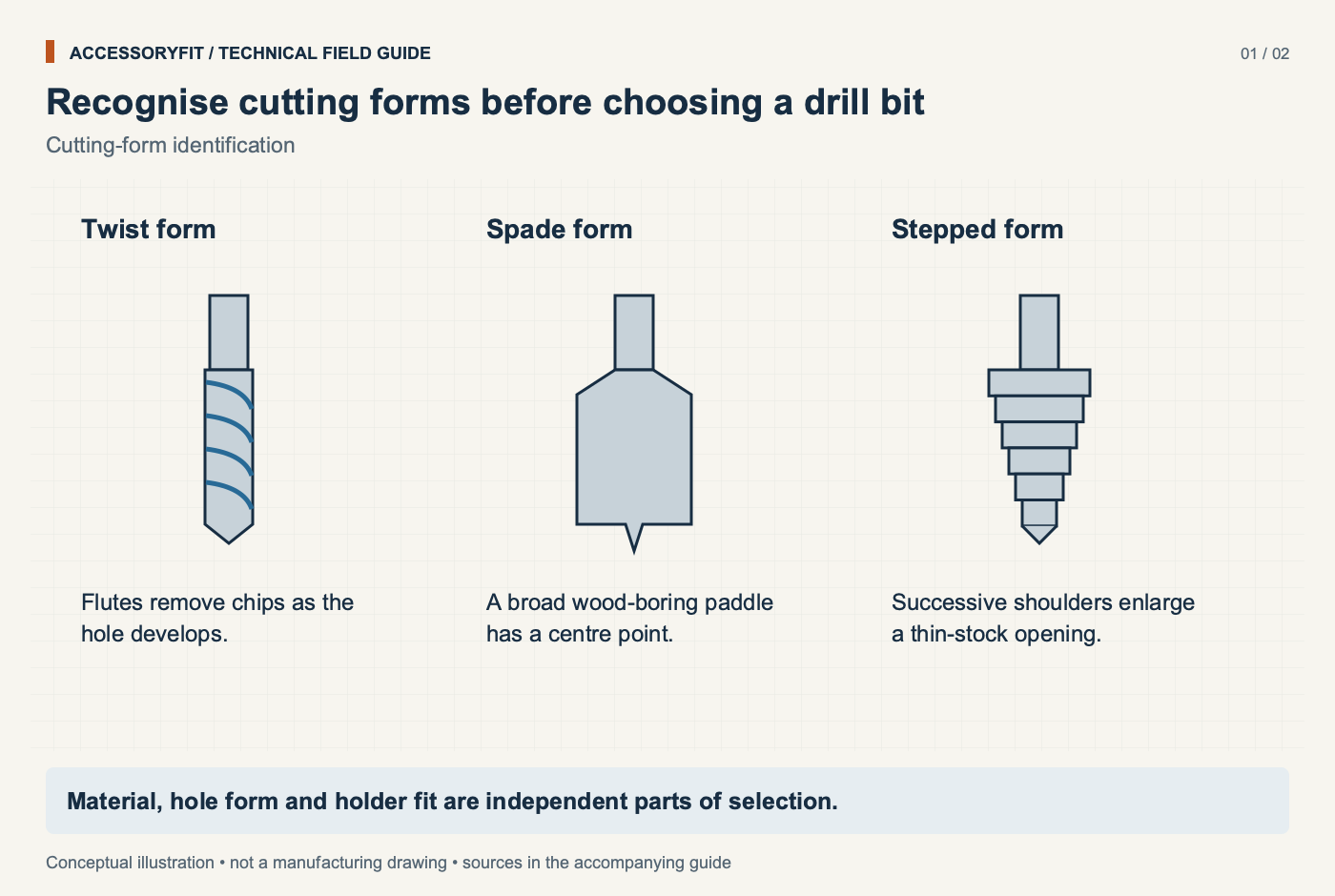
Drill bits fall into families by point shape: twist, brad-point, spade, Forstner, auger, step, masonry and glass or tile bits, plus hole saws for large round holes and driver bits for screws. Each family exists because one material or hole type defeats the others. A twist bit with a point angle of 118 degrees is the general-purpose bit for wood, metal and plastic, while a brad-point bit adds a centre spur that keeps it on line in wood.
Bits also differ by what they are made of. High-speed steel (HSS) drills metal, hardwood and most other materials and has largely replaced plain carbon steel. Cobalt HSS has cobalt alloyed into the steel itself, which keeps it hard at higher temperatures for stainless and other tough metals, at the cost of being more brittle. Black oxide and titanium nitride (TiN) are surface coatings on top of HSS, not different steels, which is the first misconception worth clearing up: a gold bit is a coated bit, and a cobalt bit is an alloy all the way through. Carbide, the hardest of the group, is brazed onto masonry bits as a tip and is also used for whole bits, which hold an edge longest but snap more easily than steel. Which countries supply them is tracked separately in the figures on where drill bits are imported from.
The table below sets out what each family is for and what decides whether it fits your tool. The article on drill bit types explains every family in detail, including the coatings and steels each is sold in.
| Bit family | Main job | What decides fit |
|---|---|---|
| Twist (HSS, cobalt) | Metal, plastic and general holes; point of 118 degrees | Round or flatted shank within the chuck's capacity |
| Brad-point | Clean, accurately placed holes in wood | Round shank in a jawed chuck |
| Spade | Fast, rough holes in wood | Flatted or 1/4 in hex shank |
| Forstner | Flat-bottomed and overlapping holes in wood | Round shank; drill press or steady drill |
| Masonry | Brick, block and concrete | Round shank (hammer drill) or SDS-plus or SDS-max shank (rotary hammer) |
| Step | Many hole sizes in sheet metal | Round or flatted shank |
| Hole saw | Large round holes for pipe, conduit and locks | Arbor thread and shank, plus pilot drill |
| Driver bits | Driving and removing screws | 1/4 in hex shank |
Which drill bit should you use for each material?
Match the bit to the hardest thing it must cut: HSS twist bits for mild steel and general work, cobalt for stainless, brad-point or Forstner bits for clean holes in wood, carbide-tipped masonry bits for concrete and brick, and diamond or carbide-pointed bits for tile and glass. The point angle follows the material too; published guidance puts steel at a steeper point than the common general-purpose angle, and Starrett makes a split-point HSS drill ground to 135 degrees that it describes as self-centring, easier to start and less prone to wander.
Metal drilling goes better with lubricant. Starrett recommends cutting fluid when drilling metal because it cuts friction wear, keeps the edge sharp longer and lowers the risk of a snapped bit. Tile and glass are the opposite of what most people expect: they are drilled slowly, not fast, and Starrett says diamond tile drills and diamond hole saws for porcelain, glass and stone must always be cooled with water.
Masonry bits carry a brazed tungsten carbide tip and are normally used with hammer action. Starrett's SDS-plus masonry bits use a carbide tip ground to 130 degrees. Tile and porcelain call for a different tool altogether: a diamond core bit or diamond hole saw, run with water, or a carbide spear-point bit at low speed for glass.
Each material has a buyer guide that compares current bits on published specs: bits for steel and stainless, masonry drill bits for concrete, drill bits for tile and porcelain and step drill bits for sheet metal and electrical boxes.
| Material | Bit type | Notes |
|---|---|---|
| Softwood / hardwood | brad point, spade, Forstner, auger, HSS twist | brad point stays in line in wood |
| Mild steel, aluminium, brass | HSS twist (118 or 135 degree split point) | use lubricant |
| Stainless / harder steels | cobalt HSS (M35/M42), 135 degree split point | lower rpm; cobalt is more brittle |
| Concrete, brick, masonry | carbide-tipped masonry / SDS bits with hammer action | 3-40 mm common |
| Ceramic tile, porcelain, glass, stone | diamond core bit or diamond hole saw; carbide spear-point for glass | water cooling; low speed for glass |
| Sheet metal, many sizes | step (unibit) drill |
Summary table. Each row is supported by facts above.
Which drill bits fit your drill, driver or hammer?
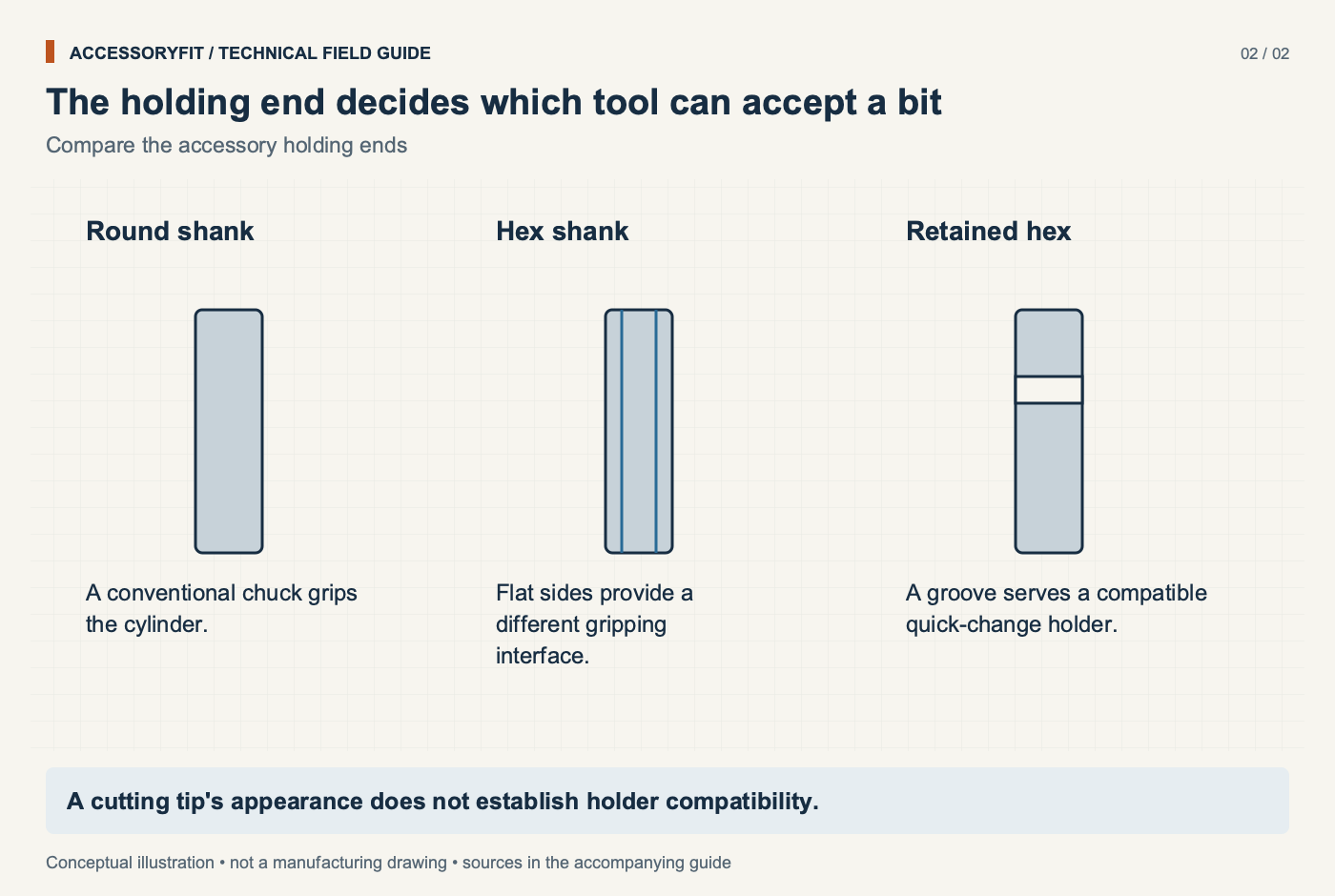
The tool's bit holder decides it. A drill/driver or hammer drill has a jawed chuck rated by the largest shank it grips, an impact driver has a hex quick-change holder that takes only hex shanks, and a rotary hammer has an SDS holder that takes only the matching SDS shank.
Chuck size names the shank limit, not the hole limit. A 1/2 in chuck takes shanks up to that size, so bits that cut bigger holes are made with a reduced shank that still fits. Many cordless drills, such as the DeWalt DCD800 and Milwaukee 2903-20, list a 1/2 in keyless chuck. Smaller drills often carry a smaller chuck; McMaster-Carr lists Jacobs keyless chucks of that class gripping shanks of 1/64 to 3/8 in. The guide to drill chuck sizes covers which bits each class takes.
Impact drivers such as the DeWalt DCF845 list a 1/4 in hex holder. Driver bits, impact-rated twist bits and some spade bits share that hex shank. Short insert bits sit in a bit holder, while longer power bits of about 2 in lock straight into the tool. Impact-rated bits work in an ordinary drill too, but standard bits can fail early in an impact driver because their harder heat treatment is more brittle. The guide to hex shank driver bits explains insert and power bit lengths and drive types, and the buyer guide to impact bit set picks compares sets from Milwaukee, DeWalt, Makita and Bosch.
Rotary hammers take SDS bits. SDS-plus bits have a 10 mm shank and SDS-max bits an 18 mm shank, and the two are not interchangeable. Hilti calls its SDS-plus fitting TE-C, so a TE-C bit is an SDS-plus bit. The comparison of SDS-plus and SDS-max shanks gives the hammer class each suits.
How are drill bit sizes named?
Drill bits are sized in four systems: fractional inches in steps of 1/64 in, metric millimetres, number sizes and letter sizes. Number and letter sizes fill the gaps between fractional sizes, which is why tap drill charts use them.
Number sizes run backwards, which surprises many people: a higher number is a smaller drill. The smallest number drill is 0.0135 in, and the largest is 0.228 in. Letter sizes then carry on upward from A at 0.234 in to Z at 0.413 in, and letter E equals a quarter inch at 0.250 in. Metric jobber drills are commonly made to DIN 338; Starrett's DIN 338 range lists both the diameter and the overall length of each drill.
Three charts on the site answer the size questions people ask most. The drill bit size chart converts between all four systems. The tap drill size chart gives the drill for each UNC, UNF and metric coarse thread; its most-used row is the #7 number drill, 0.201 in, the tap drill for the common quarter-inch coarse thread. The chart of clearance and pilot holes covers wood screws, where hardwood takes a larger pilot than softwood for the same gauge. The guide to reading drill bit sizes walks through the number and letter series with examples.
Which bit makes a large hole in wood or metal?
For large holes in wood use a Forstner bit for clean, flat-bottomed holes, a spade bit for fast rough ones, or an auger bit for deep holes; for large holes in metal or for pipe and conduit, use a hole saw or a step bit. Forstner bits bore in any grain direction and can cut overlapping holes or holes on the edge of a board. Spade bits are quick and cheap but splinter where they exit, so finish the hole from the other side. Auger bits add a long spiral flute and a screw tip that pulls the bit into the wood. The comparison of Forstner, spade and auger bits sets the three side by side.
Hole saws remove only a ring of material and mount on an arbor that carries a pilot drill. Small hole saws from 9/16 to 1-3/16 in use a 1/2–20 arbor thread, and larger ones from 1-1/4 and larger in need a large-thread arbor, so one arbor does not fit every saw. Standard bi-metal hole saws cut about 1-5/8 in deep. A door lockset needs a 2-1/8 in bore, and an electrical knockout is larger than its conduit's trade size suggests, because trade size is a nominal name rather than a measurement.
The guide to matching hole saws to fittings lists pipe, conduit and lock sizes, and the buyer guide to hole saw kit picks compares kits for electricians, plumbers and home use.
How fast should a drill bit spin?
Slower as the bit gets bigger, and slower again as the material gets harder. Published speed tables all follow the same pattern: recommended RPM falls as diameter rises, and falls again from wood to steel to stainless.
The table below, from Engineering ToolBox, shows the pattern across softwood, hardwood, acrylic, brass, aluminum and steel, and Starrett publishes a matching metric table for HSS drills in mild steel, stainless, cast iron and non-ferrous metals. Wood bits slow down sharply with size: Fisch gives about 2000 / 2400 rpm in hardwood and softwood for a small Forstner bit, and sets a maximum of 500 rpm in hardwood for its largest ones.
The common belief that a bigger wood bit should spin faster to cut faster has it backwards. A large Forstner bit run fast overheats, scorches the wood and dulls its edges, and Fisch notes that Forstner bits have no way to clear chips on their own, so they must be lifted out of the hole from time to time.
| Diameter | Softwood (pine) | Hardwood (hard maple) | Acrylic | Brass | Aluminum | Steel |
|---|---|---|---|---|---|---|
| 1/16 - 3/16 in | 3000 | 3000 | 2500 | 3000 | 3000 | 3000 |
| 1/4 - 3/8 in | 3000 | 1500 | 2000 | 1200 | 2500 | 1000 |
| 7/16 - 5/8 in | 1500 | 750 | 1500 | 750 | 1500 | 600 |
| 11/16 - 1 in (printed '1 1/16 - 1') | 750 | 500 | - | 400 | 1000 | 350 |
Single source. The last band is printed '1 1/16 - 1'; probably 11/16 - 1 in.
When does a drill bit that fits still fail?
A bit that fits the chuck still fails when it is the wrong type for the material, run at the wrong speed, started on a smooth surface or loaded sideways. The common failures each trace back to a cause covered above.
- Walking: ordinary twist drills tend to wander on a flat surface. In metal this is countered with a spotting drill, in wood with a brad-point bit, and split points reduce the drift.
- Snapping: carbide and cobalt bits are harder than plain HSS but more brittle, and they break when the drill is tilted or levered.
- Burning in wood: excess heat from too high a speed scorches the hole and dulls Forstner edges quickly.
- Slipping in the chuck: round shanks can spin under load, which is why many larger bits have flats ground on the shank.
- Breaking in an impact driver: standard driver bits share the hex shank but are more brittle than impact-rated bits.
- Dulling: a worn bit still fits and still cuts, just slowly and loudly. In a 2017 Human Factors and Ergonomics Society bench study of a Hilti TE-70 hammer drill with 19 mm two-cutter carbide bits, worn bits took about 58% longer per hole than new ones. A separate 2017 bench study in Annals of Work Exposures and Health measured mean noise of 114.4 dBA with a dull 13 mm masonry bit, up from the sharp bit's reading, a level the authors say calls for hearing protection. These 2017 bench studies remain the most recent open-access figures of their kind.
A drill bit also cannot be fixed by a bigger chuck. If a hole is too large for the chuck, the answer is a reduced-shank bit, a hole saw or a step bit, not forcing a shank the chuck was not made for. The troubleshooting guide on starting holes accurately covers the walking problem step by step.
Which drill attachments and add-ons go in a drill chuck?
Besides bits, a drill chuck takes a set of add-ons that are not drill bits at all: mixing paddles, depth stop collars that clamp onto a bit, magnetic bit holders, nut drivers, hex key bits, right-angle attachments, chuck adapters and wire brushes. Each fits the same way a bit does, by its shank, so the chuck and holder rules above still decide what goes where.
Paint mixer and mortar mixer paddles
A drill bit paint mixer is a paddle on a long shank, sized to the chuck. Collomix sells its drill paddles with shanks for 3/8 or 1/2 in chucks: the smaller paint and lacquer paddles fit a three-eighths chuck, and the larger paddles for mortar, tile cement and epoxy need a half-inch chuck. Kraft Tool's DC713 mud mixer, as listed by EMI Supply, has a 7/16 in hex shaft and is meant for a slow-speed half-inch drill. Speed matters more than most people expect: Collomix recommends mixing liquid epoxy at about 300–350 rpm and warns that higher speeds fold air bubbles into the mix.
The common belief is that any drill will do for a paddle mixer. Collomix says ordinary drills often lack the power and torque for paddle mixing and recommends a dedicated mixer drill for heavy batches. Those mixers do not use a chuck at all; they take paddles on an M14 threaded spindle, which is why Collomix's largest paddles use its HEXAFIX coupling instead of a drill shank.
| Paddle | Use | Chuck | Diameter | Length | Batch |
|---|---|---|---|---|---|
| FM 60 S | paint, lacquer, primer | 3/8 in | 2.4 in (61 mm) | 15.75 in (400 mm) | up to 1.3 gal |
| FM 80 S | paint, lacquer, primer | 3/8 in | 3.1 in (79 mm) | 15.75 in (400 mm) | 1.3-2.6 gal |
| LX 70 S | paint, bonding agents, epoxy coatings | 3/8 in | 2.75 in (70 mm) | 15.75 in (400 mm) | up to 4.0 gal |
| WK 90 S | ready-mix mortar, plaster, grout, filler | 3/8 in | 3.5 in (89 mm) | 15.75 in (400 mm) | 1.3-2.6 gal |
| LX 120 S | paint, bonding agents, epoxy coatings | 1/2 in | 4.7 in (119 mm) | 23.2 in (589 mm) | 4.0-6.6 gal |
| KR 120 S | tile cement, self-levelling, fillers | 1/2 in | 4.7 in (119 mm) | 23.2 in (589 mm) | 4.0-6.6 gal |
| WK 120 S | ready-mix mortar, plaster, grout, filler | 1/2 in | 4.7 in (119 mm) | 23.2 in (589 mm) | 4.0-6.6 gal |
Collomix 2025 US catalog pp.21-23. Larger MK, DLX and KR 140/160 paddles use the HEXAFIX coupling for dedicated mixers, not a drill chuck. mm values are calculated.
How does a drill bit depth stop collar work?
A depth stop is a collar clamped onto the bit with a set screw, so every hole stops at the same depth. McMaster-Carr describes the method: slide the collar along the bit to the depth you want, tighten the set screw, and the collar meets the surface when the hole is deep enough. A typical seven-piece set of drill bit collars, per McMaster-Carr, covers bits from 1/8 to 1/2 in, each locked with a small hex key; a separate four-piece set covers larger bits.
Collars are sized to the bit diameter, so a collar from one size will not grip a smaller bit. They suit dowel holes, shelf-pin rows and any job where several holes must match. The table below lists the bit sizes in each set and the hex key each needs.
| Set | Bit sizes | Set-screw hex key |
|---|---|---|
| 7-piece | 1/8, 3/16, 1/4, 5/16, 3/8, 7/16, 1/2 in | 1/16, 5/64, 3/32, 1/8 in depending on size |
| 4-piece | 5/8, 3/4, 7/8, 1 in | 5/32 in |
Specialist retailer listing; steel collars.
Which add-ons turn a drill bit set into a driver kit?
A magnetic bit holder, a few nut drivers and a set of hex key bits turn a drill or impact driver into a driver kit, and a right-angle attachment gets those bits into tight corners. All of them use the 1/4 in hex shank.
- Magnetic bit holder. Holds short insert bits and keeps the screw on the bit. Milwaukee sells magnetic holders in compact, 3, 6 in lengths, all with a hex shank; the longer ones reach into recesses.
- Drill bit magnetizer. A magnetiser restores the grip of a bit or holder that has lost its magnetism. With Wera's magnetiser, drawing a bit along the positive side magnetises it and drawing it along the negative side demagnetises it.
- Nut drivers. Milwaukee's impact-duty magnetic nut driver set covers 1/4, 5/16, 3/8, 7/16 in hex heads, for hex-head screws and small bolts.
- Allen wrench bits. A hex key bit is an Allen wrench on a hex shank. Milwaukee's driver bit sets include inch hex (Allen) insert bits from 1/16 to 1/4 in, and some sets add metric hex bits.
- Right-angle attachment. Turns the drive through a right angle for work between studs or inside cabinets. Milwaukee rates its 49-22-8510 right angle attachment up to 235 in-lb and fits it with a hex holder; DeWalt describes its FLEXTORQ right-angle attachment as impact ready, with a magnet to hold fasteners.
- Impact chuck adapter. Makita's 763198-1 adapter puts a 3/8 in keyless chuck on a hex shank so an impact driver can hold round-shank bits up to that size.
Do drill bits need cutting oil, and which brushes fit a drill?
Use cutting oil whenever a bit goes into metal: lubricant reduces friction wear, extends drill life and lowers the risk of breakage, according to both Starrett and Milwaukee. Milwaukee also calls for cutting fluid with its steel-plate hole cutters on deeper cuts, to keep the cutting surface cool and lubricated. Wood and masonry are drilled dry, and tile and glass with water, as covered above.
A wire cup brush is the other common drill attachment: a twisted-wire cup on a small shank, used to strip rust and paint. Shank size and maximum speed vary by brush, and the speed marked on the brush is the limit, whatever the drill can reach. The safety note below applies to every power brush.
Drill bit guides on AccessoryFit
- Drill bit types explainedTwist, brad-point, spade, Forstner, step and more
- Drill chuck sizesWhich shanks each chuck takes
- Impact driver bit shanksThe hex shank, insert and power bits
- SDS-plus vs SDS-maxRotary hammer bit fit
- Drill bit size chartFractional, metric, number and letter
- How to read drill bit sizesNumber and letter series with examples
- Tap drill size chartUNC, UNF and metric threads
- Screw pilot hole chartPilot and clearance holes by gauge
- Hole saw size chartPipe, conduit and door hardware
- Forstner vs spade vs auger bitsWhich wood bit to use
- Drill bits for metalSteel, stainless and hardened steel
- Masonry drill bitsConcrete, brick and block
- Drill bits for tileCeramic and porcelain
- Step drill bitsSheet metal and electrical work
- Hole saw kitsKits for trades and home use
- Impact driver bit setsSets from the main brands
- Why a drill bit walksFixing wandering holes
Questions readers ask
Can a 1/2 in drill make holes larger than its chuck size?
Yes. Chuck size limits the shank, not the hole. Reduced-shank twist bits, spade bits, Forstner bits, step bits and hole saws all cut larger holes while their shanks still fit the chuck.
Do impact drivers take normal drill bits?
Only bits with a 1/4 in hex shank, such as impact-rated twist bits and hex-shank spade bits. Round-shank bits need a jawed chuck or a hex chuck adapter.
Are cobalt bits just coated HSS bits?
No. Cobalt bits are a high-speed steel alloy with cobalt in the steel itself, while black oxide and titanium nitride are surface coatings on ordinary HSS. Cobalt keeps its hardness at higher temperatures, which suits stainless steel.
Can SDS bits go in a regular drill?
No. SDS-plus and SDS-max shanks are made for the locking holders on rotary hammers and do not fit a jawed chuck. The adapters that exist go the other way, letting a rotary hammer take round-shank or hex bits in rotation-only mode.
Why do number drill sizes run backwards?
Number drills come from the old wire-gauge series, where a higher number means a thinner size. The largest number drill is 0.228 in, and the letter series continues upward from there, starting at 0.234 in.
What size chuck does a paint mixer paddle need?
It depends on the paddle. Collomix makes its drill paddles with shanks for 3/8 or 1/2 in chucks: the smaller paint paddles take the smaller chuck, and the mortar and epoxy paddles the larger one. Check the shank before buying.
Where to go next
- Drill bit typesEach bit family explained, with the material it suits.
- Drill chuck sizesWhich shanks fit a 3/8 or 1/2 class chuck.
- Drill bit size chartConvert between fractional, metric, number and letter sizes.
References 95 documents, 45 publishers
- ABCM, COBEM 2005 proceedings: Influence of the Lubri-Cooling System on the Life of TiAlN Coated HSS Twist Drills when Machining Blind and Through Holes
- Abrasive Brush Manufacturers Association: Power brush safety slip AB-2 (rev. 2/2024)
- Albany County Fasteners: What Is Pozidriv? How Does It Differ From A Phillips Drive?
- AmesWeb: Decimal Equivalents of Fractional, Wire and Letter Drill Sizes; Metric tap drill chart (ISO 68-1 basic profile)
- Annals of Work Exposures and Health: The Effects of Bit Wear on Respirable Silica Dust, Noise and Productivity: A Hammer Drill Bench Study
- Applied Ergonomics (Elsevier): Pneumatic rock drill vs. electric rotary hammer drill: Productivity, vibration, dust, and noise when drilling into concrete
- BAER tools: What makes an SDS drill bit special
- BioResources: Effect of Chip Thickness and Tool Wear on Surface Roughness and Cutting Power during Up-Milling Wood of Different Density
- Bosch: Bits for drilling tiles (tile drilling guide); CYL-9 Soft Ceramic drill bit set 2 608 587 169; GBM 1600 RE Professional online manual: changing the drill chuck; GBH 2-28 F rotary hammer with SDS plus; GBH 5-40 D rotary hammer with SDS max; HA3JAWC 1/2 in SDS-plus Shank Keyless Chuck; GRW18V-160N 18V brushless 1-speed handheld mixer
- Collomix: Mixing matters catalog 2025 (EN-USA), paddles section pp. 21-23; Mixing epoxy resin and how to stir paint properly
- DeWalt: DCD771C2 20V MAX Cordless Drill/Driver Kit; DCD800B 20V MAX XR 1/2 in Brushless Cordless Drill/Driver product page; DCD800/DCD805 Instruction Manual NA043446; DCF845B 20V MAX XR 3-Speed 1/4 in Impact Driver product page; DCF845 Instruction Manual (T1); FLEXTORQ Modular Right-Angle System (DWAMRAFT)
- DICTUM (retailer) / Fisch (manufacturer): Fisch Wave Cutter Evolution Forstner Bit, 19 mm (product page with speed guidance)
- EMI Supply (retailer): Kraft Tools DC713 30 in hex shaft junior mud mixer
- Engineering ToolBox: Hardwood and Softwoods - Recommended Drill Bit Speeds; Steel Pipe Dimensions (ANSI schedule 40 and 80); ASTM B88 seamless copper water tubes - dimensions; ASTM D1785 and ASTM F441 - PVC and CPVC pipes schedule 40 and 80; ISO Metric Threads (coarse and fine) with tap and clearance drills
- Finolex Industries: ASTM PVC-U pipes schedule 40 (ASTM D1785)
- GTSE (UK tool supplier): SDS Drill Bits Explained: Types and Sizes
- Hardwick & Sons: Jacobs Multi-Craft Keyless Chuck 3/8 in capacity, model 30353
- Health and Safety Executive (UK): Hand-arm vibration: The Control of Vibration at Work Regulations 2005. Guidance on Regulations (L140, Second edition)
- Hilti UK: TE-C (SDS Plus) metric hammer drill bit set
- Hoffmann Group (GARANT): GARANT hand tap set DIN 352, M18 (130150)
- HomElectrical: Irwin 1/2 in Reduced Shank Silver & Deming HSS Drill Bits
- Human Factors and Ergonomics Society: Construction Ergonomics: Concrete Bit Wear Increases Handle Vibration and Drilling Time
- International Journal of Industrial Ergonomics (Elsevier): R2: Drilling into concrete: Effect of feed force on handle vibration and productivity
- Journal of Wood Science: Effect of tool material on tool wear and delamination during machining of particleboard
- Klein Tools: 53828 1.115-Inch Knockout Die for 3/4-Inch Conduit (with related knockout punch/die listings)
- Kwikset: 138 Installation Kit instructions (door boring jig)
- Little Machine Shop: Letter Drill Sizes; Number Drill Sizes; Tap and clearance drill sizes (with major diameters)
- Makita: B-68959 1/4 in x 4 in Glass and Tile Bit, 3 Flat Shank; 763198-1 3/8 in Keyless Chuck Adapter; B-59259 Adapter, SDS-PLUS to 1/4 in Hex; Wire cup brushes for drills (D-39908 to D-39942)
- McMaster-Carr: Starrett 117A center punch (marking punches); Jacobs Keyless Drill Chucks; Rotary-Hammer Chuck Adapters; Depth-limiting drill bit stop collar sets
- Milwaukee Tool: 1/4 in SHOCKWAVE Impact Duty RED HELIX Titanium Drill Bit 48-89-4613; 4PC Ceramic Tile & Glass Bit Set 48-20-8988; HOLE DOZER Door Lock Installation Hole Saw Kit 49-22-4063; Small Thread Arbor 3/8 in Shank 49-56-7010; Large Thread Quick Change Arbor 7/16 in Shank 49-56-7240; 5PC 3/8 in QUIK-LOK Arbor Set 49-56-7545; Hole saw arbor assembly instructions (49-56-9100, 49-56-7250, 49-56-7010, 49-56-6560); 2019 Accessory Catalog; M12 FUEL Installation Drill/Driver 2505-20; M12 FUEL 1/2 in Drill/Driver 3403-20; SHOCKWAVE Impact Duty 2 in ECX #1 Power Bits 48-32-4144; Cat. No. 2715-20, 0757-20 operator's manual (58-14-0017); 4PC M2 Steel Screw Extractor Set 49-57-9001; Right Angle Attachment 49-22-8510; SHOCKWAVE Impact Duty Magnetic Nut Driver Set 49-66-4562
- MISUMI USA: Pilot Hole Sizes for Wood Screws
- NIOSH: Nonfatal Tool- or Equipment-Related Injuries Treated in US Emergency Departments Among Workers in the Construction Industry, 1998-2005; Nonfatal work-related injuries treated in hospital emergency departments in the U.S., 2012-2023
- Penn Tool Co: Jacobs 32BA-1/2 plain bearing geared key drill chuck, 1/2-20 mount
- Rotho Blaas: HBS Softwood screw technical data sheet (EN 05-19)
- RS Components: Wood Screws Guide
- Schlage (Allegion): Generic door prep, knob/lever, no holes (115799)
- SPAX: SPAX Drill 2 Step
- Stanley Black & Decker (IRWIN, LENOX): IRWIN 29-pc Cobalt M-35 Metal Index Drill Bit Set 3018002; Left-hand mechanics length cobalt alloy high speed steel drill bit sets; Extractors catalog section (HANSON spiral, multi-spline and bolt extractors), pp. 221-224; HANSON 10-pc Spiral Extractor & Drill Bit Set in Metal Index (11119)
- Starrett: Saws & Hand Tools Catalogue 71E (hole saws, arbors, drill bits)
- Tanner Bolt & Nut: Chuck Systems, Drill Bits and Shanks for Rotary Hammer Drills
- Tribology in Industry: Comparison of Wear Behaviours of Cathodic Arc TiN, TiAlN Coated and Uncoated Twist Drills Under Aggressive Machining Conditions
- University of Pennsylvania, MEAM Design: Creating Threaded Holes (tap drill chart)
- Wera: 851/1 TZ bits, PH 1 x 25 mm datasheet (05056505001); 851/1 Z bits, PH 2 x 50 mm datasheet (05056520001); 9500 Magnetiser SB
- Wikipedia: Drill bit; High-speed steel; Screwdriver bit; List of screw drives; Drill bit sizes; Unified Thread Standard (numbered sizes)
- WOOD Magazine: Wood Screw Chart: head-bore, shank-hole and pilot-hole sizes
Accessed .