
Research · NEISS data
Table saw injury statistics (US, 2015–2024)
About 33,100 injuries involving table and bench saws were treated in US hospital emergency departments in 2024 (95% confidence interval 26,514 to 39,590 injuries), according to AccessoryFit's analysis of the Consumer Product Safety Commission's NEISS sample. 10.9% of those injuries were diagnosed as amputations, and 85.5% were to a finger. Yearly estimates from 2015 to 2024 move within overlapping confidence intervals, so the data shows a steady level of harm rather than a clear rise or fall.
By AccessoryFit editors · Checked
On this page
- What are the key findings?
- How many table saw injuries happen each year in the US?
- Are table saw injuries going up or down?
- Why do CPSC's figures differ from the NEISS totals here?
- How many table saw injuries are amputations?
- Which body parts do table saws injure?
- Who gets hurt on table saws?
- How many table saw injuries happen with the guard off or after kickback?
- How do table saws compare with other saws?
- What happened to the CPSC table saw safety rule?
- Which blade and setup choices matter on a table saw?
- How was this data produced?
- How should you cite this data?
What are the key findings?
- An estimated 33,100 injuries involving table and bench saws were treated in US emergency departments in 2024 (95% CI 26,514 to 39,590 injuries), based on CPSC NEISS data analysed by AccessoryFit.
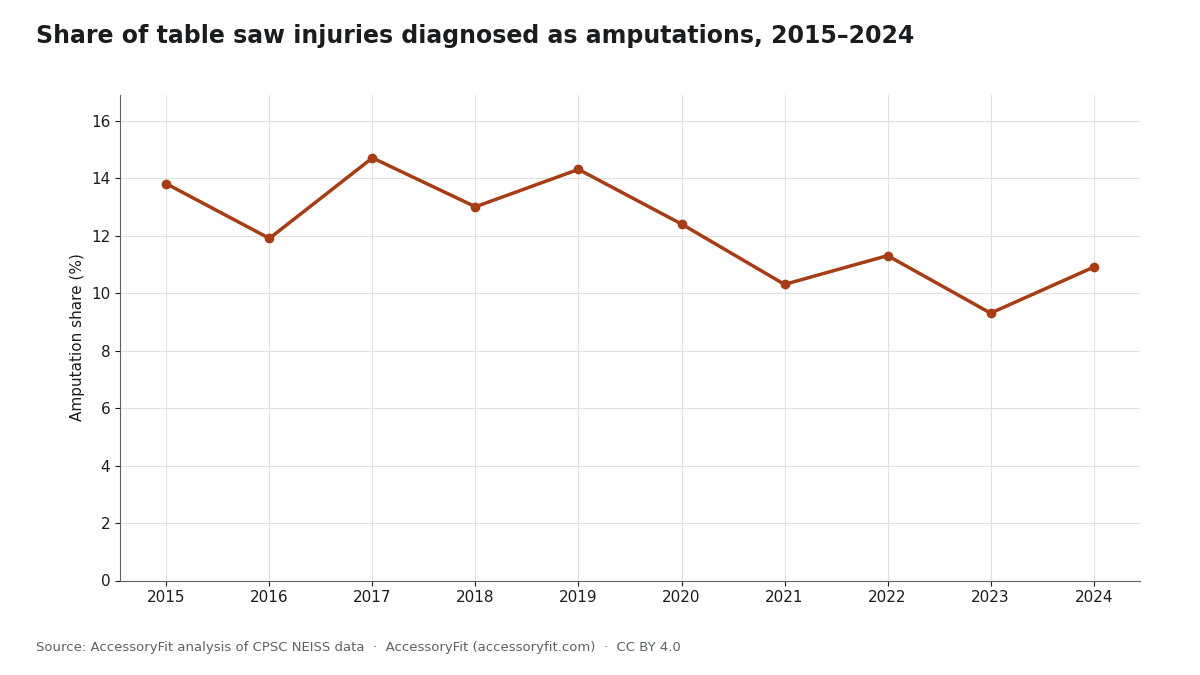
- 10.9% of US emergency-department table saw injuries in 2024 were diagnosed as amputations, a lower share than in each year from 2015 to 2019 in the same NEISS series.
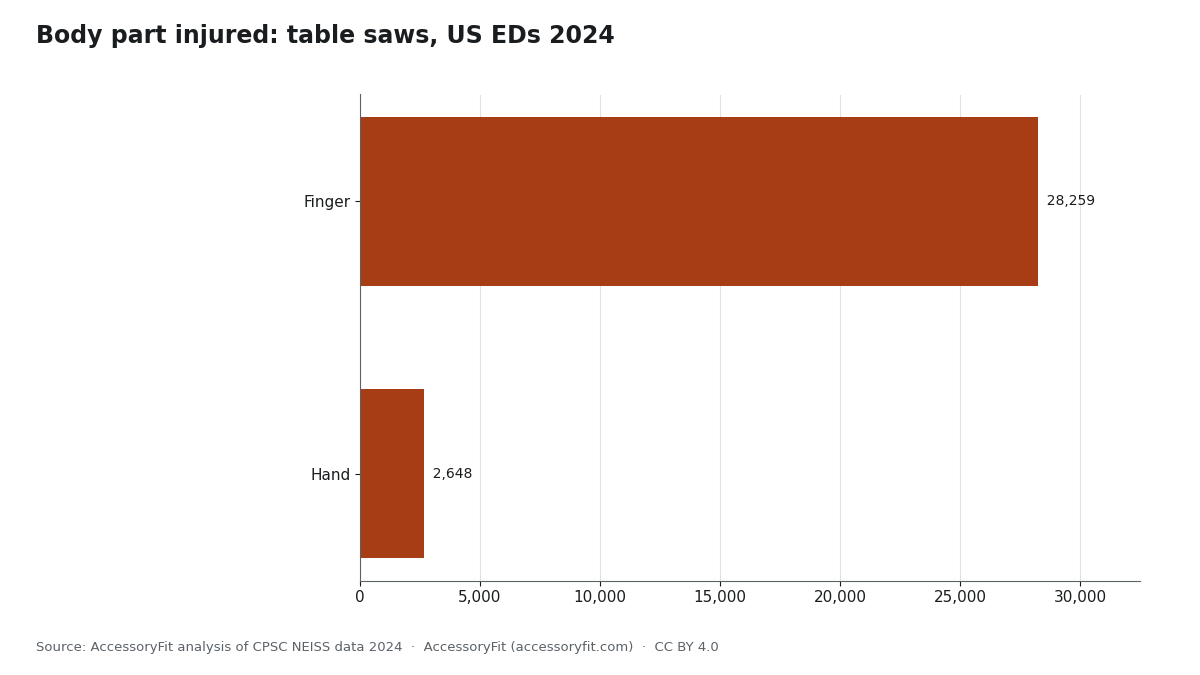
- 85.5% of US emergency-department table saw injuries in 2024 were to the fingers.
- In CPSC's 2017 special study of US table saw blade-contact injuries, the blade guard was not in use in 88.9% of cases.
- Of the 2017 US table saw injuries CPSC investigated in depth, 39.8% involved unexpected workpiece movement such as kickback before the hand reached the blade.
- CPSC estimated that US table saws sold with a traditional blade guard had a blade-contact injury rate 7.19 times that of saws with a modular guard and riving knife system in 2017.
- Only 19.9% of the US table saw blade-contact victims CPSC investigated for 2017 were using a push stick or push block.
- Amputations accounted for 55.3% of the estimated cost of US table saw blade-contact injuries in CPSC's 2023 economic analysis.
- CPSC withdrew its proposed US table saw blade-contact safety standard on 29 September 2025 and said it does not intend to issue a final rule.
How many table saw injuries happen each year in the US?
Roughly 33,100 injuries a year: that is the 2024 estimate for injuries involving table and bench saws treated in US emergency departments, and every year since 2015 falls in a similar band. Each figure is a national estimate built from a probability sample of US hospitals, so it carries a confidence interval of several thousand cases either side.
For scale, the same analysis puts all power tools in the study at 195,900 injuries in 2024. Table saws stand out less for their count than for severity, as the amputation figures below show. The US power tool injury data page covers the other tool groups.
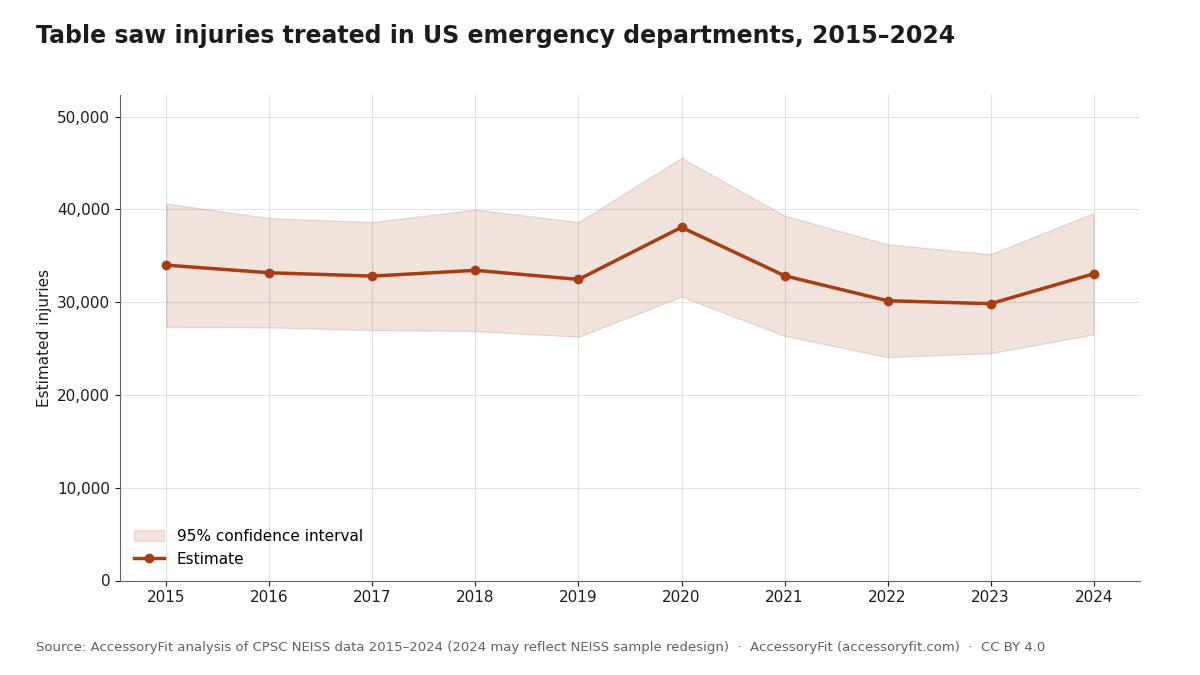
| Year | Estimated injuries | 95% confidence interval | Amputation share | Reliability |
|---|---|---|---|---|
| 2015 | 33,983 | 27,331–40,634 | 13.8% | reliable |
| 2016 | 33,164 | 27,277–39,052 | 11.9% | reliable |
| 2017 | 32,804 | 26,984–38,624 | 14.7% | reliable |
| 2018 | 33,427 | 26,879–39,975 | 13.0% | reliable |
| 2019 | 32,445 | 26,264–38,626 | 14.3% | reliable |
| 2020 | 38,063 | 30,583–45,543 | 12.4% | reliable |
| 2021 | 32,844 | 26,368–39,320 | 10.3% | reliable |
| 2022 | 30,146 | 24,060–36,233 | 11.3% | reliable |
| 2023 | 29,831 | 24,497–35,164 | 9.3% | reliable |
| 2024 | 33,052 | 26,514–39,590 | 10.9% | reliable |
CPSC's 2021 notice says NEISS was moving to a redesigned hospital sample, with 2024 estimates possibly the first from the new sample, so treat the 2023-to-2024 change with care.
Are table saw injuries going up or down?
Neither, on the evidence available: the yearly estimates from 2015 to 2024 rise and fall inside overlapping confidence intervals. The 2020 estimate is the highest in the series, but its interval still overlaps its neighbours. The step from 2023 to 2024 also sits within overlapping intervals, and CPSC said in 2021 that NEISS was moving to a redesigned hospital sample, so 2024 may be among the first years drawn from it. It is not evidence of a surge.
CPSC reached the same conclusion with its own method. Counting only blade-contact injuries, its 2023 rulemaking estimated 30,000 injuries in 2021 and found no statistically significant trend from 2010 to 2021, even as the market moved to modular guards and riving knives. That corrects a common belief: modern guards have not, on the national figures, brought injuries down.
| Year | Estimated injuries | 95% CI | Per 10,000 saws in use |
|---|---|---|---|
| 2015 | 30,800 | 25,100-36,500 | 37.2 |
| 2016 | 30,000 | 25,000-35,000 | 36.5 |
| 2017 | 31,300 | 25,800-36,700 | 38.1 |
| 2018 | 31,300 | 25,500-37,100 | 37.8 |
| 2019 | 30,300 | 24,900-35,700 | 35.6 |
| 2020 | 34,600 | 27,800-41,300 | 39.1 |
| 2021 | 30,000 | 24,100-35,900 | 29.9 |
88 FR 74916, Table 3. CPSC found no statistically significant trend. The 2017 special study's 26,500 figure counts only investigated blade-contact cases and uses a different method, so it differs from the 2017 row here.
Why do CPSC's figures differ from the NEISS totals here?
They count different things. AccessoryFit's figures include every emergency-department case where a table or bench saw was recorded, whatever happened; CPSC's rulemaking series counts only cases where the person touched the blade, so its totals run a little lower. CPSC's 2017 special study gives a third, lower figure for that year because it used in-depth follow-up and a different estimation method. When quoting a number, name its series.
How many table saw injuries are amputations?
About one in ten: 10.9% of emergency-department table saw injuries in 2024 were diagnosed as amputations. Using its blade-contact series, CPSC estimated 3,400 amputations (11.2% of table saw blade-contact injuries, 2021), with no statistically significant change in amputations since 2010.
The amputation share in the NEISS series was higher in each year from 2015 to 2019 than in any year from 2021 to 2024 (see the chart and the 2015–2024 table). That is an observed pattern in survey estimates, not a measured effect of any guard, blade or rule: each yearly share rests on a small number of sampled amputation cases, and the hospital sample has changed. Monir and colleagues' 2024 study of upper-limb injuries from all saw types, 2003 to 2022, likewise found amputations, at 9.9% of cases, did not decline significantly while total saw injuries fell.
In CPSC's 2023 economic analysis, amputations made up 55.3% of the estimated cost of table saw blade-contact injuries.
Which body parts do table saws injure?
Fingers, overwhelmingly: 85.5% of emergency-department table saw injuries in 2024 were to a finger, and the hand was the only other body part with a reliable estimate. Forearm, eye and trunk injuries appear in the case records but in numbers too small to publish; they are in the detailed CSV, flagged as unreliable. Lacerations were the most common diagnosis (62.5%), followed by fractures (15.7%) and amputations (10.9%), which fits the hand feeding stock being the part closest to the blade.
| Body part | Estimated injuries | Share |
|---|---|---|
| Finger | 28,259 | 85.5% |
| Hand | 2,648 | 8.0% |
Only categories meeting CPSC reliability thresholds are shown, so shares may not add to 100%.
Who gets hurt on table saws?
Mostly older men working at home: in 2024 men accounted for 95.1% of US emergency-department table saw injuries, people aged 65 and over were the largest age group at 40.7%, and home (43.1%) was the only recorded location with a reliable estimate. That largely reflects who owns and uses table saws for hobby and renovation work, not who is careless.
90.6% were treated and released, and 5.4% were admitted to hospital. Over half of cases have no location recorded, so the home share is a floor.
| Sex | Estimated injuries | Share |
|---|---|---|
| Male | 31,444 | 95.1% |
| Female | 1,608 | 4.9% |
Only categories meeting CPSC reliability thresholds are shown, so shares may not add to 100%.
| Disposition | Estimated injuries | Share |
|---|---|---|
| Treated/examined and released | 29,951 | 90.6% |
| Treated and admitted/hospitalized | 1,786 | 5.4% |
Only categories meeting CPSC reliability thresholds are shown, so shares may not add to 100%.
How many table saw injuries happen with the guard off or after kickback?
Most happened with the guard off. CPSC's 2017 NEISS Table Saw Special Study of US blade-contact cases estimated that the blade guard was not in use in 88.9% of injuries. In the cases its field staff investigated in depth, 39.8% involved unexpected workpiece movement, such as kickback, before the hand reached the blade; 63.4% happened during a rip or through cut, and only 19.9% of victims were using a push stick or push block.
The same study estimated that saws sold with a traditional blade guard had a blade-contact injury rate 7.19 times that of saws with a modular guard and riving knife system. These are single-study figures from one year of US data, and the relative risk compares saw populations, not individual users.
How do table saws compare with other saws?
Table saws had the highest amputation share of any power tool group in the 2024 US data, but portable circular saws were almost level (10.8%), so the two cannot be separated statistically, as the chart below shows. An older CPSC staff estimate for 2015 points the same way: 52.4% of workshop-product amputations involved table saws (2015), in a workshop group that also covers miter, circular, band and radial arm saws and routers.
Longer studies agree. Monir and colleagues' 2024 study of upper-limb saw injuries from 2003 to 2022 found bench and table saws caused 47.3% of an estimated 1.39 million ED-treated upper-limb saw injuries; the next named type came far behind, at 13.6% of upper-limb saw injuries from portable circular saws (2003-2022). Renfro and colleagues' study of US finger amputations from 2010 to 2019 found power saws were the leading product, causing 28.2% of emergency-treated finger amputations.
What happened to the CPSC table saw safety rule?
CPSC withdrew it. The Commission formally withdrew its proposed table saw blade-contact standard on 29 September 2025 and said it does not intend to issue a final rule. The proposal would have required table saws to limit how deep the blade could cut when a finger touched it.
CPSC staff had sent the Commission a proposed rule briefing package in January 2017, and the Commission published a supplemental notice of proposed rulemaking on 1 November 2023, which carried the 2021 injury estimate and the cost analysis cited above. There is now no mandatory US federal performance standard for table saw blade contact, and the data on this page is the baseline any future voluntary or regulatory action would be measured against.
Which blade and setup choices matter on a table saw?
The choices that touch the injury findings are those that keep the guard and riving knife fitted and stop the cut from binding. The riving knife only works when the blade matches it: the body must be thinner than the knife and the kerf wider. DeWalt's DWE7491 manual sets the limits for its knife (kerf >= 0.094 in; body <= 0.079 in), so a thick full-kerf blade can force the knife off. The table saw arbor sizes guide covers bore, diameter, speed rating and riving knife fit by saw.
Diameter matters too. The UK Health and Safety Executive's guidance on saw benches says a blade smaller than about 60% of the saw's maximum diameter runs at too low a rim speed and raises kickback risk; Makita's 2705X1 accepts 250–255 mm blades only.
Tooth count and grind decide whether a blade rips cleanly or labours, and a dull or wrongly chosen blade is more likely to burn and bind in a rip cut, the cut most common in CPSC's investigated cases. See how to choose a circular saw blade for rip, crosscut and combination teeth, and why a blade burns wood for signs a blade needs cleaning or replacing. Blade choice does not replace the guard.
How was this data produced?
The 2015–2024 estimates come from the public case files of the National Electronic Injury Surveillance System (NEISS), run by the US Consumer Product Safety Commission. NEISS records injuries treated in the emergency departments of a probability sample of US hospitals, and each case carries a statistical weight; summing the weights gives a national estimate. AccessoryFit counted every case listing NEISS product code 0841 (table or bench saws) in either product field, for each year.
Confidence intervals at 95% use a with-replacement variance estimate across NEISS strata and hospitals. Following CPSC's publication rules, estimates from fewer than 20 sampled cases, below 1,200 weighted cases, or with a coefficient of variation above 33% are marked unreliable and not quoted here, which is why the breakdown tables do not add up to 100%.
Limitations, in plain terms:
- A product code records that a table saw was involved, not that it caused the injury or that any accessory failed.
- Only emergency-department visits are counted, so injuries treated elsewhere or not treated are missing.
- CPSC reported in 2021 that NEISS was moving to a redesigned hospital sample; comparisons across that change are indicative only.
- Location is missing for more than half of the 2024 table saw cases.
- The guard, kickback and guard-type figures describe 2017 blade-contact cases only.
The 2021 figures and cost analysis are CPSC's own, from its 2023 supplemental rulemaking notice, and study shares come from the papers named in each sentence. Our general approach to sources is on the methodology page.
How should you cite this data?
Please cite AccessoryFit with a link to this page:
AccessoryFit, “Table saw injury statistics (US, 2015–2024)”, updated 22 October 2026, https://accessoryfit.com/research/table-saw-injury-statistics/
The data, tables and charts on this page are free to reuse under a Creative Commons Attribution 4.0 (CC BY 4.0) licence, including commercially, as long as you credit AccessoryFit and link to this page. When quoting a CPSC rulemaking figure or a journal study, also name that original source from the references below. More datasets are in AccessoryFit research.
Download the data
The CSV holds yearly national estimates, 95% confidence intervals, sampled case counts, amputation shares and reliability flags for table saws and the other power tool groups in the study. The detailed 2024 file breaks each tool down by body part, diagnosis, age, sex, location and disposition, including the categories too small to quote. Charts are 1200×675 PNG files.
- Power tool injury estimates, 2015–2024 (CSV) Yearly NEISS estimates by tool group, including table and bench saws (code 0841).
- 2024 injury detail by tool (CSV) Body part, diagnosis, age band, sex, location and disposition, with reliability flags.
- Chart: table saw injuries, 2015–2024 Yearly estimates with 95% confidence band.
- Chart: amputation share, 2015–2024 Share of table saw injuries diagnosed as amputations.
- Chart: injuries by body part, 2024 Finger and hand, the two reliable categories.
Questions readers ask
How many table saw amputations happen each year in the US?
CPSC estimated 3,400 amputations (11.2% of table saw blade-contact injuries, 2021). Both that figure and the NEISS 2024 share of 10.9% count emergency-department cases only.
Did table saw injuries surge in 2024?
No. The 2024 estimate of 33,100 injuries is higher than 2023's, but the two years' confidence intervals overlap and NEISS was changing its hospital sample, so the change is within the normal range of the series.
Does the NEISS table saw estimate count only blade contact?
No. AccessoryFit's NEISS figure includes every emergency-department case involving a table or bench saw. CPSC's blade-contact-only estimate for 2021 was 30,000 injuries.
Is there a US federal standard requiring flesh-sensing table saws?
No. CPSC proposed a blade-contact performance standard but withdrew the proposal on 29 September 2025 and said it does not plan a final rule.
Can I use these charts in an article or a class?
Yes. The charts, tables and CSV files are licensed CC BY 4.0. Credit AccessoryFit and link to this page.
Where to go next
- Power tool injury statisticsThe same NEISS data for every tool group.
- Table saw blade arbor sizesBore, diameter and riving knife fit by saw.
- How to choose a circular saw bladeRip, crosscut and combination teeth explained.
References 24 documents, 7 publishers
- BG BAU - Berufsgenossenschaft der Bauwirtschaft (Germany): Baustellenkreissaegen, Handkreissaegen - Baustein B 265
- DeWalt: DWE7491RS 10 in Job Site Table Saw instruction manual (N531890)
- Hand (N Y): Traumatic Finger Amputations: Epidemiology and Mechanism of Injury, 2010-2019; Trends in Upper Extremity Saw Injuries From 2003 to 2022
- Health and Safety Executive (UK): Circular saw benches - Safe working practices, Woodworking Information Sheet No 16 (Revision 2)
- Journal of Clinical Orthopaedics and Trauma: Patients admitted for treatment of traumatic finger amputations: Characteristics, causes, and prevention
- Makita: 2705X1 10 in Contractor Table Saw instruction manual
- U.S. Consumer Product Safety Commission: NEISS 2024 data file (neiss2024.xlsx), with NEISS_FMT code formats; The 2017 NEISS Table Saw Special Study (staff briefing package, including Table Saw Blade-Contact Injuries Special Study Report, 2017); Safety Standard Addressing Blade-Contact Injuries on Table Saws: Supplemental Notice of Proposed Rulemaking (November 1, 2023); Proposed Rule: Safety Standard Addressing Blade-Contact Injuries on Table Saws (staff briefing package, January 17, 2017); Injuries Associated with Stationary Power Saws, 2001; 2019 NEISS Coding Manual; Withdrawal of Proposed Regulatory Actions (September 29, 2025); NEISS 2015 data file (neiss2015.xlsx); NEISS 2016 data file (neiss2016.xlsx); NEISS 2017 data file (neiss2017.xlsx); NEISS 2018 data file (neiss2018.xlsx); NEISS 2019 data file (neiss2019.xlsx); NEISS 2020 data file (neiss2020.xlsx); NEISS 2021 data file (neiss2021.xlsx); NEISS 2022 data file (neiss2022.xlsx); NEISS 2023 data file (neiss2023.xlsx); Agency Information Collection Activities; Follow-Up Activities for Product-Related Injuries Including NEISS (Docket CPSC-2009-0102), FR Doc. 2021-23302
Accessed .