
Interactive tool · Fit lookup
Accessory finder: enter your tool, see what fits
Choose a tool type and then a model to see the mounting specs its manufacturer publishes: blade diameter and arbor, chuck or bit holder, router collets, sanding pad, grinder spindle thread or blade mount, plus no-load speed and battery platform. Each result links to the guides that explain which accessories fit that interface. The finder holds 61 models from DeWalt, Milwaukee, Makita, Bosch, Ryobi and Festool, taken from each maker's spec pages and manuals. A spec the maker does not state is left out rather than guessed.
By AccessoryFit editors · Checked
How do you read the finder's results?
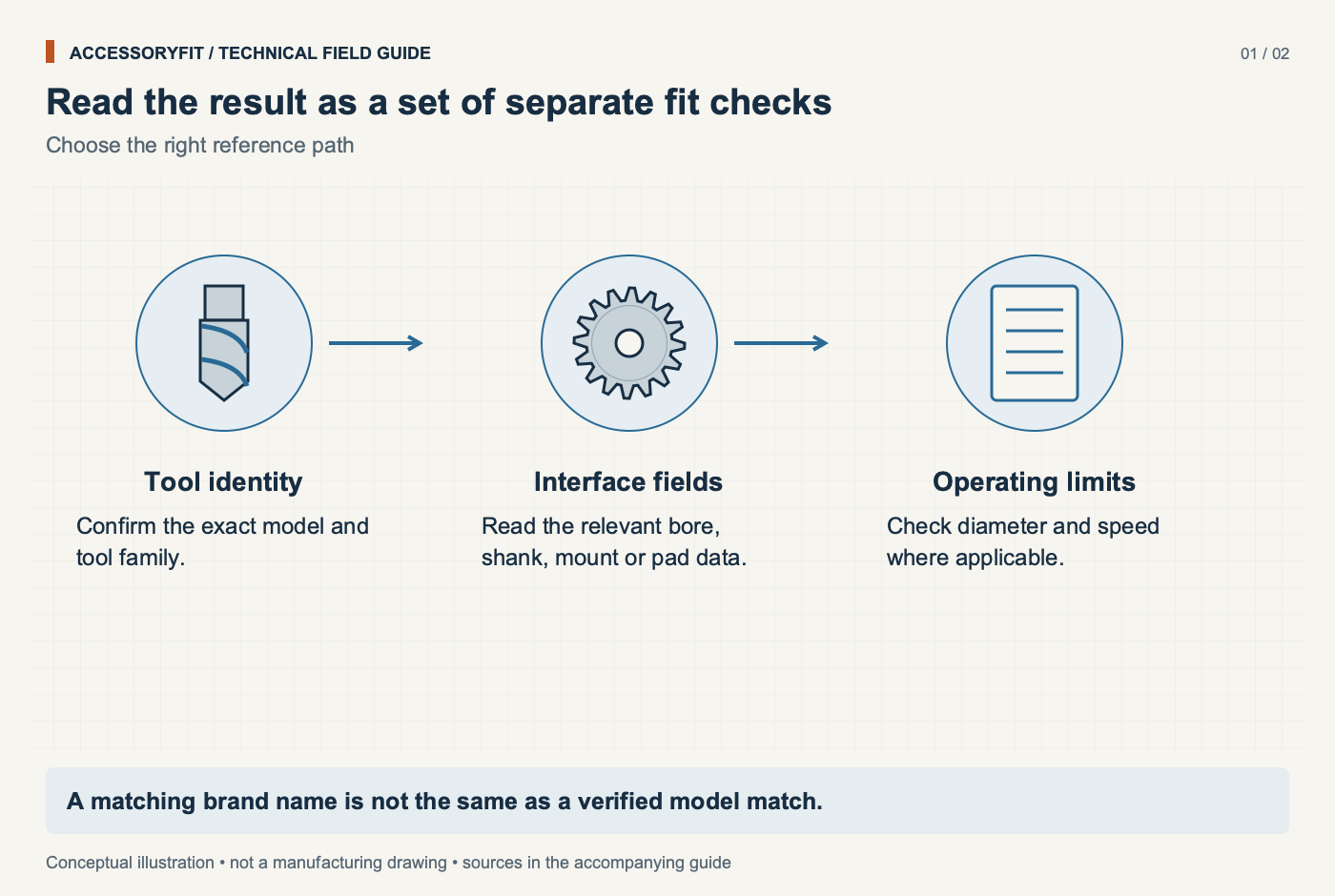
Read the result as the maker's own spec sheet, cut down to the lines that decide which accessories fit. Each row is one spec as the manufacturer states it, with its unit, and the rows that matter depend on the tool: a saw shows blade diameter, arbor and no-load speed; a drill shows chuck size and chuck type; a sander shows pad diameter, hole count and attachment; a grinder shows disc diameter, spindle thread and speed.
The speed row uses the unit that fits the tool's motion. Saws, drills, grinders and routers are given in rpm, the spindle's revolutions per minute with no load. Random orbital sanders, detail sanders and multi-tools are given in opm, orbits or oscillations per minute, and jigsaws in spm, strokes per minute. The rpm figure is the one to compare with the maximum speed marked on a blade, wheel or bit, because an accessory's rated speed must be at least the tool's marked maximum speed.
Under the specs, the list headed What fits this tool links to the guides for that interface, such as the arbor guide for a circular saw or the collet guide for a router. The address bar updates when you pick a model, so a result can be bookmarked or shared and opens on the same tool. If a row you expect is missing, the maker does not publish that spec for the model; the section on missing models below explains where else to find it.
Which spec decides blade fit on a circular, miter or table saw?
The arbor decides whether the blade goes on, and the blade diameter and speed rating decide whether it may be used. A US circular saw such as the Makita 5007F lists a 7-1/4 in blade on a 5/8 in arbor with a no-load speed of 5800 rpm, so a matching blade needs that diameter, that bore and a marked speed at or above that figure. Diablo marks its wood blades of that diameter 8000 rpm, which clears it.
Track saws are the usual surprise. The Makita SP6000J lists a 6-1/2 in blade with a 20 mm bore, not the 5/8 in arbor most US blades of that diameter use. Worm-drive saws take a diamond arbor, and European saws commonly a 30 mm bore. On miter saws, US machines take a 5/8 in hole at the smaller common diameter and a 1 in hole at the larger, and DeWalt limits its miter saws to crosscut blades with a hook of no more than 7 degrees. The guide to circular saw arbor sizes covers every common diameter.
What decides fit on jigsaws, reciprocating saws and band saws?
On a jigsaw the deciding spec is the blade mount, on a reciprocating saw it is almost never a problem, and on a band saw it is the blade length. The Milwaukee 2737-20 lists a T-shank mount, and a T-shank saw takes T-shank blades only; U-shank blades fit U-shank saws only. Every jigsaw in the finder lists a T-shank mount. The guide to jigsaw blade shank types explains how to tell the two apart.
Reciprocating saws share a universal shank across brands, so the finder shows stroke length instead, for example 1-1/4 in on the Milwaukee 2722-20; current full-size saws run 1-1/8 to 1-1/4 in. Portable band saws show blade length and width, because the loop must match the machine exactly: the DeWalt DCS374B lists 44-7/8 in, and band saw makers direct owners to the manual for each model's length.
Which spec decides bit fit on drills, drivers and rotary hammers?
The chuck or holder type decides it. A drill/driver or hammer drill lists a chuck size, such as 1/2 in keyless on the Milwaukee 2903-20, and that size is the largest shank the chuck accepts, not the largest hole the drill can make. Impact drivers list a 1/4 in hex holder, which takes hex-shank bits only. Rotary hammers list their SDS type: the Milwaukee 2912-20 is SDS-Plus, which takes bits with a 10 mm shank and not SDS-max bits with an 18 mm shank.
The guide to which bit shanks fit your chuck covers jawed chucks, reduced-shank bits and hex adapters in more detail.
What decides disc fit on an angle grinder?
Three specs decide it together: disc diameter, spindle thread and no-load speed. The Milwaukee 2880-20 lists a 4-1/2 / 5 in disc on a 5/8–11 spindle at 8500 rpm, while the European Bosch GWS 12-125 Professional lists a 125 mm disc on an M14 spindle at 11000 rpm. Plain-hole discs fit both, because they share a 7/8 in centre hole; threaded cups, hubbed wheels and threaded flap discs fit only the thread they are made for.
Compare the no-load speed with the maximum RPM printed on the wheel before fitting it. Reinforced wheels of the smallest common size are typically rated 13,300 RPM, and larger wheels are rated lower. The guide to angle grinder disc sizes gives the hole, thread and typical rating for each size.
What decides pad and disc fit on a sander?
Pad diameter, hole pattern and attachment type decide it. The DeWalt DWE6423 lists a 5 in pad with 8 holes and hook-and-loop attachment, which matches the common 8-hole pattern for that size. European and Festool sanders work in metric: the Festool ETS EC 150/3 EQ-Plus lists a 150 mm pad with StickFix, Festool's name for its hook-and-loop system, and Festool's own discs for its sanders of that size use a 48-hole pattern.
If the disc's holes do not line up with the pad's, the disc still sticks but dust extraction suffers, and extraction is what extends abrasive life. Detail sanders and multi-tool sanding pads vary by brand rather than following one standard size. The guide to hook-and-loop versus PSA discs covers sizes, hole patterns and backings.
What decides fit on routers and oscillating multi-tools?
On a router the collet decides it, and on a multi-tool the blade interface does. The DeWalt DWP611 compact router lists a 1/4 in collet, so it takes bits with that shank only, while the DeWalt DW618 lists 1/4, 1/2 in collets. The collet must match the shank exactly; a 1/4 in shank and a metric shank of similar size are not interchangeable, and a bit's rated speed must be at least the router's maximum speed. The guide to router collet sizes lists collets by router.
Multi-tools list their mount. The Bosch GOP 40-30 Professional is a StarlockPlus tool, which takes base Starlock and StarlockPlus accessories but not StarlockMax, while the DeWalt DCS356 lists a universal mount that takes other brands' blades through DeWalt's adaptor. The guide to multi-tool blade interfaces sets out which blade fits which mount.
Which tools does the finder cover?
The finder covers 61 tool models across 16 tool types: 18 from DeWalt, 16 from Makita, 11 from Milwaukee, 10 from Bosch, 4 from Ryobi and 2 from Festool. Circular saws are the largest group with 8 models; jigsaws, miter saws, routers, rotary hammers and random orbital sanders have 5 each; drill/drivers, impact drivers and angle grinders have 4 each; reciprocating saws, hammer drills and table saws have 3 each; track saws, band saws and multi-tools have 2 each; and there is 1 detail sander.
Most entries are US-market models. Six are listed for Europe or the UK, including both Festool models, which are sold in both markets. That matters because the same model number can differ by region: Makita's EU versions of some mitre and table saws take a larger metric blade with a 30 mm bore, while the US versions take inch blades with a 5/8 in hole. If you bought your tool outside the US, check its plate rather than relying on a US entry with the same number.
Not every model has every spec. Makers publish different amounts of detail, so some entries show no speed or no hole count. Values the finder shows are as the maker states them; for anything safety-critical, such as the speed a blade or wheel must be rated for, the rating plate on your own tool takes priority.
What should you do if your model is missing?
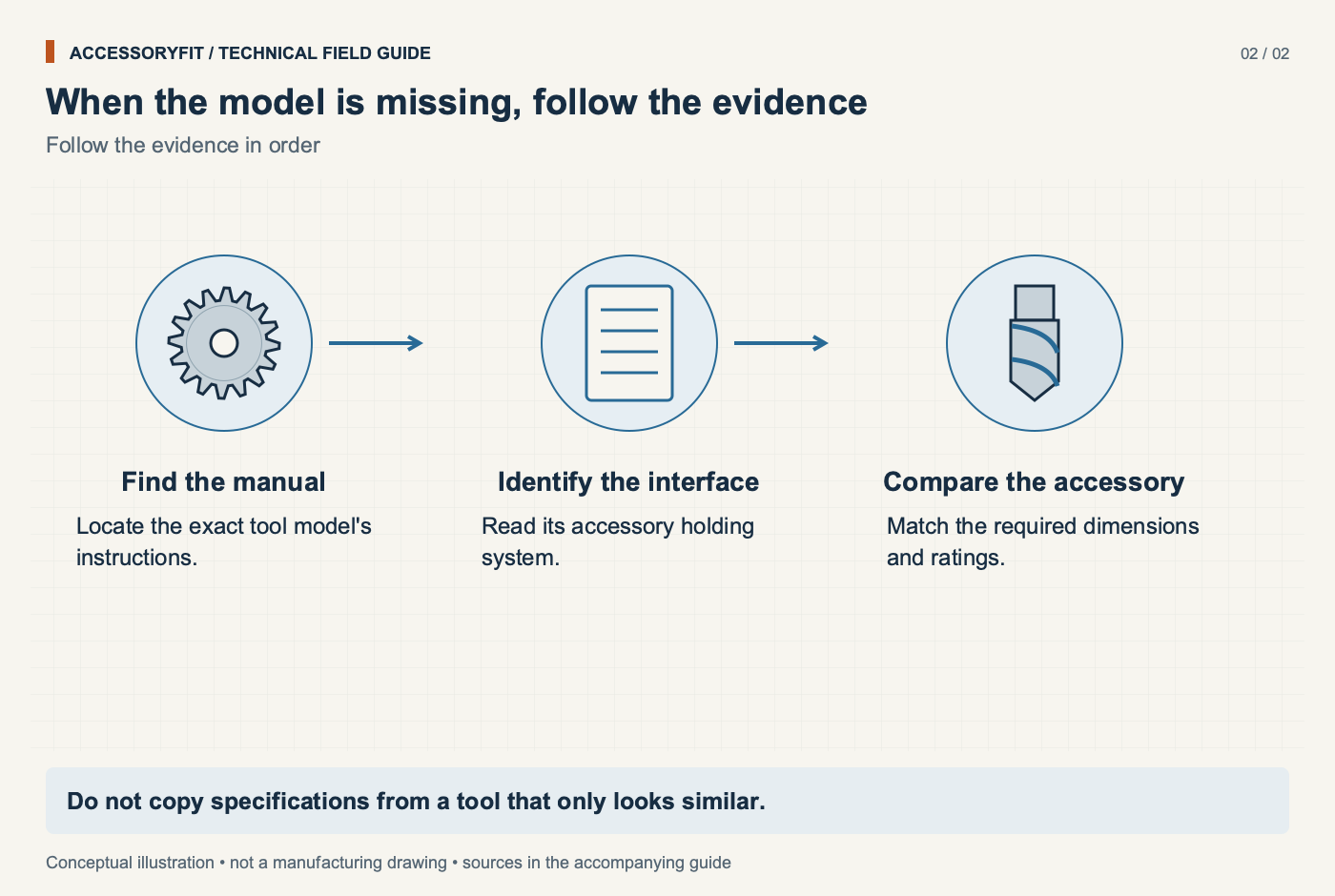
Find the same specs from the tool and its paperwork, then use the guide for that interface. These steps work for any brand.- Read the rating plate The plate on the motor housing usually gives the model number, voltage and no-load speed, and on saws and grinders often the blade or disc diameter. Note the no-load speed: any accessory you fit must be rated at or above it.
- Find the spec table in the manual The manual's specifications table states the arbor or bore, chuck capacity, collet sizes, pad size or spindle thread. DeWalt, Makita, Milwaukee and Bosch publish manuals online under the model number.
- Check the accessory you are replacing A saw blade or grinder wheel is marked with its diameter, bore and maximum speed, and a jigsaw blade shows its shank shape. These markings confirm what the tool was using.
- Open the matching compatibility guide Use the guide for that interface to see which accessories match the numbers you found, with US and metric sizes side by side and the limits manufacturers set.
When can a finder result mislead you?
A result can mislead when the tool in your hands is not exactly the one listed, or when fit is read as permission. Regional versions are the first trap, as the Makita example above shows. Match the full model number on the plate, because the finder lists each model exactly as its maker names it.
The second trap is the belief that a blade or disc that fits is safe to run. Makita states plainly that an accessory attaching to a tool does not make it safe; its rated speed and size must also suit the tool. A blade with the right arbor but a larger diameter than the saw is marked for, a wheel rated below the grinder's speed, or a StarlockMax blade forced onto a lower-class tool all fit or nearly fit, and all are ruled out by the makers. Battery packs follow the same logic: a pack from another platform is not a designated pack, and the tool battery recall data gives the background.
The third trap is assuming that tools of the same size take the same accessory. DeWalt's DWS780 accepts two different blade bores through its own adapter, and band saws of the same wheel size can need very different blade lengths. The finder shows what the maker states for one model; it does not stretch that answer to similar tools. For broader questions, the compatibility guides explain each interface, and the blade recommendation tool suggests a circular saw blade by material.
Questions readers ask
Where does the finder's data come from?
From each manufacturer's product pages, spec sheets and instruction manuals, recorded with the source and the date it was checked. Nothing in the finder comes from our own measurement or testing, and no model is rated or ranked.
Why does a spec I expected not appear?
The maker does not state it for that model in the documents the finder draws on, so it is left out rather than estimated. The tool's rating plate and manual are the next place to look.
Does the finder list specific blades or bits that fit?
No. It shows the interface specs that decide fit and links to the guides for that interface, which explain the matching sizes. Buyer guides compare individual products by published spec, and the blade selector suggests a circular saw blade type from your saw and material.
Does the finder cover European tools?
Partly. Six of the 61 models are listed for Europe or the UK, including a Bosch angle grinder and multi-tool, a Makita grinder and two Festool models. For other European tools, the compatibility guides give the metric sizes, such as a 30 mm saw bore or an M14 grinder thread.
Can I share a result?
Yes. Once you pick a model, the page address includes the tool type and model, so copying it opens the same result. The interactive tools page lists the other lookups on the site.
Where to go next
- Compatibility guidesEvery interface explained, with US and metric sizes.
- Circular saw blade selectorSuggests tooth count and grind from your saw and material.
- Saw bladesArbors, shanks and sizes for every kind of saw.
References 303 documents, 57 publishers
- Acme Tools
- Anglia Tool Centre (retailer)
- Axminster Tools
- BAER tools
- Benchmark Abrasives
- Bosch
- California DIR (Cal/OSHA)
- Carbatec
- CMT Orange Tools (C.M.T. Utensili)
- Crescent Electric Supply (retailer)
- DeWalt
- Dexis
- DGUV Institute for Occupational Safety and Health (IFA)
- Fein
- Festool
- FLEX (Chervon North America)
- Freud and Diablo
- GTSE (UK tool supplier)
- Hardwick & Sons
- HAZET
- Hemlock Hardware (Diablo listing)
- Hilti UK
- HomElectrical
- HookandLoop.com
- IGM Tools & Machinery
- ITS
- Klingspor
- Klium
- Laguna Tools
- Makita
- McMaster-Carr
- Milwaukee Tool
- Multitronic (retailer)
- Olson Saw
- OSHA
- Penn Tool Co
- PFERD
- Power Tool Centre (retailer)
- Ryobi
- Saint-Gobain Abrasives (Norton)
- SKIL
- Stanley Black & Decker (IRWIN, LENOX)
- Starrett
- Surface Prep
- Tanner Bolt & Nut
- The Power Tool Store (retailer)
- Timbecon
- Tool Nut
- ToolsToday
- United Abrasives / SAIT
- Weiler Abrasives
- WEN Products
- Whiteside Machine Co.
- Wikipedia
- Woodcraft
- Woodshop News
- Woodworker's Journal