
Interactive tool · Blade choice
Saw blade selector: pick your saw and cut, see the blade it needs
Pick your saw, then pick the cut. The selector returns the arbor or bore the blade must have, the tooth grind and hook angle suited to that cut, tooth-count examples where the makers' tables cover your blade size, the usual kerf widths and the fitting rules for that kind of saw. It covers handheld circular saws, US and European miter saws and table saws. Tooth counts come from maker examples for the common handheld, table and miter saw sizes; where no source covers your blade size, the selector says so and points you to the blade's own listing.
By AccessoryFit editors · Checked
How do you use the blade selector?
Choose the saw you own from the first menu and the job from the second; the result appears as soon as both are set. The saw menu lists US sidewinder, compact, worm-drive and larger circular saws, European metric circular and track saws, US and European miter saws, and US jobsite, cabinet-size and European table saws. The cut menu covers ripping solid wood, general and combination work, clean crosscuts, plywood and veneered sheet goods, melamine and double-sided laminate, aluminium or other non-ferrous metal, and mild steel such as studs, angle and sheet.
Pick the saw by its blade diameter and type, not its brand. A cordless saw and a corded saw that take the same blade diameter share the same row, and a European saw sold in the US with an inch blade belongs in the US row. If you are unsure which diameter and bore your model takes, the tool accessory lookup shows the figures its maker publishes, and your saw's rating plate and manual are the final word.
The page address updates with your choices, so you can bookmark a result or send it to someone and it will open on the same saw and cut. Changing either menu redraws the result straight away; nothing is stored and there is nothing to submit.
What does each part of the result mean?
The result is a short blade specification for your saw and cut, read from top to bottom in the order you would check a blade in a shop or online listing. The first gauge is the arbor or bore: the hole the blade must have to sit on your saw's spindle. US circular saws of the common sidewinder size take a 5/8 in hole, compact trim saws a 10 mm hole, worm-drive saws a diamond arbor, and European circular saws commonly 30 mm. Where a bore rests on one maker's documents, a small one source tag marks it.
The second gauge is the hook angle, the lean of each tooth into the cut. The third is the tooth count, shown either as manufacturer examples or as a plain statement that the sources do not cover your blade size. Under the gauges, the tooth grind paragraph names the tooth shape for the cut and what it does, and a table of named manufacturer blades appears when there are examples to show.
For table saws of the common size a kerf line follows, giving the slot width of full-kerf and thin-kerf blades. The list headed Check before you fit it holds the rules that saw makers set for that kind of saw, such as the blade speed rule and the direction the teeth must face. Last come links to the longer guides on grinds, arbors and blade problems.
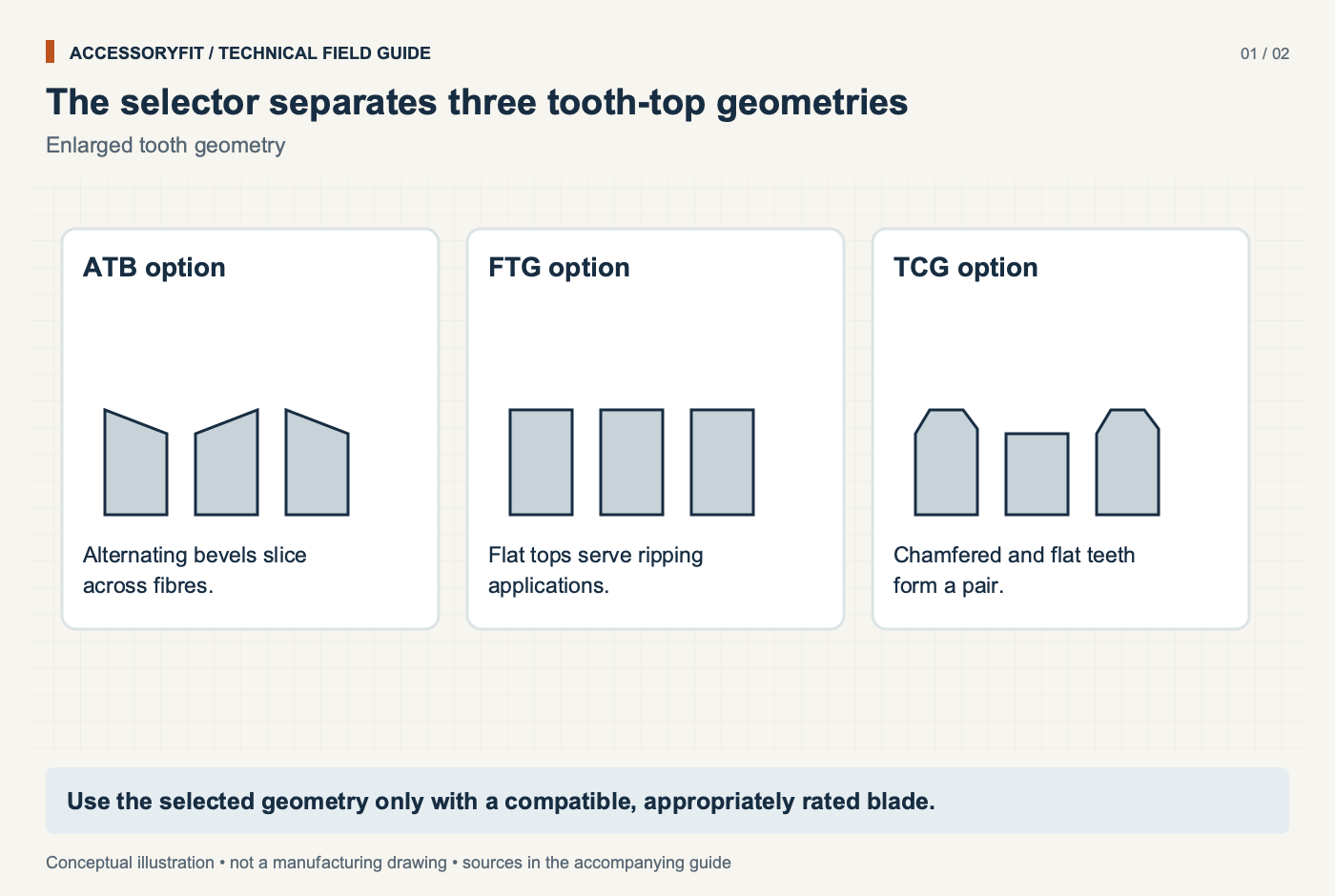
Which tooth grind suits each cut?
Flat-top teeth rip, alternate bevel teeth crosscut, steep alternate bevel teeth protect veneer, and triple chip teeth cut laminate and non-ferrous metal. FTG (Flat Top Grind) teeth are square across the top and cut fast along the grain. ATB (Alternate Top Bevel) teeth are bevelled left and right in turn so they slice wood fibres rather than chisel them, which is why crosscut and general-purpose blades use them.
Hi-ATB teeth take the bevel further, to about 30–40 degrees, for chip-free edges on veneered plywood and melamine. TCG (Triple Chip Grind) alternates a taller chamfered tooth with a flat raker, a shape that holds up in hard, abrasive or brittle material such as laminate, MDF, plastics and aluminium. A combination blade mixes the two main shapes in a repeating group of 4 ATB + 1 flat raker, with a deep gullet ahead of each raker, so one blade can rip and crosscut without a change.
Makers do not always label the same blade the same way. Freud lists its combination grind as ATB plus flat rakers, while Diablo lists its combination blade of the same size simply as ATB. Diablo also separates combination blades, meant to rip and crosscut, from general-purpose blades meant for most wood including plywood and melamine; that distinction comes from Diablo's own description. The table below sets out the grind, tooth count and hook that Freud and Diablo use for each task on their common table saw size.
| Task | Typical teeth | Grind | Hook angle | Manufacturer example |
|---|---|---|---|---|
| Ripping solid wood | 24 | FTG (Freud); ATB (Diablo) | +20 deg (Freud); +15 deg (Diablo) | Freud LU87R010; Diablo D1024X |
| General purpose | 40 | Hi-ATB (Freud); ATB (Diablo) | +13 deg (Freud); +15 deg (Diablo) | Freud LU72R010; Diablo D1040X |
| Combination (rip + crosscut) | 50 | ATB + flat raker (Freud COMB); listed as ATB (Diablo) | +10 deg (Freud); +15 deg (Diablo) | Freud LU84R011; Diablo D1050X |
| Crosscut / fine finish | 60 | Hi-ATB 38 deg (Freud LU73); ATB (Freud LU88, Diablo D1060S); Hi-ATB (Diablo D1060X) | +10 deg (LU73); +15 deg (LU88, D1060X); +7 deg (D1060S) | Freud LU73R010, LU88R010; Diablo D1060X, D1060S |
| Sliding miter / radial arm crosscut | 60 | ATB | -5 deg | Freud LU91R010 |
| Veneered plywood and melamine | 80 | Hi-ATB | +2 deg (Freud); +15 deg (Diablo) | Freud LU79R010, LU80R010; Diablo D1080X |
| Double-sided laminate / melamine | 80 | TCG | -3 deg | Freud LU97R010 |
Values come from each manufacturer's published specs. The tooth-count bands (24 rip, 40-50 general, 60-80 crosscut) agree with Rockler's guide. Hook angles vary by maker for the same task, so check the blade's own spec.
What hook angle should the blade have for your cut?
Use a positive hook for ripping, a low or neutral hook for clean crosscuts and veneer, and a negative hook on sliding miter saws and for laminate or metal. Positive hooks of about 10 to 22 degrees pull the blade into the wood for a fast feed; Freud's rip blade for the common table saw size sits at the high end. Neutral hooks of about 0 to 6 degrees give more control and less tear-out. Negative hooks of about -2 to -6 degrees lean the teeth back, which reduces grabbing and stops the blade climbing toward you on a sliding saw.
The hook gauge shows the range for your cut, but your saw's manual can be stricter. DeWalt tells owners of its sliding and non-sliding miter saws to use crosscut blades only and to avoid hooks over 7 degrees. Freud's sliding miter blades use a hook of -5 degrees, which Freud says keeps the blade from being too aggressive and pushes the work down toward the fence. Diablo, on the other hand, lists some positive-hook blades as suitable for miter and slide-miter saws. Where the saw maker and the blade maker disagree, the saw maker's limit is the one to follow.
| Hook type | Range | Effect | Typical use |
|---|---|---|---|
| Positive | +10 to +22 deg | Pulls blade into cut, fast feed | Ripping, table saws |
| Low / neutral | 0 to +6 deg | More control, less tear-out | Crosscuts, hardwoods, veneered sheet goods |
| Negative | -2 to -6 deg | Reduces grab and climbing | Sliding miter and radial arm saws, melamine, laminate, aluminium, plastics |
Ranges from Toolstoday. Rockler describes the same effects without giving full ranges.
How many teeth does the blade need, and why are some sizes blank?
Fewer teeth rip faster and more teeth crosscut cleaner, and the selector gives counts wherever makers' examples cover the blade size. For the common table saw diameter, a rip blade has as few as 24 teeth, a combination or general-purpose blade 40 to 50 teeth, and a crosscut blade 60 to 80 teeth. For miter saws, the counts come from the blade description tables in DeWalt's manuals, which cover the two US miter saw diameters side by side (table below).
Handheld saws have their own steps. On a 7-1/4 in sidewinder or worm-drive saw, makers fit 18 to 24 teeth for framing and fast cuts, 36 to 40 teeth for finish cuts, and Diablo and DeWalt both sell blades with 60 teeth for plywood, melamine and MDF. On a 6-1/2 in saw, and on the European circular and track saw row whose blades take a 20 mm bore, the usual steps are 24 / 40 / 60 teeth. On an 8-1/4 in circular saw the selector shows Diablo's steps of 24 / 40 / 60 teeth, tagged one source because no second maker's figures were read. The selector maps the lowest step to ripping and general work, the middle step to crosscuts, and the highest to plywood, veneer and laminate.
Some combinations still read See the blade's listing: the compact trim saw, the larger European circular saw with a 30 mm bore, the compact jobsite table saw and non-ferrous metal on a circular or table saw. No sourced count covers those, and the selector does not stretch one blade size's figures to another. The note under that gauge names only the two bench-saw diameters, but the handheld counts above are covered too. For those cases, read the tooth count off the blade maker's packaging or listing and compare it with the grind the selector names. The guide on ATB, FTG and TCG tooth grinds explains tooth count and gullet size in more depth.
| Application | 10 in (254 mm) teeth | 12 in (305 mm) teeth |
|---|---|---|
| General purpose (construction, thin kerf) | 32/40 | 40 |
| Fine crosscuts (construction) | 60 | 60 |
| Fine crosscuts (woodworking) | 80 | 80 |
| Non-ferrous metals (TCG only) | 80 | 96 |
From the Blade Descriptions tables in the DWS713 (10 in) and DWS780 (12 in) manuals.
| Blade diameter | Framing / rip | General / finish | Fine finish, plywood, melamine | Maker examples |
|---|---|---|---|---|
| 6-1/2 in (165 mm) | 24 | 40 | 60 | Diablo D0624A, D0641A, D0660A; DeWalt DWA261240 (40T) |
| 7-1/4 in (184 mm) | 18-24 | 36-40 | 60 | Diablo D0724A, D0740A, D0760A; DeWalt DWE575 manual (18/24/36), DWA271460 (60T) |
| 8-1/4 in (210 mm) | 24 | 40 | 60 | Diablo D0824X, D0840X, D0860X |
| 12 in (305 mm) | 30 | 44-60 | 80-100 | Freud LM72R012, LU84R012, LU85R012; Diablo D1244X, D1280X, D12100X |
8-1/4 in row is Diablo only. Metric conversions of 6-1/2 and 7-1/4 in are as printed by DeWalt; 8-1/4 in = 210 mm is a unit conversion. Counts are typical maker steps, not hard limits.
What does the selector show for mild steel?
For mild steel on a 7-1/4 in sidewinder or worm-drive saw, the selector shows 48 teeth, the count Diablo and Milwaukee both list for medium-gauge steel such as studs, angle iron, conduit and all-thread. Its note adds Diablo's thin-metal range of 56 to 70 teeth for roofing, siding and sheet. These are carbide or cermet blades made for ferrous metal, not wood blades.
For any other saw the steel result says that the sources list steel-cutting blades for that handheld size and for dry-cut metal saws only, and asks for a blade the saw's maker approves for steel. Dry-cut metal saw blades are larger, with a 1 in arbor, and Diablo and Milwaukee list blades with 72 teeth for them. On a miter saw, the steel cut falls outside the DeWalt blade tables the selector draws on, so it returns the miter saw rules instead of a blade. Check the saw's own manual before cutting steel at all; DeWalt's DWE575 manual, for example, says not to cut metal with that wood-cutting circular saw.
| Blade | Diameter | Teeth / grind | Arbor | Max RPM | Stated use |
|---|---|---|---|---|---|
| Diablo D0770F | 7-1/4 in | 70 TCG | 5/8 in | 8,000 | Thin metal: roofing, siding, sheet, studs; mild steel 12 ga or thinner |
| Diablo D0756F | 7-1/4 in | 56 TCG | 5/8 in | 5,800 | Studs, angle iron, flat bar, EMT (1/8 in max wall) |
| Diablo D0748CFA | 7-1/4 in | 48 TCG | 5/8 in | 8,000 | Steel studs, angle iron, EMT, all-thread; stainless |
| Milwaukee 48-40-4235 | 7-1/4 in | 48 ATB | 5/8 in | not listed | Steel, aluminum, strut, all-thread, angle iron |
| Diablo D1472CF | 14 in | 72 TCG | 1 in | 1,800 | Medium metal: tubing, plates, bars, rods |
| Diablo D1490CF | 14 in | 90 TCG | 1 in | 1,800 | Thin metal: studs and tubing 16 ga to 1/4 in wall |
| Milwaukee 48-40-4505 | 14 in | 72 | 1 in | not listed on Milwaukee page | Stainless, aluminum, steel, strut, all-thread |
Diablo figures from its product family listings. Milwaukee max RPM is not on the Milwaukee pages read.
Which bore does your saw need?
The blade's hole must match the saw's arbor in both size and shape, and US and European saws use different systems. US circular saws from the mid sizes up to the larger framing size take a 5/8 in round hole, with the compact trim size the exception at 10 mm. US miter saws take 5/8 in on the smaller size and 1 in on the larger, and US table saws take 5/8 in.
European tools work in metric. Track and plunge saws commonly use a 20 mm bore, larger circular saws 30 mm, and mitre and table saws 30 mm, on Bosch and Makita models alike. Some Makita models take one bore or another depending on the country version, so check the plate. The tables below list each diameter with its arbor; the guide on which blade fits your circular saw covers each size in more detail.
| Blade diameter | Arbor | Example blade max RPM (marked) | Example saw no-load RPM |
|---|---|---|---|
| 5-3/8 in | 10 mm | 12,000 (Diablo D0524X) | 3,600 (Milwaukee 2530) |
| 6-1/2 in (165 mm) | 5/8 in (15.9 mm); track saws 20 mm | 8,000 (Diablo D0624A); 10,000 (Diablo D0660A) | 3,700 (Makita XSS02Z) |
| 7-1/4 in (184 mm) | 5/8 in round; diamond on worm-drive saws | 8,000 (Diablo D0740A) | 5,800 (Makita 5007MG, Milwaukee 2732) |
| 8-1/4 in | 5/8 in | 8,000 (Diablo D0824X) | 6,300 (Milwaukee 2736 table saw) |
| 10 in (254 mm) | 5/8 in | 6,000 (Diablo D1040X) | 3,200 (Makita LS1019L); 4,600 (Makita LS1040) |
| 12 in (305 mm) | 1 in (25.4 mm) | 5,000 (Diablo D1244X) | 3,200 (Makita LS1219L) |
Max RPM values are for the named blades only; always read the marking on your blade. Exceptions exist: Diablo D0640X is a 6 in blade with a 1/2 in arbor for the Porter-Cable Saw Boss; Diablo D1632X 16-5/16 in uses 1 in. DeWalt's DWS780 12 in saw has a 5/8 in spindle and a 1 in blade adapter.
| Blade diameter | Bore | Example tool |
|---|---|---|
| 165 mm | 20 mm (some models 20 or 30 mm by country) | Makita SP6000J/XPS01Z track saws; Makita HS6601 |
| 185-190 mm | 30 mm (some models 20 or 30 mm) | Bosch GKS 190; Makita HS7611 |
| 216 mm | 30 mm | Makita LS0815FL mitre saw |
| 235 mm | 30 mm | Makita 5903R |
| 254 mm | 30 mm | Bosch GTS 254 table saw |
| 260 mm | 30 mm | Makita LS1019L, LS1040 (EU versions), MLT100N, 2704N |
| 305 mm | 30 mm | Bosch GCM 12 SDE; Makita LS1219 |
Makita's EU 10-inch-class mitre and table saws take 260 mm blades with a 30 mm bore, while the US versions of the same model numbers take 10 in (255 mm) blades with a 5/8 in hole. 216 mm and 235 mm rows rest on one Makita source each.
Should you choose a full-kerf or thin-kerf blade?
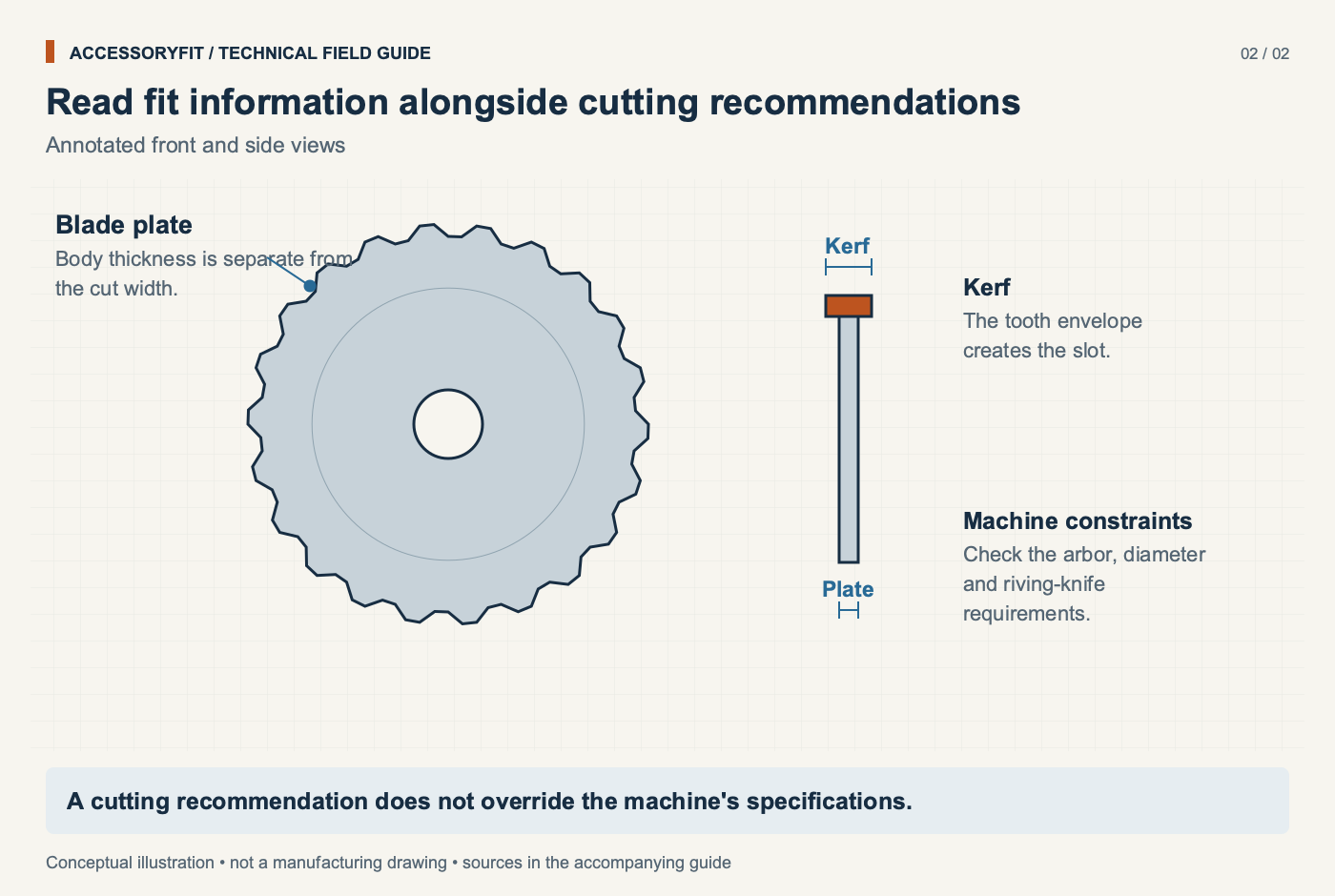
Choose thin kerf on lower-powered saws where the maker allows it, and full kerf on saws with the power to drive it. Full-kerf blades cut a slot of about 1/8 in, while published thin-kerf examples from Freud and Diablo run .087-.098 in. A thinner kerf removes less wood, so a cordless or jobsite saw labours less.
A common belief is that thin kerf is an upgrade for any table saw. Rockler says it brings no significant advantage on contractor or cabinet saws, and Rockler ties full kerf to saws of about 1-1/2 HP and up. The bigger issue is the riving knife. The knife must be thinner than the kerf and thicker than the blade body, and DeWalt's manual for its DWE7491 states narrow limits for both; the selector repeats that note when you pick the US table saw. A thin-kerf blade can bind on a riving knife made for full-kerf blades, and a full-kerf blade with a thick plate may not pass a knife sized for thin kerf.
A knife that fits does not remove the risk on its own. AccessoryFit's estimate from CPSC's NEISS emergency department data for 2024 is that about 33,000 injuries involving bench or table saws were treated in US emergency departments that year; that count covers every table saw injury, not only blade contact. For blade contact alone, the analysis behind CPSC's 2023 table saw proposal, which the agency withdrew in September 2025, found no statistically significant change from 2010 to 2021 despite the move to modular guards and riving knives. Matching the blade to the knife keeps that safeguard on the saw, alongside the guard.
When can the selector mislead you?
The selector gives the typical blade for a saw class and a cut, so it can mislead when your saw, your blade or your material sits outside the typical case. Five situations are worth knowing.
First, your manual can override the result. The hook gauge on a miter saw shows the range for the cut, but DeWalt's limit of 7 degrees rules out the positive-hook end of that range on its saws, and it rules out rip and combination blades entirely. Choosing Ripping on a miter saw returns a message to rip on another saw for that reason.
Second, the kerf line comes from table saw blades. The widths it quotes are published for blades of the common table saw size, so the line appears only for those saws; for handheld circular saws, read the kerf on your own blade's listing.
Third, regional versions differ. Makita's EU versions of some mitre and table saws take a larger metric blade with a 30 mm bore, while the US versions with the same model number take inch blades with a 5/8 in hole. Pick the row that matches the blade your saw is marked for, not the country you live in.
Fourth, blade makers disagree on hook for the same task. Freud's rip blade and Diablo's rip blade of the same size differ by several degrees, and so do their plywood blades; the table above shows both. The selector's range covers the spread, but a single named blade may sit anywhere in it.
Fifth, a matching blade is not a guaranteed clean cut. Burning, chatter and chip-out also come from pitch build-up, a dull edge, a fence toed in toward the blade or a misaligned riving knife. If a correct blade still scorches the wood, the page on why saw blades burn wood works through the other causes, and a dirty blade is cleaned before it is resharpened.
What should you do after reading the result?
Take the bore, grind, hook and, where shown, tooth count to the blade listing, and confirm each one before buying. Then check the blade's marked maximum speed against the no-load speed on your saw's plate, and check its diameter against the diameter marked on the saw. Those two numbers are printed on the blade itself and on the tool, not in the selector.
For sheet goods, the plywood blade picks compare named blades by their published tooth count, grind and kerf. For other saws and blade types, the saw blades by tool hub groups the guides for each kind of saw, and the free accessory tools page lists the other lookups on the site. How the site gathers and checks its figures is set out on the methodology page.
Questions readers ask
Can I use a table saw blade on my miter saw?
Only if it is a crosscut blade within your miter saw's limits. DeWalt rules out rip and combination blades on its miter saws and limits hook to 7 degrees, so a typical table saw combination blade does not qualify even when the bore matches.
Why does the selector show no tooth count for some saws?
It shows counts only where maker examples cover the blade size: the common table and miter saw sizes, and 6-1/2 in, 7-1/4 in and 8-1/4 in circular saws. For the compact trim saw, the larger European circular saw, the compact jobsite table saw and non-ferrous cuts on circular saws, it names the grind and hook and leaves the count to the blade's own listing.
Does the selector pick a specific blade brand?
No. It describes the blade type your saw and cut call for, using Freud, Diablo and DeWalt figures as examples. Nothing in it is rated or ranked, and no blade was tested by us.
Will a round-hole blade fit a worm-drive saw?
Not safely. Worm-drive saws use a diamond arbor, so the blade needs its diamond knockout removed, and DeWalt says never to install the blade with the knockout still in place. A blade whose hole shape does not match runs off-centre.
Which cut should I pick for MDF?
Pick Melamine and double-sided laminate. Triple chip grind is the shape blade makers use for laminate, melamine, MDF and plastics, and the result for that cut names it with a negative hook.
Where to go next
- How to choose a circular saw bladeTooth count, grind and kerf explained in full.
- Circular saw arbor sizesEvery common diameter with its arbor or bore.
- Miter saw blade sizesUS and EU miter saw blades, arbors and limits.
References 118 documents, 19 publishers
- BG BAU - Berufsgenossenschaft der Bauwirtschaft (Germany)
- Bosch
- DeWalt
- Freud and Diablo
- Grizzly Industrial
- Hand (N Y)
- Health and Safety Executive (UK)
- James Hardie
- Journal of Clinical Orthopaedics and Trauma
- Makita
- Mallory Safety and Supply (retailer)
- Milwaukee Tool
- NIOSH
- OSHA
- Rockler
- SKIL
- ToolsToday
- U.S. Consumer Product Safety Commission
- Woodcraft