
Fit guide · Jigsaws
Jigsaw blade shank types: T-shank vs U-shank and which saws take each
A jigsaw blade fits only a saw whose blade clamp is made for its shank, and the two shank styles sold today, T-shank and U-shank, do not swap. Current saws from Bosch, DeWalt, Makita and Milwaukee list T-shank blades, which Bosch created and which became the industry standard. U-shank blades are still made, but each pack is labelled for U-shank saws only. Bosch's own figure for T-shank coverage is over 90% of current jigsaw makes and models (Bosch claim). Check the saw's manual, then match the shank letter on the blade.
By AccessoryFit editors · Checked
On this page
- What is a jigsaw blade shank?
- Which shank does your jigsaw take?
- How do you tell a T-shank blade from a U-shank blade on the shelf?
- Can a U-shank blade go in a T-shank jigsaw?
- Does a universal shank blade fit every jigsaw?
- Once the shank matches, what else decides whether a blade suits the job?
- When does a blade with the right shank still fail?
- Do US and European jigsaw blades differ?
- Where do you go next?
What is a jigsaw blade shank?
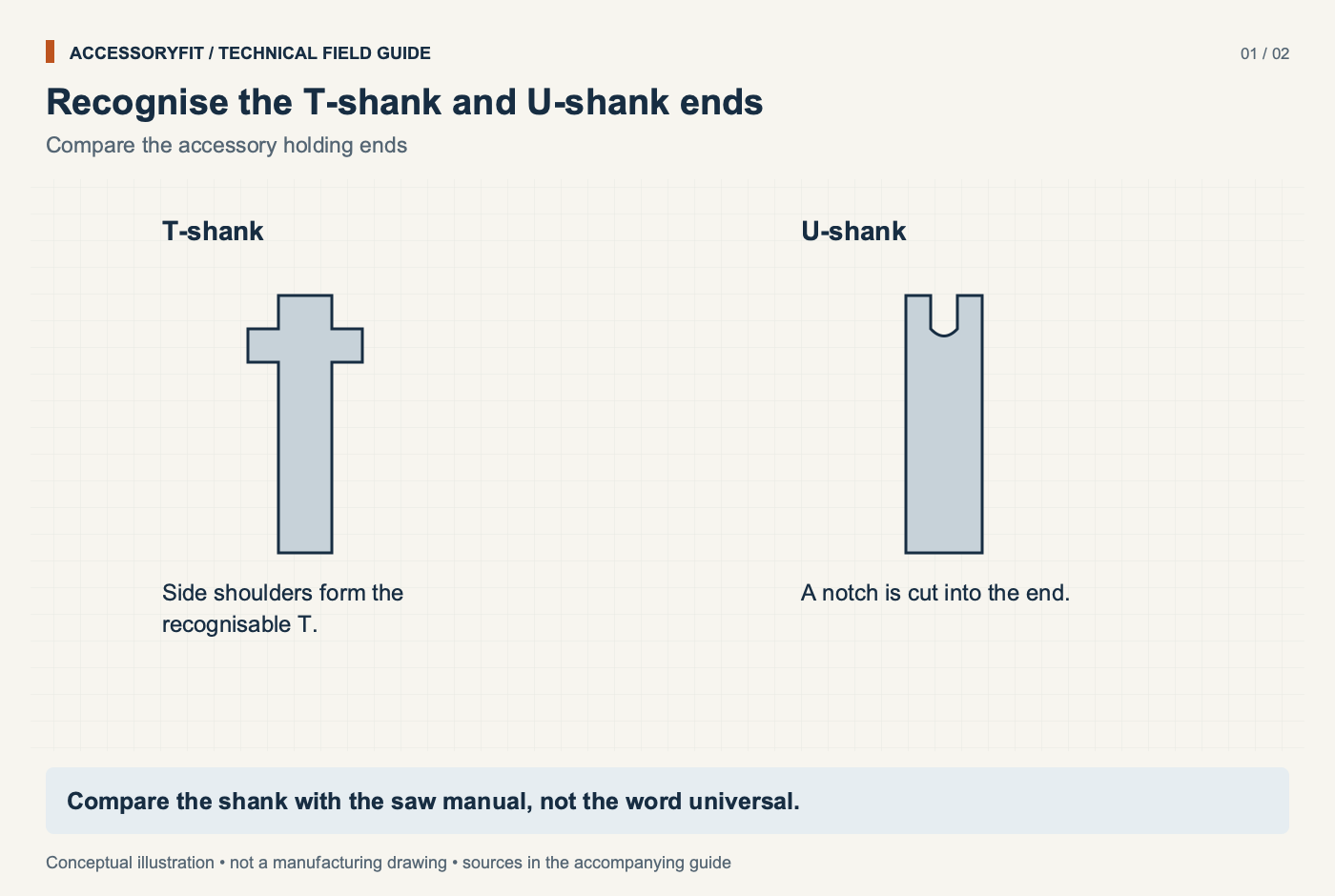
The shank is the top end of a jigsaw blade, the part without teeth that the saw's blade clamp grips, and its shape decides which saws the blade can go in. Everything below the shank (tooth count, length, blade material) decides what the blade cuts, but none of it matters if the shank and the clamp are made for different systems.
Two shank styles are on sale today. The T-shank is the one Bosch developed to replace its earlier double-tang blades, and Woodworker's Journal and the Wikipedia article on the tool both describe it as the industry-standard type. The U-shank is the older open style that some saws still use; Bosch and Lenox continue to make blades for it, often as a U version of a blade that also exists with a T-shank.
The names change across the Atlantic. Bosch's European accessory catalogue files T-shank blades under the heading single lug shank and U-shank blades under universal shank. A UK or German buyer reading that catalogue is looking at the same two systems a US buyer sees on a Bosch US pack, just under different labels. The table summarises both.
| Shank | Other names | What it fits | Notes |
|---|---|---|---|
| T-shank | Single lug shank (Bosch EU catalogue) | T-shank jigsaws only | Created by Bosch; industry-standard type; Bosch says it fits over 90% of current jigsaw models |
| U-shank | Universal shank (Bosch EU catalogue) | U-shank jigsaws only | Still sold by Bosch and Lenox, often as a U-version of a T-shank blade (for example Lenox C450T and C450U) |
Bosch's word 'universal' here means U-shank, not 'fits every saw'. Older proprietary shanks (for example some Makita and Festool tang styles) were not covered by any source fetched.
Which shank does your jigsaw take?
Current jigsaws from the major US and European brands take T-shank blades, and the safest confirmation is the line in the saw's own manual or specification sheet. DeWalt's DCS334 manual says plainly that the saw uses only T-shank blades, and the Bosch, Makita and Milwaukee models in the AccessoryFit tool database all list a T-shank blade mount.
The table below collects what each maker publishes for the jigsaws on file. Stroke length is included because it is the other figure makers print beside the blade mount; where a maker does not state a value, the table shows that instead of guessing. The same records power the look up what fits your tool search, where a model can be checked against blades, bits and discs in one place.
If your saw is not listed, the blade-change section of its manual is the place to look. A saw built for U-shank blades will say so in that section, and its packaging or nameplate often carries the same wording. Saws that use neither style, such as some older models with their own maker-specific tang, were not covered by any manufacturer source this site has fetched, so this page does not describe them; the manual for that saw is the only reliable guide.
| Tool | Blade mount | Stroke |
|---|---|---|
| Bosch JS470E | T-shank | 1 in |
| Bosch JS572EK | T-shank | 1 in |
| DeWalt DCS334B | T-shank | not stated |
| Makita 4351FCT | T-shank one source | 1 in |
| Milwaukee 2737-20 | T-shank | 1 in one source |
Values marked one source appear in a single manufacturer document; check the tool's manual or rating plate before buying.
How do you tell a T-shank blade from a U-shank blade on the shelf?
The quickest check is the letter in the blade's part code and the fit line on the pack, because both Bosch and Lenox mark the shank there. Bosch part codes start with the shank letter: T 101 BR and T 118 A are T-shank blades, while U 234 X, U111DF and U118A are U-shank blades. Lenox puts the letter at the end, so C450T is the T-shank version and C450U the U-shank version of the same wood blade.
The second check is the fit statement. Bosch's T-shank packs and product pages say they fit all T-shank jigsaws, and its U-shank packs say they fit all U-shank jig saws. Neither claims to fit both, and no manufacturer source on file sells a blade that does.
A third clue is how the blade is changed. T-shank blades lock into the tool-free quick-change clamps found on most modern jigsaws, while U-shank blades belong to older saws and usually need a tool to change. A saw that needs a tool to swap blades is therefore worth checking for a U-shank clamp, though its manual remains the final word.
Lenox's catalogue also shows how little else changes between the two versions. Its C450T and C450U list the same tooth count, length, width and thickness; only the shank differs. That is useful when a U-shank saw owner wants the same cut a T-shank blade gives: the matching U code, where one exists, is the same blade with a different top.
| Code | Shank | TPI | Length x width x thickness (in) | Metric (mm) | Application |
|---|---|---|---|---|---|
| C450T | T | 10 | 4 x 5/16 x .058 | 101.6 x 7.9 x 1.5 | Soft wood 3/16-1-1/4 in |
| C450U | U | 10 | 4 x 5/16 x .058 | 101.6 x 7.9 x 1.5 | Soft wood 3/16-1-1/4 in |
| C450DT | T | 10 | 4 x 5/16 x .058 | 101.6 x 7.9 x 1.5 | Down cutting, soft wood |
| B314T | T | 14 | 3-5/8 x 3/8 x .037 | 92.2 x 9.5 x 0.9 | Metal > 3/32 in |
| B318T | T | 18 | 3-5/8 x 3/8 x .037 | 92.2 x 9.5 x 0.9 | Metal 1/16-1/4 in |
| B324T | T | 24 | 3-5/8 x 3/8 x .037 | 92.2 x 9.5 x 0.9 | Metal < 1/8 in |
| B406T | T | 6 | 4 x 3/8 x .050 | 101.6 x 9.5 x 1.3 | General purpose 5/16-1-3/4 in |
| G300T | T | Grit | 3-1/2 x 3/8 x .032 | 88.9 x 9.5 x .81 | Ceramic tile, fiberglass, brick 3/64-5/8 in |
Lenox wood blades are thicker (.058 in) than its metal blades (.037 in).
Can a U-shank blade go in a T-shank jigsaw?
No. A T-shank jigsaw takes T-shank blades only, and a U-shank blade is labelled for U-shank saws only, so neither blade belongs in the other saw's clamp. A common belief is that the two are close enough to swap; the manufacturer evidence says otherwise. DeWalt restricts its DCS334 to T-shank blades, Bosch labels every blade for one shank, and Lenox sells separate T and U versions of the same blade, which it would have no reason to do if one fitted both.
Adapters that let one shank style sit in the other clamp are not mentioned in any manufacturer source on file, and no jigsaw manual on file approves one. The practical answer for a mismatched blade is to return it and buy the version with the right shank.
The reverse case matters as much. Owners of older U-shank saws who borrow blades from a newer T-shank kit hit the same problem in the other direction, and the fix is the same: read the shank letter before opening the pack.
Does a universal shank blade fit every jigsaw?
No. In Bosch's European catalogue, universal shank is simply the name for the U-shank, and the T-shank is called the single lug shank. A blade sold as universal therefore fits U-shank saws, not every saw on the market.
The confusion is easy to make because the word universal does mean cross-brand fit on reciprocating saw blades, where most saws share one shank. Jigsaws never settled on a single shared shank in the same way; they converged on the T-shank in practice while U-shank saws stayed in use. The reciprocating side is covered in the guide to reciprocating saw blade shank fit, which explains why the word means something different there.
When a listing or pack uses the word universal for a jigsaw blade, look for the shank letter in the part code or the fit line on the pack. Those two markings settle the question; the marketing word does not.
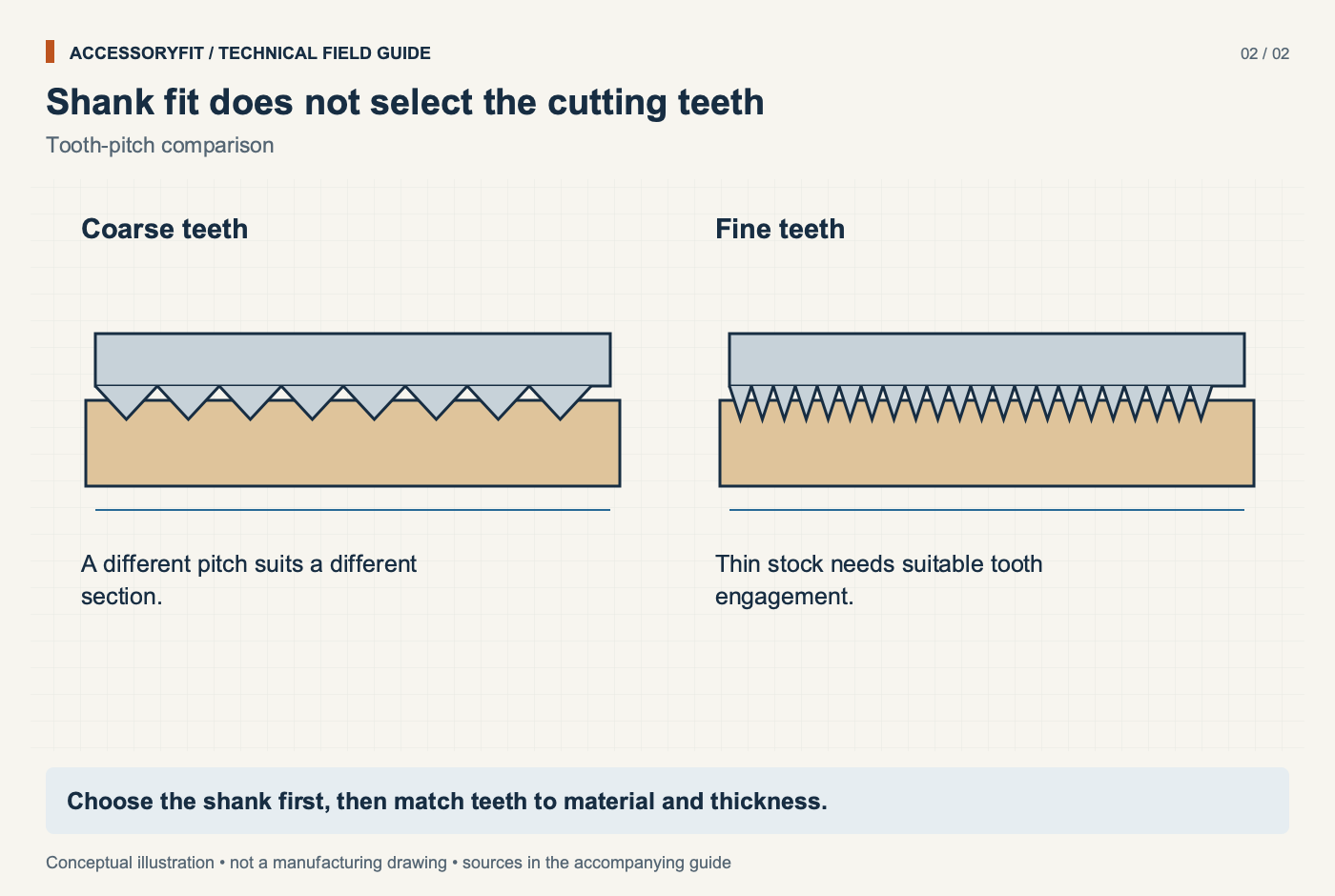
Once the shank matches, what else decides whether a blade suits the job?
Blade length, tooth count and blade material decide whether a correctly shanked blade will cut the material in front of you. Most jigsaw blades in the Bosch and Lenox ranges are 2-3/4 to 5-1/4 in (70 to 133 mm) long, and Lenox sizes the minimum length as material thickness + 2 to 2-3/4 in, depending on the cut. A blade that is too short for the stock cannot finish the cut, however well it sits in the clamp.
Tooth count follows the material. General wood blades run about 6–10 TPI, while metal blades run about 14–36 TPI, finer for thinner sheet. Lenox's rule of thumb is to keep 2–3 teeth in the material at all times. Higher tooth counts give a smoother but slower cut, so more teeth is not automatically better.
Material matters most where the shank itself is under stress. Bosch recommends flexible bi-metal blades where there is a risk of the blade breaking at the shank, and Bosch's catalogue says bi-metal blades last about 2x HSS, about 10x HCS. The full selection process for wood, metal, laminate and tile is set out in the guide on how to pick a jigsaw blade, and the shortlist of jigsaw blades for metal applies these figures to specific T-shank products.
When does a blade with the right shank still fail?
A blade with the correct shank still fails when its length, tooth count or the saw's settings do not suit the material. The cases the manufacturer sources on this page describe are these:
- Blade too short for the stock. Lenox's length rule adds a margin to the material thickness; a blade shorter than that cannot clear the cut.
- Orbital action on metal or hardwood. DeWalt's DCS334 manual says metal and hardwoods should never be cut with orbital action; its orbital settings are for soft materials such as wood and plastic.
- Forcing the saw. Pushing harder than the blade can cut loads the blade and the shank; the manufacturer instruction is to let the blade cut at its own speed.
- Wrong speed for the material. Lower speeds suit plastics, tile, laminate, hard metals and cast iron; higher speeds suit wood and soft metals.
- Thin sheet left unsupported. Clamping wood under thin sheet metal stops it vibrating and tearing.
- An older saw with its own shank. If the saw is neither T-shank nor U-shank, only its maker's blades or manual can confirm fit.
Several of these show up as blades snapping near the top. Where that happens repeatedly, the bi-metal advice above is the manufacturer-stated remedy.
| Setting | Action | Use |
|---|---|---|
| 0 | Straight | Metal and hardwood (never cut these in orbital action); flush-cut blade at 0 or 1 |
| 1-3 | Orbital, more aggressive as number rises | Soft materials such as wood and plastic; faster but less smooth cut |
Settings and their numbering vary by saw; check the saw's manual.
Do US and European jigsaw blades differ?
The shank systems are the same on both sides of the Atlantic, so a T-shank blade bought in Europe fits a T-shank saw bought in the US. What differs is the labelling. Bosch's European catalogue uses single lug and universal instead of T-shank and U-shank, and Bosch's European product pages give tooth spacing in millimetres rather than teeth per inch, so a T 118 A appears with a spacing figure where a US pack would print a TPI number.
Lengths are printed in both units on Lenox packaging, and the common range above is given both ways. European buyers will mostly meet Bosch codes such as T 101 BR and T 144 D; US buyers will see the same codes on Bosch packs, plus Lenox codes with the shank letter at the end. The shank letter rule works in both markets.
How do you check jigsaw blade fit on a saw not listed here?
Four checks confirm whether a blade suits a jigsaw that is not in the table above. They use the saw's manual and the markings on the blade pack.
- Disconnect power. Unplug the saw or remove its battery before opening the blade clamp.
- Find the shank type in the manual. The specifications or blade-change section names T-shank or U-shank; older saws may name their own blade type.
- Match the shank letter. On Bosch blades the code starts with T or U; on Lenox blades it ends with T or U. The pack's fit line should name the same shank as the manual.
- Check length and teeth against the work. Make sure the blade is long enough for the material thickness and has a tooth count suited to the material, then set the orbital and speed controls as the manual describes.
Where do you go next?
With the shank settled, the next decision is the blade itself. Readers cutting sheet steel or aluminium can go straight to the metal-cutting shortlist linked above, and readers moving to a heavier saw for demolition will find that the shortlist of demolition recip blades uses a different shank system altogether.
Every blade family on the site, from circular saw blades to band saw blades, is grouped under saw blades by tool, and fit rules for drills, grinders, sanders and routers sit together in the section on what fits which tool.
Questions readers ask
Do T-shank blades come in different lengths?
Yes. The shank is the same whatever the length, and most Bosch and Lenox blades fall between 2-3/4 to 5-1/4 in (70 to 133 mm). Bosch also makes longer specialist blades, such as the T 1044 DP for thick construction timber.
Why does Bosch still sell U-shank blades?
U-shank saws are still in use, and Bosch sells U-shank blades labelled to fit all U-shank jig saws, including the U 234 X Progressor. Lenox also lists U versions of several T-shank blades.
Do I need a tool to change a T-shank blade?
Not on most modern saws. T-shank blades lock into the tool-free quick-change clamps that most current jigsaws have, while U-shank blades are found on older saws and usually need a tool to change.
Do DeWalt jigsaws take Bosch blades?
Yes, if the blade is a T-shank. DeWalt's DCS334 manual specifies T-shank blades, and Bosch labels its T-shank blades as fitting all T-shank jigsaws. Brand does not decide fit; the shank does.
What does the T or U at the end of a Lenox code mean?
It is the shank. Lenox C450T is the T-shank version and C450U the U-shank version of the same wood blade, with matching tooth count and dimensions.
Can I cut metal with any T-shank blade?
No. The shank only decides fit. Metal needs a metal blade, typically 14–36 TPI, and DeWalt says metal should be cut with orbital action switched off.
Where to go next
- How to choose a jigsaw bladeTPI, length and material once the shank fits.
- Jigsaw blades for metalT-shank blades for sheet and bar.
- Reciprocating saw blade shankThe cross-brand shank on recip saws.
References 47 documents, 15 publishers
- BG BAU - Berufsgenossenschaft der Bauwirtschaft (Germany): Baustellenkreissaegen, Handkreissaegen - Baustein B 265
- Bosch: T 101 BR Clean for Wood Jigsaw Blade; T 118 A Basic for Metal Jigsaw Blade; U-Shank Jig Saw Blades Pro for Wood; U-Shank Jig Saw Blades Basic for Metal; U 234 X Progressor for Wood Jigsaw Blades; U-Shank Jig Saw Blades Pro for Metal; T-Shank Jig Saw Blades Pro for All Purpose; Bosch Accessories catalogue: Jigsawing, sabre sawing, multi-cutters, holesawing (1619A00Y1X, GB edition, 2016); T-Shank Jig Saw Blade Sets; T-Shank Jig Saw Blades for Wood; T-Shank Jig Saw Blades Pro for Plastic (set 43925); JS470E 7.0 Amp Top-Handle Jig Saw product page; JS470E/JS470EB operating/safety instructions 2610051979; JS572EK Top-Handle Jig Saw product page; JS572E/JS572EB operating/safety instructions 2610051980; 1617/1618 router operating/safety instructions (2610051825)
- DeWalt: DCS334/DCS335 20V MAX cordless jig saw instruction manual (N577652); DCS334B 20V MAX* XR Cordless Jig Saw product page; DWE575 circular saw instruction manual (N786997)
- Freud and Diablo: Get the most out of your Freud bits by routing at ideal feed rates and speeds
- Hand (N Y): Traumatic Finger Amputations: Epidemiology and Mechanism of Injury, 2010-2019; Trends in Upper Extremity Saw Injuries From 2003 to 2022
- Health and Safety Executive (UK): Circular saw benches - Safe working practices, Woodworking Information Sheet No 16 (Revision 2)
- Journal of Clinical Orthopaedics and Trauma: Patients admitted for treatment of traumatic finger amputations: Characteristics, causes, and prevention
- Makita: 4351FCT Barrel Grip Jig Saw, with L.E.D. Light product page; 4351T/4351CT/4351FCT instruction manual; 9557PB angle grinder instruction manual; 5007F 7-1/4 in circular saw instruction manual
- Milwaukee Tool: 2737-20 M18 FUEL D-Handle Jig Saw product page; Operator's manual 58-14-2745d4 (Cat. No. 2737-20); M18 FUEL oscillating multi-tool 2836-20 operator's manual (58-14-0217d1)
- OSHA: 29 CFR 1910.215 Abrasive wheel machinery; 29 CFR 1910.243 Guarding of portable powered tools; 29 CFR 1926.303 Abrasive wheels and tools; 29 CFR 1926.300 General requirements (Tools, hand and power); 29 CFR 1926.304 Woodworking tools
- Stanley Black & Decker (IRWIN, LENOX): LENOX Tool Catalog 2024: Power Tool Accessories, Hand Tools
- ToolsToday: Jigsaw Blades - Not So Scary
- U.S. Consumer Product Safety Commission: Safety Standard Addressing Blade-Contact Injuries on Table Saws: Supplemental Notice of Proposed Rulemaking (November 1, 2023); The 2017 NEISS Table Saw Special Study (staff briefing package, including Table Saw Blade-Contact Injuries Special Study Report, 2017); Proposed Rule: Safety Standard Addressing Blade-Contact Injuries on Table Saws (staff briefing package, January 17, 2017); Injuries Associated with Stationary Power Saws, 2001; 2019 NEISS Coding Manual; Withdrawal of Proposed Regulatory Actions (September 29, 2025)
- Wikipedia: Jigsaw (tool)
- Woodworker's Journal: Bosch Jigsaws, Then and Now (Chris Marshall, 2010)
Accessed .