
Fit guide · Table saws
Table saw blade arbor size: bores, speed ratings and dado limits
US table saws that take 10 in blades use a 5/8 in arbor, and so do compact 8-1/4 in jobsite saws. Blades of the next size up, 12 in, have a 1 in bore. European table saws such as Bosch's GTS 254 and Makita's 2704N use a 30 mm bore. A blade fits only if its bore, diameter and marked speed all suit the saw's manual, and a dado stack must also stay inside the saw's width and diameter limits.
By AccessoryFit editors · Checked
On this page
- What is a table saw arbor?
- What arbor size do table saw blades use?
- How do European table saw bores compare with US arbors?
- Can you use a reducer ring or spacer on a table saw?
- Is a blade's speed rating high enough for your table saw?
- Does every blade with the right bore work with the riving knife?
- Which dado stacks fit a jobsite table saw?
- Which way does a table saw blade face?
- When does a table saw blade not fit?
- What else should you compare between table saw blades?
What is a table saw arbor?
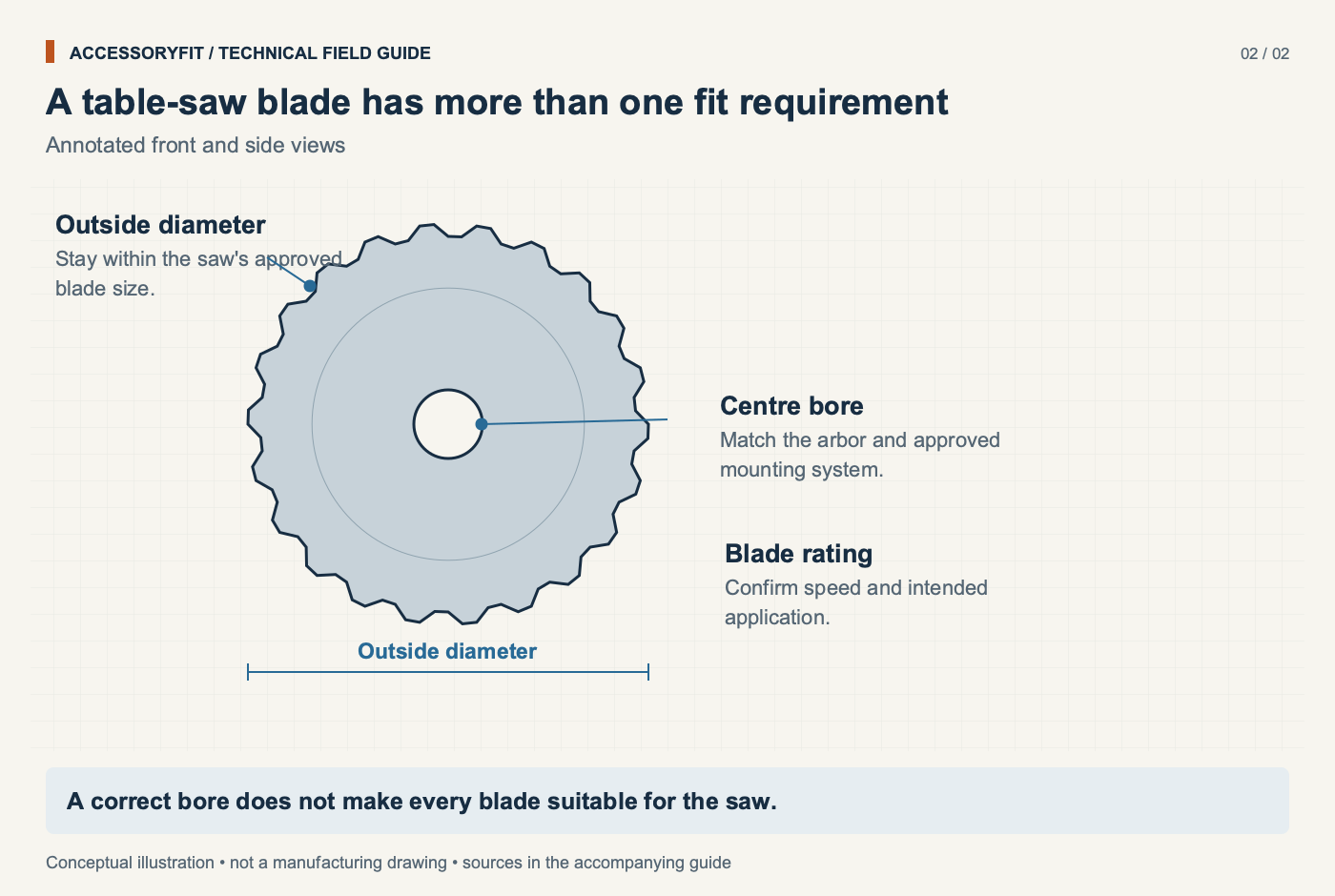
A table saw's arbor is the threaded spindle that carries the blade, or a dado stack, between the inner flange and the arbor nut. The blade's centre hole, its bore, must match the arbor's diameter, and the saw's manual also sets limits on blade diameter, speed rating and, for dado work, stack width. A blade that slides onto the arbor has passed only the first of those checks.
On a table saw the blade sits below the table and rises through a slot in the throat plate, so blade diameter also decides whether the guard, riving knife and insert work as designed. Manuals therefore state the permitted diameter precisely: Makita's 2705X1 accepts blades from 250–255 mm, while DeWalt's DWE7491 manual gives one blade diameter only. A lower limit exists for a reason: in the UK Health and Safety Executive's 2022 guidance on circular saw benches, a blade much smaller than the saw's maximum runs at too low a rim speed, cuts poorly and raises kickback risk, and HSE asks for the smallest safe diameter to be marked on the machine. HSE puts that floor at about 60% of the largest blade diameter the saw accepts.
Arbor fit rules for handheld saws differ in detail, with diamond knockouts and track-saw bores, and are covered separately under circular saw arbor sizes.
What arbor size do table saw blades use?
In the US, 10 in table saw blades use a 5/8 in arbor. DeWalt's DWE7491 manual, Makita's 2705X1 manual, Diablo's D1040X specifications and Freud's LU84R011 specifications all give that bore. Compact jobsite saws that take 8-1/4 in blades, such as the Milwaukee 2736-20, use the same 5/8 in arbor, so the two most common table saw blade sizes share one hole.
Blades of the 12 in size are different: Diablo, Freud and DeWalt list a 1 in bore for them. On the machine side, the one maker source on file is Grizzly: its manual for the G0605X and G0606X cabinet saws of that size gives a 1 in bore, and a manual update says later units have a one-piece arbor that no longer accepts blades with the smaller 5/8 in hole. Grizzly's own G0605X product page disagrees, listing both 5/8 in and 1 in as arbor sizes, which suggests older and newer units differ. No Powermatic, SawStop or Delta arbor specification for this size could be read, so owners of a large cabinet saw should read the arbor size from their own manual, and from the saw itself if it may be an older unit.
The table below collects the bore, speed and blade rules published for specific saws and blades.
| Saw / blade size | Bore | Saw no-load RPM | Blade speed rule |
|---|---|---|---|
| 8-1/4 in (Milwaukee 2736) | 5/8 in | 6,300 | Blade max RPM must be at or above saw speed |
| 10 in (DeWalt DWE7491) | 5/8 in (16 mm) | not stated in source read | Blades rated 5,000 RPM or more |
| 10 in (Makita 2705X1) | 5/8 in (15.88 mm) | 4,800 | Blades 250-255 mm diameter |
| 12 in blades (Diablo D1244X, Freud LU79R012) | 1 in (25.4 mm) | n/a | Diablo D1244X marked 5,000 RPM max |
| 254 mm EU (Bosch GTS 254) | 30 mm | 4,300 | n/a |
| 260 mm EU (Makita 2704N, MLT100N) | 30 mm | not recorded | n/a |
Always follow the speed, diameter and bore limits printed in your own saw's manual.
| Tool | Blade diameter | Arbor | No-load speed |
|---|---|---|---|
| Bosch 4100XC-10 | 10 in | 5/8 in one source | 3650 rpm |
| DeWalt DWE7491RS | 10 in | 5/8 in one source | 4800 rpm |
| Milwaukee 2736-20 | 8-1/4 in | 5/8 in | 6300 rpm |
Values marked one source appear in a single manufacturer document; check the tool's manual or rating plate before buying.
How do European table saw bores compare with US arbors?
European table saws use metric blades with a 30 mm bore, larger than the US 5/8 in arbor, so the two are not interchangeable without a maker-approved ring. Bosch's GTS 254 Professional and Makita's UK 2704N and MLT100N all list that metric bore, and the table above gives their blade sizes.
Diameters need the same care. The Makita UK saws take blades of their own metric size, and Makita's US 2705X1 accepts only a narrow range of 250–255 mm; DeWalt's DWE7491 accepts a single diameter. Combined with the bore difference, the practical rule is to buy blades for the market the saw was sold in, or to confirm in the manual that a ring for the other bore is supplied.
Can you use a reducer ring or spacer on a table saw?
Not an improvised one: DeWalt's DWE7491 manual says not to use spacers to make a blade fit the spindle, and US workplace rules for woodworking machinery require tools mounted on an arbor to be machined to fit it. A blade with a bore larger than the arbor would rely on a spacer to centre it, which is the arrangement DeWalt forbids.
Where a maker designs a ring or adapter into the saw, the rule is to use exactly that part. Makita says that where a saw uses a bore ring, the ring must match the blade's hole, because the wrong ring can let the blade move and vibrate severely. DeWalt's DWS780 miter saw is one published example of a factory adapter: its spindle takes 5/8 in holes, and DeWalt supplies an adapter for 1 in bores. No table saw manual in the fact base lists a similar adapter, and no manufacturer source approves third-party reducer bushings.
Is a blade's speed rating high enough for your table saw?
It is when the maximum speed marked on the blade equals or exceeds the speed the saw's manual requires. DeWalt is specific: blades used on the DWE7491 must be rated for 5000 rpm or more. Makita's 2705X1 runs at a lower no-load speed, and the Milwaukee 2736-20 runs at 6300 rpm, which is higher than either.
Most full-size blades clear these figures with room to spare, but the check matters for compact saws. Diablo marks its Diablo D1080X 10 in 80-tooth Ultra Finish saw blade for wood for 6000 rpm, comfortably above the DeWalt requirement. A blade borrowed from another machine, or a smaller blade fitted to a fast compact saw, needs its marking read against the saw every time. Freud does not list a maximum speed for some of its blades in the specifications on file, so for those the marking on the blade itself is the only reliable figure.
Does every blade with the right bore work with the riving knife?
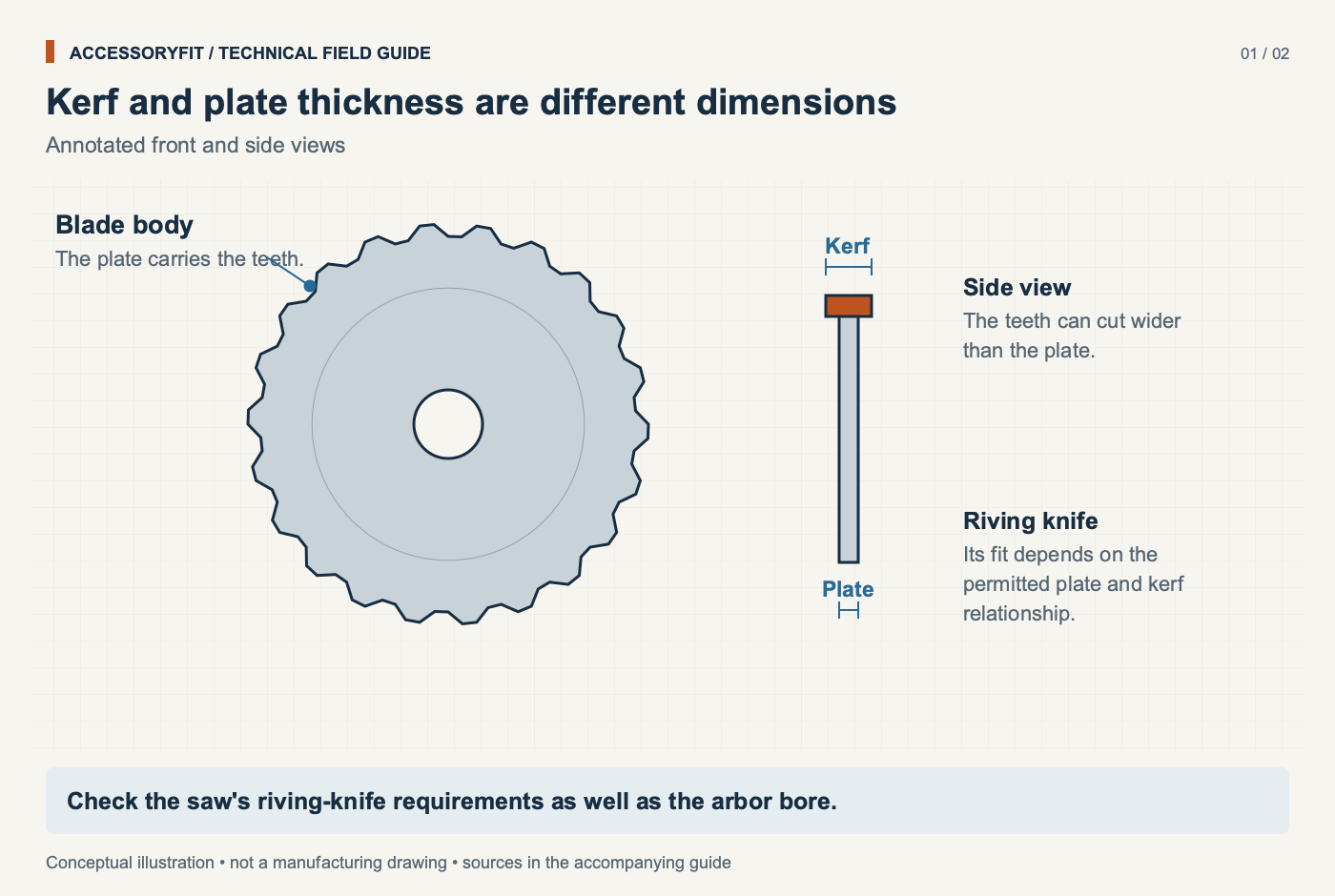
No. The riving knife must match the blade: the blade body must be thinner than the knife and the kerf wider than it, so the cut opens around the knife without binding. DeWalt's DWE7491 manual sets a range of body and kerf thickness for its knife, and a full-kerf blade with a thick plate can fall outside it even though its bore fits the arbor perfectly.
Kerf and plate figures are published for most blades. Full-kerf blades cut a slot of about 1/8 in; thin-kerf blades are narrower, with published examples of .087-.098 in. For example, the full-kerf Freud LU80R010 10 in 80-tooth Ultimate Plywood & Melamine blade (full kerf) lists a 0.126 in kerf and a 0.087 in plate, while the Diablo D1080X 10 in 80-tooth Ultra Finish saw blade for wood lists a 0.098 in kerf and a 0.071 in plate. Compare both numbers against your own saw's riving knife specification before buying.
A blade that forces the knife off the saw also gives up the protection it was designed for. The US Consumer Product Safety Commission (CPSC) compared injury rates per 10,000 saws in use in 2017 and found that saws with a traditional blade guard had 7.19 times the blade-contact injury rate of saws with a modular guard and riving knife system. That 2017 comparison is still CPSC's most recent of its kind. Those rates describe the guard design a saw was sold with, not individual blades, but they are the clearest published reason to choose a blade the knife accepts.
Larger saws set their own window. Grizzly's manual for its G0605X and G0606X cabinet saws limits blades to kerf 0.114–0.122 in; body 0.074–0.082 in so that the riving knife fits. That kerf range starts well above the thinnest kerf DeWalt allows on the DWE7491, so a thin-kerf blade that suits DeWalt's knife falls outside Grizzly's range and risks the binding on a standard riving knife that thin-kerf warnings describe. Tooth count, grind and kerf as cutting choices are covered in the guide on tooth count, grind and kerf.
Which dado stacks fit a jobsite table saw?
A dado stack fits only if its total width and diameter stay inside the saw's own limits, and both of the jobsite saws with published limits cap width at 13/16 in. The arbor's usable length is what restricts width. The two saws differ on diameter: DeWalt's DWE7491 allows a larger dado diameter than Makita's 2705X1, as the table below shows.
A common belief is that any dado set with a 5/8 in bore runs at full width on any table saw of the common size. It does not. Freud sells stacked dado sets in 6 or 8 in diameters with a 5/8 in arbor, and its larger set can cut wider than either jobsite saw allows, so it must be stacked within the saw's limit. Dado work also needs the saw's dado throat plate or insert, because the standard insert interferes or is unsafe; DeWalt sells its dado plate separately.
European dado rules were not covered by any manufacturer or standards source read for this page, so the guidance here applies to the US saws named.
| Saw | Max dado stack width | Max dado diameter | Insert |
|---|---|---|---|
| DeWalt DWE7491 | 13/16 in (20 mm) | 8 in (200 mm) | Dado throat plate (sold separately) |
| Makita 2705X1 | 13/16 in (21 mm) | 6 in | Dado table insert required |
Limits are saw-specific. A dado set that can cut wider (for example Freud SD208S up to 7/8 in) must still be stacked within the saw's own limit.
Which way does a table saw blade face?
The teeth point down at the front of the table, toward the operator. DeWalt's DWE7491 and Makita's 2705X1 manuals both give this orientation, which is the reverse of how a handheld circular saw blade looks when the saw is held upright.
Disconnect the saw before changing the blade, fit the saw's own inner flange, blade, outer flange and arbor nut in the order the manual shows, and check that the riving knife and guard are refitted before the next cut. Leaving the guard off after a blade change is a common pattern in injury data: in CPSC's 2017 special study of emergency-treated injuries in the US, still the agency's most recent in-depth study of its kind, the blade guard was not in use in 88.9% of table saw blade-contact injuries. Newer counts point at the same hands: AccessoryFit's estimate from CPSC's NEISS emergency department data for 2024 is about 33,000 injuries involving bench or table saws treated in US emergency departments that year, counting all table saw injuries rather than blade contact alone, and 85.5% of them were to the fingers. Year-by-year counts and the injury breakdown are on the table saw injury statistics page. If a correctly mounted blade still scorches the cut, the guide on saw blade burn marks works through the causes.
When does a table saw blade not fit?
A blade does not fit whenever one of the manual's limits is broken, even if the bore matches. The cases the sources on this page describe are:
- Metric bore on an inch arbor. A 30 mm blade is loose on a 5/8 in spindle without the maker's ring.
- Diameter outside the manual's range. The guard and riving knife are designed around it.
- Speed rating too low. DeWalt sets a minimum for the DWE7491.
- Plate or kerf outside the riving knife's range. The bore fits but the knife does not.
- Dado stack too wide or too large. Jobsite saws cap width at 13/16 in.
- Spacers used to take up a loose bore. DeWalt forbids it.
Fit is also tool-specific: blades for other machines follow other rules. Grinder discs use spindle threads, covered under angle grinder disc sizes; band saws use welded loops sized to each machine, covered under band saw blade sizes; and metal or nail-embedded cuts belong to other saws altogether, such as jigsaw blades for metal or demolition recip blades.
How do you check blade fit on a table saw not listed here?
Five checks against the saw's manual and the blade's markings confirm fit for any table saw.
- Disconnect power. Unplug the saw before touching the blade, flanges or insert.
- Read the manual's blade specification. Note the arbor size, the permitted blade diameter or range, and any minimum speed rating.
- Compare the blade's markings. Bore, diameter and maximum RPM must all fall within the manual's figures.
- Check plate and kerf against the riving knife. The blade body must be thinner than the knife and the kerf wider.
- For dado work, check width, diameter and insert. Keep the stack within the manual's limits and fit the saw's dado insert.
What else should you compare between table saw blades?
Once a blade passes the fit checks, tooth count, grind and hook angle decide how it cuts. Miter saws share many blade sizes but have their own hook-angle and speed rules, set out in the guide to which blades fit your miter saw. To check a specific saw model, use the accessory finder; every blade type on the site is grouped under saw blades by tool, and the other fit guides sit under what fits which tool.
Questions readers ask
Do 8-1/4 in and 10 in table saw blades have the same arbor?
Yes. Both use a 5/8 in arbor in the US, but each saw takes only the diameter its manual allows.
Can I fit a European 30 mm bore blade on a US table saw?
Not without a ring supplied by the saw's maker for that bore. DeWalt says not to use spacers to make a blade fit the spindle.
How wide a dado stack can a jobsite table saw take?
DeWalt's DWE7491 and Makita's 2705X1 both limit dado width to 13/16 in, and they set different maximum diameters. Always use the figure in your own manual.
Why doesn't my full-kerf blade work with the riving knife?
The knife must be thicker than the blade's plate and thinner than its kerf. A full-kerf blade with a thick plate can exceed the range DeWalt sets for the DWE7491's knife.
Which way do the teeth face on a table saw blade?
Down at the front of the table, toward the operator, according to DeWalt and Makita table saw manuals.
Where to go next
- Miter saw blade sizesShared blade sizes, different speed and hook rules.
- How to choose a circular saw bladeTeeth, grind and kerf once the bore fits.
- Circular saw blade arbor sizeHandheld saws, diamond knockouts and track saws.
- Circular saw blade selectorFilter blades by material and size.
References 122 documents, 18 publishers
- BG BAU - Berufsgenossenschaft der Bauwirtschaft (Germany): Baustellenkreissaegen, Handkreissaegen - Baustein B 265
- Bosch: GTS 254 Professional Table Saw - technical data; 4100XC-10 10 In. Worksite Table Saw with Gravity-Rise Wheeled Stand product page; 4100XC operating/safety instructions 1600A01Z1U; GKS 190 Professional Hand-Held Circular Saw - technical data; GCM 12 SDE Professional Mitre Saw - technical data; 1617/1618 router operating/safety instructions (2610051825)
- DeWalt: DWE7491RS 10 in Job Site Table Saw instruction manual (N531890); DWE7491RS 10-In. Jobsite Table Saw and Rolling Stand product page; DWE7491RS product page, related accessory DWA11260 12 in (305 mm) 60T blade with 1 in arbor; DWS780 12 in. Double-Bevel Sliding Compound Miter Saw product page; DWS780 Instruction Manual N466020; DWA271424 7-1/4 in 24T circular saw blade; DW3508 6-1/2 in x 1/8 in x 5/8 in Diamond Drive Metal Cutting Blade; DWE575 circular saw instruction manual (N786997); DWS535B worm drive saw instruction manual (blade table); DWS713 10 in Compound Miter Saw instruction manual (NA379757); DWA110CMB 10 in (254 mm) 40T and 60T saw blades 2-pack; DWS713 15 Amp 10 in Single-Bevel Compound Miter Saw - product page; DWS780 12 in Double-Bevel Sliding Compound Miter Saw - product page; DWS779 12 in Double-Bevel Sliding Compound Miter Saw - product page; DWAW71440 Elite Series 7-1/4 in 40T circular saw blade; DWA271460 7-1/4 in (184 mm) 60T circular saw blade; DWA261240 6-1/2 in 40T circular saw blade
- Freud and Diablo: D1040X 10 in x 40T General Purpose Saw Blade - tech specs; LU84R011 10 in Combination Blade - specs; D1244X 12 in x 44T General Purpose Saw Blade - tech specs; LU79R012 12 in Thin Kerf Ultimate Plywood & Melamine Blade - specs; LU85R012 12 in Carbide Tipped Saw Blade for Crosscutting - specs; D0824X 8-1/4 in x 24T Framing Saw Blade - tech specs; SD206 6 in Pro Dado Set - specs; SD208S 8 in Pro Dado Set - specs and description; D0524X 5-3/8 in x 24T Framing Saw Blade - tech specs; D0624A 6-1/2 in x 24T Framing Saw Blade - tech specs; D0660A 6-1/2 in x 60T Ultra Finish Saw Blade - tech specs; D0740A product page (finish family listing incl. D0641A, D0840X); D0724A product page (framing family listing incl. D0624A, D0620X, D0824X); D1472CF product page (medium metal family listing incl. D0748CFA); D12100X 12 in x 100T Ultimate Polished Finish blade - tech specs; LU91R010 10 in Thin Kerf Sliding Compound Miter Saw Blade (product specs); LU91R012 12 in Thin Kerf Sliding Compound Miter Saw Blade - specs; D1090X 10 in x 90T Wood Demon Ultimate Polished Finish Saw Blade - specs; D1060X 10 in x 60T Fine Finish Saw Blade (product specs); D1280X product page (fine finish family listing incl. D0860X); D1296N 12 in x 96T Saw Blade for Medium Aluminum - specs; D1272N 12 in x 72T Saw Blade for Thick Aluminum - specs; Get the most out of your Freud bits by routing at ideal feed rates and speeds; D1080X 10 in x 80T Ultra Finish Saw Blade (product specs); LU72R010 10 in General Purpose Blade (product specs); LU87R010 10 in Thin Kerf Rip Blade (product specs); LU79R010 10 in Thin Kerf Ultimate Plywood and Melamine Blade (product specs); D1060S 10 in x 60T Fine Finish Saw Blade (product specs); LU80R010 10 in Ultimate Plywood and Melamine Blade (product specs); Frequently Asked Questions; LU97R010 10 in Double Sided Laminate/Melamine Blade (product specs); LU73R010 10 in Cabinetmaker's Crosscut Blade (product specs); LU88R010 10 in Thin Kerf Fine Finish Crosscut Blade (product specs); D1024X 10 in x 24T Ripping Saw Blade (product specs); D1050X 10 in x 50T Combination Saw Blade (product specs); D0760A product page (ultra finish family listing incl. D0660A); D0770F product page (thin metal family listing incl. D0756F, D1490CF); LM72R012 12 in Heavy-Duty Rip Blade - tech specs; LU84R012 12 in Combination Blade - tech specs
- Grizzly Industrial: G0605X 12 in Extreme Series table saw product page (specifications); G0605X/G0606X owner's manual with Important Update (arbor change)
- Hand (N Y): Traumatic Finger Amputations: Epidemiology and Mechanism of Injury, 2010-2019; Trends in Upper Extremity Saw Injuries From 2003 to 2022
- Health and Safety Executive (UK): Circular saw benches - Safe working practices, Woodworking Information Sheet No 16 (Revision 2)
- Journal of Clinical Orthopaedics and Trauma: Patients admitted for treatment of traumatic finger amputations: Characteristics, causes, and prevention
- Makita: 2705X1 10 in Contractor Table Saw instruction manual; 2704N 260 mm Table Saw - specification; MLT100N 260 mm Table Saw - specification; 5007MG 7-1/4 in Magnesium Circular Saw - specs; XSS02Z 18V LXT 6-1/2 in Circular Saw - specs; SP6000J 6-1/2 in Plunge Circular Saw - specs; XPS01Z 36V (18V X2) 6-1/2 in Plunge Circular Saw - specs; LS1019L 10 in Dual-Bevel Sliding Compound Miter Saw - specs; LS1040 10 in Compound Miter Saw - specs; LS1219L 12 in Dual-Bevel Sliding Compound Miter Saw - specs; 5007MG/5007MGA Circular Saw instruction manual; 5377MG 7-1/4 in Hypoid Saw instruction manual; LS1019/LS1019L Slide Compound Miter Saw instruction manual; HS7611 Circular Saw instruction manual (EU); HS7611 190 mm Circular Saw - specification; HS6601 165 mm Circular Saw - specification; LS0815FL 216 mm Slide Compound Mitre Saw - specification; 5903R 235 mm Circular Saw - specification; LS1019L 260 mm Slide Compound Mitre Saw - specification; LS1040 260 mm Mitre Saw - specification; LS1219 305 mm Slide Compound Mitre Saw - specification; 9557PB angle grinder instruction manual; 5007F 7-1/4 in circular saw instruction manual
- Mallory Safety and Supply (retailer): Milwaukee 48-40-4505 14 in 72T blade listing
- Milwaukee Tool: M18 FUEL 8-1/4 in Table Saw 2736-20 - specifications; Operator's manual 58-14-0089D4 (Cat. No. 2736-20); M12 FUEL 5-3/8 in Circular Saw 2530-20 - specifications; M18 FUEL 7-1/4 in Circular Saw 2732-20 - specifications; 48-40-4505 14 in 72T metal cutting circular saw blade; M18 FUEL 10 in Dual Bevel Sliding Compound Miter Saw 2734-20 - specifications; M18 FUEL 12 in Dual Bevel Sliding Compound Miter Saw 2739-20 - specifications; M18 FUEL oscillating multi-tool 2836-20 operator's manual (58-14-0217d1); 48-40-4235 7-1/4 in 48T metal cutting circular saw blade
- OSHA: 29 CFR 1910.213 Woodworking machinery requirements; 29 CFR 1910.243 Guarding of portable powered tools; 29 CFR 1910.215 Abrasive wheel machinery; 29 CFR 1926.303 Abrasive wheels and tools; 29 CFR 1926.300 General requirements (Tools, hand and power); 29 CFR 1926.304 Woodworking tools
- Rockler: Table Saw Blades: A Complete Guide; Saw Blade Glossary; How to Clean and Maintain Your Saw Blades
- SKIL: 7-1/4 in Lightweight Worm Drive SKILSAW SPT77WML-01
- ToolsToday: Saw Blade Tooth Geometry: The Secret to a Perfect Cut
- U.S. Consumer Product Safety Commission: Safety Standard Addressing Blade-Contact Injuries on Table Saws: Supplemental Notice of Proposed Rulemaking (November 1, 2023); The 2017 NEISS Table Saw Special Study (staff briefing package, including Table Saw Blade-Contact Injuries Special Study Report, 2017); Proposed Rule: Safety Standard Addressing Blade-Contact Injuries on Table Saws (staff briefing package, January 17, 2017); Injuries Associated with Stationary Power Saws, 2001; 2019 NEISS Coding Manual; Withdrawal of Proposed Regulatory Actions (September 29, 2025); NEISS 2024 data file (neiss2024.xlsx), with NEISS_FMT code formats
- Woodcraft: Burn-Free Table Saw Cuts (Robert J. Settich)
- Zoro (retailer spec table): D1080X product specifications
Accessed .