Why reciprocating saw blades break, and how to make them last
Reciprocating saw blades most often break because the blade is forced through the cut or the saw's shoe is not held against the work, so the saw jumps and the blade flexes. DeWalt's manual ties both to blade breakage. The other common causes are a tooth pitch that does not suit the material's thickness and a blade too thin or too soft for the job. Keep the shoe pressed firmly, let the motor reach full speed before applying pressure, match TPI to the material, and use thicker bi-metal or carbide blades for demolition.
A reciprocating blade breaks when it is bent or shocked beyond what its body can take, and the usual triggers are forcing the cut, a saw that bounces because the shoe is off the work, and a blade that is the wrong pitch, thickness or material for what it is cutting. DeWalt's reciprocating saw manual names several of these directly. The list below runs from the causes you control at the trigger to the causes you control when buying blades.
Forcing the blade: pushing harder than the teeth can cut, especially in metal.
Shoe not held against the work: the saw jumps and vibrates, and the blade whips.
Pressure before full speed: loading the blade while the motor is still spinning up.
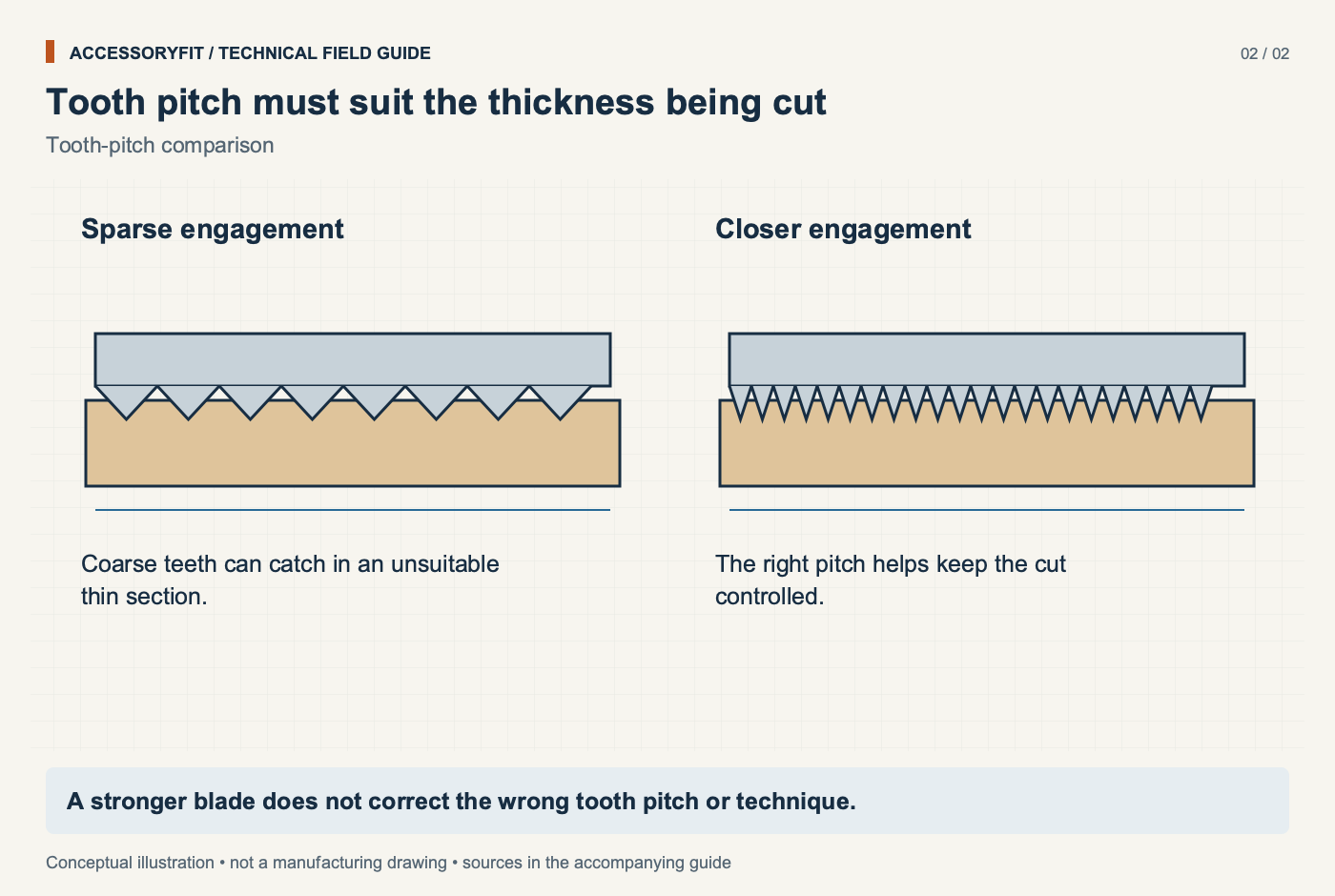
Wrong TPI for the material: coarse teeth in thin metal, or fine teeth in thick nail-filled wood.
A thin blade in demolition: a slim body bends and snaps under side loads.
The wrong blade material: a carbon-steel wood blade sent into nails or metal.
Binding in the cut: the kerf closes and pinches the blade.
Shank fit is rarely the issue. Current blades use a universal shank that fits most reciprocating saws across brands, so a blade from one maker usually clamps in another's saw. The universal reciprocating blade shank guide covers the exceptions.
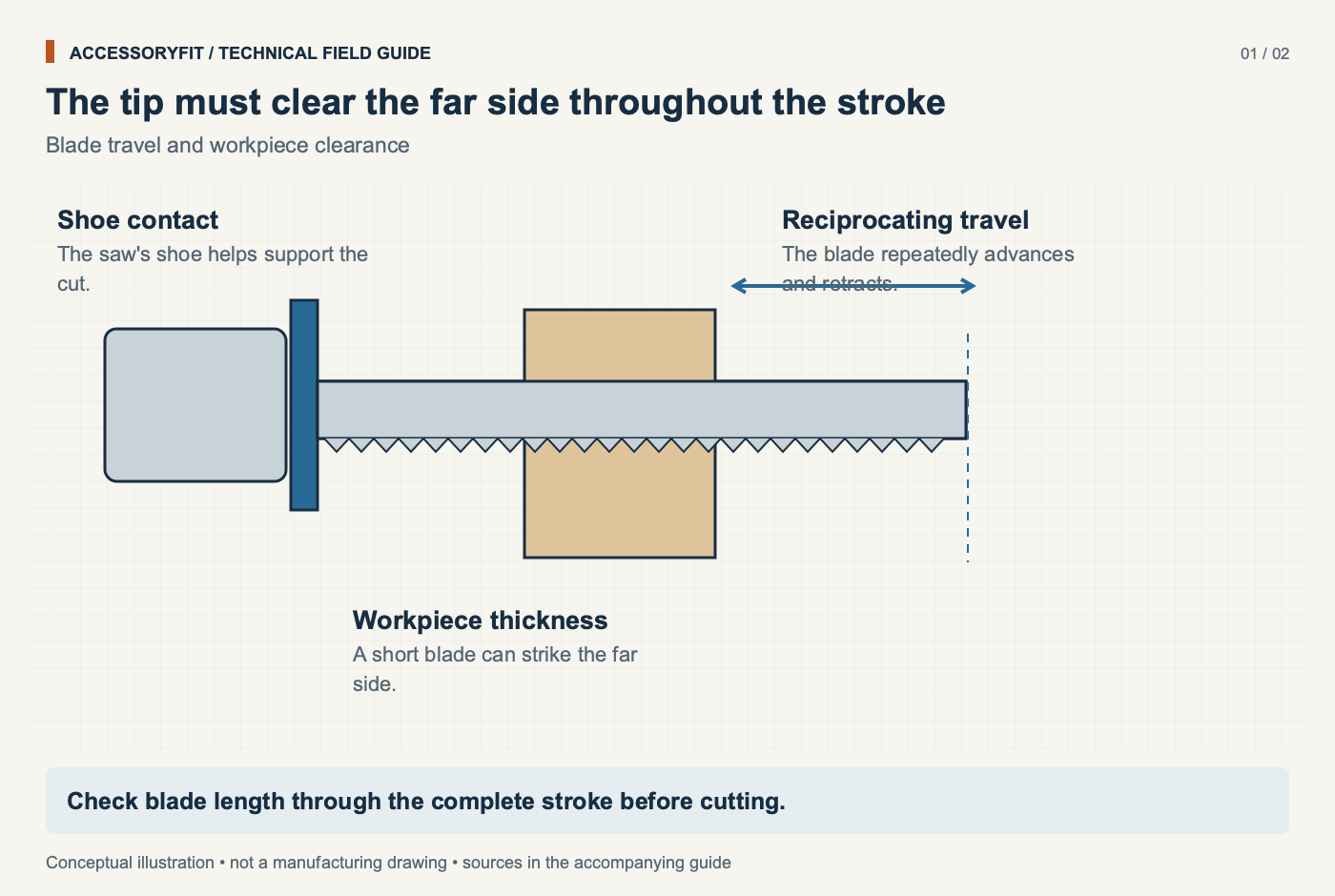
Check blade length through the complete stroke before cutting.
02Does forcing the saw break blades?
Yes. DeWalt's manual says not to force the blade in metal, because forcing shortens blade life and breaks blades. Extra push does not make the teeth cut faster; it loads the blade instead.
How do you confirm it?
Look at where and how the blade failed. A blade that snapped partway through a cut while you were leaning on the saw, or one that failed while the saw was labouring, points to force rather than a faulty blade.
How do you fix it?
Let the blade cut at its own pace and ease off if the saw slows. In metal, DeWalt says a thin film of oil or other coolant ahead of the cut helps, and the next section covers why that matters. Let the motor reach full speed before applying pressure, which DeWalt also lists, so the blade does not take the load while the motor is still accelerating.
03Does cutting metal dry wear blades out faster?
Yes. Both DeWalt and Makita call for a thin film of oil or cutting oil on the cut line when a reciprocating saw cuts metal, and Makita's manual says that skipping it causes premature blade wear.
Note what the makers do and do not claim. They tie coolant to blade wear and blade life, not directly to snapping, so a dry cut is a reason a blade goes dull early rather than a cause of breakage on its own. The link to breakage is indirect: a worn blade cuts slowly, and a slow blade tempts the extra push that DeWalt says breaks blades.
How do you fix it?
Apply a thin film of oil ahead of the cut in steel and repeat it on long cuts. Replace a blade that has already lost its edge rather than pushing it harder.
04Which orbit and speed settings protect the blade?
Set the saw as its maker specifies for the material, which for metal and plastics usually means straight-line action and a lower speed. Makita's JR3070CT manual sets straight-line action (no orbit) for mild steel, stainless steel and plastics, a small orbit for mild steel, aluminium and hardwood, and the large orbit only for fast cuts in wood and plywood.
Speed is a trade-off, not a free gain. Makita notes that higher stroke speeds cut faster but shorten blade service life, and its manual recommends low dial settings for stainless steel and plastics. No maker source names orbital action itself as a direct cause of breakage; the documented point is that each maker limits orbit and speed by material, and running outside those settings works against the blade.
Orbit numbering and dial scales differ between saws, so the table below is one maker's scheme. Check your own saw's manual for its settings.
Makita JR3070CT orbit settings by material (one maker's manual)
Position
Action
Applications
0
Straight line
Mild steel, stainless steel, plastics; clean cuts in wood and plywood
I
Small orbit
Mild steel, aluminum, hardwood
II
Medium orbit
Wood and plywood; fast cuts in aluminum and mild steel
III
Large orbit
Fast cuts in wood and plywood
One maker's manual; other saws may differ.
05Why does keeping the shoe against the work stop breakage?
The shoe braces the saw, so pressing it firmly against the material stops the saw jumping and vibrating, which DeWalt says minimizes blade breakage. Makita's JR3070CT manual gives the same instruction to keep the shoe firmly against the work. With the shoe off the work, nothing steadies the saw except the blade itself.
Awkward and overhead cuts make the shoe hard to keep in place, so reposition yourself rather than reach. Hold the saw firmly with both hands, which DeWalt also requires because the blade can bind and kick the saw back.
06Can the wrong TPI lead to a broken blade?
Indirectly, yes. The sources tie TPI to material thickness rather than to breakage itself, but a blade with the wrong pitch cuts slowly and tempts the forcing that DeWalt links to broken blades. Manufacturer guidance puts thin and medium sheet metal at 18–24 TPI, thick metal at 8–14 TPI, and wood with nails and general demolition at about 5–7 TPI.
A common belief is that any metal blade suits any metal. Lenox's catalogue sorts its metal blades by the thickness they cut, with the finest pitch for the thinnest sheet and coarser pitches as thickness rises. The table below gives TPI by application with the example blades each maker lists.
Reciprocating blade TPI by application, from Lenox, Milwaukee, Diablo and Bosch
Thickness bands for thick, medium and thin metal come from the Lenox TPI selection guide (p. 8); Diablo states its own bands on each product. The bands overlap between brands.
07Do thicker blades break less?
Yes. Manufacturers make demolition blades thicker and taller so that they resist bending and breaking and cut straighter. Lenox offers blade thicknesses of .035, .042, .050, .062 in (0.9, 1.07, 1.3, 1.6 mm), with the thin end aimed at metal cutting and the thick end at demolition, and Milwaukee says its thicker blade body resists fracturing and bending.
That corrects a common assumption that a thin, flexible blade is better for rough work because it gives rather than snaps. In demolition, the side loads from nails, twisting and pinching kerfs are what break blades, and a taller, thicker body takes them better. Lenox's own range shows the split: its thinnest blades are metal-cutting blades and its thickest are demolition blades.
Length matters too. Blades commonly come in 4, 6, 8, 9, 10, 12 in (102, 152, 203, 229, 254, 305 mm). The sources behind this page give no rule linking blade length to breakage, so pick a length that clears the material and check the maker's guidance for the blade.
A stronger blade does not correct the wrong tooth pitch or technique.
08Which blade material holds up best?
For mixed and demolition work, bi-metal or carbide-tipped blades. Bi-metal blades put a high-speed steel cutting edge on a spring steel back, which Lenox says reduces breaks, and Bosch describes the bond as flexible and unbreakable. High-carbon steel blades are for wood, fibreboard and soft plastics, so nails and metal are outside what they are made for.
Carbide-tipped blades go further on tough jobs: Lenox and Diablo both quote a life figure for carbide-tipped blades, up to 50x vs. standard bi-metal (manufacturer claims), in the tough applications they test. Nobody outside those makers has confirmed it in the sources here. For tile, cast iron and masonry, grit-edged carbide or diamond blades replace teeth altogether.
Reciprocating blade materials and what each is for
Material
Use
Manufacturer notes
High-carbon steel (HCS)
Wood, wood fibreboard, soft plastics
Bosch: carbon steel for softer materials
Bi-metal (BIM)
Metal, wood with nails, multi-material
High-speed steel cutting edge on a spring steel back to reduce breaks (Lenox); flexible, unbreakable bond of HCS and HSS (Bosch)
Bosch definitions from catalogue p. 52; Lenox from 2024 catalogue pp. 2-6.
09Is it safe to keep cutting after a blade binds or bends?
No. A blade that binds can kick the saw back toward you, and a bent blade no longer runs straight in the cut. Release the trigger, free the blade, and fit a new one if it has bent. DeWalt's manual requires holding the saw firmly with both hands for this reason, and warns against removing the blade guard.
Reaching in to free a jammed blade is where hands get hurt. Saw injuries to fingers are often severe: a 2024 review in the journal Hand of US emergency-department data for 2010 to 2019 traced 28.2% of emergency-treated finger amputations to power saws, ahead of every other product. Reciprocating saws are not listed separately there, so the figure speaks to saws as a group, but it is the reason to remove the battery before working a bound blade loose.
10How do you make a cut without breaking the blade, step by step?
The routine below follows DeWalt's manual guidance and the makers' blade-selection advice. Each step removes one cause from the list above.
Disconnect the saw Unplug it or remove the battery before fitting the blade.
Choose TPI and material for the job Fine teeth for thin metal, coarser teeth for thick metal, and a coarse bi-metal or carbide demolition blade for wood with nails.
Pick a blade body to match the loads Use a thick, tall demolition blade for rough work and save thin blades for light, flush or fine cuts.
Seat the blade fully in the clamp Push the universal shank fully home and check that it is locked before starting.
Set orbit and speed for the material Follow the saw's manual: Makita, for example, uses straight-line action for stainless steel and plastics and keeps the large orbit for fast cuts in wood.
Set the shoe on the work Press the shoe firmly against the material and hold the saw with both hands.
Reach full speed, then cut Start the motor before applying pressure, then let the blade cut at its own pace.
Lubricate metal Apply a thin film of oil or coolant ahead of the cut in metal.
Stop if it binds Release the trigger, free the blade and replace it if it has bent.
11When should you replace a reciprocating blade?
Replace the blade when it has taken a bend, when teeth are stripped or missing, or when it needs extra force to cut at all, because a dull blade invites exactly the forcing that breaks blades. The fact base holds no wear limit in cuts or hours, so judge by how the blade feeds.
If breakage happens mostly in demolition, a tougher blade type is the lasting fix. The blades below are all made for wood with nails, from Diablo, Milwaukee, Bosch and DeWalt, and each maker describes its body or teeth as built for that abuse. They fit saws that take the universal shank. For more options in the same category, see our guide to reciprocating saw blades for demolition.
12Which replacement blades stand up to demolition?
Product links go to Amazon. As an Amazon Associate I earn from qualifying purchases. How links are chosen.
Each blade below is 9 in long and sold in packs. They are grouped by tooth material, not ranked. Specs come from each maker's product page.
Carbide teeth for heavy nail-embedded wood
Diablo DS0906CWS3 9 in. 5/7 TPI Demo Demon carbide teeth reciprocating blades for nail-embedded wood (3 pk)
Length
9 in
TPI
5/7 TPI
Teeth
carbide teeth
Body height
1 in
Pack
3 pcs
Suits Rough-in demolition through nail-embedded and clean wood, in corded and cordless saws.
Skip it if Thin sheet metal, which needs a much finer pitch.
Carbide teeth on an oversized 1 in body
Variable 5/7 TPI
Diablo claims far longer life than standard bi-metal in nail-embedded wood
13What related problems show up with breaking blades?
Broken blades usually come with stripped teeth, blades that bend and wander, and saws that kick, because forcing, a lifted shoe and the wrong pitch cause all four. Stripped teeth in thin sheet point to too coarse a pitch; a blade that bends but does not snap points to a body too thin for the work. For curves in thin sheet, a jigsaw is the other option, and the metal-cutting jigsaw blades guide covers blades for it.
Why do my reciprocating saw blades keep snapping in metal?
The usual causes are forcing the cut and a pitch that does not match the metal's thickness. DeWalt says forcing a blade in metal shortens its life and breaks blades, and a thin film of oil ahead of the cut helps.
Are thicker reciprocating blades worth it?
For demolition, yes. Makers build demolition blades thicker and taller so they resist bending and breaking and cut straighter. For thin metal and flush cuts, a thinner blade is normal.
Will any brand of blade fit my saw?
Most current saws take the universal shank, and Bosch and Diablo both describe their blades as fitting most or all reciprocating saws.
Does a carbide blade stop breakage?
It resists tooth wear in nails and hard materials, and makers claim much longer life than bi-metal in those jobs. It does not protect against forcing or a lifted shoe, which break any blade.
Freud and Diablo: DS0908CF 9 in 8 TPI Steel Demon Carbide Teeth Reciprocating Saw Blade for Thick Metal; DS0614BF 6 in 14/18 TPI Bi-Metal Reciprocating Saw Blade for Medium Metal; DS0914BF 9 in 14/18 TPI Bi-Metal Reciprocating Saw Blade for Medium Metal; DS0610CF 6 in 10 TPI Steel Demon Carbide Teeth Reciprocating Saw Blade for Medium Metal; DS0606CWS 6 in 5/7 TPI Demo Demon Carbide Teeth Reciprocating Saw Blade for Nail-Embedded Wood; DS0903CP product page (pruning/clean wood carbide family incl. DS0603CP, DS1203CP); Get the most out of your Freud bits by routing at ideal feed rates and speeds; DS0906CWS3 Demo Demon carbide reciprocating blades product page
Hand (N Y): Traumatic Finger Amputations: Epidemiology and Mechanism of Injury, 2010-2019; Trends in Upper Extremity Saw Injuries From 2003 to 2022
Health and Safety Executive (UK): Circular saw benches - Safe working practices, Woodworking Information Sheet No 16 (Revision 2)
Journal of Clinical Orthopaedics and Trauma: Patients admitted for treatment of traumatic finger amputations: Characteristics, causes, and prevention
Milwaukee Tool: 48-00-5027 12 in 5 TPI AX SAWZALL Blade for Wood with Nails; 49-22-1129 SAWZALL 12PC Demolition Blade Set; 2821-20 M18 FUEL SAWZALL Recip Saw; 48-00-1301 9 in 5 TPI Pruning SAWZALL blade (5 pk); 48-00-5332 9 in 3 TPI AX carbide pruning SAWZALL blade; 48-00-1303 12 in 5 TPI Pruning SAWZALL blade (5 pk); M18 FUEL oscillating multi-tool 2836-20 operator's manual (58-14-0217d1); 9 in 5 TPI The Ax SAWZALL Blade (5 Pk) 48-00-5026
OSHA: 29 CFR 1910.215 Abrasive wheel machinery; 29 CFR 1910.243 Guarding of portable powered tools; 29 CFR 1926.303 Abrasive wheels and tools; 29 CFR 1926.300 General requirements (Tools, hand and power); 29 CFR 1926.304 Woodworking tools
Stanley Black & Decker (IRWIN, LENOX): LENOX Tool Catalog 2024: Power Tool Accessories, Hand Tools; Reciprocating Saw Blades (product range page)
U.S. Consumer Product Safety Commission: Safety Standard Addressing Blade-Contact Injuries on Table Saws: Supplemental Notice of Proposed Rulemaking (November 1, 2023); The 2017 NEISS Table Saw Special Study (staff briefing package, including Table Saw Blade-Contact Injuries Special Study Report, 2017); Proposed Rule: Safety Standard Addressing Blade-Contact Injuries on Table Saws (staff briefing package, January 17, 2017); Injuries Associated with Stationary Power Saws, 2001; 2019 NEISS Coding Manual; Withdrawal of Proposed Regulatory Actions (September 29, 2025)