
Research · Trade
Where power tool accessories sold in the US come from: import data 2021–2025
The United States imported $826 million of saws and saw blades, $611 million of drill bits and other drilling tools, and $552 million of coated abrasives such as sanding discs in 2025, according to US-reported UN Comtrade data analysed by AccessoryFit. China's share of each has fallen since 2021. In 2025 Germany was the largest source of drill bits, Switzerland and Italy led saw blades, Thailand and Vietnam led carbide and diamond circular blades, and Mexico led coated abrasives.
By AccessoryFit editors · Checked
On this page
- What are the key findings?
- How much does the US import in saw blades, drill bits and abrasives?
- Where do saw blades sold in the US come from?
- Where do carbide-tipped and diamond circular saw blades come from?
- What are the US antidumping orders on diamond sawblades from China?
- Where do drill bits sold in the US come from?
- Where do sanding discs, sandpaper and grinding wheels come from?
- Which country supplies the most of each accessory type?
- How has China's share of US accessory imports changed since 2021?
- What do the HS codes mean in plain English?
- What does "made in" on a blade or bit pack tell a buyer?
- How was this data produced?
- How should you cite this data?
What are the key findings?
- The United States imported $826 million of hand saws and saw blades of all kinds (HS 8202) in 2025, down from $885 million in 2024, according to US data reported to UN Comtrade.
- China's share of US saw blade imports (HS 8202) went from 25.1 to 12.6% of US saw blade imports between 2021 and 2025; in 2025 Switzerland and Italy were the two largest sources.
- US imports of carbide-tipped and diamond circular saw blades (HS 820239) shifted from 25.1 to 5.5% from China between 2021 and 2025, while Thailand and Vietnam together supplied 41% of the 2025 total.
- Italy supplied 55.7% of the steel circular saw blades (HS 820231) the United States imported in 2025.
- The United States imported $611 million of drill bits and other non-rock drilling tools (HS 820750) in 2025, and Germany overtook China as the largest supplier; imports under the code moved from 43.0 to 22.8% from China between 2021 and 2025.
- US imports of coated abrasives such as sandpaper, sanding discs and belts (HS 6805) were $552 million in 2025, down from $632 million in 2024, with Mexico, Canada and Germany the largest sources.
- South Korea supplied 26.0% of US imports of diamond grinding wheels and similar items (HS 680421) in 2025, ahead of Italy and China.
- The same shift shows in the tools themselves: US imports of electric hand-held saws (HS 846722) moved from 79.2 to 56.7% from China between 2021 and 2025, with Vietnam and Mexico growing.
How much does the US import in saw blades, drill bits and abrasives?
In 2025 the United States imported $826 million of saws and saw blades, $611 million of non-rock drilling tools and $552 million of coated abrasives, according to the import values the United States reported to UN Comtrade. Grinding wheels (HS 6804) are of similar size to coated abrasives.
Saw blades and coated abrasives were lower in 2025 than in 2021, with 2022 the peak year for saw blades; drilling tools and grinding wheels changed little. The power tool lines are context only: imports of the tools also fell, so the accessory figures are not moving on their own.
| HS code | Description | 2021 | 2022 | 2023 | 2024 | 2025 | Change 2021-2025 |
|---|---|---|---|---|---|---|---|
| 8202 | Hand saws; blades for saws of all kinds (all of heading 8202) | 957.2 | 1,034.7 | 818.4 | 885.2 | 826.1 | -13.7% |
| 820210 | Hand saws | 60.0 | 61.9 | 41.2 | 45.2 | 48.1 | -19.9% |
| 820220 | Band saw blades | 85.8 | 103.5 | 94.5 | 92.2 | 93.5 | +9.0% |
| 820231 | Circular saw blades, working part of steel | 217.1 | 233.9 | 163.3 | 180.3 | 167.0 | -23.1% |
| 820239 | Circular saw blades, other (incl. carbide-tipped, diamond) and parts | 250.1 | 268.0 | 211.5 | 256.0 | 203.4 | -18.7% |
| 820240 | Chain saw chain | 112.5 | 114.8 | 110.9 | 92.8 | 98.1 | -12.8% |
| 820291 | Straight saw blades for working metal | 50.0 | 55.9 | 33.1 | 31.7 | 31.4 | -37.2% |
| 820299 | Other saw blades (incl. reciprocating and jigsaw blades) | 181.6 | 196.8 | 163.9 | 187.1 | 184.7 | +1.7% |
| 8207 | Interchangeable tools for hand tools and machine tools (all of heading 8207) | 3,217.4 | 3,252.8 | 3,036.2 | 3,073.0 | 3,025.3 | -6.0% |
| 820713 | Rock drilling or earth boring tools, working part of cermets | 117.6 | 150.8 | 138.3 | 152.6 | 119.7 | +1.8% |
| 820719 | Rock drilling or earth boring tools, other (incl. parts) | 176.4 | 220.5 | 201.2 | 194.3 | 220.2 | +24.8% |
| 820750 | Tools for drilling, other than rock drilling | 631.5 | 657.3 | 609.1 | 655.7 | 611.5 | -3.2% |
| 820760 | Tools for boring or broaching | 61.9 | 70.0 | 80.1 | 78.6 | 83.2 | +34.3% |
| 820770 | Tools for milling | 292.9 | 334.0 | 305.0 | 314.2 | 322.2 | +10.0% |
| 6804 | Millstones, grindstones, grinding wheels and the like (all of heading 6804) | 529.0 | 560.1 | 571.1 | 573.5 | 534.3 | +1.0% |
| 680421 | Grinding wheels etc. of agglomerated synthetic or natural diamond | 218.7 | 252.3 | 246.9 | 252.6 | 230.1 | +5.2% |
| 680422 | Grinding wheels etc. of other agglomerated abrasives or ceramics | 252.2 | 240.1 | 255.6 | 256.4 | 252.3 | +0.0% |
| 6805 | Natural or artificial abrasive powder or grain on a backing (all of heading 6805) | 675.6 | 677.1 | 620.4 | 632.4 | 552.1 | -18.3% |
| 680510 | Coated abrasives on woven textile fabric backing | 156.8 | 163.4 | 154.6 | 159.6 | 145.4 | -7.3% |
| 680520 | Coated abrasives on paper or paperboard backing | 173.7 | 156.5 | 146.9 | 150.5 | 130.2 | -25.1% |
| 680530 | Coated abrasives on other backing (incl. fibre discs, film) | 345.1 | 357.1 | 318.8 | 322.3 | 276.5 | -19.9% |
| 846721 | Electromechanical hand drills (context) | 852.8 | 723.7 | 582.1 | 669.4 | 577.5 | -32.3% |
| 846722 | Electromechanical hand saws (context) | 1,500.5 | 1,281.0 | 944.9 | 1,112.3 | 871.0 | -42.0% |
| 846729 | Other electromechanical hand tools, incl. grinders and sanders (context) | 4,823.2 | 4,534.0 | 3,633.4 | 4,145.4 | 3,865.7 | -19.9% |
| 850760 | Lithium-ion accumulators, all uses (context only; not tool-specific) | 8,265.6 | 13,898.7 | 18,749.6 | 23,848.7 | 20,084.6 | +143.0% |
Values are UN Comtrade primaryValue for US-reported imports from all partners (World). Comtrade holds 2021 in HS 2017 (H5) and 2022-2025 in HS 2022 (H6); figures were retrieved with Comtrade's HS search across editions. HS 8207 includes metalworking machine-tool tooling, not only power tool accessories. HS 850760 covers lithium-ion batteries for all uses.
Where do saw blades sold in the US come from?
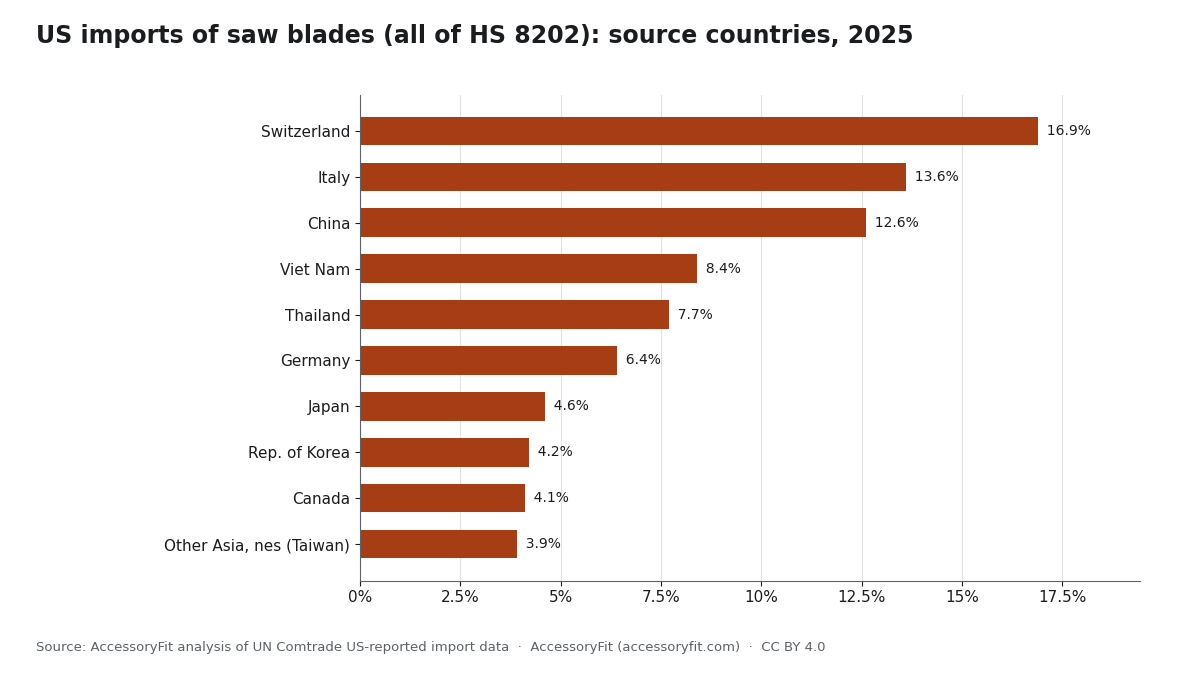
Switzerland and Italy were the two largest sources of US saw blade imports (HS 8202) in 2025, with China third, according to UN Comtrade US-reported data; China's share of the heading went from 25.1 to 12.6% of US saw blade imports between 2021 and 2025. Switzerland leads because the heading includes chain saw chain, where it supplied more than half of US imports in 2025, and the line holding reciprocating and jigsaw blades, where it was also first.
For steel circular blades (HS 820231), Italy dominates: it supplied 55.7% of the 2025 total, well ahead of Thailand and Japan. For reciprocating, jigsaw and other blades (HS 820299), China's share went from 43.0 to 23.6% from China, while Vietnam rose from a very small base.
Origin does not tell a buyer which blade fits a saw; the saw blades by tool section, the guide to tooth count, grind and kerf and teeth per inch explained cover that.
Where do carbide-tipped and diamond circular saw blades come from?
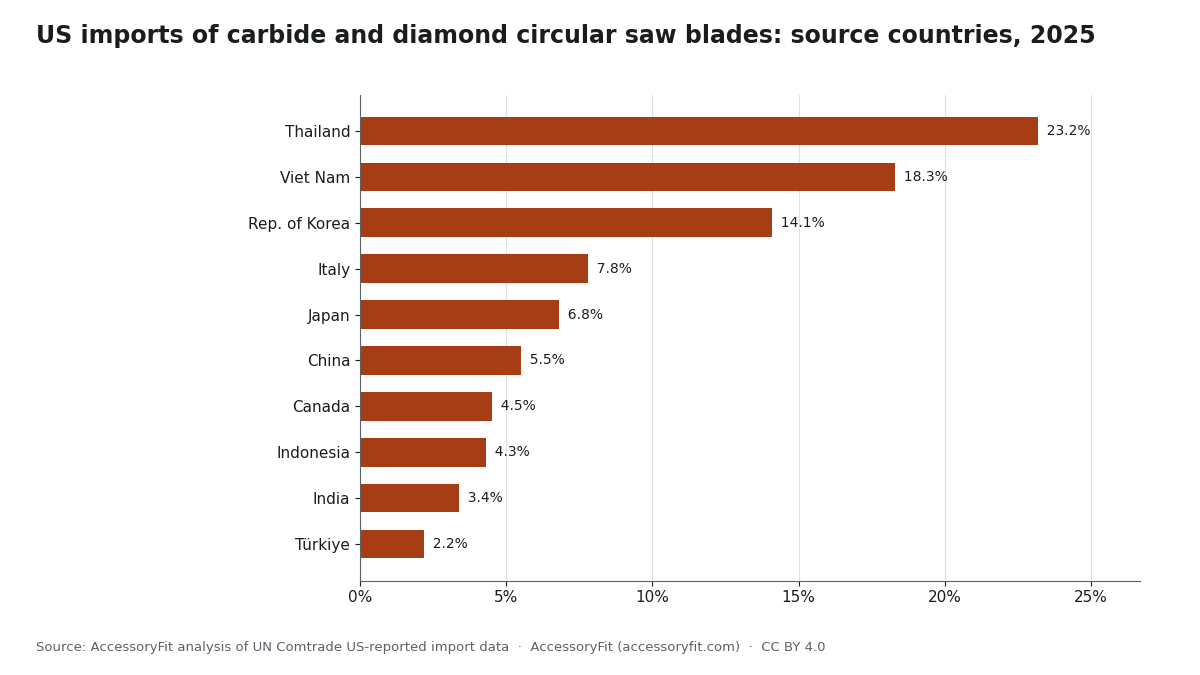
Thailand was the largest source of US imports of carbide-tipped and diamond circular saw blades (HS 820239) in 2025, followed by Vietnam and South Korea, and Thailand and Vietnam together supplied 41% of the total, according to UN Comtrade US-reported data. The line includes carbide-tipped blades for wood-cutting circular saws as well as diamond blades, and it is where China's position changed most: its share moved from 25.1 to 5.5% from China between 2021 and 2025.
The code does not separate the two blade types and also covers blade parts, so a shift could come from either. Diamond blades have a separate trade record, covered next; the guide to diamond blades for concrete covers choosing one.
What are the US antidumping orders on diamond sawblades from China?
Diamond sawblades and parts from China have been subject to US antidumping duties, and the US International Trade Commission's most recent full review of the order, published in March 2021 (Investigation No. 731-TA-1092, second review, Publication 5176), recorded a 64% drop in imports from China between 2015 and 2019. Over the same period Thailand became the largest source, and the review notes that the US Department of Commerce found in 2019 that the order was being circumvented through Thailand.
The USITC figures are landed duty-paid values for diamond sawblades only, so they do not line up with the Comtrade figures elsewhere on this page. This is the only trade measure on these products documented here; the import data shows where goods came from, not why sources changed.
Where do drill bits sold in the US come from?
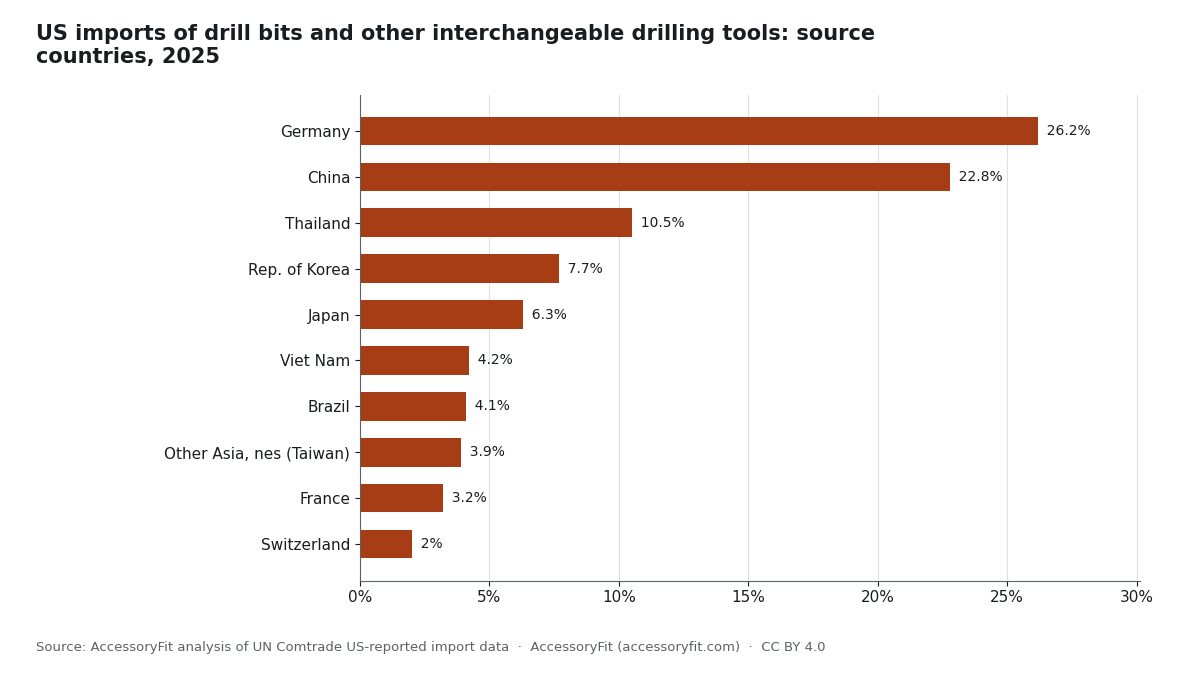
Germany was the largest source of US imports of drill bits and other non-rock drilling tools (HS 820750) in 2025, narrowly ahead of China, with Thailand third, according to UN Comtrade US-reported data. Imports under this code went from 43.0 to 22.8% from China between 2021 and 2025, while the total held roughly steady at $611 million in 2025.
Declared customs value per item differed sharply by origin, averaging 1.24 vs 5.36 US dollars per drill bit (China vs Germany) in 2025, calculated as declared value divided by reported item counts. That average spans every bit type and size, including machine-tool drills, so it is not a shop price and may reflect product mix more than cost. For the bit types a DIY or trade buyer actually chooses between, see the overview of drill bit types and the drill bit guides; for metalwork, bits for metal and stainless steel compares HSS, cobalt and carbide.
Where do sanding discs, sandpaper and grinding wheels come from?
Mexico was the largest source of US imports of coated abrasives (HS 6805) in 2025, followed by Canada and Germany, out of a total of $552 million, according to UN Comtrade US-reported data. China plays a smaller role here, and its share changed little after 2021.
The leader depends on the backing. Germany led cloth-backed abrasives, Canada led paper-backed abrasives, and Mexico led the "other backing" line, which includes fibre discs and film. For bonded wheels, South Korea supplied 26.0% of diamond grinding wheels (HS 680421), while Austria narrowly led other bonded wheels (HS 680422) just ahead of China.
For fitting these products, see sanding and grinding accessories, sandpaper grit progression and cut-off wheel types.
Which country supplies the most of each accessory type?
No single country leads across accessories: in 2025 Germany led drill bits and band saw blades, Italy steel circular blades, Thailand carbide and diamond circular blades, Switzerland chain saw chain and reciprocating and jigsaw blades, and South Korea diamond wheels. The table gives the top three sources and total for each code.
| HS code | Description | 2025 total | 1st | 2nd | 3rd |
|---|---|---|---|---|---|
| 820220 | Band saw blades | $93.5 million | Germany 33.0% | Mexico 11.9% | United Kingdom 10.9% |
| 820231 | Circular saw blades, working part of steel | $167.0 million | Italy 55.7% | Thailand 8.6% | Japan 7.4% |
| 820239 | Circular saw blades, other (incl. carbide-tipped, diamond) and parts | $203.4 million | Thailand 23.2% | Viet Nam 18.3% | Rep. of Korea 14.1% |
| 820240 | Chain saw chain | $98.1 million | Switzerland 54.7% | Canada 16.0% | China 14.6% |
| 820299 | Other saw blades (incl. reciprocating and jigsaw blades) | $184.7 million | Switzerland 36.3% | China 23.6% | Viet Nam 10.1% |
| 820750 | Tools for drilling, other than rock drilling | $611.5 million | Germany 26.2% | China 22.8% | Thailand 10.5% |
| 680421 | Grinding wheels etc. of agglomerated synthetic or natural diamond | $230.1 million | Rep. of Korea 26.0% | Italy 14.9% | China 8.8% |
| 680422 | Grinding wheels etc. of other agglomerated abrasives or ceramics | $252.3 million | Austria 13.8% | China 13.3% | Germany 10.0% |
| 680510 | Coated abrasives on woven textile fabric backing | $145.4 million | Germany 32.5% | Mexico 18.5% | Rep. of Korea 8.8% |
| 680520 | Coated abrasives on paper or paperboard backing | $130.2 million | Canada 42.4% | Rep. of Korea 11.6% | China 10.1% |
| 680530 | Coated abrasives on other backing (incl. fibre discs, film) | $276.5 million | Mexico 29.5% | Canada 9.5% | China 9.0% |
| 846721 | Electromechanical hand drills (context) | $577.5 million | China 43.9% | Viet Nam 24.9% | Mexico 21.2% |
| 846722 | Electromechanical hand saws (context) | $871.0 million | China 56.7% | Viet Nam 19.1% | Mexico 18.7% |
| 846729 | Other electromechanical hand tools, incl. grinders and sanders (context) | $3.87 billion | Viet Nam 33.0% | Mexico 28.1% | China 25.6% |
Shares are partner value divided by World value for the same code and year. Comtrade reports Taiwan as 'Other Asia, nes'.
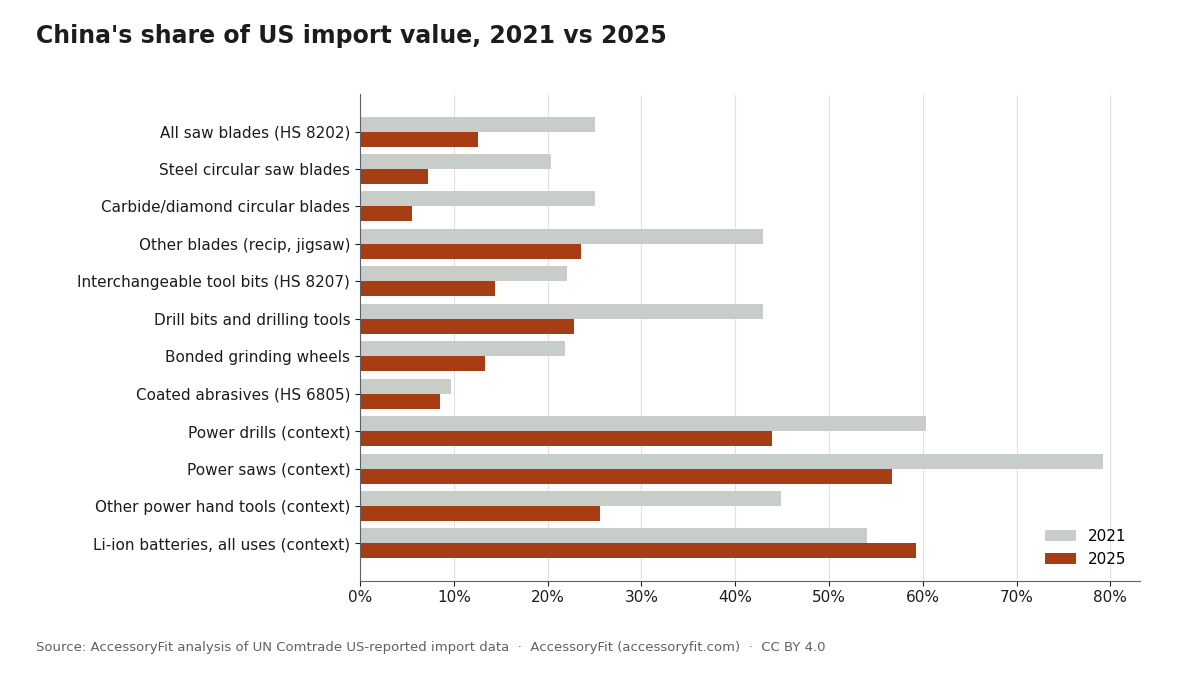
| HS code | Description | 2021 | 2025 | Change (points) |
|---|---|---|---|---|
| 8202 | Hand saws; blades for saws of all kinds (all of heading 8202) | 25.1% | 12.6% | -12.5 |
| 820231 | Circular saw blades, working part of steel | 20.4% | 7.3% | -13.1 |
| 820239 | Circular saw blades, other (incl. carbide-tipped, diamond) and parts | 25.1% | 5.5% | -19.6 |
| 820299 | Other saw blades (incl. reciprocating and jigsaw blades) | 43.0% | 23.6% | -19.4 |
| 8207 | Interchangeable tools for hand tools and machine tools (all of heading 8207) | 22.1% | 14.4% | -7.7 |
| 820750 | Tools for drilling, other than rock drilling | 43.0% | 22.8% | -20.2 |
| 680422 | Grinding wheels etc. of other agglomerated abrasives or ceramics | 21.9% | 13.3% | -8.6 |
| 6805 | Natural or artificial abrasive powder or grain on a backing (all of heading 6805) | 9.7% | 8.5% | -1.2 |
| 846721 | Electromechanical hand drills (context) | 60.3% | 43.9% | -16.4 |
| 846722 | Electromechanical hand saws (context) | 79.2% | 56.7% | -22.5 |
| 846729 | Other electromechanical hand tools, incl. grinders and sanders (context) | 44.9% | 25.6% | -19.3 |
| 850760 | Lithium-ion accumulators, all uses (context only; not tool-specific) | 54.1% | 59.3% | +5.2 |
Computed from the CSV extract; China is in the top 10 partners for each code in both years.
What do the HS codes mean in plain English?
HS codes are the international customs categories trade statistics use: four digits for a heading, six for a subheading within it. In plain English:
- 8202: all hand saws and saw blades. Within it, 820220 is band saw blades; 820231 is circular blades whose cutting part is steel; 820239 is other circular blades, including carbide-tipped and diamond blades, plus blade parts; 820240 is chain saw chain; 820291 is straight blades for cutting metal; 820299 is other blades, including reciprocating and jigsaw blades; 820210 is hand saws.
- 8207: interchangeable tools for hand tools and machine tools. 820750 is drilling tools other than rock drilling, which covers drill bits for power tools; 820713 and 820719 are rock drilling and earth boring tools; 820760 is boring and broaching tools; 820770 is milling tools.
- 6804: grinding wheels and similar. 680421 is wheels made with diamond; 680422 is wheels of other bonded abrasives or ceramics.
- 6805: coated abrasives, split by backing: 680510 cloth, 680520 paper, 680530 other backings including fibre discs and film.
- 846721, 846722, 846729: electric hand drills, saws and other hand-held tools such as grinders and sanders. 850760: lithium-ion batteries for all uses. These appear only as context.
The codes follow customs definitions, not shop categories: a hand saw and a circular blade share a heading, and the drilling and milling codes include industrial machine-tool tooling.
What does "made in" on a blade or bit pack tell a buyer?
A country of origin tells you where the item was declared to come from at customs, and nothing about whether it fits your tool or how it performs. The import data works the same way: it records origin with no brand, model or quality information, and average customs values differ widely by origin within one code, as the drill bit figures show.
A stated origin also reflects customs rules and routing, as the Thailand circumvention finding above shows. For choosing an accessory, the decisive details are in the specifications: arbor or shank size, maximum speed, tooth count or grit, and rated materials. AccessoryFit compares published specifications rather than origin, as described on the methodology page.
How was this data produced?
The figures are an AccessoryFit analysis of UN Comtrade, which publishes the trade statistics each country reports to the United Nations. AccessoryFit extracted US-reported imports for 2021 to 2025 for the codes above, for all partners (World) and the ten largest partners in each code and year; the extract is the CSV below.
Definitions: values are Comtrade's primary value for each row, in US dollars, as reported by the United States. Shares are a partner's value divided by the World value for the same code and year. Comtrade holds 2021 in the 2017 edition of the HS and 2022 to 2025 in the 2022 edition; the series were retrieved with Comtrade's cross-edition search. Comtrade lists Taiwan as "Other Asia, nes". The per-item drilling tool values divide declared value by the item counts in the record.
Limitations, in plain English:
- These are customs values at the border, not retail sales.
- The country is the country of origin recorded for US customs, not the brand's home country.
- HS codes mix products. Heading 8202 includes hand saws and chain saw chain; 8207 includes industrial machine-tool tooling; 820239 combines carbide and diamond blades.
- Chain saw chain sits inside the 8202 total, lifting Switzerland's position there.
- The lithium-ion battery code covers all uses and is context only.
- Quantities in kilograms that Comtrade marks as estimated were not used.
- Data covers imports only; US-made accessories sold in the US do not appear, so these shares are shares of imports, not of the US market.
The diamond sawblade figures come from USITC Publication 5176 (March 2021), which uses landed duty-paid values and is quoted as published.
How should you cite this data?
Please credit AccessoryFit as the source of the analysis and link to this page. A suggested citation:
AccessoryFit, "Where power tool accessories sold in the US come from: import data 2021–2025", updated 22 October 2026, https://accessoryfit.com/research/power-tool-accessory-imports/
The tables, charts and CSV are free to reuse under the Creative Commons Attribution 4.0 licence (CC BY 4.0), provided you credit AccessoryFit and link to this page. The underlying trade statistics are reported by the United States to UN Comtrade; name UN Comtrade as the original source where space allows. More datasets: AccessoryFit research.
Download the data
The CSV has one row per year, HS code and partner (World plus the ten largest partners), with the import value in US dollars and the reported quantity and unit where available. Free to reuse under CC BY 4.0 with a link to this page.
- US imports of power tool accessories by country, 2021–2025 (CSV) UN Comtrade US-reported import values by HS code and partner country, as extracted by AccessoryFit.
- Chart: China's share of US imports, 2021 vs 2025 (PNG, 1200 × 675) China's share of import value for each accessory code, with power tools and batteries for context.
- Chart: saw blade imports by country, 2025 (PNG, 1200 × 675) Top 10 sources of US imports under HS 8202.
- Chart: carbide and diamond circular blade imports by country, 2025 (PNG, 1200 × 675) Top 10 sources of US imports under HS 820239.
- Chart: drill bit imports by country, 2025 (PNG, 1200 × 675) Top 10 sources of US imports under HS 820750.
Questions readers ask
Which country makes the most drill bits imported into the US?
Germany, in 2025. It was the largest source of US imports of drilling tools (HS 820750), just ahead of China, whose share went from 43.0 to 22.8% from China between 2021 and 2025. The code also includes machine-tool drills.
Does the US still import saw blades from China?
Yes. China was the third largest source of US saw blade imports (HS 8202) in 2025, behind Switzerland and Italy, although its share went from 25.1 to 12.6% of US saw blade imports between 2021 and 2025.
Are these figures what Americans spend on blades and bits?
No. They are customs values of imports at the US border. They leave out US-made products and everything added after import, including freight, duties, distribution and retail margin.
Where to go next
- Power tool research and dataAll AccessoryFit datasets, charts and downloads.
- Saw bladesWhich blade fits which saw, by arbor, diameter and tooth count.
- Drill bitsBit types, shanks and sizes for each material.
- Sanding and grindingDiscs, belts and wheels by tool and grit.
References 10 documents, 7 publishers
- Australian Competition and Consumer Commission: Lithium-ion Batteries Issues Paper; Lithium-ion batteries and consumer product safety (Report, October 2023)
- European Parliament and Council of the European Union (EUR-Lex): Regulation (EU) 2023/1542 concerning batteries and waste batteries
- Joint Center for Housing Studies of Harvard University: Improving America's Housing 2025
- Phoenix Fire Department, Fire Investigations Task Force: Lithium-Ion Battery Fire Investigations, December 2025 (Public Release Summary)
- United Nations Statistics Division, UN Comtrade (US-reported data): UN Comtrade Database: United States imports, 2025, HS 6804, 6805, 8202, 820231, 820239, 8207, 820750; UN Comtrade Database: United States imports, 2024, HS 6804, 6805, 8202, 820231, 820239, 8207, 820750; UN Comtrade Database: United States imports by partner, annual 2021-2025, HS 8202, 8207, 6804, 6805, 846721, 846722, 846729, 850760 and subheadings (public API)
- US Environmental Protection Agency, Office of Resource Conservation and Recovery: An Analysis of Lithium-ion Battery Fires in Waste Management and Recycling (EPA 530-R-21-002)
- US International Trade Commission: Diamond Sawblades and Parts Thereof from China, Inv. No. 731-TA-1092 (Second Review), Publication 5176
Accessed .