Best jigsaw blades for metal: picks by tooth pitch, blade steel and shank
A jigsaw blade for metal needs fine teeth, roughly 14–36 TPI depending on thickness, a high-speed steel or bi-metal body, and a shank your saw accepts. For thin sheet and aluminum, the Bosch T118A runs 17–24 TPI on HSS; for medium-gauge steel, Diablo's DJT121AF5 is bi-metal at 21 TPI; for the thinnest sheet, DeWalt's DW3778-5 has 32 TPI. All four picks are T-shank. They were compared on published manufacturer specifications only; nothing was cut or tested by us.
A metal-cutting jigsaw blade should have a tooth pitch matched to the sheet thickness, a blade steel hard enough for the metal, a tooth set that keeps the cut straight, and the right shank for the saw. Wood blades fail on every one of those points, which is why metal blades are sold as a separate family. Each requirement below is stated first, followed by the published figure behind it.
Tooth pitch: the thinner the metal, the finer the teeth
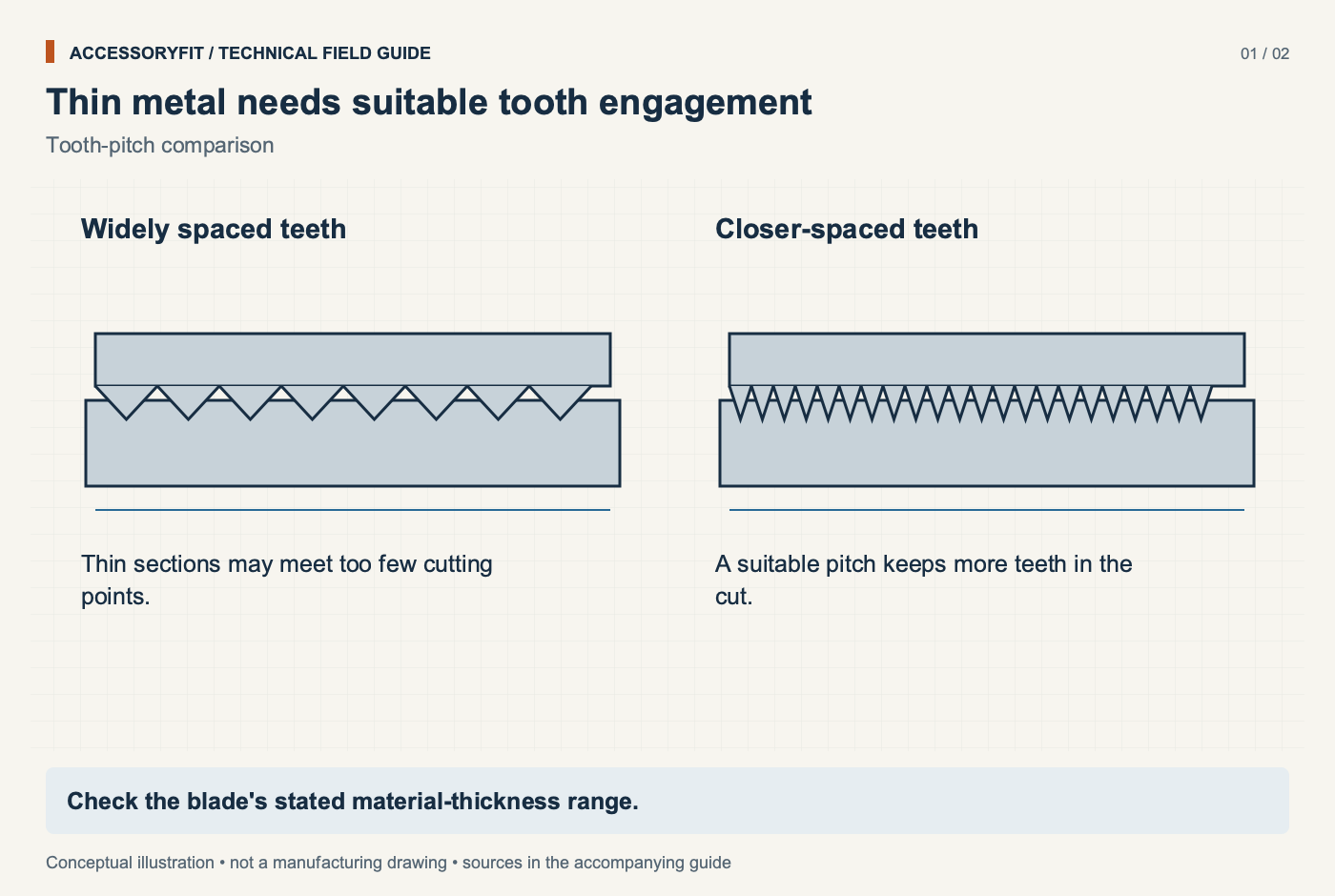
Published metal blades run from about 14–36 TPI. The coarse end suits thicker stock, while the fine end is for thin sheet, where a coarse pitch would leave too few teeth engaged. Lenox ties tooth pitch to thickness and advises keeping 2–3 teeth in the material at all times. That rule is the quickest check at the bench: measure the sheet, then pick a pitch that keeps several teeth engaged. A progressive-tooth blade, where the pitch changes along the blade, covers a band of thicknesses with one blade, which is how the Bosch T118A is built.
Blade steel: HSS or bi-metal, not carbon steel
High-carbon steel (HCS) blades are soft and flexible and belong to wood, fibreboard and soft plastics. Bosch's catalogue lists high-speed steel (HSS) for metal, aluminium and non-ferrous metal, and bi-metal (BIM) for ferrous and non-ferrous metal as well as hardwood. Bosch's own figure puts bi-metal blade life at about 2x HSS, about 10x HCS; that comparison comes from Bosch alone. Carbide-tipped blades sit above both and are what Bosch lists for stainless steel and glass-fibre reinforced plastic.
Tooth set: wavy set for straight cuts in thin stock
Bosch describes milled, wavy-set teeth as giving fine, straight cuts in soft steel, aluminium and non-ferrous metal, and milled side-set teeth as faster but rougher. The material and tooth tables below come straight from Bosch and Lenox catalogue data.
Shank: T-shank for nearly every current saw
A blade only fits a saw whose clamp is made for its shank. All four picks on this page are T-shank, the shank Bosch says fits over 90% of current jigsaw makes and models (Bosch claim). Some saws take U-shank blades instead, which are labelled to fit U-shank jigsaws only. Our guide to jigsaw blade shank types shows how to tell the two apart.
Check the blade's stated material-thickness range.
Jigsaw blade TPI by material and thickness, from Lenox and Bosch catalogue examples
Material
Typical TPI
Thickness range stated
Example blades
Softwood and hardwood, fast cuts
6
3/8-1-3/4 in (9.5-44.5 mm)
Lenox C456T, B456T; Bosch U111DF
Wood, clean cuts
10
3/16-1-1/4 in (4.8-31.8 mm)
Lenox C450T/C450U, B450T; Bosch U101BF
Wood, fine/scroll cuts
20
1/16-3/4 in (1.6-19.1 mm)
Lenox C320TS/C320US
Wood with nails, general purpose
5-10 (progressive) or 6
5/16-1-3/4 in (7.9-44.5 mm) for Lenox B406T
Bosch T345XF, T111CF (8 TPI); Lenox B406T
Metal over 3/32 in (2.4 mm)
14
> 3/32 in
Lenox B314T
Medium metal
18
1/16-1/4 in (1.6-6.4 mm)
Lenox B318T; Bosch U118EF 14-18
Thin metal
24 (17-24 progressive)
< 1/8 in (3.2 mm)
Lenox B324T; Bosch U118A 17-24P
Extra-thin sheet metal
32-36
< 1/16 in (1.6 mm)
Lenox B332T 32; Bosch U118G 36
Cement board, fiberglass, plaster
6 (carbide-tipped)
1/4-2-3/8 in cement board
Lenox CT456T
Ceramic tile, fiberglass, brick
Grit (no teeth)
3/64-5/8 in (1.2-15.9 mm)
Lenox G300T carbide grit
Bosch European pages give tooth spacing in mm instead of TPI (for example T 101 BR 2.5 mm, T 118 A 1.1-1.5 mm). Ranges are what each manufacturer lists for the named blade, not universal limits.
Jigsaw blade steels and what Bosch and Lenox list them for
Material
Code
Use
Notes
High-carbon steel
HCS
Softwood, wood fibreboard, soft plastics
Flexible; Bosch T 101 BR and U 234 X are HCS
High-speed steel
HSS
Metal, aluminium, non-ferrous metal
Fully hardened; Bosch T 118 A is HSS
Bi-metal
BIM
Hardwood, abrasive wood materials, hard plastics, non-ferrous and ferrous metal
HSS teeth on an HCS body; used where shank breakage is a risk; about 2x HSS life and about 10x HCS life (Bosch)
Bosch definitions from catalogue p. 8; Lenox carbide and diamond rows from 2024 catalogue p. 14.
02What rules a metal-cutting blade out before you compare teeth?
A blade is ruled out if its shank does not match the saw clamp, if it is shorter than the cut needs, or if its tooth pitch is far off the sheet thickness. These checks come before brand or steel type, and they hold for US and European saws alike.
Shank. A T-shank saw takes T-shank blades only. The DeWalt DCS334 manual says so directly; the mount column in the table below shows what other common saws take. In Europe, Bosch calls the T-shank the single lug shank and the U-shank the universal shank, a naming quirk from its European catalogue that trips up buyers who read "universal" as "fits everything".
Length. Most Bosch and Lenox blades are 2-3/4 to 5-1/4 in (70 to 133 mm) long. Lenox sizes the minimum length as material thickness + 2 to 2-3/4 in. Sheet metal rarely tests that limit, but box section and thicker angle can.
Pitch. A blade that leaves fewer teeth in the cut than Lenox advises is too coarse for the sheet. One with far more teeth than the thickness needs cuts smoothly but slowly, so it wastes time on thick stock.
European blades describe pitch differently. Bosch's European pages give tooth spacing in millimetres rather than teeth per inch, so a metric listing for the same T118A shows a spacing figure where a US pack shows TPI. Both describe the same blade.
Blade mount and stroke of common jigsaws (manufacturer data)
Tool
Blade mount
Stroke
No-load speed
Bosch JS470E
T-shank
1 in
not stated
Bosch JS572EK
T-shank
1 in
not stated
DeWalt DCS334B
T-shank
not stated
3200 spm
Makita 4351FCT
T-shank one source
1 in
not stated
Milwaukee 2737-20
T-shank
1 in one source
not stated
Values marked one source appear in a single manufacturer document; check the tool's manual or rating plate before buying.
03Which jigsaw blades suit metal?
Product links go to Amazon. As an Amazon Associate I earn from qualifying purchases. How links are chosen.
These four blades are the metal-cutting jigsaw blades in our catalogue whose makers publish their pitch, steel or set contents. They are grouped by the thickness and type of metal they suit, not ranked. Specs come from each manufacturer's own product page. Where a maker does not state a figure, it is left out rather than taken from a retailer title. For other blade families, the saw blades by tool hub sorts them by saw type.
For thin sheet steel and aluminum: an economical HSS jigsaw blade
Bosch T118A 5 pc. 3-5/8 in. 17-24 TPI Basic for Metal T-shank jig saw blades
Shank
T-shank
Length
3-5/8 in
Pitch
17–24 TPI
Steel
HSS
Tooth form
wavy set, milled
Pack
5 pcs
Suits DIY owners of T-shank jigsaws cutting sheet metal, thin steel and aluminum in straight lines.
Skip it if Stainless steel, thick plate, and U-shank saws.
Progressive 17–24 TPI pitch covers a range of thin gauges
Milled, wavy-set teeth, the set Bosch lists for straight cuts in thin metal
Bosch describes it as an economical choice for sheet metal
HSS body, the steel Bosch lists for metal and aluminium
HSS is less flexible than bi-metal and more likely to snap if bent
Bosch's own life comparison favours bi-metal over HSS
Bosch advises lubricant when cutting metal, which adds a step
Bosch TPM005 5 pc. T-shank jig saw blade set for Pro-Metal
T-shank
Varies by blade
Varies by blade
Not stated per blade
04How do the metal jigsaw blade picks differ?
The picks differ mainly by tooth pitch, which decides the metal thickness each one handles, and then by blade steel. Their shanks are the same, so fit is not what separates them.
Bosch T118A vs Diablo DJT121AF5: HSS or bi-metal?
The Bosch T118A is HSS with a progressive 17–24 TPI pitch, and the Diablo DJT121AF5 is bi-metal with a fixed 21 TPI pitch. Both are 3-5/8 in long. The Bosch blade covers thinner sheet thanks to its finer end, and Bosch sells it as the economical option. The Diablo blade trades that range for a tougher bi-metal body, which Bosch's own catalogue credits with a longer life than HSS, and a coating that Diablo says reduces heat. If the work is mostly light sheet and aluminum, the T118A fits the job; if it is mostly medium steel bracketry, the DJT121AF5 does.
Diablo DJT121AF5 vs DeWalt DW3778-5: how much finer is fine?
DeWalt's DW3778-5 carries 32 TPI, well above Diablo's 21 TPI, and it is shorter at 3 in. That pitch puts it in the extra-thin band of the table above, where Lenox and Bosch list their finest blades. It is the blade for flashing, light duct and thin panels, and the wrong one for anything that would fill its small gullets with chips.
Is the Bosch TPM005 set worth it over single packs?
The TPM005 is the only pick that includes a blade Bosch names for stainless steel, the T118EHM. Bosch's set page lists the five blade codes but not each blade's pitch or length, so it cannot be compared figure for figure with the single packs. Buy it when stainless or mixed metals are part of the job; buy a single pack when you know the gauge.
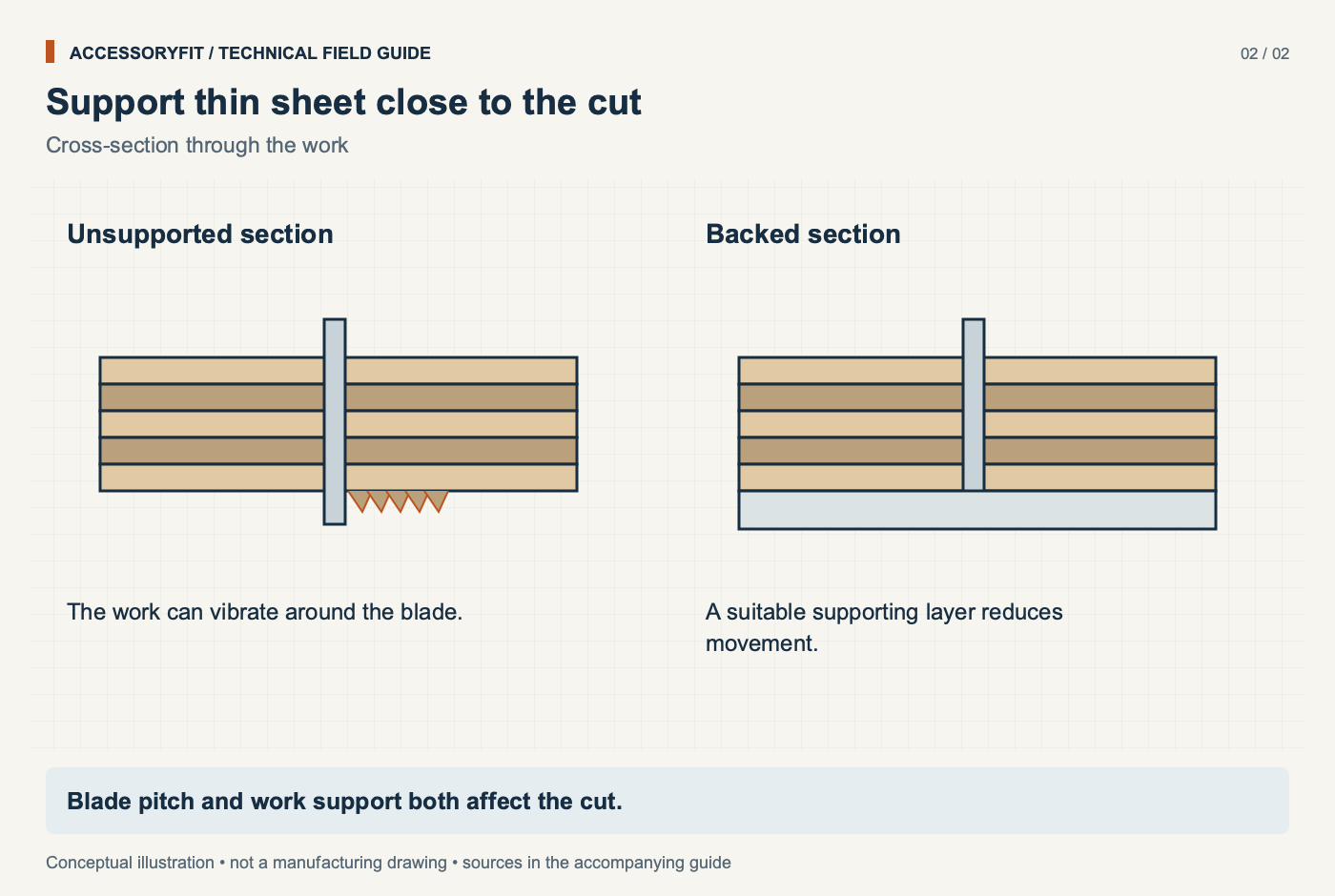
Blade pitch and work support both affect the cut.
05Which jigsaw blade cuts aluminum, and which handles stainless steel?
Aluminum takes a coarser metal blade than steel of the same thickness, and stainless steel needs a blade its maker names for stainless. The safety guidance in the Bosch and Lenox material tables says to use a finer blade for ferrous metals and a coarser one for non-ferrous metals such as aluminum, copper and brass. In practice that means stepping one band coarser than you would for steel of the same thickness.
Bosch lists HSS for aluminium and non-ferrous metal, and its tooth table names milled, wavy-set teeth for fine, straight cuts in aluminium. The T118A matches both descriptions, which makes it the closest pick for aluminum sheet. For extruded aluminum section or thicker plate, follow the thickness bands in the TPI table and move toward the coarse end of the metal range.
Stainless steel is the hardest of the common sheet metals a jigsaw meets. Bosch's catalogue lists carbide-tipped blades for stainless steel, and the T118EHM in the TPM005 set carries Bosch's Special for Stainless Steel label. Run the saw at a lower speed on stainless, as the general jigsaw safety guidance advises for hard metals, and use cutting fluid where the maker recommends it.
Bosch tooth set and grind, and the cut each produces
Tooth form
Result
Bosch examples
Milled, side set
Relatively rough cut, fast progress in hard and softwood, aluminium, plastics, non-ferrous metal
Bosch Accessories catalogue p. 8, 'The right geometry is what's important'.
06When does a jigsaw blade for metal fail?
A metal jigsaw blade fails when the saw runs with orbital action, when the pitch is wrong for the thickness, or when the blade is asked to cut stock a jigsaw is not suited to. These are the cases where a better blade does not fix the result.
Orbital action switched on. DeWalt's manual says metal should be cut with orbital action off, at straight (setting 0), and that orbital settings are meant for soft materials such as wood and plastic. This corrects a common belief that pendulum action speeds up every cut; DeWalt also notes it gives a less smooth cut even where it is allowed.
Too few teeth in the cut. A coarse blade on thin sheet leaves too few teeth engaged, against Lenox's rule of several teeth in the cut. The fix is a finer pitch, not more pressure.
Forcing the saw. Manufacturer guidance is to let the blade cut at its own speed rather than push the saw. Our explainer on why jigsaw blades bend covers deflection in more depth.
Thick plate and long straight cuts. A jigsaw blade is short and narrow. For heavy section, a reciprocating saw, band saw or cut-off wheel is the better tool.
A U-shank saw. All four picks are T-shank. Diablo says its T-shank blades fit all combination saws and most U-shank saws, but Bosch, DeWalt and Lenox label each shank for its own saw type and sell separate U-shank versions. Check the saw manual before relying on a T-shank blade in a U-shank clamp.
Higher pitch is not automatically better either. More teeth cut more smoothly but more slowly, and Lenox matches pitch to thickness rather than recommending the finest blade for every job.
07How do you get a clean cut in sheet metal with a jigsaw?
A clean metal cut comes from a fine blade, a supported sheet, a slow straight stroke and lubrication. The steps follow from manufacturer guidance rather than from shop habit.
Back up the sheet. Clamp scrap wood or plywood under thin sheet so the blade cannot lift and tear it. The sandwich also gives the shoe a flat surface to ride.
Turn orbital action off and set a moderate speed. Hard metals and stainless take lower speeds than soft metals.
Lubricate. Bosch recommends a proper lubricant for its metal blades; a few drops along the cut line reduce heat at the teeth.
Let the blade work. Keep the shoe pressed flat and feed only as fast as the blade cuts.
Deburr afterwards. Every metal cut leaves a burr. A file or a flap disc on a grinder removes it.
If you need round holes in sheet rather than profiles, a drill and the right bit are faster than a jigsaw; the metal-drilling bit picks compare cobalt and HSS sets for that job. For other buyer comparisons, see the full list of accessory buying guides. If you are unsure which shank or stroke your own saw has, you can look up what fits your tool by brand and model.
08Questions readers ask
What TPI jigsaw blade should I use for sheet metal?
Use the fine end of the metal range. Lenox and Bosch list blades of 32 TPI and finer for extra-thin sheet, and progressive blades such as the Bosch T118A at 17–24 TPI for thin metal generally. Lenox advises keeping 2–3 teeth in the material at all times.
Can a wood jigsaw blade cut aluminum?
It is the wrong tool. Wood blades are usually 6–10 TPI on a high-carbon steel body that Bosch lists for wood and soft plastics, not metal. Use an HSS or bi-metal blade made for non-ferrous metal.
Should I use orbital action when cutting steel with a jigsaw?
No. DeWalt's manual says metal and hardwood should never be cut with orbital action, and that orbital settings are for soft materials such as wood and plastic.
Are bi-metal jigsaw blades worth it for metal?
For regular metal cutting, usually yes. Bosch rates bi-metal blade life at about 2x HSS, about 10x HCS, and recommends bi-metal where the blade could snap at the shank. HSS blades such as the T118A remain a lower-cost choice for occasional thin sheet.
Do metal jigsaw blades need oil?
Bosch recommends a proper lubricant when cutting metal with its jigsaw blades. Lubricant cuts heat at the teeth, which matters most on steel and stainless.
Freud and Diablo: Get the most out of your Freud bits by routing at ideal feed rates and speeds; DJT121AF5 Jigsaw Blades Medium Metal Bi-Metal product page