Best circular saw blades for plywood: picks by tooth count, grind and fit
A plywood blade needs many teeth, a bevelled ATB or Hi-ATB grind and a low hook angle, and it must match your saw's diameter, arbor and speed. For a 7-1/4 in circular saw, the Diablo D0760A carries 60 ATB teeth on a thin kerf. For 10 in table and miter saws, the Freud LU79R010 and LU80R010 and the Diablo D1080X each carry 80 Hi-ATB teeth. These picks compare published manufacturer specifications against plywood's needs; nothing here was tested by us.
01What should a circular saw blade for plywood have?
A blade for plywood should have a high tooth count, a bevelled top grind that slices the face veneer, a low hook angle for control, and a kerf that suits the power of your saw. The blade that leaves clean edges is the one built for crosscutting, not the one built for fast ripping. Each attribute below is stated as a requirement, followed by the published figure behind it. For the general background on each term, see our explainer on tooth count, grind and kerf.
Tooth count: the crosscut range
A 10 in blade meant for clean crosscuts usually has 60 to 80 teeth, compared with 40 to 50 teeth on combination and general-purpose blades and as few as 24 teeth on a rip blade. More teeth means each tooth takes a smaller bite, which leaves a smoother edge at a slower feed. The blades that Freud and Diablo market specifically for veneered plywood and melamine sit at the top of that band. Handheld saws use lower counts for the same finish. For ultra-fine cuts in plywood, melamine and MDF with a 7-1/4 in circular saw, Diablo and DeWalt both sell blades with 60 teeth, and the usual steps for 6-1/2 in cordless saws are 24 / 40 / 60 teeth, with the highest count for plywood and melamine. Compare tooth count within the same diameter rather than against a table saw blade.
Grind: ATB at minimum, Hi-ATB for veneer
Alternate Top Bevel (ATB) teeth are bevelled left and right in turn, so they slice the fibres instead of chopping them, and they are the normal grind for crosscut and general-purpose blades. High Alternate Top Bevel (Hi-ATB) teeth use a steeper bevel of about 30–40 degrees and are sold for chip-free cuts in melamine, veneer and veneered plywood. Flat Top Grind (FTG) is the rip grind and is the wrong shape for clean plywood edges. Triple Chip Grind (TCG) belongs to laminate, melamine, MDF, plastics and non-ferrous metal, and it becomes the better choice when both faces of the panel carry a hard plastic laminate.
Hook angle: low or neutral
A low or neutral hook angle of about 0 to 6 degrees gives more control and less tear-out on crosscuts and veneered sheet goods. Positive hook angles of 10 to 22 degrees pull the blade into the cut for fast feeding, which suits ripping solid wood. Makers do not agree on the figure for the same job: Freud's 80-tooth plywood blades use 2 deg, while Diablo's 80-tooth ultra finish blade uses 15 deg. Read the hook figure on the blade's own spec sheet rather than assuming it from the tooth count.
Kerf: thin or full, matched to the saw
A full-kerf table saw blade cuts a slot of about 1/8 in, while published thin-kerf examples run .087-.098 in. Thin kerf removes less material, which helps a lower-powered saw keep its speed. Rockler's guide ties full-kerf blades to more powerful cabinet and contractor saws and thin-kerf blades to lower-powered jobsite saws. Rockler also says thin kerf brings no significant advantage on contractor or cabinet saws, which corrects the common idea that a thin-kerf blade is an upgrade for every table saw.
Tooth count, grind and hook by task for 10 in (254 mm) blades, from Freud and Diablo specs
Task
Typical teeth
Grind
Hook angle
Manufacturer example
Ripping solid wood
24
FTG (Freud); ATB (Diablo)
+20 deg (Freud); +15 deg (Diablo)
Freud LU87R010; Diablo D1024X
General purpose
40
Hi-ATB (Freud); ATB (Diablo)
+13 deg (Freud); +15 deg (Diablo)
Freud LU72R010; Diablo D1040X
Combination (rip + crosscut)
50
ATB + flat raker (Freud COMB); listed as ATB (Diablo)
Values come from each manufacturer's published specs. The tooth-count bands (24 rip, 40-50 general, 60-80 crosscut) agree with Rockler's guide. Hook angles vary by maker for the same task, so check the blade's own spec.
02What rules a plywood blade out before you compare teeth?
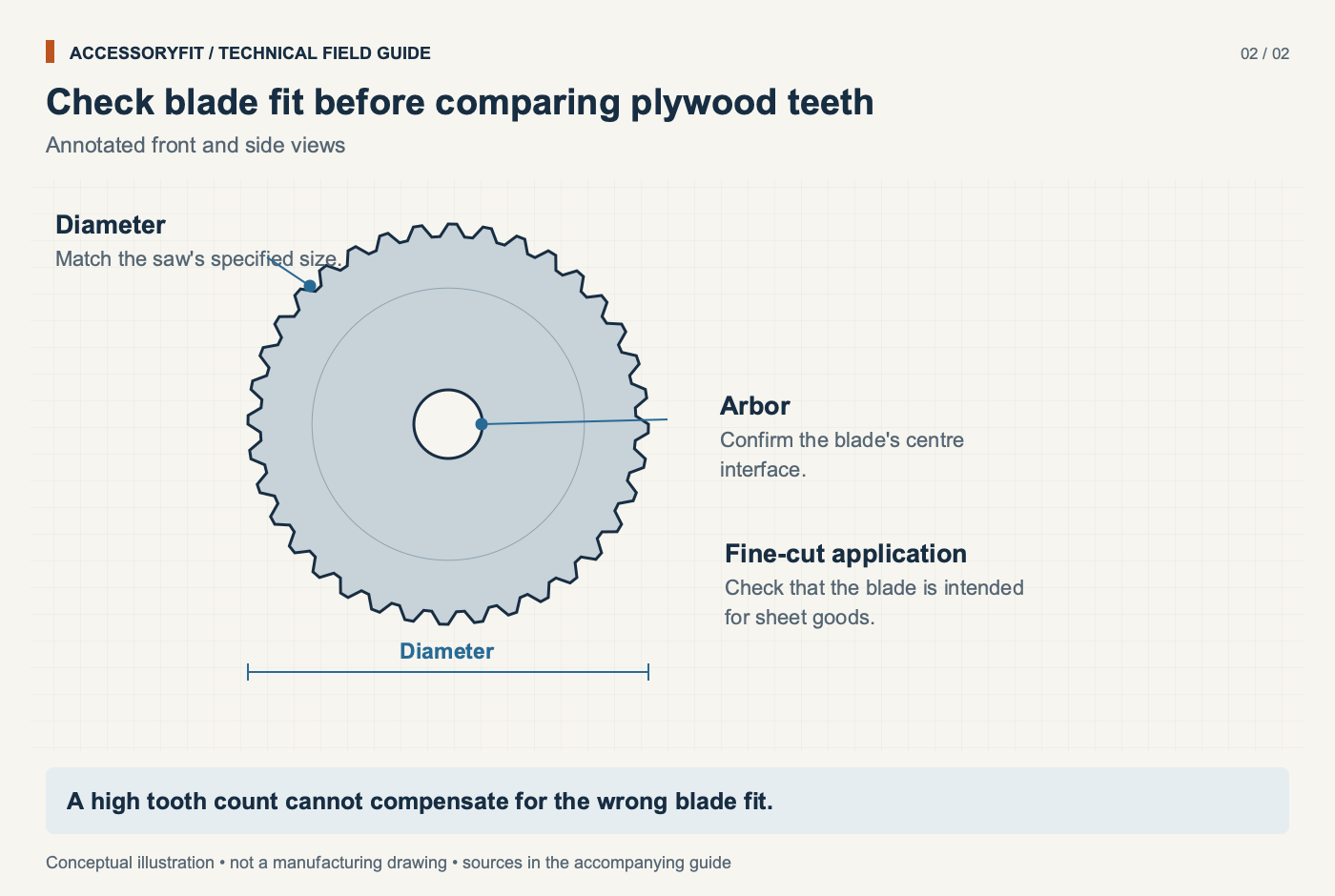
A blade is ruled out if its diameter, arbor hole or rated speed does not match the saw, however good its teeth are. These three checks come before any comparison of grind or tooth count, and they apply to US and European saws alike. The full size tables live in our guide to circular saw arbor sizes.
Diameter. Fit only the blade diameter marked on the saw or given in its manual. A 7-1/4 in blade does not belong on a 6-1/2 in saw just because both use the same arbor, because a wrong-size blade may not be guarded properly.
Arbor size and shape. US 7-1/4 in saws use a 5/8 in round arbor, and US 10 in blades also use 5/8 in. Compact 10 mm-arbor trim saws, worm-drive saws with a diamond arbor, and track saws with a 20 mm bore all need blades made for them. European circular saws such as the Bosch GKS 190 commonly take a 30 mm bore, so a US blade with a 5/8 in hole is not a direct swap on a Bosch or Makita EU model.
Rated speed. The maximum speed marked on the blade must equal or exceed the no-load speed marked on the saw.
US and European sizes differ for the same class of saw. Makita's EU mitre and table saws in the 10 in class take slightly larger metric blades with a 30 mm bore, while the US versions with the same model numbers take 10 in blades with a 5/8 in hole. The two tables below give both systems.
A high tooth count cannot compensate for the wrong blade fit.
US blade diameters and arbor sizes, with example speed ratings
Blade diameter
Arbor
Example blade max RPM (marked)
Example saw no-load RPM
5-3/8 in
10 mm
12,000 (Diablo D0524X)
3,600 (Milwaukee 2530)
6-1/2 in (165 mm)
5/8 in (15.9 mm); track saws 20 mm
8,000 (Diablo D0624A); 10,000 (Diablo D0660A)
3,700 (Makita XSS02Z)
7-1/4 in (184 mm)
5/8 in round; diamond on worm-drive saws
8,000 (Diablo D0740A)
5,800 (Makita 5007MG, Milwaukee 2732)
8-1/4 in
5/8 in
8,000 (Diablo D0824X)
6,300 (Milwaukee 2736 table saw)
10 in (254 mm)
5/8 in
6,000 (Diablo D1040X)
3,200 (Makita LS1019L); 4,600 (Makita LS1040)
12 in (305 mm)
1 in (25.4 mm)
5,000 (Diablo D1244X)
3,200 (Makita LS1219L)
Max RPM values are for the named blades only; always read the marking on your blade. Exceptions exist: Diablo D0640X is a 6 in blade with a 1/2 in arbor for the Porter-Cable Saw Boss; Diablo D1632X 16-5/16 in uses 1 in. DeWalt's DWS780 12 in saw has a 5/8 in spindle and a 1 in blade adapter.
Makita's EU 10-inch-class mitre and table saws take 260 mm blades with a 30 mm bore, while the US versions of the same model numbers take 10 in (255 mm) blades with a 5/8 in hole. 216 mm and 235 mm rows rest on one Makita source each.
03Which circular saw blades suit plywood?
Product links go to Amazon. As an Amazon Associate I earn from qualifying purchases. How links are chosen.
These five blades are the ones in our catalogue whose makers list plywood, veneered plywood or melamine among their intended cuts. They are grouped by the saw they fit, not ranked. Specs come from each manufacturer's product page. Where a maker's own page does not confirm the arbor or speed rating, that figure is left out here: read it from the blade's marking before you buy. The blade recommendation tool filters the same data by saw and material.
For 7-1/4 in circular saws: finish cuts in plywood
Diablo D0760A 7-1/4 in 60-tooth Ultra Finish saw blade for wood
Diameter
7-1/4 in
Teeth
60
Grind
ATB
Arbor
5/8 in
Kerf
0.059 in
Hook angle
10 deg
Max speed
8000 rpm
Suits Owners of corded or cordless 7-1/4 in circular saws with a round 5/8 in arbor who break down sheets of plywood, veneered plywood or melamine.
Skip it if Worm-drive saws with a diamond arbor, and any saw marked for a different diameter.
60 ATB teeth, the highest count among the 7-1/4 in blades in our catalogue
Thin 0.059 in kerf removes little material
Diablo lists veneered plywood, plywood, melamine and laminate among its cuts
Marked for 8000 rpm, above the no-load speed of common 7-1/4 in saws
ATB rather than Hi-ATB grind
Hook angle is published as 10 deg by Diablo but differently by one retailer
For 10 in miter and table saws: ultra-finish crosscuts
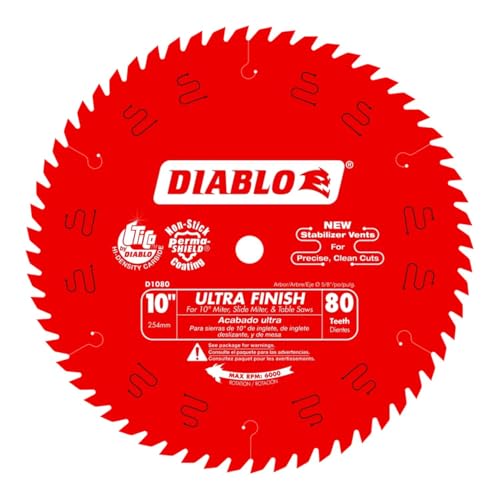
Diablo D1080X 10 in 80-tooth Ultra Finish saw blade for wood
Diameter
10 in
Teeth
80
Grind
Hi-ATB
Arbor
5/8 in
Kerf
0.098 in
Hook angle
15 deg
Max speed
6000 rpm
Suits Sliding or chop-style miter saws and portable or stationary table saws with a 5/8 in arbor, cutting veneered plywood, melamine, MDF and paneling.
Skip it if Saws whose manual calls for a negative-hook blade, and any saw not marked for a 10 in blade.
80 Hi-ATB teeth
Thin 0.098 in kerf
Arbor and 6000 rpm rating published by Diablo
Listed for both miter and table saws
15 deg hook is higher than Freud's plywood blades
Thin kerf can bind on a standard-thickness riving knife
Diablo D1080X 10 in 80-tooth Ultra Finish saw blade for wood
10 in
80
Hi-ATB
0.098 in
0.071 in
15 deg
Makita A-93681 10 in 80T Micro-Polished miter saw blade
10 in
80
ATAF
0.091 in
0.071 in
5 deg
04How do the plywood picks differ from each other?
The picks differ mainly by the saw they fit, then by kerf and hook angle, because their grinds and tooth counts are close. Only one of them, the Diablo D0760A, is a 7-1/4 in blade for a handheld circular saw. The other four are 10 in blades for table, miter and radial arm saws.
Freud LU79R010 vs LU80R010: thin or full kerf?
The two Freud blades share the same tooth count, Hi-ATB grind and 2 deg hook, and differ in kerf. The LU79R010 cuts a 0.098 in kerf on a 0.071 in plate, while the LU80R010 cuts a 0.126 in kerf on a 0.087 in plate. Freud lists portable table saws for the thin-kerf LU79R010 but not for the full-kerf LU80R010. Choose by your saw: a jobsite saw whose maker allows thin kerf points to the LU79R010, while a cabinet or contractor saw with a standard riving knife points to the LU80R010, because a thin-kerf blade can bind on a standard-thickness knife.
Freud vs Diablo at the same tooth count: does hook angle matter?
Hook angle is the clearest difference between the Freud plywood blades and the Diablo D1080X. Freud uses 2 deg, inside the low or neutral range that published guidance links to less tear-out. Diablo uses 15 deg, which sits inside the positive range used for faster feeding. Both makers sell their blade for veneered plywood and melamine, so neither figure is wrong, but the lower hook gives more control when feeding by hand. Low or negative hook blades are the type specified for sliding miter and radial arm saws, so read your saw manual before fitting a positive-hook blade on one.
Hi-ATB vs ATAF: what is Makita's grind?
Makita describes the A-93681 grind as alternate top, alternate face (ATAF), a different label from the Hi-ATB used by Freud and Diablo. Makita lists the blade for miter and cross cuts in wood, hardwood and plywood on a miter saw, so it suits a saw that cuts plywood strips and trim rather than full sheets.
Is the Diablo D0760A hook angle settled?
Not completely. Diablo lists 10 deg, while one retailer's spec table lists a higher figure. The manufacturer value is shown here. For comparison, Diablo's 40-tooth D0740A finish blade of the same diameter lists 15 deg.
05When is a plywood blade the wrong choice?
A plywood blade is the wrong choice for ripping thick solid wood, for panels with plastic laminate on both faces, and for materials its maker does not list. High tooth counts trade feed speed for finish, and that trade-off works against you in several common jobs.
Ripping solid lumber. A rip blade has as few as 24 teeth, a flat top grind and large gullets to clear chips. Feeding thick hardwood slowly through a high-count blade builds friction, and burning on hardwood rip cuts is a common result. Our page on saw blade burn marks lists the causes in order.
Double-sided laminate or melamine. Freud sells a separate 10 in blade, the LU97R010, with a TCG grind for double-sided laminate and melamine. Its spec table lists a negative hook, although one of Freud's own product bullets describes a positive hook, so check the figure on the blade. A Hi-ATB plywood blade cuts melamine, but TCG is the grind published for hard plastic faces on both sides.
Laminate flooring. Diablo lists laminate among the cuts for the D0760A and D0740A, and Freud lists laminates for the LU79R010. TCG remains the grind published for laminate-faced material.
Fiber cement and composite decking. None of the five picks lists fiber cement siding or composite decking among its manufacturer applications. Use a blade whose maker names that material; for fiber cement, that means the PCD blades in the next section.
A saw that is not on the maker's list. Freud lists the LU80R010 for stationary table saws, not portable ones, and Makita lists the A-93681 for miter saws. A handheld circular saw takes none of the 10 in picks.
Combination and general-purpose blades are the middle ground. Diablo describes general-purpose blades as suited to most wood cutting, including plywood, laminated wood and melamine, and combination blades as designed to both crosscut and rip. A combination blade groups its teeth in sets of 4 ATB + 1 flat raker, with a large gullet in front of each raker. If one blade must stay on the saw for every job, that is the compromise; if plywood is most of the work, the higher count is the better match.
06What saw blade do you need for Hardie board?
Hardie board and other fiber cement siding need a polycrystalline diamond (PCD) blade with only 4 to 8 teeth, not a plywood blade. NIOSH notes that saws cutting fiber cement normally use PCD blades of that kind, designed to cut the material and limit dust, and James Hardie recommends its HardieBlade saw blades when cutting its products with a circular saw. A common belief is that any carbide framing blade will do; both sources point the other way. None of the plywood picks above is a fiber cement blade.
Fit rules stay the same. Diablo lists HardieBlade sizes of 5, 6-1/2, 7-1/4, 10, 12 in, and Diablo's 7-1/4 in HardieBlade D0704DH lists 4 teeth, 5/8 in arbor and a marked maximum of 10000 rpm. DeWalt's DWA3193PCD of the same diameter uses a 5/8 in arbor with a lower marked speed, shown in the table, so check it against your saw's no-load speed like any other blade.
The saw matters as much as the blade. James Hardie ranks a circular saw with a HardieBlade and attached vacuum dust collection as its best power-saw method, alongside shears or score-and-snap, and says never to cut its fiber cement with a power saw indoors. NIOSH recommends connecting a dust-collecting circular saw to a shop vacuum of about 30 CFM or higher. Check the saw's manual too: DeWalt's DWE575 manual says not to cut fiber cement with that wood-cutting circular saw at all, so a plywood blade on an ordinary framing saw is the wrong setup on two counts.
Blade design changes how much dust you breathe. In a 2019 NIOSH laboratory test of 22 fiber-cement saw blades, uncontrolled respirable dust rose with tooth count, averaging 0.48 g per metre of cut with 8-tooth blades, and a continuous-rim diamond blade released the most. With the saw's dust box feeding a passive cyclone, the collector captured 26–66% of the respirable dust, depending on which blade was fitted. Both are laboratory figures for siding blades, and among them fewer teeth meant less dust, the opposite of the high-count logic that suits plywood.
PCD blades for fiber cement: diameter, teeth, arbor and marked speed
Blade
Diameter
Teeth
Arbor
Max RPM
Diablo D0504DHA HardieBlade
5 in
4 TCG (PCD)
5/8 in
11,000
Diablo D0604DH HardieBlade
6-1/2 in
4 TCG (PCD)
5/8 in
10,000
Diablo D0604TSH (track saw)
6-1/2 in
4 TCG (PCD)
20 mm
8,800
Diablo D0704DH HardieBlade
7-1/4 in
4 TCG (PCD)
5/8 in
10,000
DeWalt DWA3193PCD
7-1/4 in (184 mm)
4 PCD
5/8 in (16 mm)
7,000
Diablo D1006DH HardieBlade
10 in
6 TCG (PCD)
5/8 in
6,000
Diablo D1208DH HardieBlade
12 in
8 TCG (PCD)
1 in
6,000
Diablo rows from the fiber cement family listing on the D0704DH page. The DeWalt hook angle and kerf are not on its product page.
James Hardie's Good, Better, Best cutting practices for fiber cement
Rank
Method
Best
Circular saw with HardieBlade and attached vacuum dust collection; or shears / score and snap
Better
Dust-collecting circular saw (e.g. Roan) with HardieBlade
Good
Circular saw with HardieBlade
Indoors
Never cut with a power saw; shears or score and snap only
James Hardie states the chart does not guarantee OSHA compliance.
07How do you reduce tear-out in plywood with any blade?
Tear-out drops when the blade has more teeth, a bevelled grind and a low hook, and when those teeth are clean and sharp. Blade choice does most of the work, and upkeep and setup do the rest. The points below come from the manufacturer and specialist sources behind this page.
Keep the teeth clean. Baked-on pitch hides sharp teeth and adds friction. Rockler recommends a neutral-pH blade cleaner or mild detergent and warm water with a nylon or brass brush, then drying the blade and protecting it from rust. Strong acids and bases, such as oven cleaner, can damage the coating and weaken the cobalt binder that holds the carbide.
Replace or resharpen a dull blade. A dull blade feeds harder, runs louder and burns both sides of the cut. Clean it first, because pitch often causes the symptoms while the teeth underneath are still sharp.
Match grind to the panel. Hi-ATB for veneered plywood, TCG for double-sided laminate.
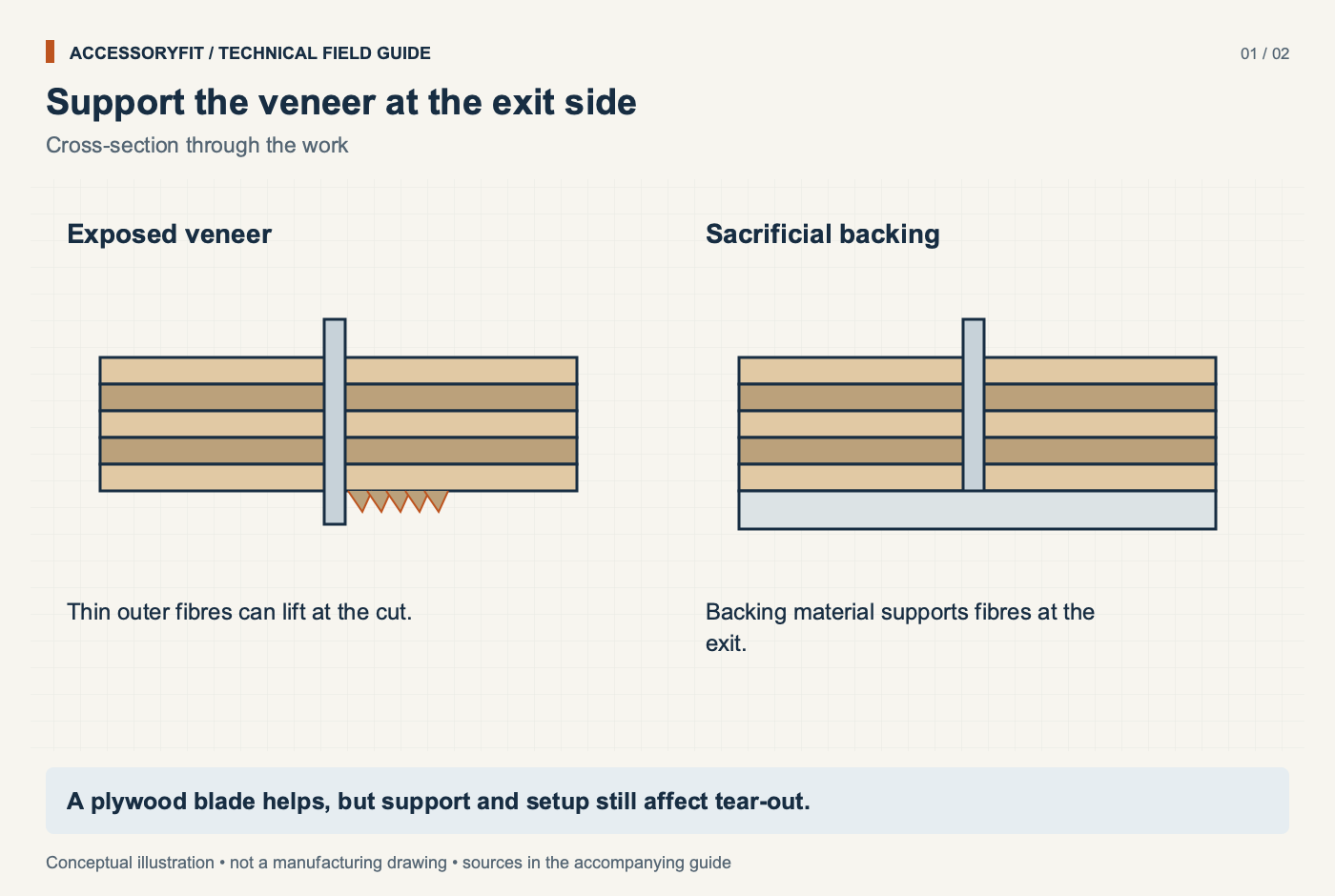
Support the panel near the cut. DeWalt and Makita tell users to support large panels near the cut line so the kerf does not close on the blade and cause kickback.
Fit the blade the right way round. On a handheld circular saw the teeth point up at the front of the saw, matching the rotation arrow on the guard.
Protect the carbide. Carbide teeth are brittle. Store blades so that teeth do not touch other blades, and do not drop them.
Setup matters as much as the blade on a table saw: Woodcraft notes that a blade not parallel to the miter slot rubs the work with the rear of the blade. For other saw blade categories and how they compare, the saw blade guides hub groups them by tool, and the buyer guides section lists the other product comparisons. If you are unsure which accessories your saw model accepts, the accessory finder lists the published specs by tool.
A plywood blade helps, but support and setup still affect tear-out.
08Questions readers ask
How many teeth should a plywood blade have?
For a 10 in blade, crosscut and fine-finish blades usually have 60 to 80 teeth, and the blades sold for veneered plywood and melamine sit at the top of that band. For a 7-1/4 in circular saw blade, compare within the same diameter: the Diablo D0760A carries 60 teeth against 40 on Diablo's D0740A finish blade.
Can I use a 10 in plywood blade on a 7-1/4 in circular saw?
No. Fit only the blade diameter marked on the saw, because a wrong-size blade may not be guarded properly. Matching arbor size alone is not enough.
Is a thin-kerf blade better for plywood?
Only on the right saw. Thin kerf removes less material and helps lower-powered saws, but Rockler says it brings no significant advantage on contractor or cabinet saws, and a thin-kerf blade can bind on a standard-thickness riving knife.
Does a plywood blade cut melamine?
Yes. Freud and Diablo list melamine among the cuts for their Hi-ATB plywood blades. For panels with hard laminate on both faces, a TCG blade is the grind published for that job.
Will a US plywood blade fit a European circular saw?
Not directly. European saws in the Bosch GKS 190 class commonly take a 30 mm bore, and some Makita models change bore by country version. Use a blade with the bore your saw specifies and never a third-party spacer.
Colorado State University and Montana Technological University, Annals of Work Exposures and Health 67(5): The Evaluation of Worker Exposure to Airborne Silica Dust During Five OSHA Table I Construction Tasks
DeWalt: DWA271460 7-1/4 in (184 mm) 60T circular saw blade; DWA261240 6-1/2 in 40T circular saw blade; DWE575 circular saw instruction manual (Recommended Blade Types); DWS535B worm drive saw instruction manual (blade table); DWA271424 7-1/4 in 24T circular saw blade; DWAW71440 Elite Series 7-1/4 in 40T circular saw blade; DWE7491RS 10 in Job Site Table Saw instruction manual (N531890); DW3508 6-1/2 in x 1/8 in x 5/8 in Diamond Drive Metal Cutting Blade; DWS713 10 in Compound Miter Saw instruction manual (NA379757); DWS780 12 in Double Bevel Sliding Compound Miter Saw instruction manual (N466020); DWA110CMB 10 in (254 mm) 40T and 60T saw blades 2-pack; DWA3193PCD 7-1/4 in laminate / fiber cement saw blade
European Parliament, Legislative Observatory (procedure 2016/0130(COD), final act summary): Protection of workers from exposure to carcinogens or mutagens at work: exposure limit values - Directive (EU) 2017/2398, final act
Freud and Diablo: D1080X 10 in x 80T Ultra Finish saw blade product page; LU73R010 10 in Cabinetmaker's Crosscut Blade (product specs); D1060X 10 in x 60T Fine Finish Saw Blade (product specs); LU72R010 10 in General Purpose Blade (product specs); LU84R011 10 in Combination Blade (product specs); D1040X 10 in x 40T General Purpose Saw Blade (product specs); D1050X 10 in x 50T Combination Saw Blade (product specs); LU87R010 10 in Thin Kerf Rip Blade (product specs); D1024X 10 in x 24T Ripping Saw Blade (product specs); D0760A 7-1/4 in x 60T Ultra Finish saw blade product page; D0724A product page (framing family listing incl. D0624A, D0620X, D0824X); D0740A product page (finish family listing incl. D0641A, D0840X); Frequently Asked Questions; LU91R010 10 in Thin Kerf Sliding Compound Miter Saw Blade (product specs); LU97R010 10 in Double Sided Laminate/Melamine Blade (product specs); LU79R010 10 in Thin Kerf Ultimate Plywood & Melamine Blade product page; LU80R010 10 in Ultimate Plywood and Melamine Blade (product specs); LU88R010 10 in Thin Kerf Fine Finish Crosscut Blade (product specs); D1060S 10 in x 60T Fine Finish Saw Blade (product specs); D1280X product page (fine finish family listing incl. D0860X); D12100X 12 in x 100T Ultimate Polished Finish blade - tech specs; D1244X 12 in x 44T General Purpose blade - tech specs; D0770F product page (thin metal family listing incl. D0756F, D1490CF); D1472CF product page (medium metal family listing incl. D0748CFA); LM72R012 12 in Heavy-Duty Rip Blade - tech specs; LU84R012 12 in Combination Blade - tech specs; LU85R012 12 in Ultimate Cut-Off blade - tech specs; D0524X 5-3/8 in x 24T Framing Saw Blade - tech specs; D0624A 6-1/2 in x 24T Framing Saw Blade - tech specs; D0660A 6-1/2 in x 60T Ultra Finish Saw Blade - tech specs; D0824X 8-1/4 in x 24T Framing Saw Blade - tech specs; D0704DH 7-1/4 in x 4T HardieBlade for fiber cement - tech specs (fiber cement family listing); Get the most out of your Freud bits by routing at ideal feed rates and speeds
Health and Safety Executive (UK): Wood dust exposures in manufacturing industries; EH40/2005 Workplace exposure limits (Fourth Edition 2020)
James Hardie: Good, Better, Best Cutting Practices; Working Safely with Silica
Mallory Safety and Supply (retailer): Milwaukee 48-40-4505 14 in 72T blade listing
Milwaukee Tool: 48-40-4235 7-1/4 in 48T metal cutting circular saw blade; 48-40-4505 14 in 72T metal cutting circular saw blade; M18 FUEL 7-1/4 in Circular Saw 2732-20 - specifications; M12 FUEL 5-3/8 in Circular Saw 2530-20 - specifications; M18 FUEL 8-1/4 in Table Saw 2736-20 - specifications; M18 FUEL oscillating multi-tool 2836-20 operator's manual (58-14-0217d1)
National Toxicology Program, US Department of Health and Human Services: Report on Carcinogens, Fifteenth Edition: Wood Dust
NIOSH: Reducing Hazardous Dust Exposure When Cutting Fiber-Cement Siding (WP Solutions 2015-185); Comprehensive Report: Laboratory Evaluation of Saw Blades for Cutting Fiber-Cement Siding; Hazard Controls: Control of Wood Dust from Random Orbital Hand Sanders and Orbital Hand Sanders
OSHA: 29 CFR 1910.213 Woodworking machinery requirements; 29 CFR 1910.243 Guarding of portable powered tools; 29 CFR 1926.1153 Respirable crystalline silica, Table 1; Occupational Exposure to Respirable Crystalline Silica; Final Rule (29 CFR Parts 1910, 1915, and 1926); 29 CFR 1910.215 Abrasive wheel machinery; 29 CFR 1926.303 Abrasive wheels and tools; 29 CFR 1926.300 General requirements (Tools, hand and power); 29 CFR 1926.304 Woodworking tools
Purdue University, Journal of Occupational and Environmental Hygiene: Evaluation of Cut-Off Saw Exposure Control Methods for Respirable Dust and Crystalline Silica in Roadway Construction
Rockler: Table Saw Blades: A Complete Guide; Saw Blade Glossary; How to Clean and Maintain Your Saw Blades
SKIL: 7-1/4 in Lightweight Worm Drive SKILSAW SPT77WML-01
Technical University in Zvolen, MM Science Journal: Effect of Selected Factors on Mass Concentration of Airborne Dust During Wood Sanding
ToolsToday: Saw Blade Tooth Geometry: The Secret to a Perfect Cut
University of California, Berkeley, Journal of Occupational and Environmental Hygiene 16(5): Effect of hollow bit local exhaust ventilation on respirable quartz dust concentrations during concrete drilling
University of Massachusetts Lowell, Journal of Occupational and Environmental Hygiene: Reducing Silica and Dust Exposures in Construction During Use of Powered Concrete-Cutting Hand Tools: Efficacy of Local Exhaust Ventilation on Hammer Drills
US Government Publishing Office, Electronic Code of Federal Regulations: 29 CFR 1926.1153 Respirable crystalline silica (current eCFR text)
Virginia Tech, Annals of Work Exposures and Health 69(3): Silica exposure controls usage in masonry and concrete trades: before and after enactment of the OSHA Silica Construction Rule (1926.1153)
Woodcraft: Burn-Free Table Saw Cuts (Robert J. Settich)