Best reciprocating saw blades for demolition: picks by tooth material, TPI and body
A demolition blade for a reciprocating saw needs a coarse pitch of about 5–7 TPI, a thick and tall body that resists bending, and teeth that survive nail strikes. Diablo's DS0906CWS3 uses carbide teeth for nail-embedded wood; Milwaukee's The Ax and Bosch's RDN9V are bi-metal options at a similar pitch; Milwaukee's 49-22-1129 kit adds metal and multi-material blades. All fit the universal shank. These picks compare published maker specifications against demolition needs; none was tested by us.
01What should a reciprocating saw blade for demolition have?
A demolition blade should combine a coarse tooth pitch, a stiff body and a tooth material that tolerates hidden nails and screws. Rip-out work rarely meets clean timber: studs carry nails, sill plates carry anchors and old floors carry staples, so the blade has to keep cutting after it hits steel. Each requirement below names the published figure behind it.
Tooth pitch: coarse enough to clear chips
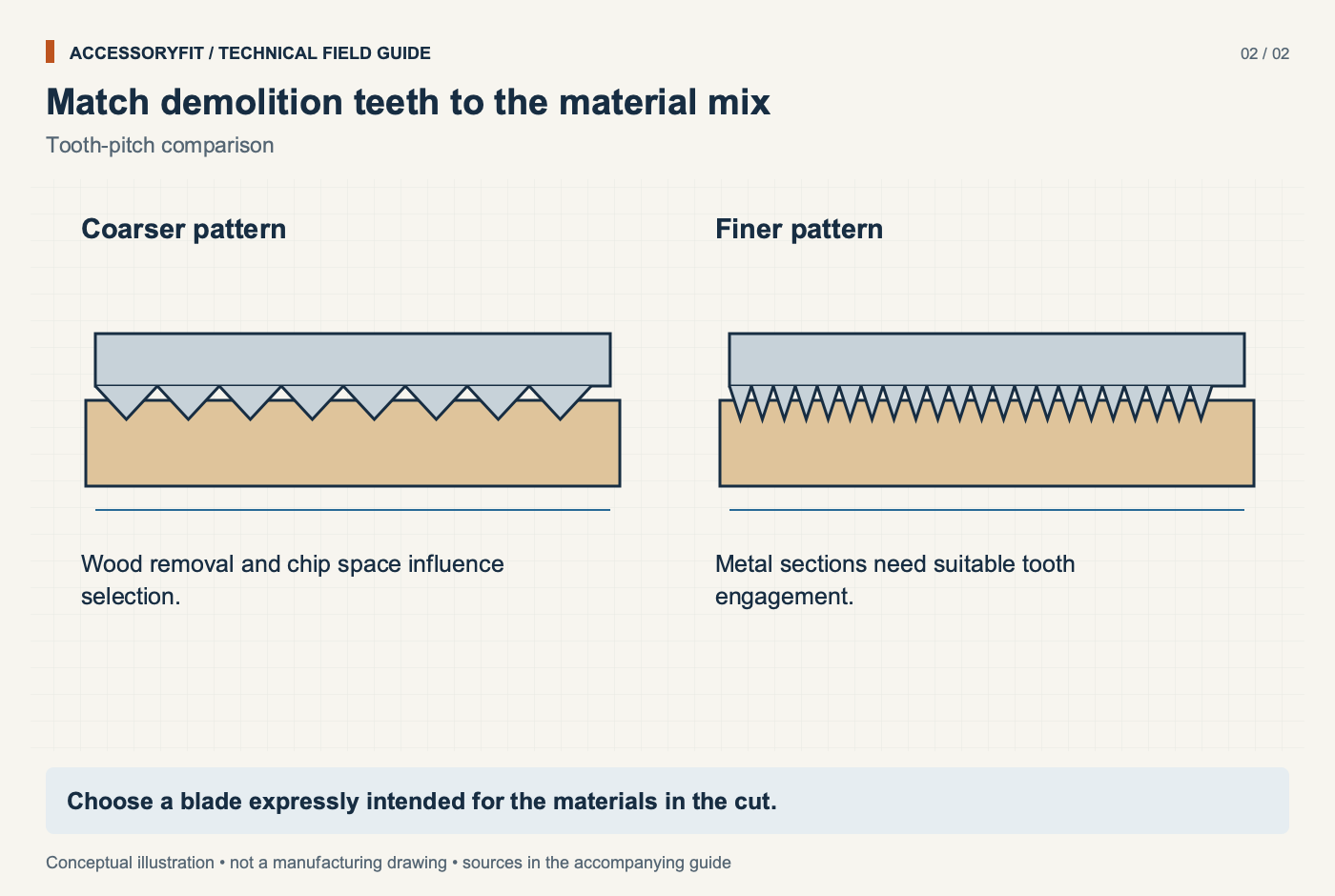
Blades sold for wood with nails and general demolition typically sit at about 5–7 TPI. Fewer, larger teeth clear wet or dirty wood quickly and leave room in each gullet for chips. That pitch is far coarser than the 18–24 TPI used for thin sheet metal, which is why a metal blade clogs and stalls in framing. Variable or progressive pitch, as on the Diablo and Bosch picks, mixes tooth sizes along the blade so that some teeth bite quickly while others smooth the stroke.
Body thickness and height: thick and tall
Manufacturers make demolition blades thicker and taller than ordinary wood or metal blades so they resist bending, cut straighter and break less often. Lenox gives its demolition blades for nail-embedded wood a thickness of .062 in (1.6 mm), the heaviest of the thicknesses it lists (.035, .042, .050, .062 in (0.9, 1.07, 1.3, 1.6 mm)). Milwaukee and Diablo both describe a body 1 in tall on their demolition picks. A taller blade also resists twisting when you lever the saw against a stud.
Tooth material: bi-metal or carbide
Bi-metal blades put a high-speed steel cutting edge on a spring-steel back, which lets the blade flex instead of snapping. Carbide-tipped blades weld hard carbide to the edge for tougher work such as nail-heavy wood, thick metal and cast iron. Lenox and Diablo both state a life figure for carbide-tipped blades of up to 50x vs. standard bi-metal (manufacturer claims); treat it as a maker's claim from their own applications, not an independent result.
Length: longer than the work, but not by much
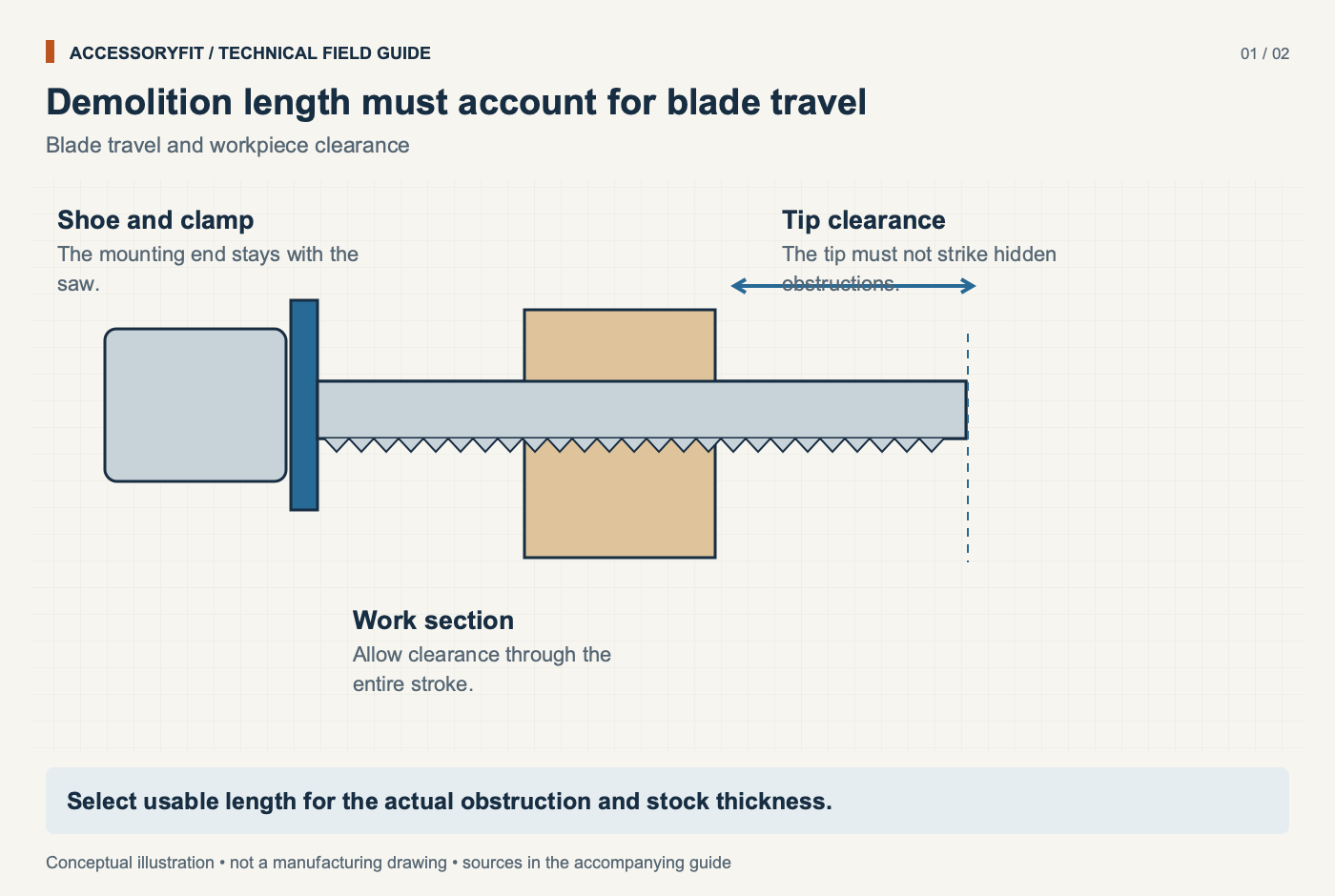
Reciprocating blades commonly come in 4, 6, 8, 9, 10, 12 in (102, 152, 203, 229, 254, 305 mm). Lenox sizes the blade as material width + 3 in (76 mm), so the tip stays in the cut through the whole stroke. All four picks below are offered at 9 in, a length that covers doubled studs and most framing without the whip of a much longer blade.
Select usable length for the actual obstruction and stock thickness.
Reciprocating blade TPI by application, from Lenox, Milwaukee, Diablo and Bosch examples
Thickness bands for thick, medium and thin metal come from the Lenox TPI selection guide (p. 8); Diablo states its own bands on each product. The bands overlap between brands.
02Will a demolition blade fit your reciprocating saw?
Yes, in nearly every case: demolition blades from Diablo, Milwaukee and Bosch use the universal shank that most current reciprocating saws accept, regardless of brand. Bosch describes its shank as a 1/2 in (12.7 mm) universal shank, and Diablo says its blades fit all corded and cordless reciprocating saws. A Milwaukee blade therefore fits a DeWalt, Makita or Bosch saw, and the same applies in Europe, where Bosch sells the shank as the S-shank. For older clamps and the few exceptions, see our guide to which recip blades fit your saw.
Stroke length matters more than brand. Current full-size saws travel about 1-1/8 to 1-1/4 in per stroke; for example, Milwaukee 2722-20 lists 1-1/4 in and Makita XRJ05Z lists 1-1/4 in. The blade has to be long enough that its teeth stay in the material at the back of the stroke, which is the reason behind Lenox's rule of the work width plus a margin. A blade that leaves the cut on each stroke slaps against the work, and that vibration loads the body. If your saw's stroke is not listed, the manual gives it.
Product links go to Amazon. As an Amazon Associate I earn from qualifying purchases. How links are chosen.
These four products are the demolition blades in our catalogue whose makers list wood with nails or general demolition as the intended work. They are grouped by tooth material and pack type, not ranked. Specs come from each manufacturer's product page. Lengths, pitches and pack sizes are as the maker states them; Amazon listings can bundle packs differently, so read the listing title before you order. To check what else your saw accepts, the accessory finder lists published tool specs.
Carbide teeth for nail-heavy framing tear-out
Diablo DS0906CWS3 9 in. 5/7 TPI Demo Demon carbide teeth reciprocating blades for nail-embedded wood (3 pk)
Length
9 in
Pitch
5/7 TPI
Teeth
carbide teeth
Body height
1 in
Pack
3 pcs
Suits Remodellers and demolition crews cutting through studs, plates and subfloor where nails are frequent, on corded or cordless saws.
Skip it if Thin sheet metal and conduit, where a fine-pitch metal blade is the published choice, and clean pruning cuts where a standard wood blade does the job.
Carbide teeth, the tooth material makers sell for the hardest demolition work
Variable 5/7 TPI pitch for nail-embedded and clean wood
Oversized 1 in body that Diablo says cuts straighter
Diablo lists corded and cordless reciprocating saws
The life advantage over bi-metal is Diablo's own claim
Only one length in this pack
Carbide is brittle if the blade is twisted or dropped
Published specs of the demolition picks (manufacturer data)
Blade
Length
Pitch
Tooth material
Body height
Pack
Diablo DS0906CWS3 9 in. 5/7 TPI Demo Demon carbide teeth reciprocating blades for nail-embedded wood (3 pk)
9 in
5/7 TPI
carbide teeth
1 in
3 pcs
Milwaukee 48-00-5026 9 in. 5 TPI The Ax SAWZALL blades (5 pk)
9 in
5 TPI
bi-metal
1 in
5 pcs
Bosch RDN9V 5 pc. 9 in. 5/8 TPI Edge reciprocating saw blades for wood/nail demolition
9 in
5–8 TPI
bi-metal
not stated
5 pcs
Milwaukee 49-22-1129 SAWZALL demolition blade set (12 pc.)
6 and 9 in
mixed
bi-metal
1 in
12 pcs
04How do the demolition picks differ from each other?
The picks split first by tooth material, carbide against bi-metal, and then by whether you buy one blade type or a mixed kit. Pitch and length are close across all four, so those two choices decide most of the difference.
Carbide or bi-metal: which edge for nail-embedded wood?
The Diablo DS0906CWS3 is the only carbide-toothed pick. Diablo sells it for nail-embedded wood and rough-in demolition, and carbide is the material makers recommend for the hardest reciprocating work, including cast iron and thick metal. The Milwaukee Ax and Bosch RDN9V use bi-metal, whose spring-steel back flexes rather than cracks. If a blade will be bent, levered or pinched often, bi-metal tolerates that abuse; if the risk is dulling on nails, carbide is the published answer.
The Ax vs the RDN9V: fixed or progressive pitch?
Milwaukee gives The Ax a fixed 5 TPI pitch and a FANG TIP shaped for plunge cuts. Bosch spaces the RDN9V teeth progressively at 5–8 TPI. Both sit inside the 5–7 TPI band used for demolition. Choose The Ax when you start many cuts in the middle of a panel, such as cutting openings in subfloor or sheathing; choose the RDN9V when cuts start at an edge and you want a smoother entry.
Single-type pack or mixed kit?
The Milwaukee 49-22-1129 kit contains The Ax for wood with nails, The Wrecker for general-purpose demolition, and The Torch for metal, in shorter and longer lengths. That suits a renovation where you cannot see what is inside the wall. A pack of one blade type suits a job where you already know the material, such as stripping out a deck frame. The kit's metal blades are finer-pitched and thinner, so they should not be pressed into framing work.
05When is a demolition blade the wrong choice?
A demolition blade is the wrong choice for thin metal, masonry, and clean cuts where finish matters. Coarse teeth and a thick body are a trade-off, and in the jobs below the trade works against you.
Thin sheet metal and conduit. Thin and medium sheet calls for about 18–24 TPI, and thick metal for 8–14 TPI. Lenox advises keeping 2–3 teeth in the material at all times; a coarse demolition blade on thin sheet has too few teeth in contact, so it snags and tears the edge.
Brick, tile, stone and cast iron pipe. These need a toothless carbide-grit or diamond-grit blade, as the table above lists. For slabs and block walls, a saw or grinder with one of our diamond blades for concrete cuts deeper and straighter.
Clean wood, pruning and plastic pipe. Lenox lists a separate clean-wood blade for these jobs with a thinner body than its demolition blades, and pruning blades use fleam-ground teeth made for green wood. A demolition blade cuts them, but the dedicated blade suits the job better.
Long, straight finish cuts. A reciprocating saw is a rough-cut tool. Where a cut must be square and smooth, a circular saw with a finish blade does the job; the saw blade hub groups blades by tool.
A common belief is that a thin blade is better for demolition because it cuts faster. The makers say the reverse: demolition blades are the thickest and tallest in their ranges, and Milwaukee states that its thicker body resists fracturing and bending. Another belief is that the longest blade is always safest. Lenox sizes the length to the work instead, because extra length adds whip and bending without adding cutting depth that the job needs.
Choose a blade expressly intended for the materials in the cut.
Reciprocating blade tooth materials and their published uses
Material
Use
Manufacturer notes
High-carbon steel (HCS)
Wood, wood fibreboard, soft plastics
Bosch: carbon steel for softer materials
Bi-metal (BIM)
Metal, wood with nails, multi-material
High-speed steel cutting edge on a spring steel back to reduce breaks (Lenox); flexible, unbreakable bond of HCS and HSS (Bosch)
Bosch definitions from catalogue p. 52; Lenox from 2024 catalogue pp. 2-6.
06Which blade should you use for clean wood or PVC pipe?
For clean wood and plastic pipe, use a wood blade rather than a demolition blade: Lenox's application table lists a clean-wood blade with a thinner body than its demolition blades. Many buyers searching for reciprocating saw blades for wood really need one of these, not a nail-rated demolition blade.
Plastic pipe such as PVC cuts cleanly with a wood or multi-purpose blade, and a finer pitch leaves fewer burrs on the cut end. Reach for a demolition blade only when the wood is likely to hide fasteners, for example fence rails, pallets, old decking and framing. If you cut mixed materials in one session, a multi-purpose blade such as Milwaukee's Wrecker sits between the two, and the kit above includes it.
Whichever blade you fit, keep the shoe on the work and let the saw's speed do the cutting. When cutting metal with any blade, DeWalt says forcing the blade shortens its life and breaks it, and both DeWalt and Makita call for a thin film of oil or coolant on the cut line.
07Which reciprocating saw blades suit trees, limbs and roots?
For trees, limbs and roots, use a pruning blade: a coarse reciprocating saw blade of about 3–6 TPI sold for limbs, branches and green wood, rather than a demolition blade. The low end of that range is carbide, as on Diablo's pruning family and Milwaukee's carbide AX pruning blade; the higher end is steel or bi-metal with fleam-ground teeth, as on Milwaukee's 48-00-1301 and Lenox's pruning blades.
Why fleam-ground teeth?
Steel and bi-metal pruning blades use fleam-ground teeth, which Milwaukee says cut cleanly in both directions in green wood. A demolition blade's job is surviving nails; a pruning blade's job is clearing sappy fibre, so the two are not substitutes even where their pitch overlaps.
What length for limbs?
Pruning blades come in 6, 9 and 12 in (152, 229, 305 mm), and the two longer sizes are the common choice for limbs. Lenox's rule of the work width plus a margin applies here as it does in framing: pick the length from the thickest limb you plan to cut, not the longest blade in the shop. Milwaukee sells its carbide AX pruning blade for branches and roots, including cuts that run into dirt and rocks, which is the case where a carbide edge earns its place over steel.
The table lists the pruning blades the makers publish, with length, pitch and stated use. All of them use the universal shank, so any of them fits the saws the demolition picks above fit.
Pruning blades by maker: length, TPI and tooth type
Blade
Length
TPI
Tooth
Stated use
Diablo DS0603CP
6 in (152 mm)
3
Carbide
Pruning and clean wood
Diablo DS0903CP
9 in (229 mm)
3
Carbide
Pruning and clean wood
Diablo DS1203CP
12 in (305 mm)
3
Carbide
Pruning and clean wood
Milwaukee 48-00-1301
9 in (229 mm)
5
Fleam ground, induction hardened
Limbs, branches, green wood
Milwaukee 48-00-1303
12 in (305 mm)
5
Fleam ground, induction hardened
Limbs, branches, green wood
Milwaukee 48-00-5332
9 in (229 mm)
3
Carbide (AX)
Branches and roots, incl. dirt and rocks
Lenox 121016W6R / 121029W6R
6 in / 9 in
6
Fleam ground bi-metal
Clean wood, plastics, pruning
Milwaukee 48-00-1303 width 3/4 in and thickness .049 in seen only in search summaries; not used.
08How do you stop a demolition blade bending or snapping?
Most broken demolition blades come from a loose shoe, forcing the cut or a blade that is too long or too thin for the work. The fixes are mostly technique, plus choosing the body and length described above.
Keep the shoe tight to the work. DeWalt says this stops the saw jumping and vibrating and reduces blade breakage.
Let the motor reach full speed first. Starting under pressure stalls the stroke and bends the blade.
Match the length to the cut. A blade much longer than the work flexes more on every stroke.
Choose a thick, tall body for demolition. The makers design these blades to resist bending and cut straighter.
Do not lever the saw sideways. Twisting a carbide-toothed blade can chip the teeth, and twisting any blade bends it.
A full list of causes and checks is in our guide to reciprocating blade breakage. For other blade categories and product comparisons, the buyer guides section lists every guide on the site.
09Questions readers ask
What TPI is best for demolition with a reciprocating saw?
Blades for wood with nails and general demolition are typically about 5–7 TPI. The Diablo and Bosch picks use a variable or progressive pitch within that range, and Milwaukee's The Ax uses a fixed 5 TPI.
Do Diablo or Bosch demolition blades fit a Milwaukee or DeWalt saw?
Yes. All four picks use the universal shank, which Bosch says suits most saws on the market and Diablo says fits all corded and cordless reciprocating saws.
Is a carbide demolition blade worth it over bi-metal?
It depends on nail density. Carbide is the material makers sell for the toughest cuts, and Lenox and Diablo claim a much longer life than bi-metal in nail-embedded wood. Bi-metal flexes rather than chipping, so it copes better with a blade that gets bent or pinched.
Can a demolition blade cut through brick or concrete?
No. Toothed demolition blades are for wood with nails and, in some cases, light metal. Brick, tile, stone and cast iron need a toothless carbide-grit or diamond-grit blade, and concrete slabs are better cut with a diamond blade on a grinder or saw.
Can I use a demolition blade to cut tree branches?
It will cut them, but a pruning blade is the better match. Pruning blades run about 3–6 TPI and, in steel and bi-metal, use fleam-ground teeth that Milwaukee says cut cleanly in both directions in green wood.
How long should a demolition blade be?
Lenox sizes the blade as material width + 3 in (76 mm). For most stud and plate cuts that points to the 9 in length that all four picks offer.