
Category hub · Router bits
Router bits: profiles, shank sizes and how to choose them
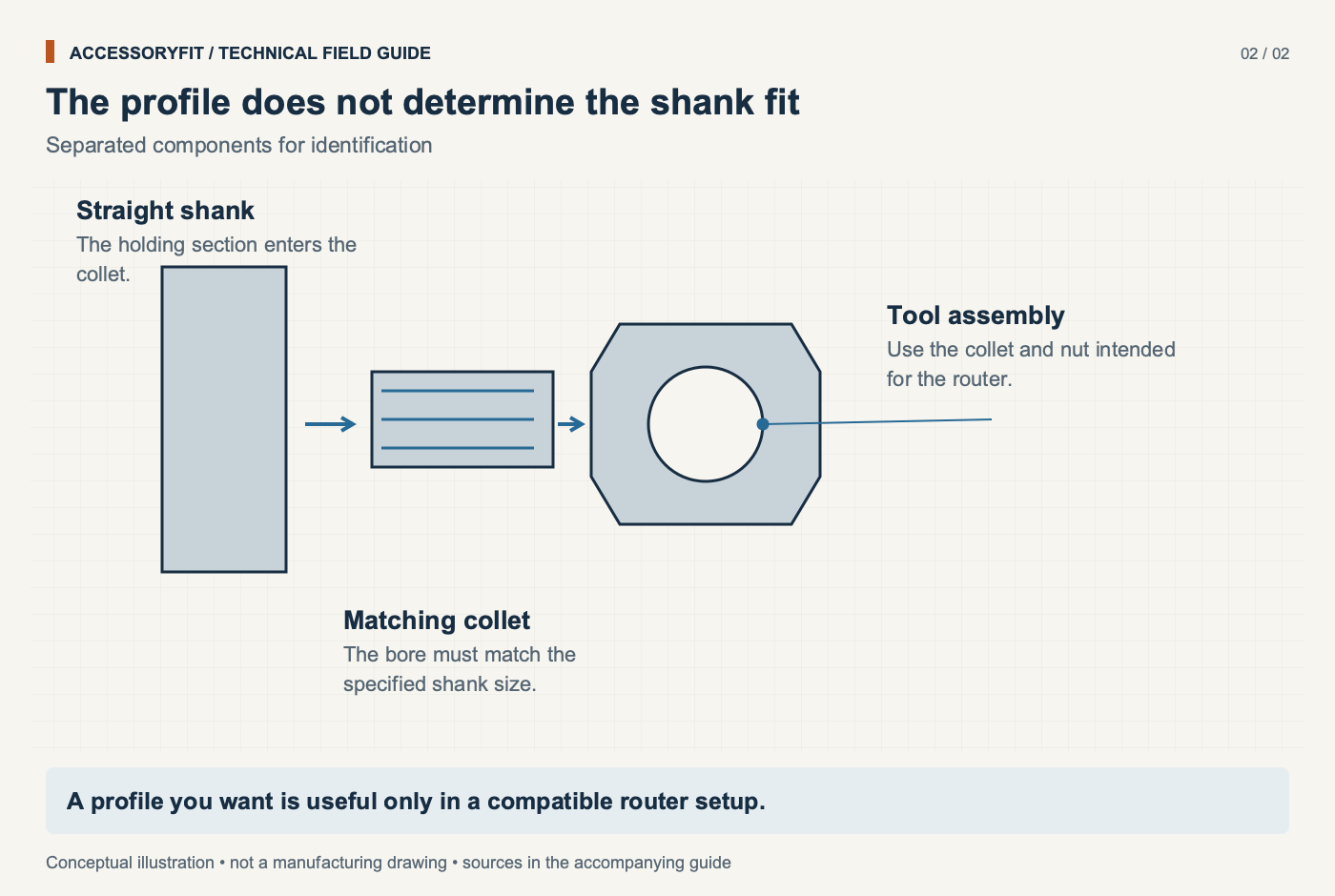
A router bit fits when its shank matches the router's collet exactly, and it is safe to run when its rated speed is at or above the router's top speed. Compact trim routers take 1/4 in shanks; mid-size and full-size routers usually take both inch sizes, and European routers add metric collets. Once the shank fits, the profile decides the cut: straight bits for grooves, bearing-guided bits for edges and templates, spiral bits for clean slots in sheet goods. This hub explains each choice for bits used in wood and links to the guide that covers it in full.
On this page
- What types of router bits are there?
- Which router bits fit your router?
- Should you buy 1/4 in or 1/2 in shank bits?
- Why do larger router bits need a lower speed setting?
- Up-cut, down-cut or compression: which spiral bit?
- Which way should you feed a router?
- When does a router bit that fits still burn or chip?
What types of router bits are there?
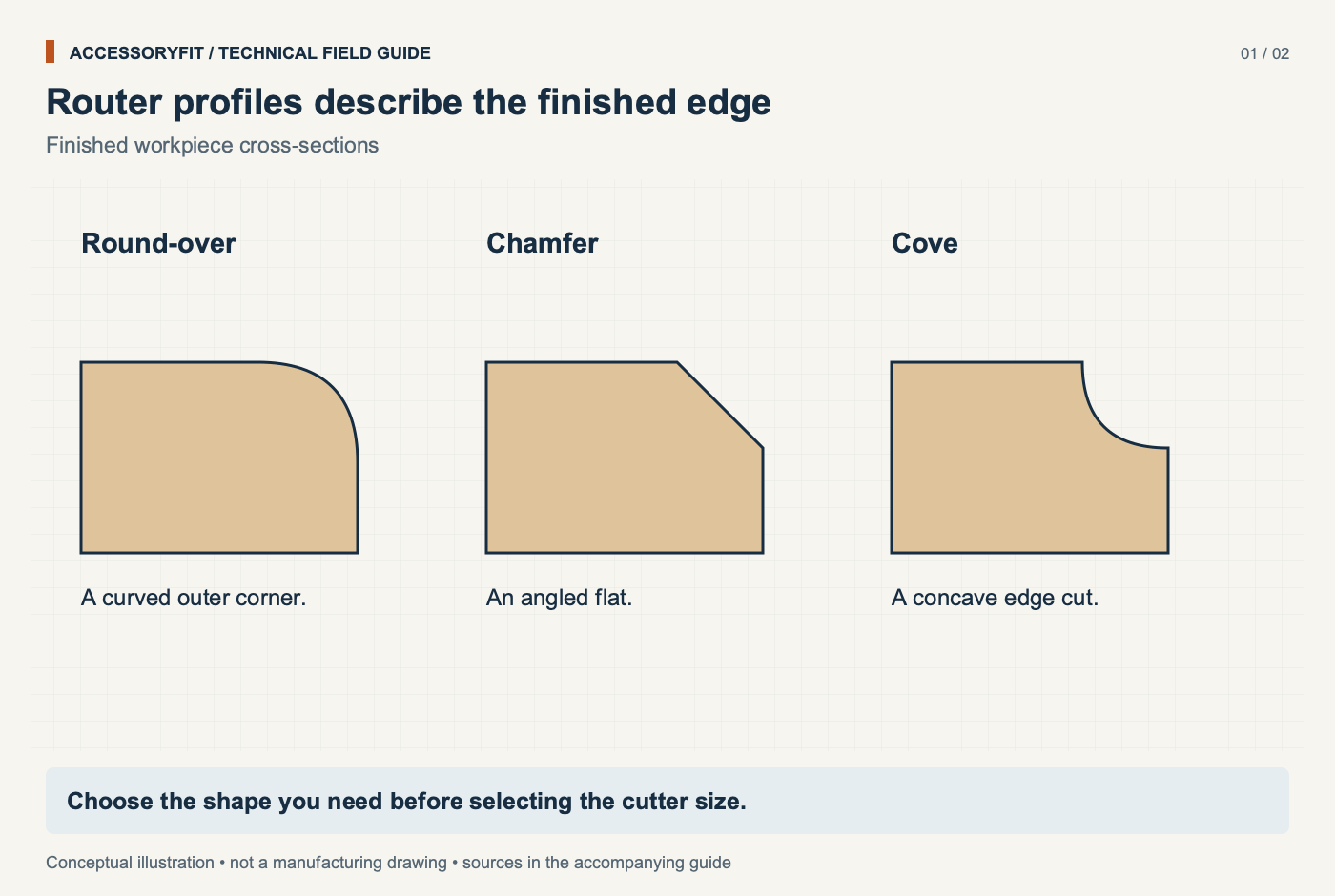
Router bits divide by the shape they leave, called the profile: straight and spiral bits cut grooves, dadoes and mortises; edge-forming bits such as round-over, cove, chamfer and ogee shape an edge; trimming bits follow a template or a second surface; and joinery bits such as dovetail, rabbeting and rail-and-stile sets cut joints. Most edge-forming bits carry a ball-bearing guide that rides along the workpiece edge or a template, so the router needs no fence.
Bearing position separates two bits that look alike and are often confused. A flush trim bit has its bearing at the tip, below the cutter, so it trims the work flush to whatever lies underneath, such as a face frame, laminate or a template under the work. A pattern bit has its bearing on the shank side, so a hand-held router follows a template fastened on top. Both cut flush, but the template goes on opposite faces. Rabbeting sets go one step further and change the depth of cut by swapping bearings.
The table below lists the common profiles with an example bit and the speed its maker rates it for. The article on choosing router bits explains each profile with the joints and edges it makes, and the buyer guide to starter router bit sets compares sets for a first router.
| Profile | What it cuts / typical use | Guide | Example bit (shank, diameter) | Example rated speed |
|---|---|---|---|---|
| Straight | Grooves, dadoes, mortises; plunge-capable | None (use fence or guide) | Whiteside 1074 (1/2 in shank, 17/32 in) | 16,000-18,000 rpm, max 24,000 |
| Flush trim (bottom bearing) | Trim to a template or edge underneath; laminate, veneer, face frames | Bearing at tip | Whiteside 2415 (1/2 in, 7/8 in) | 14,000-16,000 rpm, max 18,000 |
| Pattern (top bearing) | Follow a template fastened on top of the workpiece | Bearing on shank side | Rockler pattern flush trim (1/2 in, 3/4-1-1/8 in) | not recorded |
| Round-over | Rounded, softened edge; the most popular edge bit | Tip bearing | Whiteside 2016 (1/2 in, 3-3/4 in, 1-1/2 in radius) | 10,000-12,000 rpm, max 12,000 |
| Cove (cove & bead) | Concave (and convex) decorative edge | Tip bearing | Whiteside 3212 (1/2 in, 1-5/16 in) | 14,000-16,000 rpm, max 18,000 |
| Chamfer | 45 degree bevelled edge; mitred corners | Tip bearing | Whiteside 2310 (1/2 in, 2-5/8 in) | 10,000-12,000 rpm, max 12,000 |
| Roman ogee | Concave plus convex curve; table and top edges | Tip bearing | Whiteside 2210 (1/2 in, 2 in) | 10,000-12,000 rpm, max 12,000 |
| Rabbeting (bearing set) | Recessed shoulder along an edge; depth set by bearing | Interchangeable tip bearings | Freud 32-522 (1/2 in, 1-3/8 in); Whiteside 1952 (1/4 in, 1-3/8 in) | Whiteside 1952: 13,000-15,000 rpm, max 18,000 |
| Dovetail | Interlocking dovetail joints (drawers, boxes) | Jig or template guide | Whiteside D14-75 (1/2 in, 3/4 in, 14 deg) | 14,000-16,000 rpm, max 18,000 |
| V-groove | V-shaped grooves, lettering, sign making; 60, 90 or 120 deg | None | Whiteside 1566 (1/2 in, 1-1/2 in, 120 deg) | 14,000-16,000 rpm, max 18,000 |
| Rail and stile (set) | Interlocking stile and rail joints for cabinet doors, with the panel groove cut in the same pass; two-bit set, router table | Bearings | Whiteside 6002 ogee set (1/2 in, 1-5/8 in) | 12,000-14,000 rpm, max 16,000 |
| Raised panel | Raised door and drawer panels; router table only | Tip bearing | Whiteside 5920B (1/2 in, 3-1/4 in); Freud 99-522 (1/2 in, 3-1/2 in) | Whiteside 5920B: 10,000-12,000 rpm, max 12,000 |
| Spiral up-cut | Fast chip removal, deep cuts, mortises; clean edge on far face | None | Whiteside RU7306 (3/4 in, 3/4 in) | 12,000-14,000 rpm, max 18,000 |
| Spiral down-cut | Clean top edge; shallow grooves, dadoes, inlays | None | Whiteside RD7306 (3/4 in, 3/4 in) | 12,000-14,000 rpm, max 18,000 |
| Spiral compression | Clean edges on both faces of sheet goods | None | Whiteside UD7202 (3/4 in, 3/4 in) | 12,000-14,000 rpm, max 18,000 |
Speeds are for the specific example bit; a bit of the same profile but different diameter can carry a different rating. Always use the speed marked on or supplied with the bit.
Which router bits fit your router?
A bit fits only a collet whose bore matches its shank diameter. Compact routers from DeWalt, Milwaukee and Makita ship with a 1/4 in collet, so they take that shank only. Mid-size and full-size US routers usually ship with both 1/4 and 1/2 in collets; the Bosch 1617 family lists capacities of 1/4 in, 3/8 in, 1/2 in, 8 mm, and the DeWalt DW618 lists 1/4, 1/2 in.
European routers add metric sizes. Bosch supplies its POF 1400 ACE with 6 mm, 8 mm, 1/4 in collets, Festool sells an 8 mm collet for its OF-series routers, and Makita lists its larger plunge routers at 12 mm or 1/2 in. For two more European pro routers only retailer listings are on file: The Power Tool Store lists the Festool OF 1400 EQ-F-Plus with 1/4 in, 8 mm, 1/2 in collets in the box, and Anglia Tool Centre lists the Trend T11EK with a 1/2 in collet, other sizes sold separately. An inch shank and a nearby metric shank are not interchangeable, which corrects one of the most repeated shortcuts in routing: a 1/4 in collet does not properly grip a metric shank of similar size, and a metric collet does not properly grip an inch shank.
Smaller shanks in a large collet need the router maker's own sleeve. Makita says small-shank bits in its larger collet must use the matching collet sleeve, and that fitting them without one can break the collet cone. The guide to router collet sizes lists collets by router, US and European, and the accessory finder shows the collets each listed router's maker states.
| Router | Market | Class | Collets / capacity | No-load speed |
|---|---|---|---|---|
| DeWalt DWP611 | US | Compact (trim) | 1/4 in (6.35 mm) | 16,000-27,000 rpm |
| Milwaukee M18 FUEL 2723-20 | US | Compact (trim), cordless | 1/4 in (6.35 mm) | 10,000-31,000 rpm |
| Makita RT0701C | US | Compact (trim) | Supplied: 1/4 in; manual capacity: 1/4 in, 3/8 in | 10,000-30,000 rpm |
| Bosch 1617EVSPK | US/Canada | Mid-size | 1/4 in, 3/8 in, 1/2 in, 8 mm (capacity) | 8,000-25,000 rpm |
| Milwaukee 5616-24 | US | Mid-size | 1/4 in and 1/2 in supplied | 10,000-24,000 rpm |
| Makita RP2301FC | US | Full-size plunge | Supplied: 1/4 in and 1/2 in; capacity 12 mm or 1/2 in with 3/8 in and 1/4 in collet sleeves | 9,000-22,000 rpm |
| Bosch POF 1400 ACE | EU/UK | Mid-size (DIY) | 6 mm, 8 mm, 1/4 in supplied | 11,000-28,000 rpm |
| Bosch GOF 1600 CE Professional | UK | Full-size | Bit holder 8-12.7 mm; UK kit: 1/4 in and 1/2 in collets | 10,000-25,000 rpm |
| Festool OF 900 / OF 1000 / OF 1010 / OF 1010 R | EU | Mid-size | 8 mm collet SZ-D 8 available | not recorded |
| Festool OF 1400 EQ-F-Plus | US/EU | Mid-size | Supplied: 1/4 in, 8 mm, 1/2 in (retailer listing) | 10,000-22,500 rpm |
| Trend T11EK | UK | Full-size | Supplied: 1/2 in; 6-12 mm collets sold separately (retailer listing) | 8,000-20,000 rpm |
Supplied collets vary by kit and country; always check the specific kit. Festool speeds were not fetched (Festool site blocked automated access). Makita RT0701C: product page lists only a 1/4 in collet in the box, while the manual spec table gives 1/4 in and 3/8 in capacity. Festool OF 1400 and Trend T11EK rows come from retailer listings only, because the makers' sites blocked automated access.
Should you buy 1/4 in or 1/2 in shank bits?
Buy 1/2 in shank bits whenever the router takes them; the larger shank gives more stability and less vibration. The smaller 1/4 in shank bits are for compact routers, which have no larger collet, and for small profiles where a large shank adds nothing.
Compact routers also cap the cutter size. DeWalt says not to use bits with a diameter above 1-3/8 in in its DWP611, and Milwaukee lists a maximum bit size of 1-1/2 in for its M18 FUEL 2723 compact router. Bosch's own specification for the Bosch PR20EVS gives a maximum cutter diameter of 1-5/16 in. Large bits such as raised-panel cutters come with the larger shank and are meant for a router table, at reduced speed.
How far the shank goes in matters too. Bosch, DeWalt and Milwaukee all say to insert the bit fully and then back it out slightly so it does not bottom out in the collet, which is the opposite of the common habit of pushing it all the way home. The exact gap differs by maker, and Bosch adds that the shank must go in at least 5/8 in.
Why do larger router bits need a lower speed setting?
Never faster than the bit's rated speed, and slower as the bit gets larger. A router bit's maximum rated speed must be at least the maximum speed marked on the router, because a bit run above its rating can break and fly apart. Router manuals give lower dial settings for larger bits, and bit makers publish lower maximum speeds as cutting diameter rises.
The figures differ by source, so read the bit's own rating first. IGM's bit safety sheet, in the table below, steps the maximum down with each diameter band, and Whiteside rates its large raised-panel bit at a maximum of 12,000 rpm. CMT describes the same pattern in its own chart, with maximum speed falling as diameter rises, and says the speed marked on the bit or its packaging governs. Compact routers run far faster than that at full speed: the DeWalt DWP611 lists 27000 rpm and the Bosch PR20EVS 35000 rpm, which is one more reason large bits do not belong in them.
The belief that a router should always run at full speed is wrong for anything but small bits. Use the speed dial, and if the router has none, keep to bits small enough for its fixed speed.
| Bit diameter | Maximum rpm |
|---|---|
| 2-25 mm (about 1/16-1 in) | 24,000 |
| 25-50 mm (about 1-2 in) | 18,000 |
| 50-75 mm (about 2-3 in) | 16,000 |
| 75-90 mm (about 3-3-1/2 in) | 12,000 |
Single manufacturer chart. The maximum rpm etched on the bit or printed in its documentation always takes priority. Inch values are conversions.
Up-cut, down-cut or compression: which spiral bit?
Choose by which face must be clean. Up-cut spirals lift chips up and out, which suits deep cuts and mortises, but they leave the cleanest edge on the face farthest from the router and more tear-out on the near face. Down-cut spirals push chips down and leave the cleanest edge on the face nearest the router, which suits shallow grooves, dadoes and inlays, though they clear chips more slowly. Compression spirals combine both flute directions to leave clean edges on both faces of sheet material.
That corrects a common assumption that any spiral bit gives a clean top edge. If a slot in veneered plywood shows fuzz along the top, the bit is probably an up-cut, and a down-cut or compression spiral is the fix. Sheet goods raise the same clean-face question when they are cut to size first; the hub on saw blades and tooth grinds covers the blades used for that.
Which way should you feed a router?
Against the bit's rotation. Seen from above, a hand-held router bit turns clockwise, so when routing an edge in front of you, move the router from left to right; go counterclockwise around the outside of a workpiece and clockwise around the inside. Feeding the other way, called climb cutting, can pull the router along and cause loss of control.
Feed rate and depth matter as much as direction. Feeding too slowly leaves friction burns, and a bit that makes dust instead of chips carries less heat away, so its edge dulls sooner; Freud ties early dulling to that too-fine chip. Speed can cause the same thin-chip rubbing from the other side: ToolsToday says a bit spinning too fast for the feed rubs instead of cutting and burns, and that lowering the speed while keeping the feed can help. Deep cuts belong in several passes of increasing depth rather than one heavy pass, which overloads the motor. Makita, for example, limits groove depth per pass on its RP-series routers to 15 mm with 8 mm bit; 5 mm with 20 mm bit.
When does a router bit that fits still burn or chip?
A bit that fits the collet still burns when the feed is too slow or the bit is dull, and chips or tears when the feed direction, spiral direction or bit design is wrong for the face that shows. The table below pairs each symptom with its cause and fix, drawn from manufacturer manuals and guides.
Two failures need more than a technique change. A dull or damaged bit overloads the motor and needs extra force, which can break the bit, so manufacturers say never to use one. The load is measurable: a 2024 BioResources study, milling wood on a CNC router at 18,000 rpm with a 16 mm carbide cutter, found a blunt edge drew on average 51.6% more cutting power than a sharp one. A bit that slips or creeps in the collet points to a mismatched shank, a missing sleeve or a shank that was bottomed out before tightening. The guide to router bit burning and chipping works through each cause in order.
A router that suddenly shakes is worth stopping for, because routers are normally smooth tools. UK HSE's L140 guidance, whose 2019 second edition is still the current one, gives routers a recommended initial vibration estimate of 3 m/s², among the lowest of the woodworking tools it lists and well below its figure for jigsaws; the table reflects tools in use before 2015. Marked vibration on top of that often points back to the bit: a bent or unbalanced cutter, a small shank carrying a large profile, or a shank seated wrongly in the collet.
| Symptom | Cause | Fix |
|---|---|---|
| Burn marks | Feed too slow or not smooth | Feed at a steady, moderate rate; do not linger |
| Burn marks / early dulling | Bit making dust instead of chips (chip load too small) | Raise feed rate relative to speed; make test cuts |
| Motor overload, rough cut | Dull bit | Replace or sharpen; never use dull or damaged bits |
| Motor overload / stalling | Cut too large for one pass, or feed too fast | Make several passes of increasing depth; reduce feed |
| Router pulls or runs away | Wrong feed direction (climb cutting) | Feed against bit rotation: left to right on an edge facing you, counterclockwise around outside edges |
| Tear-out on the top face | Up-cut spiral lifts top fibres | Use a down-cut or compression spiral |
| Splintering on panel faces | Bit design | Use bits with shearing or down-cutting wings (e.g. Freud Quadra-Cut raised-panel design) |
Excess rpm as a cause of burning was not stated in any fetched source and is left out.
Router bit guides on AccessoryFit
- Router bit profilesChoosing bits for edges and joints
- Router collet sizesInch and metric collets by router
- Router bit sets for beginnersSets compared on published specs
- Router bit burning or chippingFeed, speed and sharpness
- Accessory finderSee the collets your router's maker lists
Questions readers ask
Can a metric router bit go in an inch collet?
No. A 1/4 in shank and a metric shank of similar size are different sizes and are not interchangeable. Manufacturers require the collet to match the shank, otherwise it may not grip or may break.
Do compact routers take 1/2 in shank bits?
Not the common ones. Compact routers from DeWalt, Milwaukee and Makita ship with a 1/4 in collet, and DeWalt and Milwaukee also cap the bit diameter for their compact models.
Is a flush trim bit the same as a pattern bit?
No. Both cut flush to a guide surface, but a flush trim bit has its bearing at the tip and a pattern bit has it on the shank side, so the template goes on opposite faces of the work.
Why does my router bit burn the wood?
Usually a feed that is too slow or uneven, or a dull bit. Feed steadily against the bit's rotation and take deep cuts in several passes; replace dull or damaged bits rather than forcing them.
Where to go next
- Router collet sizesWhich shank each router takes, inch and metric.
- Router bit profilesWhat each profile cuts and which bearing it uses.
- Router bit burning and chippingFix burn marks and tear-out by cause.
References 71 documents, 30 publishers
- ABCM, COBEM 2005 proceedings: Influence of the Lubri-Cooling System on the Life of TiAlN Coated HSS Twist Drills when Machining Blind and Through Holes
- Anglia Tool Centre (retailer): Trend T11EK 1/2 in router listing
- Annals of Work Exposures and Health: The Effects of Bit Wear on Respirable Silica Dust, Noise and Productivity: A Hammer Drill Bench Study
- Applied Ergonomics (Elsevier): Pneumatic rock drill vs. electric rotary hammer drill: Productivity, vibration, dust, and noise when drilling into concrete
- BioResources: Effect of Chip Thickness and Tool Wear on Surface Roughness and Cutting Power during Up-Milling Wood of Different Density
- Bosch: 1617/1618 router operating/safety instructions (2610051825); High-Speed Steel Single-Flute Straight Bits (Canada product page); 1617EVSPK combination plunge and fixed-base router (Canada product page); GOF 1600 CE Professional router (UK product page); POF 1400 ACE router (Bosch DIY UK product page); POF 1400 ACE Oberfräse (Bosch DIY Germany product page); GOF 1600 CE Professional router (Colombia product page); PR10E/PR20EVS palm router operating/safety instructions 2610021461; PR20EVS Colt palm router (Canada product page); PR20EVS Colt Electronic Variable-Speed Palm Router product page
- Burns Tools: Amana HSS1640 HSS double flute aluminium bit 5/16 in listing
- CMT Orange Tools (C.M.T. Utensili): Router bits and drill bits safety recommendations (2025)
- DeWalt: DWP611 compact router instruction manual (N336740); DWP611 1.25 HP max torque variable speed compact router with LED; DW616/DW618 Instruction Manual N384518; DWE575 circular saw instruction manual (N786997), general power tool safety; DWP611 1-1/4 HP Max Torque Variable Speed Compact Router product page
- Festool: Collet SZ-D 8/OF 1010 (488755)
- Freud and Diablo: Get the most out of your Freud bits by routing at ideal feed rates and speeds (CNC feed and speed sheet)
- Health and Safety Executive (UK): Hand-arm vibration: The Control of Vibration at Work Regulations 2005. Guidance on Regulations (L140, Second edition)
- Human Factors and Ergonomics Society: Construction Ergonomics: Concrete Bit Wear Increases Handle Vibration and Drilling Time
- IGM Tools & Machinery: GPSR router bits safety instructions (2024-12-17)
- Infinity Cutting Tools: How to choose solid carbide spiral router bits
- International Journal of Industrial Ergonomics (Elsevier): R2: Drilling into concrete: Effect of feed force on handle vibration and productivity
- Journal of Wood Science: Effect of tool material on tool wear and delamination during machining of particleboard
- Makita: RP1800/RP1801F/RP2301FC plunge router instruction manual; RP0910/RP1110C electronic router instruction manual (Makita Czech catalogue file); RT0701C 1-1/4 HP compact router product page; RP2301FC 3-1/4 HP plunge router product page; RT0701C compact router instruction manual; RP2301FC router data sheet (Ficha técnica)
- Milwaukee Tool: M18 FUEL compact router 2723-20 operator's manual (58-14-0194d1); M18 FUEL compact router 2723-20 product page; 2-1/4 Max HP EVS multi-base router kit 5616-24
- Multitronic (retailer): Bosch POF 1400 ACE router listing
- NIOSH: Nonfatal Tool- or Equipment-Related Injuries Treated in US Emergency Departments Among Workers in the Construction Industry, 1998-2005; Nonfatal work-related injuries treated in hospital emergency departments in the U.S., 2012-2023
- Power Tool Centre (retailer): Festool 488755 collet SZ-D 8/OF 1010 listing
- Rockler: Rockler Pattern Flush Trim Router Bits - 1/2" Shank; Rockler Piloted Flush Trim Router Bits - 1/2" Shank
- The Power Tool Store (retailer): Festool OF 1400 EQ-F-Plus router 578951 listing
- Timbecon: Freud 1/2in shank router bits (collection page)
- ToolsToday: Is a flush trim bit the same as a pattern bit? (Q&A); Why Your CNC Router Bit Is Burning Wood (And Why Slowing Down Might Make It Worse); Router Safety: Best Practices for Safe, Precise, & Efficient Routing
- Tribology in Industry: Comparison of Wear Behaviours of Cathodic Arc TiN, TiAlN Coated and Uncoated Twist Drills Under Aggressive Machining Conditions
- Whiteside Machine Co.: 2016 roundover bit; 2210 roman ogee bit; 2310 45 degree chamfer bit; 3212 cove and bead bit; 1566 120 degree V-groove bit; D14-75 14 degree dovetail bit; RU7306 up cut spiral; RD7306 down cut spiral; UD7202 up/down cut (compression) spiral; 2415 flush trim bit; 6002 ogee stile and rail set; 5920B raised panel bit with back cutter; 1984 small pilot roundover; SC01 carbide straight bit; 1952 multi-rabbet bit set; 1074 straight bit; Steel router collet / reducer bushing 6400x10
- Woodcraft: Freud 32-522 4 piece rabbeting router bit set with bearings, 1/2" shank; Freud 99-522 Quadra-Cut raised panel router bit, bevel, 1/2" shank
- Woodworker's Journal: Router Speed Settings
Accessed .