
Fit guide · Circular saws
Circular saw blade arbor size: which blade fits your saw
Most US circular saws, including the common 6-1/2 in and 7-1/4 in sizes, take blades with a 5/8 in round arbor hole. A blade fits only when three things match the saw: the diameter marked on the saw, the arbor size and shape (round or diamond), and a marked maximum speed at or above the saw's no-load RPM. The exceptions are compact trim saws (10 mm), track saws (20 mm), worm-drive saws with a diamond arbor, and European saws, which commonly use a 30 mm bore.
By AccessoryFit editors · Checked
On this page
- What is a circular saw arbor, and what does arbor size mean?
- What arbor size do circular saw blades use?
- Which blades fit popular circular and track saws?
- What is the diamond knockout, and when do you remove it?
- Can you use a reducer bushing or arbor adapter on a circular saw?
- Is a blade safe at your saw's RPM?
- Can a 7-1/4 in blade go on a 6-1/2 in saw?
- Which direction does a circular saw blade go on?
- How do US arbor sizes compare with European bores?
- When does a blade not fit, even if the hole looks right?
- What else decides which blade to buy?
What is a circular saw arbor, and what does arbor size mean?
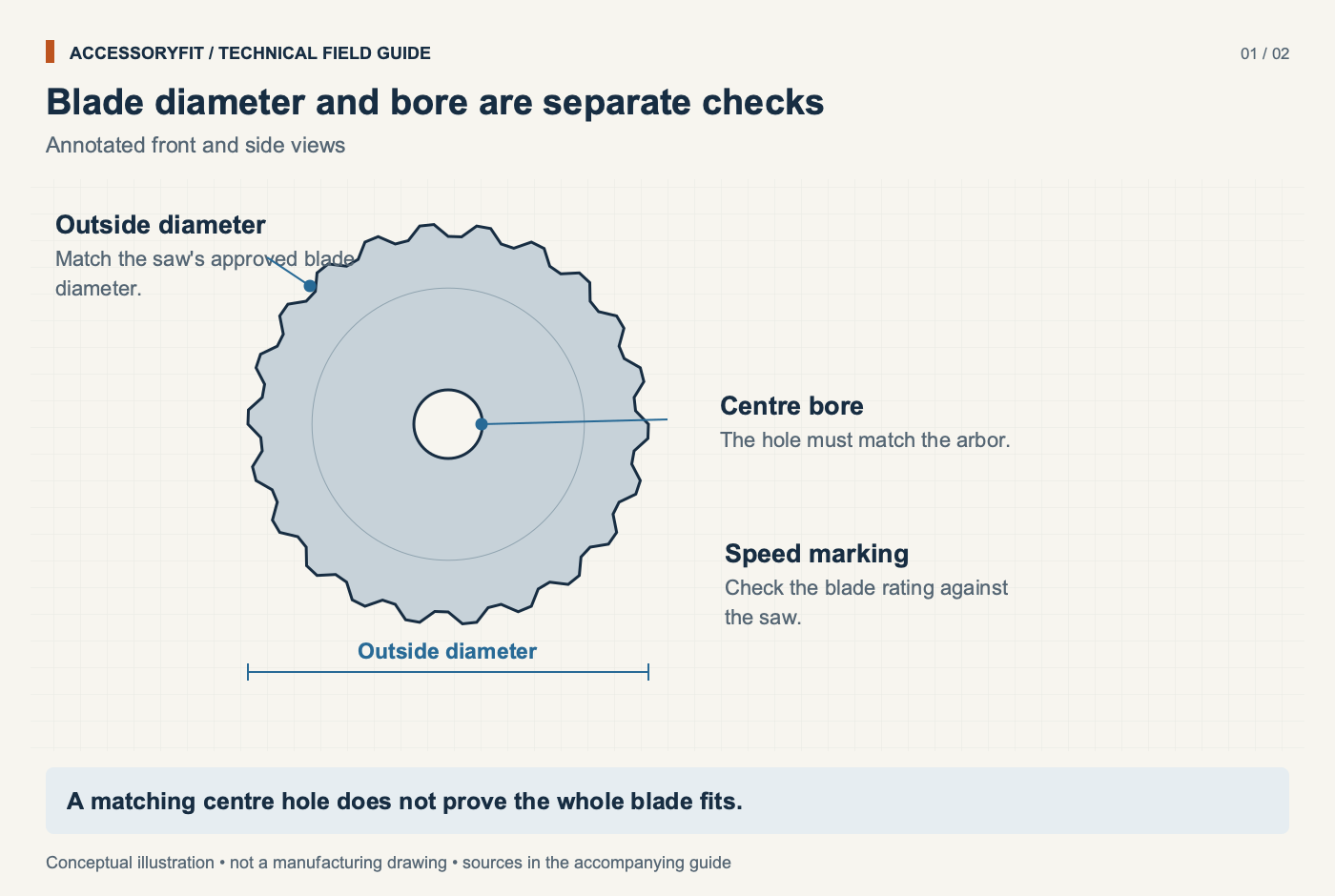
The arbor is the spindle the blade mounts on, and the arbor size is the diameter of that spindle, which the hole in the centre of the blade (the bore or arbor hole) must match exactly. The blade is clamped between the saw's own inner and outer flanges by the arbor bolt, and the saw's manual names both the hole size and its shape.
Two hole shapes exist on handheld saws. Most sidewinder saws use a round arbor; many worm-drive saws use a diamond-shaped one. Makita's 5007MG manual and DeWalt's DWE575 manual both say to use only blades with the correct arbor-hole size and shape, because a mismatched blade runs off-centre and can cause loss of control. The US workplace rule for woodworking machinery says the same thing in regulatory language: blades must be machined to fit the arbor.
Arbor size is only one of three fit checks. The other two are blade diameter and rated speed, both covered below. A blade that slides onto the spindle can still be the wrong blade for the saw, which is why Makita's own manuals warn that an accessory attaching to a tool does not make it safe to use.
What arbor size do circular saw blades use?
In the US, circular saw blades use a 5/8 in arbor for every common handheld size, with compact trim blades as the main exception. Diablo, Makita, Milwaukee and DeWalt all list that hole for 7-1/4 in blades and saws, and Diablo and Makita list the same 5/8 in hole for 6-1/2 in cordless saws and their blades.
The same hole carries on to the larger blades used in table and miter saws: Diablo and Milwaukee list 5/8 in for the next size up, and Diablo, Makita and DeWalt list 5/8 in for the common miter and table saw size, until the largest miter-saw class switches to a 1 in hole. Compact saws go the other way: Diablo's trim blades and Milwaukee's M12 FUEL compact saw use a 10 mm arbor, so a standard blade from a full-size saw will not fit them. Two less common sizes sit outside that pattern. Diablo lists a 1/2 in arbor for its small blades made for saws such as the Porter-Cable Saw Boss, so those saws take neither the standard nor the trim-saw hole. At the other end, the large dry-cut metal saw blades from Diablo and Milwaukee use a 1 in arbor, the same hole as the biggest miter-saw blades but on a blade built for a dedicated metal-cutting saw. Sizes for the bigger bench saws are covered in more depth in the guides to table saw arbor sizes and miter saw blade sizes.
The table below lists each US diameter with its arbor, plus one example of a blade's marked maximum speed next to a saw's no-load speed, all from manufacturer specifications.
| Blade diameter | Arbor | Example blade max RPM (marked) | Example saw no-load RPM |
|---|---|---|---|
| 5-3/8 in | 10 mm | 12,000 (Diablo D0524X) | 3,600 (Milwaukee 2530) |
| 6-1/2 in (165 mm) | 5/8 in (15.9 mm); track saws 20 mm | 8,000 (Diablo D0624A); 10,000 (Diablo D0660A) | 3,700 (Makita XSS02Z) |
| 7-1/4 in (184 mm) | 5/8 in round; diamond on worm-drive saws | 8,000 (Diablo D0740A) | 5,800 (Makita 5007MG, Milwaukee 2732) |
| 8-1/4 in | 5/8 in | 8,000 (Diablo D0824X) | 6,300 (Milwaukee 2736 table saw) |
| 10 in (254 mm) | 5/8 in | 6,000 (Diablo D1040X) | 3,200 (Makita LS1019L); 4,600 (Makita LS1040) |
| 12 in (305 mm) | 1 in (25.4 mm) | 5,000 (Diablo D1244X) | 3,200 (Makita LS1219L) |
Max RPM values are for the named blades only; always read the marking on your blade. Exceptions exist: Diablo D0640X is a 6 in blade with a 1/2 in arbor for the Porter-Cable Saw Boss; Diablo D1632X 16-5/16 in uses 1 in. DeWalt's DWS780 12 in saw has a 5/8 in spindle and a 1 in blade adapter.
Which blades fit popular circular and track saws?
Each saw's maker states the blade diameter and arbor it accepts, and the table below collects those published figures for the circular and track saws in the AccessoryFit tool database. Where a maker does not state a value, the table says so rather than filling it in. The same data, searchable by model, sits behind the accessory finder.
Two saws with the same blade diameter can still take different blades. The Makita XSH03Z and the Makita SP6000J both take 6-1/2 in blades, but the first has a 5/8 in arbor and the plunge-cut track saw has a 20 mm arbor. A track-saw blade and a framing blade of the same diameter are not interchangeable for that reason alone. Among 7-1/4 in saws, the Makita 5007F and Milwaukee 2731-20 both list a 5/8 in round arbor, while the DeWalt DWS535B worm-drive saw needs a diamond-arbor blade.
| Tool | Blade diameter | Arbor | No-load speed |
|---|---|---|---|
| DeWalt DCS570 | 7-1/4 in | 5/8 in one source | 5500 rpm |
| DeWalt DWE575 | 7-1/4 in | 5/8 in one source | 4800 rpm one source |
| DeWalt DWS535B | 7-1/4 in | diamond one source | 4800 rpm |
| Festool TS 55 FEQ-F-Plus | 160 mm | 20 mm | 5800 rpm |
| Makita 5007F | 7-1/4 in | 5/8 in | 5800 rpm |
| Makita 5377MG | 7-1/4 in | 5/8 in | 4500 rpm |
| Makita SP6000J | 6-1/2 in | 20 mm | 5200 rpm |
| Makita XSH03Z | 6-1/2 in | 5/8 in | 5000 rpm |
| Milwaukee 2731-20 | 7-1/4 in | 5/8 in | 5000 rpm |
| Ryobi PBLCS300 | 7-1/4 in one source | 5/8 in one source | 4300 rpm one source |
Values marked one source appear in a single manufacturer document; check the tool's manual or rating plate before buying.
What is the diamond knockout, and when do you remove it?
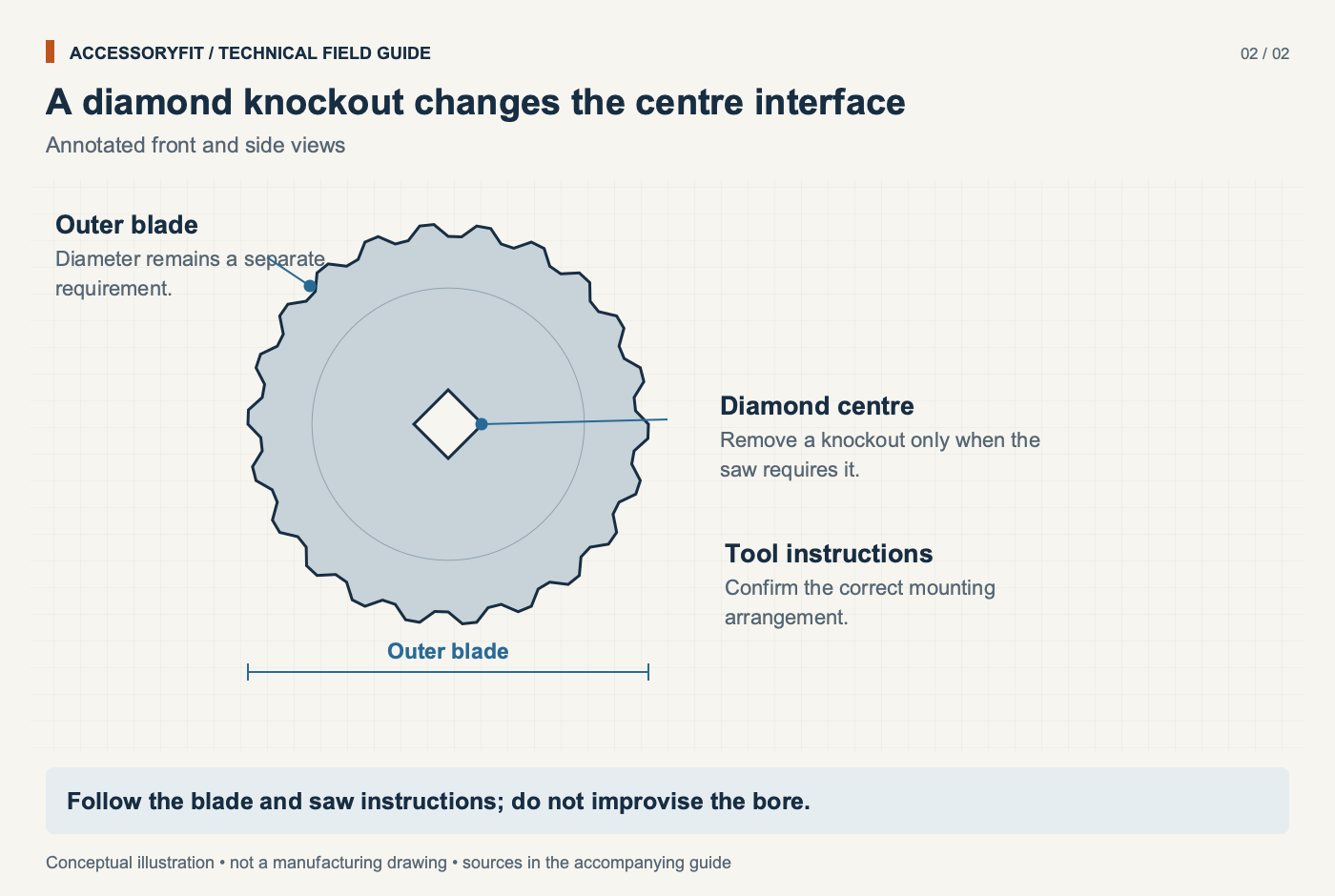
The diamond knockout is a pre-cut diamond-shaped centre in some blades that is knocked out so the blade fits a worm-drive saw's diamond arbor. Worm-drive saws such as the SKILSAW SPT77WML and the DeWalt DWS535B use a diamond-shaped arbor, and DeWalt's DWS535B manual says only blades with a diamond-shaped arbor centre can be used on that saw. DeWalt's DW3508 metal-cutting blade is one example sold with a diamond knockout for worm-drive saws.
DeWalt's manual adds that the knockout must be removed before the blade goes on, and that a blade should never be installed with the knockout still in place, because without full engagement the blade can contact parts of the saw. The same manual asks for care when knocking the centre out.
Not every worm-drive-style saw uses a diamond. The Makita 5377MG hypoid saw lists a 5/8 in arbor, and Makita's 5377MG manual describes a two-sided inner flange whose sides suit 5/8 or 13/16 in blade holes. Makita warns that mounting the flange on the wrong side causes dangerous vibration. Check the manual of your own saw rather than assuming from its gearbox style.
Can you use a reducer bushing or arbor adapter on a circular saw?
Only the ring, flange side or adapter that the saw's own maker supplies for that bore is acceptable; saw manuals say not to use spacers to make a blade fit. DeWalt's DWE7491 table saw manual says not to use any spacers to make a blade fit onto the spindle. Makita's HS7611 manual covers saws designed with an arbor-hole ring and warns that the ring must match the blade's hole, because the wrong ring can let the blade move and vibrate severely.
Factory adapters do exist. DeWalt's DWS780 miter saw has a 5/8 in spindle and DeWalt supplies its own adapter for blades with a 1 in hole. Makita's two-sided 5377MG flange, described above, is another manufacturer-designed solution for two hole sizes.
Aftermarket reducer bushings sold separately are a different matter. No saw manufacturer source in the AccessoryFit fact base approves third-party bushings, and the no-spacers instruction points the other way. The practical rule follows: if the blade's hole does not match your saw and the saw's manual does not list a ring or adapter for that hole, buy a blade with the correct hole instead.
Is a blade safe at your saw's RPM?
A blade is safe for speed when the maximum RPM marked on it equals or exceeds the no-load speed marked on the saw. DeWalt and Makita manuals both state this rule, and the general accessory rule behind it is that an accessory run faster than its rated speed can break and fly apart.
In one published example the check passes with room to spare. Diablo marks its 7-1/4 in wood blades for a maximum of 8000 rpm, while the Makita 5007F runs at 5800 rpm and the Milwaukee 2731-20 at 5000 rpm. The check matters more when a blade crosses between tool types. In the US table above, the larger blades meant for miter and table saws carry lower marked maximums than the handheld sizes, so a blade borrowed from a bench saw needs its marking read before it goes on anything else.
The marking on the blade itself is the figure that counts. The maximum speeds in the tables are for the named blades only, and two blades of the same diameter can carry different ratings, as the two Diablo 6-1/2 in blades in the US table show.
Can a 7-1/4 in blade go on a 6-1/2 in saw?
No. Both sizes share a 5/8 in arbor, but manufacturers require the exact blade diameter marked on the saw, because a wrong-size blade may not be guarded properly. A common belief is that a matching arbor makes any blade a fit; Makita's HS7611 and LS1019 manuals say an incorrectly sized blade may affect guarding, and DeWalt's DWE575 manual tells owners to use the correct size blade. OSHA also expects the saw frame to limit the blade size that can be mounted.
Going smaller is no better. DeWalt's DWS713 manual says never to use a smaller blade, because it will not be guarded properly. A portable circular saw must have guards above and below the base plate, and the lower guard must return automatically and instantly to cover the blade when the saw comes out of the work.
Even the correct diameter leaves blade exposed below the work if the depth is set carelessly. Germany's construction-industry accident insurer, BG BAU, in its 2021 guidance for hand-held and site circular saws, says the blade should project no more than 10 mm (about 3/8 in) below solid timber, so the depth is set to the board being cut rather than left at the saw's maximum. Exposed teeth are what injure hands. Using CPSC's NEISS emergency department data for 2024, AccessoryFit estimates that about 9,500 injuries involving portable circular saws were treated in US emergency departments that year, and that 10.8% of them were diagnosed as amputations.
Which direction does a circular saw blade go on?
On a handheld circular saw, the blade goes on with the teeth pointing up at the front of the saw, so the arrow printed on the blade matches the rotation arrow on the guard. Makita's 5007MG manual and DeWalt's DWE575 manual both give this instruction.
Circular saw blade direction differs by saw type, which is why a blade can look backwards when it is moved between tools. A table saw blade is mounted with the teeth down at front, and on a miter saw DeWalt's manuals put the teeth at bottom toward back. All three follow the same underlying rule: the arrow on the blade matches the rotation arrow on the saw's guard.
Unplug the saw or remove its battery before changing the blade, then fit the saw's own inner flange, the blade, the outer flange and the bolt in the order the manual shows. Makita's manuals add a maintenance point that affects how a correctly mounted blade behaves: hardened gum and pitch slow the saw and raise kickback risk, so the blade should be cleaned off the saw with gum and pitch remover, hot water or kerosene, never gasoline. If cuts scorch even with a clean, correctly mounted blade, the guide on why saw blades burn wood works through the other causes.
How do US arbor sizes compare with European bores?
US blades are sized in inches and most have a 5/8 in hole, while European blades are sized in millimetres with bores of 20 mm or 30 mm. Both metric bores are larger than the US hole, so a European blade would sit loose on a US spindle, which is the off-centre condition the manuals forbid.
Bosch's GKS 190 hand-held saw takes a 30 mm bore, and Bosch's GCM 12 SDE mitre saw takes 30 mm as well. Makita's UK specifications for the HS7611 and HS6601 list two bores, depending on the country version, so a European owner needs to check the plate on the saw rather than the model number alone. Makita also sells the same model numbers in both markets with different blades: the European LS1019L takes a metric blade with a 30 mm bore, while the US version takes an inch blade with a 5/8 in hole.
Track saws are where a metric bore turns up on US saws. Makita's US track saws, the SP6000J and XPS01Z, list a 20 mm arbor, so their blades are not interchangeable with ordinary 6-1/2 in framing blades. Metric conversions of inch sizes also vary slightly between makers: DeWalt and Makita give different millimetre figures for the same inch blade, and the US table follows DeWalt's figures.
One metric size is easy to confuse with an inch size. DeWalt prints 10 in (254 mm) on its blades and manuals, so the two labels describe the same blade. Makita's EU specifications list a separate 260 mm size for European mitre and table saws such as the EU LS1019L and LS1040, with a 30 mm bore; per Makita, that is a different blade, not a relabelled inch size.
| Blade diameter | Bore | Example tool |
|---|---|---|
| 165 mm | 20 mm (some models 20 or 30 mm by country) | Makita SP6000J/XPS01Z track saws; Makita HS6601 |
| 185-190 mm | 30 mm (some models 20 or 30 mm) | Bosch GKS 190; Makita HS7611 |
| 216 mm | 30 mm | Makita LS0815FL mitre saw |
| 235 mm | 30 mm | Makita 5903R |
| 254 mm | 30 mm | Bosch GTS 254 table saw |
| 260 mm | 30 mm | Makita LS1019L, LS1040 (EU versions), MLT100N, 2704N |
| 305 mm | 30 mm | Bosch GCM 12 SDE; Makita LS1219 |
Makita's EU 10-inch-class mitre and table saws take 260 mm blades with a 30 mm bore, while the US versions of the same model numbers take 10 in (255 mm) blades with a 5/8 in hole. 216 mm and 235 mm rows rest on one Makita source each.
When does a blade not fit, even if the hole looks right?
A blade does not fit whenever any one of the three checks fails: diameter, hole size and shape, or speed rating. These are the cases the manufacturer manuals on this page call out:
- Diameter differs from the saw marking. Even with the right arbor, a wrong-size blade may not be guarded properly.
- Round hole on a diamond arbor, or the reverse. The blade runs off-centre and can cause loss of control.
- Metric bore on an inch spindle. A 20 mm or 30 mm blade is loose on a 5/8 in arbor unless the saw maker supplies a ring for it.
- Blade speed rating below the saw's no-load speed. Check this every time a blade moves between tool types.
- Worn or wrong flanges, washers or bolts. Makita says to use only the parts designed for that saw.
- Wrong ring or flange side. Both Makita warnings on rings and two-sided flanges describe severe vibration.
A blade can also fit perfectly and still be the wrong tool for the job. Demolition cuts through nail-embedded framing, for example, are covered in the guide to reciprocating saw blades built for demolition.
How do you check blade fit on a saw not listed here?
Five checks, in this order, confirm whether a blade fits a saw that is not in the table above. Each uses the markings on the saw, its manual and the blade itself.
- Disconnect power. Unplug the saw or remove the battery before handling the blade or flanges.
- Read the saw's blade diameter and no-load speed. Both are marked on the saw's nameplate or guard and listed in the manual's specifications.
- Confirm the arbor size and shape. The manual's specifications or blade-changing section states the hole size and whether the arbor is round or diamond, and lists any ring or adapter the maker supplies.
- Read the blade's markings. Check its diameter, bore and maximum RPM. The bore must match the arbor, and the maximum RPM must equal or exceed the saw's no-load speed.
- Mount it the right way round. Fit the saw's own flanges and bolt with the teeth pointing up at the front and the blade arrow matching the guard arrow, then check that the lower guard closes freely.
What else decides which blade to buy?
Once the arbor, diameter and speed checks pass, the remaining choice is about the cut: tooth count, grind, hook angle and kerf decide whether a blade rips fast, crosscuts cleanly or handles laminate. Those attributes are covered in the guide on how to choose a circular saw blade, and the circular saw blade selector narrows blades by material, teeth and size. For sheet goods, the shortlist of circular saw blades for plywood applies the same fit rules to specific products.
Every blade type on the site is grouped under the saw blade guides, and fit rules for drills, grinders, sanders and routers sit alongside this page in the compatibility guides.
Questions readers ask
Are all circular saw blades a 5/8 in arbor?
No. That is the US norm for 6-1/2 in and 7-1/4 in handheld saws, but compact trim saws use 10 mm, worm-drive saws use a diamond arbor, track saws commonly use 20 mm and the largest miter-saw blades use 1 in.
Do track saw blades fit an ordinary circular saw of the same diameter?
Not as a rule. Makita's SP6000J track saw has a 20 mm arbor, while Makita's XSH03Z circular saw of the same blade diameter has a 5/8 in arbor. Match the bore to the saw's manual, not the diameter alone.
Can I put a European 30 mm bore blade on a US saw?
Only if the saw's maker supplies a ring for that bore. Manufacturer manuals say not to use spacers, and a bore larger than the arbor lets the blade run off-centre.
What arbor does the largest miter saw blade class use?
US blades in that class use 1 in, and European mitre saws of the same class use 30 mm. DeWalt's DWS780 is an exception with a smaller spindle and DeWalt's own adapter for the larger hole.
Which way should the teeth face on a circular saw blade?
Up at the front of the saw, with the arrow on the blade matching the rotation arrow on the guard, according to Makita and DeWalt manuals.
Where to go next
- How to choose a circular saw bladeTeeth, grind and kerf once the blade fits.
- Table saw blade arbor sizesBench-saw arbors, adapters and kerf limits.
- Miter saw blade sizesLarger blades, lower speed ratings.
- Circular saw blade selectorFilter blades by material and size.
References 109 documents, 16 publishers
- Axminster Tools: Festool 160 mm TCT saw blades (160 x 2.2 x 20 mm) for TS 55
- BG BAU - Berufsgenossenschaft der Bauwirtschaft (Germany): Baustellenkreissaegen, Handkreissaegen - Baustein B 265
- Bosch: GKS 190 Professional Hand-Held Circular Saw - technical data; GCM 12 SDE Professional Mitre Saw - technical data; GTS 254 Professional Table Saw - technical data; 1617/1618 router operating/safety instructions (2610051825)
- DeWalt: DWA271424 7-1/4 in 24T Circular Saw Blade; DWE575 7-1/4 in Circular Saw instruction manual (N786997); DW3508 6-1/2 in x 1/8 in x 5/8 in Diamond Drive Metal Cutting Blade; DWS535B 7-1/4 in Worm Drive Circular Saw instruction manual (N512189); DWE7491RS 10 in Job Site Table Saw instruction manual (N531890); DWS713 10 in Compound Miter Saw instruction manual (NA379757); DWS780 12 in Double Bevel Sliding Compound Miter Saw instruction manual (N466020); DWA110CMB 10 in (254 mm) 40T and 60T saw blades 2-pack; DCS570P1 20V MAX* XR 7-1/4 in. Brushless Circular Saw Kit product page; DCS570 Instruction Manual NA517038 (Type 3); DWE575 7-1/4 in. Lightweight Circular Saw product page; DWS535B 7-1/4-in Worm Drive Circular Saw With Electric Brake product page; DWE7491RS product page, related accessory DWA11260 12 in (305 mm) 60T blade with 1 in arbor; DWS713 15 Amp 10 in Single-Bevel Compound Miter Saw - product page; DWS780 12 in Double-Bevel Sliding Compound Miter Saw - product page; DWS779 12 in Double-Bevel Sliding Compound Miter Saw - product page
- Festool: Track Saw TS 55 FEQ-F-Plus (576708) product page; TS 55 FEQ original operating manual (US)
- Freud and Diablo: D0740A 7-1/4 in x 40T Finish Saw Blade - tech specs; D0524X 5-3/8 in x 24T Framing Saw Blade - tech specs; D0624A 6-1/2 in x 24T Framing Saw Blade - tech specs; D0660A 6-1/2 in x 60T Ultra Finish Saw Blade - tech specs; D0824X 8-1/4 in x 24T Framing Saw Blade - tech specs; D1040X 10 in x 40T General Purpose Saw Blade - tech specs; D1244X 12 in x 44T General Purpose Saw Blade - tech specs; D0724A product page (framing family listing incl. D0620X 6 in); D1472CF 14 in x 72T Steel Demon Cermet II - tech specs; Get the most out of your Freud bits by routing at ideal feed rates and speeds; LU84R011 10 in Combination Blade - specs; LU79R012 12 in Thin Kerf Ultimate Plywood & Melamine Blade - specs; LU85R012 12 in Carbide Tipped Saw Blade for Crosscutting - specs; SD206 6 in Pro Dado Set - specs; SD208S 8 in Pro Dado Set - specs and description; LU91R010 10 in Thin Kerf Sliding Compound Miter Saw Blade - specs; LU91R012 12 in Thin Kerf Sliding Compound Miter Saw Blade - specs; D1090X 10 in x 90T Wood Demon Ultimate Polished Finish Saw Blade - specs; D1060X 10 in x 60T Fine Finish Saw Blade - specs; D12100X 12 in x 100T Wood Demon Ultimate Polished Finish Saw Blade - specs; D1280X 12 in x 80T Fine Finish Saw Blade - specs; D1296N 12 in x 96T Saw Blade for Medium Aluminum - specs; D1272N 12 in x 72T Saw Blade for Thick Aluminum - specs
- Grizzly Industrial: G0605X 12 in Extreme Series table saw product page (specifications); G0605X/G0606X owner's manual with Important Update (arbor change)
- Hand (N Y): Traumatic Finger Amputations: Epidemiology and Mechanism of Injury, 2010-2019; Trends in Upper Extremity Saw Injuries From 2003 to 2022
- Health and Safety Executive (UK): Circular saw benches - Safe working practices, Woodworking Information Sheet No 16 (Revision 2)
- Journal of Clinical Orthopaedics and Trauma: Patients admitted for treatment of traumatic finger amputations: Characteristics, causes, and prevention
- Makita: 5007MG 7-1/4 in Magnesium Circular Saw - specs; SP6000J 6-1/2 in Plunge Circular Saw - specs; XPS01Z 36V (18V X2) 6-1/2 in Plunge Circular Saw - specs; HS6601 165 mm Circular Saw - specification; HS7611 190 mm Circular Saw - specification; XSS02Z 18V LXT 6-1/2 in Circular Saw - specs; LS1019L 10 in Dual-Bevel Sliding Compound Miter Saw - specs; LS1040 10 in Compound Miter Saw - specs; LS1219L 12 in Dual-Bevel Sliding Compound Miter Saw - specs; 5007MG/5007MGA Circular Saw instruction manual; 5377MG 7-1/4 in Hypoid Saw instruction manual; LS1019/LS1019L Slide Compound Miter Saw instruction manual; HS7611 Circular Saw instruction manual (EU); LS0815FL 216 mm Slide Compound Mitre Saw - specification; 5903R 235 mm Circular Saw - specification; LS1019L 260 mm Slide Compound Mitre Saw - specification; LS1040 260 mm Mitre Saw - specification; MLT100N 260 mm Table Saw - specification; 2704N 260 mm Table Saw - specification; LS1219 305 mm Slide Compound Mitre Saw - specification; 9557PB angle grinder instruction manual; 5007F/5008F instruction manual; 5007F 7-1/4" Circular Saw product page; XSH03Z 18V LXT Brushless 6-1/2" Circular Saw (tool only) product page; XSH03 instruction manual; SP6000 instruction manual; XSH03T new tool flyer; SP6000J product flyer; 5007F product flyer; 5377MG 7-1/4" Magnesium Hypoid Saw product page; Magnesium circular saw flyer (5007MG / 5377MG); 2705X1 10 in Contractor Table Saw instruction manual
- Milwaukee Tool: M18 FUEL 7-1/4 in Circular Saw 2732-20 - specifications; M12 FUEL 5-3/8 in Circular Saw 2530-20 - specifications; M18 FUEL 8-1/4 in Table Saw 2736-20 - specifications; 48-40-4505 14 in metal cutting circular saw blade; M18 FUEL oscillating multi-tool 2836-20 operator's manual (58-14-0217d1); 2731-20 M18 FUEL 7-1/4 in Circular Saw product page; Operator's manual 58-14-0013d3 (Cat. No. 2731-20); M18 FUEL 10 in Dual Bevel Sliding Compound Miter Saw 2734-20 - specifications; M18 FUEL 12 in Dual Bevel Sliding Compound Miter Saw 2739-20 - specifications
- OSHA: 29 CFR 1910.213 Woodworking machinery requirements; 29 CFR 1910.243 Guarding of portable powered tools; 29 CFR 1910.215 Abrasive wheel machinery; 29 CFR 1926.303 Abrasive wheels and tools; 29 CFR 1926.300 General requirements (Tools, hand and power); 29 CFR 1926.304 Woodworking tools
- Ryobi: PBLCS300B 18V ONE+ HP Brushless 7-1/4 in Circular Saw product page
- SKIL: 7-1/4 in Lightweight Worm Drive SKILSAW SPT77WML-01
- U.S. Consumer Product Safety Commission: Safety Standard Addressing Blade-Contact Injuries on Table Saws: Supplemental Notice of Proposed Rulemaking (November 1, 2023); The 2017 NEISS Table Saw Special Study (staff briefing package, including Table Saw Blade-Contact Injuries Special Study Report, 2017); Proposed Rule: Safety Standard Addressing Blade-Contact Injuries on Table Saws (staff briefing package, January 17, 2017); Injuries Associated with Stationary Power Saws, 2001; 2019 NEISS Coding Manual; Withdrawal of Proposed Regulatory Actions (September 29, 2025); NEISS 2024 data file (neiss2024.xlsx), with NEISS_FMT code formats
Accessed .