How to choose a circular saw blade: fit first, then teeth, grind, hook and kerf
Choose a circular saw blade in two passes. First match the saw: the diameter marked on it, its arbor size and shape, and a blade speed rating at or above the saw's no-load speed. Then match the cut: fewer teeth with a flat or steep-hook grind for fast ripping, more teeth with a bevelled grind and low hook for clean crosscuts and sheet goods, and a thin or full kerf to suit the saw's power. On a 7-1/4 in saw, that usually means picking between a 40-tooth finish blade and a 60-tooth ultra-finish blade.
Two groups of attributes decide it: fit attributes that the saw dictates, and geometry attributes that the material and cut dictate. Fit covers the blade diameter, the bore or arbor hole and the maximum speed marked on the blade. Geometry covers the number of teeth, the shape each tooth is ground to, how far the teeth lean into the cut, and how wide a slot the blade cuts. A blade can have perfect geometry for your wood and still be the wrong blade if any fit attribute is off, so fit always comes first.
Tooth geometry is the part that makes one blade rip, another crosscut, a third cut veneered sheet goods cleanly and a fourth cut laminate and non-ferrous metal. Each tooth is carbide on most woodworking blades, and Freud and Diablo describe their carbide only as proprietary blends without grade numbers, so carbide grade is not something you can compare across brands from published data. This page walks through each attribute in the order you should check it. For the blade categories by saw type, the saw blades by tool hub groups circular, table, miter, jigsaw and reciprocating blades.
02What types of circular saw blade are there?
Saw blade types are named for the cut they make: rip, crosscut, combination or general purpose, fine-finish blades for plywood and melamine, triple-chip blades for laminate and non-ferrous metal, metal-cutting blades for steel, and specialist blades such as the polycrystalline diamond (PCD) blades used on fiber cement. Each type is a bundle of the attributes covered below, mainly tooth count, grind and hook angle.
Rip blades have few teeth with large gullets and usually a flat top grind, for fast cuts along the grain.
Crosscut blades carry more teeth with alternate top bevels and a lower hook, for clean cuts across the grain.
Combination and general-purpose blades sit between the two. Diablo describes combination blades as designed to crosscut and rip, and general-purpose blades as suited to most wood cutting, including plywood, laminated wood and melamine.
Fine-finish and plywood blades use high counts, often with a steep bevel, to limit splintering on veneer.
Laminate and non-ferrous blades use a triple chip grind and usually a negative hook.
Ferrous metal blades are carbide or cermet blades made for steel, covered in their own section below.
Fiber cement blades have only 4 to 8 teeth with PCD tips, made to cut that material and limit its silica dust.
A type name on the packaging is a starting point, not a specification. Makers label the same grind differently, so read the tooth count, grind and hook figures on the listing.
03How do you choose a circular saw blade, step by step?
Work through these checks in order. The first three come from the saw's rating plate or manual; the last four come from the job.
Read the blade diameter from the saw. Fit only the diameter marked on the saw or given in its manual. A smaller or larger blade on the same arbor may not be guarded properly.
Match the arbor size and shape. US 5/8 in round arbors are standard on full-size handheld saws, worm-drive saws use a diamond arbor, and many European saws use metric bores. The blade's hole must match exactly.
Check the speed rating. The maximum RPM marked on the blade must equal or exceed the no-load speed marked on the saw.
Choose a tooth count for the cut. Fewer teeth for fast ripping, more teeth for smooth crosscuts and sheet goods, and a middle count for one blade that does both.
Choose the grind for the material. Flat top for ripping, alternate top bevel for crosscuts and general work, steep bevel for veneer and melamine, and triple chip for laminate, plastics and non-ferrous metal.
Set a hook angle for the saw type. Positive hook for fast hand-fed ripping, low or neutral for clean crosscuts, and low or negative on sliding miter and radial arm saws.
Pick thin or full kerf. Thin kerf for lower-powered saws, full kerf for powerful cabinet and contractor saws, and never a thin kerf on a riving knife that is too thick for it.
04Which blade size, bore and speed does your saw take?
Your saw takes the diameter marked on it, a bore that matches its arbor in size and shape, and any blade rated at or above its no-load speed. US 7-1/4 in handheld saws use a 5/8 in arbor, US 10 in table and miter saw blades use 5/8 in, and compact trim saw blades use 10 mm. Worm-drive saws such as the DeWalt DWS535B use a diamond arbor, and a blade must have its diamond knockout removed to fit. In Europe, saws in the Bosch GKS 190 class commonly take a 30 mm bore and track and plunge saws commonly a 20 mm bore (Festool's TS 55 takes a 160 mm blade on a 20 mm arbor), with some Makita models changing bore by country version.
Speed is a simple comparison once you have both numbers. Diablo marks its 7-1/4 in wood blades for 8000 rpm; the table below shows the published no-load speed of each circular saw in our fact base, every one of which sits below that figure. The full size-by-size tables for both systems are in our guide to arbor and bore sizes for circular saws.
Handheld circular and track saws in our fact base: blade size, arbor and no-load speed
Tool
Blade diameter
Arbor
No-load speed
DeWalt DCS570
7-1/4 in
5/8 in one source
5500 rpm
DeWalt DWE575
7-1/4 in
5/8 in one source
4800 rpm one source
DeWalt DWS535B
7-1/4 in
diamond one source
4800 rpm
Festool TS 55 FEQ-F-Plus
160 mm
20 mm
5800 rpm
Makita 5007F
7-1/4 in
5/8 in
5800 rpm
Makita 5377MG
7-1/4 in
5/8 in
4500 rpm
Makita SP6000J
6-1/2 in
20 mm
5200 rpm
Makita XSH03Z
6-1/2 in
5/8 in
5000 rpm
Milwaukee 2731-20
7-1/4 in
5/8 in
5000 rpm
Ryobi PBLCS300
7-1/4 in one source
5/8 in one source
4300 rpm one source
Values marked one source appear in a single manufacturer document; check the tool's manual or rating plate before buying.
05How many teeth should a circular saw blade have?
Fewer teeth cut faster and rougher, more teeth cut slower and smoother. For 10 in blades, published bands are as few as 24 teeth for ripping, 40 to 50 teeth for combination and general-purpose blades, and 60 to 80 teeth for crosscuts. Rip blades pair low counts with large gullets so chips clear quickly when cutting with the grain.
Handheld saws follow the same pattern at their own counts. For framing and fast rip and cross cuts with a 7-1/4 in saw, makers fit 18 to 24 teeth; for smoother finish cuts, 36 to 40 teeth; and for ultra-fine cuts in plywood, melamine and MDF, Diablo and DeWalt both sell blades with 60 teeth. Cordless 6-1/2 in saws step through 24 / 40 / 60 teeth for framing, finish and ultra-finish work. Diablo's 8-1/4 in blades, the size used on compact jobsite table saws, step through 24 / 40 / 60 teeth in the same order; that range is Diablo's only, as no second maker's figures were read. At the large end, 12 in blades from Freud and Diablo run 30 rip / 44–60 general / 80–100 fine.
These are typical maker steps, not hard limits. Diablo's own 7-1/4 in range shows the pattern: the D0740A has 40 teeth and is sold as a finish blade for crosscuts in hardwood, softwood and plywood, while the D0760A has 60 teeth and is sold as an ultra-finish blade that adds veneered plywood and melamine to the list.
Miter saws have their own guidance. DeWalt's manuals for its DWS713 and DWS780 miter saws list tooth counts by application, from construction blades for general cuts to high-count blades for fine woodworking crosscuts, shown in the table below.
Tooth count by task for handheld and larger blade diameters (maker examples)
8-1/4 in row is Diablo only. Metric conversions of 6-1/2 and 7-1/4 in are as printed by DeWalt; 8-1/4 in = 210 mm is a unit conversion. Counts are typical maker steps, not hard limits.
DeWalt's recommended miter saw blade tooth counts by application
Application
10 in (254 mm) teeth
12 in (305 mm) teeth
General purpose (construction, thin kerf)
32/40
40
Fine crosscuts (construction)
60
60
Fine crosscuts (woodworking)
80
80
Non-ferrous metals (TCG only)
80
96
From the Blade Descriptions tables in the DWS713 (10 in) and DWS780 (12 in) manuals.
06Which tooth grind suits which material?
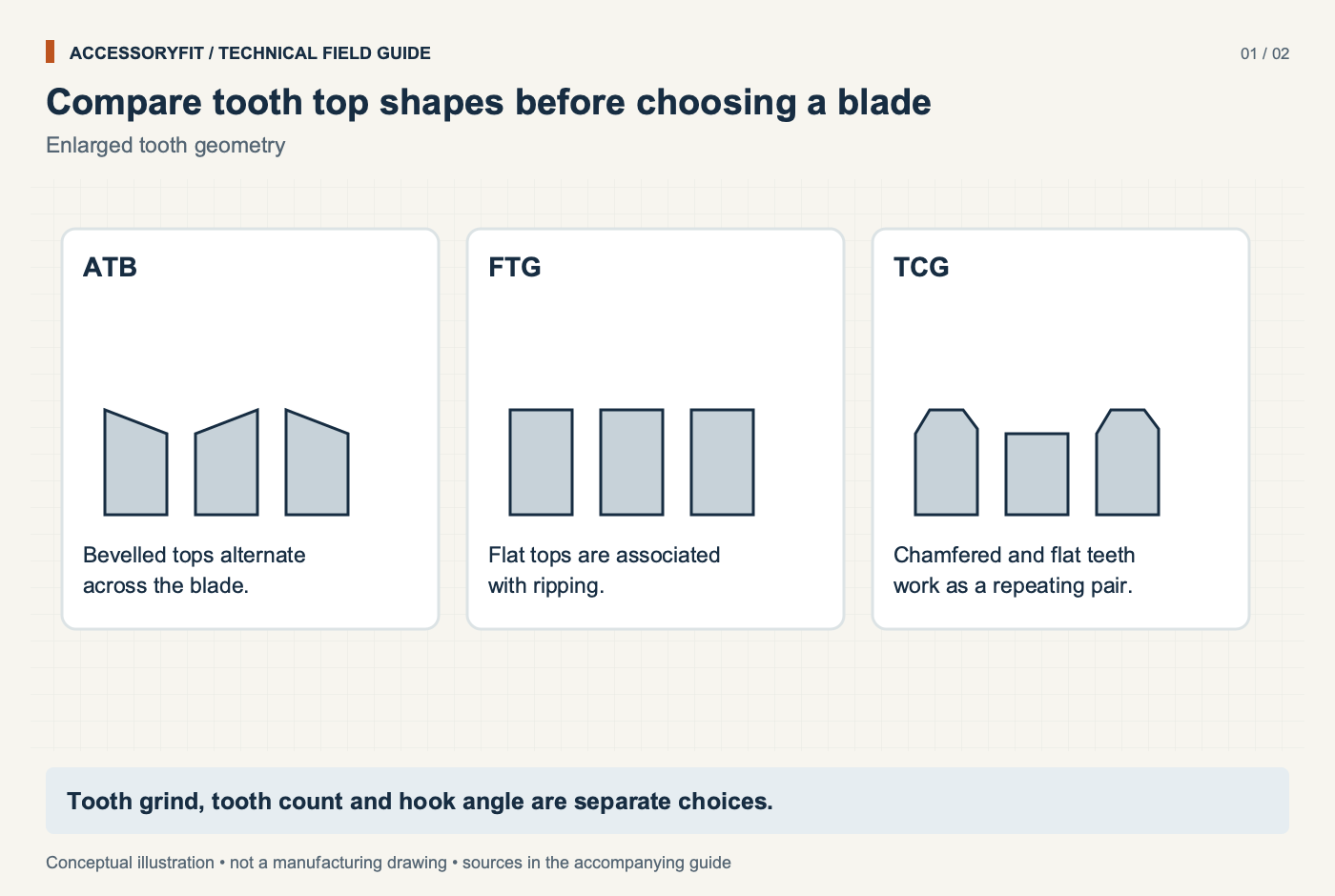
Flat Top Grind (FTG) suits ripping solid wood, Alternate Top Bevel (ATB) suits crosscuts and general work, High ATB suits veneer and melamine, and Triple Chip Grind (TCG) suits laminate, MDF, plastics and non-ferrous metal. The grind is the shape of the top of each tooth, and it decides whether the tooth chisels, slices or chips its way through the material.
FTG teeth are square across the top and cut fast with the grain.
ATB teeth are bevelled left and right in turn, so they slice fibres across the grain.
Hi-ATB teeth use a steeper bevel of about 30–40 degrees for chip-free cuts in melamine and veneered plywood.
TCG alternates a taller chamfered tooth with a flat raker, which chips a hard surface away rather than tearing it.
Combination (ATB+R) groups teeth as 4 ATB + 1 flat raker, with a large gullet before each raker, so one blade can rip and crosscut.
Makers do not always label grinds the same way. Freud calls its combination grind COMB, Diablo lists its combination blade simply as ATB, and Makita describes the A-93681 as alternate top, alternate face (ATAF). Read the description, not just the abbreviation.
Tooth grind, tooth count and hook angle are separate choices.
07What hook angle should a circular saw blade have?
A positive hook suits hand-fed ripping, a low or neutral hook suits clean crosscuts, and a low or negative hook suits sliding miter and radial arm saws. Hook angle is how far each tooth leans forward into the cut. Positive hooks of about 10 to 22 degrees pull the blade into the wood; low or neutral hooks of about 0 to 6 degrees give more control; negative hooks of about -2 to -6 degrees reduce grab and climbing.
Makers differ for the same job. Freud's plywood blades sit at the low end, while Diablo's 80-tooth D1080X uses 15 deg. On miter saws the saw maker's limit wins: DeWalt tells owners of its DWS713 and DWS780 not to use blades with hook angles over 7 degrees, while Diablo lists the D1080X for miter saws. Freud's own sliding miter blades use -5 degrees. Check your saw's manual before fitting a positive-hook blade to a miter saw.
Hook angle ranges and what each does
Hook type
Range
Effect
Typical use
Positive
+10 to +22 deg
Pulls blade into cut, fast feed
Ripping, table saws
Low / neutral
0 to +6 deg
More control, less tear-out
Crosscuts, hardwoods, veneered sheet goods
Negative
-2 to -6 deg
Reduces grab and climbing
Sliding miter and radial arm saws, melamine, laminate, aluminium, plastics
Ranges from Toolstoday. Rockler describes the same effects without giving full ranges.
08Thin kerf or full kerf: what is the difference?
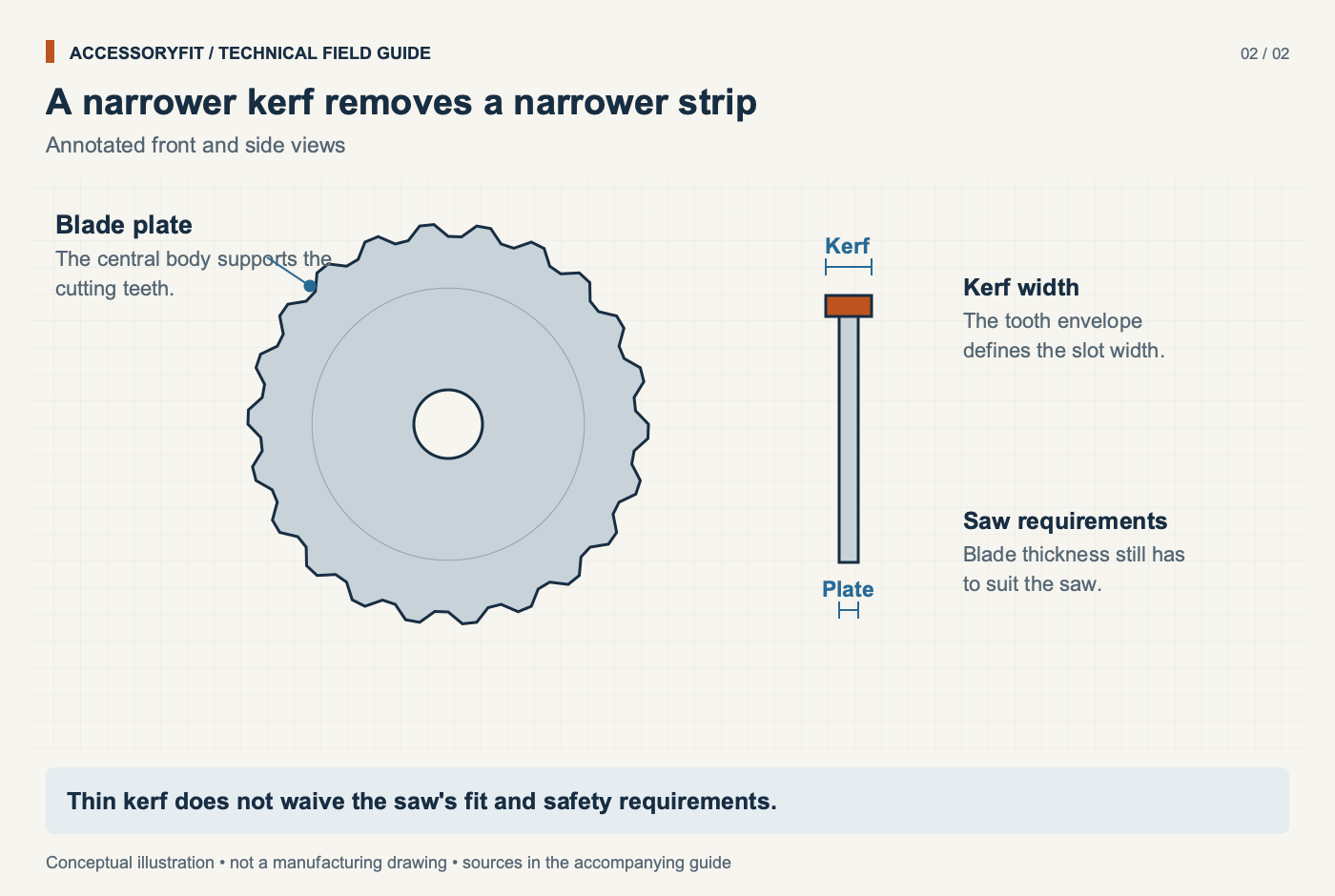
A full-kerf blade cuts a slot of about 1/8 in, and a thin-kerf blade cuts a narrower one, with published 10 in examples of .087-.098 in. Kerf is the width of the cut, set by the teeth, which are wider than the steel body. Plate thickness is the body itself. On Diablo's 7-1/4 in D0760A, the kerf is 0.059 in on a 0.040 in plate, which is why searches for saw blade width and saw blade thickness return two different numbers for the same blade.
Thin kerf removes less wood, which helps a lower-powered saw keep its speed. Rockler says saws above about 1-1/2 HP have ample power for full kerf, and that thin kerf brings no significant advantage on contractor or cabinet saws. That corrects a common belief that thin kerf is an upgrade for every saw. The table compares published kerf and plate figures for 10 in blades.
Thin kerf does not waive the saw's fit and safety requirements.
Published kerf and plate thickness of Freud and Diablo 10 in blades
Blade
Type
Kerf
Plate
Freud LU72R010
Full kerf general purpose
.126 in (3.2 mm)
.087 in (2.2 mm)
Freud LU84R011
Full kerf combination
.126 in (3.2 mm)
.087 in (2.2 mm)
Freud LU97R010
Full kerf TCG laminate
.126 in (3.2 mm)
.087 in (2.2 mm)
Freud LU87R010
Thin kerf rip
.094 in (2.4 mm)
.071 in (1.8 mm)
Freud LU91R010
Thin kerf sliding miter
.090 in (2.3 mm)
.071 in (1.8 mm)
Freud LU79R010
Thin kerf plywood / melamine
.098 in (2.5 mm)
.071 in (1.8 mm)
Diablo D1040X
Thin kerf general purpose
.098 in (2.5 mm)
.071 in (1.8 mm)
Diablo D1060S
Thin kerf fine finish
.087 in (2.2 mm)
.063 in (1.6 mm)
Inch values are as published; mm values are conversions.
09Which blades show these choices in practice?
Product links go to Amazon. As an Amazon Associate I earn from qualifying purchases. How links are chosen.
The four blades below illustrate the decisions above at two diameters. They are examples to compare against, not a ranking. Specs come from each maker's product page; where a figure rests on one source, the blade's own marking is the final check. If you already know the material, the tool to pick a blade by material filters the same data.
7-1/4 in handheld saws: a middle tooth count for mixed cuts
Diablo D0740A 7-1/4 in 40-tooth Finish saw blade for wood
Diameter
7-1/4 in
Teeth
40
Grind
ATB
Kerf
0.059 in
Hook
15 deg
Suits Corded and cordless circular saw owners who crosscut hardwood, softwood, plywood and OSB with one blade.
Skip it if Veneered panels where the finest edge matters, and worm-drive saws with a diamond arbor.
40 ATB teeth cut faster than a higher-count blade
Thin 0.059 in kerf
Diablo lists hardwoods, 2x lumber, laminate, melamine, plywood and OSB
Non-stick coating
Arbor and speed rating rest on one Diablo listing: check the marking
Steel needs a carbide or cermet blade made for ferrous metal, never a wood blade. For medium-gauge steel such as studs, angle iron, conduit and all-thread on a 7-1/4 in saw, Diablo and Milwaukee both list blades with 48 teeth. For thin steel such as roofing, siding and sheet, Diablo's thin-metal blades of that diameter have 56 to 70 teeth, and Diablo reserves the highest count for thin mild steel. Dry-cut metal saws use a larger blade with a 1 in arbor, and Diablo and Milwaukee list blades with 72 teeth for them.
Speed ratings on these blades differ sharply from wood blades. The table shows Diablo's handheld steel blades rated at different maximums for the same diameter, so a metal blade must be checked against the saw's no-load speed like any other. Diablo rates its dry-cut saw blades at 1800 rpm, far below the speed of an abrasive chop saw, so they belong only on a saw built for them. Before cutting steel with a wood-cutting saw at all, check its manual: DeWalt's DWE575 manual, for one, says not to cut metal with that saw.
Carbide and cermet blades for steel: teeth, arbor and marked speed
Blade
Diameter
Teeth / grind
Arbor
Max RPM
Stated use
Diablo D0770F
7-1/4 in
70 TCG
5/8 in
8,000
Thin metal: roofing, siding, sheet, studs; mild steel 12 ga or thinner
Diablo D0756F
7-1/4 in
56 TCG
5/8 in
5,800
Studs, angle iron, flat bar, EMT (1/8 in max wall)
Diablo figures from its product family listings. Milwaukee max RPM is not on the Milwaukee pages read.
11When does a blade choice go wrong?
A blade choice goes wrong when fit is assumed rather than checked, when a geometry suited to one saw goes on another, or when a dirty blade is blamed for being the wrong type. These are the cases the saw and blade makers warn about most.
Same arbor, wrong diameter. A 7-1/4 in blade does not belong on a 6-1/2 in saw just because both use a 5/8 in arbor. Saw makers require the marked diameter, because a wrong-size blade may not be guarded properly.
A rip or combination blade on a miter saw. DeWalt says to use crosscut blades only on its miter saws and rules out rip and combination blades. Blades with deep gullets can deflect and hit the guard.
A US blade on a European saw. A blade with a 5/8 in hole is not a direct swap on a saw with a 30 mm bore, and third-party spacers are not allowed.
A wood blade on steel or fiber cement. Both need blades made for them, and some wood-cutting saw manuals, such as DeWalt's DWE575, rule out cutting either with that saw.
Burning blamed on the blade type. Burning often comes from pitch build-up, a dull edge, feed rate or fence alignment rather than tooth count. Our guide to fixing scorched cuts lists the causes in order.
12How do you clean a saw blade without damaging it?
Clean it off the saw with a neutral-pH blade cleaner or mild detergent and warm water and a nylon or brass brush, then dry it and protect it from rust. Rockler warns that strong acids and bases such as oven cleaner can damage the coating and weaken the cobalt that binds the carbide to the blade. Makita's manuals name gum and pitch remover, hot water or kerosene for the job, and rule out gasoline; hardened pitch slows the saw and raises kickback risk, according to Makita.
Clean before you decide a blade is dull. Baked-on pitch hides sharp teeth and causes the same symptoms as a worn edge. Store blades so the carbide teeth do not touch other blades, because carbide is brittle and chips if knocked.
13What if the job needs a different saw blade?
If the work is mostly sheet goods, our picks of circular saw blades for plywood compare high-count blades by kerf and hook. Demolition, nail-embedded lumber and pruning are reciprocating saw jobs, and the comparison of reciprocating saw blades for demolition covers them. For table and miter saws, start from the saw's own sizes, and for anything else the tool accessory lookup lists published blade sizes by model. The how-to guides section has the other technique pages.
14Questions readers ask
Is a higher tooth count always better?
No. More teeth give a smoother edge but feed slower and clear chips less well. For ripping thick solid wood, a low-count blade with large gullets is the published choice.
What is the difference between kerf and plate thickness?
Kerf is the width of the cut the teeth make; plate thickness is the steel body. Diablo's D0760A has a 0.059 in kerf on a 0.040 in plate.
Can I put a table saw blade on a miter saw?
Only if it is a crosscut blade within the miter saw maker's limits. DeWalt rules out rip blades, combination blades and hook angles over 7 degrees on its miter saws.
What blade cleaner is safe for carbide blades?
A neutral-pH blade cleaner or mild detergent with warm water, per Rockler. Avoid oven cleaner and other strong acids or bases, and never gasoline, which Makita rules out.
Does a cordless circular saw need a special blade?
It needs the diameter, arbor and speed rating the saw is marked for. Diablo lists its 7-1/4 in D0760A and D0740A for corded and cordless saws, and thin kerf reduces the load on any lower-powered saw.
Rockler: Saw Blade Glossary; Table Saw Blades: A Complete Guide; How to Clean and Maintain Your Saw Blades
Ryobi: PBLCS300B 18V ONE+ HP Brushless 7-1/4 in Circular Saw product page
SKIL: 7-1/4 in Lightweight Worm Drive SKILSAW SPT77WML-01
ToolsToday: Saw Blade Tooth Geometry: The Secret to a Perfect Cut
U.S. Consumer Product Safety Commission: The 2017 NEISS Table Saw Special Study (staff briefing package, including Table Saw Blade-Contact Injuries Special Study Report, 2017); Safety Standard Addressing Blade-Contact Injuries on Table Saws: Supplemental Notice of Proposed Rulemaking (November 1, 2023); Proposed Rule: Safety Standard Addressing Blade-Contact Injuries on Table Saws (staff briefing package, January 17, 2017); Injuries Associated with Stationary Power Saws, 2001; 2019 NEISS Coding Manual; Withdrawal of Proposed Regulatory Actions (September 29, 2025)
Woodcraft: Burn-Free Table Saw Cuts (Robert J. Settich)