
Fit guide · Band saws
Band saw blade sizes: length, width and TPI for your machine
A band saw blade fits when its length matches the machine model and its width falls inside the saw's range; TPI is then chosen from the material's thickness. Length is fixed by wheel size and spacing, so it comes from the manual or a blade maker's fit chart. Classic cast-iron saws such as the JET JWBS-14CS take 93-1/2 in, many small benchtop saws take 59-1/2 in, and portable deep-cut saws take 44-7/8 in. Other models in the same wheel class can need very different lengths.
By AccessoryFit editors · Checked
On this page
- What sizes decide whether a band saw blade fits?
- What length band saw blade does your saw take?
- How do you work out blade length without a manual?
- What blade width should you use?
- How many teeth per inch should a band saw blade have?
- Does blade thickness have to match the wheel size?
- Are band saw blade sizes the same in inches and millimetres?
- When does a band saw blade not fit or fail early?
- How do band saw blades compare with other saw blade fits?
What sizes decide whether a band saw blade fits?
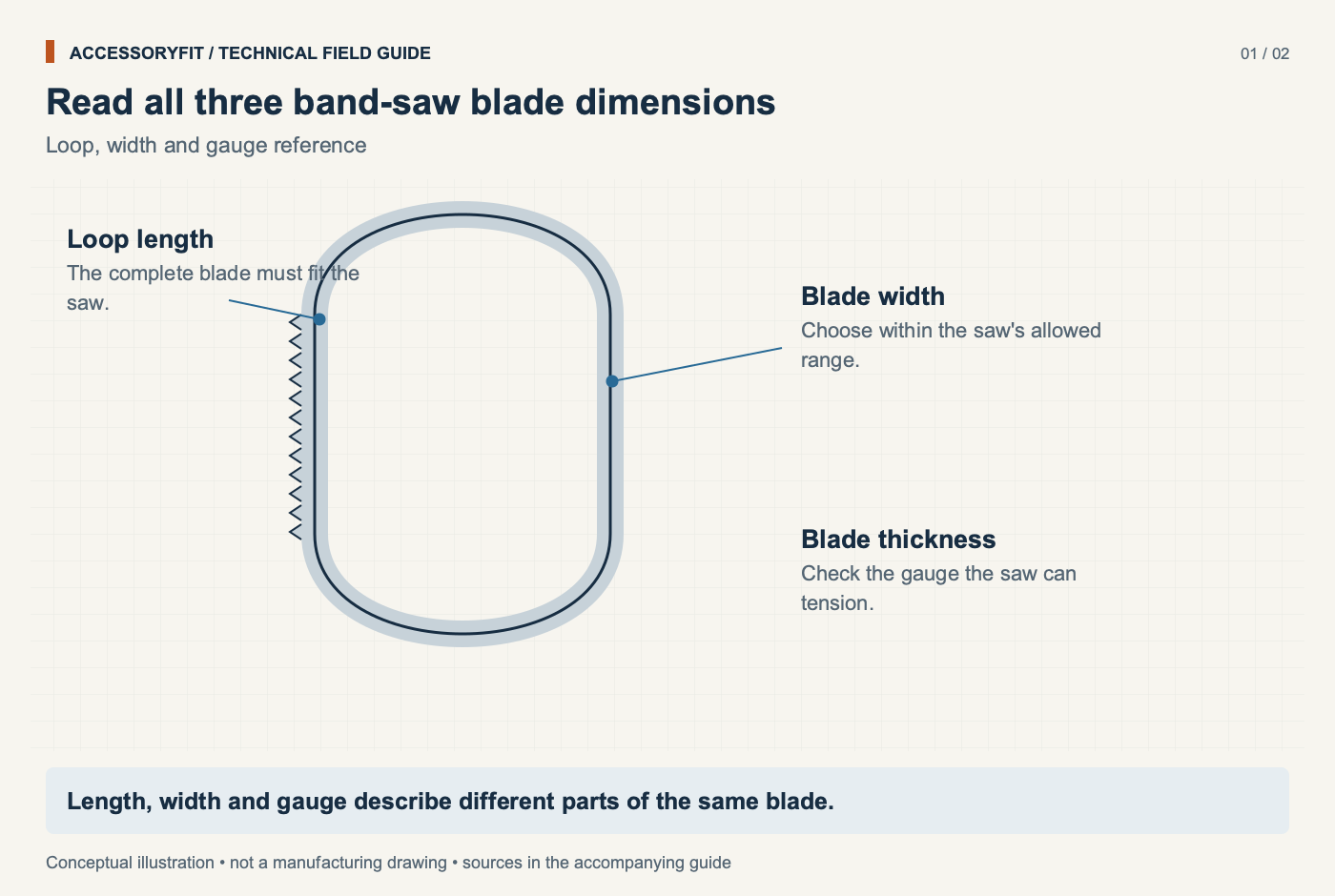
Length and width decide physical fit; pitch (teeth per inch, or TPI) and thickness decide how well the blade cuts and how long it lasts. A band saw blade is a continuous welded steel loop, so unlike a circular blade there is no arbor or bore to match. Instead, the loop must be the exact length the wheels and tensioner are built around, and its width, measured from the tooth tips to the back edge, must fall within what the guides can support.
The order matters when buying. Length first, because a blade of the wrong length cannot be tensioned at all. Width second, because it sets the tightest curve the blade can follow and must sit in the saw's published range. Pitch third, chosen from the thickness of the work. Thickness, or gauge, comes last and mostly matters on saws with small wheels.
Because blade length is fixed by the machine, the rules here are model-specific in a way that arbor sizes on bench saws are not. A table of published lengths for named machines follows, and a measuring method covers saws whose manual is lost.
What length band saw blade does your saw take?
The length your saw's manual or a blade maker's fit chart gives for that exact model; Starrett and Olson both direct owners to the operator manual for the correct length. The wheel size alone does not settle it, because wheel spacing differs between models.
Some lengths are widely shared. Olson's fit chart and JET's specifications list 93-1/2 in for classic cast-iron saws such as the JET JWBS-14CS, the Rikon 10-320 and the Powermatic PWBS-14CS. Many two-wheel benchtop saws, including the WEN BA3959, Ryobi BS900 and BS901 and Delta 28-150, take 59-1/2 in. Portable deep-cut saws such as DeWalt's DWM120 and Milwaukee's standard and deep-cut models use 44-7/8 in, and DeWalt lists the same length for its cordless DeWalt DCS374B: 44-7/8 in. Compact cordless saws are a separate size: Milwaukee's M18 FUEL compact band saw (Milwaukee 2829-20) takes 35-3/8 in compact blades, so a standard portable blade will not fit it even within one brand.
A frequent misconception is that every saw in the popular cast-iron wheel class takes the classic length. Many do, but the Rikon 10-326 Deluxe needs a much longer blade, and Laguna's LT14 and LT14SUV each take their own length again. Olson's chart even describes the classic length as fitting any JET model of that class, a claim that may be outdated, since retailer listings suggest some newer JET steel-frame saws take longer blades. Confirm in your own manual.
| Machine | Wheel / class | Blade length | Blade width range | Source |
|---|---|---|---|---|
| JET JWBS-14CS | 14 in | 93-1/2 in (2375 mm) | 1/8 to 3/4 in | s4, s2 |
| Rikon 10-320 | 14 in | 93-1/2 in (2375 mm) | 1/8 to 3/4 in | s2 |
| Rikon 10-326 Deluxe | 14 in | 111 in (2819 mm) | 3/16 to 3/4 in | s10 |
| Rikon 10-325 Deluxe | 14 in | 111 in (2819 mm) | 1/8 to 3/4 in | s2 |
| Laguna LT14 | 14 in | 104-1/2 in (2654 mm) | 1/8 to 1 in | s2 |
| Laguna LT14SUV | 14 in | 125 in (3175 mm) | 1/8 to 1 in | s2 |
| Powermatic PWBS-14CS | 14 in | 93-1/2 in (2375 mm) | 1/8 to 3/4 in | s2 |
| Rikon 10-305 | 10 in | 70-1/2 in (1791 mm) | 1/8 to 1/2 in | s2 |
| WEN BA3962 | 10 in | 72 in (1829 mm) | 1/8 to 1/2 in | s5b |
| WEN BA3959 | 9 in benchtop | 59-1/2 in (1511 mm) | 1/8 to 3/8 in | s5 |
| Ryobi BS900 / BS901, Delta 28-150 | 9 in two-wheel benchtop | 59-1/2 in (1511 mm) | not listed | s2 |
| Skil 3104, Grizzly G8976 | 12 in three-wheel benchtop | 62 in (1575 mm) | not listed | s2 |
| Delta 28-180 / 28-185 | 8 in | 56-1/8 in (1426 mm) | not listed | s2 |
| DeWalt DWM120 | portable deep cut | 44-7/8 in (1140 mm), 1/2 in wide, .020 in thick | 1/2 in (supplied) | s6 |
| Milwaukee standard / deep-cut portable | portable | 44-7/8 in (1140 mm) | not listed | s7, s8 |
Each row is the length published for that model. Do not apply a row to a different model, even with the same wheel size. Metric values are conversions.
How do you work out blade length without a manual?
Use Olson's wheel formula: (R1 x 3.1416) + (R2 x 3.1416) + (2 x C), where R1 and R2 are the upper and lower wheel radii and C is the distance between the wheel centres. Olson specifies taking the measurements with the wheels in their working position, not slackened off for a blade change.
On a two-wheel saw with equal wheels, the formula reduces to one wheel's circumference plus twice the centre distance, because the two half-wraps add up to one full wrap. The result is a figure to compare with the lengths blade makers list. For three-wheel benchtop saws such as the Skil 3104 and Grizzly G8976, Olson's fit chart gives a published length, which is the more reliable source for those machines.
How do you measure a band saw for a replacement blade?
Five steps produce a blade length for a two-wheel saw when neither the manual nor a fit chart lists the model.
- Disconnect power and open the wheel covers. Unplug the saw before reaching inside, and leave any old blade in place if it still fits.
- Put the wheels in working position. Olson's formula assumes the wheels are where they sit when a blade is tensioned for cutting.
- Measure both wheel diameters and halve them. Measure across the wheel faces; the halves give R1 and R2.
- Measure the distance between wheel centres. Measure from axle centre to axle centre to get C.
- Apply the formula and compare with listed lengths. Add each radius multiplied by pi to twice C, then compare with the lengths blade makers list.
What blade width should you use?
For straight cuts, use the widest blade the saw allows; for curves, use the widest blade that still clears the tightest radius in the work. Starrett, Olson and Laguna all give this rule. Narrowing the blade is therefore a choice made only when the curve demands it.
Each saw has a published width range, and the table of lengths above shows it for each model: the larger stationary saws list the widest ranges, small benchtop saws stop at a narrower maximum, and DeWalt supplies its portable DWM120 with a single width. The DeWalt DCS374B is listed by DeWalt for a 1/2 in blade.
For curves, Starrett and Olson publish a minimum radius for each width, read from the charts in their catalogues. The two disagree slightly for the narrowest blade and for the mid-width blade, so the table below shows both and uses the larger, more conservative figure as its display value. Olson alone covers the widest blades.
| Blade width | Minimum radius (Olson) | Minimum radius (Starrett) | Display value |
|---|---|---|---|
| 1/8 in (3.2 mm) | 3/16 in (4.8 mm) | 1/8 in (3 mm) | 3/16 in (4.8 mm) |
| 3/16 in (4.8 mm) | 5/16 in (7.9 mm) | 5/16 in (8 mm) | 5/16 in (7.9 mm) |
| 1/4 in (6.4 mm) | 5/8 in (15.9 mm) | 5/8 in (16 mm) | 5/8 in (15.9 mm) |
| 3/8 in (9.5 mm) | 1-1/2 in (38.1 mm) | 1-1/2 in (38 mm) | 1-1/2 in (38.1 mm) |
| 1/2 in (12.7 mm) | 2-1/2 in (63.5 mm) | 2-5/8 in (67 mm) | 2-5/8 in (67 mm) |
| 5/8 in (15.9 mm) | 4 in (101.6 mm) | not listed | 4 in (101.6 mm) |
| 3/4 in (19.1 mm) | 5-1/2 in (139.7 mm) | not listed | 5-1/2 in (139.7 mm) |
| 1 in (25.4 mm) | 7 in (177.8 mm) | not listed | 7 in (177.8 mm) |
Read from the graphic charts on Starrett catalogue p.14 and Olson catalogue p.16. Where they differ the larger (more conservative) radius is displayed. Rows for 5/8, 3/4 and 1 in come from Olson only.
How many teeth per inch should a band saw blade have?
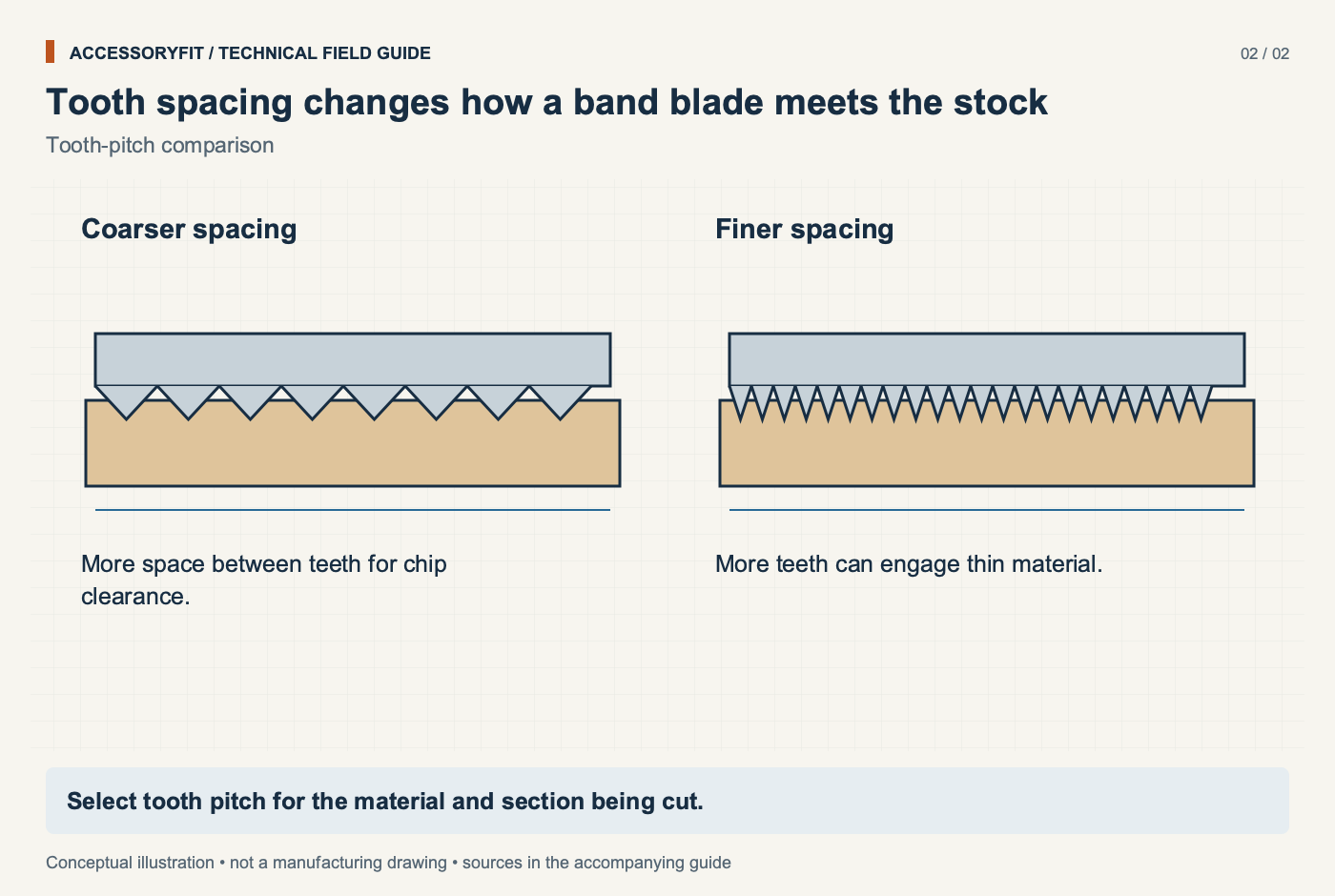
Enough that at least 3 teeth teeth are in the workpiece at all times, and not so many that the gullets clog. Olson and Laguna both give that minimum; Laguna also sets an upper limit on teeth in the cut, and Olson states a preferred figure above the minimum. In practice, thicker stock calls for a coarser blade and thinner stock for a finer one.
The makers give concrete figures at each end of the range. Coarse blades of 2–3 TPI are recommended for resawing and for thick wood. Fine blades of 18–32 TPI are recommended for thin metals and plastics. For plywood of common cabinet thickness, Laguna and Olson give 4 (fast) or 14 (smooth) TPI. Olson's chart below turns the rule into minimum stock thicknesses for each pitch, and Starrett's chart, written for industrial metal-cutting bands, gives constant and variable pitches by section size.
A myth worth correcting is that more teeth always make a better cut. Laguna and Olson both say that too fine a pitch for the stock cuts slowly, overheats and can break the blade early, while too coarse a pitch vibrates and wears the teeth. The same teeth-in-the-cut logic applies to other reciprocating and band blades; the guide to teeth per inch explained sets it out for jigsaws.
| TPI | Minimum material thickness |
|---|---|
| 32 | 3/32 in (2.4 mm) |
| 24 | 1/8 in (3.2 mm) |
| 18 | 5/32 in (4.0 mm) |
| 14 | 1/4 in (6.4 mm) |
| 10 | 5/16 in (7.9 mm) |
| 8 | 3/8 in (9.5 mm) |
| 6 | 1/2 in (12.7 mm) |
| 4 | 3/4 in (19.1 mm) |
| 3 | 1 in (25.4 mm) |
| 2 | 1-1/2 in (38.1 mm) |
Olson catalogue p.16 table beside the TPI section. These values keep roughly three teeth in the cut.
| Section to be cut | Constant pitch (TPI) | Variable pitch (TPI) |
|---|---|---|
| 5/32 to 3/8 in | 32 or 24 | 14-18 |
| 1/4 to 1/2 in | 18 or 14 | 10-14 |
| 1/2 to 3/4 in | 14 or 10 | 8-12 |
| 3/4 to 1 in | 10 or 8 | 6-10 |
| 1 to 1-1/2 in | 8 or 6 | 5-8 |
| 1-1/2 to 3-1/2 in | 6 or 4 | 4-6 |
| 3-1/2 to 7 in | 4 or 3 | 3-4 |
| 7 to 10 in | 3 | 2-3 |
| 10 to 16 in | - | 1.4-2 |
| 14 to 20 in | 1.3 | 1-2 |
| 16 to 32 in | 1.3 | 1-1.2 |
| Over 30 in | 1 | .8-1.3 / .9-1.1 |
Starrett catalogue p.14 'Pitch' chart, aimed at industrial metal-cutting bands. Starrett says to choose coarser for speed and finer for finish.
Does blade thickness have to match the wheel size?
Yes. Laguna says a blade too thick for the wheel diameter will crack, and it publishes a recommended thickness for each wheel size. Smaller wheels need thinner blades.
The sources disagree for the popular cast-iron class. Laguna's chart recommends a heavier gauge for wheels in that size band, while Olson specifies a lighter gauge for stationary saws with wheels up to that size, and Olson's own wood blades for the classic length are made in that lighter gauge. Both figures appear in the table below and its note. For most owners of those saws, the gauge the blade maker supplies for the stated length is the practical answer.
| Wheel diameter | Recommended blade thickness |
|---|---|
| 4-6 in | .014 in (0.36 mm) |
| 6-8 in | .018 in (0.46 mm) |
| 8-11 in | .020 in (0.51 mm) |
| 11-18 in | .025 in (0.64 mm) |
| 18-24 in | .032 in (0.81 mm) |
| 24-30 in | .035 in (0.89 mm) |
| 30 in and over | .042, .050 or .063 in |
Laguna says a blade too thick for the wheel diameter will crack. Olson's catalogue instead specifies .020 in for stationary saws with wheels up to 14 in (see conflicts).
Are band saw blade sizes the same in inches and millimetres?
The sizes are the same blades described two ways: US makers sell blade length and width in inches, and the metric figures in the tables are conversions, not separate sizes. The classic length of 93-1/2 in, for example, appears in the table with its millimetre equivalent beside it. When ordering from a European supplier, convert the exact length from your manual rather than picking a round metric figure that looks close.
Pitch is quoted in teeth per inch on both sides of the Atlantic in the sources read for this page, so TPI figures need no conversion.
When does a band saw blade not fit or fail early?
A blade does not fit when its length is wrong for the model or its width is outside the saw's range, and it fails early when its pitch or gauge is wrong for the work or the wheels. The cases the sources describe are:
- Length taken from wheel size alone. Saws in the same wheel class can need very different lengths.
- Width outside the published range. The guides cannot support it.
- Too wide for the curve. It cannot follow a radius below the makers' minimum for that width.
- Fewer than 3 teeth teeth in the work. The pitch is too coarse for the stock.
- Pitch too fine for thick stock. Gullets overfill, heat builds and the blade can break.
- Gauge too thick for the wheels. Laguna says it will crack.
A blade that cracks, wanders or binds also brings hands closer to the teeth than planned. AccessoryFit's estimate from CPSC's NEISS emergency department data for 2024 is that about 2,400 injuries involving band saws were treated in US emergency departments that year, nearly all of them to the fingers. A blade sized and tensioned to the maker's figures keeps the cut predictable.
For cuts a band saw cannot reach, other saws take over. Nail-embedded demolition work suits carbide demolition blades, and sheet metal on site suits metal-cutting jigsaw blades.
How do band saw blades compare with other saw blade fits?
Band saws are the one saw type where the machine model fixes the blade length; circular, table and miter saws instead match a bore to an arbor. Those rules are set out in the guides to which blade fits your circular saw, table saw blade bore and adapters and miter saw blade sizes. To look up what a specific machine accepts, use the look up what fits your tool finder; all blade types are grouped under the saw blade guides, and the full set of fit rules is in the compatibility guides.
Questions readers ask
Does every band saw in the classic cast-iron class take a 93-1/2 in blade?
No. The JET JWBS-14CS, Rikon 10-320 and Powermatic PWBS-14CS do, but the Rikon 10-326 and Laguna LT14 models need longer blades. Check the manual for your model.
What blade length does a portable deep-cut band saw take?
DeWalt's DWM120 and Milwaukee's standard and deep-cut portable saws use 44-7/8 in blades, and DeWalt lists the same length for its DeWalt DCS374B. Milwaukee's M18 FUEL compact model is the exception: it takes 35-3/8 in compact blades.
What TPI is best for resawing?
Laguna and Olson recommend coarse blades of 2–3 TPI for resawing and for thick wood.
Can I use a narrower blade than my saw's range allows?
Stay inside the width range published for the model. The fit charts list a minimum and maximum width for each saw, and the makers give no guidance for running outside it.
Why did my new band saw blade crack after a short time?
Laguna names a blade too thick for the wheel diameter as a cause of cracking, and too fine a pitch for the stock as a cause of heat and early breakage.
Where to go next
- How to pick a jigsaw bladeTPI and material choice for another narrow blade.
- Table saw blade arbor sizeBore, speed and dado limits on bench saws.
- Miter saw blade sizesArbor fit for the other workshop saw.
- Saw blade guidesEvery blade type in one place.
References 18 documents, 10 publishers
- Acme Tools: JET 708115K JWBS-14CS 14 in Closed Stand Bandsaw specifications
- Crescent Electric Supply (retailer): Milwaukee 2829-20 compact band saw listing (35-3/8 in L blade)
- DeWalt: DWM120 Deep Cut Band Saw; DCS374B 20V MAX* XR Cordless Brushless Deep Cut Band Saw product page; DCS374 Instruction Manual NA756283 (Type 2)
- Laguna Tools: Bandsaw Blade Education
- Milwaukee Tool: 48-39-0560 44-7/8 in 14/18 TPI Standard / Deep Cut Band Saw Blade; 48-39-0510 44-7/8 in 14 TPI Standard / Deep Cut Band Saw Blade; 2829-20 M18 FUEL Compact Band Saw product page
- Olson Saw: Olson catalogue January 2025 (fit charts pp.12-14; How-To's for all Band Saw Blades pp.15-16); FAQs: What size blade does my band saw or scroll saw take?
- Starrett: Starrett Band Saw Blades catalogue (Choosing the Correct Blade, pp.14-15; installation guidelines)
- U.S. Consumer Product Safety Commission: NEISS 2024 data file (neiss2024.xlsx), with NEISS_FMT code formats
- WEN Products: WEN BA3959 2.8-Amp 9-Inch Benchtop Band Saw; WEN BA3962 3.5-Amp 10-Inch Two-Speed Band Saw
- Woodcraft: RIKON 14 in Deluxe Bandsaw Model 10-326; Timber Wolf Bandsaw Blade 111 x 3/16 in x 10 TPI Raker; Timber Wolf Bandsaw Blade 82 x 3/16 in x 10 TPI Raker
Accessed .