Why a circular saw blade burns wood, and how to fix it
A circular saw blade usually burns wood because pitch and resin have baked onto the teeth or the teeth are dull, and the first fix is to clean the blade before you sharpen or replace it. If a clean blade still scorches the cut, check the feed rate, whether the tooth count suits the cut, and on a table saw the fence, riving knife and blade alignment. Replace the blade when cleaning does not restore the cut or the carbide is damaged.
Burning is friction heat, and the usual sources are pitch buildup, dull teeth, a feed that is too slow, the wrong blade for the cut, and parts of the saw that press the wood against the side of the blade. The causes below are listed roughly in the order worth checking, starting with the ones that apply to every circular blade and ending with table saw setup and the wood itself.
Pitch and resin buildup: baked-on residue that adds friction and hides teeth that may still be sharp.
Dull teeth: worn carbide that rubs instead of cutting.
Wrong tooth count or grind: a blade built for a different cut, such as a fine-finish blade used to rip thick stock.
Feed too slow, or the saw bogging down: the blade dwells in one spot and heats up.
A blade that heats and distorts: the plate warps enough to bind and burn in spots.
Fence, splitter or riving knife out of line: the wood is crowded against the blade.
Blade not parallel to the miter slot: the rear of the blade rubs the work.
Crooked, cupped or stressed stock: the board angles into or pinches the blade.
Burn-prone species: cherry, maple and some exotic woods scorch easily.
The table below sets out the sign, mechanism and fix for each cause as given by Woodcraft, Rockler and Toolstoday. Woodcraft's article is written for table saws, but the causes involving pitch, dullness, feed rate and tooth choice apply to any circular blade, including a handheld saw.
Common causes of burning on saw cuts, with signs and fixes
Cause
Sign / mechanism
Fix
Sources
Pitch and resin buildup
Friction and heat; sharp teeth hidden under baked-on residue
Clean the blade before resharpening
r3, w1, r1
Dull blade
Harder feeding, louder running, burning on both sides of the cut; scorching and swirl marks
Resharpen or replace
w1, r3
Wrong tooth count or style for the task
Wrong geometry can cause chatter, burning or chip-out
Match tooth count and grind to the cut
w1, tt
Feed too slow or saw bogging down
Slow feed creates friction; bogging heats and can distort the blade
Feed steadily; use a thin-kerf blade on low-power saws
w1, r2
Blade heating and distorting (warp)
Blade distorts enough to bind and burn in spots
Feed without pausing; keep the blade clean and sharp
w1, r2
Fence toed in toward the blade
Burn on the fence-side edge; can also cause kickback
Align fence parallel or toe out up to about .004 in
w1
Misaligned splitter or riving knife
Crowds the wood against the back of the blade
Align with the blade
w1
Blade not parallel to the miter slot
Rear of blade rubs the work
Align top or trunnions per the saw manual
w1
Crooked, cupped or stressed stock
Board angles into or pinches the blade
Joint and flatten first; use a splitter
w1
Burn-prone species
Cherry, maple and some exotics burn easily
Rip slightly oversize and plane or joint the edge
w1
Woodcraft's article is about table saws; the causes involving pitch, dullness, feed rate and tooth choice apply to any circular blade.
02Is pitch buildup making the blade burn?
Pitch is the first thing to check, because baked-on resin often causes burning while the teeth underneath are still sharp. A common belief is that a burning cut always means the blade needs sharpening; Woodcraft and Rockler both point to pitch as the cause to rule out first.
How do you confirm it?
Unplug the saw or remove its battery, then look at the faces and sides of the teeth and the plate just below them. A brown or black glaze on the teeth and the body of the blade is pitch. A non-stick coating such as Diablo's Perma-SHIELD or Freud's Perma-Shield is meant to resist this residue, but it does not stop it building up over time.
How do you fix it?
Clean the blade off the saw. Makita's circular saw manuals tell owners to remove hardened gum and pitch with a gum and pitch remover, hot water or kerosene, and never gasoline, and they link pitch to a slower saw and a higher kickback risk. Rockler recommends a neutral-pH blade cleaner, or mild detergent and warm water, with a nylon or brass brush, then drying the blade and protecting it from rust. Avoid oven cleaner: strong acids and bases can damage the blade coating and weaken the cobalt that binds the carbide to the plate. Cleaning comes before resharpening, because a sharpening service cannot judge the edge through a layer of residue.
03How do you tell if the blade is dull?
A dull blade feeds harder, runs louder than usual and burns both sides of the cut, often with scorching and swirl marks on the cut face. Check this only after cleaning, so that pitch is not mistaken for wear. If a freshly cleaned blade still needs extra push and still burns both faces, the teeth are worn.
The fix is to resharpen or replace the blade. Carbide teeth are brittle, so a blade that has been dropped or stored loose against other blades may have chipped or missing teeth, which no amount of cleaning will fix. Store blades so that the teeth do not touch other blades.
04Can the wrong blade type cause burning?
Yes. A blade whose tooth count or grind does not suit the cut can chatter, burn or chip out the wood. The common case is a high-count finish blade used to rip thick solid lumber. A 10 in rip blade has as few as 24 teeth with large gullets to clear chips quickly, while a crosscut blade carries 60 to 80 teeth and needs a slower feed. Pushing a long rip through a fine-finish blade builds heat in the small gullets.
Hook angle plays a part too. Positive hook angles of 10 to 22 degrees pull the blade into the cut for fast feeding, which suits ripping, while low or neutral angles of 0 to 6 degrees favour control on crosscuts. Match tooth count and grind to the cut, and use a combination or general-purpose blade of 40 to 50 teeth if one blade has to do both jobs. Our guide to tooth count, grind and kerf explains how each attribute changes the cut.
05Does feed rate cause burn marks?
Yes. A feed that is too slow, or a saw that bogs down in the cut, creates friction and heat, and a hot blade can distort enough to bind and burn in spots. Feed at a steady rate without pausing partway through, and keep the blade clean and sharp so that the saw does not labour.
On lower-powered saws, kerf width matters. A full-kerf table saw blade cuts a slot of about 1/8 in, while published thin-kerf examples run .087-.098 in. Rockler suggests thin-kerf blades for lower-powered jobsite saws, because they remove less wood. That advice has limits: a thin-kerf blade can bind on a standard-thickness riving knife, so use one only where the saw maker allows it.
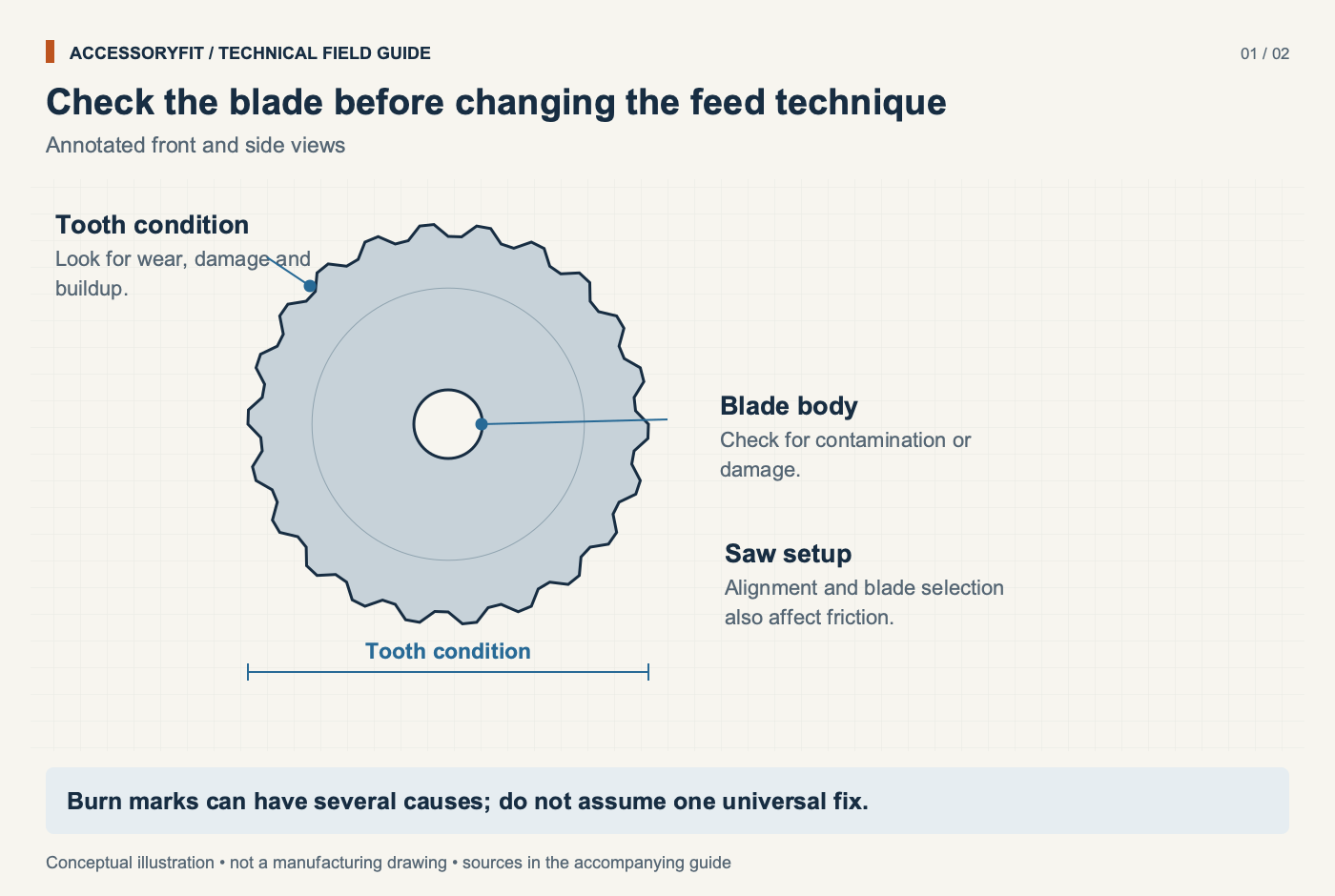
Burn marks can have several causes; do not assume one universal fix.
06Can fence or riving knife alignment cause burning?
Yes, on a table saw. A fence toed in toward the blade burns the fence-side edge of the cut, and a misaligned splitter or riving knife crowds the wood against the back of the blade. Both can also cause kickback. Woodcraft recommends setting the fence parallel to the blade or toed slightly away from it at the outfeed end, and warns that too much toe-out burns the other side of the cut instead. A blade that is not parallel to the miter slot also rubs the work with its rear teeth; align the top or the trunnions as the saw manual describes.
On a handheld circular saw the equivalents are a guide or straightedge that pushes the saw sideways into the cut, and a panel that sags so that the kerf closes on the blade. Support large panels near the cut line, as DeWalt and Makita direct for kickback prevention.
07Can the wood itself cause burning?
Yes. Crooked, cupped or stressed boards angle into or pinch the blade, and some species burn easily whatever the blade. Woodcraft names cherry, maple and some exotic woods as burn-prone. Joint and flatten stock before ripping it, use a splitter or riving knife, and for burn-prone species rip slightly oversize and then plane or joint the burned edge away.
08How do you diagnose a burning blade, step by step?
Work from the cheapest, most common cause toward the least common one. Each check takes the cause out of play before you move on.
Disconnect the saw Unplug the saw or remove its battery before touching the blade.
Check which side burns Burning on both faces points to the blade (pitch, dullness, wrong type or slow feed). Burning on one face only, on a table saw, points to fence, riving knife or blade alignment.
Inspect and clean the blade Look for residue on the teeth and plate. Clean it off the saw with a pitch remover or mild detergent and warm water and a nylon or brass brush. Do not use oven cleaner or gasoline. Dry the blade fully.
Inspect the carbide Look for chipped, cracked or missing teeth. Damaged carbide means a replacement or a professional repair, not more cleaning.
Confirm the blade suits the cut Compare the tooth count and grind with the job: low count and large gullets for ripping, high count for crosscuts and sheet goods.
Refit the blade correctly Check that the bore matches the arbor size and shape, that the blade diameter matches the saw's marking, and that the teeth point the way the rotation arrow on the guard shows.
Make a test cut at a steady feed Cut scrap of the same species at a steady rate without pausing. If it still burns on a clean, sharp, correct blade, check the fence, riving knife and blade-to-slot alignment, then the stock itself.
Decide to sharpen or replace If a clean blade of the right type still feeds hard and burns, resharpen or replace it.
09Is it safe to keep cutting with a blade that burns?
No. A blade that burns is running with extra friction, and the same conditions that cause burning, pitch, a closing kerf, a toed-in fence or a crowding riving knife, also raise the risk of kickback. Kickback is a sudden reaction to a pinched, bound or misaligned blade that makes the saw lift out of the cut and drive back toward the operator. DeWalt and Makita describe it as the result of misuse or wrong operating conditions that the right precautions can avoid, which corrects the idea that kickback is simply bad luck. Stop, find the cause, and fix it before the next cut.
Injury records show how often that reaction ends in blade contact. In CPSC's study of US stationary saw injuries in 2001, the most recent breakdown of its kind, kickback of the saw or the stock threw the hand into the blade in 25% of blade-contact injuries, ahead of blade jams and reaching over the blade. A burning cut is an early sign of the binding that leads to it.
10How do you prevent burn marks?
Prevention comes down to a clean, sharp blade of the right type, a steady feed, and a saw that is set up square. The habits below cover each cause in the list above.
Clean pitch off the blade regularly, before the residue hardens.
Keep a rip blade or combination blade for long rips in thick stock, and a high-count blade for crosscuts and sheet goods.
Feed steadily and do not stop partway through a cut.
On a table saw, check fence, riving knife and blade alignment against the miter slot whenever burning appears on one side only.
Flatten and straighten stock before ripping it.
For cherry, maple and similar species, rip slightly oversize and remove the scorched edge afterwards.
Store blades so that the carbide teeth do not touch other blades or metal.
Fitting the right blade also means fitting one the saw accepts. The blade's bore must match the arbor size and shape, round or diamond, its diameter must match the saw's marking, and its marked maximum speed must equal or exceed the saw's no-load speed. Our guide to circular saw arbor sizes lists US and European sizes, and the circular saw blade selector filters blades by saw and material.
11When should you replace the blade rather than clean it?
Replace or resharpen the blade when it still feeds hard and burns after a thorough cleaning, when carbide teeth are chipped, cracked or missing, or when the blade is the wrong type for the work you do most. The fact base behind this page holds no wear limit in hours or cuts, and none of the blade makers in it publishes one, so judge by how the clean blade cuts. A plate that has warped from heat also burns in spots and binds, and a blade that binds is a kickback risk.
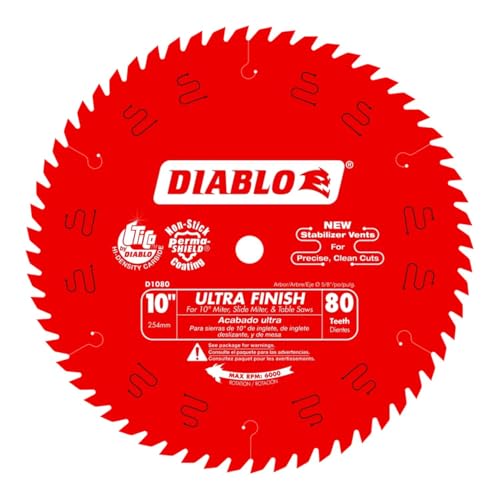
When you replace a blade, match the tooth count to the job rather than buying the same blade again by habit. The blades below are finish and plywood blades from Diablo and Freud with published specs. They suit crosscuts and sheet goods; for long rips in thick stock, a low-count rip blade is the better match. The clean-cutting plywood blades guide compares more options for sheet goods.
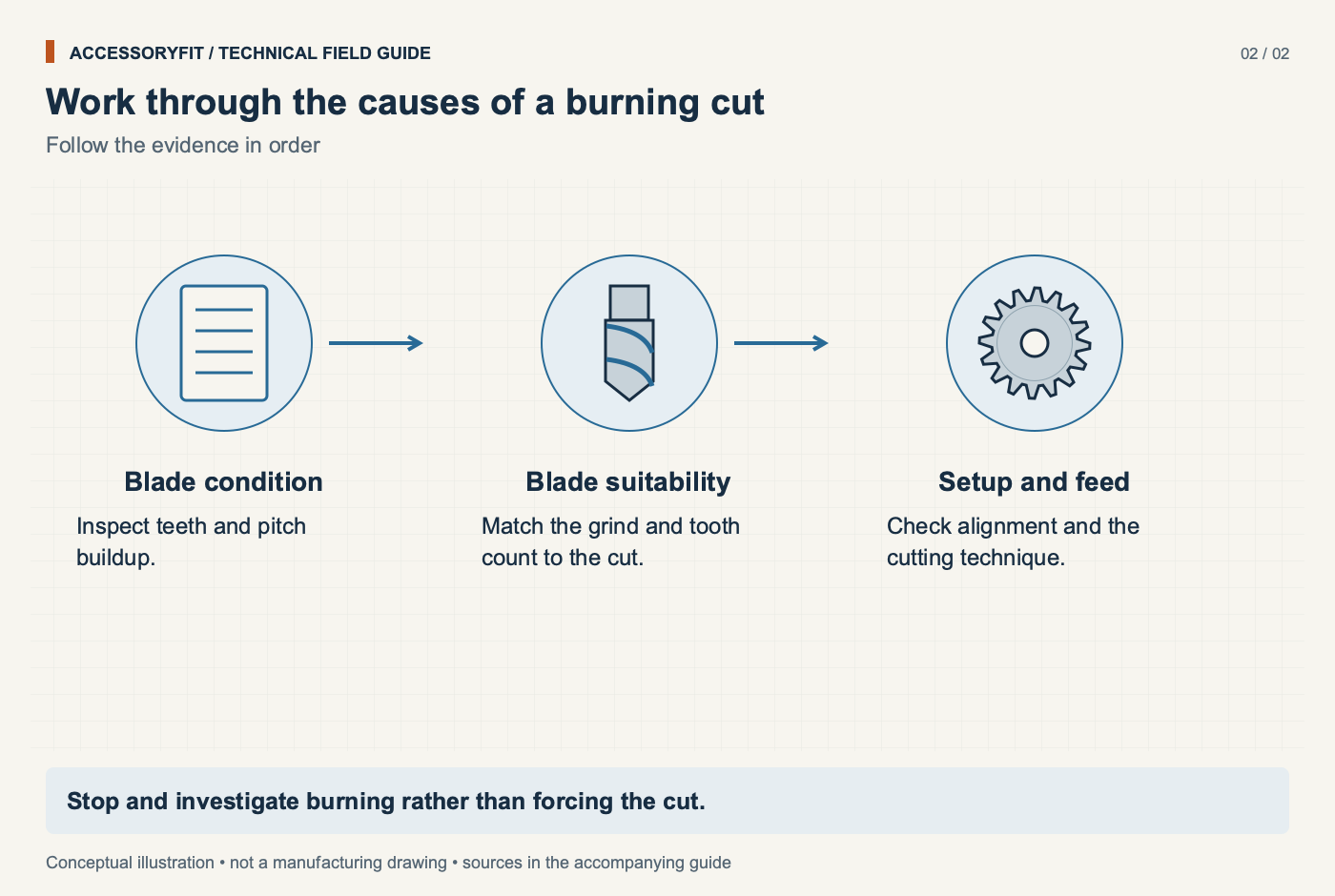
Stop and investigate burning rather than forcing the cut.
12Which replacement blades suit crosscuts and sheet goods?
Product links go to Amazon. As an Amazon Associate I earn from qualifying purchases. How links are chosen.
Each blade below has a non-stick coating meant to resist pitch buildup, and each maker lists wood and plywood among its cuts. Figures come from the manufacturer's product page. Where the maker's page does not confirm the arbor or speed rating, that spec is left out: read it from the blade marking before fitting.
For 7-1/4 in circular saws: smooth crosscuts in mixed work
Diablo D0740A 7-1/4 in 40-tooth Finish saw blade for wood
Diameter
7-1/4 in
Teeth
40
Grind
ATB
Kerf
0.059 in
Hook angle
15 deg
Coating
Perma-SHIELD non-stick
Suits Corded and cordless 7-1/4 in circular saws cutting hardwood, softwood, dimensional lumber, plywood and OSB.
Skip it if Saws marked for another diameter, worm-drive saws with a diamond arbor, and long rips in thick hardwood.
40 ATB teeth, sold by Diablo for smooth crosscuts
Thin 0.059 in kerf
Perma-SHIELD non-stick coating
Diablo lists hardwoods, dimensional lumber, laminate, melamine, plywood and OSB
Arbor and maximum speed rest on a single Diablo listing: check the blade marking
13What related problems often appear with burning?
Burning often appears alongside chatter, chip-out and kickback, because they share causes. A blade with the wrong tooth count or grind can chatter, burn or chip out the wood, and the alignment faults that burn the cut also crowd the blade and invite kickback. Tear-out on plywood is the opposite problem to burning on a rip: it calls for more teeth and a finer grind, while a burning rip often calls for fewer.
Cutting into old lumber with nails in it is a separate job. A finish or plywood blade is the wrong tool there, and our guide to carbide demolition blades covers reciprocating saw options. For other blade problems, the troubleshooting guides list causes and fixes by tool, the saw blades by tool hub groups every blade guide, and the tool accessory lookup shows which blades your saw model accepts.
14Questions readers ask
Why does my new circular saw blade burn wood?
A new blade is sharp, so look at the blade type, the feed and the setup. A high-count finish blade used for long rips, a feed that pauses partway, a sagging panel that closes the kerf, or on a table saw a fence toed in toward the blade can all burn the cut with a sharp blade.
Should I sharpen a blade that burns?
Clean it first. Baked-on pitch often causes burning while the teeth underneath are still sharp. Sharpen or replace only if the clean blade still feeds hard and burns.
What should I use to clean pitch off a saw blade?
Makita's manuals name gum and pitch remover, hot water or kerosene, and never gasoline. Rockler recommends a neutral-pH blade cleaner or mild detergent and warm water with a nylon or brass brush. Avoid oven cleaner, which can damage the coating and the carbide bond.
Why does only one side of the cut burn?
On a table saw, burning on one face usually points to alignment: a fence toed in toward the blade burns the fence side, and too much toe-out burns the other side. A riving knife or blade out of line with the miter slot also rubs one face.
Do cherry and maple always burn?
They burn more easily than many woods. Woodcraft suggests ripping them slightly oversize and planing or jointing away the burned edge.
DeWalt: DWE575 circular saw instruction manual (Recommended Blade Types); DWS535B worm drive saw instruction manual (blade table); DWA271424 7-1/4 in 24T circular saw blade; DWAW71440 Elite Series 7-1/4 in 40T circular saw blade; DWA271460 7-1/4 in (184 mm) 60T circular saw blade; DWA261240 6-1/2 in 40T circular saw blade; DW3508 6-1/2 in x 1/8 in x 5/8 in Diamond Drive Metal Cutting Blade; DWE7491RS 10 in Job Site Table Saw instruction manual (N531890); DWS713 10 in Compound Miter Saw instruction manual (NA379757); DWS780 12 in Double Bevel Sliding Compound Miter Saw instruction manual (N466020); DWA110CMB 10 in (254 mm) 40T and 60T saw blades 2-pack
Freud and Diablo: Frequently Asked Questions; LU87R010 10 in Thin Kerf Rip Blade (product specs); LU91R010 10 in Thin Kerf Sliding Compound Miter Saw Blade (product specs); LU97R010 10 in Double Sided Laminate/Melamine Blade (product specs); LU72R010 10 in General Purpose Blade (product specs); LU84R011 10 in Combination Blade (product specs); LU79R010 10 in Thin Kerf Ultimate Plywood and Melamine Blade (product specs); LU80R010 10 in Ultimate Plywood and Melamine Blade (product specs); LU73R010 10 in Cabinetmaker's Crosscut Blade (product specs); LU88R010 10 in Thin Kerf Fine Finish Crosscut Blade (product specs); D1024X 10 in x 24T Ripping Saw Blade (product specs); D1040X 10 in x 40T General Purpose Saw Blade (product specs); D1050X 10 in x 50T Combination Saw Blade (product specs); D1060X 10 in x 60T Fine Finish Saw Blade (product specs); D1060S 10 in x 60T Fine Finish Saw Blade (product specs); D1080X 10 in x 80T Ultra Finish Saw Blade (product specs); D0724A product page (framing family listing incl. D0624A, D0620X, D0824X); D0740A product page (finish family listing incl. D0641A, D0840X); D0760A product page (ultra finish family listing incl. D0660A); D1280X product page (fine finish family listing incl. D0860X); D12100X 12 in x 100T Ultimate Polished Finish blade - tech specs; D1244X 12 in x 44T General Purpose blade - tech specs; D0770F product page (thin metal family listing incl. D0756F, D1490CF); D1472CF product page (medium metal family listing incl. D0748CFA); LM72R012 12 in Heavy-Duty Rip Blade - tech specs; LU84R012 12 in Combination Blade - tech specs; LU85R012 12 in Ultimate Cut-Off blade - tech specs; D0524X 5-3/8 in x 24T Framing Saw Blade - tech specs; D0624A 6-1/2 in x 24T Framing Saw Blade - tech specs; D0660A 6-1/2 in x 60T Ultra Finish Saw Blade - tech specs; D0824X 8-1/4 in x 24T Framing Saw Blade - tech specs; Get the most out of your Freud bits by routing at ideal feed rates and speeds
Hand (N Y): Traumatic Finger Amputations: Epidemiology and Mechanism of Injury, 2010-2019; Trends in Upper Extremity Saw Injuries From 2003 to 2022
Health and Safety Executive (UK): Circular saw benches - Safe working practices, Woodworking Information Sheet No 16 (Revision 2)
Journal of Clinical Orthopaedics and Trauma: Patients admitted for treatment of traumatic finger amputations: Characteristics, causes, and prevention
Makita: 5007MG 7-1/4 in Magnesium Circular Saw - specs; XSS02Z 18V LXT 6-1/2 in Circular Saw - specs; SP6000J 6-1/2 in Plunge Circular Saw - specs; XPS01Z 36V (18V X2) 6-1/2 in Plunge Circular Saw - specs; LS1019L 10 in Dual-Bevel Sliding Compound Miter Saw - specs; LS1040 10 in Compound Miter Saw - specs; LS1219L 12 in Dual-Bevel Sliding Compound Miter Saw - specs; 5007MG/5007MGA Circular Saw instruction manual; 5377MG 7-1/4 in Hypoid Saw instruction manual; LS1019/LS1019L Slide Compound Miter Saw instruction manual; HS7611 Circular Saw instruction manual (EU); HS7611 190 mm Circular Saw - specification; HS6601 165 mm Circular Saw - specification; LS0815FL 216 mm Slide Compound Mitre Saw - specification; 5903R 235 mm Circular Saw - specification; LS1019L 260 mm Slide Compound Mitre Saw - specification; LS1040 260 mm Mitre Saw - specification; MLT100N 260 mm Table Saw - specification; 2704N 260 mm Table Saw - specification; LS1219 305 mm Slide Compound Mitre Saw - specification; 9557PB angle grinder instruction manual; 5007F 7-1/4 in circular saw instruction manual
Mallory Safety and Supply (retailer): Milwaukee 48-40-4505 14 in 72T blade listing
Milwaukee Tool: 48-40-4235 7-1/4 in 48T metal cutting circular saw blade; 48-40-4505 14 in 72T metal cutting circular saw blade; M12 FUEL 5-3/8 in Circular Saw 2530-20 - specifications; M18 FUEL 7-1/4 in Circular Saw 2732-20 - specifications; M18 FUEL 8-1/4 in Table Saw 2736-20 - specifications; M18 FUEL oscillating multi-tool 2836-20 operator's manual (58-14-0217d1)
OSHA: 29 CFR 1910.213 Woodworking machinery requirements; 29 CFR 1910.243 Guarding of portable powered tools; 29 CFR 1910.215 Abrasive wheel machinery; 29 CFR 1926.303 Abrasive wheels and tools; 29 CFR 1926.300 General requirements (Tools, hand and power); 29 CFR 1926.304 Woodworking tools
Rockler: Saw Blade Glossary; Table Saw Blades: A Complete Guide; How to Clean and Maintain Your Saw Blades
SKIL: 7-1/4 in Lightweight Worm Drive SKILSAW SPT77WML-01
ToolsToday: Saw Blade Tooth Geometry: The Secret to a Perfect Cut
U.S. Consumer Product Safety Commission: Injuries Associated with Stationary Power Saws, 2001; Safety Standard Addressing Blade-Contact Injuries on Table Saws: Supplemental Notice of Proposed Rulemaking (November 1, 2023); The 2017 NEISS Table Saw Special Study (staff briefing package, including Table Saw Blade-Contact Injuries Special Study Report, 2017); Proposed Rule: Safety Standard Addressing Blade-Contact Injuries on Table Saws (staff briefing package, January 17, 2017); 2019 NEISS Coding Manual; Withdrawal of Proposed Regulatory Actions (September 29, 2025)
Woodcraft: Burn-Free Table Saw Cuts (Robert J. Settich)