
Fit guide · Reciprocating saws
Reciprocating saw blade compatibility: the universal shank and what else to match
Reciprocating saw blades use a universal shank that most current corded and cordless saws accept, whatever the brand. Bosch, Diablo and Lenox all describe their blades as a cross-brand fit, so a Diablo blade goes in a Milwaukee, DeWalt or Makita saw just as well as in its own maker's tool. Bosch, which calls the system the S-shank, describes it as a 1/2 in (12.7 mm) universal shank. With the shank settled, the real choices are length, thickness and teeth per inch for the material.
By AccessoryFit editors · Checked
On this page
- What is the universal reciprocating saw shank?
- Do reciprocating saw blades only fit the same brand of saw?
- Does stroke length change which blades fit?
- What blade length does a cut need?
- Does blade thickness affect fit or performance?
- Which tooth count suits which material?
- Which blade material should you pick?
- How does the reciprocating shank compare with jigsaw shanks?
- When does a blade that fits still fail?
- Where do you go next?
What is the universal reciprocating saw shank?
The universal shank is the single blade-end design that reciprocating saws across brands are built to clamp, so one blade fits most current saws without an adapter. Bosch calls it the S-shank and says its blades fit all S-shank reciprocating saws; Diablo says its blades fit all corded and cordless reciprocating saws; Lenox sells its range on the same cross-brand basis.
Only one source in the AccessoryFit fact base gives a dimension for the shank: Bosch describes it as a 1/2 in (12.7 mm) universal shank. Because no second manufacturer document confirms that figure, it is shown here as Bosch's description rather than as a standard. The practical point does not depend on the number: buyers do not need to measure the shank, because the blades and saws are made to match each other.
The word universal deserves a caution. On jigsaw blades, Bosch's European catalogue uses universal shank as the name for the U-shank, which fits only U-shank saws. On reciprocating saw blades the same word really does mean cross-brand fit. The two systems are compared further down this page and in full in the guide explaining which jigsaw blades fit your jigsaw.
Do reciprocating saw blades only fit the same brand of saw?
No. Blades use the universal shank, so brand does not decide fit. The belief that a Milwaukee saw needs Milwaukee blades, or a DeWalt saw DeWalt blades, is a common one; Bosch's description of its Universal Brand Fit as suiting most saws on the market, and Diablo's statement that its blades fit all corded and cordless saws, say otherwise.
The table below lists the reciprocating saws in the AccessoryFit tool database with the stroke length each maker publishes. None of these makers lists a proprietary blade fitting in the specifications on file, and the cross-brand statements above cover them. Where a maker leaves a value out, the table says so. The same records feed the tool accessory lookup, which matches a saw model to blades and other accessories.
European buyers will often see the tool sold as a sabre saw, the name Bosch uses in its UK accessory catalogue. The blades are the same family, and the cross-brand statements apply in the same way to European and US models.
| Tool | Stroke |
|---|---|
| DeWalt DWE305 | 1-1/8 in one source |
| Makita XRJ05Z | 1-1/4 in |
| Milwaukee 2722-20 | 1-1/4 in |
Values marked one source appear in a single manufacturer document; check the tool's manual or rating plate before buying.
Does stroke length change which blades fit?
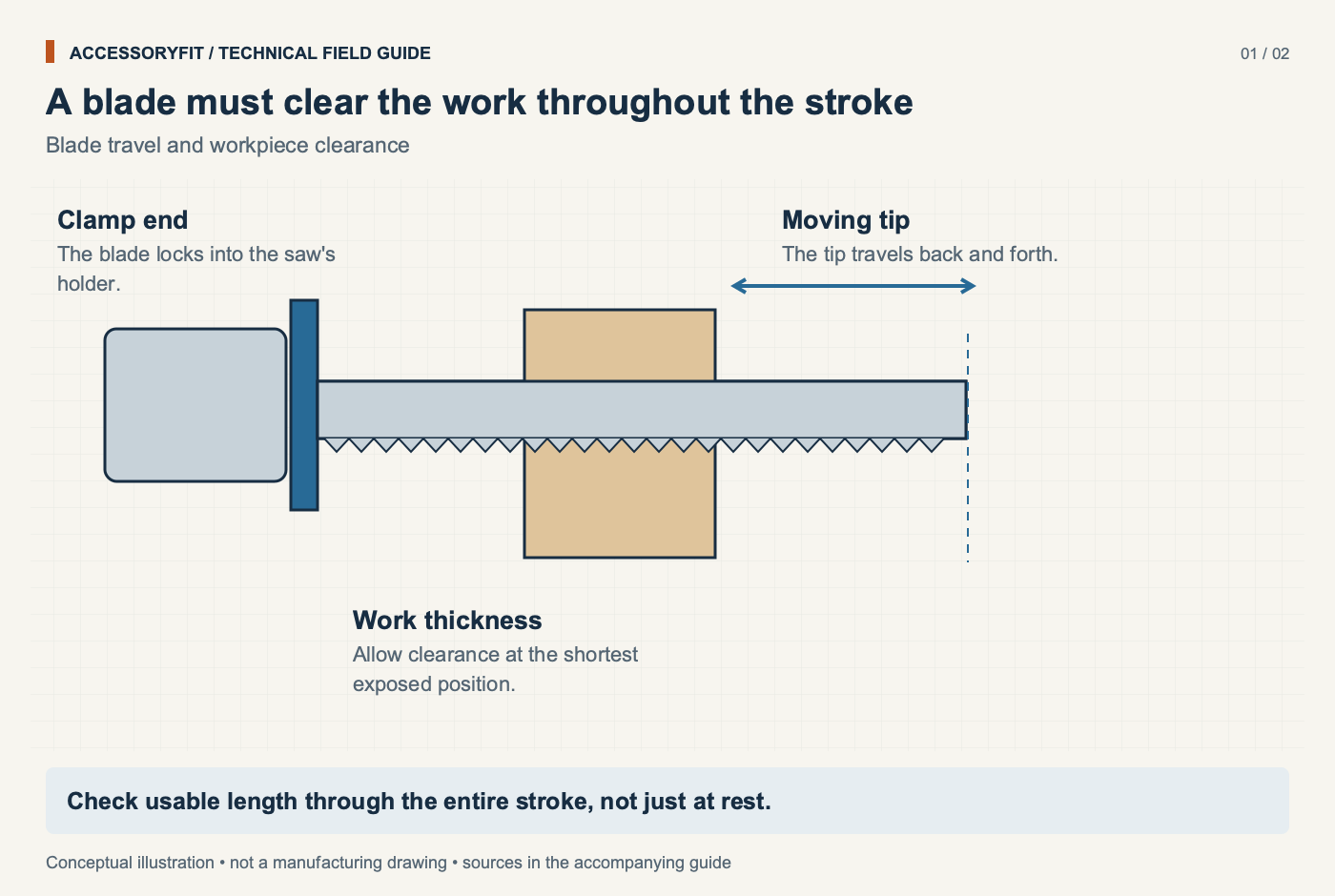
No manufacturer source on file links stroke length to blade fit; it describes how far the saw moves the blade, not what the clamp accepts. Current full-size saws have stroke lengths of about 1-1/8 to 1-1/4 in, with the DeWalt DWE305 at the shorter end and the Milwaukee 2821-20 and Makita XRJ05Z at the longer end.
Blade sizing works from the workpiece instead. Lenox sizes blades from the width of the material rather than from the saw, and that rule is covered in the next section. The stroke figures for three example saws are listed below for reference, since makers print them beside the stroke rate.
| Saw | Stroke length | Max strokes per minute |
|---|---|---|
| Milwaukee M18 FUEL SAWZALL 2821-20 | 1-1/4 in | 3,000 |
| DeWalt DWE305 (corded) | 1-1/8 in | - |
| DeWalt DCS389 60V MAX | 1-1/8 in | 3,000 |
Metric values not stated by the manufacturers; 1-1/8 in is about 28.6 mm and 1-1/4 in about 31.8 mm.
What blade length does a cut need?
Lenox sizes a reciprocating blade with a simple formula, material width + 3 in (76 mm), so the blade length follows the workpiece rather than the saw. Blades commonly come in 4, 6, 8, 9, 10, 12 in (102, 152, 203, 229, 254, 305 mm), and the middle and longest sizes are the ones most often stocked.
A widespread misconception is that the longest blade is always the safest pick. Lenox's rule points the other way: it picks the length from the work, so a blade far longer than the material needs is not the safer choice, just the less suitable one.
Pruning blades follow the same pattern. Diablo, Milwaukee and Lenox sell them in 6, 9 and 12 in (152, 229, 305 mm), with the two longer sizes the usual choice for limbs, and they clamp in the same universal shank as a demolition or metal blade.
All lengths share the same shank, so length is purely a cutting decision. Any blade from the common range will clamp into any universal-shank saw.
Does blade thickness affect fit or performance?
Thickness does not affect fit, because thin and thick blades share the same shank, but it decides how well a blade resists bending. Lenox blades come in .035, .042, .050, .062 in (0.9, 1.07, 1.3, 1.6 mm), and Bosch's own range spans a narrower band of metric thicknesses.
Thin blades suit metal: Lenox's thin metal blades sit at the bottom of that range. Demolition blades go the other way. Lenox's demolition blades for nail-embedded wood are .062 in (1.6 mm) thick, and Lenox, Milwaukee and Diablo all make demolition blades with a thicker, taller body so they resist bending and breaking and cut straighter. The belief that a thin blade is best for demolition is the reverse of what these makers publish.
The Lenox catalogue figures below show the pattern across one maker's range: the demolition blades are both the tallest and the thickest, and the thin-metal blade is the slimmest.
| Product | TPI | Length x width x thickness (in) | Metric (mm) | Application |
|---|---|---|---|---|
| DEMOWOLF 966R | 6 | 9 x 1 x .062 | 229 x 25 x 1.6 | Demolition, nail-embedded wood |
| DEMOWOLF 960R | 10 | 9 x 1 x .062 | 229 x 25 x 1.6 | Demolition, fire and rescue |
| DEMOWOLF 950R | 10 | 9 x 1 x .050 | 229 x 25 x 1.3 | Demolition, wood, metal, plastic |
| LUMBERWOLF 956R | 6 | 9 x 3/4 x .050 | 229 x 19 x 1.3 | Nail-embedded wood |
| METALWOLF 9110R | 10 | 9 x 1 x .042 | 229 x 25 x 1.07 | Thick metal |
| METALWOLF 9114R | 14 | 9 x 1 x .035 | 229 x 25 x .9 | Thick metal |
| METALWOLF 9118R | 18 | 9 x 1 x .035 | 229 x 25 x .9 | Medium metal |
| METALWOLF 624R | 24 | 6 x 3/4 x .035 | 152 x 19 x .9 | Thin metal |
| MULTIWOLF 810R | 10 | 8 x 3/4 x .050 | 203 x 19 x 1.3 | Wood, metal, plastic |
| Carbide tipped 9108RCT | 8 | 9 x 1 x .050 | 229 x 25 x 1.3 | Thick and medium metal, stainless, fire rescue |
| Carbide grit 20576800RG | Grit | 9 x 3/4 x .040 | 229 x 19 x 1 | Fiberglass, ceramic, tile, cultured marble, brick |
Product codes shortened as Lenox prints them in its kit tables. Thickness and height rise for demolition blades.
Which tooth count suits which material?
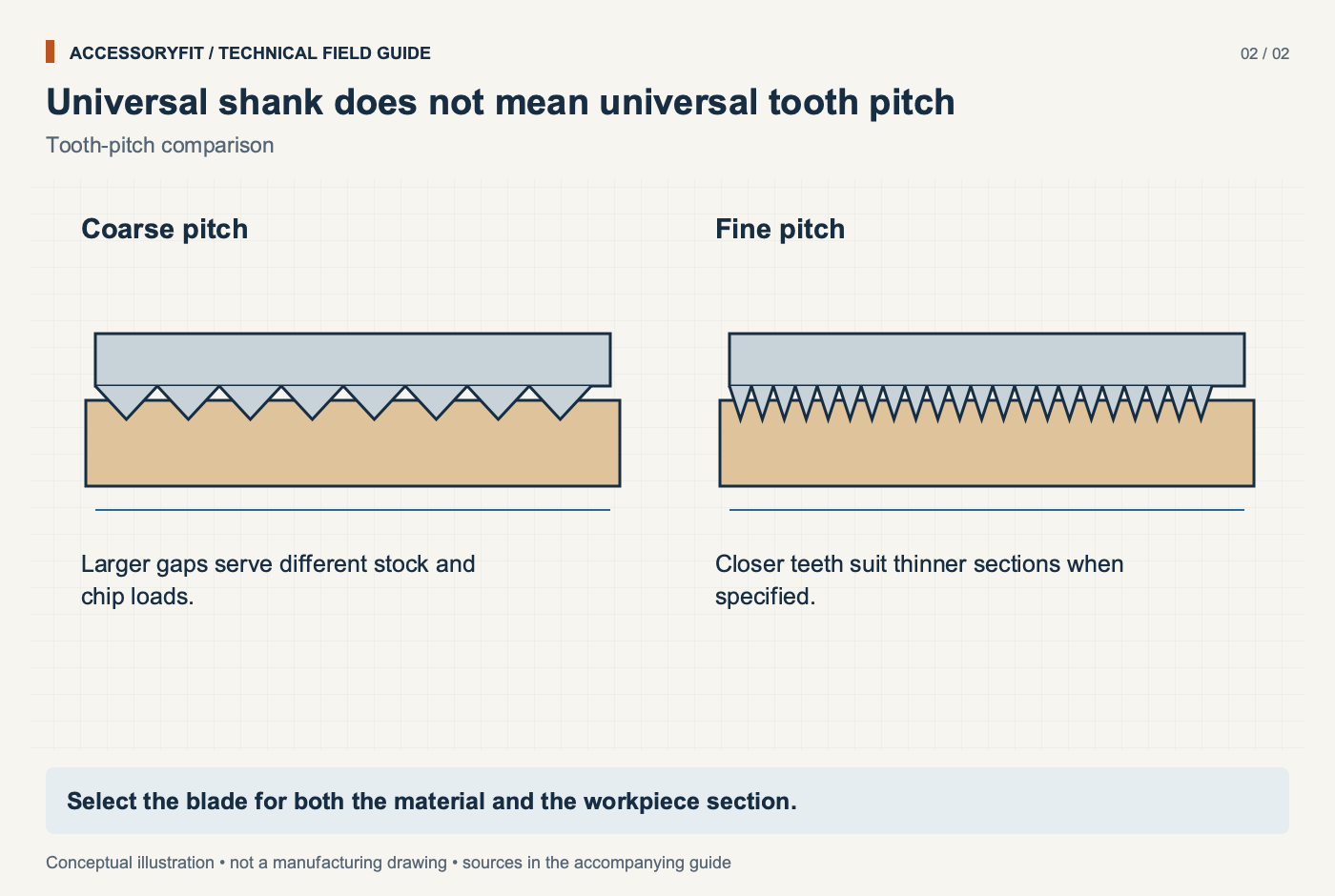
Coarse blades of about 5–7 TPI suit wood and nail-embedded demolition, while metal needs finer teeth that follow its thickness. Thin and medium sheet calls for about 18–24 TPI, and thick metal is cut with coarser blades of about 8–14 TPI. Lenox advises keeping 2–3 teeth in the material at all times.
The belief that any metal blade works on any metal thickness is common and wrong. Tooth count follows thickness, and the bands each maker states overlap rather than match exactly, so the band printed on the blade itself is the one to trust. The table lists manufacturer examples by application.
For heavy tear-out work, the shortlist of carbide demolition blades applies these thickness and tooth figures to specific products. Lenox and Diablo both claim carbide-tipped blades last up to 50x vs. standard bi-metal (manufacturer claims) in the applications they test; those are the makers' own claims.
| Application | TPI | Material thickness stated | Example blades |
|---|---|---|---|
| Clean wood, pruning, plastic pipe | 6 | - | Lenox 121016W6R (6 x 3/4 x .050 in) |
| Fast wood, demolition, nail-embedded wood | 5-7 | - | Lenox DEMOWOLF 6 TPI .062 in; Milwaukee AX 5 TPI; Diablo DS0606CWS 5/7 TPI carbide |
| Wood, metal and plastic (multi-purpose) | 10 or 10/14 | - | Lenox MULTIWOLF 810R, 650R; Milwaukee WRECKER 7/11 |
| Thick metal (bi-metal) | 10-14 | 1/8-1/2 in (3.2-12.7 mm) | Lenox METALWOLF 6110R, 6114R |
| Thick metal (carbide-tipped) | 8 | 3/16-9/16 in (Diablo); 4-12 mm (Bosch) | Diablo DS0908CF; Bosch S1155CHC; Lenox 6108RCT |
| Medium metal | 14/18 or 18 (bi-metal); 10 (carbide) | 3/32-5/16 in (Lenox); 1/16-5/16 in (Diablo) | Lenox 6118R; Diablo DS0614BF, DS0914BF, DS0610CF |
| Thin metal | 24 | under 1/8 in (3.2 mm) | Lenox 624R |
| Thin stainless and sheet (carbide) | 18 | 1.5-4 mm | Bosch S922EHM |
| Cast iron, tile, brick, stone, fiberglass | Grit (no teeth) | - | Lenox carbide grit 20576800RG; Lenox DIAMOND 1766338 |
Thickness bands for thick, medium and thin metal come from the Lenox TPI selection guide (p. 8); Diablo states its own bands on each product. The bands overlap between brands.
Which blade material should you pick?
Bi-metal is the general choice for metal, nail-embedded wood and mixed work, high-carbon steel suits soft materials, and carbide-tipped or grit blades handle the hardest jobs. Lenox describes bi-metal as a high-speed steel edge on a spring steel back that reduces breaks, and Lenox says it made the first bi-metal reciprocating blade in 1977. Bosch describes the same construction as a flexible bond of high-carbon and high-speed steel.
Carbide-tipped blades carry carbide welded to the edge and target thick metal, stainless, cast iron and nail-embedded wood. Grit blades have no teeth at all and are made for tile, fiberglass, brick and cast iron pipe. Every one of these materials sits on the same universal shank, so the decision is about the work, not the saw.
| Material | Use | Manufacturer notes |
|---|---|---|
| High-carbon steel (HCS) | Wood, wood fibreboard, soft plastics | Bosch: carbon steel for softer materials |
| Bi-metal (BIM) | Metal, wood with nails, multi-material | High-speed steel cutting edge on a spring steel back to reduce breaks (Lenox); flexible, unbreakable bond of HCS and HSS (Bosch) |
| Carbide-tipped | Thick metal, stainless steel, cast iron, nail-embedded wood | Carbide welded to the edge; up to 50x life vs. bi-metal claimed by Lenox and Diablo |
| Carbide grit | Ceramic, tile, fiberglass, brick, cultured marble | Grit edge, no teeth (Lenox) |
| Diamond grit | Cast iron pipe, tile, brick, natural stone | Nickel alloy-brazed diamond particles (Lenox); diamond-coated blades for cast pipe (Bosch) |
Bosch definitions from catalogue p. 52; Lenox from 2024 catalogue pp. 2-6.
How does the reciprocating shank compare with jigsaw shanks?
Reciprocating saws share one cross-brand shank, while jigsaws split between T-shank and U-shank blades that do not swap. A reciprocating blade buyer can ignore brand; a jigsaw blade buyer has to match the shank letter to the saw.
The two blade types are not interchangeable with each other either. They are built for different tools, different clamps and different strokes, and no manufacturer source on file approves fitting one in the other. The materials do overlap: bi-metal is common on both, and the metal-cutting logic of finer teeth for thinner stock holds for both, which is why the shortlist of bi-metal jigsaw blade picks reads much like a reciprocating metal-blade guide at a smaller scale.
When does a blade that fits still fail?
A blade that clamps correctly still fails when it is forced, unsupported or wrong for the material. The cases manufacturers describe are these:
- Forcing the blade in metal. DeWalt says this shortens blade life and breaks blades.
- Cutting metal dry. DeWalt and Makita both call for a thin film of oil or coolant on the cut line, and Makita says skipping it wears the blade out early.
- Shoe lifted off the work. Keeping the shoe pressed against the material stops the saw jumping and vibrating and reduces breakage.
- Starting under load. Let the motor reach full speed before applying pressure.
- A thin blade on demolition. Demolition blades are thicker and taller for a reason.
- A tooth count outside the stated band. Each blade lists the material thickness it is made for; using it outside that band works against the maker's guidance.
Repeated snapping is the clearest sign one of these is at work, and the guide on why recip blades break works through the causes in order.
How do you pick a blade for a saw you already own?
Four checks take a buyer from the saw in hand to the right blade. None of them involves the saw's brand.
- Confirm the saw takes universal-shank blades. Current corded and cordless saws do; the blade-change section of the manual confirms it for older or unusual models.
- Measure the work. Add the Lenox margin to the material width to get the minimum blade length, then pick the nearest common length.
- Match teeth to the material. Coarse for wood and demolition, fine for thin metal, medium for thick metal, grit for tile and masonry.
- Choose thickness for the job. Thin for metal and flexible flush cuts, thick and tall for demolition and nail-embedded wood.
Where do you go next?
Readers comparing every saw blade family can start from the saw blade guides, which link the reciprocating, jigsaw, circular and band saw pages together. Fit rules for other tools, from drill chucks to router collets, are grouped under the compatibility guides.
Questions readers ask
Will a Diablo reciprocating blade fit a Milwaukee Sawzall?
Yes. Diablo says its blades fit all corded and cordless reciprocating saws, and the universal shank is shared across current brands.
What is an S-shank?
It is Bosch's name for the universal reciprocating saw shank. Bosch says its blades fit all S-shank saws, which covers most saws on the market.
How long a blade do I need to cut through a wall stud?
Lenox's rule is material width + 3 in (76 mm), using the stud's width as the material width; then choose the nearest common length from 4, 6, 8, 9, 10, 12 in (102, 152, 203, 229, 254, 305 mm).
Do cordless reciprocating saws take different blades from corded ones?
No. Diablo and Bosch describe the same blades as fitting corded and cordless saws alike. Battery platform affects the saw, not the blade fit.
Can a jigsaw blade be used in a reciprocating saw?
No manufacturer source on file approves it. Jigsaw blades use T-shank or U-shank ends made for jigsaw clamps, while reciprocating saws take universal-shank blades.
Where to go next
- Why reciprocating saw blades breakCauses and fixes once the blade fits.
- Reciprocating saw blades for demolitionThick, carbide and bi-metal options.
- Jigsaw blade shank typesT-shank and U-shank, which do not swap.
References 63 documents, 15 publishers
- BG BAU - Berufsgenossenschaft der Bauwirtschaft (Germany): Baustellenkreissaegen, Handkreissaegen - Baustein B 265
- Bosch: EXPERT Thick Tough Metal S1155CHC Blade; EXPERT Thin Tough Metal S922EHM Blade; Reciprocating Saw Blades (category page); Bosch Accessories catalogue: Jigsawing, sabre sawing, multi-cutters, holesawing (1619A00Y1X, GB edition, 2016); T-Shank Jig Saw Blade Sets; U-Shank Jig Saw Blades Pro for Wood; U-Shank Jig Saw Blades Pro for Metal; U-Shank Jig Saw Blades Basic for Metal; T-Shank Jig Saw Blades for Wood; T-Shank Jig Saw Blades Pro for All Purpose; T 101 BR Clean for Wood Jigsaw Blade; T 118 A Basic for Metal Jigsaw Blade; U 234 X Progressor for Wood Jigsaw Blades; T-Shank Jig Saw Blades Pro for Plastic (set 43925); 1617/1618 router operating/safety instructions (2610051825)
- DeWalt: DWE305 12 Amp Corded Reciprocating Saw; DWE305 reciprocating saw instruction manual (N392518); DCS389B 60V MAX Brushless Cordless Reciprocating Saw; DWE305 12 Amp Reciprocating Saw product page; DCS334/DCS335 20V MAX cordless jig saw instruction manual (N577652); DWE575 circular saw instruction manual (N786997)
- Freud and Diablo: DS0908CF 9 in 8 TPI Steel Demon Carbide Teeth Reciprocating Saw Blade for Thick Metal; DS0614BF 6 in 14/18 TPI Bi-Metal Reciprocating Saw Blade for Medium Metal; DS0914BF 9 in 14/18 TPI Bi-Metal Reciprocating Saw Blade for Medium Metal; DS0610CF 6 in 10 TPI Steel Demon Carbide Teeth Reciprocating Saw Blade for Medium Metal; DS0606CWS 6 in 5/7 TPI Demo Demon Carbide Teeth Reciprocating Saw Blade for Nail-Embedded Wood; DS0903CP product page (pruning/clean wood carbide family incl. DS0603CP, DS1203CP); Get the most out of your Freud bits by routing at ideal feed rates and speeds
- Hand (N Y): Traumatic Finger Amputations: Epidemiology and Mechanism of Injury, 2010-2019; Trends in Upper Extremity Saw Injuries From 2003 to 2022
- Health and Safety Executive (UK): Circular saw benches - Safe working practices, Woodworking Information Sheet No 16 (Revision 2)
- Journal of Clinical Orthopaedics and Trauma: Patients admitted for treatment of traumatic finger amputations: Characteristics, causes, and prevention
- Makita: JR3070CT reciprocating saw instruction manual (EU); XRJ05Z 18V LXT Brushless Recipro Saw (tool only) product page; XRJ05 instruction manual 885449A940; 9557PB angle grinder instruction manual; 5007F 7-1/4 in circular saw instruction manual
- Milwaukee Tool: 48-00-5027 12 in 5 TPI AX SAWZALL Blade for Wood with Nails; 49-22-1129 SAWZALL 12PC Demolition Blade Set; 2821-20 M18 FUEL SAWZALL Recip Saw; 48-00-1301 9 in 5 TPI Pruning SAWZALL blade (5 pk); 48-00-5332 9 in 3 TPI AX carbide pruning SAWZALL blade; 48-00-1303 12 in 5 TPI Pruning SAWZALL blade (5 pk); 2722-20 M18 FUEL SUPER SAWZALL Reciprocating Saw product page; Operator's manual 58-14-2838d3 (Cat. No. 2722-20); M18 FUEL oscillating multi-tool 2836-20 operator's manual (58-14-0217d1)
- OSHA: 29 CFR 1910.215 Abrasive wheel machinery; 29 CFR 1910.243 Guarding of portable powered tools; 29 CFR 1926.303 Abrasive wheels and tools; 29 CFR 1926.300 General requirements (Tools, hand and power); 29 CFR 1926.304 Woodworking tools
- Stanley Black & Decker (IRWIN, LENOX): LENOX Tool Catalog 2024: Power Tool Accessories, Hand Tools; Reciprocating Saw Blades (product range page)
- ToolsToday: Jigsaw Blades - Not So Scary
- U.S. Consumer Product Safety Commission: Safety Standard Addressing Blade-Contact Injuries on Table Saws: Supplemental Notice of Proposed Rulemaking (November 1, 2023); The 2017 NEISS Table Saw Special Study (staff briefing package, including Table Saw Blade-Contact Injuries Special Study Report, 2017); Proposed Rule: Safety Standard Addressing Blade-Contact Injuries on Table Saws (staff briefing package, January 17, 2017); Injuries Associated with Stationary Power Saws, 2001; 2019 NEISS Coding Manual; Withdrawal of Proposed Regulatory Actions (September 29, 2025)
- Wikipedia: Jigsaw (tool)
- Woodworker's Journal: Bosch Jigsaws, Then and Now (Chris Marshall, 2010)
Accessed .