How to pick a jigsaw blade: shank, TPI, material and avoiding bent blades
Start with the shank your jigsaw clamps, T-shank or U-shank, because a blade with the other shank will not fit. Then match teeth per inch to the material: Lenox and Bosch put most wood blades at 6–10 TPI and metal blades at 14–36 TPI, finer for thinner stock. Choose high-carbon steel for softwood and soft plastics, bi-metal for hardwood, hard plastics and metal, and carbide or grit edges for tile and cement board. Pick a blade long enough to clear the material, and turn orbital action off for metal and hardwood.
Four attributes decide it: the shank, which must match the saw's blade clamp; the teeth per inch (TPI), which must suit the material's thickness; the blade material, which must be harder than what it cuts; and the tooth form, which sets how fast and how clean the cut is. Length comes fifth and only matters once the stock gets thick.
The order matters. A blade with the wrong shank cannot be fitted at all, so that check comes first. A blade with the wrong TPI fits but cuts badly: too coarse and it snags thin sheet, too fine and it clogs and overheats in thick timber. A blade of the wrong material fits and may cut for a while, then dulls quickly. Tooth form is a refinement you choose once the first three are right.
Jigsaw blades are the most varied of the saw blade guides on this site because one saw is expected to cut softwood, worktops, sheet steel, acrylic and tile. Most packaging prints all four attributes on the blade itself or on the card: shank style, TPI, material code and the intended material, often as a colour code or a short phrase such as clean for wood or basic for metal.
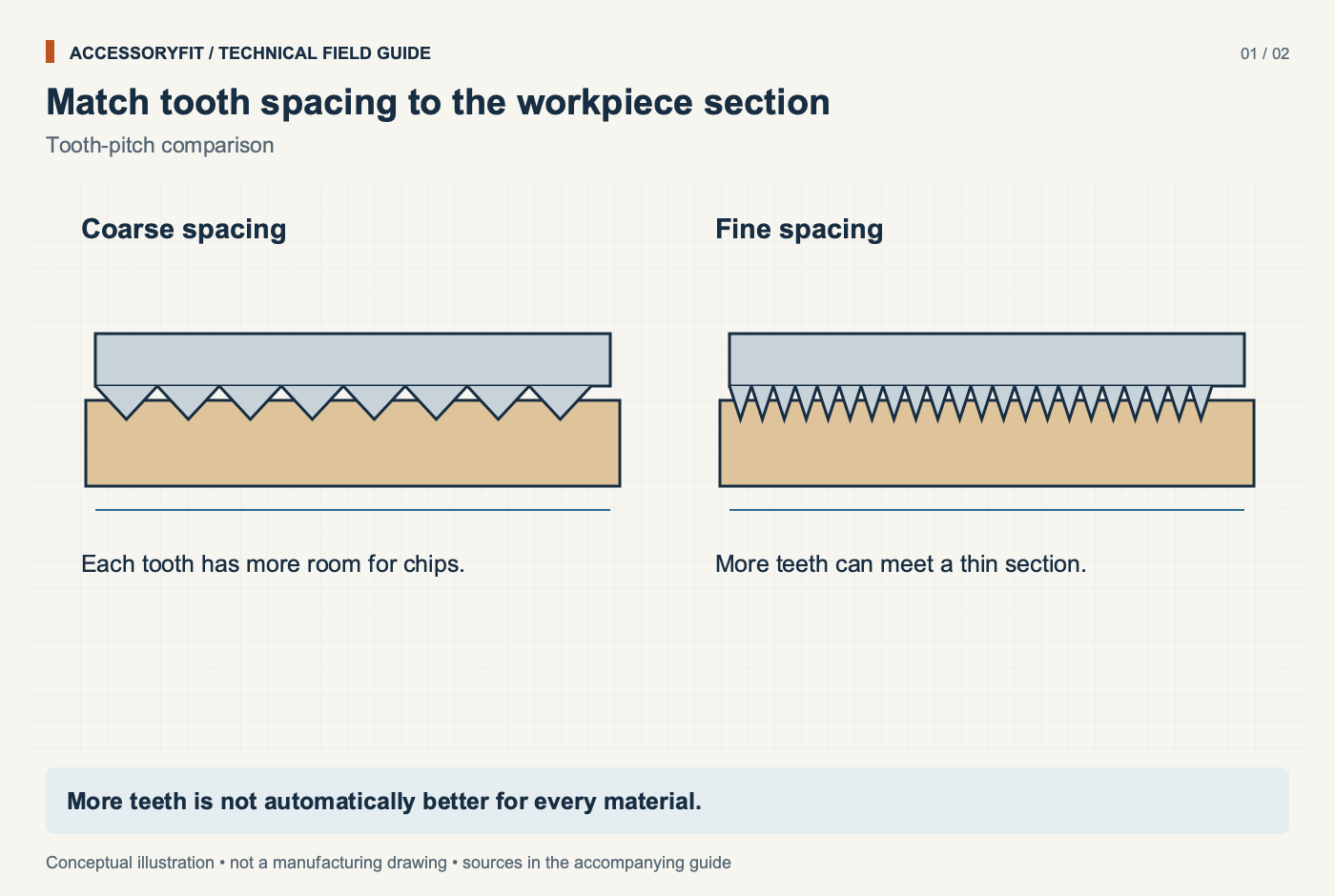
More teeth is not automatically better for every material.
02Does your jigsaw take T-shank or U-shank blades?
Almost every jigsaw sold today takes T-shank blades, and a T-shank saw takes only T-shank blades. DeWalt's manual for the DCS334, for example, says the saw uses T-shank blades only. U-shank blades are still made but are labelled for U-shank saws only.
The T-shank was created by Bosch and replaced its earlier tang-style blades to become the industry standard. Bosch's own marketing says its T-shank blades fit over 90% of current jigsaw makes and models (Bosch claim); no independent count was found to confirm it. Lenox still sells U versions of several T blades, such as its C450U alongside the C450T.
The names catch out European buyers. Bosch's European catalogue calls the T-shank the single lug shank and the U-shank the universal shank. That makes it easy to believe a universal blade fits every jigsaw, which is wrong: universal here is simply Bosch's name for the U-shank. Likewise, T-shank and U-shank blades are not interchangeable even when the toothed part looks identical. The guide to T-shank and U-shank jigsaw blades shows how to tell them apart and which older proprietary shanks exist.
Jigsaw blade shank types and what each fits, from Bosch, Lenox and DeWalt
Shank
Other names
What it fits
Notes
T-shank
Single lug shank (Bosch EU catalogue)
T-shank jigsaws only
Created by Bosch; industry-standard type; Bosch says it fits over 90% of current jigsaw models
U-shank
Universal shank (Bosch EU catalogue)
U-shank jigsaws only
Still sold by Bosch and Lenox, often as a U-version of a T-shank blade (for example Lenox C450T and C450U)
Bosch's word 'universal' here means U-shank, not 'fits every saw'. Older proprietary shanks (for example some Makita and Festool tang styles) were not covered by any source fetched.
03Which shank do current jigsaws use?
Every jigsaw in our tool fact base takes T-shank blades, which matches the makers' own statements above. The table lists the blade mount and stroke length each maker publishes, so you can confirm a model before buying blades for it.
Blade mount and stroke length of selected jigsaws, from manufacturer specifications
Tool
Blade mount
Stroke
Bosch JS470E
T-shank
1 in
Bosch JS572EK
T-shank
1 in
DeWalt DCS334B
T-shank
not stated
Makita 4351FCT
T-shank one source
1 in
Milwaukee 2737-20
T-shank
1 in one source
Values marked one source appear in a single manufacturer document; check the tool's manual or rating plate before buying.
04How many teeth per inch should a jigsaw blade have?
Match TPI to the material and its thickness: general wood-cutting blades run 6–10 TPI, and metal-cutting blades run 14–36 TPI, with the finest teeth for the thinnest sheet. Lenox's rule of thumb is to keep 2–3 teeth in the material at all times, so thin material needs more, closer teeth and thick material fewer, larger ones.
The table below sets out the TPI and thickness ranges that Lenox and Bosch list for named blades in each material. Read it by material first, then by thickness: a blade listed for medium metal will clog in thick plate and snag in thin sheet. Bosch's European pages give tooth spacing in millimetres between teeth instead of TPI, so a larger spacing figure on a European card means a coarser blade, the opposite of how TPI reads.
Jigsaw blade TPI by material and stated thickness, from Lenox and Bosch blade listings
Material
Typical TPI
Thickness range stated
Example blades
Softwood and hardwood, fast cuts
6
3/8-1-3/4 in (9.5-44.5 mm)
Lenox C456T, B456T; Bosch U111DF
Wood, clean cuts
10
3/16-1-1/4 in (4.8-31.8 mm)
Lenox C450T/C450U, B450T; Bosch U101BF
Wood, fine/scroll cuts
20
1/16-3/4 in (1.6-19.1 mm)
Lenox C320TS/C320US
Wood with nails, general purpose
5-10 (progressive) or 6
5/16-1-3/4 in (7.9-44.5 mm) for Lenox B406T
Bosch T345XF, T111CF (8 TPI); Lenox B406T
Metal over 3/32 in (2.4 mm)
14
> 3/32 in
Lenox B314T
Medium metal
18
1/16-1/4 in (1.6-6.4 mm)
Lenox B318T; Bosch U118EF 14-18
Thin metal
24 (17-24 progressive)
< 1/8 in (3.2 mm)
Lenox B324T; Bosch U118A 17-24P
Extra-thin sheet metal
32-36
< 1/16 in (1.6 mm)
Lenox B332T 32; Bosch U118G 36
Cement board, fiberglass, plaster
6 (carbide-tipped)
1/4-2-3/8 in cement board
Lenox CT456T
Ceramic tile, fiberglass, brick
Grit (no teeth)
3/64-5/8 in (1.2-15.9 mm)
Lenox G300T carbide grit
Bosch European pages give tooth spacing in mm instead of TPI (for example T 101 BR 2.5 mm, T 118 A 1.1-1.5 mm). Ranges are what each manufacturer lists for the named blade, not universal limits.
05Is a higher TPI always the better blade?
No: more teeth give a smoother cut but a slower one, and in thick stock a fine blade packs its gullets with sawdust, heats up and wanders. Lenox matches TPI to thickness rather than to finish alone, with most wood work in the coarse-to-medium range.
For a clean edge in wood, tooth form often matters more than tooth count. A taper-ground or reverse-tooth blade in the normal wood range can leave a cleaner face than a much finer blade that is struggling to clear chips. Fine scroll blades earn their place on tight curves in thin stock, where their narrow bodies turn more easily.
06Which blade material suits wood, metal and tile?
High-carbon steel (HCS) suits softwood, fibreboard and soft plastics; high-speed steel (HSS) suits metal; bi-metal (BIM) covers hardwood, abrasive wood products, hard plastics and both ferrous and non-ferrous metal. Carbide-tipped, carbide-grit and diamond-grit blades take over for cement board, tile and stone.
Bi-metal is the most versatile choice because it puts hardened HSS teeth on a flexible HCS body, and Bosch recommends it where a blade might snap at the shank. Bosch's catalogue, the only source for this figure, puts bi-metal blade life at about 2x HSS, about 10x HCS. HCS blades are flexible and suit soft materials. HSS is fully hardened and cuts metal well, but it lacks the flexible body that makes bi-metal the safer choice where a blade may bend.
Jigsaw blade materials, codes and uses, from Bosch and Lenox catalogues
Material
Code
Use
Notes
High-carbon steel
HCS
Softwood, wood fibreboard, soft plastics
Flexible; Bosch T 101 BR and U 234 X are HCS
High-speed steel
HSS
Metal, aluminium, non-ferrous metal
Fully hardened; Bosch T 118 A is HSS
Bi-metal
BIM
Hardwood, abrasive wood materials, hard plastics, non-ferrous and ferrous metal
HSS teeth on an HCS body; used where shank breakage is a risk; about 2x HSS life and about 10x HCS life (Bosch)
Bosch definitions from catalogue p. 8; Lenox carbide and diamond rows from 2024 catalogue p. 14.
07What do tooth set, grind and direction change?
Tooth form decides the trade-off between speed and finish: milled, side-set teeth cut fast and rough, wavy-set teeth cut fine and straight in thin metal and plywood, and taper-ground teeth leave the cleanest edge in wood and plastic. Bosch's catalogue groups its blades by these forms.
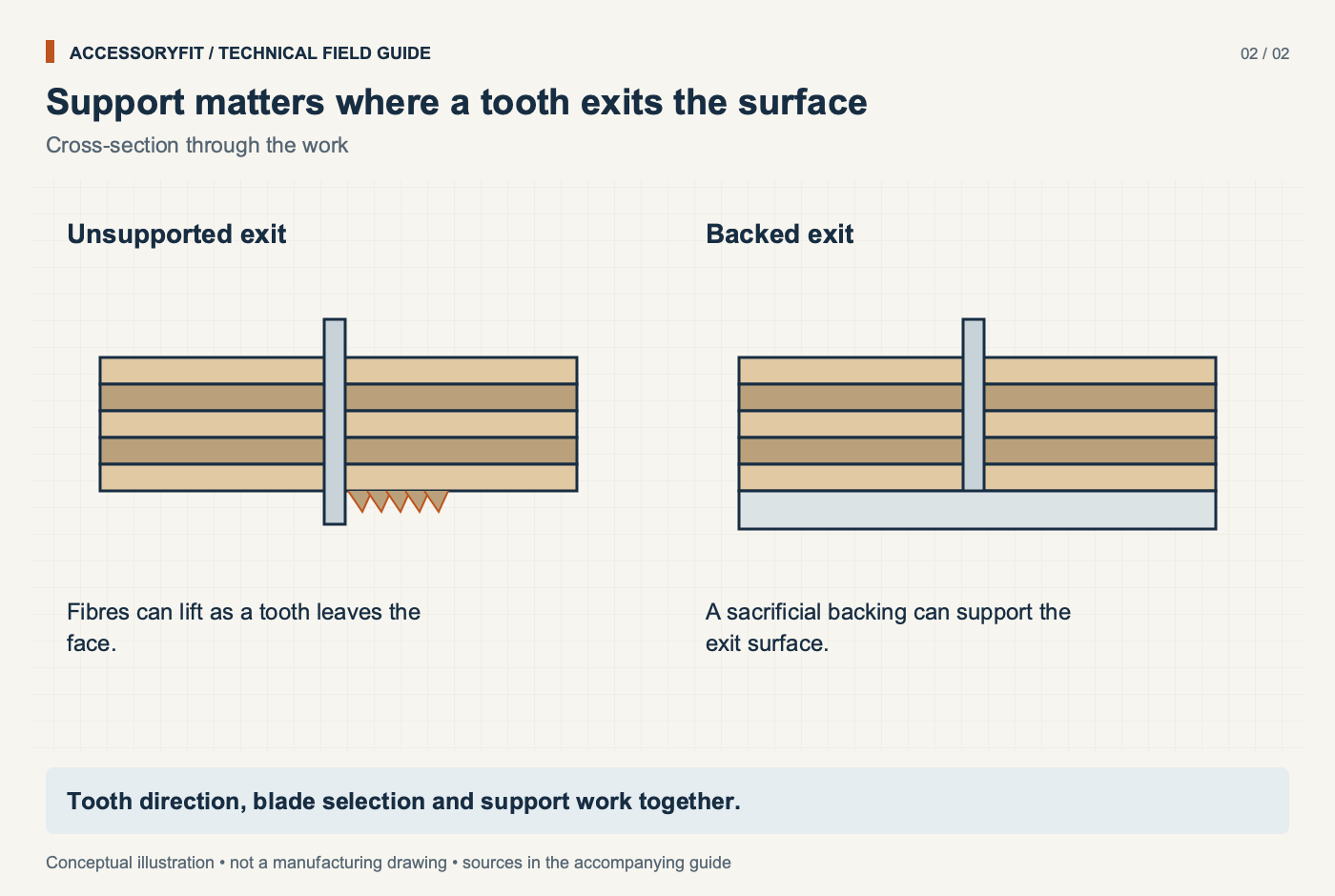
Two other tooth patterns solve specific problems. A reverse-tooth or down-cut blade cuts on the down stroke, so the top face stays free of splinters; it suits laminate worktops and veneered panels cut from the good side. A progressive-tooth blade changes pitch along its length, so one blade can handle thin and thick material across a range of densities, which makes it a useful general blade for mixed jobs such as timber with hidden nails.
Tooth direction, blade selection and support work together.
Jigsaw tooth set and grind and the cut each gives, from Bosch's accessory catalogue
Tooth form
Result
Bosch examples
Milled, side set
Relatively rough cut, fast progress in hard and softwood, aluminium, plastics, non-ferrous metal
Bosch Accessories catalogue p. 8, 'The right geometry is what's important'.
08Which jigsaw blade cuts plastic, plexiglass and polycarbonate?
For plastics, use a blade whose maker lists plastic, run at a low saw speed: HCS blades for soft plastics, bi-metal blades for hard plastics, and a taper-ground tooth form for the cleanest edge. DeWalt's DCS334 manual puts plastics among the materials that need a lower speed, along with tile, laminate, hard metals and cast iron.
Acrylic, sold as Plexiglas, Perspex or PMMA, has its own blade in Bosch's range. Bosch lists the T 102 BF (13 TPI, bi-metal) as its Clean for PMMA blade, made to leave an edge that needs no rework. For polycarbonate sheet, Bosch's accessory catalogue gives a different blade, the T 101 A (HSS) Clean for PC, with ground, taper-ground teeth. Both are Bosch's own recommendations and no second maker in the fact base names an equivalent, so with other brands look for plexiglass, acrylic or polycarbonate on the blade card rather than assuming any fine blade will do. Both Bosch blades are T-shank.
The saw setting matters as much as the blade. DeWalt designs orbital action for soft materials such as wood or plastic, so its manual allows it on plastic, but it also notes that orbital cuts are less smooth; for a visible edge on acrylic or polycarbonate, a straight stroke at the lower speed DeWalt recommends for plastics is the cleaner choice.
09How long should a jigsaw blade be?
A jigsaw blade must be long enough to stay in the cut through the full stroke, and Lenox sizes the minimum length as material thickness + 2 to 2-3/4 in, the extra depending on the cut. Most blades in the Bosch and Lenox ranges are 2-3/4 to 5-1/4 in (70 to 133 mm) long.
Longer is not automatically better. A long, narrow blade flexes more, so for thin sheet and tight curves the shortest blade that clears the stock gives the most control. For thick timber, a longer specialist blade is needed, and Bosch makes some for construction timber. Width also affects curves: narrow scroll blades turn tighter radii, while wide blades track straighter.
10When should orbital action be off?
Orbital action should be off for metal and hardwood. DeWalt's DCS334 manual says those materials should never be cut with orbital action and reserves the orbital settings for soft materials such as wood and plastic, where they cut faster but less smoothly. The belief that orbital action improves every cut is therefore wrong.
Speed follows the same logic. DeWalt's manual advises lower speed for plastics, tile, laminate, hard metals and cast iron, and higher speed for wood and soft metals. Numbering of orbital settings varies between saws, so the table below shows DeWalt's scheme as an example; check your own saw's manual for its scale.
Orbital setting by material, from the DeWalt DCS334 manual
Setting
Action
Use
0
Straight
Metal and hardwood (never cut these in orbital action); flush-cut blade at 0 or 1
1-3
Orbital, more aggressive as number rises
Soft materials such as wood and plastic; faster but less smooth cut
Settings and their numbering vary by saw; check the saw's manual.
11How do you pick a jigsaw blade, step by step?
These steps turn the attributes above into a blade choice for one job.
Check the saw's shank. Look at the blade clamp or the manual. Most current saws are T-shank; buy U-shank only for a saw built for it.
Name the material. Softwood, hardwood, laminate, plastic, sheet metal, plate, cement board or tile each point to a different blade material.
Measure the thickness. Choose TPI so several teeth stay in the material: coarse for thick timber, fine for thin sheet.
Choose the blade material. HCS for softwood and soft plastic, bi-metal for hardwood, hard plastic and mixed work, HSS or bi-metal for metal, carbide or grit for tile and board.
Pick the tooth form for the finish. Side-set for fast rough cuts, taper-ground or wavy-set for clean cuts, reverse-tooth for a splinter-free top face.
Check the length. Add the Lenox allowance to the thickness and pick a blade at least that long, but no longer than needed.
Set the saw. Orbital off for metal and hardwood, lower speed for plastic, tile and hard metals.
12Why do jigsaw blades bend, wander or snap?
The causes makers name are forcing the saw, using orbital action on metal or hardwood, and a brittle blade where the shank takes the load. DeWalt's jigsaw manual says not to force the saw but to let the blade cut at its own speed; pushing harder makes a thin blade deflect sideways, which shows as a bevelled or curved edge.
Orbital action on hard material adds to the problem, because the blade is driven forward into wood or metal it cannot clear quickly. Where blades break at the shank, Bosch recommends switching to flexible bi-metal blades. In thin sheet metal the sheet itself vibrates and tears unless wood is clamped underneath it.
Other likely causes, such as a blade that is too thin for the cut or a dull blade, are widely discussed, but the manufacturer documents in our fact base do not tie them to wandering cuts, so this page does not state them as rules. If a cut still drifts with the right blade at a steady feed, the saw's blade guide roller and clamp are the next things to check in its manual.
13Which jigsaw blades and sets cover these jobs?
Product links go to Amazon. As an Amazon Associate I earn from qualifying purchases. How links are chosen.
These five blades and sets are the T-shank jigsaw products in our catalogue that match the attributes on this page. They are grouped by job, not ranked, and the specs come from each maker's product page. For a wider choice of metal blades, the bi-metal jigsaw blade picks page compares more options.
Starter set: clean and fast wood cuts plus thin metal
Bosch T500 5 pc. T-shank jig saw blade set for wood and metal
Shank
T-shank
Pieces
5 pcs
Blades
T101B, T144D, T119BO, T118A, T118B
Suits New T-shank jigsaw owners who want one blade for each common job in wood and metal.
Skip it if U-shank saws, and anyone needing more than one of each blade.
Mixes clean-cut and fast-cut wood blades with metal blades
Every blade carries a Bosch part code, so replacements are easy to match
A jigsaw is the wrong saw when the cut is long and straight in thick timber, when the stock is deeper than any blade can clear, or when the job is demolition. A band saw handles deep curved cuts with a continuous blade, and the guide to band saw blade length and width covers sizing for those machines. For cutting through nailed framing or pipe in place, a reciprocating saw with demolition recip blades is the faster tool.
To find the blades that fit a specific saw model, the accessory finder filters by tool, and the other how-to guides cover drill bits, router bits and abrasives in the same way.
15Questions readers ask
Can a U-shank blade be used in a T-shank jigsaw?
No. Each shank fits only saws built for it, and makers label their blades for one shank or the other. Lenox even sells separate T and U versions of the same blade.
What does tooth spacing in millimetres mean on a European blade card?
It is the distance between tooth tips, which Bosch uses on its European pages instead of TPI. A larger spacing means fewer, bigger teeth and a coarser, faster cut.
Is there a jigsaw blade made for plexiglass?
Yes. Bosch makes the T 102 BF (13 TPI, bi-metal) Clean for PMMA specifically for acrylic, and lists the T 101 A (HSS) for polycarbonate. Run either at a low speed, which DeWalt's manual advises for plastics.
Which blade gives a splinter-free top face on a laminate worktop?
A reverse-tooth (down-cut) blade, which cuts on the down stroke and leaves the top surface clean. Run it with orbital action off.
Can a jigsaw cut ceramic tile?
Yes, with a toothless carbide-grit blade such as those Bosch sells under the RIFF name or Lenox's grit blades, run at a low speed. Diamond-grit blades are listed for harder stone and porcelain.
BG BAU - Berufsgenossenschaft der Bauwirtschaft (Germany): Baustellenkreissaegen, Handkreissaegen - Baustein B 265
Bosch: T-Shank Jig Saw Blade Sets; U-Shank Jig Saw Blades Pro for Wood; U-Shank Jig Saw Blades Pro for Metal; U-Shank Jig Saw Blades Basic for Metal; T-Shank Jig Saw Blades for Wood; T-Shank Jig Saw Blades Pro for All Purpose; T 101 BR Clean for Wood Jigsaw Blade; T 118 A Basic for Metal Jigsaw Blade; U 234 X Progressor for Wood Jigsaw Blades; Bosch Accessories catalogue: Jigsawing, sabre sawing, multi-cutters, holesawing (1619A00Y1X, GB edition, 2016); T-Shank Jig Saw Blades Pro for Plastic (set 43925); JS470E 7.0 Amp Top-Handle Jig Saw product page; JS470E/JS470EB operating/safety instructions 2610051979; JS572EK Top-Handle Jig Saw product page; JS572E/JS572EB operating/safety instructions 2610051980; 1617/1618 router operating/safety instructions (2610051825); T-Shank Jig Saw Blade Sets (T500 row); T-Shank Jig Saw Blades Basic for Metal
DeWalt: DCS334/DCS335 20V MAX cordless jig saw instruction manual (N577652); DCS334B 20V MAX* XR Cordless Jig Saw product page; DWE575 circular saw instruction manual (N786997); DW3741C T-Shank Jig Saw Blade Set With Case (10 pc.) product page
Freud and Diablo: Get the most out of your Freud bits by routing at ideal feed rates and speeds; DJT10S 10-piece jig saw blade set product page; DJT121AF5 Jigsaw Blades Medium Metal Bi-Metal product page
Hand (N Y): Traumatic Finger Amputations: Epidemiology and Mechanism of Injury, 2010-2019; Trends in Upper Extremity Saw Injuries From 2003 to 2022
Health and Safety Executive (UK): Circular saw benches - Safe working practices, Woodworking Information Sheet No 16 (Revision 2)
Journal of Clinical Orthopaedics and Trauma: Patients admitted for treatment of traumatic finger amputations: Characteristics, causes, and prevention
OSHA: 29 CFR 1910.215 Abrasive wheel machinery; 29 CFR 1910.243 Guarding of portable powered tools; 29 CFR 1926.303 Abrasive wheels and tools; 29 CFR 1926.300 General requirements (Tools, hand and power); 29 CFR 1926.304 Woodworking tools
Stanley Black & Decker (IRWIN, LENOX): LENOX Tool Catalog 2024: Power Tool Accessories, Hand Tools
ToolsToday: Jigsaw Blades - Not So Scary
U.S. Consumer Product Safety Commission: Safety Standard Addressing Blade-Contact Injuries on Table Saws: Supplemental Notice of Proposed Rulemaking (November 1, 2023); The 2017 NEISS Table Saw Special Study (staff briefing package, including Table Saw Blade-Contact Injuries Special Study Report, 2017); Proposed Rule: Safety Standard Addressing Blade-Contact Injuries on Table Saws (staff briefing package, January 17, 2017); Injuries Associated with Stationary Power Saws, 2001; 2019 NEISS Coding Manual; Withdrawal of Proposed Regulatory Actions (September 29, 2025)
Wikipedia: Jigsaw (tool)
Woodworker's Journal: Bosch Jigsaws, Then and Now (Chris Marshall, 2010)