
Reference chart · Threads
Tap drill size chart: which drill each UNC, UNF and metric thread needs
A 1/4-20 tap needs a #7 drill, which measures 0.201 in. A 5/16-18 tap takes letter F, and a 3/8-16 tap takes 5/16 in. In metric, drill 5.0 mm for M6, 6.8 mm for M8 and 8.5 mm for M10 coarse threads. These are the standard drills for a near-full thread; the tables below list every common UNC, UNF and metric coarse thread, with a slightly larger alternative for hard metals.
By AccessoryFit editors · Checked
On this page
- What is a tap drill, and why is it smaller than the thread?
- Tap drill chart for UNC and UNF threads
- Tap drill chart for metric coarse threads
- How do you work out a metric tap drill without a chart?
- What tap drill do fine-pitch metric threads need?
- What drill bit size do you need for a 1/4-20 tap?
- What drill size do 5/16 and 3/8 taps need?
- Should you drill for 75% or 50% thread?
- How do you read a thread callout and find its drill?
- Which drill bit should you use for a tap hole?
- When doesn't a tap drill chart give the right hole?
- Where do number and letter drills fit into tap drilling?
What is a tap drill, and why is it smaller than the thread?
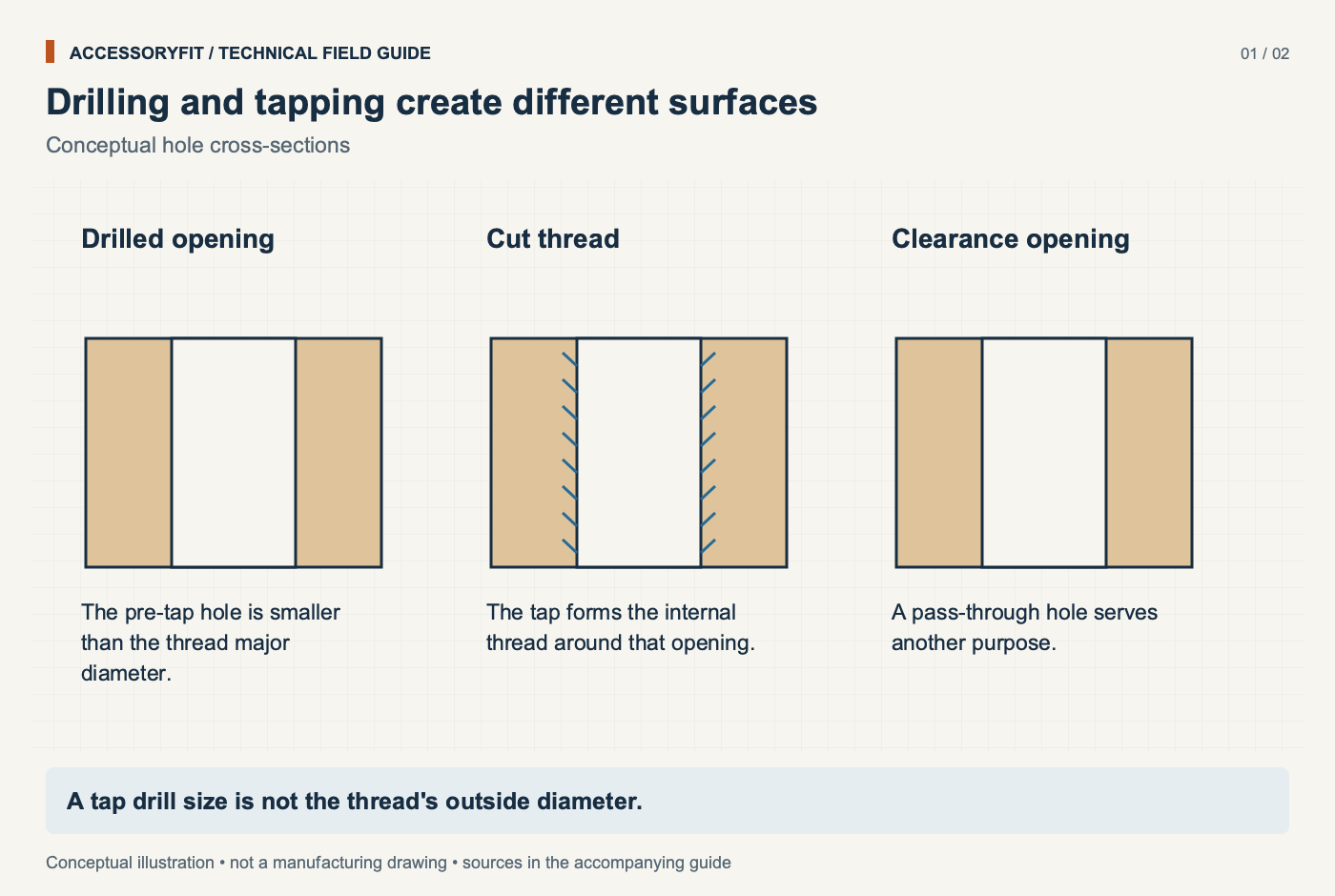
A tap drill is the bit that makes the hole before a tap cuts the thread, and it is always smaller than the thread's nominal size because the tap needs metal left in the wall to form the thread. The nominal size of a thread is its major diameter, measured across the crests; the tap drill sits close to the minor diameter at the roots, leaving enough material for the tap to cut most of the full thread profile.
Most charts, including the inch and metric tables on this page, give two drills per thread, one for each of 75% / 50% thread. The first figure is the usual default. The second is a slightly larger drill that leaves less metal for the tap to remove, which makes tapping easier in tough material at the cost of a shallower thread. Thread percentage here means how much of the full theoretical thread depth the tap actually cuts, not a share of strength.
Tap drill chart for UNC and UNF threads
The inch table covers machine-screw sizes from #0 up to one inch, in both coarse (UNC) and fine (UNF) pitches. Each row gives the thread, its major diameter, threads per inch (TPI), and two drills, one for each of the 75% / 50% thread columns. Every drill is shown in its own system, number, letter or fraction, followed by the decimal inch and millimetre values, so you can find it in any drill index. Little Machine Shop and the University of Pennsylvania's design chart agree on the standard drill for every thread they both list, from #0-80 to 1/2-20 (cross-check result: 21 of 21 match). Rows from 9/16 in to one inch come from Little Machine Shop alone.
| Thread | Major diameter | TPI | Tap drill, 75% thread | Tap drill, 50% thread |
|---|---|---|---|---|
| #0-80 UNF | 0.0600 in | 80 | 3/64 in (0.0469 in / 1.19 mm) | #55 (0.0520 in / 1.32 mm) |
| #1-64 UNC | 0.0730 in | 64 | #53 (0.0595 in / 1.51 mm) | 1/16 in (0.0625 in / 1.59 mm) |
| #1-72 UNF | 0.0730 in | 72 | #53 (0.0595 in / 1.51 mm) | #52 (0.0635 in / 1.61 mm) |
| #2-56 UNC | 0.0860 in | 56 | #50 (0.0700 in / 1.78 mm) | #49 (0.0730 in / 1.85 mm) |
| #2-64 UNF | 0.0860 in | 64 | #50 (0.0700 in / 1.78 mm) | #48 (0.0760 in / 1.93 mm) |
| #3-48 UNC | 0.0990 in | 48 | #47 (0.0785 in / 1.99 mm) | #44 (0.0860 in / 2.18 mm) |
| #3-56 UNF | 0.0990 in | 56 | #45 (0.0820 in / 2.08 mm) | #43 (0.0890 in / 2.26 mm) |
| #4-40 UNC | 0.1120 in | 40 | #43 (0.0890 in / 2.26 mm) | #41 (0.0960 in / 2.44 mm) |
| #4-48 UNF | 0.1120 in | 48 | #42 (0.0935 in / 2.37 mm) | #40 (0.0980 in / 2.49 mm) |
| #5-40 UNC | 0.1250 in | 40 | #38 (0.1015 in / 2.58 mm) | 7/64 in (0.1094 in / 2.78 mm) |
| #5-44 UNF | 0.1250 in | 44 | #37 (0.1040 in / 2.64 mm) | #35 (0.1100 in / 2.79 mm) |
| #6-32 UNC | 0.1380 in | 32 | #36 (0.1065 in / 2.71 mm) | #32 (0.1160 in / 2.95 mm) |
| #6-40 UNF | 0.1380 in | 40 | #33 (0.1130 in / 2.87 mm) | #31 (0.1200 in / 3.05 mm) |
| #8-32 UNC | 0.1640 in | 32 | #29 (0.1360 in / 3.45 mm) | #27 (0.1440 in / 3.66 mm) |
| #8-36 UNF | 0.1640 in | 36 | #29 (0.1360 in / 3.45 mm) | #26 (0.1470 in / 3.73 mm) |
| #10-24 UNC | 0.1900 in | 24 | #25 (0.1495 in / 3.80 mm) | #20 (0.1610 in / 4.09 mm) |
| #10-32 UNF | 0.1900 in | 32 | #21 (0.1590 in / 4.04 mm) | #18 (0.1695 in / 4.31 mm) |
| #12-24 UNC | 0.2160 in | 24 | #16 (0.1770 in / 4.50 mm) | #12 (0.1890 in / 4.80 mm) |
| #12-28 UNF | 0.2160 in | 28 | #14 (0.1820 in / 4.62 mm) | #10 (0.1935 in / 4.91 mm) |
| 1/4-20 UNC | 0.2500 in | 20 | #7 (0.2010 in / 5.11 mm) | 7/32 in (0.2188 in / 5.56 mm) |
| 1/4-28 UNF | 0.2500 in | 28 | #3 (0.2130 in / 5.41 mm) | #1 (0.2280 in / 5.79 mm) |
| 5/16-18 UNC | 0.3125 in | 18 | F (0.2570 in / 6.53 mm) | J (0.2770 in / 7.04 mm) |
| 5/16-24 UNF | 0.3125 in | 24 | I (0.2720 in / 6.91 mm) | 9/32 in (0.2812 in / 7.14 mm) |
| 3/8-16 UNC | 0.3750 in | 16 | 5/16 in (0.3125 in / 7.94 mm) | Q (0.3320 in / 8.43 mm) |
| 3/8-24 UNF | 0.3750 in | 24 | Q (0.3320 in / 8.43 mm) | S (0.3480 in / 8.84 mm) |
| 7/16-14 UNC | 0.4375 in | 14 | U (0.3680 in / 9.35 mm) | 25/64 in (0.3906 in / 9.92 mm) |
| 7/16-20 UNF | 0.4375 in | 20 | 25/64 in (0.3906 in / 9.92 mm) | 13/32 in (0.4062 in / 10.32 mm) |
| 1/2-13 UNC | 0.5000 in | 13 | 27/64 in (0.4219 in / 10.72 mm) | 29/64 in (0.4531 in / 11.51 mm) |
| 1/2-20 UNF | 0.5000 in | 20 | 29/64 in (0.4531 in / 11.51 mm) | 15/32 in (0.4688 in / 11.91 mm) |
| 9/16-12 UNC | 0.5625 in | 12 | 31/64 in (0.4844 in / 12.30 mm) | 33/64 in (0.5156 in / 13.10 mm) |
| 9/16-18 UNF | 0.5625 in | 18 | 33/64 in (0.5156 in / 13.10 mm) | 17/32 in (0.5312 in / 13.49 mm) |
| 5/8-11 UNC | 0.6250 in | 11 | 17/32 in (0.5312 in / 13.49 mm) | 9/16 in (0.5625 in / 14.29 mm) |
| 5/8-18 UNF | 0.6250 in | 18 | 37/64 in (0.5781 in / 14.68 mm) | 19/32 in (0.5938 in / 15.08 mm) |
| 3/4-10 UNC | 0.7500 in | 10 | 21/32 in (0.6562 in / 16.67 mm) | 11/16 in (0.6875 in / 17.46 mm) |
| 3/4-16 UNF | 0.7500 in | 16 | 11/16 in (0.6875 in / 17.46 mm) | 45/64 in (0.7031 in / 17.86 mm) |
| 7/8-9 UNC | 0.8750 in | 9 | 49/64 in (0.7656 in / 19.45 mm) | 51/64 in (0.7969 in / 20.24 mm) |
| 7/8-14 UNF | 0.8750 in | 14 | 13/16 in (0.8125 in / 20.64 mm) | 53/64 in (0.8281 in / 21.03 mm) |
| 1-8 UNC | 1.0000 in | 8 | 7/8 in (0.8750 in / 22.22 mm) | 59/64 in (0.9219 in / 23.42 mm) |
| 1-12 UNF | 1.0000 in | 12 | 15/16 in (0.9375 in / 23.81 mm) | 61/64 in (0.9531 in / 24.21 mm) |
Values from Little Machine Shop. UPenn agrees on all rows it lists (#0-80 to 1/2-20 UNC/UNF; it omits #1, #3, #5 and sizes above 1/2 in). Rows 9/16 in to 1 in are single-source. UNC/UNF labels follow Engineering ToolBox thread tables. mm values are conversions. Extra-fine (UNEF) rows on the LMS page are omitted.
Tap drill chart for metric coarse threads
Metric threads are named by major diameter and pitch: in M8 x 1.25 the first figure is the diameter in millimetres and the second the distance between thread crests, also in millimetres, and the tap drill is given in millimetres too. For the three most common sizes the sources agree: 5.0 mm for M6 x 1.0, 6.8 mm for M8 x 1.25 and 8.5 mm for M10 x 1.5. The table adds the inch conversion for readers working with an imperial drill set.
Two sources were compared and they do not always match. The University of Pennsylvania chart gives values for both thread percentages up to M14, while Engineering ToolBox, working from the ISO coarse series, gives one value per thread without stating the percentage. For M2.5, M12 and M14 the two disagree by a small fraction of a millimetre; the table shows the UPenn figure and marks the row. M3.5 and the sizes from M16 upward appear only in Engineering ToolBox. M18 is missing from both of those charts, so it is not in the table, but it is now confirmed elsewhere: the tap drill for M18 x 2.5 coarse is 15.5 mm, a figure AmesWeb's metric chart and Hoffmann Group's GARANT M18 hand tap set agree on.
How do you work out a metric tap drill without a chart?
Subtract the pitch from the thread diameter. AmesWeb's metric chart puts the rule as tap drill roughly equals major diameter minus pitch, and the confirmed sizes follow it closely: M18 x 2.5 gives 15.5 mm, and the fine M8 x 1 gives 7.0 mm.
The rule is a quick check rather than a replacement for the table. It gives a single figure without a thread percentage, so in hard steel you may still prefer the slightly larger drill the coarse table lists as its second value, and where the table has a row, use it.
What tap drill do fine-pitch metric threads need?
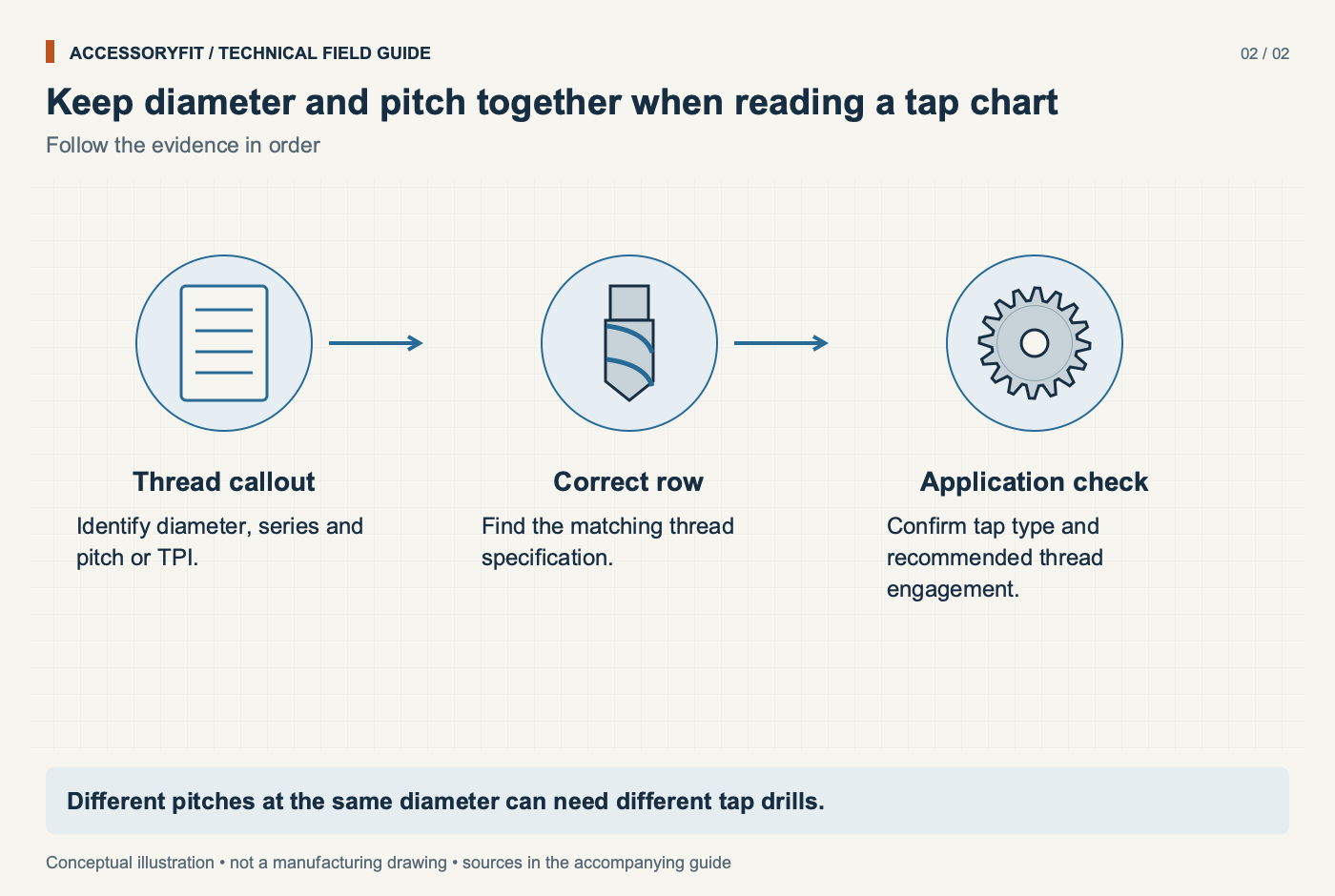
A fine-pitch metric thread needs a larger tap drill than the coarse thread of the same diameter, because its teeth are shallower. The three fine pitches people meet most often are M8 x 1, which takes 7.0 mm; M10 x 1.25, which takes 8.8 mm; and M12 x 1.5, which takes 10.5 mm. Compare M8 x 1 with the coarse M8 x 1.25 at 6.8 mm: same diameter, different drill, which is why the pitch in the callout matters.
The table below covers fine pitches from M8 to M20. AmesWeb and Engineering ToolBox agree on every row, though neither states the thread percentage behind its figures, and no tap maker's fine-pitch chart was reached, so check the maker's data for critical work.
| Thread | Tap drill |
|---|---|
| M8 x 1.0 | 7.0 mm (0.276 in) |
| M10 x 1.0 | 9.0 mm (0.354 in) |
| M10 x 1.25 | 8.8 mm (0.346 in) |
| M12 x 1.25 | 10.8 mm (0.425 in) |
| M12 x 1.5 | 10.5 mm (0.413 in) |
| M14 x 1.5 | 12.5 mm (0.492 in) |
| M16 x 1.5 | 14.5 mm (0.571 in) |
| M18 x 1.5 | 16.5 mm (0.650 in) |
| M20 x 1.5 | 18.5 mm (0.728 in) |
Both sources agree on every row. Inch values calculated. Percent of thread not stated by either source.
| Thread | Tap drill (UPenn 75% value where listed) | Tap drill, 50% thread (UPenn) | Source agreement |
|---|---|---|---|
| M2 x 0.4 | 1.60 mm (0.0630 in) | 1.75 mm | UPenn + ETB |
| M2.5 x 0.45 | 2.05 mm (0.0807 in) | 2.20 mm | UPenn (ETB differs) |
| M3 x 0.5 | 2.50 mm (0.0984 in) | 2.70 mm | UPenn + ETB |
| M3.5 x 0.6 | 2.90 mm (0.1142 in) | not listed | ETB only |
| M4 x 0.7 | 3.30 mm (0.1299 in) | 3.50 mm | UPenn + ETB |
| M5 x 0.8 | 4.20 mm (0.1654 in) | 4.50 mm | UPenn + ETB |
| M6 x 1 | 5.00 mm (0.1969 in) | 5.40 mm | UPenn + ETB |
| M8 x 1.25 | 6.80 mm (0.2677 in) | 7.20 mm | UPenn + ETB |
| M10 x 1.5 | 8.50 mm (0.3346 in) | 9.00 mm | UPenn + ETB |
| M12 x 1.75 | 10.30 mm (0.4055 in) | 10.90 mm | UPenn (ETB differs) |
| M14 x 2 | 12.10 mm (0.4764 in) | 12.70 mm | UPenn (ETB differs) |
| M16 x 2 | 14.00 mm (0.5512 in) | not listed | ETB only |
| M20 x 2.5 | 17.50 mm (0.6890 in) | not listed | ETB only |
| M22 x 2.5 | 19.50 mm (0.7677 in) | not listed | ETB only |
| M24 x 3 | 21.00 mm (0.8268 in) | not listed | ETB only |
UPenn gives 75% and 50% values up to M14; Engineering ToolBox (ISO 724 coarse) gives one tap drill value up to M68 without stating a thread percentage. M18 is not listed by either source. Inch values are conversions.
What drill bit size do you need for a 1/4-20 tap?
Use a #7 drill, which is 0.201 in across. It is the most-searched tap drill size because 1/4-20 is the standard coarse quarter-inch thread. A #7 is a number drill, so it is often missing from fractional sets; it is worth buying singly if you tap this thread more than once.
The table also gives a lower-percentage alternative for this thread, a fractional size a little larger than the #7, for steel or stainless where a full-depth thread makes the tap hard to turn. The fine-thread version, 1/4-28 UNF, has more threads per inch and therefore shallower teeth, so its tap drill is a larger number drill; read its own row rather than reusing the coarse-thread drill.
What drill size do 5/16 and 3/8 taps need?
A 5/16-18 tap needs a letter F drill, which measures 0.257 in, and a 3/8-16 tap needs a 5/16 in drill. Notice that the 3/8-16 tap drill has the same nominal fraction as the 5/16 thread: that is a coincidence of the numbers, not a sign that the two can share a drill. Using a 5/16 in bit for a 5/16-18 tap would leave a hole as large as the thread itself, with nothing for the tap to cut.
Both threads also come in fine pitches, 5/16-24 and 3/8-24 UNF, and each calls for a letter drill listed in its own row. Going up the coarse series, the half-inch thread 1/2-13 UNC takes a 27/64 in drill.
Should you drill for 75% or 50% thread?
Use the deeper-thread drill for soft materials and the larger, shallower-thread drill for hard ones. Little Machine Shop labels its two columns (75% / 50% thread) by material: the first for aluminium, brass and plastics, the second for steel, stainless and iron. The larger drill leaves less metal for the tap to remove, so the tap turns more easily in a tough material.
A common misconception is that the strongest thread comes from drilling to the screw's minor diameter so the tap cuts a full profile. Both charts used here stop short of a full-depth thread, and Little Machine Shop lists the larger drills for the hardest metals because they are easier to tap. The University of Pennsylvania chart takes the same approach, listing two thread percentages rather than a single minor-diameter drill.
How do you read a thread callout and find its drill?
Split the callout into size and pitch, find the matching row, and read the drill from the column for your material. An inch callout such as #10-32 UNF names a #10 machine screw (its major diameter is in the second column) followed, after the dash, by its threads per inch. Its row gives a #21 drill in the standard column. The coarse #10-24 UNC thread shares the same major diameter but has fewer, deeper threads, so its row calls for a smaller #25 drill. Reading the TPI column is what stops you mixing up two threads with the same screw number.
A metric callout works the same way. M8 x 1.25 is the coarse eight-millimetre thread, so the metric table gives 6.8 mm. When a drawing writes only M8 with no pitch, it means the coarse series. If the callout lists a smaller pitch, such as M8 x 1, use the fine-pitch table instead, which gives 7.0 mm for that thread.
Once you have the drill name, the decimal and millimetre values in the same cell let you find it in a drill index, or confirm a metric bit is close enough for a soft material. For the full list of number, letter and fractional decimals, the decimal drill size table covers every size up to one inch.
Which drill bit should you use for a tap hole?
A high-speed steel twist drill handles tap holes in most metals, and Wikipedia describes cobalt high-speed steel as the choice for stainless steel and other hard materials. Starrett's catalogue describes split-point drills ground to 135 degrees as self-centering, which helps the hole start exactly on the punch mark. Starrett recommends lubricant when drilling metal: it cuts friction, keeps the edge sharp and lowers the risk of the bit breaking.
Cobalt and carbide bits are more brittle than plain high-speed steel, so keep the drill square to the work and avoid side loads. If the bit wanders before it bites, the hole and the thread both end up off position; the page on stopping a drill bit from wandering goes through the fixes. For choosing a bit for steel, aluminium or stainless, the buyer guide to drill bits for metal compares current options.
When doesn't a tap drill chart give the right hole?
The chart gives a hole for cutting a thread, so it is the wrong reference whenever the hole is not going to be tapped with a standard cutting tap. The main exceptions are:
- Clearance holes. A hole the screw passes through is larger than the thread, not smaller. Drilling a clearance hole with the tap drill leaves the screw jammed in the wrong part.
- Wood screws. Wood is not tapped; screws cut their own thread in a pilot hole sized by gauge and wood type, which the screw pilot hole chart covers.
- Pipe threads. Tapered pipe threads are outside these tables, and fine metric pitches beyond the sizes in the fine-pitch table are not covered.
- Large holes. Above one inch the inch table stops. Large pass-through holes for pipe and conduit are a hole saw job rather than a tapped hole; the guide to matching hole saws to fittings gives outside diameters and knockout sizes.
- Disputed sizes. For M2.5, M12 and M14 the two sources differ; check the tap maker's own data for those.
Questions readers ask
What drill bit do I use for a 1/4-20 tap?
A #7 drill, 0.201 in, in the standard column. In steel or stainless, the chart's larger, shallower-thread drill makes tapping easier.
What size drill for a 5/16-18 tap?
Letter F, which is 0.257 in. The fine-thread 5/16-24 takes a different letter drill.
What size drill bit for a 3/8-16 tap?
A 5/16 in drill. Do not confuse it with the 5/16-18 thread, which needs a smaller letter drill.
What is the tap drill for M8?
6.8 mm for the standard M8 x 1.25 coarse thread. For M6 it is 5.0 mm and for M10 8.5 mm.
Do 10-24 and 10-32 taps use the same drill?
No. #10-24 UNC takes a #25 drill and #10-32 UNF a #21 drill, because the fine thread is shallower.
Where to go next
- Drill bit size chartDecimal and mm values for every number, letter and fractional drill.
- Screw pilot hole chartHole sizes for wood screws, which are driven rather than tapped.
- Drill bits for metalBits suited to drilling tap holes in steel and stainless.
References 20 documents, 13 publishers
- AmesWeb: Metric tap drill chart (ISO 68-1 basic profile); Decimal Equivalents of Fractional, Wire and Letter Drill Sizes
- Bosch: Bits for drilling tiles (tile drilling guide); CYL-9 Soft Ceramic drill bit set 2 608 587 169
- Engineering ToolBox: ISO Metric Threads (coarse and fine) with tap and clearance drills; Hardwood and Softwoods - Recommended Drill Bit Speeds
- Hoffmann Group (GARANT): GARANT hand tap set DIN 352, M18 (130150)
- HomElectrical: Irwin 1/2 in Reduced Shank Silver & Deming HSS Drill Bits
- Little Machine Shop: Tap Drill Sizes
- Makita: B-68959 1/4 in x 4 in Glass and Tile Bit, 3 Flat Shank
- McMaster-Carr: Starrett 117A center punch (marking punches)
- Milwaukee Tool: 1/4 in SHOCKWAVE Impact Duty RED HELIX Titanium Drill Bit 48-89-4613; 4PC Ceramic Tile & Glass Bit Set 48-20-8988
- Stanley Black & Decker (IRWIN, LENOX): IRWIN 29-pc Cobalt M-35 Metal Index Drill Bit Set 3018002; Left-hand mechanics length cobalt alloy high speed steel drill bit sets
- Starrett: Saws & Hand Tools Catalogue 71E (hole saws, arbors, drill bits)
- University of Pennsylvania, MEAM Design: Creating Threaded Holes (tap drill chart)
- Wikipedia: Drill bit sizes; Drill bit; High-speed steel
Accessed .