
Size chart · Drill bits
Drill bit size chart: number, letter, fractional and metric sizes in decimal inches and millimetres
Twist drills are sized in four systems: number (wire gauge) sizes #80 to #1, letter sizes A to Z, fractional inch sizes in 1/64 in steps, and metric millimetres. The decimal inch value is what links them. The largest number drill, #1, is 0.228 in, letter A starts just above it at 0.234 in, and letter E is 0.250 in, exactly the same as a quarter-inch bit. The tables below give every size with its decimal and millimetre value.
By AccessoryFit editors · Checked
On this page
- What do the four drill size systems measure?
- Number drill sizes (#80 to #1)
- Letter drill sizes (A to Z)
- Fractional drill sizes up to one inch
- Common metric drill sizes (DIN 338 jobber)
- How do the four systems fit together?
- How do you read a decimal drill size?
- Which sizes are close equivalents across systems?
- Does a bigger drill number mean a bigger drill?
- When should you use a tap drill or pilot hole chart instead?
- What drill bit sizes do common taps need?
- Which drill length do you need?
- When doesn't the drill size chart give you the answer?
- What mistakes do people make with drill size charts?
- Once you know the size, which type of bit should you use?
What do the four drill size systems measure?
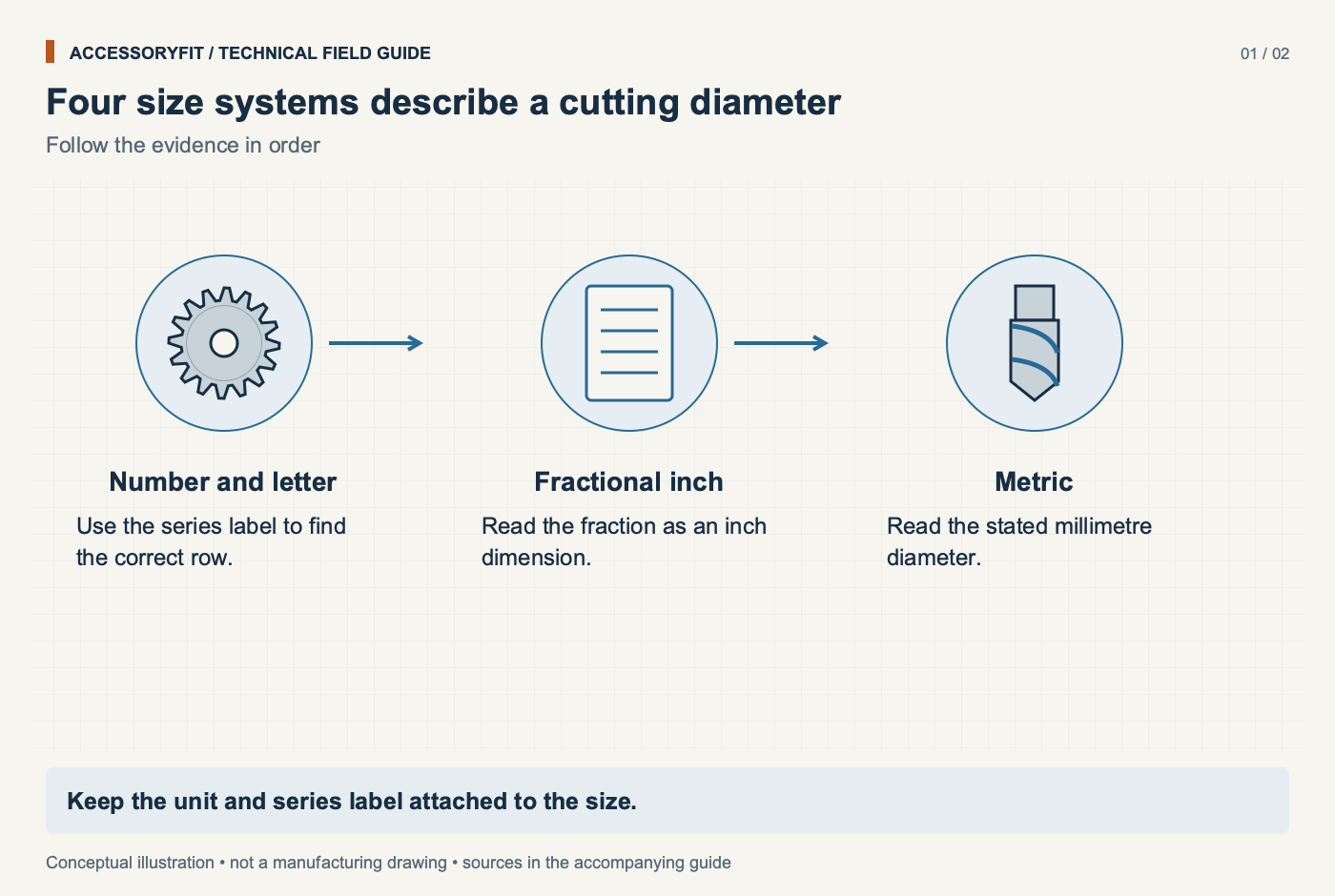
All four systems name the cutting diameter of a twist drill; they differ only in how that diameter is labelled. Fractional sizes are the familiar inch fractions printed on most US bits. Metric sizes are labelled directly in millimetres, which is how Starrett's UK range, Fisch and most bits sold in Europe are labelled. Number sizes, also called wire gauge sizes, and letter sizes are older US designations that fill the gaps between neighbouring fractional sizes, which is why tap drill charts lean on them so heavily.
A drill size chart is therefore a translation table. Find your bit in whichever system it is labelled in, read across to the decimal inch column, and you can compare it with any other bit, fastener or thread on the same scale. The millimetre column does the same job for readers who work in metric. The four tables below are split by system so each one stays short enough to scan: number sizes first, then letter sizes, then fractional sizes, then the common metric jobber sizes. If you have a bit in your hand and only want its decimal, go straight to the table for the label printed on its shank. If you are trying to match a hole to a screw, a thread or a fitting, read the sections further down before you pick a size, because the right answer is often not in this chart at all. All four tables also come as one PDF sheet, in US Letter and A4, among the site's printable charts.
Number drill sizes (#80 to #1)
Number drills cover the smallest end of the range, from #80 at 0.0135 in up to #1 at 0.228 in. The steps between them are uneven: at the small end neighbouring sizes differ by a few ten-thousandths of an inch, while near #1 the jumps are larger. The decimal values below agree in AmesWeb and Wikipedia for all 80 sizes; the millimetre values are Wikipedia's three-decimal conversions.
| Size | Decimal inch | Millimetres |
|---|---|---|
| #80 | 0.0135 in | 0.343 mm |
| #79 | 0.0145 in | 0.368 mm |
| #78 | 0.0160 in | 0.406 mm |
| #77 | 0.0180 in | 0.457 mm |
| #76 | 0.0200 in | 0.508 mm |
| #75 | 0.0210 in | 0.533 mm |
| #74 | 0.0225 in | 0.572 mm |
| #73 | 0.0240 in | 0.610 mm |
| #72 | 0.0250 in | 0.635 mm |
| #71 | 0.0260 in | 0.660 mm |
| #70 | 0.0280 in | 0.711 mm |
| #69 | 0.0292 in | 0.742 mm |
| #68 | 0.0310 in | 0.787 mm |
| #67 | 0.0320 in | 0.813 mm |
| #66 | 0.0330 in | 0.838 mm |
| #65 | 0.0350 in | 0.889 mm |
| #64 | 0.0360 in | 0.914 mm |
| #63 | 0.0370 in | 0.940 mm |
| #62 | 0.0380 in | 0.965 mm |
| #61 | 0.0390 in | 0.991 mm |
| #60 | 0.0400 in | 1.016 mm |
| #59 | 0.0410 in | 1.041 mm |
| #58 | 0.0420 in | 1.067 mm |
| #57 | 0.0430 in | 1.092 mm |
| #56 | 0.0465 in | 1.181 mm |
| #55 | 0.0520 in | 1.321 mm |
| #54 | 0.0550 in | 1.397 mm |
| #53 | 0.0595 in | 1.511 mm |
| #52 | 0.0635 in | 1.613 mm |
| #51 | 0.0670 in | 1.702 mm |
| #50 | 0.0700 in | 1.778 mm |
| #49 | 0.0730 in | 1.854 mm |
| #48 | 0.0760 in | 1.930 mm |
| #47 | 0.0785 in | 1.994 mm |
| #46 | 0.0810 in | 2.057 mm |
| #45 | 0.0820 in | 2.083 mm |
| #44 | 0.0860 in | 2.184 mm |
| #43 | 0.0890 in | 2.261 mm |
| #42 | 0.0935 in | 2.375 mm |
| #41 | 0.0960 in | 2.438 mm |
| #40 | 0.0980 in | 2.489 mm |
| #39 | 0.0995 in | 2.527 mm |
| #38 | 0.1015 in | 2.578 mm |
| #37 | 0.1040 in | 2.642 mm |
| #36 | 0.1065 in | 2.705 mm |
| #35 | 0.1100 in | 2.794 mm |
| #34 | 0.1110 in | 2.819 mm |
| #33 | 0.1130 in | 2.870 mm |
| #32 | 0.1160 in | 2.946 mm |
| #31 | 0.1200 in | 3.048 mm |
| #30 | 0.1285 in | 3.264 mm |
| #29 | 0.1360 in | 3.454 mm |
| #28 | 0.1405 in | 3.569 mm |
| #27 | 0.1440 in | 3.658 mm |
| #26 | 0.1470 in | 3.734 mm |
| #25 | 0.1495 in | 3.797 mm |
| #24 | 0.1520 in | 3.861 mm |
| #23 | 0.1540 in | 3.912 mm |
| #22 | 0.1570 in | 3.988 mm |
| #21 | 0.1590 in | 4.039 mm |
| #20 | 0.1610 in | 4.089 mm |
| #19 | 0.1660 in | 4.216 mm |
| #18 | 0.1695 in | 4.305 mm |
| #17 | 0.1730 in | 4.394 mm |
| #16 | 0.1770 in | 4.496 mm |
| #15 | 0.1800 in | 4.572 mm |
| #14 | 0.1820 in | 4.623 mm |
| #13 | 0.1850 in | 4.699 mm |
| #12 | 0.1890 in | 4.801 mm |
| #11 | 0.1910 in | 4.851 mm |
| #10 | 0.1935 in | 4.915 mm |
| #9 | 0.1960 in | 4.978 mm |
| #8 | 0.1990 in | 5.055 mm |
| #7 | 0.2010 in | 5.105 mm |
| #6 | 0.2040 in | 5.182 mm |
| #5 | 0.2055 in | 5.220 mm |
| #4 | 0.2090 in | 5.309 mm |
| #3 | 0.2130 in | 5.410 mm |
| #2 | 0.2210 in | 5.613 mm |
| #1 | 0.2280 in | 5.791 mm |
Decimals match in AmesWeb and Wikipedia for all 80 sizes. mm from Wikipedia (3 decimals). LMS rounds some to 3 decimals (see conflicts).
Letter drill sizes (A to Z)
Letter drills pick up where number drills stop. Letter A is 0.234 in, just above #1, and the series climbs to letter Z at 0.413 in. Unlike the number series, the letters run in the direction you would expect: A is the smallest and Z the largest. AmesWeb, Wikipedia and Little Machine Shop all give the same decimals for every letter.
| Size | Decimal inch | Millimetres |
|---|---|---|
| A | 0.2340 in | 5.944 mm |
| B | 0.2380 in | 6.045 mm |
| C | 0.2420 in | 6.147 mm |
| D | 0.2460 in | 6.248 mm |
| E | 0.2500 in | 6.350 mm |
| F | 0.2570 in | 6.528 mm |
| G | 0.2610 in | 6.629 mm |
| H | 0.2660 in | 6.756 mm |
| I | 0.2720 in | 6.909 mm |
| J | 0.2770 in | 7.036 mm |
| K | 0.2810 in | 7.137 mm |
| L | 0.2900 in | 7.366 mm |
| M | 0.2950 in | 7.493 mm |
| N | 0.3020 in | 7.671 mm |
| O | 0.3160 in | 8.026 mm |
| P | 0.3230 in | 8.204 mm |
| Q | 0.3320 in | 8.433 mm |
| R | 0.3390 in | 8.611 mm |
| S | 0.3480 in | 8.839 mm |
| T | 0.3580 in | 9.093 mm |
| U | 0.3680 in | 9.347 mm |
| V | 0.3770 in | 9.576 mm |
| W | 0.3860 in | 9.804 mm |
| X | 0.3970 in | 10.08 mm |
| Y | 0.4040 in | 10.26 mm |
| Z | 0.4130 in | 10.49 mm |
All three sources agree on decimals.
Fractional drill sizes up to one inch
Fractional drills step up in 1/64 in increments from the smallest fraction to one inch, and they overlap both the number and letter ranges. Because a fraction converts to an exact decimal, the millimetre column here is an exact conversion rather than a rounded one. The sources consulted did not tabulate fractional sizes above one inch, so they are not listed; for larger holes in wood or sheet material, a hole saw or step bit usually takes over.
| Size | Decimal inch | Millimetres (exact) |
|---|---|---|
| 1/64 in | 0.015625 in | 0.396875 mm |
| 1/32 in | 0.03125 in | 0.79375 mm |
| 3/64 in | 0.046875 in | 1.190625 mm |
| 1/16 in | 0.0625 in | 1.5875 mm |
| 5/64 in | 0.078125 in | 1.984375 mm |
| 3/32 in | 0.09375 in | 2.38125 mm |
| 7/64 in | 0.109375 in | 2.778125 mm |
| 1/8 in | 0.125 in | 3.175 mm |
| 9/64 in | 0.140625 in | 3.571875 mm |
| 5/32 in | 0.15625 in | 3.96875 mm |
| 11/64 in | 0.171875 in | 4.365625 mm |
| 3/16 in | 0.1875 in | 4.7625 mm |
| 13/64 in | 0.203125 in | 5.159375 mm |
| 7/32 in | 0.21875 in | 5.55625 mm |
| 15/64 in | 0.234375 in | 5.953125 mm |
| 1/4 in | 0.250 in | 6.350 mm |
| 17/64 in | 0.265625 in | 6.746875 mm |
| 9/32 in | 0.28125 in | 7.14375 mm |
| 19/64 in | 0.296875 in | 7.540625 mm |
| 5/16 in | 0.3125 in | 7.9375 mm |
| 21/64 in | 0.328125 in | 8.334375 mm |
| 11/32 in | 0.34375 in | 8.73125 mm |
| 23/64 in | 0.359375 in | 9.128125 mm |
| 3/8 in | 0.375 in | 9.525 mm |
| 25/64 in | 0.390625 in | 9.921875 mm |
| 13/32 in | 0.40625 in | 10.31875 mm |
| 27/64 in | 0.421875 in | 10.715625 mm |
| 7/16 in | 0.4375 in | 11.1125 mm |
| 29/64 in | 0.453125 in | 11.509375 mm |
| 15/32 in | 0.46875 in | 11.90625 mm |
| 31/64 in | 0.484375 in | 12.303125 mm |
| 1/2 in | 0.500 in | 12.700 mm |
| 33/64 in | 0.515625 in | 13.096875 mm |
| 17/32 in | 0.53125 in | 13.49375 mm |
| 35/64 in | 0.546875 in | 13.890625 mm |
| 9/16 in | 0.5625 in | 14.2875 mm |
| 37/64 in | 0.578125 in | 14.684375 mm |
| 19/32 in | 0.59375 in | 15.08125 mm |
| 39/64 in | 0.609375 in | 15.478125 mm |
| 5/8 in | 0.625 in | 15.875 mm |
| 41/64 in | 0.640625 in | 16.271875 mm |
| 21/32 in | 0.65625 in | 16.66875 mm |
| 43/64 in | 0.671875 in | 17.065625 mm |
| 11/16 in | 0.6875 in | 17.4625 mm |
| 45/64 in | 0.703125 in | 17.859375 mm |
| 23/32 in | 0.71875 in | 18.25625 mm |
| 47/64 in | 0.734375 in | 18.653125 mm |
| 3/4 in | 0.750 in | 19.050 mm |
| 49/64 in | 0.765625 in | 19.446875 mm |
| 25/32 in | 0.78125 in | 19.84375 mm |
| 51/64 in | 0.796875 in | 20.240625 mm |
| 13/16 in | 0.8125 in | 20.6375 mm |
| 53/64 in | 0.828125 in | 21.034375 mm |
| 27/32 in | 0.84375 in | 21.43125 mm |
| 55/64 in | 0.859375 in | 21.828125 mm |
| 7/8 in | 0.875 in | 22.225 mm |
| 57/64 in | 0.890625 in | 22.621875 mm |
| 29/32 in | 0.90625 in | 23.01875 mm |
| 59/64 in | 0.921875 in | 23.415625 mm |
| 15/16 in | 0.9375 in | 23.8125 mm |
| 61/64 in | 0.953125 in | 24.209375 mm |
| 31/32 in | 0.96875 in | 24.60625 mm |
| 63/64 in | 0.984375 in | 25.003125 mm |
| 1 in | 1.000 in | 25.400 mm |
Exact conversions (1 in = 25.4 mm). Sizes above 1 in were not tabulated by the sources fetched.
Common metric drill sizes (DIN 338 jobber)
Metric twist drills are labelled by their diameter in millimetres. The table lists the common high-speed steel jobber sizes in Starrett's catalogue, which are made to DIN 338, with the inch conversion and the overall length Starrett gives for each. It is a list of common sizes, not the full metric series: finer metric steps exist but were not tabulated by the sources consulted, so they are left out rather than guessed.
| Diameter | Decimal inch (converted) | Overall length |
|---|---|---|
| 1.5 mm | 0.0591 in | 40 mm (1.57 in) |
| 2 mm | 0.0787 in | 49 mm (1.93 in) |
| 2.5 mm | 0.0984 in | 57 mm (2.24 in) |
| 3 mm | 0.1181 in | 61 mm (2.40 in) |
| 3.2 mm | 0.1260 in | 65 mm (2.56 in) |
| 3.5 mm | 0.1378 in | 70 mm (2.76 in) |
| 4 mm | 0.1575 in | 75 mm (2.95 in) |
| 4.5 mm | 0.1772 in | 80 mm (3.15 in) |
| 4.8 mm | 0.1890 in | 86 mm (3.39 in) |
| 5 mm | 0.1969 in | 86 mm (3.39 in) |
| 5.5 mm | 0.2165 in | 93 mm (3.66 in) |
| 6 mm | 0.2362 in | 93 mm (3.66 in) |
| 6.5 mm | 0.2559 in | 101 mm (3.98 in) |
| 7 mm | 0.2756 in | 109 mm (4.29 in) |
| 8 mm | 0.3150 in | 117 mm (4.61 in) |
| 9 mm | 0.3543 in | 125 mm (4.92 in) |
| 10 mm | 0.3937 in | 133 mm (5.24 in) |
| 12 mm | 0.4724 in | 151 mm (5.94 in) |
Sizes and lengths from Starrett catalogue 71E (KBAR line and KBK13 set). Inch values are conversions.
How do the four systems fit together?
They form one continuous scale once you convert to decimal inches. The number series covers the small end and stops at #1 (0.228 in). The letter series begins immediately above it with A (0.234 in) and ends at Z (0.413 in), so number and letter sizes never overlap each other. Fractional sizes run across both ranges and beyond, and metric sizes sit among all three.
That arrangement is the whole point of the older systems. A fractional set jumps in 1/64 in steps, which is too coarse when a thread or press fit needs a hole a few thousandths larger or smaller. Number and letter sizes slot in between the fractions, so a machinist can choose a drill that lands close to the ideal diameter instead of rounding to the nearest sixty-fourth. For general wood and DIY work, a fractional or metric set is usually all you need; number and letter drills earn their place when you start tapping threads or fitting parts.
For a slower walkthrough of the labels, the guide to reading drill bit sizes explains each system step by step, with examples of how the markings appear on real bits and cases.
How do you read a decimal drill size?
Read the decimal inch value as thousandths of an inch, and compare sizes digit by digit from the left. A #7 drill at 0.201 in and letter F at 0.257 in share the same first decimal digit, so the second digit decides it: F is the larger of the two. Machinists often say "thou" for a thousandth of an inch and quote drill sizes that way, which is how the decimal column is normally read aloud.
The fourth decimal place matters in the number series. Several number sizes carry a significant fourth digit, and one popular online chart, Little Machine Shop, rounds six of them (#69, #28, #25, #18, #10 and #5) to three decimals. AmesWeb and Wikipedia carry the full four-decimal values, and this page uses those. If two charts disagree in the last digit for one of those six sizes, this is why.
For metric work, use the millimetre column as given rather than converting by hand. The fractional table shows exact conversions, the number and letter tables show three-decimal conversions, and the metric table shows Starrett's diameters with their inch equivalents. Mixing a rounded value from one chart with an exact value from another is an easy way to end up a size off.
Which sizes are close equivalents across systems?
Only a few pairs are true equivalents; most are near neighbours that differ in the third or fourth decimal place. Reading the decimal columns of the four tables above side by side gives these matches:
- Letter E and 1/4 in are identical at 0.250 in.
- #12 and 4.8 mm show the same decimal to four places in these tables, with 3/16 in just below both.
- 4 mm and #22 differ only in the fourth decimal place, with 4 mm the larger.
- 3.2 mm sits just over 1/8 in.
- 2.5 mm falls between #40 and #39, much nearer #40.
- 5 mm falls between #9 and #8, nearer #9. The #7 drill (0.201 in) is larger than both, and a little smaller than 13/64 in.
- 6 mm falls between 15/64 in and letter B, roughly midway; letter A is just under 15/64 in.
- 6.5 mm is just under letter F (0.257 in).
- 7 mm is just under letter J.
- 8 mm is almost exactly letter O and a little over 5/16 in.
- 10 mm falls between 25/64 in and letter X.
- 12 mm falls between 15/32 in and 31/64 in, nearer 15/32 in.
A near neighbour is fine for a clearance hole or a hole in wood, where a few thousandths make no practical difference. It is not fine for a tapped thread, a dowel or a bearing seat, where the drill size is specified for a reason. In those cases, use the size the thread or part calls for, and buy that exact bit rather than substituting the nearest one from a different system.
Does a bigger drill number mean a bigger drill?
No. Number drills run backwards: #1 is the largest at 0.228 in and #80 the smallest at 0.0135 in. The letter series runs the other way, from A as the smallest to Z as the largest. Mixing the two directions up is an easy mistake when reading a number drill chart, and it can put you dozens of sizes away from the drill you wanted.
A related trap is the screw gauge. A #8 wood screw and a #8 drill are unrelated: the screw number describes the screw's diameter in a separate gauge system, while the drill number is a wire gauge size. For a #8 screw in hardwood, WOOD Magazine's chart gives a 7/64 in pilot hole, and for softwood 3/32 in, neither of which is a #8 drill. Always look up the screw in a pilot chart rather than matching numbers.
When should you use a tap drill or pilot hole chart instead?
Use a tap drill chart whenever the hole will be threaded, and a pilot hole chart whenever a wood screw will be driven into it. This chart tells you what each drill measures; those charts tell you which drill a particular job calls for, and the answer is often a number or letter size you would not pick by eye.
For threads, the tap drill for a 1/4-20 UNC thread is a #7 drill, and for 5/16-18 UNC it is letter F. That is why both appear in the At a glance panel on this page. Metric threads are simpler: the tap drill for M6 coarse is 5.0 mm, which appears in the metric table above, but the tap drill for M8 coarse is 6.8 mm, which is not among the common jobber sizes listed here. That gap is a good example of why you look up the thread rather than guess from the nearest drill. Tap drill charts are also built around a stated thread percentage; Little Machine Shop lists 75% / 50% thread drills and recommends the larger, lower-percentage drill for steel, stainless and iron because it is easier to tap. The full metric tap drill sizes and UNC/UNF list covers every thread from the smallest machine screws up.
For wood screws, pilot hole size depends on the screw gauge and on the wood. Hardwood takes a larger pilot than softwood for the same gauge, which is why a single drill size cannot serve both. The chart of pilot hole sizes for screws gives the pilot, shank and countersink sizes by gauge and wood type.
What drill bit sizes do common taps need?
Common taps need these drills: a #7 for 1/4-20, letter F for 5/16-18, 5/16 in for 3/8-16, and 6.8 mm for M8 coarse. The short table below pulls the most-asked taps together, inch and metric, coarse and fine, so you can find the drill and then look up its decimal in the tables above. Fine-pitch metric taps take a larger drill than coarse ones of the same diameter, so check the pitch before you drill.
For any tap not in this short list, the full tap drill size chart covers every UNC and UNF thread up to one inch, metric coarse and fine threads, and the alternative drill for hard metals.
| Tap | Tap drill |
|---|---|
| #10-24 UNC | #25 |
| #10-32 UNF | #21 |
| 1/4-20 UNC | #7 (0.201 in) |
| 5/16-18 UNC | Letter F (0.257 in) |
| 3/8-16 UNC | 5/16 in |
| 1/2-13 UNC | 27/64 in |
| M6 x 1.0 | 5.0 mm |
| M8 x 1.25 | 6.8 mm |
| M8 x 1 (fine) | 7.0 mm |
| M10 x 1.5 | 8.5 mm |
| M10 x 1.25 (fine) | 8.8 mm |
| M12 x 1.5 (fine) | 10.5 mm |
| M18 x 2.5 | 15.5 mm |
Which drill length do you need?
Most general-purpose drilling uses jobber-length bits, the medium length sold in standard sets. Wikipedia describes three common length series: stub (also called screw-machine) bits, which are short and stiff; jobber bits, which are the most common; and taper or long-series bits for deep holes. A shorter bit flexes less and wanders less when starting; a longer one reaches through thicker stock.
In metric, jobber drills follow DIN 338, according to Starrett's catalogue, and the overall lengths in the metric table above are Starrett's figures for that standard. Inch jobber, stub and taper lengths were not available from the sources consulted, so they are not given here; check the maker's listing if overall length matters for your job.
When doesn't the drill size chart give you the answer?
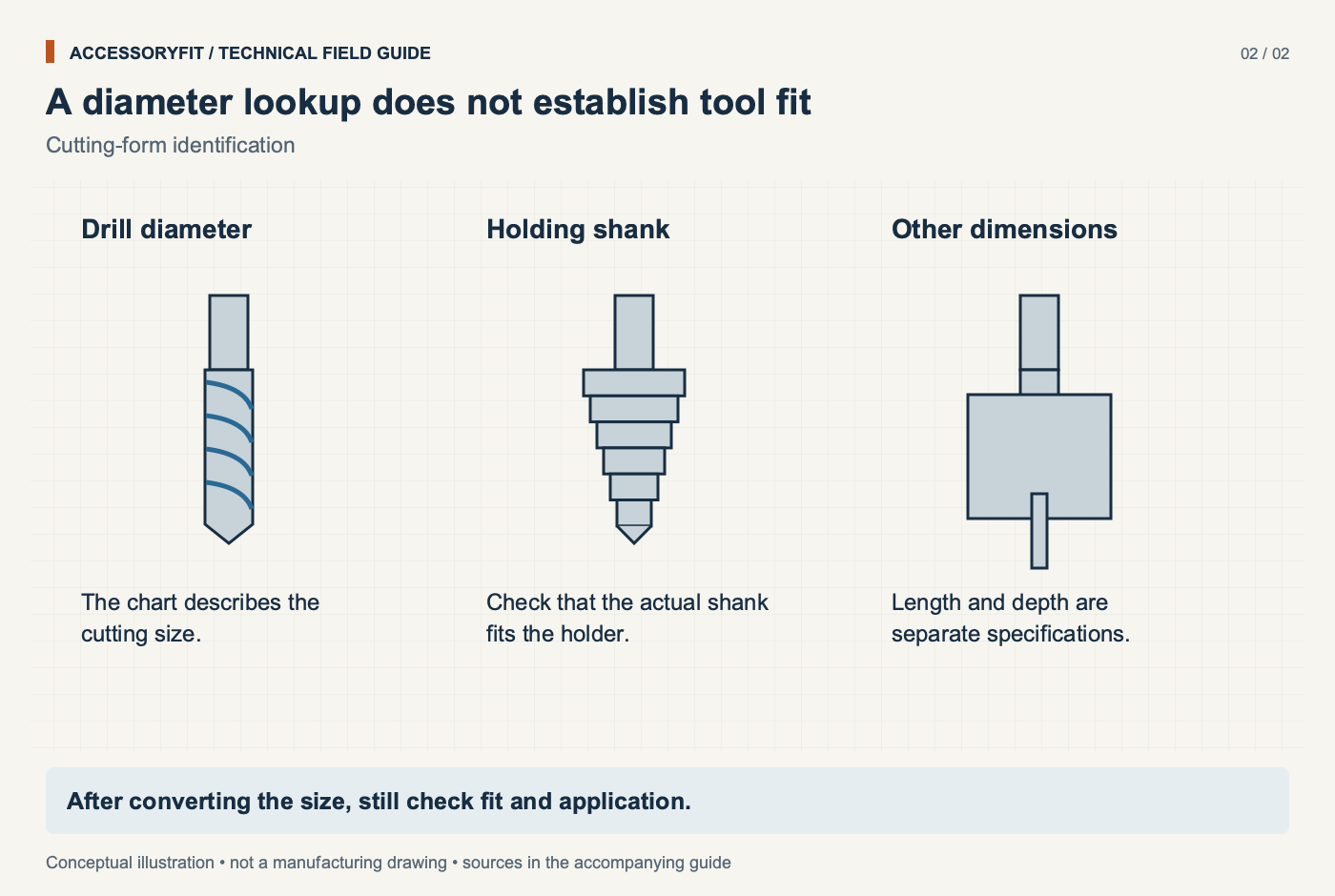
The chart gives the diameter a drill cuts, not whether it fits your tool or suits your job. Four situations need something else:
- The bit will not fit the chuck. Chuck size names the largest shank a chuck accepts, not the largest hole it can drill: a 1/2 in chuck takes shanks up to that size, and larger-cutting bits need a reduced shank. The guide to drill chuck capacity covers keyed, keyless and hex holders.
- The hole is larger than one inch. The tables stop at one inch because the sources stop there. For bigger holes, see hole saw sizes for pipe and conduit or hole saw kits; for thin sheet, a single step bit covers many sizes, and the step bit picks compare current models.
- The hole is for a thread or screw. Use the tap drill or pilot hole chart, as above.
- The drill size is right but the hole is not. Ordinary twist drills tend to wander on a flat surface, which puts the hole off position. In metal a spotting drill helps, in wood a brad-point bit holds its line, and split points reduce the drift. The page on why a drill bit wanders goes through the fixes.
What mistakes do people make with drill size charts?
Most errors come from reading the right chart the wrong way. The ones that cost the most time are:
- Reading the number series upwards. #60 is smaller than #6, not larger.
- Treating screw gauge numbers as drill numbers. A #10 screw does not want a #10 drill.
- Substituting a near metric size for a tap drill. A near neighbour leaves too much or too little thread; buy the size the chart specifies.
- Comparing a rounded chart with a four-decimal one. For the six number sizes that Little Machine Shop rounds, two correct charts can disagree in the last digit.
- Assuming a set covers every size. Fractional sets step in sixty-fourths; number and letter sizes between them are usually sold singly or in a separate index.
Drill index cases and drill gauge plates are labelled in these same four systems, so the tables on this page double as a key for reading them. When a bit's markings have worn off, its decimal can be matched against the tables to identify it.
Once you know the size, which type of bit should you use?
The material decides the bit type, and the size chart applies to all of them. A general-purpose twist drill has a point angle of 118 degrees and works in wood, metal and plastic. Starrett's catalogue describes split-point HSS drills ground to 135 degrees as self-centering, needing less feed pressure and wandering less, which helps in steel. For wood, brad-point bits keep the hole in line, and larger holes call for spade, Forstner or auger bits, which are compared in the guide to Forstner, spade and auger bits.
For an overview of every family, from cobalt and carbide to masonry and glass bits, see the main kinds of drill bits. The drill bit guides hub groups the buyer guides by material, the reference charts section collects the other size tables on this site, and the tool accessory lookup shows which accessories fit a specific drill model.
Questions readers ask
What size is a #7 drill bit?
A #7 drill is 0.201 in. It is the standard tap drill for a 1/4-20 UNC thread, and it sits just under 13/64 in.
Is a letter E drill the same as 1/4 inch?
Yes. Letter E is 0.250 in, the same diameter as a 1/4 in fractional drill.
What decimal is a letter F drill?
Letter F is 0.257 in. It is the usual tap drill for a 5/16-18 UNC thread.
Is a 6 mm drill the same as a 1/4 inch drill?
No. In the tables above, 6 mm falls between 15/64 in and letter B, below letter E, which equals 1/4 in at 0.250 in. For a loose clearance hole the difference may not matter; for a fit or a thread it does.
What are the smallest and largest number drills?
The smallest is #80 at 0.0135 in and the largest is #1 at 0.228 in. Above #1 the letter series takes over, starting at A.
Where to go next
- Tap drill size chartWhich drill each UNC, UNF and metric thread needs.
- How to read drill bit sizesA slower walkthrough of the four labelling systems.
- Screw pilot hole chartPilot and clearance sizes by screw gauge and wood type.
References 15 documents, 11 publishers
- AmesWeb: Decimal Equivalents of Fractional, Wire and Letter Drill Sizes; Metric tap drill chart (ISO 68-1 basic profile)
- Engineering ToolBox: ISO Metric Threads (coarse and fine) with tap and clearance drills
- Hoffmann Group (GARANT): GARANT hand tap set DIN 352, M18 (130150)
- HomElectrical: Irwin 1/2 in Reduced Shank Silver & Deming HSS Drill Bits
- Little Machine Shop: Letter Drill Sizes; Number Drill Sizes; Tap Drill Sizes
- McMaster-Carr: Jacobs Keyless Drill Chucks
- MISUMI USA: Pilot Hole Sizes for Wood Screws
- Starrett: Saws & Hand Tools Catalogue 71E (hole saws, arbors, drill bits)
- University of Pennsylvania, MEAM Design: Creating Threaded Holes (tap drill chart)
- Wikipedia: Drill bit; Drill bit sizes
- WOOD Magazine: Wood Screw Chart: head-bore, shank-hole and pilot-hole sizes
Accessed .