
How-to · Drill bits
Drill bit types: twist, brad-point, spade, Forstner, step, masonry and more
Choose a drill bit by the material first. Twist bits in high-speed steel (HSS) drill metal, wood and plastic; cobalt HSS handles stainless. Brad-point, spade, Forstner and auger bits are for wood. Step bits drill many hole sizes in sheet metal. Carbide-tipped masonry and SDS bits drill concrete and brick with hammer action, and diamond or carbide spear-point bits drill tile and glass at low speed. The common general-purpose twist bit has a 118 degrees point. After the type, check the shank fits your chuck and the length suits the hole.
By AccessoryFit editors · Checked
On this page
- What are the main types of drill bit?
- What is a twist drill bit, and which point angle should it have?
- What is the difference between HSS, cobalt and carbide drill bits?
- Which drill bits are made for wood?
- What is a step drill bit used for?
- Which bits drill concrete, brick and stone?
- Which bits drill tile, porcelain and glass?
- When do you need a hole saw instead of a drill bit?
- What are jobber, stub and long drill bit lengths?
- Which shank does a drill bit need to fit your drill?
- How fast should each type of drill bit spin?
- Is there a drill bit that cuts sideways?
- Why does a drill bit wander, burn or snap?
- Where should you go from here?
What are the main types of drill bit?
Drill bits fall into six working groups by the material they are made to drill: general-purpose twist bits, wood bits, sheet-metal bits, masonry bits, tile and glass bits, and hole saws for holes larger than a bit can cut. Within each group, the point shape, the cutting material and the coating decide how well a given bit suits the job.
The names most people meet on a rack are twist (or jobber) bits, brad-point bits, spade (or paddle) bits, Forstner bits, auger bits, step (or unibit) drills, masonry and SDS bits, diamond core bits and spear-point glass bits. Some names describe the shape of the point, such as brad-point and split-point; others describe the material, such as cobalt or carbide; others describe the length, such as stub, jobber and long-series. A single bit can carry all three: a jobber-length, split-point cobalt twist drill is one specific bit.
The table below sums up which bit type each material calls for. The sections after it take each group in turn, with the point angles, materials, lengths and shanks that separate one bit from another. For buying advice by material, the drill bits by material hub links every guide on the site.
| Material | Bit type | Notes |
|---|---|---|
| Softwood / hardwood | brad point, spade, Forstner, auger, HSS twist | brad point stays in line in wood |
| Mild steel, aluminium, brass | HSS twist (118 or 135 degree split point) | use lubricant |
| Stainless / harder steels | cobalt HSS (M35/M42), 135 degree split point | lower rpm; cobalt is more brittle |
| Concrete, brick, masonry | carbide-tipped masonry / SDS bits with hammer action | 3-40 mm common |
| Ceramic tile, porcelain, glass, stone | diamond core bit or diamond hole saw; carbide spear-point for glass | water cooling; low speed for glass |
| Sheet metal, many sizes | step (unibit) drill |
Summary table. Each row is supported by facts above.
What is a twist drill bit, and which point angle should it have?
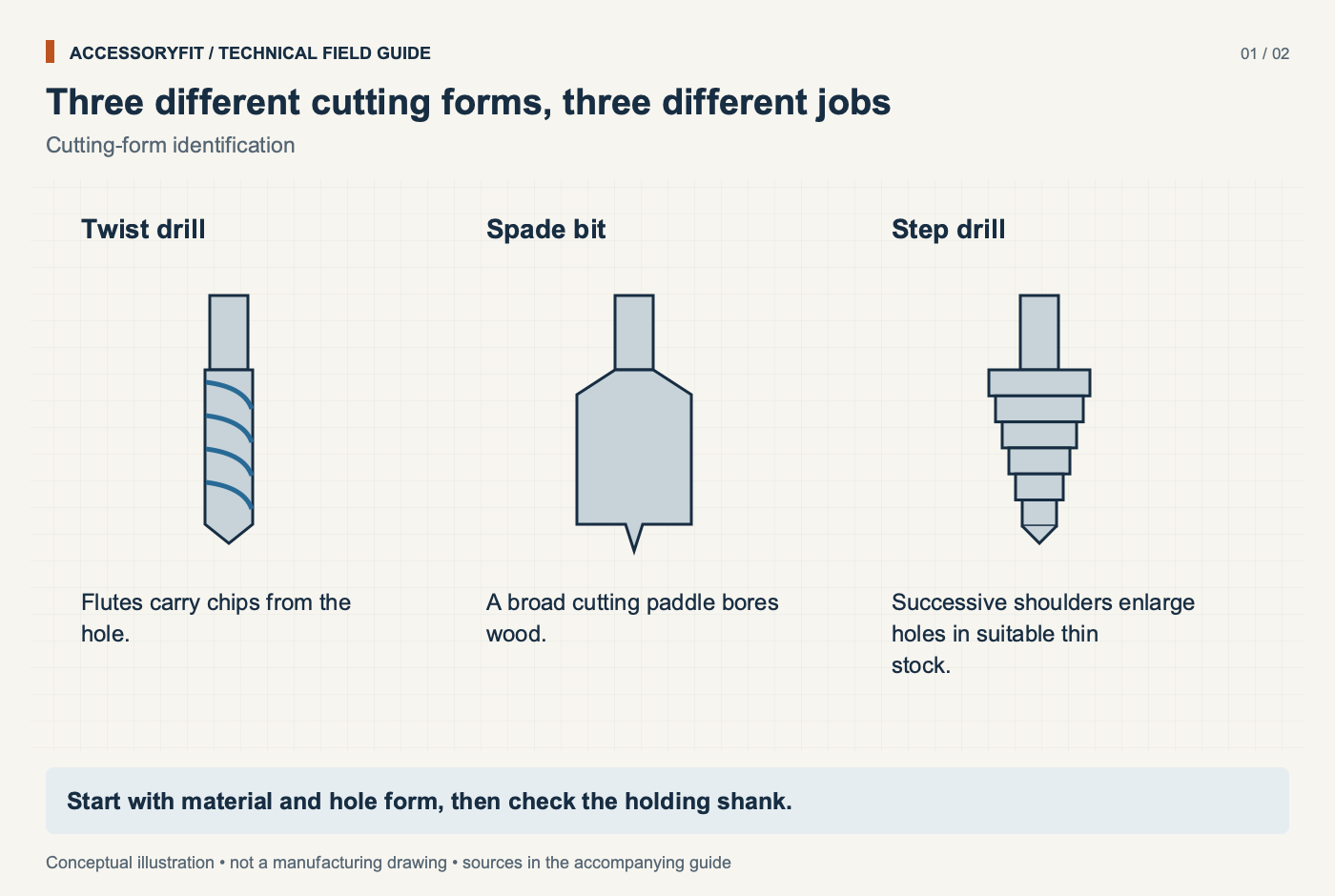
A twist bit is the general-purpose drill bit: two helical flutes carry chips out of the hole while two cutting lips at the tip do the cutting. The common general-purpose version has a 118 degrees point, which works in wood, metal and plastic.
The point angle is the angle between the two cutting lips, and it is the figure people mean by drill bit angle. A flatter point bites into harder material; a sharper point suits soft material. The reference table below gives point angles of 118–135 degrees for mild and stainless steel and a much sharper range for plastics; these figures come from Wikipedia's tool-geometry table, which cites a machining reference, and no maker's chart was available to confirm them. Starrett notes that 135 degrees split-point HSS drills are self-centring, start more easily, need less feed pressure and wander less. A split point has the chisel edge at the very tip ground away, so the bit starts cutting at once instead of skating.
Twist bits are sold in four sizing systems: fractional inch, metric, number and letter. The drill size chart with decimal equivalents lists every size side by side, and the same sizes feed the metric tap drill sizes and the pilot hole sizes for screws charts.
| Material | Point angle (degrees) |
|---|---|
| Aluminum | 90-135 |
| Brass | 90-118 |
| Cast iron | 90-118 |
| Mild steel | 118-135 |
| Stainless steel | 118-135 |
| Plastics | 60-90 |
Single source (Wikipedia tool geometry table, citing a machining reference).
What is the difference between HSS, cobalt and carbide drill bits?
They are different cutting materials. High-speed steel is the standard: it drills metal, hardwood and most other materials, and has largely replaced plain carbon-steel bits. Reference sources such as Wikipedia describe cobalt HSS as holding its hardness at higher temperatures, which suits stainless steel and other hard materials, and tungsten carbide as harder again, holding an edge longest but much more brittle than steel.
A common mix-up is to treat cobalt as a coating. It is not: a cobalt bit is a high-speed steel alloy with cobalt in the steel itself, usually sold under two grades: M35 (also called HSS-E) is M2 high-speed steel with 5% cobalt added, and M42 is a molybdenum HSS with 8% cobalt. IRWIN's M-35 set shows how such a set is laid out: it runs 1/16 to 1/2 by 1/64 in steps with split points, per IRWIN's listing. Black oxide and titanium nitride (TiN), by contrast, are surface coatings on an ordinary HSS bit. The life gains claimed for coatings in our sources come from limited references or from makers; Milwaukee, for example, claims longer life for its RED HELIX titanium bits than for its black-oxide bits. Treat such figures as maker claims. Independent lab figures are scarce. One 2008 Tribology in Industry study, drilling a 12% chromium steel dry with 7 mm M2 HSS twist drills, counted 29 vs 3 holes before failure for a TiN-coated drill against an uncoated one, while in mild steel all three drills it tested lasted the full run. It is an older study and among the few open-access direct comparisons: a coating earns its keep in hard, hot cutting, and makes little difference in mild steel.
For metal work, the bits most worth choosing carefully are those for stainless and hardened steel, where a plain HSS bit dulls quickly. The guide to bits for stainless and hardened steel compares cobalt and other options by published spec.
Which drill bits are made for wood?
Four bit types are made for wood, as reference sources including Wikipedia group them: brad-point bits for clean, accurate small holes, spade bits for fast rough holes, Forstner bits for clean flat-bottomed holes, and auger bits for deep holes. An ordinary HSS twist bit also drills wood, but it tends to wander and tear the exit side.
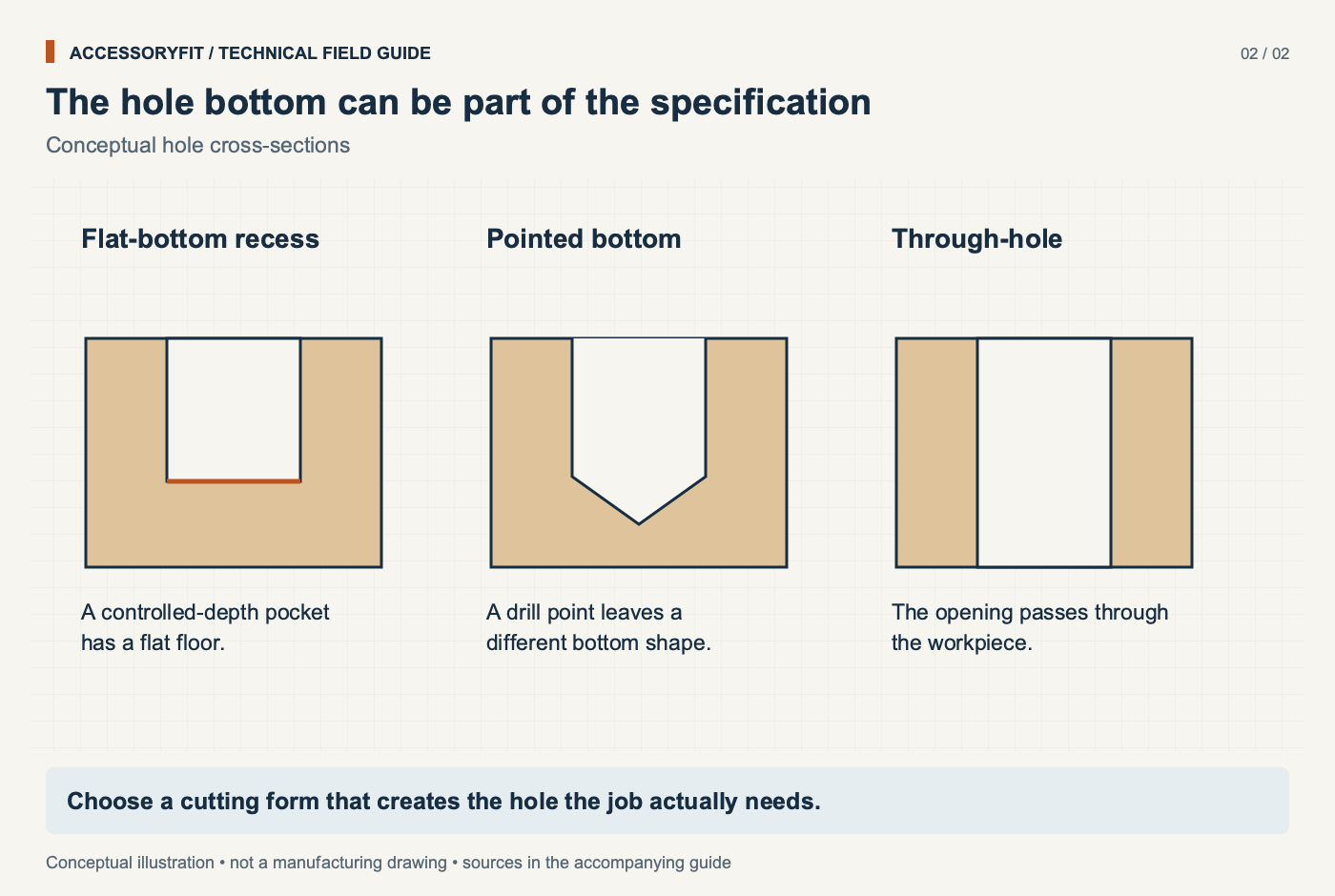
A brad-point (lip and spur) bit is a twist bit optimised for wood: a sharp centre spur holds it on the mark, and the outer spurs score the rim before the lips lift the waste. Spade bits are flat paddles with a centre point; they cut fast in a hand drill but splinter where they exit, and versions with spurs on the cutters leave a cleaner hole. Forstner bits bore precise, flat-bottomed holes in any grain direction and can overlap one hole with another or cut on the edge of a board, but they cannot clear their own chips and must be withdrawn often. Auger bits add a long spiral flute to clear chips from deep holes, and the common Jennings pattern has a self-feeding screw tip, two spurs and two cutting edges.
What sizes do auger bits come in?
Auger sizes from Milwaukee's accessory catalogue give a typical spread. Milwaukee lists ship auger bits from 3/8 to 1-1/2 in, in short and long versions with impact-rated shanks, and spur auger bits from 1/2 to 1-1/2 in. Whatever the diameter, the long spiral flute is what carries chips out of the hole. No maker speed chart for auger bits was available, so this page does not give auger speeds.
The difference that matters most in use is speed. Recommended speed falls as diameter rises, and large Forstner bits are run slowly to avoid scorching. The comparison of wood boring bits compared sets out hole quality, sizes and speed charts for these three bits side by side.
What is a step drill bit used for?
A step drill, also sold as a unibit, is described in reference sources such as Wikipedia as drilling a range of hole sizes with one bit: its cone is cut into a series of steps, each a larger diameter than the one before. It is mainly used in sheet material such as thin steel, aluminium and plastic, where a large twist bit would grab and tear the sheet.
Because each step is short, a step bit only drills thin stock to its full size; on thicker material the hole stops at whatever step has reached through. The step bit picks page compares step ranges and steel grades.
Which bits drill concrete, brick and stone?
Masonry bits drill concrete, brick and block. They have a brazed tungsten carbide tip and are normally used with hammer action, either in a hammer drill with a round or hex shank or in a rotary hammer with an SDS shank. Starrett's SDS-plus masonry bits use a 130 degrees carbide tip.
Hammer action has a cost in vibration. HSE's L140 guidance, in the 2019 second edition that is still current, gives 11 m/s² as its recommended starting estimate for an impact (hammer) drill with a 5 to 8 mm masonry bit, more than double its figure for a drill with a standard bit; the table is based on tools in use before 2015. HSE also notes that keeping bits sharp and not over-pushing lowers vibration, so a worn masonry bit is worth replacing rather than forcing.
SDS shanks are slotted so a rotary hammer can deliver its blow while the bit slides back and forth in the holder. The two common sizes are SDS-plus, with a 10 mm shank, and SDS-max, with an 18 mm shank, and the two are not interchangeable. Hilti labels its SDS-plus connection TE-C. The guide to SDS-plus and SDS-max shanks explains which hammers take which bits, and the picks for masonry drill bits cover sizes for anchors and plugs.
Which bits drill tile, porcelain and glass?
Diamond core bits and diamond hole saws drill porcelain, stone and glass, and carbide spear-point bits drill glass. Both work by grinding rather than cutting, and both need low speed and cooling.
Starrett says diamond tile drills and diamond hole saws must always be cooled with water. Wikipedia describes glass bits as having a spear-shaped carbide point, run at low speed, that gets hot and wears quickly. The idea that tile and glass drill faster at high speed is wrong on both counts: speed adds heat, and heat is what destroys these bits and cracks the work. For tile-specific choices, the tile and porcelain drill bits page compares spear-point and diamond options.
Does a glass and tile bit drill porcelain?
Not according to the makers. Milwaukee says its carbide ceramic tile and glass bits are not recommended for porcelain tile, and Bosch points porcelain jobs to its HEX-9 HardCeramic bit. Diamond bits are the type sold for porcelain.
Should tile be drilled with hammer action?
No. Bosch says to drill ceramic tile on the rotary setting only, Milwaukee says its tile and glass bits are for drill drivers only, and Makita says its tile bits are for a driver-drill. Bosch adds that the hole should be started slowly with light pressure, raising pressure and speed once the bit has bitten. That is the opposite of a masonry bit, which relies on hammer action.
When do you need a hole saw instead of a drill bit?
You need a hole saw when the hole is larger than a drill bit can practically cut, or when you only want to remove a ring of material. A hole saw is a toothed cup that mounts on an arbor carrying a pilot drill, and it cuts only the rim of the hole, leaving a solid core.
Hole saws come in the same material families as bits. Bi-metal saws cut metal, including stainless sheet, as well as wood and plastic; carbide-tipped saws are for non-metallics such as wood, MDF, plasterboard and tile; and diamond-grit saws cut glass, ceramics, porcelain and stone with water cooling. Standard bi-metal saws cut about 1-5/8 in deep, so thicker work needs a deep-cut saw or a cut from both sides. The hole saw sizes for pipe and conduit chart lists sizes for common fittings, and hole saw kits are compared on a separate page.
What are jobber, stub and long drill bit lengths?
Reference sources such as Wikipedia list three length series for twist drills: stub (also called screw-machine) length, which is short and stiff; jobber length, the medium length and the most common; and taper or long-series length for deep holes. Jobber length is what most retail drill sets contain.
Shorter bits flex less, so they start more accurately and resist snapping in hard metal; longer bits reach further but wander more and break more easily if the drill is not held straight. In Europe, metric jobber-length HSS drills are made to DIN 338, and the table below lists overall lengths for common sizes from Starrett's catalogue. Matching inch figures for jobber, stub and taper lengths were not available from a source we could verify, so this page does not give them.
| Diameter | Decimal inch (converted) | Overall length |
|---|---|---|
| 1.5 mm | 0.0591 in | 40 mm (1.57 in) |
| 2 mm | 0.0787 in | 49 mm (1.93 in) |
| 2.5 mm | 0.0984 in | 57 mm (2.24 in) |
| 3 mm | 0.1181 in | 61 mm (2.40 in) |
| 3.2 mm | 0.1260 in | 65 mm (2.56 in) |
| 3.5 mm | 0.1378 in | 70 mm (2.76 in) |
| 4 mm | 0.1575 in | 75 mm (2.95 in) |
| 4.5 mm | 0.1772 in | 80 mm (3.15 in) |
| 4.8 mm | 0.1890 in | 86 mm (3.39 in) |
| 5 mm | 0.1969 in | 86 mm (3.39 in) |
| 5.5 mm | 0.2165 in | 93 mm (3.66 in) |
| 6 mm | 0.2362 in | 93 mm (3.66 in) |
| 6.5 mm | 0.2559 in | 101 mm (3.98 in) |
| 7 mm | 0.2756 in | 109 mm (4.29 in) |
| 8 mm | 0.3150 in | 117 mm (4.61 in) |
| 9 mm | 0.3543 in | 125 mm (4.92 in) |
| 10 mm | 0.3937 in | 133 mm (5.24 in) |
| 12 mm | 0.4724 in | 151 mm (5.94 in) |
Sizes and lengths from Starrett catalogue 71E (KBAR line and KBK13 set). Inch values are conversions.
Which shank does a drill bit need to fit your drill?
A bit's shank must suit the drill's holder: round and three-flat shanks go in a jawed chuck, 1/4 in hex shanks go in an impact driver's quick-change holder, and SDS shanks go only in an SDS rotary hammer. Chuck size names the largest shank the chuck accepts, not the largest hole the drill can make.
That last point corrects a common belief: a 1/2 in drill is not limited to holes of that size. Reduced-shank bits, sometimes called Silver and Deming bits, cut larger holes but have a shank turned down to fit the chuck. Flats ground on a shank, as on three-flat bits and spade bits, are there to stop the bit slipping. Impact-rated bits with a hex shank are made for impact drivers; Milwaukee sells such bits for its drivers. The drill chuck sizes guide lists the capacity range of common keyless chucks.
How fast should each type of drill bit spin?
Smaller bits spin faster than larger ones, and hard materials need lower speeds than soft ones. Starrett and Engineering ToolBox both publish speed charts on that pattern; the inch chart below is from Engineering ToolBox, and Starrett's metric catalogue chart follows the same pattern for HSS drills in steel, stainless, cast iron and non-ferrous metals.
Starrett also recommends a lubricant when drilling metal, to reduce friction wear, keep the edge sharp and lower the risk of breakage. Wood bits follow the same rule: Forstner and spade bits slow down sharply as their diameter grows. Glass and tile bits sit at the bottom of the range, as noted above.
| Diameter | Softwood (pine) | Hardwood (hard maple) | Acrylic | Brass | Aluminum | Steel |
|---|---|---|---|---|---|---|
| 1/16 - 3/16 in | 3000 | 3000 | 2500 | 3000 | 3000 | 3000 |
| 1/4 - 3/8 in | 3000 | 1500 | 2000 | 1200 | 2500 | 1000 |
| 7/16 - 5/8 in | 1500 | 750 | 1500 | 750 | 1500 | 600 |
| 11/16 - 1 in (printed '1 1/16 - 1') | 750 | 500 | - | 400 | 1000 | 350 |
Single source. The last band is printed '1 1/16 - 1'; probably 11/16 - 1 in.
Is there a drill bit that cuts sideways?
Ordinary drill bits are made to cut at the tip, not along their sides; a twist bit pushed sideways in the hole will bend or snap rather than cut. Cutters that remove material sideways belong to a different family, such as router bits, which cut with the edges along their length and are guided across the work.
That is why a search for a drill bit router usually ends at a router rather than a drill: spiral router bits look like drill bits but are made for a router's much higher speed and a sideways feed. The guide to router bits that cut sideways explains how those cutters are chosen. Reamers, which enlarge an existing hole to a precise size, are not covered by the sources in our fact base, so this page does not give guidance on them.
How do you choose the right drill bit, step by step?
These steps narrow the choice from the material to a specific bit.
- Name the material. Wood, mild steel, stainless, sheet metal, masonry, tile or glass each point to a different bit type in the table above.
- Pick the bit type. Brad-point, spade, Forstner or auger for wood; twist for general metal; cobalt for stainless; step for sheet; carbide masonry or SDS for concrete; diamond or spear-point for tile and glass.
- Check the hole size. If the hole is larger than common bits, move to a Forstner bit in wood or a hole saw in other materials.
- Match the shank to the tool. Round or three-flat for a jawed chuck, hex for an impact driver, SDS for a rotary hammer.
- Choose the length. Use the shortest length that reaches through the work: stub for accuracy in hard metal, jobber for general use, long-series for deep holes.
- Set speed and cooling. Lower speed for larger bits and harder materials, lubricant for metal, water for diamond bits.
Why does a drill bit wander, burn or snap?
Wandering, burning and snapping each trace to a mismatch between bit, material and technique. Ordinary twist drills tend to wander on a flat surface; in metal this is countered with a spotting (pilot) drill, in wood with a brad-point bit, and split points reduce deviation. In metal, a center punch mark gives the tip a place to start; McMaster-Carr's listing for a Starrett punch describes it as stopping the drill wandering. The guide to stopping a drill bit walking goes through each fix.
Burning comes from heat. A Forstner bit run too fast scorches the wood and dulls quickly, and a glass bit run fast overheats. Snapping is most common with brittle bits, carbide and cobalt, when the drill is tipped sideways, and with long bits that flex. A dull bit makes every one of these worse because it needs more feed pressure. If a bit keeps slipping in the chuck instead, the cause is usually at the shank, and flatted shanks exist to resist that slip.
Where should you go from here?
Once you know the bit type, the next step is usually a size: the drill size chart, the tap drill chart and the pilot hole chart linked above give the exact figure for threads and screws. To see which bits suit a particular drill or driver, the accessory finder filters by tool, and the other how-to guides cover saw blades, router bits and abrasives in the same way.
Questions readers ask
What is a jobber drill bit?
A jobber bit is a twist drill of medium length, the most common length series and the one in most drill sets. Shorter stub bits and longer taper or long-series bits are the other two lengths.
Are cobalt drill bits coated?
No. Cobalt is alloyed into the high-speed steel itself, so the whole bit carries it. Black oxide and titanium nitride are thin surface coatings on ordinary HSS bits.
What is the difference between a 118 degrees and a 135 degrees drill point?
The figure is the point angle. A 118 degrees point is the general-purpose angle for wood, metal and plastic; Starrett describes a 135 degrees split point as self-centring, easier to start and less prone to wander in metal.
What does a step drill do that a twist bit cannot?
It drills several hole sizes with one bit, and it starts cleanly in thin sheet, where a large twist bit tends to grab. It only reaches full size in material thinner than its steps.
Can a masonry bit drill porcelain tile?
The sources in our fact base do not list masonry bits for porcelain. They point to diamond core bits or diamond hole saws, always cooled with water, and to carbide spear-point bits at low speed for glass.
Where to go next
- Forstner vs spade bitWhich large wood bit suits the hole.
- Drill bit size chartFractional, metric, number and letter sizes in one table.
- Why a drill bit walksFixes for holes that start off the mark.
- Drill chuck sizesMake sure the shank fits the chuck.
References 100 documents, 42 publishers
- ABCM, COBEM 2005 proceedings: Influence of the Lubri-Cooling System on the Life of TiAlN Coated HSS Twist Drills when Machining Blind and Through Holes
- AmesWeb: Decimal Equivalents of Fractional, Wire and Letter Drill Sizes
- Annals of Work Exposures and Health: The Effects of Bit Wear on Respirable Silica Dust, Noise and Productivity: A Hammer Drill Bench Study
- Applied Ergonomics (Elsevier): Pneumatic rock drill vs. electric rotary hammer drill: Productivity, vibration, dust, and noise when drilling into concrete
- BAER tools: What makes an SDS drill bit special
- BioResources: Effect of Chip Thickness and Tool Wear on Surface Roughness and Cutting Power during Up-Milling Wood of Different Density
- Bosch: Bits for drilling tiles (tile drilling guide); CYL-9 Soft Ceramic drill bit set 2 608 587 169; 1617/1618 router operating/safety instructions (2610051825); GBH 2-28 F rotary hammer with SDS plus; GBH 5-40 D rotary hammer with SDS max; HA3JAWC 1/2 in SDS-plus Shank Keyless Chuck; GBM 1600 RE Professional online manual: changing the drill chuck; High-Speed Steel Single-Flute Straight Bits (Canada product page)
- Burns Tools: Amana HSS1640 HSS double flute aluminium bit 5/16 in listing
- DeWalt: DWE575 circular saw instruction manual (N786997); DCD771C2 20V MAX Cordless Drill/Driver Kit; DWP611 compact router instruction manual (N336740)
- DICTUM (retailer) / Fisch (manufacturer): Fisch Wave Cutter Evolution Forstner Bit, 19 mm (product page with speed guidance)
- Engineering ToolBox: Hardwood and Softwoods - Recommended Drill Bit Speeds; Steel Pipe Dimensions (ANSI schedule 40 and 80); ASTM B88 seamless copper water tubes - dimensions; ASTM D1785 and ASTM F441 - PVC and CPVC pipes schedule 40 and 80
- Finolex Industries: ASTM PVC-U pipes schedule 40 (ASTM D1785)
- Freud and Diablo: Get the most out of your Freud bits by routing at ideal feed rates and speeds (CNC feed and speed sheet)
- GTSE (UK tool supplier): SDS Drill Bits Explained: Types and Sizes
- Hardwick & Sons: Jacobs Multi-Craft Keyless Chuck 3/8 in capacity, model 30353
- Health and Safety Executive (UK): Hand-arm vibration: The Control of Vibration at Work Regulations 2005. Guidance on Regulations (L140, Second edition)
- Hilti UK: TE-C (SDS Plus) metric hammer drill bit set
- HomElectrical: Irwin 1/2 in Reduced Shank Silver & Deming HSS Drill Bits
- Human Factors and Ergonomics Society: Construction Ergonomics: Concrete Bit Wear Increases Handle Vibration and Drilling Time
- Infinity Cutting Tools: How to choose solid carbide spiral router bits
- International Journal of Industrial Ergonomics (Elsevier): R2: Drilling into concrete: Effect of feed force on handle vibration and productivity
- Journal of Wood Science: Effect of tool material on tool wear and delamination during machining of particleboard
- Klein Tools: 53828 1.115-Inch Knockout Die for 3/4-Inch Conduit (with related knockout punch/die listings)
- Kwikset: 138 Installation Kit instructions (door boring jig)
- Little Machine Shop: Letter Drill Sizes; Number Drill Sizes
- Makita: B-68959 1/4 in x 4 in Glass and Tile Bit, 3 Flat Shank; 9557PB angle grinder instruction manual; 5007F 7-1/4 in circular saw instruction manual; B-59259 Adapter, SDS-PLUS to 1/4 in Hex; RP1800/RP1801F/RP2301FC plunge router instruction manual; RP0910/RP1110C electronic router instruction manual (Makita Czech catalogue file)
- McMaster-Carr: Starrett 117A center punch (marking punches); Rotary-Hammer Chuck Adapters; Jacobs Keyless Drill Chucks
- Milwaukee Tool: 1/4 in SHOCKWAVE Impact Duty RED HELIX Titanium Drill Bit 48-89-4613; 4PC Ceramic Tile & Glass Bit Set 48-20-8988; M18 FUEL oscillating multi-tool 2836-20 operator's manual (58-14-0217d1); 2019 Accessory Catalog; Cat. No. 2715-20, 0757-20 operator's manual (58-14-0017); HOLE DOZER Door Lock Installation Hole Saw Kit 49-22-4063; Small Thread Arbor 3/8 in Shank 49-56-7010; Large Thread Quick Change Arbor 7/16 in Shank 49-56-7240; 5PC 3/8 in QUIK-LOK Arbor Set 49-56-7545; Hole saw arbor assembly instructions (49-56-9100, 49-56-7250, 49-56-7010, 49-56-6560); M12 FUEL Installation Drill/Driver 2505-20; M12 FUEL 1/2 in Drill/Driver 3403-20; M18 FUEL compact router 2723-20 operator's manual (58-14-0194d1)
- NIOSH: Nonfatal Tool- or Equipment-Related Injuries Treated in US Emergency Departments Among Workers in the Construction Industry, 1998-2005; Nonfatal work-related injuries treated in hospital emergency departments in the U.S., 2012-2023
- OSHA: 29 CFR 1910.215 Abrasive wheel machinery; 29 CFR 1910.243 Guarding of portable powered tools; 29 CFR 1926.303 Abrasive wheels and tools; 29 CFR 1926.300 General requirements (Tools, hand and power); 29 CFR 1926.304 Woodworking tools
- Penn Tool Co: Jacobs 32BA-1/2 plain bearing geared key drill chuck, 1/2-20 mount
- Rockler: Rockler Pattern Flush Trim Router Bits - 1/2" Shank; Rockler Piloted Flush Trim Router Bits - 1/2" Shank
- Schlage (Allegion): Generic door prep, knob/lever, no holes (115799)
- Stanley Black & Decker (IRWIN, LENOX): IRWIN 29-pc Cobalt M-35 Metal Index Drill Bit Set 3018002; Left-hand mechanics length cobalt alloy high speed steel drill bit sets
- Starrett: Saws & Hand Tools Catalogue 71E (hole saws, arbors, drill bits)
- Tanner Bolt & Nut: Chuck Systems, Drill Bits and Shanks for Rotary Hammer Drills
- ToolsToday: Is a flush trim bit the same as a pattern bit? (Q&A); Why Your CNC Router Bit Is Burning Wood (And Why Slowing Down Might Make It Worse)
- Tribology in Industry: Comparison of Wear Behaviours of Cathodic Arc TiN, TiAlN Coated and Uncoated Twist Drills Under Aggressive Machining Conditions
- Whiteside Machine Co.: 2016 roundover bit; 2210 roman ogee bit; 2310 45 degree chamfer bit; 3212 cove and bead bit; 1566 120 degree V-groove bit; D14-75 14 degree dovetail bit; RU7306 up cut spiral; RD7306 down cut spiral; UD7202 up/down cut (compression) spiral; 2415 flush trim bit; 6002 ogee stile and rail set; 5920B raised panel bit with back cutter; 1984 small pilot roundover; SC01 carbide straight bit; 1952 multi-rabbet bit set; 1074 straight bit
- Wikipedia: Drill bit; High-speed steel; Drill bit sizes
- Woodcraft: Freud 32-522 4 piece rabbeting router bit set with bearings, 1/2" shank; Freud 99-522 Quadra-Cut raised panel router bit, bevel, 1/2" shank
- Woodworker's Journal: Router Speed Settings
Accessed .