Forstner vs spade bit (and auger bit): which wood boring bit to use
Use a Forstner bit when the hole has to look good: it bores a clean, flat-bottomed hole in any grain direction, and it can overlap another hole or cut on the edge of a board. Use a spade (paddle) bit when speed matters more than finish, such as boring rough holes through framing. Use an auger bit for deep holes, where its spiral flute pulls the chips out. Forstner bits must run slower than the other two, and most burning comes from running them too fast.
01What is the difference between Forstner, spade and auger bits?
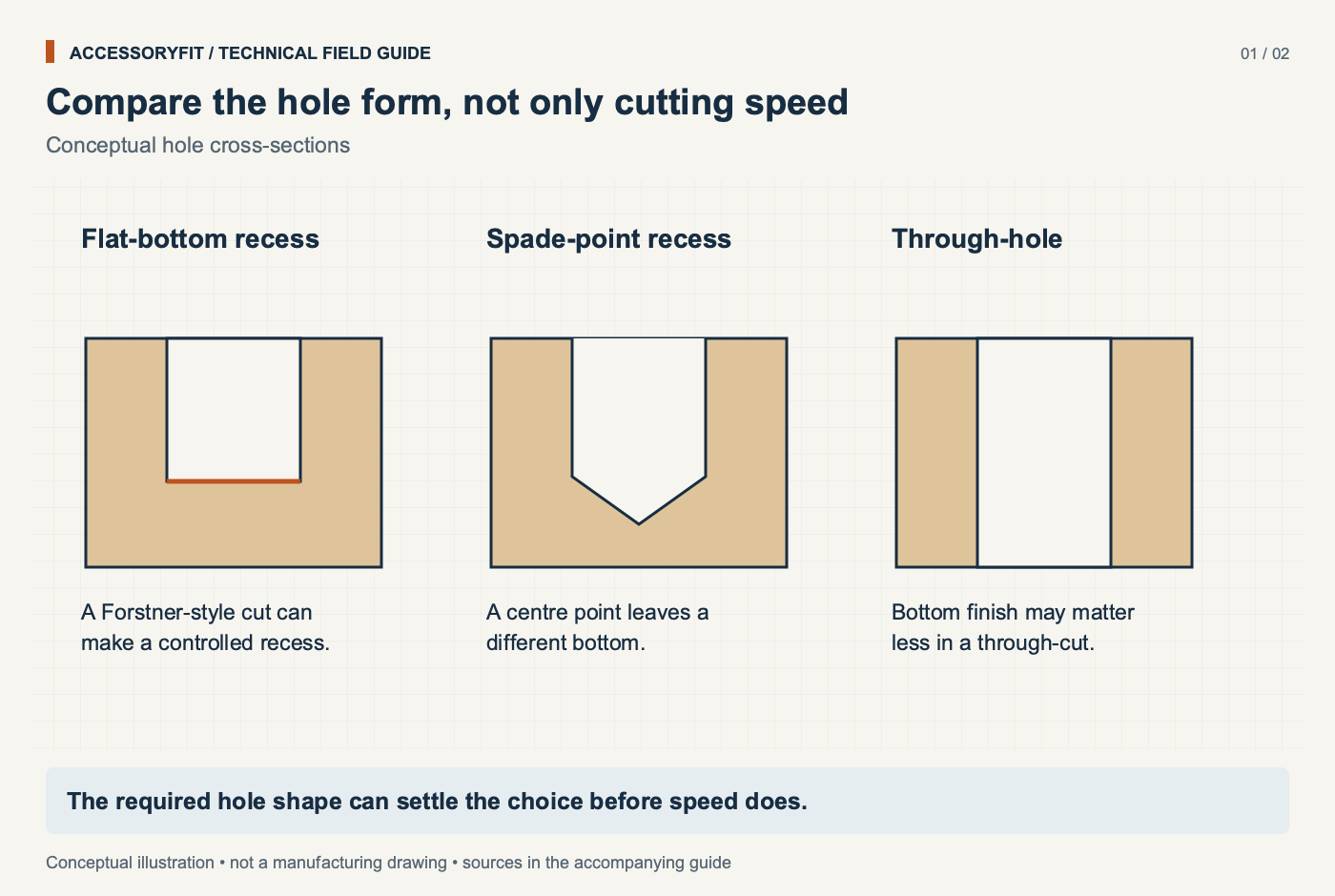
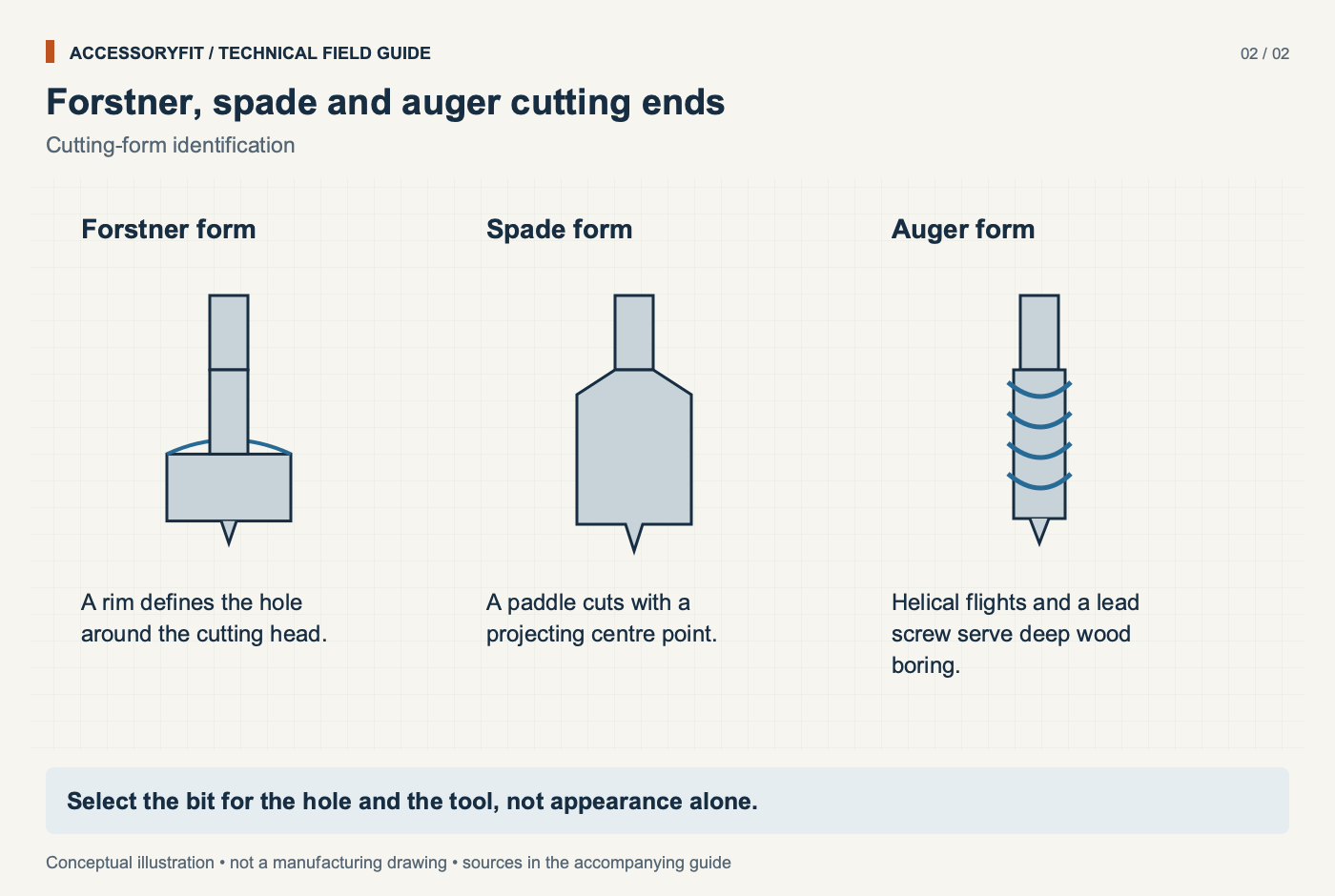
All three bore holes larger than an ordinary twist drill can manage in wood, but they cut in very different ways. A Forstner bit has a rim and flat cutters that shear a precise hole with a flat bottom, guided by its rim rather than its centre point, which is why it can cut part of a circle on the edge of a board or overlap a hole already drilled. A spade bit, also called a paddle bit or flat wood bit, is a flat blade with a centre point that scrapes the hole out quickly and roughly. An auger bit has a screw tip that pulls the bit into the wood and a long spiral flute that lifts chips out of the hole as it goes.
The table compares the attributes that decide which one to buy. Speeds are the sources' published guidance, not measured cutting rates, and the auger column is thin because the sources consulted did not give auger size ranges or speeds.
The required hole shape can settle the choice before speed does.
Forstner vs spade vs auger bits: hole quality, size and speed
Attribute
Forstner bit
Spade (paddle) bit
Auger bit
Hole quality
Clean, precise, tear-free
Rough; splinters where it exits (spurs help)
Clean entry; suited to deep holes
Flat-bottomed hole
Yes
No
No
Overlapping or edge holes
Yes
No
No
Speed of cut
Slow; withdraw to clear chips
Fast; rough cut (Wikipedia)
Self-feeding; flute clears chips
Typical sizes
8 to 50 mm (Wikipedia)
1/4 to 1-1/2 in (Wikipedia)
Not stated by the sources
Recommended speed
Fisch: 2000 / 2400 rpm (hardwood / softwood) for a small bit; at most 500 rpm in hardwood for its largest bits
See the Engineering ToolBox speed table below
Not stated by the sources
Shank examples
Fisch Wave Cutter: 8 / 10 mm by diameter
Some Starrett models: 1/4 in hex for impact drivers
Milwaukee 48-13-6000: impact-rated
02Which is faster, a spade bit or a Forstner bit?
A spade bit is faster. Wikipedia describes spade bits as made for rough, fast boring with a hand drill, while Forstner bits are run slower than twist bits and have to be pulled out of the hole now and then to clear chips. The published speed charts show the same gap. In Engineering ToolBox's tables below, the recommended hardwood speed for a spade bit is higher than the Forstner speed in every diameter band the two tables share, and at the largest sizes the spade figure is more than double.
Speed of cut is not the same as speed of the job, though. A spade bit's exit hole splinters, so a hole that will show often needs to be finished from the other side or cleaned up afterwards. A Forstner hole is usually done when the bit comes out. If the hole will be hidden inside a wall or a frame, the spade bit wins; if it will be seen, the Forstner bit often saves time overall.
Select the bit for the hole and the tool, not appearance alone.
03What speed should you run each bit at?
Run every wood boring bit slower as its diameter goes up, and run Forstner bits slowest of all. The three tables below give the published figures: Engineering ToolBox's inch-size chart for Forstner bits, Fisch's metric guidance for its own Forstner bits, and Engineering ToolBox's chart for spade bits. Fisch also says to start slowly and build speed gradually.
The two Forstner sources disagree in the middle of the range. Engineering ToolBox gives 500 rpm for 3/4 to 1 in Forstner bits in hardwood. Fisch rates its 19 mm Wave Cutter Evolution bit to a maximum of 1000 rpm in hardwood, and its general guidance for a 20 mm bit is in the same region. Both figures are shown because both are published; the Engineering ToolBox figure is the cautious one, and Fisch's applies specifically to Fisch bits. Starting at the lower figure and only increasing speed if the cut is clean and cool keeps you inside both.
Forstner bit speeds by diameter, inch sizes (Engineering ToolBox)
Diameter
Softwood (pine) rpm
Hardwood (hard maple) rpm
1/4 - 3/8 in (6.4-9.5 mm)
2400
700
1/2 - 5/8 in (12.7-15.9 mm)
2400
500
3/4 - 1 in (19.1-25.4 mm)
1500
500
1-1/8 - 1-1/4 in (28.6-31.8 mm)
1000
250
1-3/8 - 2 in (34.9-50.8 mm)
500
250
mm conversions added.
Forstner bit speeds by diameter, metric sizes (Fisch guidance)
Diameter
Softwood rpm
Hardwood rpm
10 mm (0.39 in)
about 2400
about 2000
20 mm (0.79 in)
about 1800
about 1000
40 mm (1.57 in) and above
max 1000
max 500
Fisch says to start slow and build up gradually. At 20 mm Fisch (1000 rpm hardwood) runs higher than the Engineering ToolBox 3/4-1 in row (500 rpm).
Spade bit speeds by diameter (Engineering ToolBox)
Diameter
Softwood rpm
Hardwood rpm
1/4 - 1/2 in (6.4-12.7 mm)
2000
1500
5/8 - 1 in (15.9-25.4 mm)
1750
1500
1-1/8 - 1-1/2 in (28.6-38.1 mm)
1500
1000
1-5/8 - 2 in (41.3-50.8 mm)
1200
700
mm conversions added.
04When should you choose a Forstner bit?
Choose a Forstner bit whenever the hole is part of the finished piece. Its rim-guided cut gives a flat bottom, a clean wall and little tear-out, in any grain direction, and it is the only one of the three that can bore overlapping holes or cut a partial hole on the edge of a board. Typical jobs include flat-bottomed pockets for hardware, stopped holes that must not go through, holes in end grain and holes through knots, which Bosch lists among the uses for its FB700 set. Freud lists flat-bottom, pocket and overlapping holes for its PB-100 set, in plywood, hardwoods, softwoods, veneered plywood, composites and solid surface material.
A drill press gives the most control, but a Forstner bit is not limited to one: both Freud and Bosch state their sets work in a hand-held drill as well as a drill press or stationary machine. Wikipedia gives a typical Forstner range of 8 to 50 mm, with sawtooth-rim versions going larger. Fisch makes its Wave Cutter Forstner bits with 8 / 10 mm shanks depending on diameter, so check that your chuck takes the shank of the largest bit you plan to use.
05When is a spade bit the better choice?
A spade bit is the better choice for fast, rough holes in wood where appearance does not matter: boring through studs and framing timber, or roughing out a hole that will be covered. Bosch describes its Daredevil spade bits as built for fast drilling through framing lumber, in corded and cordless drills.
Spade bits are also inexpensive, cover a useful range in a small set, and some fit an impact driver. Starrett makes flat wood bits with a 1/4 in hex shank for impact drivers, and impact drivers hold accessories in a 1/4 in hex quick-connect holder rather than jaws.
Two details improve the hole. Spade bits with spurs on the cutters give a cleaner hole with less breakout. And because the exit side splinters, Wikipedia advises finishing the hole from the other side; stopping as soon as the centre point breaks through leaves a mark to start from.
06Spade bit vs auger bit: which is better for deep holes?
An auger bit is better for deep holes, because its long spiral flute carries chips out of the hole while it cuts. A spade bit has no flute, so chips pack around it in a deep bore. The common Jennings pattern auger has a self-feeding screw tip, two spurs and two cutting edges, so the screw pulls the bit in and the spurs score a clean entry.
Long ship augers are built for site work. Milwaukee's 48-13-6000, for example, is 1 in across and 18 in long, with an impact-rated shank, and Milwaukee lists it for clean or nail-embedded wood and for boring holes for cable, PEX, rebar and bolts in piers, playground equipment and landscaping timbers. Some spade bits borrow the self-feeding idea: Bosch's DSB5013P spade bits have a full-thread self-feeding tip with spurs, which pulls the bit in like an auger tip but still leaves the flat-blade hole of a spade bit.
The sources consulted did not give auger size ranges or recommended speeds, so this page does not state them. Check the maker's listing for the bit you are buying.
07Why does a Forstner bit burn or smoke, and how do you stop it?
A Forstner bit burns because it is running hot, and the usual cause is too much speed. Fisch states that a Forstner bit must not run hot: excess heat leaves scorch marks on the wood and quickly dulls the cutting edges, which is why its speeds are kept low. The second factor is chips. A Forstner bit has no way to clear its own chips, so Wikipedia advises pulling it out of the hole periodically; leaving it buried in its own waste keeps the heat in the cut.
Large bits burn more readily than small ones because recommended speed falls as diameter rises. A drill that cuts cleanly with a small Forstner bit can scorch with a large one at the same setting. Fisch's ceiling of 500 rpm in hardwood for its largest bits is a long way below its figure of 2000 / 2400 rpm (hardwood / softwood) for the smallest bit in its table. The sources fetched name heat and speed as the cause; they do not separately rate dull edges or resin build-up, so this page does not claim them as causes.
08How do you stop a Forstner bit burning, step by step?
These steps follow the speed and chip-clearing guidance from Fisch, Engineering ToolBox and Wikipedia.
Look up the speed for the bit's diameter Find the bit's diameter in the speed tables above and set the drill press or variable-speed drill to the hardwood or softwood figure for that size. Use the lower figure where the two sources disagree.
Start slowly Begin the cut at low speed and build up gradually, as Fisch advises, rather than starting at full speed.
Withdraw to clear chips Lift the bit out of the hole every so often to clear the chips, especially in deep holes, so the waste does not trap heat in the cut.
Watch for scorch marks If the wood darkens or smokes, stop, let the bit cool and reduce speed before continuing. Running the bit hot dulls its edges quickly.
Drop speed again for larger bits Each time you move to a larger bit, turn the speed down. Recommended speed falls as diameter rises.
09Do bigger wood bits need more speed to cut faster?
No. Recommended speed falls as diameter rises, for Forstner, spade and brad-point bits alike. A larger bit's rim travels further with each turn, so the same spindle speed moves its outer edge much faster through the wood. Every speed table on this page follows that pattern, and Fisch caps its large Forstner bits at 500 rpm in hardwood. Turning the speed up on a big bit does not speed the job; it brings on the burning described above.
10When does each bit not fit the job?
Each bit has a clear point where it stops being the right tool:
Forstner bits in deep holes. With no flute to lift chips, a Forstner bit has to be withdrawn repeatedly. For long through-holes, an auger is the better tool.
Spade bits on show faces. They cannot cut a flat bottom or overlap holes, and they splinter on exit. Use a Forstner bit where the hole will be seen.
Any bit that does not fit the chuck. Chuck size limits the shank, not the hole: Jacobs' smaller keyless chuck grips shanks of 1/64 to 3/8 in, so check the shank of the largest bit in a set before buying it for a small drill. Hex shanks suit impact drivers and drills with hex holders.
Metal and thin sheet. None of these three bits is for metal. For sheet metal and electrical boxes, unibit-style step bits cover many sizes with one bit; for threaded holes in metal, the tap drill size chart gives the twist drill each thread needs.
Hammer drills come up often with spade bits. The sources consulted describe hammer action only for carbide-tipped masonry bits, and describe spade bits as wood bits for a hand drill, so none of them pairs spade bits with hammer mode. On a hammer drill, use the plain drilling setting for wood.
11Which Forstner, spade and auger bits match these jobs?
Product links go to Amazon. As an Amazon Associate I earn from qualifying purchases. How links are chosen.
These four products cover the three bit types compared above. Specs come from each manufacturer's product page; the notes reflect those specs and the applications the maker states; none of the products was tested for this page.
Forstner set covering small to lockset-size holes
Freud PB-100 Precision Shear forstner bit set, 16 pc
Pieces
16
Diameters
1/4 to 2-1/8 in
Shank
1/4 to 3/8 in
Overall length
3-1/2 in
Cutting edge
serrated edge with spur
Suits Furniture and cabinet work where holes show, including overlapping and pocket holes.
Skip it if Rough holes through framing, where a spade bit is faster.
One set spans 1/4 to 2-1/8 in, per Freud
Serrated cutting edge with a centre spur
Freud lists plywood, hardwoods, softwoods, composites and solid surface material
Freud states use in a drill press or hand-held drill
Shanks run 1/4 to 3/8 in, so check your chuck takes the largest
Large diameters need the low speeds in the tables above
For holes below the spade and Forstner range, a brad-point bit is the usual choice. It is a twist bit with a centre spur that holds it in line, which keeps it from wandering the way a plain twist drill can on a flat face. If your holes drift off their marks, see why bits wander.
Yes, if the bit has a hex shank. Starrett makes flat wood bits with a 1/4 in hex shank for impact drivers, which matches the impact driver's 1/4 in quick-connect holder. A round-shank bit needs a drill chuck.
Can a Forstner bit be used in a hand drill?
Yes. Freud and Bosch both state their Forstner sets work in hand-held or portable drills as well as drill presses. Keep the speed low, start slowly and hold the drill square to the work.
What is the difference between a spade bit and an auger bit?
A spade bit is a flat blade that bores quickly but roughly; an auger bit has a screw tip and a long spiral flute that lifts chips out, which suits deep holes. Spade bits are typically 1/4 to 1-1/2 in; the sources consulted did not give a size range for augers.
Why does a spade bit splinter the back of the board?
Spade bits tear fibres where they exit. Stop when the point breaks through and finish from the other side, or use a spade bit with spurs, which gives less breakout.
Can Forstner bits drill overlapping holes?
Yes. A Forstner bit is guided by its rim, so it can bore holes that overlap and can cut on the edge of a board. Spade and auger bits cannot.
Where to go next
Drill bit typesWhere Forstner, spade and auger bits sit among all drill bits.
Hole saw kitsFor holes larger than spade or Forstner bits cover.
Milwaukee Tool: 2019 Accessory Catalog; 48-13-6000 1" x 18" Ship Auger Bit product page; M12 FUEL Installation Drill/Driver 2505-20; M18 FUEL oscillating multi-tool 2836-20 operator's manual (58-14-0217d1); 1/4 in SHOCKWAVE Impact Duty RED HELIX Titanium Drill Bit 48-89-4613; 4PC Ceramic Tile & Glass Bit Set 48-20-8988
OSHA: 29 CFR 1910.215 Abrasive wheel machinery; 29 CFR 1910.243 Guarding of portable powered tools; 29 CFR 1926.303 Abrasive wheels and tools; 29 CFR 1926.300 General requirements (Tools, hand and power); 29 CFR 1926.304 Woodworking tools
Stanley Black & Decker (IRWIN, LENOX): IRWIN 29-pc Cobalt M-35 Metal Index Drill Bit Set 3018002; Left-hand mechanics length cobalt alloy high speed steel drill bit sets