Best hole saw kits: bi-metal sets picked by size range, cut depth and arbor
A general-purpose hole saw kit should be bi-metal, so it cuts wood, plastic and sheet metal, and its arbors must match both the saw threads and your drill chuck. Milwaukee's 49-22-4185 spans the widest range, 3/4 to 4-3/4 in; Bosch's HBT15M runs 3/4 to 3 in and is listed for impact drivers; Diablo's DHS14SGP cuts deepest at 2-3/8 in. DeWalt and Lenox kits complete the group. All five were compared on published manufacturer specifications; none was tested by us.
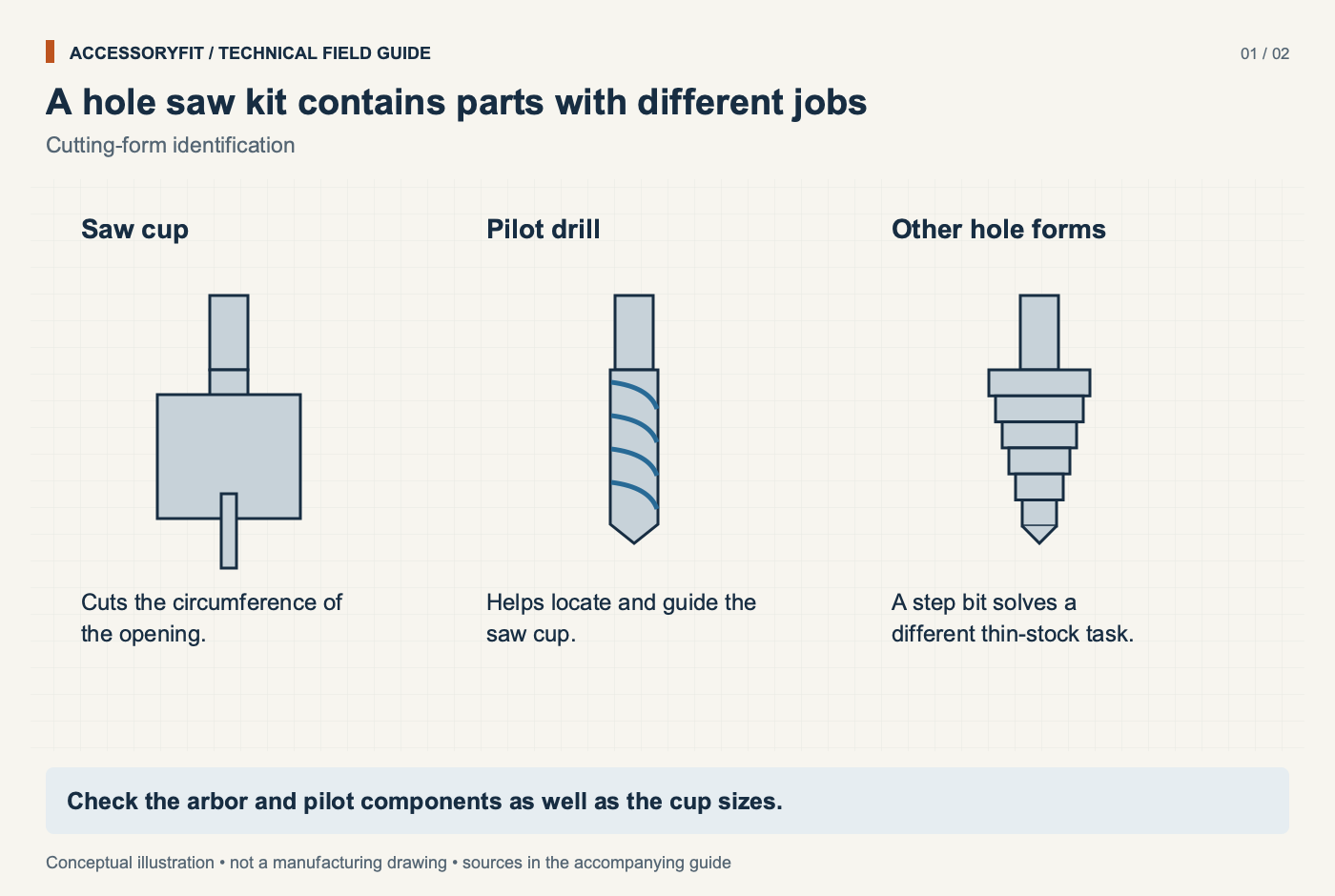
A hole saw kit should have bi-metal saws in the sizes you actually cut, enough cutting depth for the material, arbors that fit every saw in the box, and pilot bits. A hole saw is a cup-shaped saw that removes only a ring of material and leaves a plug, and it mounts on an arbor that carries a pilot drill. The kit's value is in how well those parts work together.
Tooth material: bi-metal for mixed jobs
Bi-metal hole saws have HSS or cobalt-HSS teeth on a tougher backing, and they cut metals, including stainless sheet, as well as wood and plastics. Starrett lists carbide-tipped hole saws for non-metallics such as wood, MDF, plasterboard and tile, where it says they cut faster than bi-metal, and diamond-grit hole saws for glass, porcelain and stone. All five picks are bi-metal, which makes them the general kits; carbide and diamond saws are specialist add-ons.
Cutting depth: standard or deep cut
Standard bi-metal hole saws cut about 1-5/8 in deep. Starrett's deep-cut bi-metal saws reach about 2 in and need arbors with an extended pilot drill. Depth decides whether you can cut through a door, a joist or a stud in one pass or have to finish from the other side.
Arbors: the part most kits are judged on
Small hole saws use a small-thread arbor with a 1/2–20 thread; larger ones use a large-thread arbor, which Milwaukee gives as 5/8–18. A kit that spans both groups therefore needs two arbors or an adapter. The arbor shank must also suit your chuck: 3/8 in hex-shank arbors fit drills with a chuck of that size or larger, while the larger hex shank found in some kits needs a 1/2 in chuck. Milwaukee's own arbor set uses a 1/4 in pilot bit. The hole saw size chart lists which hole each common fitting needs.
Which arbor each hole saw size takes, from Milwaukee and Starrett
Hole saw diameter
Arbor type
Thread
Arbor shank options
9/16 - 1-3/16 in (14-30 mm)
small-thread arbor
1/2-20
3/8 in hex, 7/16 in hex (Milwaukee); 8.75 mm (11/32 in) or 6.5 mm (1/4 in) hex (Starrett)
1-1/4 in (32 mm) and larger
large-thread arbor
5/8-18 (Milwaukee large thread adapter, 1-1/4 to 2 in)
3/8 in or 7/16 in hex (Milwaukee); 11 mm (7/16 in) or 8.75 mm (11/32 in) hex (Starrett)
The large-thread size is single-source (Milwaukee). Starrett shank sizes are hex across flats as printed.
Hole saw types, what they cut and their cutting depth (Starrett)
Type
Best for
Cutting depth
Bi-metal fast cut (FCH)
metals incl. stainless sheet; also wood, plastic
41 mm (1-5/8 in)
Bi-metal deep cut (DCH)
metal and thicker material
51 mm (2 in)
Carbide-tipped multi-purpose (MPH)
wood, MDF, plastics, plasterboard, ceramic tile
54 mm (2-1/8 in)
Diamond grit (D)
glass, ceramic, porcelain, stone
38 mm (1-1/2 in) per features list; 41 mm in spec box
Starrett's diamond page gives both 38 mm and 41 mm (see conflicts).
02What rules a hole saw kit out before you compare sizes?
A kit is ruled out if its arbor shank is too big for your chuck, if it lacks the sizes your fittings need, or if it is the wrong tooth type for the material. Check these before piece count, because a large kit that misses your key size is still the wrong kit.
Chuck size. A 1/2 in chuck accepts every arbor in these kits. A smaller chuck limits you to the smaller hex arbors. The common drills in the table below all list a chuck of that size; compact drills may not. Our guide to drill chuck sizes covers the difference.
Key sizes. Door locksets need a 2-1/8 in bore through the door face and a 1 in hole in the edge. Electrical knockouts are larger than their trade names suggest: Klein gives the knockout for the smallest common conduit trade size as 0.875 in. A kit's size range only tells you its smallest and largest saw, so read the contents list to confirm the exact sizes are included.
Tooth type. Bi-metal for mixed work; diamond for tile, porcelain or glass, which none of these kits covers.
A common mistake is to assume any arbor fits any hole saw. Small saws need the small-thread arbor and larger saws the large-thread arbor, so a lone arbor bought separately may only fit half a kit.
Check the arbor and pilot components as well as the cup sizes.
Chuck size and top speed of common drills that drive hole saws (manufacturer data)
Tool
Chuck
Chuck type
No-load speed
DeWalt DCD800
1/2 in
keyless
2000 rpm one source
DeWalt DCD805
1/2 in
keyless
2000 rpm one source
Makita XFD131
1/2 in
keyless one source
not stated
Makita XPH14Z
1/2 in one source
keyless
not stated
Milwaukee 2903-20
1/2 in
keyless
2100 rpm
Milwaukee 2904-20
1/2 in
keyless
2100 rpm
Ryobi PBLDD02
1/2 in one source
not stated
2150 rpm one source
Values marked one source appear in a single manufacturer document; check the tool's manual or rating plate before buying.
03Which hole saw kits suit general work?
Product links go to Amazon. As an Amazon Associate I earn from qualifying purchases. How links are chosen.
These five kits are the bi-metal hole saw kits in our catalogue with a manufacturer spec page. They are grouped by the job their range and arbors suit, not ranked. Each figure comes from the maker's own page; where a maker does not publish a figure, such as Lenox's size range, it is left out. For bits sorted by job and material, the drill bit guides hub has the rest.
For the widest size spread: a large general-purpose bi-metal kit
The kits differ most in size range and arbor system, then in cutting depth. Tooth material is the same family across all five, so the choice comes down to which holes you cut and which drill drives the saw.
Milwaukee 49-22-4185 vs Bosch HBT15M: range or impact-driver use?
Milwaukee's kit reaches 3/4 to 4-3/4 in, well past Bosch's 3/4 to 3 in, and includes three arbors. Bosch's set is the only pick whose maker lists impact drivers alongside drill/drivers, and it states an M42 alloy in its teeth. Pick Milwaukee for the widest spread of holes; pick Bosch if your main cordless tool is an impact driver and the sizes fit your work. Keep impact-driver hole sawing to light work: Milwaukee rates its own SHOCKWAVE impact hole saws for plastics and thin-gauge metal up to 1/8 in thick, so check the materials Bosch lists before taking the HBT15M into thicker stock.
Diablo DHS14SGP vs DeWalt D180005: depth or a standard arbor?
Diablo's saws are 2-3/8 in long, the deepest figure published by any maker here, and they eject plugs without tools. The trade-off is Diablo's own Snap-Lock Plus mandrel. DeWalt's kit uses conventional small and large hex arbors and covers 3/4 to 2-1/2 in. Both suit framing work; Diablo saves passes in thick stock, and DeWalt keeps you on a standard arbor format.
Where does the Lenox kit fit?
Lenox sells the 1786647 for electricians and plumbers and says it fits quick-change and standard arbors without adapters. Lenox's size range could not be confirmed from a page we were able to verify, so it is not given here. Compare the box contents with the sizes your fittings need before buying.
05When do you need a hole saw extension?
You need a hole saw extension when the drill body cannot get close enough to the surface you are cutting, for example inside a cabinet, through a stack of joists or behind an obstruction. The extension is a bar that fits between the chuck and the arbor; none of the five kits above includes one, so it is a separate purchase. Milwaukee sells its QUIK-LOK extensions in 5-1/2, 6, 12, 18, 24 in lengths, with a choice of two hex shank sizes, and its catalogue says they fit all major brands. Starrett's extensions are 300 mm bars, one for half-inch chucks and one for three-eighths-inch chucks.
Match the extension's shank to your chuck in the same way as the arbor: the larger hex shank needs a half-inch chuck. An extension adds reach, not cutting depth; the cup still stops at its own depth, so a thick beam still needs a deep-cut saw or a cut from both sides. A long bar also magnifies any wobble, so start the cut slowly and keep the drill in line with the bar.
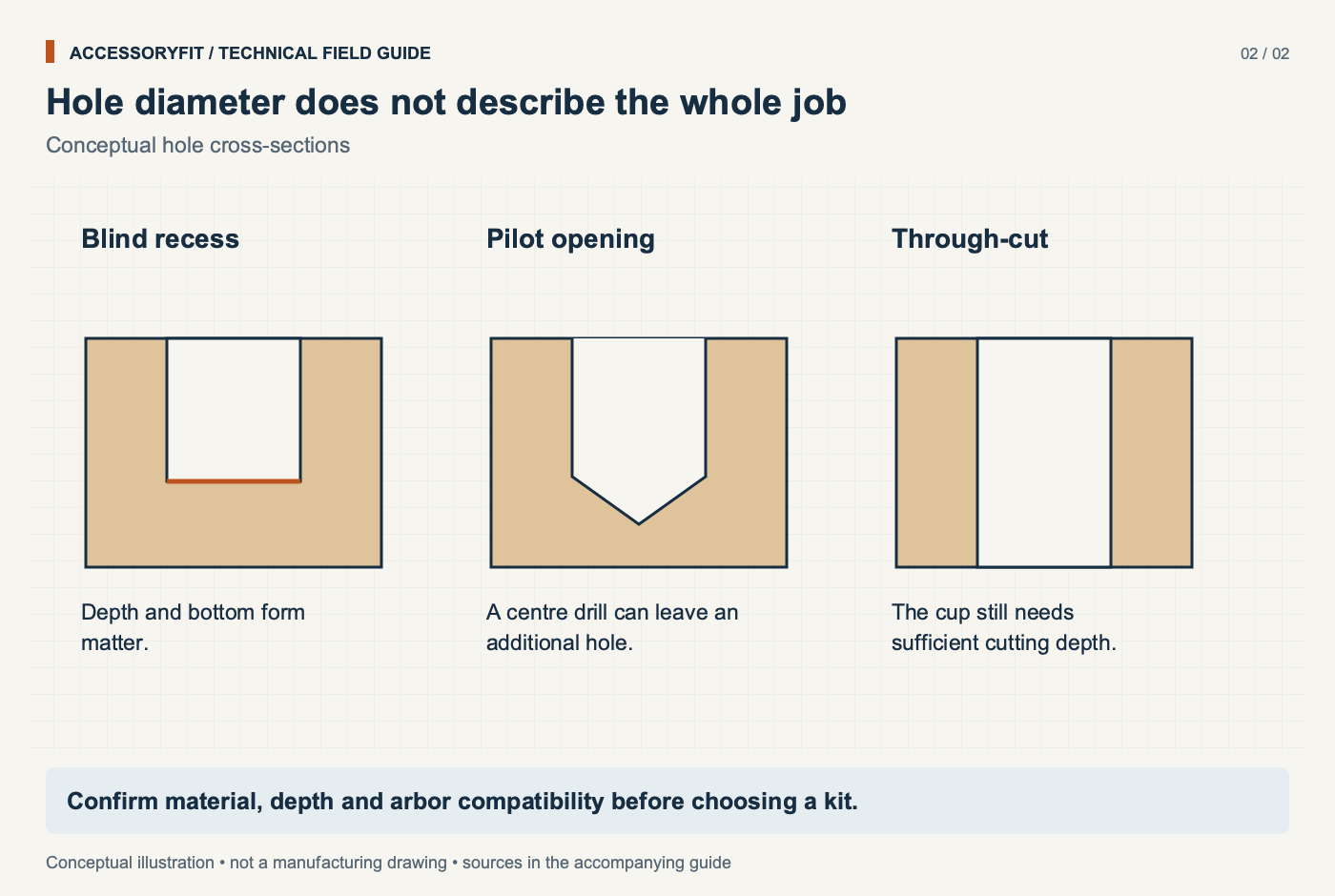
Confirm material, depth and arbor compatibility before choosing a kit.
Hole saw arbor extensions: shank and length (Milwaukee and Starrett)
Brand / part
Shank
Length
Milwaukee 48-28-2010 QUIK-LOK
3/8 in
6 in (152 mm)
Milwaukee 48-28-2020 QUIK-LOK
3/8 in
12 in (305 mm)
Milwaukee 48-28-2030 QUIK-LOK
3/8 in
18 in (457 mm)
Milwaukee 48-28-2040 QUIK-LOK
3/8 in
24 in (610 mm)
Milwaukee 48-28-1030 QUIK-LOK
7/16 in
5-1/2 in (140 mm)
Milwaukee 48-28-1040 QUIK-LOK
7/16 in
12 in (305 mm)
Milwaukee 48-28-1050 QUIK-LOK
7/16 in
18 in (457 mm)
Milwaukee 48-28-1060 QUIK-LOK
7/16 in
24 in (610 mm)
Starrett A5 (for A2 arbors)
fits 13 mm / 1/2 in chuck
300 mm (12 in)
Starrett A15 (for A1/A10 arbors)
fits 9.5 mm / 3/8 in chuck
300 mm (12 in)
Milwaukee catalog p.33 says its QUIK-LOK extensions fit all major brands. mm values for Milwaukee lengths are calculated.
06How slowly should the larger saws in these kits run?
A hole saw should run slower as it gets bigger and as the material gets harder. Starrett's chart, reproduced below, gives speed bands by diameter for mild steel, stainless, cast iron, non-ferrous metals and wood. Large saws in stainless run at a small fraction of the speed of small saws in wood. A drill's top speed is far above these bands for the larger sizes, so use low gear and let the teeth cut rather than pressing hard. In metal, a little cutting oil helps the teeth, in line with Starrett's advice to lubricate when drilling metal.
Hole sawing is also hard on the hands. UK HSE's hand-arm vibration guidance L140, in its second edition from 2019 and still the current one, gives a drill running a hole saw a recommended initial estimate of 10 m/s², twice its figure for a drill with a standard bit. The estimate is based on tools in use before 2015 and remains HSE's most recent figure of its kind. For a kit buyer it is a reason to keep the bi-metal teeth sharp, use the drill's side handle on the larger sizes, and cut a batch of large holes in short spells rather than one long session.
Starrett bi-metal hole saw speeds by diameter and material (rpm)
Saw diameter
Mild steel
Stainless & tool steel
Cast iron
Brass, copper, aluminium
Wood & plastic
9/16 - 1 in (14-25 mm)
580-350
300-175
400-235
790-470
800-500
1-1/16 - 2 in (27-51 mm)
325-170
160-85
215-115
435-230
500-200
2-1/16 - 3 in (52-76 mm)
165-115
80-55
110-75
220-150
200-150
3-1/8 - 4 in (79-102 mm)
110-85
55-40
70-55
140-110
150-100
4-1/8 - 5 in (105-127 mm)
80-65
40-30
55-25
110-85
100-85
5-1/4 - 6 in (133-152 mm)
55
25
55-25
75
75
6-5/16 - 8-9/32 in (160-210 mm)
40
20
55-25
60
60
Starrett FCH and DCH hole saws, catalogue p.24. Ranges run from the small to the large end of each diameter band.
07When is a hole saw kit the wrong tool?
A hole saw kit is the wrong tool for small holes, for tile and glass, for flat-bottomed holes, and for cuts deeper than the saw. Each of these has a better accessory.
Small holes. Below the smallest saw in the kit, a twist bit or step bit does the job. Stepped bits drill a range of sizes in sheet metal with one bit; see the stepped bits for sheet metal.
Tile, porcelain and glass. Bi-metal teeth are not made for these. Diamond-grit hole saws cut them and must be cooled with water, and Starrett also lists carbide-tipped hole saws for ceramic tile. Swap the pilot too: Milwaukee says to use its carbide-tipped pilot bit with carbide-grit saws in tile, brick and other abrasive materials.
Flat-bottomed or partial holes in wood. A hole saw cuts straight through and leaves a plug. For a hinge cup or a blind hole, a boring bit is the tool; our comparison of Forstner versus spade bits explains which to use.
Material thicker than the saw. Cut until the pilot bit comes through, then finish from the other side using the pilot hole as a guide, or choose a deeper saw.
Masonry. SDS rotary hammer core bits are a separate system; a bi-metal hole saw is not made for concrete.
Electrical knockout hole sizes by conduit trade size (Klein)
Conduit trade size
Knockout hole
Klein part
1/2 in
0.875 in (22.2 mm)
53820 die
3/4 in
1.115 in (28.3 mm)
53828 die
1 in
1.362 in (34.6 mm)
53837 punch
1-1/4 in
1.701 in (43.2 mm)
53850 die
1-1/2 in
1.951 in (49.6 mm)
53858 die
2 in
2.416 in (61.4 mm)
53868 die
Single source. Which hole saw to use for each knockout was not confirmed on a fetched page (see unverified_fields).
08How do you match a kit to your holes?
List the holes you cut most often, then choose the kit whose contents include those exact sizes and whose arbors fit your chuck. A door installer needs the lockset bore; an electrician needs the knockout sizes in the table above; a plumber needs pass-through sizes for the pipe in use. Klein's knockout figures are a single-source reference, so confirm against your own fitting when the fit is tight.
The kits on this page cover the common sizes for each trade, but none publishes exactly the same list. For more comparisons, the accessory buying guides index lists every buyer guide, and the accessory finder shows the chuck size of your drill by model.
09Questions readers ask
What size hole saw do I need for a door lock?
A standard lockset needs a 2-1/8 in bore through the door face and a 1 in hole in the edge for the latch. Kwikset lockset jigs are set for a 2-3/8 or 2-3/4 in backset.
Do hole saws fit any drill?
Most do with the right arbor. Smaller hex arbors fit a 3/8 in chuck or larger, while larger hex arbors need a 1/2 in chuck. Bosch lists its HBT15M set for impact drivers as well.
Can a bi-metal hole saw cut stainless steel?
Yes, for sheet. Bi-metal saws are listed for metals including stainless sheet. Run them at the lower stainless speeds in Starrett's chart and use cutting oil.
Why does my hole saw need two arbors?
Because small saws use a 1/2–20 thread and larger saws a bigger thread, which Milwaukee gives as 5/8–18. A kit that spans both groups needs an arbor for each.
Is a conduit knockout the same size as the conduit's trade name?
No. Trade sizes are nominal. Klein gives the knockout for the smallest common conduit trade size as 0.875 in, larger than the name suggests. Match the hole saw to the knockout figure and check the fitting before cutting.
Will a hole saw extension fit a kit from another brand?
Often, yes. Milwaukee's catalogue says its QUIK-LOK extensions fit all major brands, in lengths of 5-1/2, 6, 12, 18, 24 in. Check that the extension's hex shank suits your chuck before buying.
ABCM, COBEM 2005 proceedings: Influence of the Lubri-Cooling System on the Life of TiAlN Coated HSS Twist Drills when Machining Blind and Through Holes
Annals of Work Exposures and Health: The Effects of Bit Wear on Respirable Silica Dust, Noise and Productivity: A Hammer Drill Bench Study
Applied Ergonomics (Elsevier): Pneumatic rock drill vs. electric rotary hammer drill: Productivity, vibration, dust, and noise when drilling into concrete
BioResources: Effect of Chip Thickness and Tool Wear on Surface Roughness and Cutting Power during Up-Milling Wood of Different Density
Bosch: Bi-Metal Hole Saw Sets (HBT15M) product page; Bits for drilling tiles (tile drilling guide); CYL-9 Soft Ceramic drill bit set 2 608 587 169
DeWalt: DCD800B 20V MAX XR 1/2 in Brushless Cordless Drill/Driver product page; DCD800/DCD805 Instruction Manual NA043446; DCD805B 20V MAX XR Brushless Cordless 1/2 in Hammer Drill/Driver product page; D180005 Master Hole Saw Kit (14 pc.) product page
Engineering ToolBox: Steel Pipe Dimensions (ANSI schedule 40 and 80); ASTM B88 seamless copper water tubes - dimensions; ASTM D1785 and ASTM F441 - PVC and CPVC pipes schedule 40 and 80; Hardwood and Softwoods - Recommended Drill Bit Speeds
Freud and Diablo: DHS14SGP 14 pc General Purpose Bi-Metal Hole Saw Set product page
Health and Safety Executive (UK): Hand-arm vibration: The Control of Vibration at Work Regulations 2005. Guidance on Regulations (L140, Second edition)
Milwaukee Tool: HOLE DOZER Door Lock Installation Hole Saw Kit 49-22-4063; Small Thread Arbor 3/8 in Shank 49-56-7010; Large Thread Quick Change Arbor 7/16 in Shank 49-56-7240; 5PC 3/8 in QUIK-LOK Arbor Set 49-56-7545; Hole saw arbor assembly instructions (49-56-9100, 49-56-7250, 49-56-7010, 49-56-6560); 2019 Accessory Catalog; 2903-20 M18 FUEL 1/2 in Drill Driver product page; Operator's manual 58-14-9998d1 (Cat. No. 2904-20); 2904-20 M18 FUEL 1/2 in Hammer Drill/Driver product page; 49-22-4185 28PC HOLE DOZER General-Purpose Hole Saw Kit product page; 1/4 in SHOCKWAVE Impact Duty RED HELIX Titanium Drill Bit 48-89-4613; 4PC Ceramic Tile & Glass Bit Set 48-20-8988
NIOSH: Nonfatal Tool- or Equipment-Related Injuries Treated in US Emergency Departments Among Workers in the Construction Industry, 1998-2005; Nonfatal work-related injuries treated in hospital emergency departments in the U.S., 2012-2023
Ryobi: PBLDD02B 18V ONE+ HP Brushless 1/2 in Drill/Driver product page
Schlage (Allegion): Generic door prep, knob/lever, no holes (115799)
Stanley Black & Decker (IRWIN, LENOX): 1786647 Electrician/Plumber Bi-Metal Speed Slot Hole Saw Kit 13 pc product page; IRWIN 29-pc Cobalt M-35 Metal Index Drill Bit Set 3018002; Left-hand mechanics length cobalt alloy high speed steel drill bit sets