
Fit guide · Rotary hammers
SDS-plus vs SDS-max: which rotary hammer bits fit which tool
SDS-plus and SDS-max bits do not interchange. SDS-plus bits have a 10 mm shank and fit the lighter rotary hammers that most homeowners and many trades use; SDS-max bits have an 18 mm shank and fit heavy hammers of about the 5 kg class and above. Check the tool holder named on the hammer, buy bits with the matching shank, and treat adapters as one-way: an SDS-max hammer can be adapted down to SDS-plus bits, but an SDS-plus hammer cannot take SDS-max bits.
By AccessoryFit editors · Checked
On this page
- What is an SDS shank?
- How do SDS-plus and SDS-max shanks differ?
- Which rotary hammers take SDS-plus and which take SDS-max?
- How long can you drill with a rotary hammer, and does pushing harder help?
- What size holes does each system drill?
- Can SDS-max bits fit an SDS-plus hammer?
- Can a rotary hammer take ordinary drill bits or hex bits?
- Should you use an SDS hammer on tile?
- When does an SDS bit not fit or not work?
- Where do you go next for masonry bits?
What is an SDS shank?
An SDS shank is a slotted bit shank for rotary hammers: grooves in the shank carry the turning force and lock the bit in the tool, while letting the bit slide back and forth so the hammer's blow reaches the tip. A jaw chuck clamps a round shank tight; an SDS holder deliberately leaves the bit free to move along its axis.
The bit itself is usually a masonry bit: a steel body with a brazed tungsten carbide tip, run with hammer action. Starrett's SDS-plus masonry bits, for example, use a 130 degrees carbide tip. The shank system, plus or max, only decides which hammer the bit fits.
How do SDS-plus and SDS-max shanks differ?
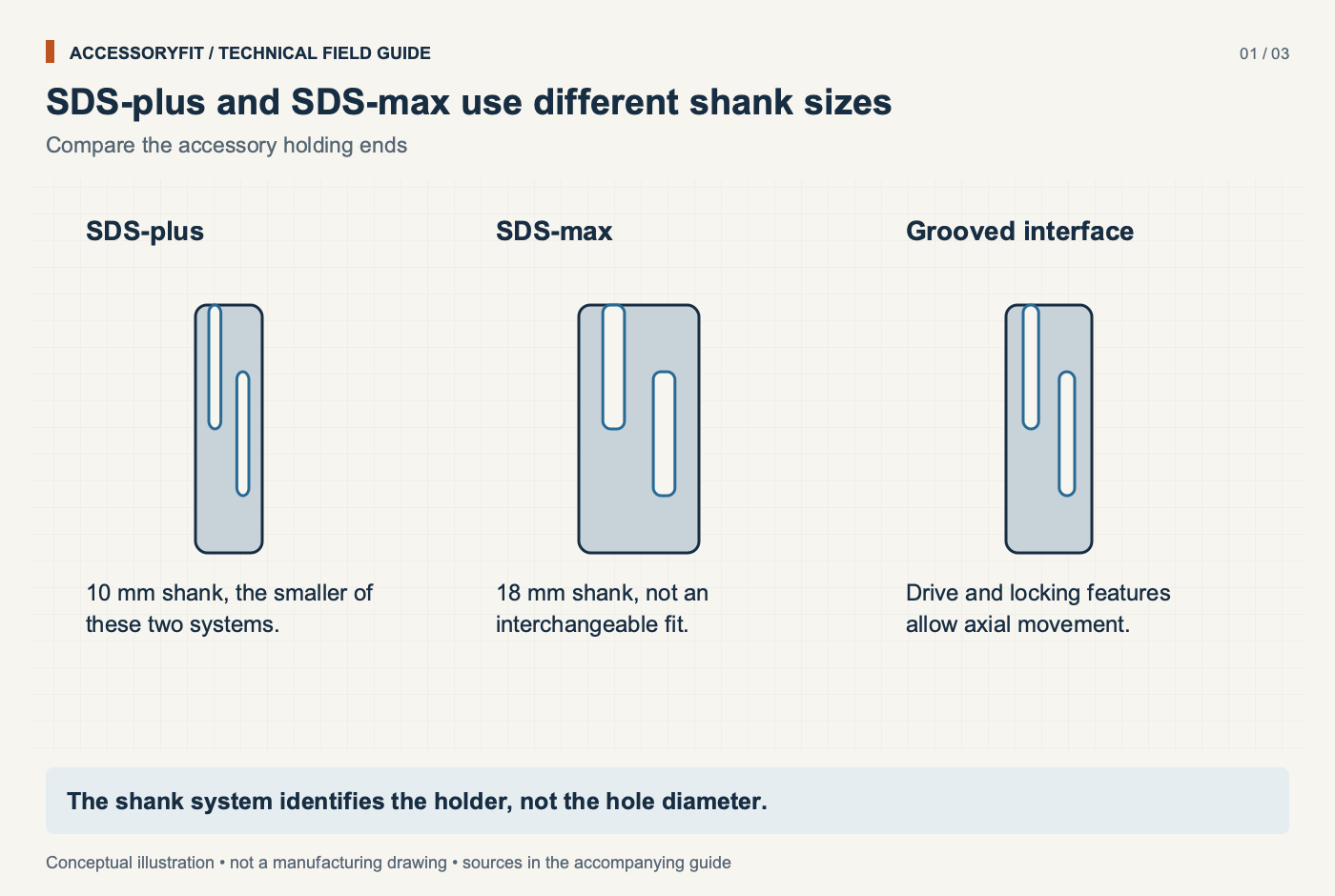
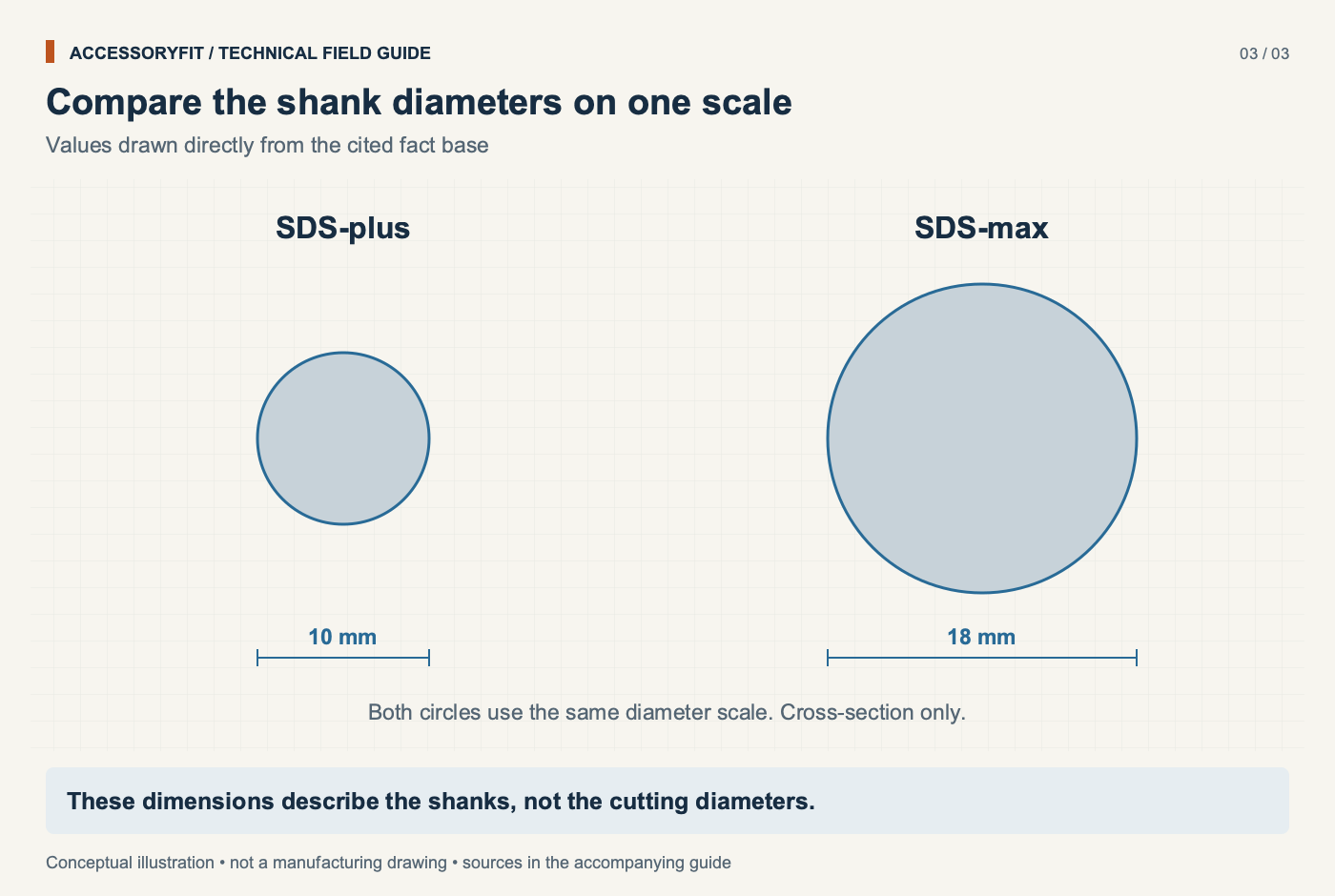
SDS-plus has a 10 mm shank with 2 open + 2 closed grooves; SDS-max has an 18 mm shank with 3 open grooves and a locking feature. Tanner Bolt, BAER and GTSE agree on both diameters.
The sources disagree on how SDS-max locks. Tanner Bolt describes extra closed grooves alongside the open ones; GTSE describes a locking segment instead. Either way, the open-groove layout and the larger diameter mean an SDS-max shank cannot enter an SDS-plus holder, and an SDS-plus shank is far too thin for an SDS-max holder to grip.
Brand naming adds one more label. Hilti calls its SDS-plus connection TE-C on its UK bit sets, so a Hilti bit marked that way fits SDS-plus hammers from other makers. A matching Hilti label for SDS-max was not confirmed on a Hilti page, so it is not given here.
| Attribute | SDS-plus | SDS-max |
|---|---|---|
| Shank diameter | 10 mm | 18 mm |
| Grooves | 2 open + 2 closed | 3 open, plus locking (sources differ) |
| Hammer class | Lighter hammers; Bosch GBH 2-28 F weighs 3.1 kg | About 5 kg and above |
| Example concrete range, hammer bits | 4 to 28 mm (Bosch GBH 2-28 F) | 12 to 40 mm (Bosch GBH 5-40 D) |
Which rotary hammers take SDS-plus and which take SDS-max?
Light and mid-size rotary hammers, corded and cordless, take SDS-plus; heavy rotary and demolition hammers of roughly the 5 kg class and up take SDS-max. BAER and GTSE both place SDS-max at that weight class, and Bosch's GBH 5-40 D SDS-max hammer is an example from it.
Every rotary hammer in the AccessoryFit tool database is an SDS-plus tool, from corded models by Bosch and Makita to cordless models on DeWalt's 20V MAX, Makita's 18V LXT and Milwaukee's M18 batteries. That reflects the tools in the database rather than the whole market, but it shows how widely one bit system spans brands and batteries. Batteries do not cross brands, but SDS-plus bits do, as the guide to which cordless batteries fit which tools explains from the battery side.
| Tool | Chuck type | No-load speed | Platform |
|---|---|---|---|
| Bosch GBH2-28L | SDS-Plus | 1230 rpm one source | not stated |
| DeWalt DCH273 | SDS-Plus | 1100 rpm | 20V MAX |
| Makita HR2641 | SDS-Plus | not stated | not stated |
| Makita XRH01Z | SDS-Plus | not stated | 18V LXT |
| Milwaukee 2912-20 | SDS-Plus | 1330 rpm | M18 |
Values marked one source appear in a single manufacturer document; check the tool's manual or rating plate before buying.
How long can you drill with a rotary hammer, and does pushing harder help?
Not long at a stretch, and no. UK HSE's 2019 hand-arm vibration guidance (L140) gives a good-quality modern rotary hammer about 15 minutes to reach the daily exposure action value, counting trigger time only, and about one hour to reach the exposure limit value. That applies to SDS-plus and SDS-max tools alike, so the choice of system does not buy extra trigger time; the bit and the technique are where you have control.
Leaning on the hammer works against you. A 2020 International Journal of Industrial Ergonomics test-bench study of one 10 kg rotary hammer drilling 19 mm holes in concrete found that 17% more concrete could be drilled per day within ISO 5349 vibration limits when the operator pushed with about 90 N rather than 160 N, because handle vibration fell and the time before the action limit grew. The authors advise a push force of about 90 to 100 N: enough to keep the bit seated, and no more. A sharp bit inside the hammer's rated range matters for the same reason.
Dust is the other cost of SDS drilling in concrete. A 2019 University of California, Berkeley test-bench study drilled concrete with a rotary hammer and found respirable quartz many times the ACGIH limit with no extraction; fitting either a drilling shroud or a hollow vacuum bit brought it below the detection level, a reduction of 98.7% or more. Both SDS-plus and SDS-max hollow bits and shrouds are sold, so either shank system can be paired with a vacuum.
What size holes does each system drill?
SDS-plus covers small and medium holes and SDS-max covers large ones, with an overlap in the middle. Bosch gives its SDS-plus GBH 2-28 F a concrete range of 4 to 28 mm with hammer bits, and its SDS-max GBH 5-40 D a range of 12 to 40 mm, with core cutters taking that hammer to larger holes still. Bosch rates the SDS-max example at 8.5 J of impact energy.
Sources do not agree on the upper limit of SDS-plus bits in general. BAER, GTSE and Tanner Bolt each give a slightly different top size, and Bosch's own figure for one hammer sits among them. The useful reading is that the hammer's own specification sets the limit, not the shank system: a light SDS-plus hammer may be rated for less than the largest SDS-plus bits on sale. Bosch's spec sheet also gives the GBH 2-28 F an optimum range well inside its maximum, which is worth checking on any hammer before buying large bits.
For general masonry, carbide-tipped bits are the norm, and common masonry bit sizes run across both systems. The shortlist of carbide masonry bits for concrete applies these shank rules to specific products.
| Model | Tool holder | Weight | Impact energy | Concrete, hammer bits |
|---|---|---|---|---|
| Bosch GBH 2-28 F | SDS plus | 3.1 kg (6.8 lb) | 3.2 J | 4-28 mm (optimum 8-16 mm) |
| Bosch GBH 5-40 D | SDS max | 6.8 kg (15.0 lb) | 8.5 J | 12-40 mm; core cutters 40-90 mm |
Pound conversions added.
Can SDS-max bits fit an SDS-plus hammer?
No. The shanks are 18 mm and 10 mm, and the two systems are not interchangeable in either direction without an adapter. A common belief is that the two are close enough to swap; GTSE and Tanner Bolt both say otherwise.
Adapters only work one way. GTSE notes that adapters let an SDS-max hammer take SDS-plus bits for lighter work, while the reverse is not practical. That suits a crew that owns one heavy hammer and wants to use its stock of smaller bits in it; it does not turn a light hammer into a heavy one.
Can a rotary hammer take ordinary drill bits or hex bits?
Yes, through an adapter, but only in rotation-only mode with the hammer action switched off. Bosch's HA3JAWC gives an SDS-plus hammer a 1/2 in keyless chuck for round-shank bits, and Makita's B-59259 lets an SDS-plus hammer drive 1/4 in hex bits. Makita, McMaster-Carr and Starrett all describe these adapters as rotation-only.
One source differs. Bosch's HA3JAWC page says the adapter can be used in hammer mode, which conflicts with Makita, McMaster-Carr and Starrett and may be a page error. The safer reading, and the one used on this page, is rotation only. A common belief is that a chuck adapter turns a rotary hammer into a hammer drill for round-shank masonry bits; the adapter makers describe it for rotation-only drilling with standard bits. Makita adds that its hex adapter has a short shank to help prevent damage if hammer mode is selected by mistake.
What modes does a rotary hammer have, and which one suits an adapter?
Milwaukee's manual for its SDS-plus rotary hammers lists 3 modes: rotation only, rotary hammer, and hammer only, and says to stop the motor before changing mode. Rotation only is the setting for adapters and for drilling steel or wood; rotary hammer is the setting for carbide masonry bits, which are normally run with hammer action. The same manual says Milwaukee's 2715-20 SDS-plus hammer needs its chuck adapter kit (48-66-1370) for drill-only work in steel and wood, which is the maker confirming the adapter route for round-shank bits rather than a bare SDS holder.
The opposite move, an SDS bit in a drill's jaw chuck, is not covered by any source used here. An SDS shank is designed to slide in an SDS holder rather than be clamped, so the bit belongs in an SDS tool. Chuck capacity and what a jaw chuck is made to hold are covered in the guide to bit shanks a drill chuck can hold.
Should you use an SDS hammer on tile?
Not with hammer action on glazed or porcelain tile. Bosch says to drill tile on the rotary setting only, Milwaukee rates its tile and glass bits for drill drivers only, and Makita says its tile bits are for a driver-drill. Diamond tile drills and diamond hole saws for porcelain, glass and stone must always be cooled with water, and glass bits run at low speed; neither is a job for hammer action.
The bits suited to that first step are compared in the guide to diamond and carbide bits for tile. A rotary hammer in rotation-only mode with a chuck adapter can drive such a bit, provided the bit maker's speed and cooling guidance is followed.
When does an SDS bit not fit or not work?
An SDS bit fails whenever the shank system, the hammer's rating or the mode is wrong for it. These are the cases in the sources on this page:
- SDS-max bit in an SDS-plus hammer. The shank is too large, and no practical adapter exists.
- SDS-plus bit in an SDS-max hammer without an adapter. The thinner shank cannot be held.
- Bit beyond the hammer's rated range. The hammer's spec, such as Bosch's for the GBH 2-28 F, sets the limit.
- Chuck or hex adapter used with hammer action on. The adapter can be damaged.
- Hammer action on tile or glass. These need diamond or glass bits at low speed, with water for diamond.
- Older or uncommon shank systems. Other shank systems, such as spline, exist on some heavy hammers, but their dimensions were confirmed by only one source and are not covered here.
How do you check which bits a rotary hammer takes?
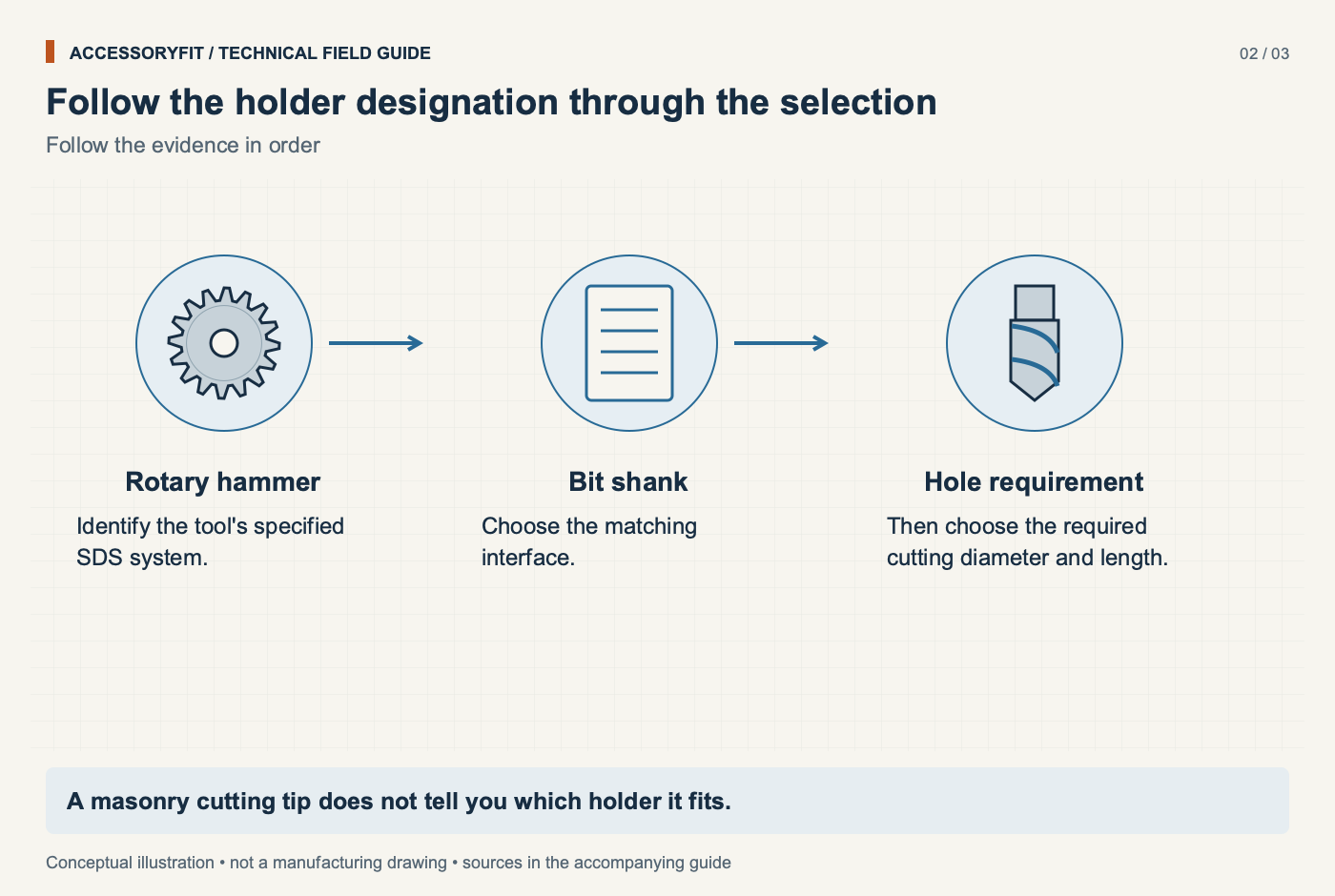
Four checks against the hammer and its manual confirm which bits it takes before buying a set.
- Read the tool holder on the hammer. The nameplate, manual or product page names the system, SDS-plus or SDS-max; Hilti uses its own label for SDS-plus.
- Check the rated drilling range. The manual or spec sheet gives the concrete range with hammer bits, and sometimes an optimum range inside it.
- Measure an old bit's shank if unsure. A shank near 10 mm is SDS-plus; one near 18 mm is SDS-max.
- Set the mode for adapters. When fitting a chuck or hex adapter, stop the motor and switch the hammer to rotation-only before drilling, as Milwaukee's manual describes for its mode selector.
Where do you go next for masonry bits?
With the shank system settled, the bit choice comes down to material and size. All drill bit guides are collected under drill bit fit and buying guides, and the guide to twist, masonry and specialty bits explains where SDS bits sit among the rest. For any specific hammer model, the model-by-model accessory lookup lists the bits that fit, and every other fit question is in the fit guides by tool.
Questions readers ask
Is SDS the same as SDS-plus?
In everyday use, an SDS bit usually means SDS-plus, the 10 mm shank system found on light and mid-size hammers. SDS-max is the larger 18 mm system and is always named in full.
Do SDS-plus bits fit all brands of SDS-plus hammer?
Yes. SDS-plus is a shared shank system, so DeWalt, Makita, Milwaukee, Bosch and Hilti TE-C bits all fit SDS-plus hammers whatever the brand.
Can I use SDS-plus bits in an SDS-max hammer?
Only with an SDS-max to SDS-plus adapter, which GTSE describes for lighter work. The reverse adapter is not practical.
Can a rotary hammer drill with hammer action through a chuck adapter?
No. Makita, McMaster-Carr and Starrett describe chuck and hex adapters as rotation-only. One Bosch page says otherwise, which appears to be an error.
Where to go next
- Masonry drill bits for concreteSDS-plus and round-shank picks.
- Drill chuck sizesWhat a jaw chuck can hold.
- Drill bit typesWhere masonry bits fit among the rest.
References 69 documents, 35 publishers
- ABCM, COBEM 2005 proceedings: Influence of the Lubri-Cooling System on the Life of TiAlN Coated HSS Twist Drills when Machining Blind and Through Holes
- Annals of Work Exposures and Health: The Effects of Bit Wear on Respirable Silica Dust, Noise and Productivity: A Hammer Drill Bench Study
- Applied Ergonomics (Elsevier): Pneumatic rock drill vs. electric rotary hammer drill: Productivity, vibration, dust, and noise when drilling into concrete
- BAER tools: What makes an SDS drill bit special
- BioResources: Effect of Chip Thickness and Tool Wear on Surface Roughness and Cutting Power during Up-Milling Wood of Different Density
- Bosch: GBH 2-28 F rotary hammer with SDS plus; GBH 5-40 D rotary hammer with SDS max; HA3JAWC 1/2 in SDS-plus Shank Keyless Chuck; Bits for drilling tiles (tile drilling guide); CYL-9 Soft Ceramic drill bit set 2 608 587 169; GBH2-28L SDS-plus Bulldog Xtreme Max 1-1/8 In. Rotary Hammer product page; GBH2-28L operating/safety instructions 2610047986; 1617/1618 router operating/safety instructions (2610051825)
- Colorado State University and Montana Technological University, Annals of Work Exposures and Health 67(5): The Evaluation of Worker Exposure to Airborne Silica Dust During Five OSHA Table I Construction Tasks
- DeWalt: DCH273B 20V MAX XR SDS PLUS Brushless 1 in L-Shape Rotary Hammer product page; DCH253/DCH273 Instruction Manual N439089; DWE575 circular saw instruction manual (N786997)
- Engineering ToolBox: Hardwood and Softwoods - Recommended Drill Bit Speeds
- European Parliament, Legislative Observatory (procedure 2016/0130(COD), final act summary): Protection of workers from exposure to carcinogens or mutagens at work: exposure limit values - Directive (EU) 2017/2398, final act
- Freud and Diablo: Get the most out of your Freud bits by routing at ideal feed rates and speeds
- GTSE (UK tool supplier): SDS Drill Bits Explained: Types and Sizes
- Health and Safety Executive (UK): Hand-arm vibration: The Control of Vibration at Work Regulations 2005. Guidance on Regulations (L140, Second edition); Wood dust exposures in manufacturing industries; EH40/2005 Workplace exposure limits (Fourth Edition 2020)
- Hilti UK: TE-C (SDS Plus) metric hammer drill bit set
- HomElectrical: Irwin 1/2 in Reduced Shank Silver & Deming HSS Drill Bits
- Human Factors and Ergonomics Society: Construction Ergonomics: Concrete Bit Wear Increases Handle Vibration and Drilling Time
- International Journal of Industrial Ergonomics (Elsevier): R2: Drilling into concrete: Effect of feed force on handle vibration and productivity
- Journal of Wood Science: Effect of tool material on tool wear and delamination during machining of particleboard
- Makita: B-59259 Adapter, SDS-PLUS to 1/4 in Hex; B-68959 1/4 in x 4 in Glass and Tile Bit, 3 Flat Shank; HR2641 1" SDS-PLUS AVT Rotary Hammer product page; HR2631F/HR2641 instruction manual; XRH01Z 18V LXT Brushless 1" SDS-PLUS Rotary Hammer (tool only) product page; XRH01/XRH02 instruction manual; 9557PB angle grinder instruction manual; 5007F 7-1/4 in circular saw instruction manual
- McMaster-Carr: Rotary-Hammer Chuck Adapters; Starrett 117A center punch (marking punches)
- Milwaukee Tool: Cat. No. 2715-20, 0757-20 operator's manual (58-14-0017); 1/4 in SHOCKWAVE Impact Duty RED HELIX Titanium Drill Bit 48-89-4613; 4PC Ceramic Tile & Glass Bit Set 48-20-8988; 2912-20 M18 FUEL 1 in SDS Plus Rotary Hammer product page; Operator's manual 58-14-0244d3 (Cat. No. 2912-20); M18 FUEL oscillating multi-tool 2836-20 operator's manual (58-14-0217d1)
- National Toxicology Program, US Department of Health and Human Services: Report on Carcinogens, Fifteenth Edition: Wood Dust
- NIOSH: Nonfatal Tool- or Equipment-Related Injuries Treated in US Emergency Departments Among Workers in the Construction Industry, 1998-2005; Nonfatal work-related injuries treated in hospital emergency departments in the U.S., 2012-2023; Comprehensive Report: Laboratory Evaluation of Saw Blades for Cutting Fiber-Cement Siding; Hazard Controls: Control of Wood Dust from Random Orbital Hand Sanders and Orbital Hand Sanders
- OSHA: Occupational Exposure to Respirable Crystalline Silica; Final Rule (29 CFR Parts 1910, 1915, and 1926); 29 CFR 1910.215 Abrasive wheel machinery; 29 CFR 1910.243 Guarding of portable powered tools; 29 CFR 1926.303 Abrasive wheels and tools; 29 CFR 1926.300 General requirements (Tools, hand and power); 29 CFR 1926.304 Woodworking tools
- Purdue University, Journal of Occupational and Environmental Hygiene: Evaluation of Cut-Off Saw Exposure Control Methods for Respirable Dust and Crystalline Silica in Roadway Construction
- Stanley Black & Decker (IRWIN, LENOX): IRWIN 29-pc Cobalt M-35 Metal Index Drill Bit Set 3018002; Left-hand mechanics length cobalt alloy high speed steel drill bit sets
- Starrett: Saws & Hand Tools Catalogue 71E (hole saws, arbors, drill bits)
- Tanner Bolt & Nut: Chuck Systems, Drill Bits and Shanks for Rotary Hammer Drills
- Technical University in Zvolen, MM Science Journal: Effect of Selected Factors on Mass Concentration of Airborne Dust During Wood Sanding
- Tribology in Industry: Comparison of Wear Behaviours of Cathodic Arc TiN, TiAlN Coated and Uncoated Twist Drills Under Aggressive Machining Conditions
- University of California, Berkeley, Journal of Occupational and Environmental Hygiene 16(5): Effect of hollow bit local exhaust ventilation on respirable quartz dust concentrations during concrete drilling
- University of Massachusetts Lowell, Journal of Occupational and Environmental Hygiene: Reducing Silica and Dust Exposures in Construction During Use of Powered Concrete-Cutting Hand Tools: Efficacy of Local Exhaust Ventilation on Hammer Drills
- US Government Publishing Office, Electronic Code of Federal Regulations: 29 CFR 1926.1153 Respirable crystalline silica (current eCFR text)
- Virginia Tech, Annals of Work Exposures and Health 69(3): Silica exposure controls usage in masonry and concrete trades: before and after enactment of the OSHA Silica Construction Rule (1926.1153)
- Wikipedia: Drill bit; High-speed steel
Accessed .