
Size chart · Hole saws
Hole saw size chart: matching hole diameters to pipe, conduit, locks and arbors
Choose a hole saw by the outside diameter of whatever passes through the hole, never by its nominal name. A door lockset needs a 2-1/8 in bore through the face and a 1 in latch hole in the edge. Pipe and conduit are named by trade size, so read the outside diameter or knockout size from the tables below and pick a saw slightly larger. Small saws (9/16 to 1-3/16 in) take a small-thread arbor and larger ones (1-1/4 and larger in) a large-thread arbor.
By AccessoryFit editors · Checked
On this page
- What does a hole saw size measure?
- Which hole saw size clears a steel pipe?
- Which hole saw size clears copper tube?
- What size hole does Schedule 40 PVC pipe need?
- What hole size does each conduit trade size need?
- What size hole saw do you need for a door lock?
- What size hole saw do recessed lights need?
- Which arbor fits which hole saw size?
- How deep can each type of hole saw cut?
- What speed should a hole saw run at?
- Do diamond hole saws follow the same speeds?
- How do you read the chart for a real job?
- Which hole saw sizing assumptions are wrong?
- When is a hole saw the wrong tool?
- How does hole saw sizing relate to drill and tap sizes?
What does a hole saw size measure?
A hole saw size is the diameter of the finished hole, measured across the tips of the teeth. The saw is a cup that removes only a thin ring of material and leaves a solid core behind, and it turns on an arbor (also called a mandrel) that carries a pilot drill in the centre to keep the cut located.
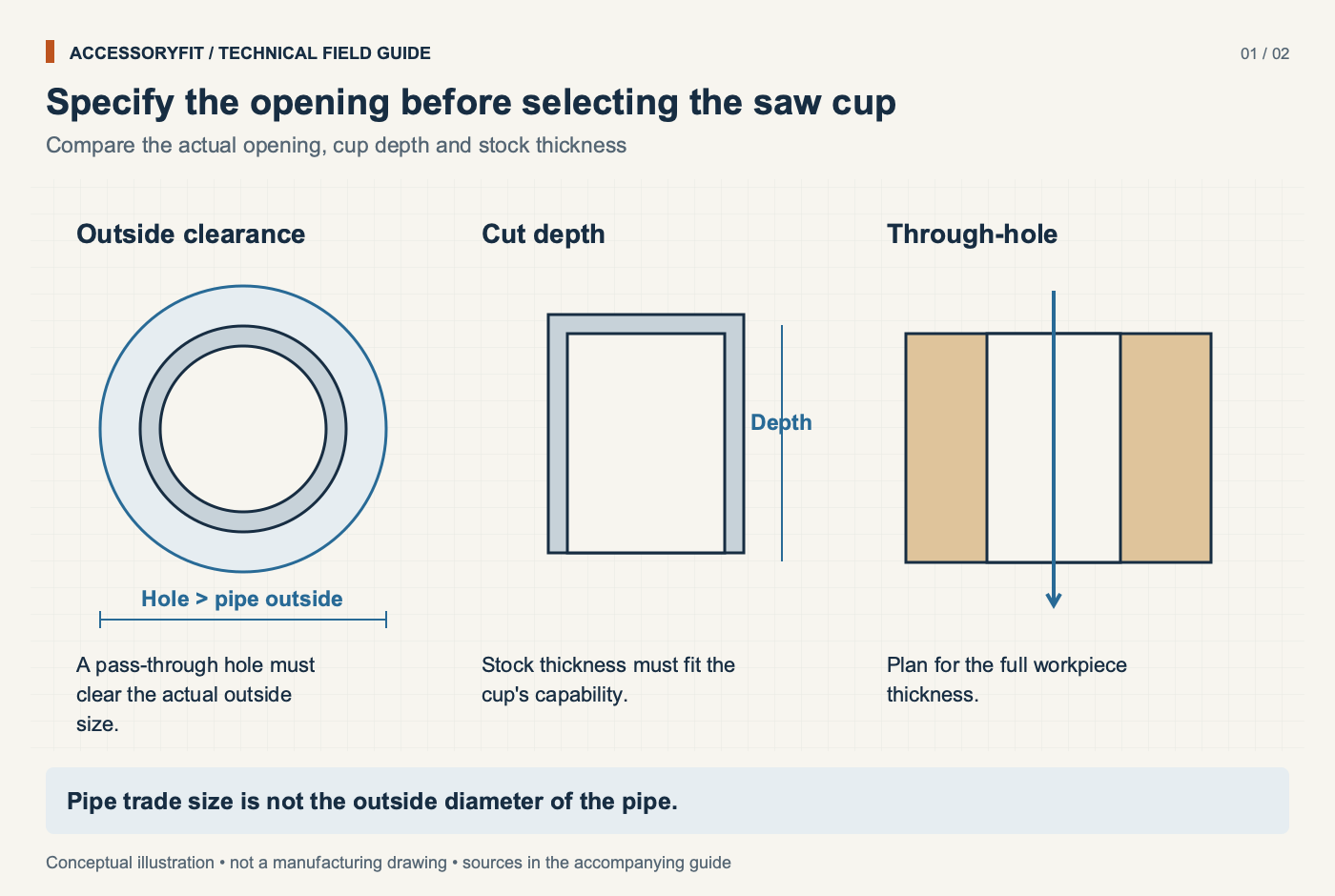
Because the size names the hole and not the part going through it, almost every sizing mistake comes from the same place: a plumbing or electrical part is called by a trade size that is smaller than its real outside diameter. A pipe sold as half-inch is not half an inch across, and the knockout for half-inch conduit is not half an inch either. The charts on this page translate those trade names into real diameters so you can pick the saw from a measurement, not a label. US hole saws are sold in fractional inch sizes and European ranges such as Starrett's UK catalogue are listed in millimetres as well, so each table carries both where the source gives them.
Which hole saw size clears a steel pipe?
Any saw larger than the pipe's outside diameter clears it, and the table gives that diameter for each nominal pipe size. Nominal pipe size (NPS) is a name, not a measurement: below the larger sizes the real outside diameter is noticeably bigger than the number in the name. Engineering ToolBox notes that the outside diameter stays the same for every schedule of a given NPS, because heavier schedules add wall thickness on the inside. That makes the outside diameter a stable figure to size a pass-through hole from, whether the pipe is thin-wall or heavy.
| Nominal pipe size | Outside diameter |
|---|---|
| 1/8 in NPS | 0.405 in (10.3 mm) |
| 1/4 in NPS | 0.540 in (13.7 mm) |
| 3/8 in NPS | 0.675 in (17.1 mm) |
| 1/2 in NPS | 0.840 in (21.3 mm) |
| 3/4 in NPS | 1.050 in (26.7 mm) |
| 1 in NPS | 1.315 in (33.4 mm) |
| 1 1/4 in NPS | 1.660 in (42.2 mm) |
| 1 1/2 in NPS | 1.900 in (48.3 mm) |
| 2 in NPS | 2.375 in (60.3 mm) |
| 2 1/2 in NPS | 2.875 in (73.0 mm) |
| 3 in NPS | 3.500 in (88.9 mm) |
| 3 1/2 in NPS | 4.000 in (101.6 mm) |
| 4 in NPS | 4.500 in (114.3 mm) |
| 5 in NPS | 5.563 in (141.3 mm) |
| 6 in NPS | 6.625 in (168.3 mm) |
Single source. OD is the same across schedules for a given NPS. Allow clearance when choosing a hole saw.
Which hole saw size clears copper tube?
Pick a saw just larger than the tube's outside diameter, which for copper water tube is easy to work out: Engineering ToolBox's ASTM B88 table gives an outside diameter of nominal + 1/8 in, so half-inch tube is five-eighths of an inch across. Types K, L and M share the same outside diameter and differ only in wall thickness, so the type stamped on the tube does not change the hole. The table below lists each nominal size with its outside diameter in inches and millimetres.
Copper is a different series from steel pipe, so do not read a copper size from the steel table. The steel and PVC tables share their outside diameters with each other, but copper tube of the same nominal name is smaller. Allow some clearance above the listed diameter for insulation, a grommet or a slightly off-line run.
| Nominal size | Outside diameter |
|---|---|
| 1/4 in | 3/8 in (0.375 in, 9.5 mm) |
| 3/8 in | 1/2 in (0.500 in, 12.7 mm) |
| 1/2 in | 5/8 in (0.625 in, 15.9 mm) |
| 5/8 in | 3/4 in (0.750 in, 19.1 mm) |
| 3/4 in | 7/8 in (0.875 in, 22.2 mm) |
| 1 in | 1-1/8 in (1.125 in, 28.6 mm) |
| 1-1/4 in | 1-3/8 in (1.375 in, 34.9 mm) |
| 1-1/2 in | 1-5/8 in (1.625 in, 41.3 mm) |
| 2 in | 2-1/8 in (2.125 in, 54.0 mm) |
| 2-1/2 in | 2-5/8 in (2.625 in, 66.7 mm) |
| 3 in | 3-1/8 in (3.125 in, 79.4 mm) |
| 4 in | 4-1/8 in (4.125 in, 104.8 mm) |
Single source; same OD for types K, L and M (wall thickness differs). mm values calculated. Allow clearance when picking a hole saw.
What size hole does Schedule 40 PVC pipe need?
Schedule 40 PVC uses the same outside diameters as steel pipe of the same nominal size, so half-inch PVC measures 0.840 in across, the same as half-inch steel pipe. Engineering ToolBox's ASTM D1785 table and Finolex's Schedule 40 data agree on that figure. The table below gives the outside diameter for each common size; choose the next hole saw above the listed figure.
Most rows are confirmed by both sources. The rows for one-and-a-quarter, two and three-inch pipe come from Engineering ToolBox alone, as the table note says, so measure the pipe if the fit is tight.
| Nominal size | Outside diameter |
|---|---|
| 1/2 in | 0.840 in (21.3 mm) |
| 3/4 in | 1.050 in (26.7 mm) |
| 1 in | 1.315 in (33.4 mm) |
| 1-1/4 in | 1.660 in (42.2 mm) |
| 1-1/2 in | 1.900 in (48.3 mm) |
| 2 in | 2.375 in (60.3 mm) |
| 3 in | 3.500 in (88.9 mm) |
| 4 in | 4.500 in (114.3 mm) |
Finolex confirms 1/2, 3/4, 1, 1-1/2 and 4 in; other rows Engineering ToolBox only. Same ODs as steel pipe of the same NPS (see steel_pipe_od).
What hole size does each conduit trade size need?
Electrical conduit passes through a knockout hole sized for its fitting, and Klein Tools lists those knockout diameters for its punches and dies: 0.875 in for half-inch trade size, 1.115 in for three-quarter EMT and 1.362 in for one-inch conduit. The full Klein list is below. These are single-source figures from one manufacturer's catalogue, so treat them as a reference for the hole a fitting expects rather than a code requirement.
This page deliberately does not pair each knockout with a specific hole saw. Fractional hole saw sizes that sit close to these knockout diameters are widely quoted online, but no manufacturer page we consulted confirmed the pairings, so they are left out. Compare the knockout diameter with the saw sizes you own or plan to buy, and confirm against the fitting maker's instructions.
| Conduit trade size | Knockout hole | Klein part |
|---|---|---|
| 1/2 in | 0.875 in (22.2 mm) | 53820 die |
| 3/4 in | 1.115 in (28.3 mm) | 53828 die |
| 1 in | 1.362 in (34.6 mm) | 53837 punch |
| 1-1/4 in | 1.701 in (43.2 mm) | 53850 die |
| 1-1/2 in | 1.951 in (49.6 mm) | 53858 die |
| 2 in | 2.416 in (61.4 mm) | 53868 die |
Single source. Which hole saw to use for each knockout was not confirmed on a fetched page (see unverified_fields).
What size hole saw do you need for a door lock?
A standard door lockset needs a 2-1/8 in hole through the face of the door and a 1 in hole into the edge for the latch. These two sizes are the most-searched hole saw sizes for a reason: almost every residential knob or lever installation in North America uses them.
Two more measurements decide whether the lock will fit. Kwikset's instructions mark the centre of the face bore at a backset of 2-3/8 or 2-3/4 in from the door edge, and lockset jigs are set for one or the other, so check which backset the latch is built for before drilling. Schlage states that its standard knob and lever preparation fits doors 1-3/8 to 1-3/4 in thick; a thinner or thicker door needs a different kit.
What size hole saw do recessed lights need?
The cut-out depends on the light housing, so use the size printed on the housing or its template rather than a general chart. Published cut-out figures for popular housings disagree between retailers, so this page does not list them. What can be stated is the range an adjustable cutter covers: Milwaukee lists its adjustable recessed-light hole cutter as cutting 2 to 7 in holes in drywall and ceiling tile, set in small steps, which takes in the common downlight sizes without buying one fixed saw per housing.
Ceiling work brings the core-ejection warning below into play, because the cut piece falls towards you. Wear eye protection and let the core drop clear rather than reaching under the saw.
Which arbor fits which hole saw size?
Small hole saws, from 9/16 to 1-3/16 in, screw onto a small-thread arbor with a 1/2–20 thread; larger saws (1-1/4 and larger in) need a large-thread arbor. Milwaukee and Starrett both draw the line at the same diameter. Milwaukee's large-thread adapter is listed with a 5/8–18 thread; that figure comes from Milwaukee's own product page and was not confirmed by a second maker, so check the arbor packaging if you mix brands.
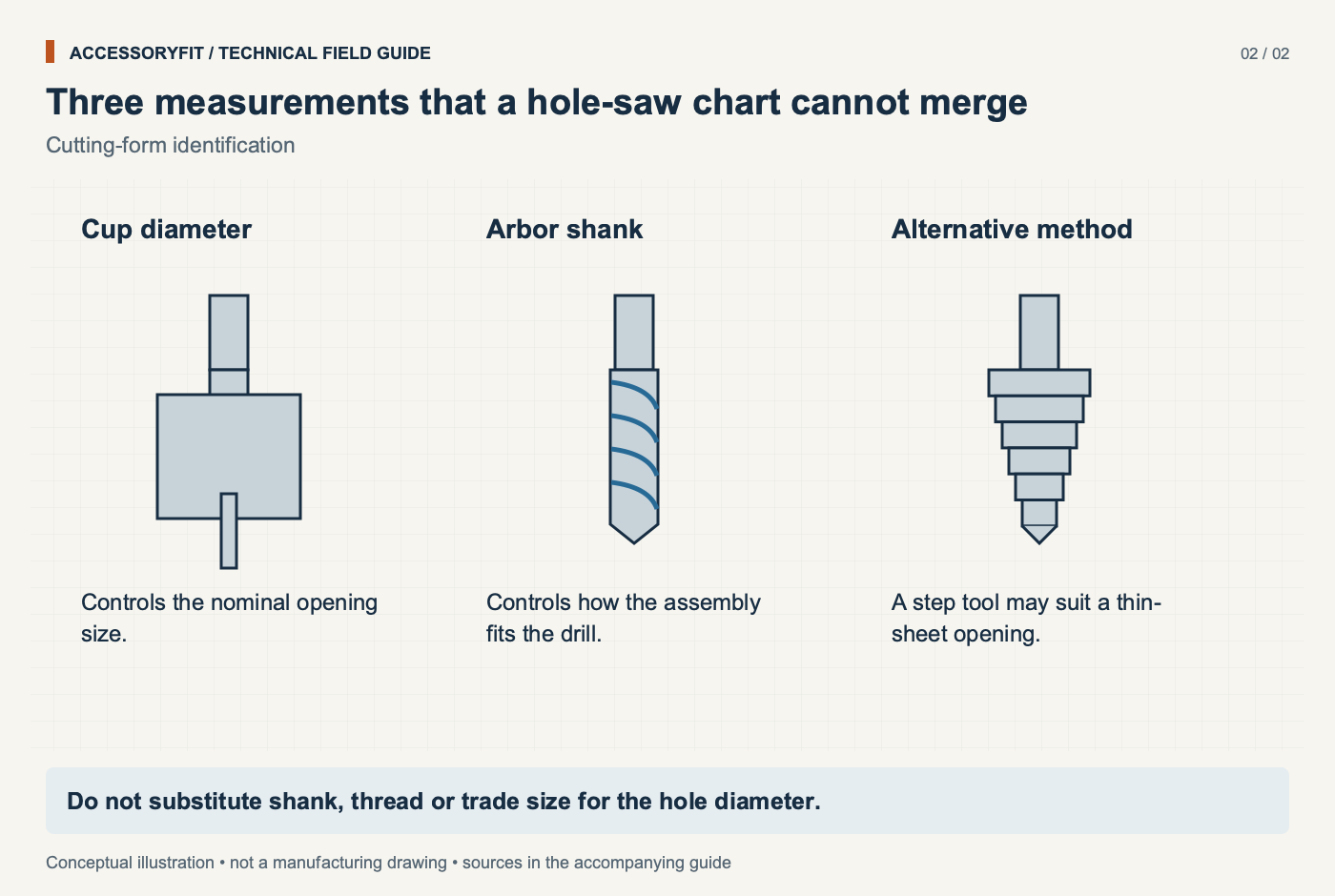
The arbor's shank decides which drill it fits. Milwaukee states that 3/8 in hex-shank arbors fit drills with a chuck of that size or larger, while its larger hex-shank arbors need a half-inch chuck. Starrett lists metric hex shanks across flats, as the table shows. The pilot drill is a separate part: Milwaukee's arbor set uses a 1/4 in high-speed steel pilot bit, and its pilot bits come in 3-1/2 or 4 in lengths. The steel pilot is the weak point in abrasive work, and Milwaukee says to fit its carbide-tipped pilot bit when running carbide-grit hole saws in ceramic tile, brick and similar materials. The guide to chuck capacity by drill explains how chuck size limits the shank you can fit.
| Hole saw diameter | Arbor type | Thread | Arbor shank options |
|---|---|---|---|
| 9/16 - 1-3/16 in (14-30 mm) | small-thread arbor | 1/2-20 | 3/8 in hex, 7/16 in hex (Milwaukee); 8.75 mm (11/32 in) or 6.5 mm (1/4 in) hex (Starrett) |
| 1-1/4 in (32 mm) and larger | large-thread arbor | 5/8-18 (Milwaukee large thread adapter, 1-1/4 to 2 in) | 3/8 in or 7/16 in hex (Milwaukee); 11 mm (7/16 in) or 8.75 mm (11/32 in) hex (Starrett) |
The large-thread size is single-source (Milwaukee). Starrett shank sizes are hex across flats as printed.
How deep can each type of hole saw cut?
A standard bi-metal hole saw cuts about 1-5/8 in deep before the material reaches the back of the cup. Starrett's deep-cut bi-metal saws reach about 2 in and, according to Starrett, need an arbor with an extended pilot drill so the pilot still reaches the work. Material thicker than the saw's depth has to be cut from both sides or cleared in stages, removing the core between passes.
Tooth material decides what the saw can cut. Bi-metal saws, with high-speed or cobalt high-speed steel teeth, cut metal + general materials, including stainless sheet. Starrett describes its carbide-tipped multi-purpose saws as made for non-metallics such as wood, MDF, plasterboard, plastics and ceramic tile, and says they cut faster than bi-metal there. Starrett's diamond-grit saws are for glass, tile, stone. Starrett's own diamond page gives two different depths, one in its specification box and another in its features list, so the table shows both rather than picking one.
| Type | Best for | Cutting depth |
|---|---|---|
| Bi-metal fast cut (FCH) | metals incl. stainless sheet; also wood, plastic | 41 mm (1-5/8 in) |
| Bi-metal deep cut (DCH) | metal and thicker material | 51 mm (2 in) |
| Carbide-tipped multi-purpose (MPH) | wood, MDF, plastics, plasterboard, ceramic tile | 54 mm (2-1/8 in) |
| Diamond grit (D) | glass, ceramic, porcelain, stone | 38 mm (1-1/2 in) per features list; 41 mm in spec box |
Starrett's diamond page gives both 38 mm and 41 mm (see conflicts).
What speed should a hole saw run at?
Speed falls as diameter rises: a large hole saw's teeth travel much further per revolution than a small one's, so Starrett's chart cuts the RPM sharply for each larger band and for harder metals. Stainless and tool steel get the lowest figures in every size band, brass, copper and aluminium the highest of the metals. Each cell is a range running from the small end of the diameter band to the large end, so a saw near the top of a band should run near the lower figure.
| Saw diameter | Mild steel | Stainless & tool steel | Cast iron | Brass, copper, aluminium | Wood & plastic |
|---|---|---|---|---|---|
| 9/16 - 1 in (14-25 mm) | 580-350 | 300-175 | 400-235 | 790-470 | 800-500 |
| 1-1/16 - 2 in (27-51 mm) | 325-170 | 160-85 | 215-115 | 435-230 | 500-200 |
| 2-1/16 - 3 in (52-76 mm) | 165-115 | 80-55 | 110-75 | 220-150 | 200-150 |
| 3-1/8 - 4 in (79-102 mm) | 110-85 | 55-40 | 70-55 | 140-110 | 150-100 |
| 4-1/8 - 5 in (105-127 mm) | 80-65 | 40-30 | 55-25 | 110-85 | 100-85 |
| 5-1/4 - 6 in (133-152 mm) | 55 | 25 | 55-25 | 75 | 75 |
| 6-5/16 - 8-9/32 in (160-210 mm) | 40 | 20 | 55-25 | 60 | 60 |
Starrett FCH and DCH hole saws, catalogue p.24. Ranges run from the small to the large end of each diameter band.
Do diamond hole saws follow the same speeds?
No, diamond-grit saws have their own minimum and maximum speeds, and Starrett says they must be cooled with water throughout the cut. The diamond chart uses wider diameter bands than the bi-metal chart, so look up the band your saw falls in rather than reading across from the table above.
| Saw diameter | Minimum | Maximum |
|---|---|---|
| 9/16 - 1 in (14-25 mm) | 500 | 1000 |
| 1-1/16 - 2 in (27-51 mm) | 250 | 500 |
| 2-1/16 - 3-1/4 in (52-83 mm) | 150 | 300 |
| 3-3/8 - 6 in (86-152 mm) | 100 | 200 |
Use water cooling.
How do you read the chart for a real job?
Start from the part, find its real diameter, then choose the smallest saw that is larger. Suppose a one-inch steel pipe has to pass through a stud wall. The 1 in NPS row of the pipe table shows an outside diameter well above one inch, and above even the smallest saw in the large-thread range (1-1/4 and larger in), so that saw is too small even though the pipe's name suggests a one-inch hole would do. The answer is the next saw size that clears the listed diameter, and it needs the large-thread arbor from the arbor table.
Now check depth and speed. A stud is thicker than the standard bi-metal depth of 1-5/8 in, so plan to cut from both faces or clear the core part way through. For a cut in wood, read the wood and plastic column of the bi-metal speed table in the band your saw falls in. If the same saw later goes through steel, drop to the mild steel column; the range for steel is a fraction of the range for wood in the same band.
The same steps work in metric. Read the millimetre value from the pipe table, compare it with the millimetre size marked on a European hole saw, and pick the next size up.
Which hole saw sizing assumptions are wrong?
Two assumptions cause most wrong purchases. The first is that any arbor fits any hole saw. It does not: saws up to the top of the small range need the small-thread arbor, and larger saws (1-1/4 and larger in) need the large-thread one. Many kits ship both, or an arbor with a screw-on adapter, and a single saw bought separately may need an arbor you do not own.
The second is that a conduit or pipe hole matches the trade size. Trade size is nominal; the knockout for half-inch conduit is 0.875 in, and the real outside diameter of a steel pipe is larger than its name for every size in the table. A saw chosen by the name alone will be too small.
When is a hole saw the wrong tool?
A hole saw is the wrong choice when the hole is small, blind, or in a material its teeth are not made for. These cases come up often:
- Small holes in thin sheet. Below the smallest saw sizes, or when you need several sizes in a panel, one stepped cone does the work of many saws. The step drill bits buyer guide compares the common models.
- Flat-bottomed or overlapping holes in wood. A hole saw leaves a ring and needs a pilot hole, so it cannot make a clean blind recess. A Forstner bit can, as the comparison of Forstner, spade and auger bits explains.
- Tile, glass and stone. Bi-metal teeth dull at once on these materials. Use a diamond saw with water, or a tile bit for smaller holes.
- The drill cannot hold the arbor. A larger hex shank needs a half-inch chuck; an impact driver with a quick-change holder is not a substitute for a drill on large saws.
Thick stock is the fifth case: once the work is deeper than the cup, the core jams and the saw stops cutting, so a deep-cut saw or a two-sided cut is needed.
Questions readers ask
What size hole saw do I need for a door knob?
A 2-1/8 in saw for the face bore and a 1 in bit or saw for the latch hole in the door edge. Check the backset, 2-3/8 or 2-3/4 in, before marking the centre.
What thread does a small hole saw arbor use?
Small-thread arbors use 1/2–20 and fit saws from 9/16 to 1-3/16 in. Larger saws screw onto a large-thread arbor.
Is the hole for half-inch conduit half an inch across?
No. Klein Tools lists the knockout for half-inch trade-size conduit as 0.875 in. Trade sizes are names, not diameters.
Can I use a hole saw in an SDS-plus rotary hammer?
Only with an SDS-plus arbor and the hammer off, according to Starrett.
How thick a board can a standard hole saw cut in one pass?
About 1-5/8 in for a standard bi-metal saw. Thicker stock needs a deep-cut saw, which Starrett rates at about 2 in, or cutting from both sides.
Where to go next
- Hole saw kitsSets compared by trade, size range and arbor type.
- Drill bit size chartTwist drill sizes below the hole saw range, in inch and mm.
- Step drill bitsOne bit for many small holes in sheet metal and panels.
References 14 documents, 7 publishers
- Engineering ToolBox: Steel Pipe Dimensions (ANSI schedule 40 and 80); ASTM B88 seamless copper water tubes - dimensions; ASTM D1785 and ASTM F441 - PVC and CPVC pipes schedule 40 and 80
- Finolex Industries: ASTM PVC-U pipes schedule 40 (ASTM D1785)
- Klein Tools: 53828 1.115-Inch Knockout Die for 3/4-Inch Conduit (with related knockout punch/die listings)
- Kwikset: 138 Installation Kit instructions (door boring jig)
- Milwaukee Tool: HOLE DOZER Door Lock Installation Hole Saw Kit 49-22-4063; Small Thread Arbor 3/8 in Shank 49-56-7010; Large Thread Quick Change Arbor 7/16 in Shank 49-56-7240; 5PC 3/8 in QUIK-LOK Arbor Set 49-56-7545; Hole saw arbor assembly instructions (49-56-9100, 49-56-7250, 49-56-7010, 49-56-6560); 2019 Accessory Catalog
- Schlage (Allegion): Generic door prep, knob/lever, no holes (115799)
- Starrett: Saws & Hand Tools Catalogue 71E (hole saws, arbors, drill bits)
Accessed .