
Reference chart · Wood screws
Screw pilot hole size chart: drill sizes by screw gauge and wood type
For a #8 wood screw, WOOD Magazine's chart gives a 7/64 in pilot hole in hardwood and 3/32 in in softwood, with a 5/32 in shank hole through the top board. For a #10 screw in hardwood the pilot is 1/8 in. Hardwood always takes the larger pilot of the two. The tables below give pilot, shank and head-bore sizes for gauges #2 to #14, with millimetre conversions, a second chart for comparison and metric pre-drilling figures from European screw makers.
By AccessoryFit editors · Checked
On this page
- What are pilot, shank and head-bore holes?
- Pilot hole chart for traditional tapered wood screws
- Which pilot holes suit modern straight-shank screws?
- Why do pilot hole charts give different sizes?
- How do you use the chart to join two boards?
- What size pilot hole do metric wood screws need?
- Do you always need a pilot hole?
- Drill bit vs screw bit: what is the difference?
- Which drill bit removes a stripped screw?
- How do you drill out a stripped screw with an extractor?
- When doesn't a pilot hole chart help?
- Which other charts and guides go with this one?
What are pilot, shank and head-bore holes?
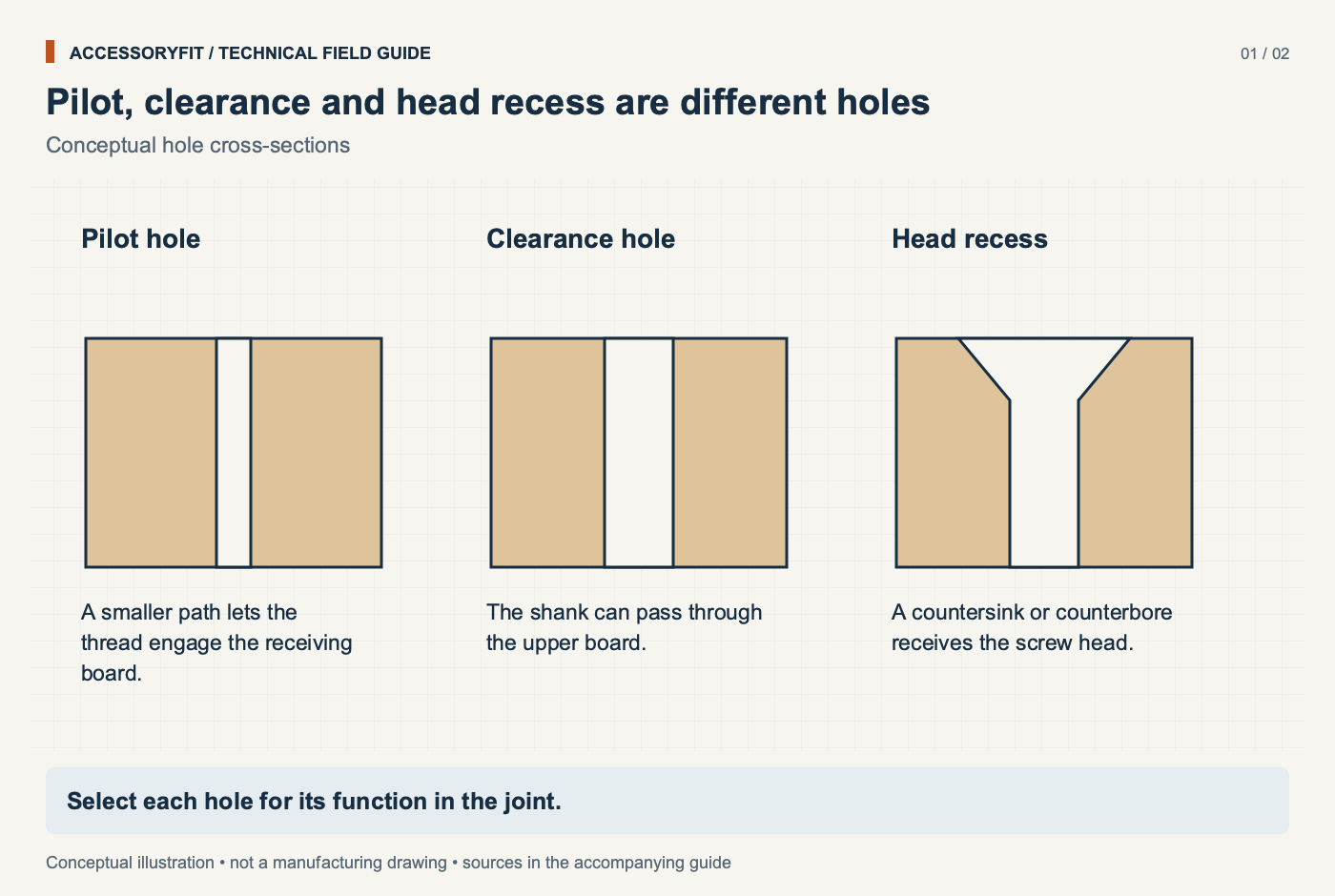
A screwed wood joint can use up to three holes, each with a different job. The pilot hole is the small hole in the lower board that the screw threads bite into; it lets the screw drive straight without splitting the wood. The shank or clearance hole goes through the top board and is wide enough for the screw to slide through, so the threads grip only the lower board and pull the two pieces tight together. The head bore, or countersink, lets the head sit flush with the surface.
RS Components says a pilot hole prevents splitting or cracking as the screw goes in, and notes that it matters most in dense timber such as oak. In every chart consulted for this page, hardwood takes a larger pilot than softwood for the same screw.
Pilot hole chart for traditional tapered wood screws
This is WOOD Magazine's chart for traditional wood screws, the kind with a tapered thread and a plain shank under the head. Find the screw gauge in the first column and read across for the pilot hole in hardwood or softwood, the shank hole for the top board and the head bore. The millimetre values are conversions rounded to a tenth of a millimetre, which is close enough to choose the nearest metric bit. Gauges #11 and #13 are not on the chart.
| Gauge | Pilot, hardwood | Pilot, softwood | Shank (clearance) hole | Head bore |
|---|---|---|---|---|
| #2 | 1/16 in (1.6 mm) | 1/16 in (1.6 mm) | 3/32 in (2.4 mm) | 11/64 in (4.4 mm) |
| #3 | 1/16 in (1.6 mm) | 1/16 in (1.6 mm) | 7/64 in (2.8 mm) | 13/64 in (5.2 mm) |
| #4 | 5/64 in (2.0 mm) | 1/16 in (1.6 mm) | 7/64 in (2.8 mm) | 15/64 in (6.0 mm) |
| #5 | 5/64 in (2.0 mm) | 1/16 in (1.6 mm) | 1/8 in (3.2 mm) | 1/4 in (6.3 mm) |
| #6 | 3/32 in (2.4 mm) | 5/64 in (2.0 mm) | 9/64 in (3.6 mm) | 9/32 in (7.1 mm) |
| #7 | 7/64 in (2.8 mm) | 3/32 in (2.4 mm) | 5/32 in (4.0 mm) | 5/16 in (7.9 mm) |
| #8 | 7/64 in (2.8 mm) | 3/32 in (2.4 mm) | 5/32 in (4.0 mm) | 11/32 in (8.7 mm) |
| #9 | 1/8 in (3.2 mm) | 7/64 in (2.8 mm) | 11/64 in (4.4 mm) | 23/64 in (9.1 mm) |
| #10 | 1/8 in (3.2 mm) | 7/64 in (2.8 mm) | 3/16 in (4.8 mm) | 25/64 in (9.9 mm) |
| #12 | 9/64 in (3.6 mm) | 1/8 in (3.2 mm) | 7/32 in (5.6 mm) | 7/16 in (11.1 mm) |
| #14 | 5/32 in (4.0 mm) | 9/64 in (3.6 mm) | 1/4 in (6.3 mm) | 1/2 in (12.7 mm) |
WOOD Magazine chart. mm values are conversions rounded to 0.1 mm. #11 and #13 not listed.
Which pilot holes suit modern straight-shank screws?
Modern production screws, the straight-shank type sold for general woodworking and cabinet work, take slightly larger pilots than traditional screws of the same gauge in WOOD Magazine's chart. For these screws WOOD Magazine sets the shank hole equal to the pilot hole, so there is no separate clearance column.
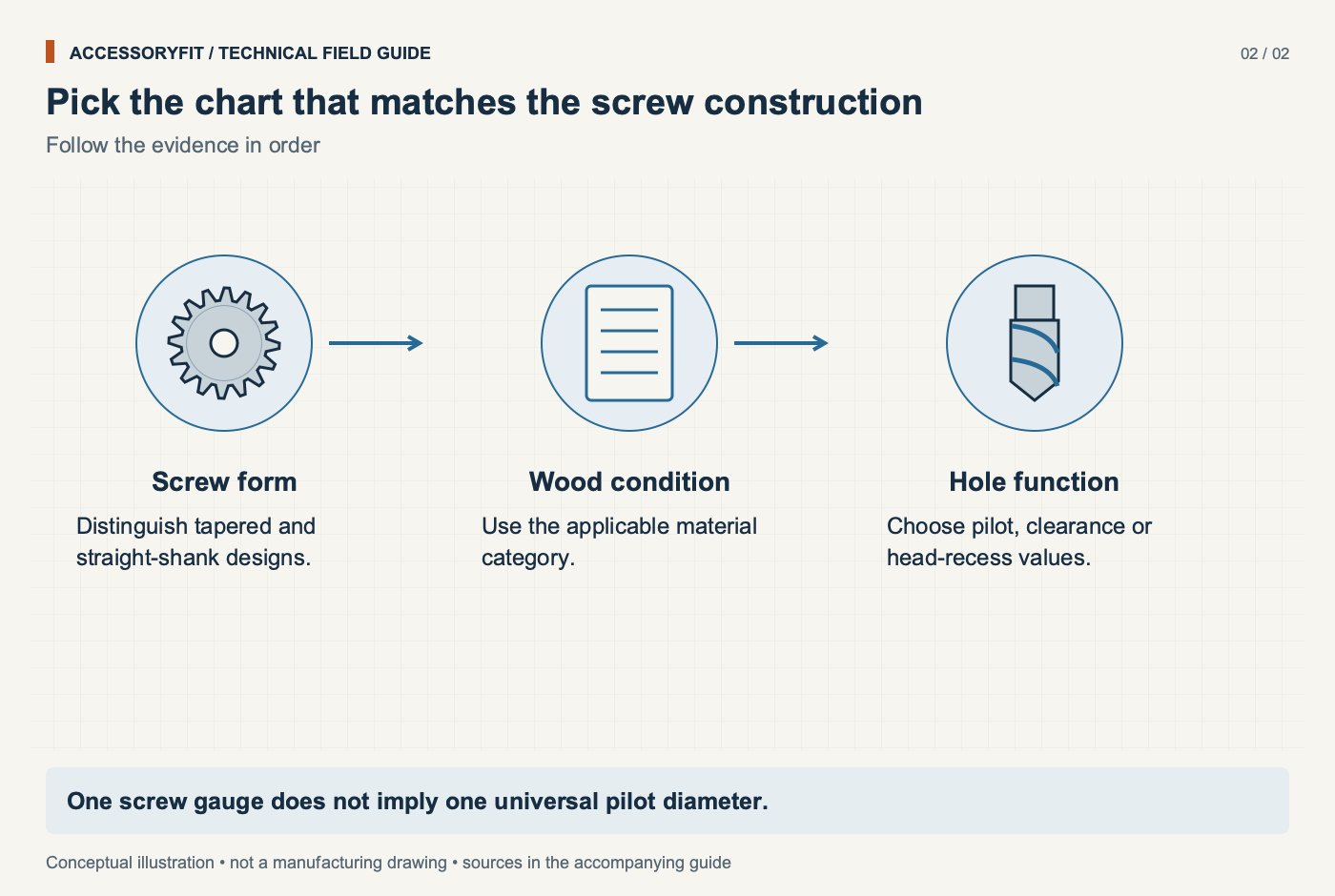
Check the shape of the screw before choosing a table. If the shank under the head is parallel rather than tapered, use the table below; if it narrows towards the point, the traditional chart above applies.
| Gauge | Pilot, hardwood | Pilot, softwood | Head bore |
|---|---|---|---|
| #4 | 5/64 in (2.0 mm) | 1/16 in (1.6 mm) | 7/32 in (5.6 mm) |
| #6 | 7/64 in (2.8 mm) | 3/32 in (2.4 mm) | 17/64 in (6.7 mm) |
| #8 | 1/8 in (3.2 mm) | 7/64 in (2.8 mm) | 11/32 in (8.7 mm) |
| #10 | 9/64 in (3.6 mm) | 1/8 in (3.2 mm) | 23/64 in (9.1 mm) |
| #12 | 5/32 in (4.0 mm) | 9/64 in (3.6 mm) | 7/16 in (11.1 mm) |
| #14 | 3/16 in (4.8 mm) | 5/32 in (4.0 mm) | 1/2 in (12.7 mm) |
WOOD Magazine chart: for production screws the shank hole is the same as the pilot hole.
Why do pilot hole charts give different sizes?
Because there is no single standard for wood screw pilots, and different publishers size them for different bits and screw shapes. MISUMI's chart, shown below, splits each wood type into a tapered-bit column and a straight-bit column. A tapered pilot bit follows the shape of a traditional screw, so MISUMI lists a larger nominal size for it; a straight twist bit needs a smaller one. For a #8 screw, WOOD Magazine's hardwood pilot is 7/64 in, while MISUMI's hardwood figures are larger for a tapered bit and slightly larger for a straight one. Neither chart is wrong; they assume different bits.
The head sizes differ in the same way. MISUMI's countersink for a #8 screw is 3/8 in, a little larger than WOOD Magazine's head bore for the same gauge, and the gap widens at #10. This page shows WOOD Magazine's values as the main chart because it covers pilot, shank and head bore together, and MISUMI's as an alternative for readers using tapered bits.
| Screw size | Hardwood, tapered bit | Hardwood, straight bit | Softwood, tapered bit | Softwood, straight bit | Countersink size |
|---|---|---|---|---|---|
| #2 | 3/32 in | 1/16 in | 1/16 in | 1/32 in | 1/4 in |
| #3 | 7/64 in | 5/64 in | 5/64 in | 3/64 in | 1/4 in |
| #4 | 7/64 in | 5/64 in | 5/64 in | 1/16 in | 1/4 in |
| #5 | 1/8 in | 3/32 in | 3/32 in | 5/64 in | 5/16 in |
| #6 | 9/64 in | 7/64 in | 7/64 in | 3/32 in | 5/16 in |
| #7 | 5/32 in | 7/64 in | 7/64 in | 7/64 in | 3/8 in |
| #8 | 11/64 in | 1/8 in | 1/8 in | 7/64 in | 3/8 in |
| #9 | 11/64 in | 9/64 in | 9/64 in | 1/8 in | 3/8 in |
| #10 | 3/16 in | 9/64 in | 9/64 in | 1/8 in | 1/2 in |
| #11 | 3/16 in | 5/32 in | 5/32 in | 9/64 in | 1/2 in |
| #12 | 7/32 in | 5/32 in | 5/32 in | 9/64 in | 1/2 in |
| #13 | 7/32 in | 11/64 in | 11/64 in | 5/32 in | 1/2 in |
| #14 | 1/4 in | 3/16 in | 3/16 in | 5/32 in | 5/8 in |
MISUMI USA blog. Straight-bit values differ from WOOD Magazine for several gauges (see conflicts).
How do you use the chart to join two boards?
Pick the screw, find its gauge row, then drill each board with the hole its role needs. Say you are fixing a softwood rail to a softwood post with #8 traditional screws. The top board, the rail, gets the 5/32 in shank hole all the way through so the screw slides freely. The post gets the 3/32 in softwood pilot, drilled about as deep as the screw will reach. Finish with the head bore or a countersink so the head lands flush.
Swap the post for oak and only the pilot changes: the hardwood column gives 7/64 in, one size up. Use straight-shank screws instead and switch to the production table, where the pilot and shank are the same and the pilot steps up again. If you only have metric bits, use the millimetre value in the same cell and pick the nearest bit; the conversions in the traditional table already give you a starting point.
What size pilot hole do metric wood screws need?
Metric screws are sized by thread diameter in millimetres, and European screw makers publish their own pre-drilling figures rather than using a gauge chart. Rotho Blaas, a European maker of timber screws, specifies a 4.0 mm pre-drilling hole for its 6 mm HBS softwood screw, with matching figures for the 5 mm and 8 mm sizes in the table below. SPAX's decking step drill bores 4.1 / 6.5 mm in one pass, the second step making room for the decking screw's head so it sits flush.
US gauge numbers do translate into a diameter. A No. 8 screw measures 0.164 in across the thread and a No. 10 measures 0.190 in; the numbered sizes follow the rule 0.060 + 0.013 x N in, where N is the gauge, so each step up adds the same small amount. The table below lists the major diameter of each numbered size in inches and millimetres, which tells you roughly which metric screw a US gauge sits closest to.
Treat that conversion as a guide rather than a swap rule. The diameters come from machine-screw references; wood screws use the same numbering, but no wood-screw-specific table was found, and a metric screw of similar diameter can still have a different thread and core. Use the maker's pre-drilling data for the metric screw you are driving, and the gauge chart for US screws.
| Size | Major diameter (in) | Major diameter (mm) |
|---|---|---|
| #0 | 0.060 | 1.52 |
| #1 | 0.073 | 1.85 |
| #2 | 0.086 | 2.18 |
| #3 | 0.099 | 2.51 |
| #4 | 0.112 | 2.84 |
| #5 | 0.125 | 3.18 |
| #6 | 0.138 | 3.51 |
| #8 | 0.164 | 4.17 |
| #10 | 0.190 | 4.83 |
| #12 | 0.216 | 5.49 |
Machine-screw numbered sizes; mm column calculated (in x 25.4). Wood-screw gauges use the same numbering, but this table comes from machine-screw references. #14 not sourced.
| Screw | Pre-drill diameter | Source note |
|---|---|---|
| Rotho Blaas HBS softwood 5 mm | 3.0 mm (0.12 in) | technical sheet geometry table |
| Rotho Blaas HBS softwood 6 mm | 4.0 mm (0.16 in) | technical sheet geometry table |
| Rotho Blaas HBS softwood 8 mm | 5.0 mm (0.20 in) | technical sheet geometry table |
| SPAX decking screws (step drill) | 4.1 mm then 6.5 mm head step | SPAX Drill 2 Step |
Manufacturer-specific; other screw brands may differ.
Do you always need a pilot hole?
No. Pilot holes are not always necessary: Rotho Blaas, for example, publishes data for its HBS softwood screw both with and without pre-drilling. The risk rises with density: RS Components says pilot holes matter most in dense woods such as oak.
The honest rule is to follow the screw maker's instructions when they exist and use the chart when they do not. A hairline crack beside a screw head is a sign that the pilot was too small, or missing, for that timber.
Drill bit vs screw bit: what is the difference?
A drill bit cuts the hole; a screw bit, more properly a driver bit, has no cutting edge and only turns the screw by its recess. They look alike in a hex-shank case because both commonly use the 1/4 in hex shank, and Milwaukee sells impact-rated twist drills with that shank so they fit an impact driver as well as a drill.
The driver bit has to match the screw head. A Phillips driver will turn a Pozidriv screw loosely but cams out under load, and a Pozidriv driver in a Phillips screw is likely to slip. Pozidriv screws carry small tick marks between the main slots, which is the quickest way to tell them apart, and Albany County Fasteners describes Torx and square drives as more resistant to cam-out than Phillips. The guide to hex shank driver bits covers holder fit and impact ratings.
Which drill bit removes a stripped screw?
The drill bit you need to remove a stripped screw is the pilot size printed for your screw extractor, not a size taken from the pilot chart above. You drill a small hole into the damaged head, then turn a reverse-threaded extractor into it until it grips and backs the screw out. IRWIN's HANSON spiral extractors show the pairing: the EX-1 takes a 5/64 in pilot hole for the smallest screws, the EX-2 a 7/64 in hole and the EX-3 a 5/32 in hole. For bolts, IRWIN pairs the EX-4 with 1/4 in and the EX-5 with 19/64 in.
It is a common belief that an extractor will work in any hole you drill. IRWIN gives each extractor one pilot size, and on its spiral extractor and drill set it etches both the extractor size and the matching drill size on every tool, so read the shank before you drill. The full range, with the screw gauges and metric sizes each extractor covers, is in the table below.
| Extractor | Pilot drill | Removes bolts and screws | Pipe fittings |
|---|---|---|---|
| EX-1 | 5/64 in (2.0 mm) | 3/32-5/32 in, 2.5-4 mm, No. 3-6 | - |
| EX-2 | 7/64 in (2.8 mm) | 5/32-7/32 in, 4-6 mm, No. 6-12 | - |
| EX-3 | 5/32 in (4.0 mm) | 7/32-9/32 in, 6-8 mm, No. 12 | - |
| EX-4 | 1/4 in (6.4 mm) | 9/32-3/8 in, 8-10 mm | 1/8 in NPT, 1/8 in BSP |
| EX-5 | 19/64 in (7.5 mm) | 3/8-5/8 in, 10-16 mm | 1/4 in NPT, 1/4 in BSP |
| EX-6 | 13/32 in (10.3 mm) | 5/8-7/8 in, 16-22 mm | 3/8 in NPT, 3/8 in BSP |
| EX-7 | 17/32 in (13.5 mm) | 7/8-1-1/8 in, 22-27 mm | 1/2 in NPT, 1/2 in BSP |
| EX-8 | 13/16 in (20.6 mm) | 1-1/8-1-3/8 in, 27-36 mm | 3/4 in NPT, 3/4 in BSP |
| EX-9 | 1-1/16 in (27.0 mm) | 1-3/8-2 in, 36-52 mm | 1 in NPT, 1 in BSP |
| EX-10 | 1-15/16 in (49.2 mm) | 2-1/8-2-1/2 in, 52-68 mm | 1-1/4 in NPT, 1-1/4 in BSP |
IRWIN catalog p.221 (534/524 series). EX-1 to EX-5 drill sizes confirmed again by the 11119 set page. mm conversions of the drill sizes are calculated.
How do you drill out a stripped screw with an extractor?
Drill and extract with the drill in reverse. Milwaukee's double-ended extractors combine both steps: side A drills into the screw at high speed in reverse, then side B bites and extracts at low speed, still in reverse. Because both ends turn the same way, the drill never has to be switched between steps. Milwaukee says its double-ended set covers No. 4 - No. 24 screws and that only the smaller sizes in it are suitable for an impact driver, again at low speed in reverse.
For seized bolts with a sound head, IRWIN also sells hex-head multi-spline extractors. These use a pilot drill equal to the extractor size and are turned with a wrench rather than in the drill, which suits larger fasteners. The smaller sizes are listed below.
| Extractor | Hex head | Bolt diameter | Pilot drill |
|---|---|---|---|
| 1/8 in | 1/2 in | #12 | 1/8 in |
| 5/32 in | 1/2 in | 1/4 in | 5/32 in |
| 3/16 in | 1/2 in | 5/16 in | 3/16 in |
| 7/32 in | 1/2 in | 3/8 in | 7/32 in |
| 1/4 in | 1/2 in | 7/16 in | 1/4 in |
| 9/32 in | 1/2 in | 1/2 in | 9/32 in |
| 5/16 in | 1/2 in | 9/16 in | 5/16 in |
| 11/32 in | 1/2 in | 5/8 in | 11/32 in |
| 3/8 in | 1/2 in | 11/16 in | 3/8 in |
| 13/32 in | 1/2 in | 3/4 in | 13/32 in |
| 7/16 in | 5/8 in | 13/16 in | 7/16 in |
| 15/32 in | 5/8 in | 7/8 in | 15/32 in |
| 1/2 in | 5/8 in | 15/16 in | 1/2 in |
IRWIN catalog p.224; the catalog continues to 7/8 in extractors for 1-11/16 in bolts. The pilot drill equals the extractor size.
When doesn't a pilot hole chart help?
The chart sizes holes for wood screws driven into wood, and it stops being the right reference in several cases:
- Machine screws and bolts. A screw that goes into a tapped thread needs a tap drill, not a pilot. The metric tap drill sizes and UNC/UNF tables give those.
- Gauge numbers read as drill numbers. A #8 screw needs nothing like a #8 number drill. Look up the screw by gauge here, then find the bit by its fraction in the drill bit size chart.
- Stripped screws. A screw with a damaged head needs the extractor pilot sizes above, not a pilot from the wood chart. Many damaged recesses start with a driver that cams out, so matching the bit to the recess is the best prevention.
- Large holes. Holes for pipes, cables or locks are a hole saw or step bit job. The step drill bits and bi-metal hole saw sets buyer guides cover those.
The most common mistake remains drilling the same pilot in every timber. The charts consistently give a larger pilot for hardwood, so a size that drives well in pine can split oak.
Questions readers ask
What size pilot hole for a #10 wood screw?
WOOD Magazine gives 1/8 in in hardwood and one size smaller in softwood for a traditional #10 screw. Straight-shank #10 screws take a larger pilot; see the production table.
Do hardwood and softwood need different pilot holes?
Yes. Every chart consulted gives a larger pilot for hardwood than for softwood with the same screw, because dense wood splits more easily.
How big should the shank hole be for a #8 screw?
5/32 in in WOOD Magazine's chart. It goes through the top board only, so the threads grip the lower board and draw the joint tight.
What countersink size does a #8 screw need?
MISUMI lists 3/8 in; WOOD Magazine's head-bore figure for #8 is slightly smaller. Either lets the head sit flush.
What pilot hole for a 6 mm timber screw?
Rotho Blaas specifies 4.0 mm for its 6 mm HBS softwood screw. Other brands may differ, so check the maker's sheet.
What size drill bit goes with a screw extractor?
The size marked on the extractor. IRWIN etches the matching drill size on each spiral extractor; its EX-2, for example, takes a 7/64 in pilot hole.
Where to go next
- Drill bit size chartFind the decimal and mm size of any bit the pilot chart names.
- Impact driver bit shanksWhich driver bits and hex-shank drills fit your driver.
- Tap drill size chartHole sizes for machine screws and bolts that need a thread.
References 31 documents, 19 publishers
- Abrasive Brush Manufacturers Association: Power brush safety slip AB-2 (rev. 2/2024)
- Albany County Fasteners: What Is Pozidriv? How Does It Differ From A Phillips Drive?
- Bosch: GRW18V-160N 18V brushless 1-speed handheld mixer
- Collomix: Mixing matters catalog 2025 (EN-USA), paddles section pp. 21-23; Mixing epoxy resin and how to stir paint properly
- DeWalt: FLEXTORQ Modular Right-Angle System (DWAMRAFT)
- EMI Supply (retailer): Kraft Tools DC713 30 in hex shaft junior mud mixer
- Little Machine Shop: Tap and clearance drill sizes (with major diameters)
- Makita: 763198-1 3/8 in Keyless Chuck Adapter; Wire cup brushes for drills (D-39908 to D-39942)
- McMaster-Carr: Depth-limiting drill bit stop collar sets
- Milwaukee Tool: 1/4 in SHOCKWAVE Impact Duty RED HELIX Titanium Drill Bit 48-89-4613; SHOCKWAVE Impact Duty 2 in ECX #1 Power Bits 48-32-4144; 4PC M2 Steel Screw Extractor Set 49-57-9001; 2019 Accessory Catalog; Right Angle Attachment 49-22-8510; SHOCKWAVE Impact Duty Magnetic Nut Driver Set 49-66-4562
- MISUMI USA: Pilot Hole Sizes for Wood Screws
- Rotho Blaas: HBS Softwood screw technical data sheet (EN 05-19)
- RS Components: Wood Screws Guide
- SPAX: SPAX Drill 2 Step
- Stanley Black & Decker (IRWIN, LENOX): Extractors catalog section (HANSON spiral, multi-spline and bolt extractors), pp. 221-224; HANSON 10-pc Spiral Extractor & Drill Bit Set in Metal Index (11119)
- Starrett: Saws & Hand Tools Catalogue 71E (hole saws, arbors, drill bits)
- Wera: 851/1 TZ bits, PH 1 x 25 mm datasheet (05056505001); 851/1 Z bits, PH 2 x 50 mm datasheet (05056520001); 9500 Magnetiser SB
- Wikipedia: Unified Thread Standard (numbered sizes); Screwdriver bit; List of screw drives
- WOOD Magazine: Wood Screw Chart: head-bore, shank-hole and pilot-hole sizes
Accessed .