
Fit guide · Drills and drivers
Drill chuck sizes: 3/8 in vs 1/2 in, and which bits fit each
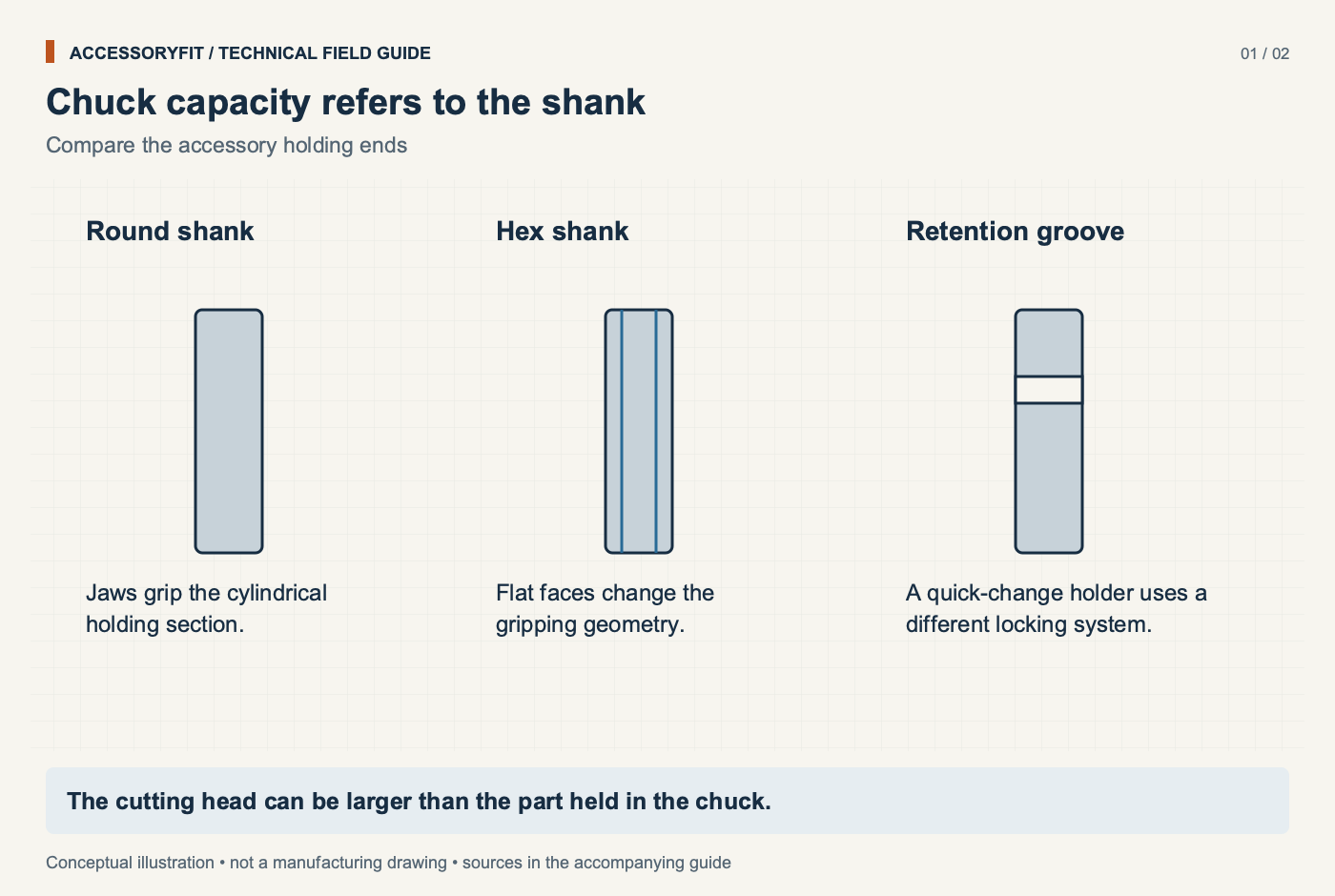
Chuck size is the largest bit shank a drill's chuck can grip, not the largest hole it can drill. A 1/2 in keyless chuck in the Jacobs range grips shanks from 1/32 to 1/2 in, and a 3/8 in chuck grips 1/64 to 3/8 in. Current cordless drill/drivers and hammer drills from DeWalt, Milwaukee, Makita and Ryobi list the larger size. Impact drivers have no jaws at all: they take 1/4 in hex-shank bits in a quick-change holder, and rotary hammers take SDS shanks.
By AccessoryFit editors · Checked
On this page
- What does drill chuck size mean?
- Which chuck does your drill or driver have?
- Which bits fit a 3/8 in chuck, and which need a 1/2 in chuck?
- Does a keyed, keyless or ratcheting chuck change what fits?
- What fits a 1/4 in hex quick-change holder?
- Which drill bit adapters are there, and when are they safe?
- How is a chuck attached, and can it be changed?
- When does a bit not fit, or not hold, even in the right chuck?
- Where do you go next?
What does drill chuck size mean?
Drill chuck size is the maximum shank diameter the chuck's jaws can close around, stated in inches in the US and millimetres in Europe. A chuck sold as 1/2 in takes shanks up to that size; it does not limit the diameter of the hole the bit cuts. McMaster-Carr's listing of Jacobs keyless chucks shows the full range each size grips, from the smallest bits up to the stated maximum, in both inch and metric.
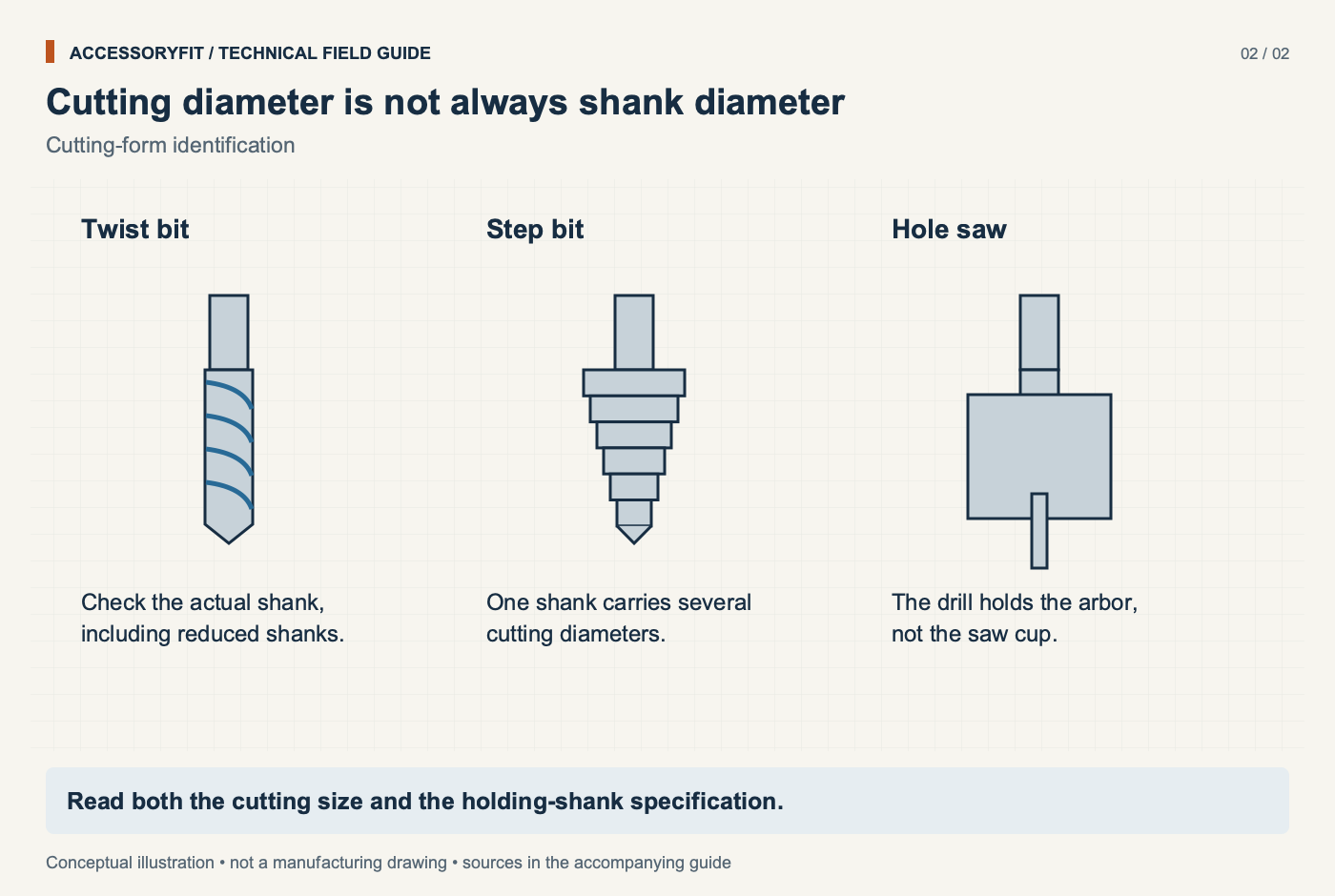
The most common misconception follows from the name: that a drill with the larger chuck can only bore holes up to that diameter. Bits that cut bigger holes are made with a reduced shank so they still fit. An Irwin distributor listing describes reduced-shank (Silver and Deming style) bits that cut larger holes on a 1/2 in shank with three flats for grip. Spade bits, hole saw arbors, step bits and Forstner bits all work the same way: a large cutter on a shank sized for common chucks.
The table below lists the Jacobs keyless capacity ranges as McMaster-Carr publishes them. The inch and metric columns are the catalogue's own pairing, so a buyer reading a metric specification can match it to the inch size without converting.
| Shank capacity (in) | Shank capacity (mm) |
|---|---|
| 0 to 1/4 in | 0 to 6.5 mm |
| 1/64 to 3/8 in | 0.5 to 10 mm |
| 1/32 to 1/2 in | 1 to 13 mm |
| 1/8 to 5/8 in | 3 to 16 mm |
McMaster lists these ranges plus 3/8-24 and 1/2-20 thread mounts, taper mounts (drill presses, mills, lathes) and 1/4 in hex-shank mounts on one page, without pairing each range to a mount.
Which chuck does your drill or driver have?
Current cordless drill/drivers and hammer drills from DeWalt, Makita, Milwaukee and Ryobi in the AccessoryFit database all list a 1/2 in chuck, while impact drivers list a hex holder and rotary hammers list SDS-plus. The table collects each maker's published chuck size and chuck type. Where a maker does not state a value, it shows as not stated.
The DeWalt DCD800, Milwaukee 2903-20 and Makita XFD131 drill/drivers each list a 1/2 in keyless chuck, and the DeWalt DCD805, Milwaukee 2904-20 and Makita XPH14Z hammer drills list the same. The DeWalt DCF845 and Milwaukee 2953-20 impact drivers instead list a 1/4 in hex holder. Because drills of the same platform often share batteries but not accessories, the battery side is covered separately in the guide to cross-brand battery compatibility.
The smaller chuck size is now most often found on compact tools and attachments. Milwaukee's M12 FUEL 2505 installation drill, for example, ships with a 3/8 in metal chuck head plus a hex head that swap on the same tool.
A shared chuck size does not mean a shared workload. A hammer drill grips the same round masonry bit as a drill/driver, but the current 2019 second edition of UK HSE's L140 guidance gives 11 m/s² as its starting vibration estimate for an impact drill with a 5 to 8 mm masonry bit, against a much lower figure for a drill with a standard bit. Those HSE figures reflect tools in use before 2015 and remain its most recent estimates of this kind. If most of your holes are in masonry, the hammer function and an SDS tool matter more than chuck capacity.
| Tool | Chuck | Chuck type | Platform |
|---|---|---|---|
| Bosch GBH2-28L | not stated | SDS-Plus | not stated |
| DeWalt DCD800 | 1/2 in | keyless | 20V MAX |
| DeWalt DCD805 | 1/2 in | keyless | 20V MAX |
| DeWalt DCF845 | 1/4 in | 1/4 in hex | 20V MAX |
| DeWalt DCH273 | not stated | SDS-Plus | 20V MAX |
| Makita HR2641 | not stated | SDS-Plus | not stated |
| Makita XDT13Z | not stated | 1/4 in hex one source | 18V LXT |
| Makita XFD131 | 1/2 in | keyless one source | 18V LXT one source |
| Makita XPH14Z | 1/2 in one source | keyless | 18V LXT one source |
| Makita XRH01Z | not stated | SDS-Plus | 18V LXT |
| Milwaukee 2903-20 | 1/2 in | keyless | M18 |
| Milwaukee 2904-20 | 1/2 in | keyless | M18 |
| Milwaukee 2912-20 | not stated | SDS-Plus | M18 |
| Milwaukee 2953-20 | 1/4 in | 1/4 in hex | M18 |
| Ryobi PBLDD02 | 1/2 in one source | not stated | ONE+ one source |
| Ryobi PBLID01 | 1/4 in | 1/4 in hex | ONE+ |
Values marked one source appear in a single manufacturer document; check the tool's manual or rating plate before buying.
Which bits fit a 3/8 in chuck, and which need a 1/2 in chuck?
Every shank a 3/8 in chuck grips also fits the larger chuck, but shanks above the smaller chuck's maximum need the larger one. Most twist bit sets stay inside both: Bosch's Bosch CO14B 14 pc. Cobalt M42 drill bit set covers 1/16 to 1/2 in, and the three-flat shanks on its larger sizes are made to resist slipping. Anything larger needs either a reduced shank or the larger chuck.
Hole saw arbors show the split most clearly. Milwaukee says its 3/8 in hex-shank arbors fit drills with a chuck of that size or larger, while its heavier hex-shank arbors need the larger chuck. The table below gives both arbor shank options alongside the thread each hole saw size uses, which is useful when building a set around one drill. The shortlist of hole saw kits notes the arbor each kit ships with.
Step bits come both ways. DeWalt's DeWalt DWA1790IR IMPACT READY titanium nitride step drill bit set, 3 pc has a 1/4 in hex shank, so it fits an impact driver as well as any chuck, while Milwaukee's Milwaukee 48-89-9221 3 pc step drill bit set (#1, #2, #4) uses a 3-flat SECURE-GRIP shank for jawed chucks. Both are compared in the round-up of step drill bits.
Mixing paddles follow chuck size too. Collomix sells its drill paddles with shanks for a 3/8 or 1/2 in chuck: the small paint paddles for the smaller chuck, the larger paddles for the larger one. Kraft Tool's DC713 mud mixer has a 7/16 in hex shaft and is meant for a slow-speed drill with the larger chuck. Collomix also warns that ordinary drills often lack the power and torque for paddle mixing and recommends a dedicated mixer, so a shank that fits the chuck does not settle whether the drill is up to the job.
| Hole saw diameter | Arbor type | Thread | Arbor shank options |
|---|---|---|---|
| 9/16 - 1-3/16 in (14-30 mm) | small-thread arbor | 1/2-20 | 3/8 in hex, 7/16 in hex (Milwaukee); 8.75 mm (11/32 in) or 6.5 mm (1/4 in) hex (Starrett) |
| 1-1/4 in (32 mm) and larger | large-thread arbor | 5/8-18 (Milwaukee large thread adapter, 1-1/4 to 2 in) | 3/8 in or 7/16 in hex (Milwaukee); 11 mm (7/16 in) or 8.75 mm (11/32 in) hex (Starrett) |
The large-thread size is single-source (Milwaukee). Starrett shank sizes are hex across flats as printed.
Does a keyed, keyless or ratcheting chuck change what fits?
No. Chuck type changes how the jaws are tightened, not which shanks fit; capacity alone decides that. Keyless chucks grip and release with a twist of the sleeve, and McMaster-Carr notes that economy thread-mount keyless models add a ratchet lock that holds bits in both directions. Keyed chucks are tightened with a geared key matched to the chuck: Penn Tool Co lists the Jacobs 32BA-1/2 as using key K32.
Makers describe their own chucks in these terms. DeWalt specifies a single-sleeve ratcheting chuck on its DCD771, and Milwaukee sells the all-metal chuck on its M12 FUEL 3403 on bit retention and durability. Both are the same 1/2 in capacity; the difference is in grip and wear, not in which bits go in.
| Tool | Chuck | Type |
|---|---|---|
| DeWalt DCD771 drill/driver | 1/2 in | single-sleeve ratcheting keyless |
| Milwaukee M12 FUEL 3403 drill/driver | 1/2 in | all-metal keyless |
| Milwaukee M12 FUEL 2505 installation drill | 3/8 in metal chuck head + 1/4 in hex head | interchangeable heads |
| Jacobs 32BA-1/2 (replacement chuck) | 1/32 to 3/8 in | keyed, key K32, 1/2-20 mount |
Examples only; check the specific tool manual.
What fits a 1/4 in hex quick-change holder?
A quick-change holder takes only hex-shank accessories: driver bits, impact-rated drill bits and hex-shank spade, step and hole saw tools. Milwaukee and McMaster-Carr both describe impact drivers and some multi-head drivers as using a 1/4 in hex quick-connect holder in place of jaws. These are the quick-change, quick-connect and quick-release holders that buyers search for under those names.
The hex itself is standardised. In ISO terms the power-bit shank is form E 6.3, with a groove for the ball-detent lock in power-tool holders, while shorter insert bits use form C 6.3 and sit in a separate bit holder; in the US the parallel standard is ASME B107.4, according to the Wikipedia summary of both. Milwaukee makes impact-rated twist bits with a 1/4 in hex shank so they fit both impact drivers and drills, and Starrett makes spade bits the same way.
A hex-shank bit also fits a jawed chuck, because the jaws close on the flats. The reverse needs an adapter: McMaster-Carr lists hex-shank chuck adapters that let round-shank bits run in a hex holder, and Makita's 763198-1 puts a keyless chuck on a hex shank so an impact driver can hold round- or hex-shank bits up to 3/8 in, per Makita. Driver-bit fit in more depth, including impact-rated torsion zones, is covered in the guide to impact driver bit shanks.
Which drill bit adapters are there, and when are they safe?
Three adapter families cover most needs: hex-shank chuck adapters for impact drivers, keyless chuck adapters for SDS-plus rotary hammers, and hex adapters for SDS-plus hammers. Each one is limited to rotation-only work. Bosch's HA3JAWC gives an SDS-plus hammer a 1/2 in keyless chuck for ordinary round-shank bits, and Makita's B-59259 lets an SDS-plus hammer drive 1/4 in hex bits.
Makita, McMaster-Carr and Starrett all say chuck and hex adapters on SDS-plus hammers are for rotation-only mode with the hammer action switched off. One source disagrees: Bosch's HA3JAWC product page says the adapter can be used in hammer-only mode, which conflicts with the other three and may be a page error. This page follows the majority and the safer reading, rotation only. A common belief is that a chuck adapter turns a rotary hammer into a hammer drill for round-shank masonry bits; the manufacturers describe adapters for plain rotation with standard bits instead.
SDS bits have their own rules. SDS-plus shanks are 10 mm and SDS-max shanks 18 mm, both slotted to slide in an SDS tool holder, and the two systems are not interchangeable. No manufacturer source on file approves clamping an SDS bit in a jawed drill chuck. The full comparison is in the guide to SDS-Plus and SDS-Max bits.
How is a chuck attached, and can it be changed?
Most handheld drill chucks screw onto the spindle on one of two threads, 3/8–24 or 1/2–20, and replacement chucks are sold for each. McMaster-Carr and Hardwick and Sons list the first for chucks such as the Jacobs Multi-Craft 30353; McMaster-Carr and Penn Tool Co list the second for the Jacobs 32BA-1/2. Which thread a given drill model uses is not stated in the sources on file, so check the drill's manual or the existing chuck's marking before ordering one.
Removing a chuck has one trap. Bosch notes that many drills secure the chuck with a screw inside the open jaws that has a left-hand thread, so it comes out by turning clockwise. Only after that screw is out does the chuck itself unscrew counter-clockwise. The common assumption that the screw loosens like any other screw is how many retaining screws get damaged.
When does a bit not fit, or not hold, even in the right chuck?
A bit fails to fit when its shank is larger than the chuck's maximum, uses a system the chuck is not made for, or is the wrong type for the driving tool. The cases the sources on file describe are these:
- Shank above capacity. A cutter larger than the chuck's maximum fits only if it has a reduced shank.
- Round shank in a hex holder. An impact driver's quick-change holder has no jaws; a round-shank bit needs a hex-shank chuck adapter.
- SDS bit in a jawed chuck. SDS shanks are made for SDS tool holders, and the two SDS sizes do not cross over.
- Standard bits in an impact driver. The Wikipedia summary of driver bits says non-impact bits share the hex but may fail early, because their harder heat treatment is more brittle.
- Round shanks that spin. Bits with three flats ground on the shank are made to resist slipping in the chuck.
No manufacturer or standards source on file lists the causes of bit slip in a chuck, such as worn or dirty jaws, so this page does not rank them. Where a bit keeps wandering at the start of a hole rather than slipping, the guide on why drill bits walk covers that separate problem.
How do you check whether a bit fits your drill?
Four checks, using the drill's manual and the bit's packaging, confirm fit before buying.
- Identify the holder. Jawed chuck, hex quick-change holder or SDS tool holder: the manual's specifications name it.
- Read the chuck capacity. The specification gives the chuck size; that is the largest shank it grips.
- Read the bit's shank. The pack states round, three-flat, hex or SDS, and its size. Large cutters list a reduced shank size.
- Add an adapter only where the maker allows it. Hex-shank chuck adapters for impact drivers; SDS chuck or hex adapters for rotation-only work on a rotary hammer.
Where do you go next?
With the shank question settled, the bit itself is the next choice: material, point and coating are covered across the drill bit guides. The accessory finder matches a drill or driver model to the bits, saws and adapters that fit it, and the wider set of fit rules for saws, grinders, sanders and routers sits in the section on what fits which tool.
Questions readers ask
Can a drill with a 3/8 in chuck use bits that cut larger holes?
Only if the bit has a reduced shank no larger than the chuck's maximum. The cutting diameter does not matter; the shank does.
Is there a universal drill bit adapter?
No single adapter covers every system. Hex-shank chuck adapters let round-shank bits run in an impact driver, and SDS-plus chuck and hex adapters let a rotary hammer drive round-shank or hex bits in rotation-only mode.
Do hex-shank bits fit a normal drill chuck?
Yes. The jaws close on the flats of a 1/4 in hex shank, which is why Milwaukee sells hex-shank impact drill bits for both drills and impact drivers.
What is the metric equivalent of the larger chuck size?
The Jacobs range McMaster-Carr lists gives the 1/32 to 1/2 in range with its metric equivalent beside it, as shown in the capacity table on this page.
Why won't my chuck unscrew from the drill?
Many chucks are held by a left-hand screw inside the jaws, which Bosch says must be removed first by turning it clockwise.
Where to go next
- SDS-Plus vs SDS-MaxRotary hammer shanks and adapters.
- Impact driver bit shanksHex sizes, forms and impact ratings.
- Step drill bitsHex and three-flat shank options.
References 103 documents, 34 publishers
- ABCM, COBEM 2005 proceedings: Influence of the Lubri-Cooling System on the Life of TiAlN Coated HSS Twist Drills when Machining Blind and Through Holes
- Abrasive Brush Manufacturers Association: Power brush safety slip AB-2 (rev. 2/2024)
- Albany County Fasteners: What Is Pozidriv? How Does It Differ From A Phillips Drive?
- Annals of Work Exposures and Health: The Effects of Bit Wear on Respirable Silica Dust, Noise and Productivity: A Hammer Drill Bench Study
- Applied Ergonomics (Elsevier): Pneumatic rock drill vs. electric rotary hammer drill: Productivity, vibration, dust, and noise when drilling into concrete
- BAER tools: What makes an SDS drill bit special
- BioResources: Effect of Chip Thickness and Tool Wear on Surface Roughness and Cutting Power during Up-Milling Wood of Different Density
- Bosch: GBM 1600 RE Professional online manual: changing the drill chuck; GBH2-28L SDS-plus Bulldog Xtreme Max 1-1/8 In. Rotary Hammer product page; GBH2-28L operating/safety instructions 2610047986; Cobalt Drill Bit Sets (CO14B) product page; GRW18V-160N 18V brushless 1-speed handheld mixer; HA3JAWC 1/2 in SDS-plus Shank Keyless Chuck; GBH 2-28 F rotary hammer with SDS plus; GBH 5-40 D rotary hammer with SDS max; 1617/1618 router operating/safety instructions (2610051825)
- Collomix: Mixing matters catalog 2025 (EN-USA), paddles section pp. 21-23; Mixing epoxy resin and how to stir paint properly
- DeWalt: DCD771C2 20V MAX Cordless Drill/Driver Kit; DCD800B 20V MAX XR 1/2 in Brushless Cordless Drill/Driver product page; DCD800/DCD805 Instruction Manual NA043446; DCF845B 20V MAX XR 3-Speed 1/4 in Impact Driver product page; DCF845 Instruction Manual (T1); DCD805B 20V MAX XR Brushless Cordless 1/2 in Hammer Drill/Driver product page; DCH273B 20V MAX XR SDS PLUS Brushless 1 in L-Shape Rotary Hammer product page; DCH253/DCH273 Instruction Manual N439089; DWA1790IR IMPACT READY Step Drill Bit Set product page; FLEXTORQ Modular Right-Angle System (DWAMRAFT); DWE575 circular saw instruction manual (N786997)
- EMI Supply (retailer): Kraft Tools DC713 30 in hex shaft junior mud mixer
- Freud and Diablo: Get the most out of your Freud bits by routing at ideal feed rates and speeds
- GTSE (UK tool supplier): SDS Drill Bits Explained: Types and Sizes
- Hardwick & Sons: Jacobs Multi-Craft Keyless Chuck 3/8 in capacity, model 30353
- Health and Safety Executive (UK): Hand-arm vibration: The Control of Vibration at Work Regulations 2005. Guidance on Regulations (L140, Second edition)
- Hilti UK: TE-C (SDS Plus) metric hammer drill bit set
- HomElectrical: Irwin 1/2 in Reduced Shank Silver & Deming HSS Drill Bits
- Human Factors and Ergonomics Society: Construction Ergonomics: Concrete Bit Wear Increases Handle Vibration and Drilling Time
- International Journal of Industrial Ergonomics (Elsevier): R2: Drilling into concrete: Effect of feed force on handle vibration and productivity
- Journal of Wood Science: Effect of tool material on tool wear and delamination during machining of particleboard
- Makita: HR2641 1" SDS-PLUS AVT Rotary Hammer product page; HR2631F/HR2641 instruction manual; XDT13Z 18V LXT Brushless Impact Driver (tool only) product page; XDT13 instruction manual 885505-946; XFD131 18V LXT Brushless 1/2" Driver-Drill Kit product page; XFD131 new tool flyer; XFD13 instruction manual 885654-949; XPH14Z 18V LXT Brushless 1/2" Hammer Driver-Drill (tool only) product page; XPH14 instruction manual 885826A946; XRH01Z 18V LXT Brushless 1" SDS-PLUS Rotary Hammer (tool only) product page; XRH01/XRH02 instruction manual; Wire cup brushes for drills (D-39908 to D-39942); 763198-1 3/8 in Keyless Chuck Adapter; B-59259 Adapter, SDS-PLUS to 1/4 in Hex; 9557PB angle grinder instruction manual; 5007F 7-1/4 in circular saw instruction manual
- McMaster-Carr: Jacobs Keyless Drill Chucks; Depth-limiting drill bit stop collar sets; Rotary-Hammer Chuck Adapters
- Milwaukee Tool: M12 FUEL Installation Drill/Driver 2505-20; M12 FUEL 1/2 in Drill/Driver 3403-20; 2903-20 M18 FUEL 1/2 in Drill Driver product page; Operator's manual 58-14-9998d1 (Cat. No. 2904-20); 2904-20 M18 FUEL 1/2 in Hammer Drill/Driver product page; 2912-20 M18 FUEL 1 in SDS Plus Rotary Hammer product page; Operator's manual 58-14-0244d3 (Cat. No. 2912-20); 2953-20 M18 FUEL 1/4 in Hex Impact Driver product page; Operator's manual 58-14-9987d1 (Cat. No. 2953-20); Small Thread Arbor 3/8 in Shank 49-56-7010; Large Thread Quick Change Arbor 7/16 in Shank 49-56-7240; 48-89-9221 3PC Step Drill Bit Set product page; 4PC M2 Steel Screw Extractor Set 49-57-9001; 2019 Accessory Catalog; Right Angle Attachment 49-22-8510; SHOCKWAVE Impact Duty Magnetic Nut Driver Set 49-66-4562; 5PC 3/8 in QUIK-LOK Arbor Set 49-56-7545; Hole saw arbor assembly instructions (49-56-9100, 49-56-7250, 49-56-7010, 49-56-6560); SHOCKWAVE Impact Duty 2 in ECX #1 Power Bits 48-32-4144; 1/4 in SHOCKWAVE Impact Duty RED HELIX Titanium Drill Bit 48-89-4613; Cat. No. 2715-20, 0757-20 operator's manual (58-14-0017); M18 FUEL oscillating multi-tool 2836-20 operator's manual (58-14-0217d1)
- NIOSH: Nonfatal Tool- or Equipment-Related Injuries Treated in US Emergency Departments Among Workers in the Construction Industry, 1998-2005; Nonfatal work-related injuries treated in hospital emergency departments in the U.S., 2012-2023
- OSHA: 29 CFR 1910.215 Abrasive wheel machinery; 29 CFR 1910.243 Guarding of portable powered tools; 29 CFR 1926.303 Abrasive wheels and tools; 29 CFR 1926.300 General requirements (Tools, hand and power); 29 CFR 1926.304 Woodworking tools
- Penn Tool Co: Jacobs 32BA-1/2 plain bearing geared key drill chuck, 1/2-20 mount
- Ryobi: PBLDD02B 18V ONE+ HP Brushless 1/2 in Drill/Driver product page; PBLID01B 18V ONE+ HP Brushless 1/4 in Impact Driver product page (US); PBLID01B 18V ONE+ HP Brushless 1/4 in Impact Driver product page (Canada)
- Stanley Black & Decker (IRWIN, LENOX): Extractors catalog section (HANSON spiral, multi-spline and bolt extractors), pp. 221-224; HANSON 10-pc Spiral Extractor & Drill Bit Set in Metal Index (11119)
- Starrett: Saws & Hand Tools Catalogue 71E (hole saws, arbors, drill bits)
- Tanner Bolt & Nut: Chuck Systems, Drill Bits and Shanks for Rotary Hammer Drills
- Tribology in Industry: Comparison of Wear Behaviours of Cathodic Arc TiN, TiAlN Coated and Uncoated Twist Drills Under Aggressive Machining Conditions
- U.S. Consumer Product Safety Commission: NEISS 2024 data file (neiss2024.xlsx), with NEISS_FMT code formats
- Wera: 9500 Magnetiser SB; 851/1 TZ bits, PH 1 x 25 mm datasheet (05056505001); 851/1 Z bits, PH 2 x 50 mm datasheet (05056520001)
- Wikipedia: Drill bit; Screwdriver bit; List of screw drives
Accessed .