
How-to · Drill bits
How to read drill bit sizes: number, letter, fractional and metric
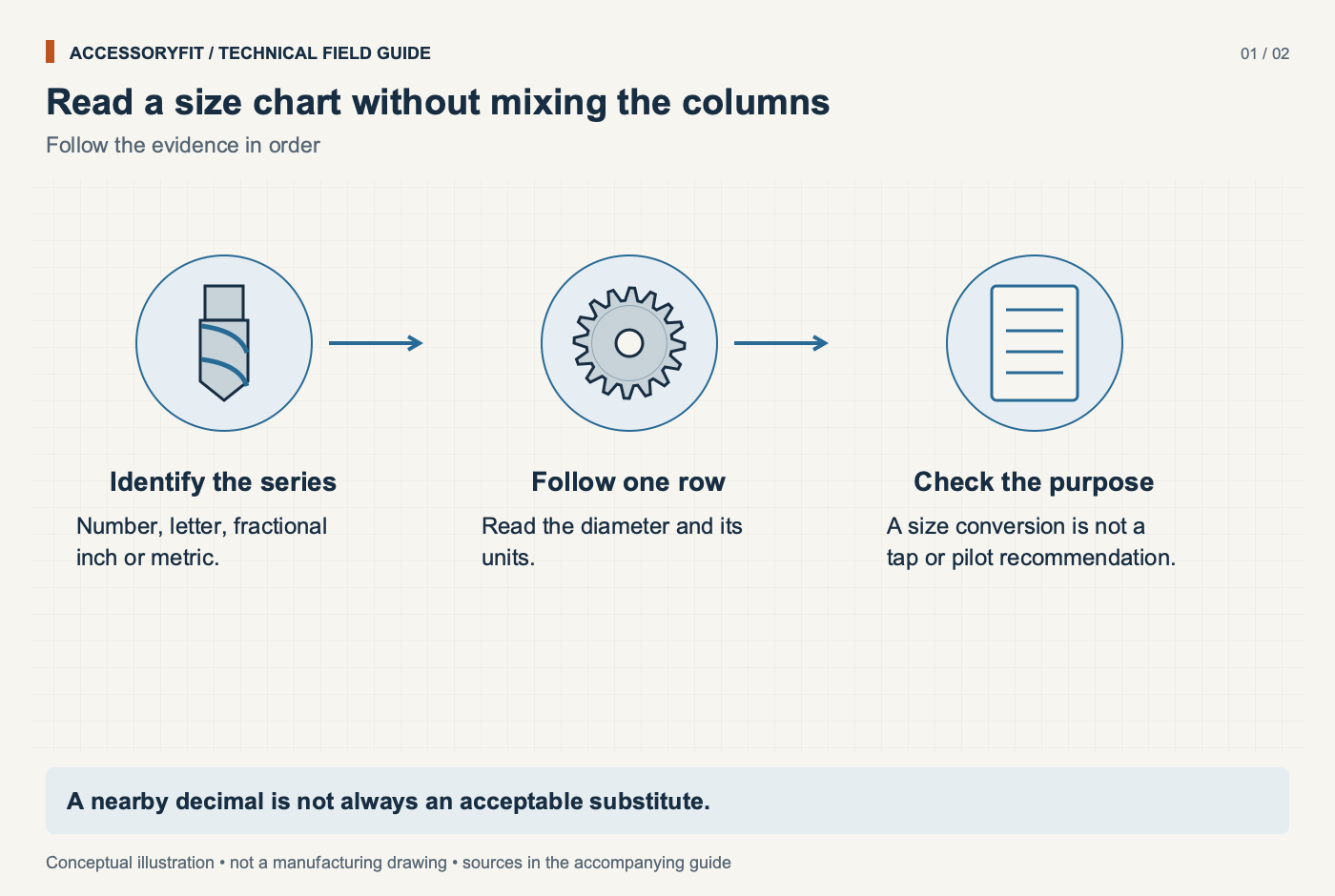
To read a drill bit size, first identify the system from the label: a # sign means a number (wire gauge) size, a single capital letter means a letter size, a fraction means inches, and mm means metric. Then read across to the decimal inch or millimetre column, which puts every system on one scale. Remember that number sizes run backwards, so #1 at 0.228 in is the largest. Finally, if the hole will be tapped or take a screw, use the tap drill or pilot hole chart, because they name the size the job needs.
By AccessoryFit editors · Checked
On this page
- What does a drill bit size chart actually tell you?
- How do you tell which system a bit is labelled in?
- What do real lookups look like?
- How do you read a tap drill chart row?
- How do you read a pilot hole chart for wood screws?
- Why do conduit, pipe and hole saw sizes not match the label?
- Which numbers on a bit or packet are not the cutting size?
- When does reading the chart give the wrong answer?
What does a drill bit size chart actually tell you?
A drill bit size chart tells you the cutting diameter behind each label, nothing more. It converts a label, whether a number, a letter, an inch fraction or a millimetre figure, into a decimal inch figure and a millimetre figure so you can compare bits from different systems. It does not tell you which bit a job needs, whether the bit fits your chuck, or what type of bit suits the material. Those answers come from other charts and from the tool's specs.
Twist drills are sold in four sizing systems: number sizes from #80 to #1, letter sizes from A to Z, fractional inch sizes in 1/64 in steps, and metric sizes in millimetres. Number and letter sizes fill the gaps between neighbouring fractions, which is why thread-tapping charts rely on them. The full tables for all four systems are on our drill size conversion chart; this page explains how to use them and the charts that sit beside them.
How do you tell which system a bit is labelled in?
Look at the format of the marking on the shank, the index case or the packet. Each system has a distinct format, and once you know which one you have, you know which table to open.
- Number sizes carry a number, usually with a # sign or the word No. They run from #80, the smallest at 0.0135 in, to #1, the largest.
- Letter sizes carry a single capital letter. A is the smallest at 0.234 in, just above #1, and Z the largest at 0.413 in.
- Fractional sizes carry an inch fraction, the common format on US bits and sets.
- Metric sizes carry a millimetre figure, the format on bits sold in Europe. Metric jobber drills are made to DIN 338, according to Starrett's catalogue.
The direction of each series is the trap. In the number series a higher number is a smaller drill, while letters and fractions grow as you would expect. Reading the number series the wrong way can put you dozens of sizes from the bit you meant.
How do you read a drill size chart, step by step?
The same five steps work for a wall chart, a drill index lid or the tables on our size chart page.
- Identify the system. Read the marking and decide whether it is a number, letter, fractional or metric size.
- Open the matching table. Find the label in the column for that system, not in a neighbouring system's column.
- Read the decimal or millimetre value. Read the decimal inch value from left to right, digit by digit, or read the millimetre column if you work in metric.
- Compare on the common scale. To find an equivalent in another system, look for the nearest decimal in that system's table and note whether it is larger or smaller.
- Check the job chart. If the hole will be tapped, use a tap drill chart; if it will take a wood screw, use a pilot hole chart; if it passes a pipe or conduit, use the fitting's outside size.
What do real lookups look like?
Real lookups start from a job, not from a bit. The table below follows six common jobs through to the size, its system and the chart that gives it. Notice how often the answer is a number or letter size that a fractional set does not contain: a 1/4-20 thread needs a #7 drill, and a 5/16-18 thread needs letter F. Notice too that letter E and a quarter-inch fractional bit come out identical at 0.250 in, one of the few exact matches across systems.
| Job | Size to use | System | Decimal or note | Chart |
|---|---|---|---|---|
| Tap a 1/4-20 UNC thread | #7 | Number | 0.201 in | Tap drill |
| Tap a 5/16-18 UNC thread | F | Letter | 0.257 in | Tap drill |
| Tap a 3/8-16 UNC thread | 5/16 in | Fractional | a standard fractional size | Tap drill |
| Tap an M10 coarse thread | 8.5 mm | Metric | not a whole millimetre | Tap drill |
| Pilot for a #10 wood screw in hardwood | 1/8 in | Fractional | WOOD Magazine chart | Pilot hole |
| Clearance hole for a #8 wood screw | 5/32 in | Fractional | WOOD Magazine chart | Pilot hole |
How do you read a tap drill chart row?
Read a tap drill chart row from left to right: thread name, then the drill for the thread engagement you want. An inch thread such as 1/4-20 gives the nominal diameter and the threads per inch; a metric thread such as M10 x 1.5 gives the diameter and the pitch in millimetres. The drill column then gives the size in whichever system lands closest to the ideal hole, which is why inch charts mix number, letter and fractional sizes in one column.
Many charts show two drill columns. Little Machine Shop lists drills for 75% / 50% thread, with the higher engagement suggested for aluminium, brass and plastics and the lower one for steel, stainless and iron, because the slightly larger hole is easier to tap. That guidance comes from one source. The inch values themselves agree across the two charts consulted (21 of 21 match for the threads both list). Metric charts disagree in places: for M12 and M14 the University of Pennsylvania and Engineering ToolBox give slightly different drills, so check which chart your tap maker follows. The full table is on our tap drill size chart.
A common belief is that the strongest thread comes from a drill at the screw's minor diameter. Charts deliberately use partial engagement instead, and list larger drills for hard metals because they are easier to tap without breaking the tap.
How do you read a pilot hole chart for wood screws?
Find the screw gauge in the first column, then read the pilot size for your wood (hardwood or softwood) and, if the screw passes through a top board, the shank or clearance hole. The screw gauge is not a drill size: a #8 screw and a #8 drill are unrelated, because the screw number belongs to a separate gauge system. For a #8 traditional wood screw, WOOD Magazine's chart gives a 7/64 in pilot in hardwood and 3/32 in in softwood.
Two charts can give different answers for the same screw. MISUMI's chart lists pilot sizes by tapered or straight bit, and several of its figures differ from WOOD Magazine's, so this site displays WOOD Magazine's values and notes MISUMI's as an alternative. Hardwood always takes the larger pilot in both charts. Metric screws are often specified by the screw maker instead: Rotho Blaas, for example, gives a 4.0 mm pre-drill for one of its HBS softwood screws. The full gauge-by-gauge table is on our screw pilot hole chart.
Why do conduit, pipe and hole saw sizes not match the label?
Because conduit and pipe are named by a nominal trade size, while the hole has to fit the actual outside diameter of the conduit fitting or pipe. Klein lists the knockout for the smallest conduit size in its table as 0.875 in, well above the nominal figure printed on the conduit. Steel pipe works the same way: its outside diameter is set by the nominal pipe size and stays the same across schedules, so you size the hole from the outside diameter plus some clearance.
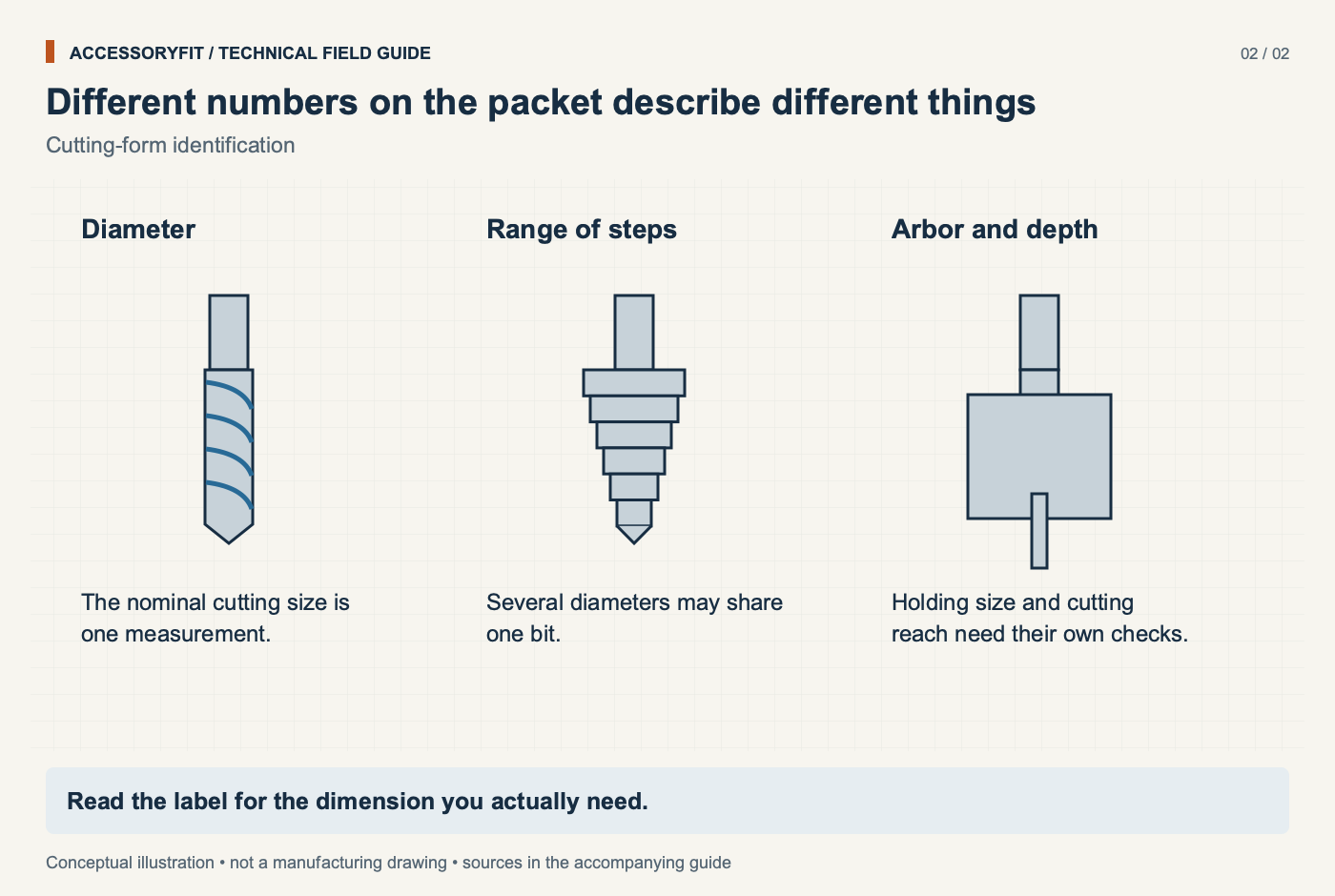
Hole saws add a second label to read, the arbor. Small hole saws from 9/16 to 1-3/16 in use a small-thread arbor with a 1/2–20 thread, and larger ones need the large-thread arbor, so a hole saw size also tells you which arbor to buy. The size tables are on our page of hole saw sizes for pipe and conduit, and current sets are compared in the hole saw kits guide. For a spread of sizes in thin sheet, unibit-style step bits cover many holes with one cone; their brand numbers, such as #1 or #4, are family labels and not sizes.
Which numbers on a bit or packet are not the cutting size?
Shank size, length series and system names are printed alongside the cutting size and are easy to misread as it. Check which number you are looking at before comparing.
- Shank and chuck capacity. Chuck size names the largest shank a chuck accepts, not the largest hole it can drill. A 1/2 in chuck takes shanks up to that size, and reduced-shank bits cut larger holes on a shank that still fits. The guide to drill chuck capacity covers keyed, keyless and hex holders.
- Hex shank size. Impact-rated bits and driver bits share a 1/4 in hex shank, whatever the cutting diameter.
- SDS shank size. SDS-plus shanks are 10 mm and SDS-max shanks 18 mm. These are shank sizes for rotary hammers and say nothing about the hole.
- Length series. Words such as stub, jobber and taper describe length, not diameter. Jobber is the most common length, stub bits are shorter and stiffer, and taper or long-series bits reach deeper.
When does reading the chart give the wrong answer?
Reading the chart gives the wrong answer when the chart is rounded, when a near size is substituted for an exact one, or when the label belongs to a different system from the one you assumed. Each mistake has a quick check.
- A rounded chart. Little Machine Shop rounds six number sizes to three decimals (#69, #28, #25, #18, #10 and #5), while AmesWeb and Wikipedia carry four. If two charts disagree in the last digit for one of those sizes, neither is wrong; one is rounded.
- A near metric substitute for a tap drill. A metric bit that is close to a #7 or letter F is still a different hole and changes thread engagement. Use the size the tap chart names.
- Screw gauge mistaken for drill number. A #10 screw does not want a #10 drill. Use the pilot hole chart.
- Trade size mistaken for hole size. Conduit and pipe sizes are nominal, so the hole is always larger than the label suggests.
- Sizes above the chart's range. The fractional table on our chart page stops at one inch because the sources stop there; larger holes belong to hole saws and step bits.
For the types of bit each size comes in, from brad-point to cobalt, the drill bits by material hub groups the buyer guides, and the technique guides section holds the other how-to pages. If you are unsure which bits your drill or driver accepts, you can look up what fits your tool by model.
Questions readers ask
Why is a drill index missing some sizes I need?
Fractional sets step in 1/64 in increments, and number and letter sizes between those steps are usually sold singly or in separate number and letter indexes. Tap drill charts often call for exactly those in-between sizes.
What does jobber length mean on a drill packet?
It is the length series, not the diameter. Jobber drills are the medium, most common length, between short stub drills and long taper or long-series drills.
How do you read a metric drill size on an inch chart?
Find the nearest decimal inch value in the inch tables and note whether it sits above or below. For a tap drill, use the metric size itself; the tap drill for M10 coarse is 8.5 mm.
Is a letter drill bigger than a number drill?
Yes, every letter size is larger than every number size. The letter series starts at A, 0.234 in, just above the largest number drill, #1.
Do the numbers on step bits match drill chart sizes?
No. Brand numbers such as #1 or #4 on step bits name a size range within that brand. Read the range printed on the bit or its packet instead.
Where to go next
- Drill bit size chartAll number, letter, fractional and metric sizes with decimals.
- Tap drill size chartThe drill for each UNC, UNF and metric thread.
- Screw pilot hole chartPilot and clearance holes by screw gauge.
References 56 documents, 30 publishers
- Albany County Fasteners: What Is Pozidriv? How Does It Differ From A Phillips Drive?
- AmesWeb: Decimal Equivalents of Fractional, Wire and Letter Drill Sizes; Metric tap drill chart (ISO 68-1 basic profile)
- BAER tools: What makes an SDS drill bit special
- Bosch: GBM 1600 RE Professional online manual: changing the drill chuck; GBH 2-28 F rotary hammer with SDS plus; GBH 5-40 D rotary hammer with SDS max; HA3JAWC 1/2 in SDS-plus Shank Keyless Chuck
- DeWalt: DCD771C2 20V MAX Cordless Drill/Driver Kit
- Engineering ToolBox: ISO Metric Threads (coarse and fine) with tap and clearance drills; Steel Pipe Dimensions (ANSI schedule 40 and 80); ASTM B88 seamless copper water tubes - dimensions; ASTM D1785 and ASTM F441 - PVC and CPVC pipes schedule 40 and 80
- Finolex Industries: ASTM PVC-U pipes schedule 40 (ASTM D1785)
- GTSE (UK tool supplier): SDS Drill Bits Explained: Types and Sizes
- Hardwick & Sons: Jacobs Multi-Craft Keyless Chuck 3/8 in capacity, model 30353
- Hilti UK: TE-C (SDS Plus) metric hammer drill bit set
- Hoffmann Group (GARANT): GARANT hand tap set DIN 352, M18 (130150)
- HomElectrical: Irwin 1/2 in Reduced Shank Silver & Deming HSS Drill Bits
- Klein Tools: 53828 1.115-Inch Knockout Die for 3/4-Inch Conduit (with related knockout punch/die listings)
- Kwikset: 138 Installation Kit instructions (door boring jig)
- Little Machine Shop: Letter Drill Sizes; Number Drill Sizes; Tap Drill Sizes
- Makita: 763198-1 3/8 in Keyless Chuck Adapter; B-59259 Adapter, SDS-PLUS to 1/4 in Hex
- McMaster-Carr: Jacobs Keyless Drill Chucks; Rotary-Hammer Chuck Adapters
- Milwaukee Tool: HOLE DOZER Door Lock Installation Hole Saw Kit 49-22-4063; Small Thread Arbor 3/8 in Shank 49-56-7010; Large Thread Quick Change Arbor 7/16 in Shank 49-56-7240; 5PC 3/8 in QUIK-LOK Arbor Set 49-56-7545; Hole saw arbor assembly instructions (49-56-9100, 49-56-7250, 49-56-7010, 49-56-6560); 2019 Accessory Catalog; M12 FUEL Installation Drill/Driver 2505-20; M12 FUEL 1/2 in Drill/Driver 3403-20; 1/4 in SHOCKWAVE Impact Duty RED HELIX Titanium Drill Bit 48-89-4613; SHOCKWAVE Impact Duty 2 in ECX #1 Power Bits 48-32-4144; Cat. No. 2715-20, 0757-20 operator's manual (58-14-0017)
- MISUMI USA: Pilot Hole Sizes for Wood Screws
- Penn Tool Co: Jacobs 32BA-1/2 plain bearing geared key drill chuck, 1/2-20 mount
- Rotho Blaas: HBS Softwood screw technical data sheet (EN 05-19)
- RS Components: Wood Screws Guide
- Schlage (Allegion): Generic door prep, knob/lever, no holes (115799)
- SPAX: SPAX Drill 2 Step
- Starrett: Saws & Hand Tools Catalogue 71E (hole saws, arbors, drill bits)
- Tanner Bolt & Nut: Chuck Systems, Drill Bits and Shanks for Rotary Hammer Drills
- University of Pennsylvania, MEAM Design: Creating Threaded Holes (tap drill chart)
- Wera: 851/1 TZ bits, PH 1 x 25 mm datasheet (05056505001); 851/1 Z bits, PH 2 x 50 mm datasheet (05056520001)
- Wikipedia: Drill bit sizes; Drill bit; Unified Thread Standard (numbered sizes); Screwdriver bit; List of screw drives
- WOOD Magazine: Wood Screw Chart: head-bore, shank-hole and pilot-hole sizes
Accessed .