Best drill bits for tile: carbide spear and diamond picks for ceramic and porcelain
Drill porcelain and dense tile with a diamond bit or diamond hole saw cooled by water, and keep carbide spear-point bits for glass and softer glazed tile. For small holes, DeWalt's 1/4 in DW5572 diamond core bit and Milwaukee's 1/4 in hex-shank diamond bit are sold for porcelain. For larger holes, Bosch's HDG11 diamond set runs from 1/4 to 2-1/2 in, and Bosch's GT3000 spear-point set covers glass and tile. These picks compare published manufacturer specifications; nothing here was tested by us.
A tile bit needs a cutting edge harder than the glaze, a way to stay on the slippery surface when the hole starts, a shank your drill can hold, and a way to shed heat. Ordinary twist drills and wood bits meet none of these, which is why tile has its own family of bits. Porcelain is the hardest case, and the requirements below are listed with that in mind.
Cutting edge: carbide spear or diamond
Two edge types are sold for tile. A carbide spear-point bit has a spade-shaped carbide point; Wikipedia's drill-bit summary describes these as glass bits that run at low speed and get hot and wear quickly. A diamond bit or diamond hole saw grinds rather than cuts, and Starrett's catalogue lists diamond tile drills and diamond hole saws for porcelain, glass and stone. In the summary of bit types by material, the diamond core bit or diamond hole saw is the entry for ceramic tile, porcelain, glass and stone, with carbide spear points kept for glass. Our drill bits by material hub shows how tile sits beside wood, metal and masonry bits.
Starting control
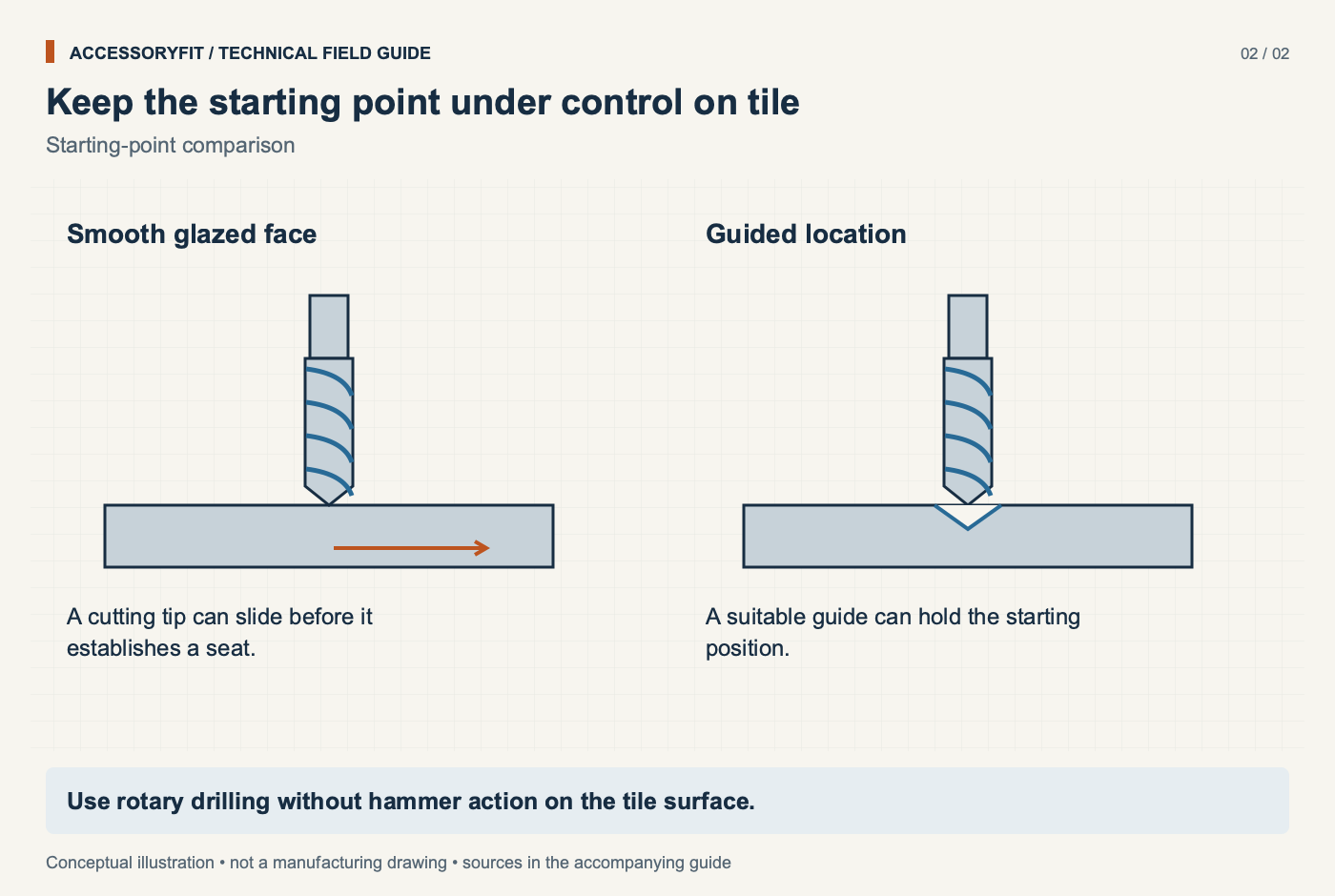
Tile gives a bit nothing to bite into, so starting is where most holes go wrong. Makers answer this in different ways: Bosch grinds the GT3000 tip to a precision point that it says reduces walking, Bosch's HDG11 set comes with an AutoStart pilot bit, and Diablo says its DHS1500DG needs no pilot bit at all and is started at an angle. A guide jig or tape on the glaze is a common workshop habit, but none of the sources behind this page states it, so it is left as an option rather than a rule.
Cooling
Diamond tile drills and diamond hole saws must always be cooled with water, according to Starrett. DeWalt builds this into the DW5572, which has reverse-spiral threads for continuous water cooling, and Milwaukee tells users to dip its diamond bit in water before each cut.
Shank and drive
Shanks on tile bits vary more than on twist drills: three-flat, straight round, 1/4 in hex and mandrel-mounted designs all appear in the picks below. Match the shank to the chuck or holder you have before choosing on edge type alone.
Which bit type suits which material (source summary)
Material
Bit type
Notes
Softwood / hardwood
brad point, spade, Forstner, auger, HSS twist
brad point stays in line in wood
Mild steel, aluminium, brass
HSS twist (118 or 135 degree split point)
use lubricant
Stainless / harder steels
cobalt HSS (M35/M42), 135 degree split point
lower rpm; cobalt is more brittle
Concrete, brick, masonry
carbide-tipped masonry / SDS bits with hammer action
3-40 mm common
Ceramic tile, porcelain, glass, stone
diamond core bit or diamond hole saw; carbide spear-point for glass
water cooling; low speed for glass
Sheet metal, many sizes
step (unibit) drill
Summary table. Each row is supported by facts above.
02Which tile bits fit which job?
Product links go to Amazon. As an Amazon Associate I earn from qualifying purchases. How links are chosen.
These five products are the tile and glass bits in our catalogue, grouped by hole size and tool rather than ranked. Every spec comes from the maker's product page. Where the maker's own page gives two different figures, the figure from its specification table is shown and the conflict is noted.
Small holes in dense tile and solid-body porcelain
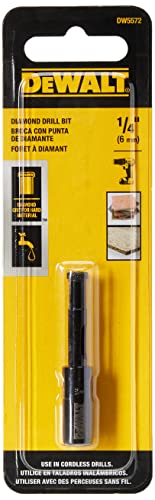
DeWalt DW5572 diamond tile drill bit
Diameter
1/4 in
Bit type
core
Edge
diamond-welded tip
Length
2.25 in
Shank
straight
Suits Fixing anchors and pipe clips through porcelain or dense floor and wall tile with a standard drill chuck.
Skip it if Glass, and holes bigger than 1/4 in, which is the size DeWalt's specification table and a distributor listing give.
Diamond-welded tip on a core design with an ejection slot
Reverse-spiral threads carry water for continuous cooling, per DeWalt
DeWalt lists dense tile and solid-body porcelain
Straight shank fits an ordinary jawed chuck
DeWalt's page heading names a smaller size than its own spec table, so read the size marked on the bit
Published sizes and mounts of the tile picks (manufacturer data)
Product
Edge
Size
Shank or mount
DeWalt DW5572 diamond tile drill bit
diamond-welded tip
1/4 in (spec table; page heading differs)
straight
Milwaukee 49-56-0505 1/4 in DIAMOND MAX hole saw bit
diamond grit
1/4 in
1/4 in hex
Bosch GT3000 8 pc. glass and tile bit set
carbide tip, reinforced head
1/8 to 3/4 in
three-flat
Bosch HDG11 11 pc. diamond hole saw set for hard ceramics
vacuum-brazed diamond grit
1/4 to 2-1/2 in
Power Change Plus keyless arbor with AutoStart pilot bit
Diablo DHS1500DG 1-1/2 in diamond grit hole saw
diamond grit, continuous rim
1-1/2 in
Diablo Snap-Lock Plus mandrel
03Which bit should you use on ceramic and which on porcelain?
Use a diamond bit or diamond hole saw on porcelain, and either a diamond bit or a carbide spear point on glazed ceramic. Porcelain is the material the diamond picks are sold for: DeWalt names solid-body porcelain, Milwaukee names porcelain and hard tile, Bosch names the hardest tiles and hard ceramics, and Diablo names porcelain first in its list. Bosch's spear-point GT3000 is listed for glass and tile in general without naming porcelain.
Two makers go further and say outright that a glass-and-tile bit is the wrong choice for porcelain. Milwaukee states that its carbide ceramic tile and glass bits are not recommended for porcelain tile, and Bosch's tile guidance sends porcelain jobs to its HEX-9 HardCeramic bit rather than to its glass and tile range. A spear point that drills glazed wall tile well is therefore no evidence that it will drill through-body porcelain.
Carbide spear point vs diamond core: what changes?
The spear point cuts with a sharpened carbide edge, and its weakness is heat: it runs hot and wears quickly. The diamond core grinds a ring of material away and needs water throughout. For a few anchor holes in a glazed wall tile, a spear set covers the most sizes in one box. For porcelain floor tile, the diamond bits are the ones whose makers list it.
Small bit vs hole saw: where is the line?
The line is the hole size. Small diamond bits such as the Milwaukee 1/4 in bit make holes for plugs and screws. Pipe, valve and fitting holes need a diamond hole saw such as one from the Bosch HDG11 set or the Diablo DHS1500DG. To size a hole around a steel pipe, read the outside diameter from our page on hole saw sizes for pipe and conduit and allow some clearance.
Which pilot bit goes with a tile hole saw?
A hole saw that uses a pilot needs one that can survive the tile. Milwaukee's standard hole saw pilot bits are 3-1/2 or 4 in long, and for carbide-grit hole saws in ceramic tile, brick and other abrasive materials Milwaukee tells users to fit its carbide-tipped pilot bit instead of the plain one. Diamond saws avoid the question in different ways: Bosch's HDG11 kit includes its own AutoStart pilot, and Diablo's DHS1500DG runs with no pilot at all.
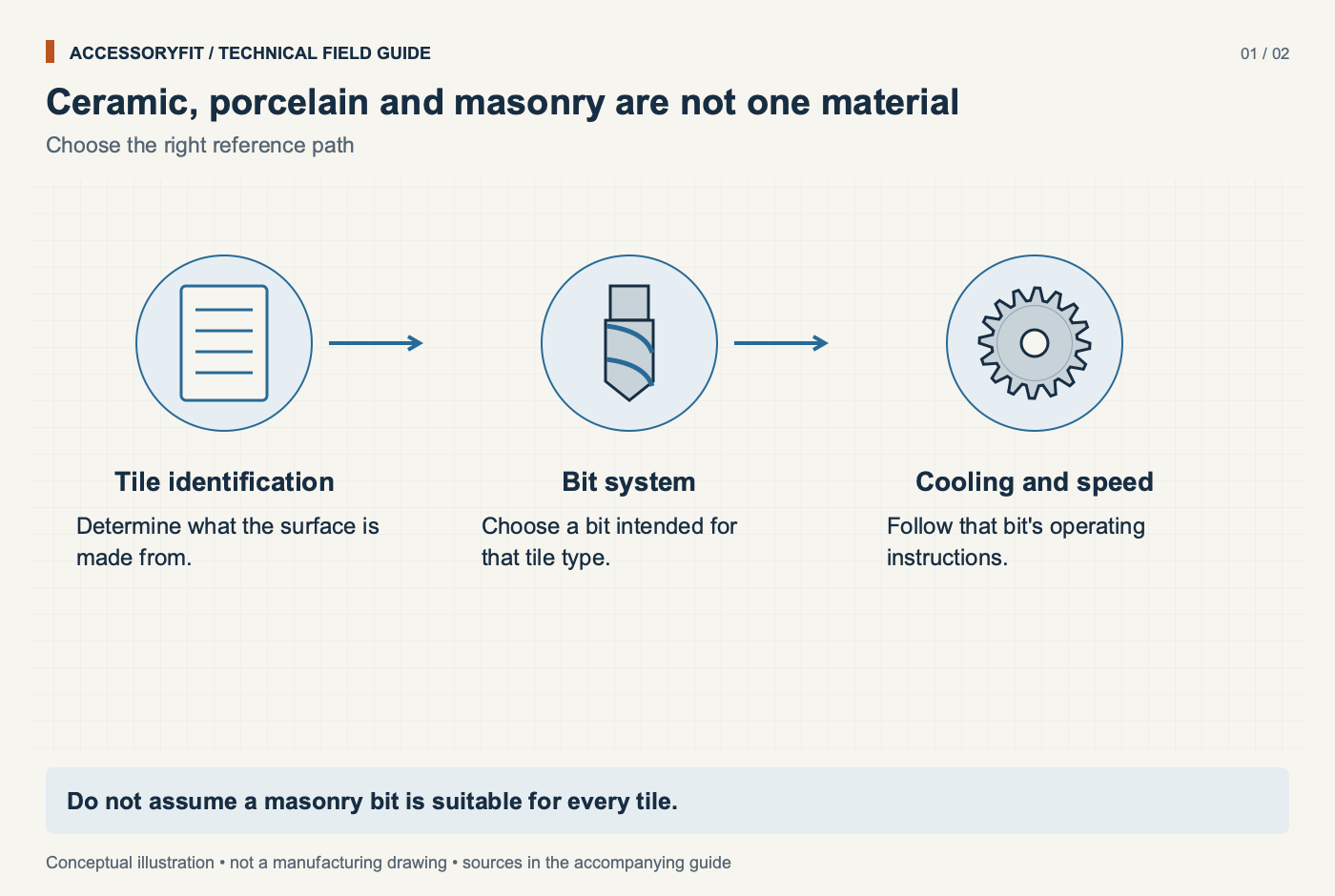
Do not assume a masonry bit is suitable for every tile.
04How fast should you drill tile?
Drill tile slowly. Glass bits are run at low speed, and diamond hole saws have published speed bands that fall as the diameter rises. Starrett's catalogue gives the bands in the table below for its diamond-grit hole saws, always with water cooling. A bigger saw means a lower speed, because the rim travels further on each turn.
The figures are Starrett's for its own saws. Bosch, DeWalt, Diablo and Milwaukee do not publish a speed table on the product pages behind this guide, so use the lower end of Starrett's band as a starting point and the bit maker's own instructions where they exist. One common belief is that tile should be drilled fast to get through the glaze. The sources say the opposite: glass bits are run at low speed, and diamond tile tools need water to carry heat away.
Starrett diamond-grit hole saw speeds by diameter (RPM)
Saw diameter
Minimum
Maximum
9/16 - 1 in (14-25 mm)
500
1000
1-1/16 - 2 in (27-51 mm)
250
500
2-1/16 - 3-1/4 in (52-83 mm)
150
300
3-3/8 - 6 in (86-152 mm)
100
200
Use water cooling.
05Should hammer mode be on when you drill tile?
No. Every maker behind this page that addresses it says to drill ceramic tile with the hammer action off: Bosch says to use the rotary setting only, Milwaukee says its tile and glass bits are for drill drivers only, and Makita says its tile bits are for use in a driver-drill. Hammer action is how masonry bits break up concrete; on a glazed tile it cracks the face around the hole instead of cutting it.
The same goes for a combi drill with a hammer collar: set the collar to drill, not to the hammer symbol, before the bit touches the glaze. Once the tile is through and the bit reaches concrete or block behind it, change to a masonry bit and only then switch hammer on.
How should the hole be started?
Start slowly and lightly, then build up. Bosch's tile guidance is to begin the hole at low speed with light pressure and to raise pressure and speed only once the bit has cut into the surface. That matches the reason tile bits skate: until the tip has broken through the glaze it has nothing to hold it, and extra force at that moment pushes it sideways rather than down.
Use rotary drilling without hammer action on the tile surface.
06Can a masonry bit drill tile?
A masonry bit is the wrong first tool for tile. Masonry bits have a brazed carbide tip and are normally used with hammer action in concrete, brick and block, where the tip breaks the material up. Tile calls for a bit that grinds or slices through a hard glaze, which is why the material summary gives it diamond bits and spear points instead.
The two meet when tile is fixed to concrete or block. Drill through the tile with a tile bit, then change to a masonry bit for the substrate behind it. Our carbide masonry bit picks cover that second step, including sizes for anchors.
A rotary hammer is not needed for tile and its bits will not fit an ordinary chuck. SDS-plus bits have a 10 mm slotted shank and SDS-max bits an 18 mm one, and neither system takes a round or hex tile bit directly. Chuck adapters on SDS-plus hammers are for rotation-only drilling with the hammer switched off. The difference between the two hammer systems is set out in our page on SDS-Plus versus SDS-Max.
07Which grinder disc cuts tile when a drill bit is not enough?
For straight cuts, notches and outlet cut-outs in ceramic and porcelain tile, makers point to a continuous-rim diamond blade on an angle grinder, not a drill bit. Unlike the diamond drill bits above, which need water, a blade on an electric grinder is run dry. Blade choice, speed ratings and guards are covered in the tile blades for angle grinders section of the grinder disc guide.
08Why does a tile bit fail early?
Most tile bits fail from heat, from wandering at the start, or from being used on a harder material than they are made for. Each cause points to a different fix.
Heat from dry drilling. A diamond bit run dry overheats, and spear points get hot and wear quickly even when used correctly. Keep water on the cut and slow down.
Walking on the glaze. A bit that skates across the surface chips the glaze before the hole starts. Choose a bit with a starting aid, such as a precision spear tip or a pilot bit, or start an unpiloted diamond saw at an angle as Diablo instructs. The causes of bits drifting off the mark are covered in more depth in our page on why bits wander.
Wrong edge for the tile. A spear point used on porcelain is working outside its maker's stated applications, and Milwaukee says plainly that its glass and tile bits are not for porcelain. Move to a diamond bit.
Hammer action left on. Bosch, Milwaukee and Makita all limit their tile bits to rotary drilling, so a drill left in hammer mode is being used against the makers' instructions.
Wrong tool. Bosch lists the HDG11 for impact drill/drivers and Milwaukee's bit has a hex shank, while Bosch lists the GT3000 for rotary drills and drivers and Diablo lists its saw for hand-held drills. Check the maker's tool listing before fitting a bit to an impact driver.
Bit snapping. Carbide and diamond tools are brittle, so a drill held at an angle can break the bit once the hole has started.
For tools beyond drills, the accessory finder shows the published chuck and holder type for each drill and driver in our fact base, and the buyer guides cover bits for wood, metal and concrete.
09Questions readers ask
Do you need water to drill porcelain tile?
Yes, with a diamond bit or hole saw. Starrett says diamond tile drills and diamond hole saws must always be cooled with water, and DeWalt and Milwaukee build water cooling into their instructions.
Can a glass and tile bit drill porcelain?
Not reliably. Milwaukee says its carbide ceramic tile and glass bits are not recommended for porcelain, and Bosch points porcelain users to its HEX-9 HardCeramic bit rather than its glass and tile set. The picks here whose makers list porcelain are diamond: DeWalt's DW5572, Milwaukee's 49-56-0505, Bosch's HDG11 and Diablo's DHS1500DG.
Should you switch off hammer mode to drill tile?
Yes. Bosch says to drill tile on the rotary setting only, Milwaukee rates its tile and glass bits for drill drivers only, and Makita says its tile bits are for a driver-drill. Switch to hammer only after the tile is through, when a masonry bit takes over in the wall behind.
What size hole saw do you need for a pipe through tile?
Start from the pipe's outside diameter, not its nominal size, and add clearance. Bosch's HDG11 set covers 1/4 to 2-1/2 in, and Diablo sells single 1-1/2 in diamond saws.
Can you use an impact driver to drill tile?
Only with bits whose maker lists it. Bosch lists its HDG11 diamond hole saws for impact drill/drivers. The other picks are described for rotary drills or hand-held drills, so check the listing before you fit one to an impact driver.
Why does a tile bit skid when the hole starts?
Glazed tile is hard and smooth, so the tip has nothing to grip until it cuts through. A precision spear tip, a pilot bit, or starting a diamond saw at an angle all address it.
Bosch: Bits for drilling tiles (tile drilling guide); CYL-9 Soft Ceramic drill bit set 2 608 587 169; Glass & Tile Drill Bit Sets (GT3000) product page; Diamond Hole Saw Sets (HDG11) product page; GBH 2-28 F rotary hammer with SDS plus; GBH 5-40 D rotary hammer with SDS max; HA3JAWC 1/2 in SDS-plus Shank Keyless Chuck; GWS 12-125 angle grinder (UK); PRO Stainless Steel and Metal Bonded Cutting Disc, bore 22.23 mm (2 608 600 549); PRO Metal Bonded Cutting Disc for Chop Saws, bore 25.4 mm (2 608 600 543); GWS 12-125 / GWS 12-125 S original instructions 1 609 92A D3M (21.10.2025); Premium Turbo Rim Diamond Abrasive Blades; EXPERT Hard Ceramic Diamond Cutting Disc (X-LOCK); X-LOCK system page (GB); Bosch X-LOCK - The ultimate changing system for grinders (news)
California DIR (Cal/OSHA): Title 8 §3575 Scope and Definitions (abrasive wheels)
DeWalt: DW5572 Diamond Drill Bit product page; DWE402 4-1/2 in (115 mm) paddle switch small angle grinder; DW402G angle grinder instruction manual; DW8062 High Performance 4-1/2 in x .045 in x 7/8 in Metal Cut-Off Wheel; DW4719 7 x 1/4 x 7/8 in High Performance Metal Grinding Wheel; DW8080 HP 4-1/2 in x 3/32 in x 7/8 in T1 Cutting/Notching Wheel (Stainless); DWE402/DWE402N/DWE402G/DWE4222N Instruction Manual NA190466
DGUV Institute for Occupational Safety and Health (IFA): Ageing of resinoid bonded grinding wheels (project BIA 6055)
Engineering ToolBox: Hardwood and Softwoods - Recommended Drill Bit Speeds; Steel Pipe Dimensions (ANSI schedule 40 and 80); ASTM B88 seamless copper water tubes - dimensions; ASTM D1785 and ASTM F441 - PVC and CPVC pipes schedule 40 and 80
Klein Tools: 53828 1.115-Inch Knockout Die for 3/4-Inch Conduit (with related knockout punch/die listings)
Klingspor: Klingspor Kronenflex A 60 Extra cut-off wheel 125 x 22.23 x 1 mm, 12200 RPM; Klingspor Kronenflex A 46 TZ Special cutting disc 115 x 1.6 x 22.23 mm; Klingspor Kronenflex A 24 Extra cutting disc 150 x 2.5 x 22.23 mm, depressed; Klingspor Kronenflex A 36 TZ Special cutting disc 180 x 2 x 22.23 mm; Klingspor Kronenflex A 46 TZ Special cutting disc 230 x 1.9 x 22.23 mm; Maximum operating speed (Lowdown on grinding)
Makita: B-68959 1/4 in x 4 in Glass and Tile Bit, 3 Flat Shank; B-59259 Adapter, SDS-PLUS to 1/4 in Hex; GA5030R 125 mm angle grinder; Diamond Blades new accessory overview (PDF); T-03903 X-LOCK 4-1/2 in 60 Grit Type 29 Flap Disc product page
McMaster-Carr: Starrett 117A center punch (marking punches); Rotary-Hammer Chuck Adapters
Milwaukee Tool: 1/4 in SHOCKWAVE Impact Duty RED HELIX Titanium Drill Bit 48-89-4613; 4PC Ceramic Tile & Glass Bit Set 48-20-8988; HOLE DOZER Door Lock Installation Hole Saw Kit 49-22-4063; Small Thread Arbor 3/8 in Shank 49-56-7010; Large Thread Quick Change Arbor 7/16 in Shank 49-56-7240; 5PC 3/8 in QUIK-LOK Arbor Set 49-56-7545; Hole saw arbor assembly instructions (49-56-9100, 49-56-7250, 49-56-7010, 49-56-6560); 2019 Accessory Catalog; 49-56-0505 1/4" DIAMOND MAX Hole Saw Bit product page; Cat. No. 2715-20, 0757-20 operator's manual (58-14-0017); Guard for Type 1 Grinding Discs 4-1/2 in (49-12-0361); M18 FUEL 4-1/2 in / 5 in Braking Grinder, Paddle Switch No-Lock (2880-20); 6 in x .045 in x 7/8 in Metal Cut Off Wheel - Type 1 (49-94-0023); 9 in x 1/4 in x 5/8-11 Grinding Wheel (Type 27) 49-94-9735 (discontinued listing); 7 in x 1/16 in x 7/8 in Metal Cut Off Wheel - Type 1 (49-94-0033)
Schlage (Allegion): Generic door prep, knob/lever, no holes (115799)
Source Atlantic (distributor): DeWALT DW5572 tile drill bit listing
Stanley Black & Decker (IRWIN, LENOX): IRWIN 29-pc Cobalt M-35 Metal Index Drill Bit Set 3018002; Left-hand mechanics length cobalt alloy high speed steel drill bit sets