Best step drill bits for sheet metal and electrical work: picks by range and shank
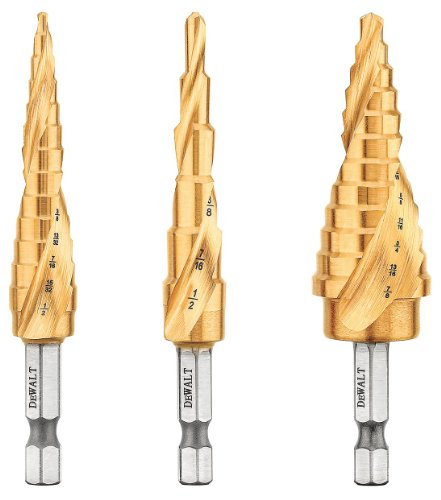
A step drill bit should cover the hole sizes you need in one cone and have a shank your drill or driver holds securely. For small holes in thin metal, Irwin's Unibit 10231 runs 1/8 to 1/2 in in 1/32 in steps. For a wider spread, the three-bit sets from Milwaukee, DeWalt and Bosch each reach 1/8 to 7/8 in; DeWalt's has a 1/4 in hex shank for impact drivers. These picks compare published manufacturer specifications only; none was tested by us.
A step drill bit should have a size range that covers your target holes, small enough increments to land on the size you need, a shank that suits your drill or driver, and a tip that starts without wandering. A step bit, sometimes called a unibit after the name Irwin sells its step bits under, has a stair-step cone so one bit drills a range of hole sizes, usually in sheet material, according to Wikipedia's summary of drill bit types. That one property is why electricians and HVAC fitters carry them in place of a drawer of twist drills. For how step bits compare with every other bit family, see our overview of drill bit types.
Size range and increment
Range is the first filter. A single small bit such as Irwin's #1 covers 1/8 to 1/2 in, while each of the three sets below spans 1/8 to 7/8 in across three bits. Increment decides whether you can hit an in-between size: Irwin states 1/32 in steps for the 10231, and Milwaukee gives 1/32 or 1/16 in steps across its three bits. Milwaukee's catalogue goes further and lists every bit's range, increment and hole count: #1 1/8-1/2 in by 1/32 (13 holes); #2 3/16-1/2 in by 1/16 (6 holes); #4 3/16-7/8 in by 1/16 (12 holes). Bosch lists the three bits in the SDC30 as 1/8-1/2, 3/16-1/2, 3/16-7/8 in on its product page but gives no increment, and DeWalt publishes only the set's overall range, so for those two check the size marks on the bit itself before buying for one exact hole.
Shank and drive
Shanks on these bits come in three forms: a 1/4 in hex for impact drivers and quick-change holders, a hex quick-change shank, and a three-flat shank for jawed chucks. Impact drivers hold accessories in a 1/4 in hex quick-connect holder rather than jaws, so only the hex shanks go straight in. Bits with flats ground on the shank are made to resist slipping in a jawed chuck. The guide to which bit shanks fit your chuck explains keyed, keyless and hex holders.
Point and flutes
A self-starting tip saves a centre-punch mark on thin sheet, where ordinary twist drills tend to wander. DeWalt grinds a split point that it says starts on contact, and Irwin uses its SpeedPoint tip, which it says prevents walking. Starrett describes split points in general as self-centering, needing less feed pressure and wandering less. Flutes clear chips: Milwaukee and Bosch both use two cutting edges, and DeWalt describes a double-spiral flute for chip removal.
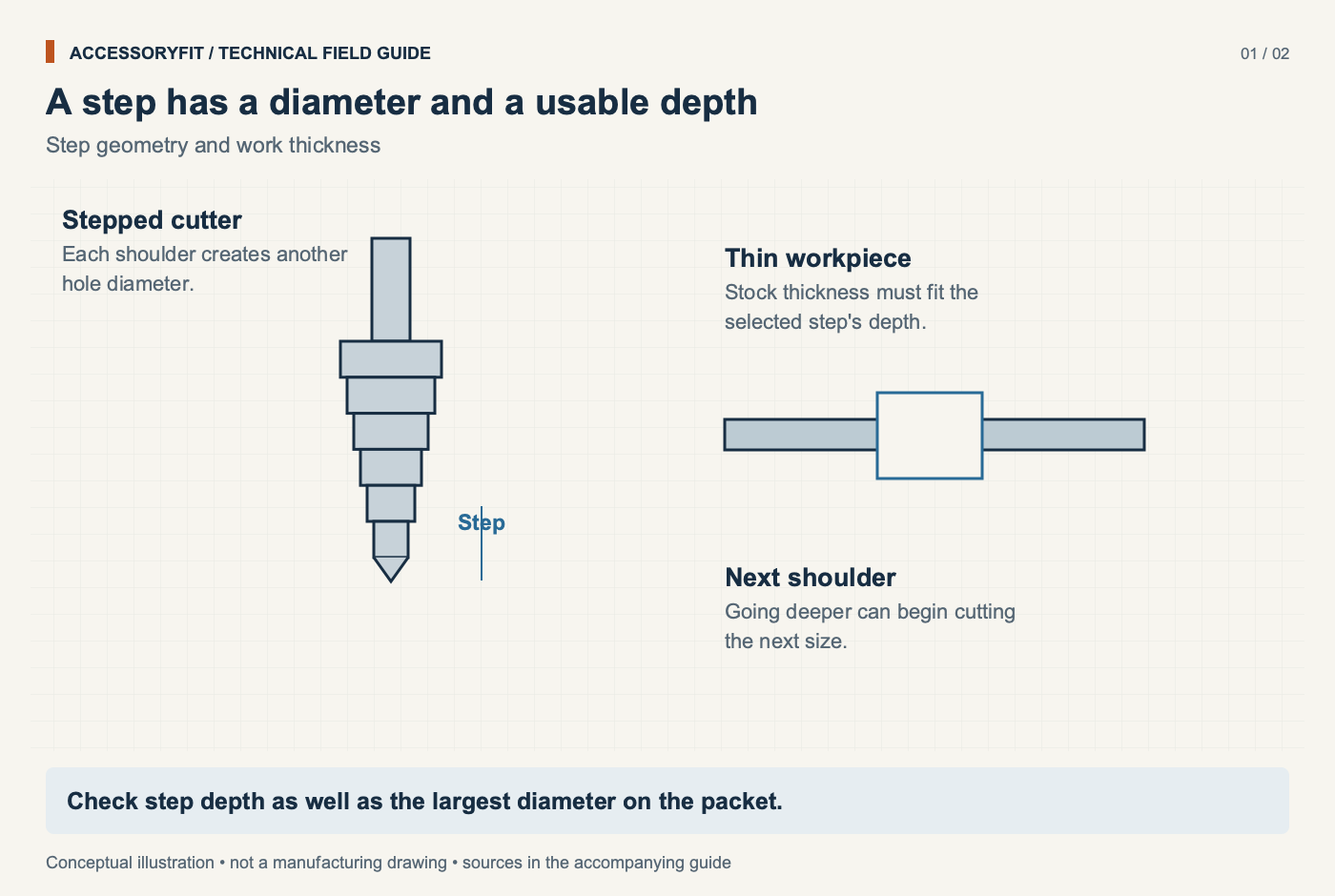
Check step depth as well as the largest diameter on the packet.
02Which step drill bits suit which work?
Product links go to Amazon. As an Amazon Associate I earn from qualifying purchases. How links are chosen.
The four products below are the step bits in our catalogue, grouped by size range and drive rather than ranked. Every figure comes from the maker's product page. For other bit categories, the accessory buying guides list the rest of our comparisons.
Small holes in thin metal: one bit, fine steps
Irwin Unibit 10231 #1 step drill bit, 1/8 to 1/2 in
Range
1/8 to 1/2 in
Step
1/32 in
Material
high speed steel
Shank
hex quick-change
Tip
SpeedPoint self-starting
Suits Pilot and screw-clearance holes in thin stainless, copper, brass, aluminium, plastic and laminate, which are the materials Irwin lists.
Skip it if Holes above 1/8 to 1/2 in, such as conduit knockouts, which need a larger bit or set.
Published 1/32 in step increment, the finest stated among the picks
Self-starting SpeedPoint tip
Hex quick-change shank
Irwin lists thin stainless, copper, brass, aluminium, plastic and laminates
Published specs of the step bit picks (manufacturer data)
Product
Bits
Range
Material
Coating
Shank
Irwin Unibit 10231 #1 step drill bit, 1/8 to 1/2 in
single bit
1/8 to 1/2 in
high speed steel
none listed
hex quick-change
Milwaukee 48-89-9221 3 pc step drill bit set (#1, #2, #4)
3
1/8 to 7/8 in
not stated
black oxide
3-flat SECURE-GRIP
DeWalt DWA1790IR IMPACT READY titanium nitride step drill bit set, 3 pc
3
1/8 to 7/8 in
high speed steel
titanium nitride
1/4 in hex
Bosch SDC30 3 pc. high-speed steel Turbo step drill bit set
3
1/8 to 7/8 in
high speed steel
none listed
not stated
03How do the step bit picks differ?
The three sets share the same overall range, so they differ by shank, coating and tip, while the Irwin bit differs by being a single small bit with a published step size.
Hex shank vs three-flat shank: which drive do you use?
Choose the hex-shank DeWalt set if you reach for an impact driver, and the three-flat Milwaukee set if you use a drill with a jawed chuck. DeWalt says its set is optimised for impact drivers and also works in rotary drills; Milwaukee describes its set as optimised for cordless drills at high speed. Impact-rated drill bits in general use a hex shank so they fit both impact drivers and drills, according to Milwaukee.
Coated vs uncoated: does it matter?
The coatings differ, and the sources behind this page do not support a firm claim about how much each adds. Milwaukee uses black oxide, DeWalt uses titanium nitride, and Bosch and Irwin list plain high-speed steel. Wikipedia credits black oxide with heat resistance and lubricity and titanium nitride with longer life, but those figures come from one general source and are not repeated here as fact. High-speed steel itself is the standard material for drilling metal and has largely replaced carbon steel.
Single bit vs set: which suits your work?
A single small bit suits repeated pilot and fastener holes in thin sheet. A set suits mixed work where some holes are small and some reach the top of the 1/8 to 7/8 in span, such as panel and enclosure work. Milwaukee names its bits #1, #2 and #4, and Irwin calls the 10231 its #1; the number is a family label, not a size, so compare the published ranges rather than the numbers.
04Can a step bit cut conduit knockout holes?
Yes, within its range, but conduit holes are sized by the fitting, not by the conduit's trade name. Trade size is nominal: the knockout for the smallest conduit size in Klein's table is 0.875 in, not the size printed on the conduit. Klein's figures for the next two sizes are 1.115 in and 1.362 in.
The first knockout in the table converts to the same decimal as the largest size on the three sets (1/8 to 7/8 in). The next two knockouts are larger than any step on these picks, which is where a bi-metal hole saw or knockout punch takes over. Note the limits of this data: the knockout sizes come from a single source, and no manufacturer page behind this guide pairs a particular step with a particular conduit size. Check the connector maker's required hole before drilling an enclosure. Our page on matching hole saws to fittings lists pipe outside diameters and hole saw arbors for the larger sizes.
Electrical knockout hole sizes by conduit trade size (Klein data)
Conduit trade size
Knockout hole
Klein part
1/2 in
0.875 in (22.2 mm)
53820 die
3/4 in
1.115 in (28.3 mm)
53828 die
1 in
1.362 in (34.6 mm)
53837 punch
1-1/4 in
1.701 in (43.2 mm)
53850 die
1-1/2 in
1.951 in (49.6 mm)
53858 die
2 in
2.416 in (61.4 mm)
53868 die
Single source. Which hole saw to use for each knockout was not confirmed on a fetched page (see unverified_fields).
05Step bit, twist drill or hole saw: which fits the job?
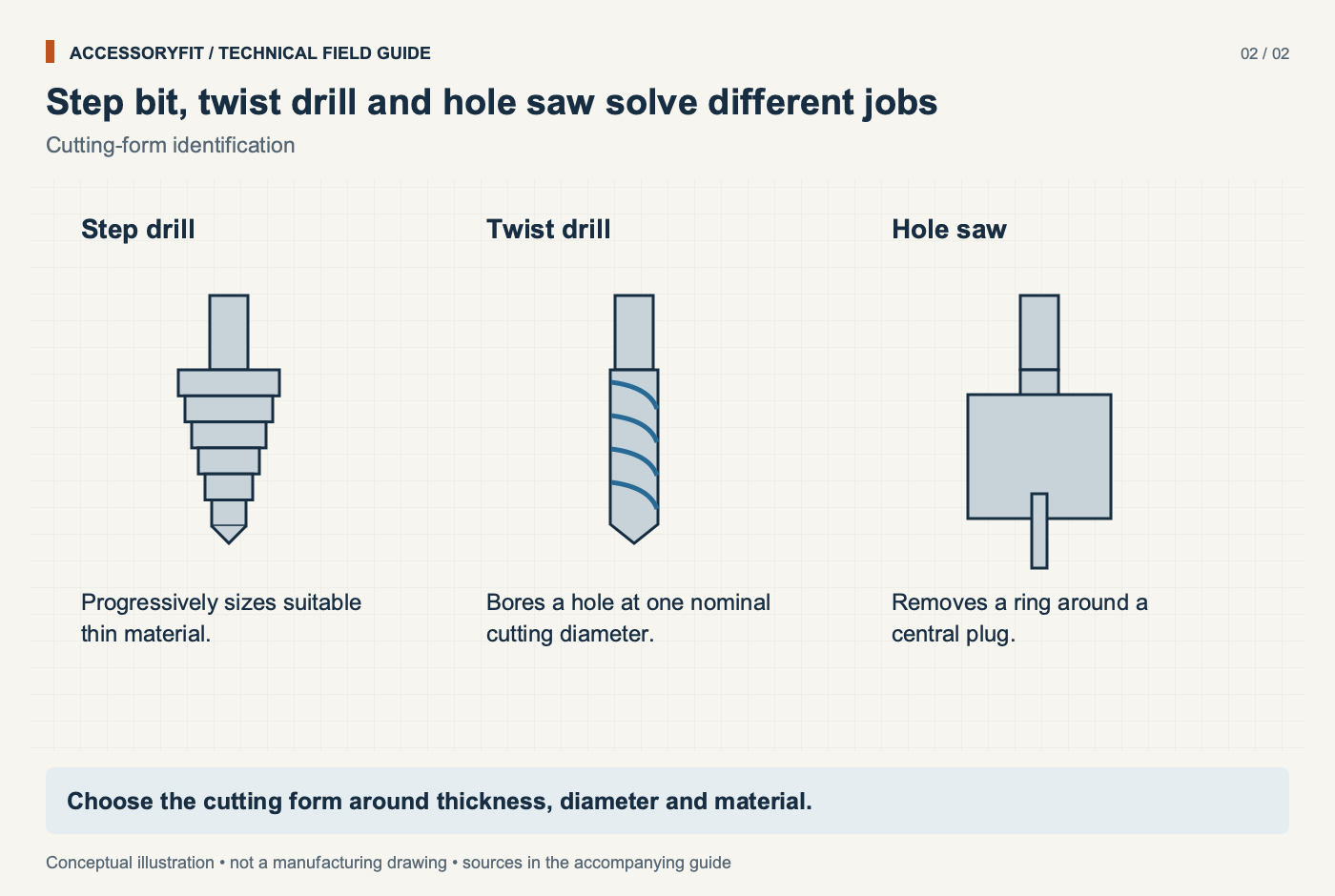
Use a step bit for many sizes in thin sheet, a twist drill for small holes in thick metal, and a hole saw for holes beyond the step bit's range. The step bit's advantage is the range from one tool; its limit is material thickness, because each step only cuts a full-diameter hole through material no deeper than that step. None of the four makers publishes step heights or a maximum material thickness on the pages behind this guide.
Where the step bit stops, a hole saw kit picks up. DeWalt's D180005 bi-metal kit, for example, covers 3/4 to 2-1/2 in, and DeWalt lists its saws as 3/4, 7/8, 1, 1-1/8, 1-3/8, 1-1/2, 1-3/4, 2, 2-1/8, 2-1/4, 2-1/2 in, so its smallest saws overlap the top steps of the three sets. DeWalt pairs them with 1/4 x 3-7/16 in stepped pilot bits on 3/8 in and 7/16 in mandrels.
For thicker steel, stainless or hardened parts, a twist drill is the better tool: plain high-speed steel for mild steel, aluminium and brass, and cobalt high-speed steel for stainless and harder steels, which is more brittle than standard HSS. Our cobalt and HSS bit picks cover those. Starrett recommends a lubricant when drilling metal, to cut friction wear, extend drill life, keep the edge sharp and lower the risk of breakage, and the same reasoning applies to the cutting edges of a step bit.
Above the top step, a bi-metal hole saw takes over. Standard bi-metal hole saws cut about 1-5/8 in deep and handle metals including stainless sheet, so depth is rarely the limit for panel work. The drill bit guides hub groups these options by material.
Choose the cutting form around thickness, diameter and material.
06When is a step bit the wrong choice?
A step bit is the wrong choice for thick stock, for holes larger than its top step, for exact sizes it does not carry, and for rotary hammers. Each of these follows from the bit's design or the tool it is fitted to.
Thick material. Once the stock is deeper than a step, the hole tapers instead of reaching full size.
An unlisted size. If the bit's steps skip the size you need, the hole ends up either undersize or one step too large. Irwin publishes 1/32 in steps and Milwaukee 1/32 or 1/16 in steps; DeWalt and Bosch publish no increment for their sets.
An impact driver with a three-flat bit. Impact drivers take hex shanks only; a three-flat shank needs a jawed chuck.
A rotary hammer. SDS rotary hammers take slotted SDS-plus or SDS-max shanks, not step bits. A chuck adapter can hold a round or flatted bit, but only for rotation-only drilling. Our comparison of SDS-Plus and SDS-Max bits explains the two hammer systems.
Bit walking on a curved or oily surface. A self-starting tip helps on flat sheet, but on round tube or a slick surface any bit can skate. A split point or a spotting drill is the published answer for metal.
07How do you confirm a step bit fits your drill?
Read the drive from your tool's specs: an impact driver needs a hex shank, while a drill with a jawed chuck takes hex, three-flat or round shanks up to its capacity. Chuck size names the largest shank a chuck accepts, not the largest hole it can drill, so a 1/2 in chuck can drive a step bit whose top step is far larger than its shank. If you only know the tool's model number, you can look up what fits your tool in our accessory finder, which lists the published chuck type for each drill and driver.
08Questions readers ask
Can step drill bits go in an impact driver?
Only with a hex shank. DeWalt's DWA1790IR has a 1/4 in hex shank and DeWalt says it is optimised for impact drivers. Milwaukee's set has a three-flat shank for jawed chucks.
What is the difference between a unibit and a step bit?
None in function. Irwin sells its step drill bits under the Unibit name, and the word is often used for step bits in general, as in Wikipedia's summary of bit types.
What do the numbers on step bits such as #1 and #4 mean?
They are family labels that identify a size range within a brand, not a hole size. Irwin's #1, the 10231, covers 1/8 to 1/2 in, and Milwaukee publishes its numbers as #1 1/8-1/2 in by 1/32 (13 holes); #2 3/16-1/2 in by 1/16 (6 holes); #4 3/16-7/8 in by 1/16 (12 holes). Compare published ranges between brands rather than the numbers.
Do you need oil when using a step bit on steel?
Starrett recommends a lubricant when drilling metal because it reduces friction wear, extends drill life, keeps the edge sharp and lowers breakage risk. None of the four step bit makers' pages behind this guide gives its own lubricant instruction.
Makita: B-68959 1/4 in x 4 in Glass and Tile Bit, 3 Flat Shank; 763198-1 3/8 in Keyless Chuck Adapter; 9557PB angle grinder instruction manual; 5007F 7-1/4 in circular saw instruction manual; B-59259 Adapter, SDS-PLUS to 1/4 in Hex
Milwaukee Tool: 1/4 in SHOCKWAVE Impact Duty RED HELIX Titanium Drill Bit 48-89-4613; 4PC Ceramic Tile & Glass Bit Set 48-20-8988; 48-89-9221 3PC Step Drill Bit Set product page; 2019 Accessory Catalog; M12 FUEL Installation Drill/Driver 2505-20; M12 FUEL 1/2 in Drill/Driver 3403-20; SHOCKWAVE Impact Duty 2 in ECX #1 Power Bits 48-32-4144; HOLE DOZER Door Lock Installation Hole Saw Kit 49-22-4063; Small Thread Arbor 3/8 in Shank 49-56-7010; Large Thread Quick Change Arbor 7/16 in Shank 49-56-7240; 5PC 3/8 in QUIK-LOK Arbor Set 49-56-7545; Hole saw arbor assembly instructions (49-56-9100, 49-56-7250, 49-56-7010, 49-56-6560); M18 FUEL oscillating multi-tool 2836-20 operator's manual (58-14-0217d1); Cat. No. 2715-20, 0757-20 operator's manual (58-14-0017)
OSHA: 29 CFR 1910.215 Abrasive wheel machinery; 29 CFR 1910.243 Guarding of portable powered tools; 29 CFR 1926.303 Abrasive wheels and tools; 29 CFR 1926.300 General requirements (Tools, hand and power); 29 CFR 1926.304 Woodworking tools
Penn Tool Co: Jacobs 32BA-1/2 plain bearing geared key drill chuck, 1/2-20 mount
Schlage (Allegion): Generic door prep, knob/lever, no holes (115799)
Stanley Black & Decker (IRWIN, LENOX): IRWIN 29-pc Cobalt M-35 Metal Index Drill Bit Set 3018002; Left-hand mechanics length cobalt alloy high speed steel drill bit sets; 10231 UNIBIT 1/8-1/2 in step drill bit #1 product page