Why a drill bit walks off the mark, and how to keep holes on line
A drill bit walks because an ordinary twist point has nothing to hold it on a flat surface, so it skates before it bites. In metal, start with a small spotting (pilot) drill or switch to a split-point bit; in wood, use a brad-point bit whose centre spur pins the mark. If the hole still wanders, check that the bit type suits the material and that the bit is held straight. Replace a general-purpose set with split-point or self-centring bits when walking keeps costing you holes.
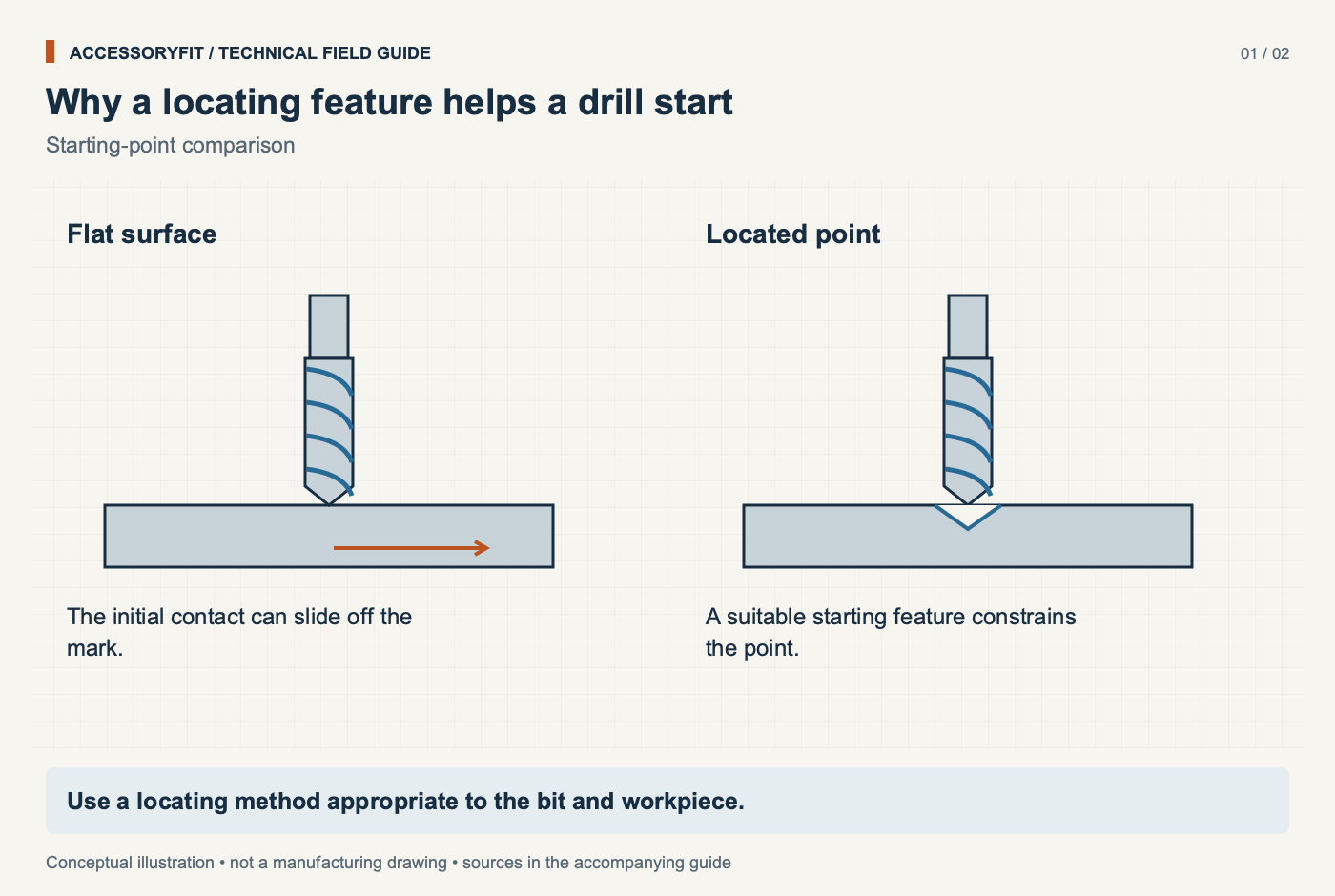
A bit walks when its point cannot grip the surface at the moment it starts turning, so the cutting edges push it sideways instead of down. Reference sources on drill geometry describe this as a basic trait of ordinary twist drills on a flat face, and they name three remedies by material: a spotting drill in metal, a brad-point bit in wood, and split points to reduce deviation. The causes below follow that logic, starting with the point itself.
A conventional twist point: the general-purpose point is not self-centring, so it slides on a flat face until a cutting lip catches.
No starting recess in metal: a hard, smooth surface gives the point nothing to seat in.
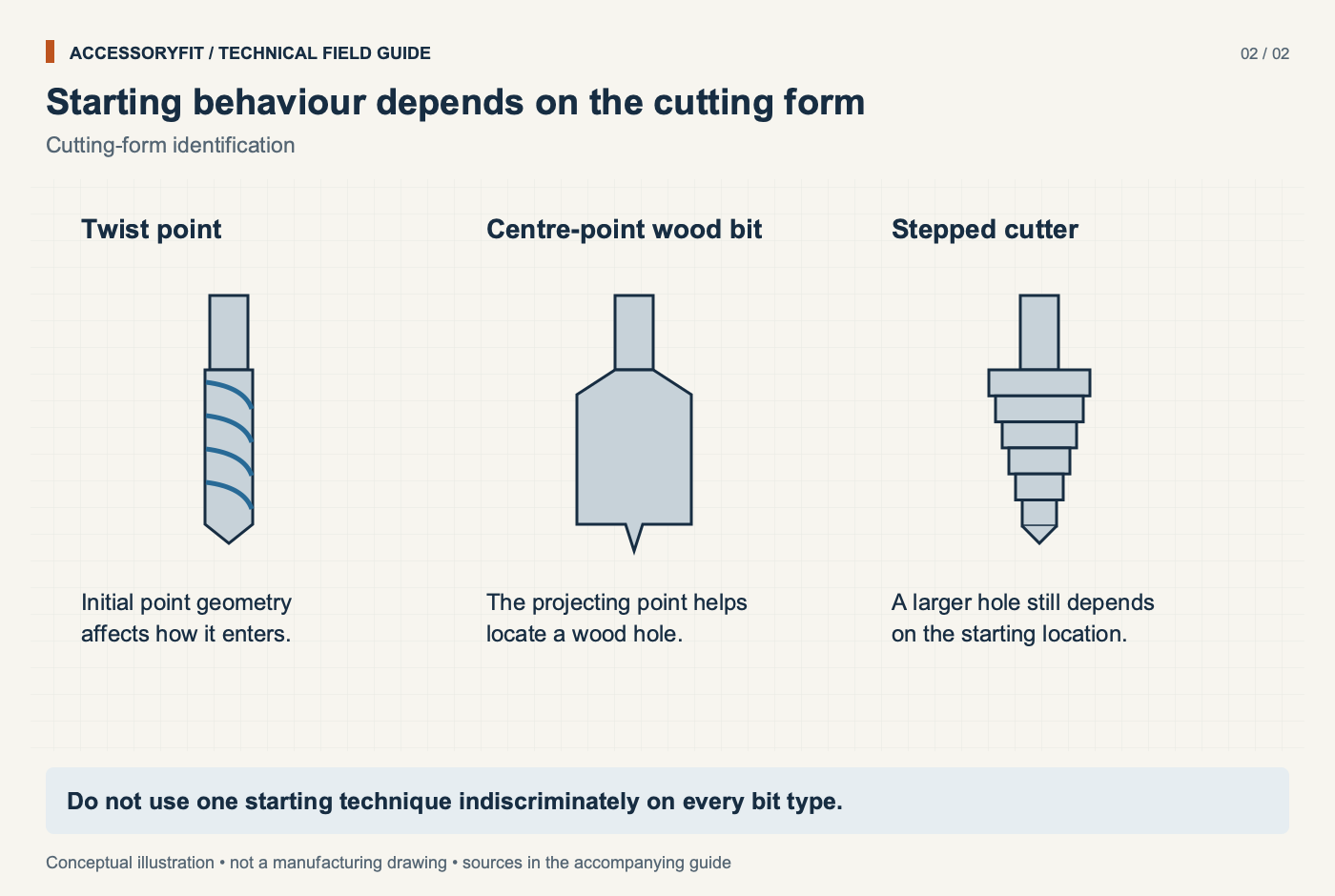
A metal bit used in wood: a twist bit has no spur, so nothing pins the centre while the lips start cutting.
The wrong bit family for the hole: large holes cut with a bit that has no guiding centre, where a hole saw on a pilot drill or a centred wood bit would track.
A bit that is not held straight: a tilted start puts the point on the work at an angle and risks a side load on the bit.
Each cause has its own check and fix. If you are not sure which bit families exist, the drill bits by material hub groups them by what they cut.
Use a locating method appropriate to the bit and workpiece.
02Why does a standard twist bit skate on metal?
A standard twist bit skates on metal because its general-purpose point, ground to 118 degrees, is a compromise for wood, metal and plastic and is not self-centring. On painted steel, polished aluminium or a curved tube, the tip has no recess to drop into, so the first contact slides until a cutting lip catches.
Point angle also changes by workpiece. The recommended range for mild and stainless steel is 118–135 degrees, a figure given in the Wikipedia drill bit reference rather than by a bit maker, and plastics take a much sharper point. The table below shows the published ranges. A bit sharpened for one material can start poorly on another, so a set reground at home is worth checking before blaming technique.
Recommended twist drill point angle by workpiece material
Material
Point angle (degrees)
Aluminum
90-135
Brass
90-118
Cast iron
90-118
Mild steel
118-135
Stainless steel
118-135
Plastics
60-90
Single source (Wikipedia tool geometry table, citing a machining reference).
03How does a spotting or pilot drill stop walking in metal?
A spotting or pilot drill stops walking because it cuts a small, accurately placed recess that the full-size bit then follows. Once that seat exists, the larger point has somewhere to centre instead of a flat face to slide across.
How do you confirm this is the problem?
If the bit wanders before it has cut a full circle and then drills cleanly once it is in, the start is the problem rather than the bit's sharpness. A hole that is round but in the wrong place points to the start; a hole that is oversized or ragged points to something else, such as a damaged lip.
How do you fix it?
Drill a small hole on the mark first, then open it up with the finished size. In steel, Starrett recommends a lubricant, which reduces friction wear, keeps the edge sharp and lowers the risk of breaking the bit. Edge life matters for walking because a rounded lip starts less cleanly: in a 2005 COBEM lab study of 10 mm cobalt HSS drills in alloy steel, flood coolant made drills last 52% longer on average than dry drilling, and pushing the cutting speed from 45 to 60 m/min shortened drill life considerably. The study is older and used industrial coolant, but it is still the clearest open-access figure of its kind, and it supports lubricating and slowing down on the pilot hole as well as the finished size. Starrett's speed chart gives lower speeds as diameter rises; for example it lists about 1167 rpm for a small HSS drill in mild steel. If you need the decimal size of the pilot or finished bit, the decimal drill size table lists fractional, number, letter and metric sizes side by side.
Does a center punch help?
Yes. A center punch struck with a hammer leaves a small dimple on the hole centre, so the drill point has a seat and does not wander when it starts, as McMaster-Carr's listing for a Starrett center punch describes it. The punch mark and a spotting drill work together: the punch places the centre, and the spotting drill turns that dimple into a true recess for the finished bit. The punch source is a supplier listing rather than a drilling guide from a bit maker, so it states the purpose of the tool but no depth or technique.
04Does a split-point bit stop walking?
Yes, to a large degree: a split point is ground so that the tip cuts as soon as it touches, rather than sliding until the lips catch. Starrett's catalogue describes its split-point HSS drills, ground to 135 degrees, as self-centring, easier to start, needing less feed pressure, and wandering less. That is one maker's description, but the drill bit reference makes the same general point that split points reduce deviation.
Bit makers market the same idea under their own names. DeWalt's PILOT POINT bits are sold as starting on contact, Bosch calls the tip on its cobalt bits a no-skate tip, and DeWalt's BLACK & GOLD set uses a 135 degree split point. These are manufacturer descriptions; nothing here was drilled or measured by us. A split point does not remove the need for a straight start, and on very hard or curved stock a spotting hole is still the surer route.
One common belief about these bits needs correcting. Cobalt bits are often taken to be ordinary bits with a coating, but cobalt is alloyed into the high-speed steel itself, while black oxide and titanium nitride are surface finishes. A cobalt bit with a split point helps on stainless; a coating alone does not change the point geometry that causes walking.
05How do you stop a bit walking in wood?
Use a brad-point bit. A brad-point (lip and spur) bit is a twist bit optimised for wood, and its centre spur holds the bit in line from the first turn, which is why the drill bit reference names it as the wood answer to wandering.
For larger holes, the bit family matters more than the start. Forstner bits bore clean, flat-bottomed holes, can cut on the edge of a board and can overlap holes, which a twist bit or spade bit cannot do. Spade bits are fast and rough and splinter where they exit; versions with spurs on the cutters leave a cleaner hole with less breakout. Auger bits add a self-feeding screw tip and a long spiral flute for deep holes. The trade-offs are set out in our comparison of Forstner, spade and auger bits.
Speed is a separate issue from walking, but it matters once the bit is in. Fisch and Engineering ToolBox both give lower speeds for larger Forstner bits, and an overheated bit scorches the wood and dulls quickly.
Which bit suits which material, from drill bit references and Starrett
Material
Bit type
Notes
Softwood / hardwood
brad point, spade, Forstner, auger, HSS twist
brad point stays in line in wood
Mild steel, aluminium, brass
HSS twist (118 or 135 degree split point)
use lubricant
Stainless / harder steels
cobalt HSS (M35/M42), 135 degree split point
lower rpm; cobalt is more brittle
Concrete, brick, masonry
carbide-tipped masonry / SDS bits with hammer action
3-40 mm common
Ceramic tile, porcelain, glass, stone
diamond core bit or diamond hole saw; carbide spear-point for glass
water cooling; low speed for glass
Sheet metal, many sizes
step (unibit) drill
Summary table. Each row is supported by facts above.
06How do you keep large holes on the mark?
For holes beyond twist-bit sizes, use a tool that carries its own centre: a hole saw on an arbor with a pilot drill, or a step drill in sheet material. A hole saw cuts only a ring, and the pilot drill in the arbor locates it before the teeth touch, so the saw cannot skate as long as the pilot stays in its hole. Milwaukee's arbor set, for example, uses a 1/4 in HSS pilot bit.
Standard bi-metal hole saws cut about 1-5/8 in deep, and Starrett notes that its deep-cut saws, at about 2 in, need arbors with an extended pilot drill. A short pilot can leave a deep saw unguided before it has cut deep enough to steady itself. When a hole saw does wander, check that the pilot is tight in the arbor and long enough for the saw, and pick the saw size from the hole saw size chart rather than by eye.
In thin sheet, a step drill cuts a range of sizes from one cone-shaped bit, and its small first step acts as its own starting hole. Our guide to step drill bits compares models for electrical boxes and panels, and for plumbing and lock work the bi-metal hole saw sets guide covers kits with arbors and pilot bits.
Do not use one starting technique indiscriminately on every bit type.
07Is it safe to keep drilling when a bit wanders?
No. A bit that skates can slip off the work toward your hand, and a bit forced back onto the mark at an angle is loaded sideways. Carbide and cobalt bits are harder than plain HSS but also more brittle, and the drill bit reference advises keeping the drill straight so that they do not snap. Stop, make a proper start, and then continue.
08How do you start a hole that stays on the mark, step by step?
The sequence below uses only the methods the sources name: the right bit family, a small starting hole in metal, a straight start and the right speed. Each step removes one cause from the list above.
Disconnect the drill Unplug the drill or remove its battery before fitting a bit.
Match the bit to the material Use a brad-point bit in wood, a split-point HSS or cobalt bit in metal, and a step drill or hole saw for large holes in sheet.
Seat the bit squarely in the chuck Tighten the chuck on the shank, using the flats on a three-flat shank where the bit has them, so the bit runs true.
Center-punch the mark in metal Strike a center punch on the mark with a hammer so the point has a dimple to seat in.
Cut a starting recess in metal Drill a small spotting or pilot hole in the punch mark, then switch to the finished size.
Hold the drill straight Keep the bit square to the surface as it starts, especially with brittle cobalt or carbide bits.
Set the speed and lubricate metal Use a lower speed as the diameter rises, following the published chart for the material, and apply lubricant when drilling steel.
Check the hole before going deeper Once the point has cut a full circle on the mark, continue; if it has drifted, stop and correct the start rather than forcing the bit sideways.
09How do you prevent walking on future holes?
Prevention comes down to owning the right points for the work you do and starting every metal hole on a recess. The habits below cover each cause.
Keep a set of split-point bits for metal rather than relying on general-purpose points.
Keep brad-point bits for wood, and Forstner bits where the hole must be flat-bottomed or overlap another hole.
Center-punch metal and drill a small starting hole in steel, aluminium and tube before the finished size.
Use bits with flats on the shank where you can, since three-flat and spade-style shanks are made to resist slipping in the chuck.
Use a hole saw with a pilot drill long enough for the saw's depth.
Use lubricant in metal to protect the edge.
For screws in wood, a pilot hole does a similar job: it guides the screw and stops the wood splitting, especially in dense species such as oak. The clearance and pilot holes chart lists sizes by screw gauge for hardwood and softwood.
10When should you replace the bit rather than change technique?
Replace the bit when the point geometry is wrong for the job or the edge is damaged, not because one hole wandered. A set of plain conventional points used mostly on steel is the clearest case: a split-point set addresses the cause directly. A cobalt bit with a chipped lip, or any bit whose lips are visibly uneven, will cut off-centre whatever the start. The fact base behind this page holds no wear limit for drill bits, so judge by how a clean, correctly started bit behaves.
The sets below are sold by DeWalt and Bosch with tips the makers describe as self-centring or as starting on contact. Specifications come from each manufacturer's product page. For a broader comparison by metal type, see our guide to bits for steel and stainless.
11Which replacement bit sets are made to start without walking?
Product links go to Amazon. As an Amazon Associate I earn from qualifying purchases. How links are chosen.
Each set below is a fractional-inch twist bit set with a split or self-centring point, as stated by the maker. They are grouped by material and use, not ranked. Sizes are in inches; check the metric equivalent in the drill size table if you work to metric drawings.
For mixed wood, plastic and light metal work
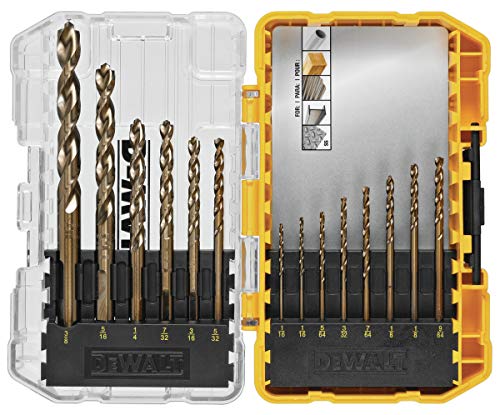
DeWalt DWA1184 BLACK & GOLD black oxide drill bit set, 14 pc
Pieces
14
Material
high speed steel
Finish
black oxide
Point
135 degree split point
Shank
3-flat
Suits General drilling in plastic, wood and metal where a split point is wanted on every size.
Skip it if Stainless steel and hard alloys, which DeWalt's cobalt sets are made for.
135 degree split point, which DeWalt says helps reduce walking
Three-flat shank resists slipping in the chuck
Black oxide finish on high speed steel
Size range not stated on the manufacturer page captured here
Plain HSS, not a cobalt alloy, so not intended for stainless
12What related drilling problems often appear with walking?
Walking often comes with oversized holes, snapped small bits and tapped threads that start crooked, because all three begin with a bit that did not centre. A tap drill that wanders leaves a thread off position even when the size is right; the tap drill sizes chart gives the drill for each thread, and a spotting hole first keeps it on the layout mark. Tile and glass are a separate case: glass bits are run at low speed and diamond tile tools need water cooling at all times, which corrects the idea that hard surfaces should be drilled fast. On tile, Bosch's advice for a clean start is to begin slowly with light pressure and raise pressure and speed only once the bit has bitten, with the hammer action off; Bosch, Milwaukee and Makita all limit their tile bits to rotary drilling. Our ceramic and porcelain tile bits guide covers bits that start on glaze.
Why does my drill bit slide across metal before it starts cutting?
The general-purpose twist point is not self-centring, and on smooth metal there is no recess to hold it. Drill a small spotting hole first, or use a split-point bit, which drill references and Starrett describe as self-centring.
Is a split point the same as a pilot point?
PILOT POINT is DeWalt's name for its self-starting tip; DeWalt describes its PILOT POINT cobalt bits as having a split tip. Bosch calls its version a no-skate tip. The common idea is a point ground so that it cuts on contact instead of skating.
Which bit stops wandering in wood?
A brad-point bit. Its centre spur holds the bit on the mark and keeps it in line as it cuts. For large, clean holes, a Forstner bit bores a flat-bottomed hole and can even cut on a board's edge.
Why does my hole saw jump off the mark?
The pilot drill in the arbor locates a hole saw. If it is loose, missing or too short for a deep-cut saw, the saw has no centre. Starrett says deep-cut hole saws need arbors with an extended pilot drill.
Does a coated bit walk less than an uncoated one?
Not because of the coating. Black oxide and titanium nitride are surface finishes that affect heat and wear; walking comes from point geometry, so look for a split or self-centring point instead.
Drill bit size chartFind pilot and finished sizes across fractional, number, letter and metric.
References 67 documents, 35 publishers
ABCM, COBEM 2005 proceedings: Influence of the Lubri-Cooling System on the Life of TiAlN Coated HSS Twist Drills when Machining Blind and Through Holes
Annals of Work Exposures and Health: The Effects of Bit Wear on Respirable Silica Dust, Noise and Productivity: A Hammer Drill Bench Study
Applied Ergonomics (Elsevier): Pneumatic rock drill vs. electric rotary hammer drill: Productivity, vibration, dust, and noise when drilling into concrete
BioResources: Effect of Chip Thickness and Tool Wear on Surface Roughness and Cutting Power during Up-Milling Wood of Different Density
Bosch: Bits for drilling tiles (tile drilling guide); CYL-9 Soft Ceramic drill bit set 2 608 587 169; 1617/1618 router operating/safety instructions (2610051825); GBM 1600 RE Professional online manual: changing the drill chuck; Cobalt Drill Bit Sets (CO14B) product page
DeWalt: DWA1184 Black Oxide Set (14 pc.) product page; DWE575 circular saw instruction manual (N786997); DCD771C2 20V MAX Cordless Drill/Driver Kit; DW1354 Titanium Nitride Coating Drill Bit Set product page; DWA1240 Industrial Cobalt Alloy Steel Set product page
DICTUM (retailer) / Fisch (manufacturer): Fisch Wave Cutter Evolution Forstner Bit, 19 mm (product page with speed guidance)
Engineering ToolBox: Hardwood and Softwoods - Recommended Drill Bit Speeds; Steel Pipe Dimensions (ANSI schedule 40 and 80); ASTM B88 seamless copper water tubes - dimensions; ASTM D1785 and ASTM F441 - PVC and CPVC pipes schedule 40 and 80
Freud and Diablo: Get the most out of your Freud bits by routing at ideal feed rates and speeds
Hardwick & Sons: Jacobs Multi-Craft Keyless Chuck 3/8 in capacity, model 30353
Health and Safety Executive (UK): Hand-arm vibration: The Control of Vibration at Work Regulations 2005. Guidance on Regulations (L140, Second edition)
Milwaukee Tool: 1/4 in SHOCKWAVE Impact Duty RED HELIX Titanium Drill Bit 48-89-4613; 4PC Ceramic Tile & Glass Bit Set 48-20-8988; 2019 Accessory Catalog; HOLE DOZER Door Lock Installation Hole Saw Kit 49-22-4063; Small Thread Arbor 3/8 in Shank 49-56-7010; Large Thread Quick Change Arbor 7/16 in Shank 49-56-7240; 5PC 3/8 in QUIK-LOK Arbor Set 49-56-7545; Hole saw arbor assembly instructions (49-56-9100, 49-56-7250, 49-56-7010, 49-56-6560); M18 FUEL oscillating multi-tool 2836-20 operator's manual (58-14-0217d1); M12 FUEL Installation Drill/Driver 2505-20; M12 FUEL 1/2 in Drill/Driver 3403-20
MISUMI USA: Pilot Hole Sizes for Wood Screws
NIOSH: Nonfatal Tool- or Equipment-Related Injuries Treated in US Emergency Departments Among Workers in the Construction Industry, 1998-2005; Nonfatal work-related injuries treated in hospital emergency departments in the U.S., 2012-2023
OSHA: 29 CFR 1910.215 Abrasive wheel machinery; 29 CFR 1910.243 Guarding of portable powered tools; 29 CFR 1926.303 Abrasive wheels and tools; 29 CFR 1926.300 General requirements (Tools, hand and power); 29 CFR 1926.304 Woodworking tools
Penn Tool Co: Jacobs 32BA-1/2 plain bearing geared key drill chuck, 1/2-20 mount
Rotho Blaas: HBS Softwood screw technical data sheet (EN 05-19)
RS Components: Wood Screws Guide
Schlage (Allegion): Generic door prep, knob/lever, no holes (115799)
SPAX: SPAX Drill 2 Step
Stanley Black & Decker (IRWIN, LENOX): IRWIN 29-pc Cobalt M-35 Metal Index Drill Bit Set 3018002; Left-hand mechanics length cobalt alloy high speed steel drill bit sets