Router bit profiles: what each bit cuts and how to choose one
Pick a router bit by the shape you want left in the wood, then by how the cut is guided, then by shank and speed. Round-over, cove, chamfer and ogee bits shape an edge and ride a bearing along it; straight, spiral, V-groove and dovetail bits cut grooves and joints guided by a fence, jig or template. Choose the largest shank your collet accepts, 1/2 in where the router takes it, and never run a bit faster than the speed its maker marks on it. Panel-raising bits belong in a router table.
A router bit profile is the shape the spinning cutter leaves in the workpiece: a flat-bottomed groove, a rounded edge, a hollow cove, an angled chamfer or the S-curve of an ogee. The cutter's outline is the reverse of the shape it leaves, so a round-over bit has a concave cutting edge and a cove bit a convex one. Most bits are named after the profile they produce, which is why searches for router bit types and router bit profiles land on the same question.
Every bit has the same four parts. The shank is the plain round section that the router's collet clamps. The cutting edges, usually carbide on a steel body, form the profile. The cutting diameter is the widest point the edges sweep, and it decides how fast the bit may spin. Edge-forming bits add a fourth part: a ball-bearing guide that rolls along the edge of the board or a template so the profile stays the same depth all the way round.
Profiles fall into three working families, and the family tells you how the cut is guided. Edge-forming bits shape the outside of a board and steer themselves on a bearing. Grooving bits, such as straight, spiral, V-groove and dovetail bits, cut into the face and need a fence, edge guide, jig or template. Joinery bits, such as rabbeting sets, rail and stile pairs and raised-panel cutters, make the mating parts of doors, drawers and frames. The router bit guides hub collects every page on the site that deals with these families.
02Which router bit profiles are most common, and what does each one cut?
The profiles in the table below cover most hand-held and table routing, from softening an edge to cutting cabinet-door joints. Each row names one example bit from a maker's catalogue, with its shank, cutting diameter and the speed the maker rates it for. The example ratings are useful because they show the pattern clearly: the wider the profile, the lower the rated speed. A bit of the same profile in a different size can carry a different rating, so treat the speed column as an illustration and read the figure supplied with your own bit.
Starter sets show which profiles makers treat as the basics. Bosch's Canadian page lists the six bits in its Bosch RBS006 6 pc. multi-purpose router bit set (1/4 in shank) as 3/8 in trimming; 1/4 in straight; 1/2 in straight; 1/4 in radius roundover; 1-1/4 in 45 deg chamfer; 1/2 in dovetail: two straight bits, a trimming bit and one each of the round-over, chamfer and dovetail families. The larger Bosch RBS015MBS 15 pc. Carbide-Tipped Wood Router Bit Set keeps those families and adds cove, Roman ogee, V-groove, slotting, rabbeting and both flush trim and top-bearing trim bits, all on the same small shank.
Common router bit profiles, how each is guided and an example bit, from Whiteside, Freud and Rockler pages
Profile
What it cuts / typical use
Guide
Example bit (shank, diameter)
Example rated speed
Straight
Grooves, dadoes, mortises; plunge-capable
None (use fence or guide)
Whiteside 1074 (1/2 in shank, 17/32 in)
16,000-18,000 rpm, max 24,000
Flush trim (bottom bearing)
Trim to a template or edge underneath; laminate, veneer, face frames
Bearing at tip
Whiteside 2415 (1/2 in, 7/8 in)
14,000-16,000 rpm, max 18,000
Pattern (top bearing)
Follow a template fastened on top of the workpiece
Bearing on shank side
Rockler pattern flush trim (1/2 in, 3/4-1-1/8 in)
not recorded
Round-over
Rounded, softened edge; the most popular edge bit
Tip bearing
Whiteside 2016 (1/2 in, 3-3/4 in, 1-1/2 in radius)
10,000-12,000 rpm, max 12,000
Cove (cove & bead)
Concave (and convex) decorative edge
Tip bearing
Whiteside 3212 (1/2 in, 1-5/16 in)
14,000-16,000 rpm, max 18,000
Chamfer
45 degree bevelled edge; mitred corners
Tip bearing
Whiteside 2310 (1/2 in, 2-5/8 in)
10,000-12,000 rpm, max 12,000
Roman ogee
Concave plus convex curve; table and top edges
Tip bearing
Whiteside 2210 (1/2 in, 2 in)
10,000-12,000 rpm, max 12,000
Rabbeting (bearing set)
Recessed shoulder along an edge; depth set by bearing
Interchangeable tip bearings
Freud 32-522 (1/2 in, 1-3/8 in); Whiteside 1952 (1/4 in, 1-3/8 in)
Whiteside 1952: 13,000-15,000 rpm, max 18,000
Dovetail
Interlocking dovetail joints (drawers, boxes)
Jig or template guide
Whiteside D14-75 (1/2 in, 3/4 in, 14 deg)
14,000-16,000 rpm, max 18,000
V-groove
V-shaped grooves, lettering, sign making; 60, 90 or 120 deg
None
Whiteside 1566 (1/2 in, 1-1/2 in, 120 deg)
14,000-16,000 rpm, max 18,000
Rail and stile (set)
Interlocking stile and rail joints for cabinet doors, with the panel groove cut in the same pass; two-bit set, router table
Bearings
Whiteside 6002 ogee set (1/2 in, 1-5/8 in)
12,000-14,000 rpm, max 16,000
Raised panel
Raised door and drawer panels; router table only
Tip bearing
Whiteside 5920B (1/2 in, 3-1/4 in); Freud 99-522 (1/2 in, 3-1/2 in)
Whiteside 5920B: 10,000-12,000 rpm, max 12,000
Spiral up-cut
Fast chip removal, deep cuts, mortises; clean edge on far face
None
Whiteside RU7306 (3/4 in, 3/4 in)
12,000-14,000 rpm, max 18,000
Spiral down-cut
Clean top edge; shallow grooves, dadoes, inlays
None
Whiteside RD7306 (3/4 in, 3/4 in)
12,000-14,000 rpm, max 18,000
Spiral compression
Clean edges on both faces of sheet goods
None
Whiteside UD7202 (3/4 in, 3/4 in)
12,000-14,000 rpm, max 18,000
Speeds are for the specific example bit; a bit of the same profile but different diameter can carry a different rating. Always use the speed marked on or supplied with the bit.
03Which bits shape the edge of a board?
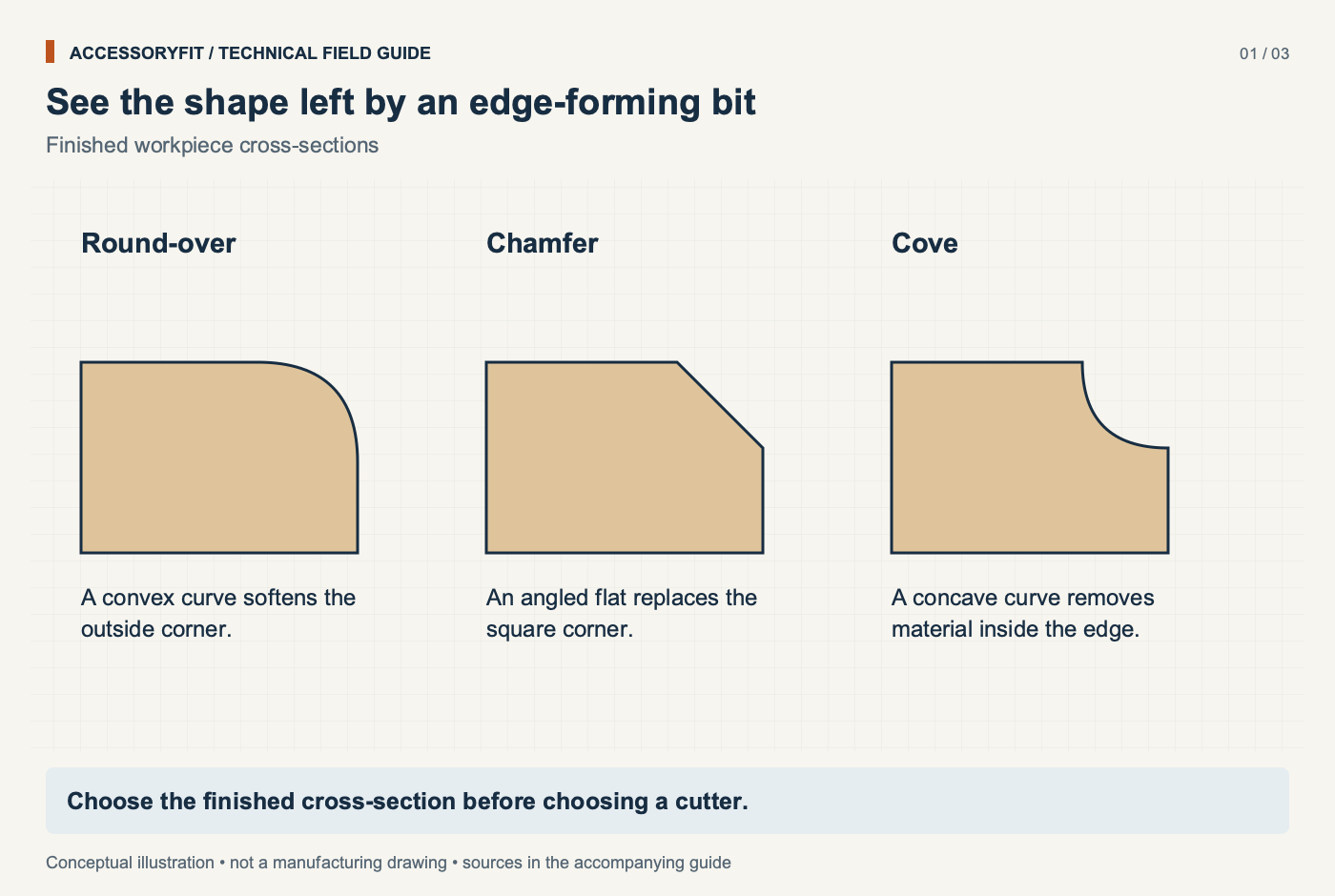
Round-over, cove, chamfer and ogee bits shape edges, and all four usually carry a bearing at the tip that rides the edge below the cut. The round-over is the profile most woodworkers buy first: it softens a sharp arris into a quarter-round, and its size is given as a radius. Freud's Freud 34-120 1/4 in radius Quadra-Cut rounding over bit (1/2 in shank), for example, cuts a 1/4 in radius and Freud lists it for softening furniture edges and making decorative beads.
A cove bit cuts the opposite shape, a hollow quarter-circle, and is often paired with a round-over to make matching table-leaf joints or mouldings. A chamfer bit cuts a straight bevel, which reads as crisper than a round-over and is also used to join mitred corners. The Roman ogee combines a cove and a bead into one S-curve and is the classic edge for table tops and shelving.
Two things follow from the bearing. First, the bearing copies whatever it rolls on, so a dent or a glue lump on the reference edge appears in the profile. Plane or sand the edge straight before routing it. Second, the bearing has to have something to ride on: if the profile would remove the whole edge, nothing is left for the bearing, and the cut must be guided by a fence or router table instead. Large edge profiles also have large diameters, which pushes them into the lower speed range covered further down.
Choose the finished cross-section before choosing a cutter.
04Which bits cut grooves, rabbets and joints?
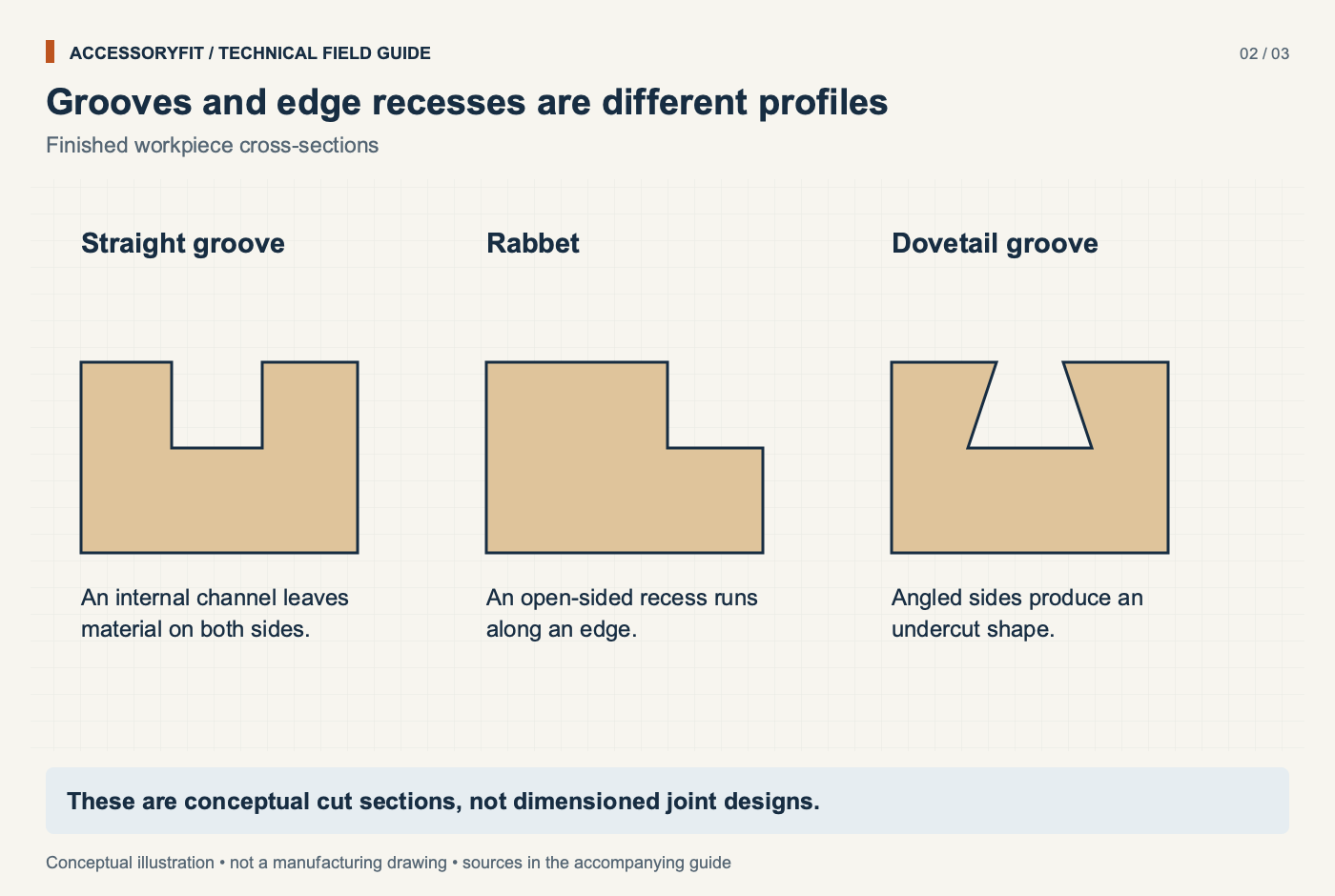
Straight, spiral, V-groove and dovetail bits cut into the face of the work, and rabbeting, rail and stile and raised-panel bits cut the parts of a joint. None of the grooving bits has a bearing, so the router must be steered by an edge guide, a straightedge clamped to the board, a router-table fence or a jig.
Straight bits cut flat-bottomed grooves, dadoes and mortises, and most can plunge straight down into the wood.
V-groove bits cut V-shaped channels for lettering, sign making and decorative lines; they are sold in several included angles.
Dovetail bits cut the angled pins and tails of drawer and box joints and are run in a jig or against a template guide.
Rabbeting bits cut a recessed shoulder along an edge. They come in sets with interchangeable bearings: a smaller bearing lets the cutter reach further into the board, so one cutter makes several rabbet depths.
Rail and stile sets are two matched bits that cut interlocking frame joints for cabinet doors, with the panel groove cut in the same pass. They are run in a router table.
Raised-panel bits shape the bevelled field of a door panel. Whiteside and Woodcraft describe them as router table bits only, with 1/2 in shanks.
A rabbet can also be cut with a straight bit and a fence, and a dado can be cut with a spiral bit. The specialised bit earns its place when the same cut is repeated many times and the bearing or matched pair saves setup.
05Is a flush trim bit the same as a pattern bit?
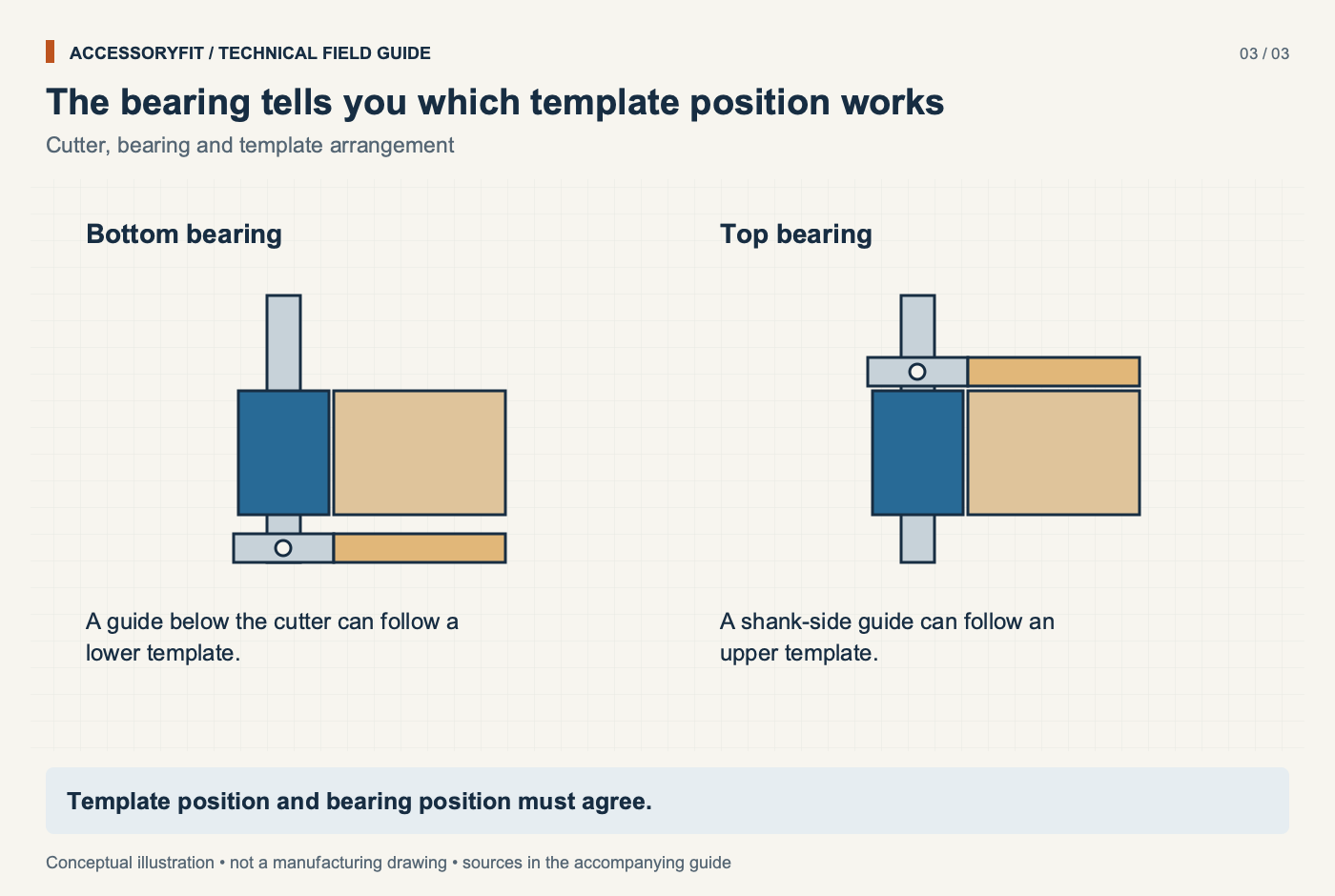
No: both cut the work flush to a guide surface, but the bearing sits at opposite ends, so the template goes on opposite sides of the workpiece. Treating them as the same bit is a common mix-up.
A flush trim bit has its bearing at the tip, below the cutter. It trims the workpiece to whatever lies underneath: a face frame, a substrate under plastic laminate or veneer, or a template screwed to the underside. A pattern bit, also sold as a top-bearing bit, has its bearing on the shank side of the cutter at the same diameter as the cutter. The template goes on top of the workpiece, which suits a hand-held router working down onto a board clamped to the bench.
The choice therefore depends on where the template can go. If the template is on the underside, as when trimming laminate on a counter, a flush trim bit is the tool. If the template sits on top, because the workpiece is easier to clamp that way or the template carries the setout marks, a pattern bit is the tool. Some makers sell bits with a bearing at both ends so one cutter can follow a template on either face.
These are conceptual cut sections, not dimensioned joint designs.
06Which spiral bit gives a clean edge: up-cut, down-cut or compression?
It depends on which face must be clean. An up-cut spiral leaves the cleanest edge on the face farthest from the router, a down-cut spiral leaves it on the face nearest the router, and a compression spiral leaves clean edges on both faces of sheet material.
Up-cut spirals pull chips up and out of the cut, which makes them the better choice for deep grooves and mortises where chips would otherwise pack in and burn. The cost is tear-out on the near face, because the flutes lift the surface fibres as they leave the wood. Whiteside's Whiteside RU2100 1/4 in solid carbide up cut spiral bit is a solid carbide up cut bit with a 1/4 in cutting diameter, listed for grooves, dados, slots and pockets.
Down-cut spirals push chips down into the groove and press the top fibres flat, so they give a crisp top edge for shallow dadoes, grooves and inlay recesses. They clear chips more slowly, so deep cuts need several shallow passes. A compression spiral has up-cut flutes near the tip and down-cut flutes above, so both faces of plywood or melamine stay clean when the bit cuts right through.
The belief that any spiral bit gives a clean top edge is wrong: an up-cut spiral is the one most likely to fray the visible face of a veneered panel.
07Which shank size should a router bit have?
A bit's shank must match a collet your router has, and when the router accepts more than one size the larger shank is the better choice. Bosch and Timbecon both advise using a 1/2 in shank whenever the router takes one, because a thicker shank is stiffer and vibrates less.
Compact or trim routers from DeWalt, Milwaukee and Makita ship with a 1/4 in collet, so they take only the smaller shank. Mid-size and full-size US routers usually come with both a 1/4 and 1/2 in collet; the Bosch 1617 family lists collet capacities of 1/4 in, 3/8 in, 1/2 in, 8 mm. In Europe metric shanks are common, and Bosch states that its POF 1400 ACE DIY router is supplied with 6 mm, 8 mm, 1/4 in collets. A metric shank and an inch shank of similar size are not interchangeable in the same collet, so a set bought in one market may not fit a router bought in another. The metric router collets guide lists the collets supplied with each router family.
The table below lists the routers in our fact base with the collets and top no-load speeds their makers publish.
Collet sizes and maximum no-load speed of selected routers, from manufacturer specifications
Tool
Collets
No-load speed
Bosch 1617EVS
1/4, 3/8, 1/2, 8 mm in
25000 rpm one source
Bosch PR20EVS
1/4 in
35000 rpm
DeWalt DW618
1/4, 1/2 in one source
24000 rpm
DeWalt DWP611
1/4 in
27000 rpm
Makita RT0701C
1/4 in; 3/8 in
30000 rpm
Values marked one source appear in a single manufacturer document; check the tool's manual or rating plate before buying.
08How large a profile can a small router run?
Only as large as its maker allows, and compact routers set a hard limit. DeWalt's manual says not to use router bits larger than 1-3/8 in in diameter in the DWP611, and Milwaukee lists a maximum bit size of 1-1/2 in for its M18 FUEL compact router. Those limits rule out large ogees, big round-overs, rail and stile sets and every raised-panel bit, whatever the shank.
Check the cutting diameter, not just the radius or the name. A round-over described by its radius can be several times wider overall, because the cutting diameter includes the bearing and both sides of the profile. Whiteside's large round-over in the profile table is a good example: it is named for its radius but measures far more across the cutter. Full-size routers also have a limit set by the hole in the sub-base, and Bosch says any cutter should be smaller than that opening by a clear margin.
09How fast should a router bit spin?
A router bit should never spin faster than the maximum speed marked on it or supplied with it, and larger bits need lower speeds. Bosch, Makita and Freud state the rule as a match between bit and tool: the bit's rated speed must be at least the router's maximum speed, because a bit run above its rating can break apart.
Router manuals turn this into speed-dial advice. Bosch and DeWalt both reserve the low dial settings for large-diameter bits and the high settings for small bits, softwoods, plastics and laminates, and both tell the user to follow the bit maker's own speed recommendation where one is given. The bit makers' ratings show why: in Whiteside's catalogue a small straight bit is rated far higher than a wide chamfer, ogee or raised-panel bit. Whiteside rates its large raised-panel bit with back cutter at a maximum of 12,000 rpm, below the top speed of every router in the table above. A bit like that only belongs in a variable-speed router turned down to the bit's rating, mounted in a table.
Published speed guidance does not fully agree. IGM's chart by bit diameter allows a higher speed for bits in the mid-large range than Whiteside gives for its own ogee and chamfer bits of similar size, and Woodworker's Journal gives broader bands again. Where they differ, the figure on the bit itself takes priority.
Template position and bearing position must agree.
Whiteside's rated speeds for individual router bits, ordered by cutting diameter
Bit (Whiteside part)
Shank
Large/cutting diameter
Recommended rpm
Max rpm
Carbide straight SC01
1/4 in
1/16 in (1.6 mm)
18,000-20,000
24,000
Straight bit 1074
1/2 in
17/32 in (13.5 mm)
16,000-18,000
24,000
Flush trim 2415
1/2 in
7/8 in (22.2 mm)
14,000-16,000
18,000
Cove & bead 3212
1/2 in
1-5/16 in (33.3 mm)
14,000-16,000
18,000
120 deg V-groove 1566
1/2 in
1-1/2 in (38.1 mm)
14,000-16,000
18,000
Roman ogee 2210
1/2 in
2 in (50.8 mm)
10,000-12,000
12,000
45 deg chamfer 2310
1/2 in
2-5/8 in (66.7 mm)
10,000-12,000
12,000
Raised panel with back cutter 5920B
1/2 in
3-1/4 in (82.6 mm)
10,000-12,000
12,000
Roundover 2016 (1-1/2 in radius)
1/2 in
3-3/4 in (95.3 mm)
10,000-12,000
12,000
Per-bit ratings from Whiteside product pages; other bits of the same diameter may carry different ratings.
10Does a carbide-tipped or solid-carbide bit last longer?
Both outlast high-speed steel by a wide margin, according to Whiteside, which says carbide cutting edges last far longer than comparable HSS router bits. The difference between the two carbide types is construction rather than edge life alone.
Independent lab work points the same way on manufactured board. In a 2016 Journal of Wood Science study cutting melamine-faced particleboard, an HSS cutter wore to a 1 mm flank-wear limit after 290 vs 1,000 m of cut (the shorter figure at the higher spindle speed), while a carbide cutter run at the higher speed was judged against a five-times-stricter wear limit and still lasted longer. No newer open-access study of this kind turned up, so it stands as the most recent estimate available. For profiles routed in MDF, chipboard or melamine, that is the practical case for carbide even on bits you use only now and then.
Whiteside describes carbide-tipped bits as carbide cutting edges brazed to a steel body, which keeps cost down and gives a rigid steel shank. Most profile bits are made this way, because a large profile in solid carbide would be very costly. Solid-carbide bits are made entirely of carbide for hardness and long edge life, and they are typical of small-diameter spiral bits such as up-cut, down-cut and compression spirals. Freud adds a coating called Perma-SHIELD to many of its bits, which it lists on both the round-over and the larger-shank set covered below. High-speed steel bits are still sold. Bosch sells HSS single-flute straight bits for hardwood, softwood, plywood, MDF and particleboard, and its page gives no speed rating for them. No maker's speed chart for HSS bits is on file; one retailer example is Burns Tools' listing of the Amana HSS1640 double-flute bit at a maximum of 18000 rpm. That is one bit's figure, not a rule for HSS, so read the rating supplied with the bit.
11How do you choose a router bit for a job, step by step?
These steps take a job from the shape you want to the bit you fit, using the guidance router and bit makers publish.
Name the shape. Decide whether the job is an edge profile, a groove or a joint, and pick the profile family from the table above.
Decide how the cut is guided. Use a bearing-guided bit for edges and templates; use a fence, edge guide or jig for grooves, dadoes and dovetails. For template work, choose flush trim or pattern by which face the template sits on.
Match the shank to a collet. Choose a shank size your router has a collet for, preferring the larger shank when both fit. Do not mix inch and metric shanks in one collet.
Check the router's diameter limit. Compare the bit's cutting diameter with the limit in the router manual and with the base opening. Compact routers rule out large profiles.
Check the speed rating. Read the bit's maximum speed and confirm the router can be set at or below it. Large bits need a variable-speed router.
Pick spiral direction for sheet goods. For veneered or melamine panels, choose a down-cut or compression spiral to protect the face that will show.
Plan the passes. Split deep cuts into several passes of increasing depth rather than one heavy pass.
12Why does a profile cut burn, tear out or pull the router?
Most bad profile cuts come from feed rate, feed direction or a dull edge rather than from the bit's shape. Bosch and Woodworker's Journal say a feed that is too slow leaves friction burns, and Freud explains why: when the bit makes fine dust instead of chips, the chips no longer carry heat away and the cutting edge dulls early. Feeding slowly for a cleaner cut is a myth; a steady, moderate feed gives the better surface.
Direction matters as much as speed. Seen from above, a hand-held router bit turns clockwise, so Bosch and Milwaukee say to move the router from left to right along an edge in front of you, counterclockwise around the outside of a workpiece and clockwise around the inside. Feeding the other way is called climb cutting. It lets the bit pull the router along, and Bosch, DeWalt and Milwaukee all say to avoid it.
Dull bits overload the motor, need more force and can break, and makers say never to use a dull or damaged bit. Deep cuts taken in one pass overload the motor too; Makita's per-pass groove-depth limits for its RP-series routers read: 15 mm with 8 mm bit; 5 mm with 20 mm bit. Bosch also advises several passes of increasing depth. Speed can burn the wood from the other direction too. ToolsToday says a bit spinning too fast for the feed takes a thinner chip with each edge, rubs instead of cutting and builds heat, so turning the speed down while keeping the feed can reduce burning. Tear-out on the top face usually means an up-cut spiral where a down-cut or compression spiral was needed. The router feed direction problems page takes each symptom in turn with checks and fixes.
13Which bits and sets cover the common profiles?
Product links go to Amazon. As an Amazon Associate I earn from qualifying purchases. How links are chosen.
These four products are the router bits and sets in our catalogue that match the profiles on this page. They are grouped by job, not ranked, and the specs come from each maker's product page. Read the speed rating supplied with any bit before use, because some of these pages do not state one we could confirm.
For trim and compact routers with a 1/4 in collet
Whiteside 402 Basic 7 Piece Router Bit Set (1/4 in shank)
Pieces
7
Shank
1/4 in
Profiles
3/8 in R cove (1801); 3/8 x 1/2 in rabbet (1900); 3/8 in R roundover (2003); 45 deg chamfer (2302); 1/4 in straight (1013); 1/2 in straight (1026); 1/2 in flush trim (2402)
Suits Owners of a compact router who want the core edge and groove profiles: cove, rabbet, round-over, chamfer, straight and flush trim.
Skip it if Routers fitted only with a metric collet, and jobs that need dovetail, ogee or V-groove profiles, which this set leaves out.
7 bits covering both edge-forming and grooving families
1/4 in shanks fit compact routers that take no larger size
Whiteside lists natural woods, composite woods and hard plastics
Whiteside lists both hand-held routers and router tables
Smaller shanks are less stiff than larger ones on routers that take both
Once the profile is chosen, the next questions are fit and value. If you are buying your first bits, the starter router bit sets page compares sets by shank size and contents. If a bit will not seat or the router came from another market, the collet guide linked above explains inch and metric sizes. To check which accessories suit a particular router model, the tool accessory lookup filters by tool, and the other technique guides cover saw blades, drill bits and abrasives in the same way.
15Questions readers ask
Do you need a router table for a raised-panel bit?
Yes. Whiteside and Woodcraft describe large raised-panel bits as router-table bits, and makers say to run them at the reduced speed rated for the bit, which is well below a router's top speed.
What does changing the bearing on a rabbeting bit do?
It changes the depth of the rabbet. A smaller bearing lets the cutter reach further into the edge, so one cutter with a set of bearings cuts several rabbet depths.
Can router bits cut plastic or aluminium?
Some can. Whiteside lists hard plastics for its basic set and hard plastics and thin aluminum for its solid-carbide up-cut spiral. Bosch's 1617 manual also lists the lowest dial setting for nonferrous metals. Check the bit maker's listed materials first.
Which way should a router travel around a picture frame?
Counterclockwise around the outside edge and clockwise around the inside of the opening, seen from above. That keeps the feed against the bit's rotation and avoids climb cutting.
Is a round-over bit sized by radius or diameter?
It is named by the radius it cuts, but its overall cutting diameter is larger, and that diameter decides the speed limit and whether a compact router can take it. Freud's 1/4 in round-over, for example, has an overall diameter of 1-1/4 in.
ABCM, COBEM 2005 proceedings: Influence of the Lubri-Cooling System on the Life of TiAlN Coated HSS Twist Drills when Machining Blind and Through Holes
Anglia Tool Centre (retailer): Trend T11EK 1/2 in router listing
Annals of Work Exposures and Health: The Effects of Bit Wear on Respirable Silica Dust, Noise and Productivity: A Hammer Drill Bench Study
Applied Ergonomics (Elsevier): Pneumatic rock drill vs. electric rotary hammer drill: Productivity, vibration, dust, and noise when drilling into concrete
BioResources: Effect of Chip Thickness and Tool Wear on Surface Roughness and Cutting Power during Up-Milling Wood of Different Density
CNC Router Store (retailer): Whiteside RU2100 up cut spiral listing
DeWalt: DWP611 compact router instruction manual (N336740); DWP611 1.25 HP max torque variable speed compact router with LED; DWE575 circular saw instruction manual (N786997), general power tool safety; DW616/DW618 Instruction Manual N384518; DW618 2-1/4 HP EVS Fixed Base Router With Soft Start product page; DWP611 1-1/4 HP Max Torque Variable Speed Compact Router product page
Festool: Collet SZ-D 8/OF 1010 (488755)
Freud and Diablo: Get the most out of your Freud bits by routing at ideal feed rates and speeds (CNC feed and speed sheet); 34-120 1/4 in Radius Rounding Over Bit product page; 91-100 13 Piece Super Bit Set product page
Health and Safety Executive (UK): Hand-arm vibration: The Control of Vibration at Work Regulations 2005. Guidance on Regulations (L140, Second edition)
Human Factors and Ergonomics Society: Construction Ergonomics: Concrete Bit Wear Increases Handle Vibration and Drilling Time
NIOSH: Nonfatal Tool- or Equipment-Related Injuries Treated in US Emergency Departments Among Workers in the Construction Industry, 1998-2005; Nonfatal work-related injuries treated in hospital emergency departments in the U.S., 2012-2023
OSHA: 29 CFR 1910.215 Abrasive wheel machinery; 29 CFR 1910.243 Guarding of portable powered tools; 29 CFR 1926.303 Abrasive wheels and tools; 29 CFR 1926.300 General requirements (Tools, hand and power); 29 CFR 1926.304 Woodworking tools
Power Tool Centre (retailer): Festool 488755 collet SZ-D 8/OF 1010 listing
Rockler: Rockler Pattern Flush Trim Router Bits - 1/2" Shank; Rockler Piloted Flush Trim Router Bits - 1/2" Shank
The Power Tool Store (retailer): Festool OF 1400 EQ-F-Plus router 578951 listing
ToolsToday: Is a flush trim bit the same as a pattern bit? (Q&A); Why Your CNC Router Bit Is Burning Wood (And Why Slowing Down Might Make It Worse); Router Safety: Best Practices for Safe, Precise, & Efficient Routing
Tribology in Industry: Comparison of Wear Behaviours of Cathodic Arc TiN, TiAlN Coated and Uncoated Twist Drills Under Aggressive Machining Conditions
Whiteside Machine Co.: 2016 roundover bit; 2210 roman ogee bit; 2310 45 degree chamfer bit; 3212 cove and bead bit; 1566 120 degree V-groove bit; D14-75 14 degree dovetail bit; RU7306 up cut spiral; RD7306 down cut spiral; UD7202 up/down cut (compression) spiral; 2415 flush trim bit; 6002 ogee stile and rail set; 5920B raised panel bit with back cutter; 1984 small pilot roundover; SC01 carbide straight bit; 1952 multi-rabbet bit set; 1074 straight bit; RU2100 1/4 in up cut spiral product page; Steel router collet / reducer bushing 6400x10; 402 Basic Router Bit Set product page
Woodcraft: Freud 32-522 4 piece rabbeting router bit set with bearings, 1/2" shank; Freud 99-522 Quadra-Cut raised panel router bit, bevel, 1/2" shank