
Section hub · How-to guides
How-to guides: choosing accessories by teeth, TPI, grit and profile
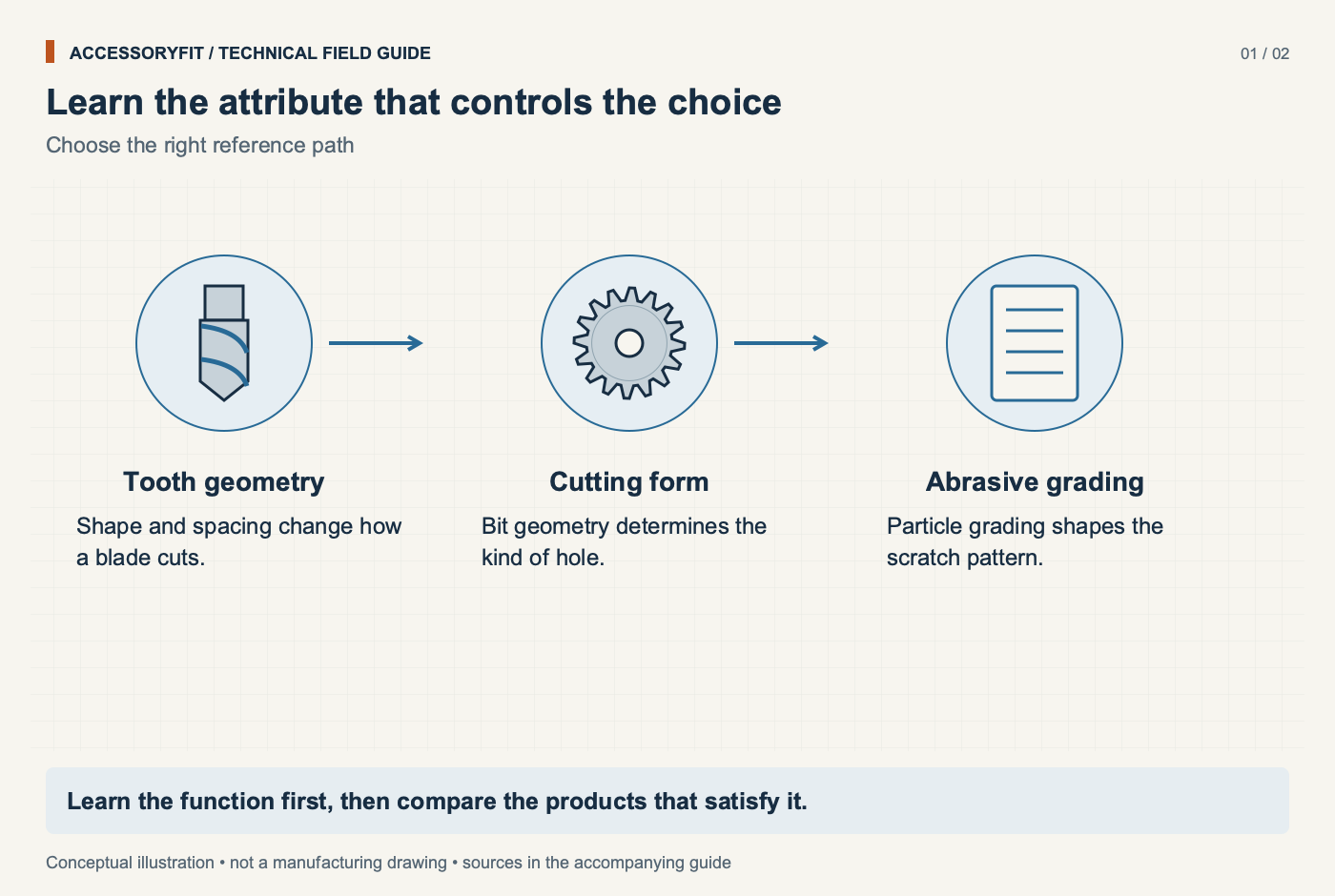
Once an accessory fits the tool, one attribute usually decides whether it suits the job. For round saw blades it is tooth count and grind; for jigsaw, reciprocating and band saw blades it is teeth per inch (TPI); for abrasives it is grit and grain; for drill bits it is point type and size; for router bits it is profile; for grinder wheels it is the type number. These guides explain each attribute, how to read it on the packaging in US and European terms, and which value suits which material.
On this page
- Which attribute decides each accessory choice?
- How do tooth count and grind decide a saw blade?
- What does TPI tell you about a straight or band saw blade?
- How do grit and grain work together on abrasives?
- How do you read drill bit sizes and choose a bit type?
- How do router profiles and wheel type numbers work?
- Which common beliefs do these guides correct?
- Where do you go after choosing?
Which attribute decides each accessory choice?
Each accessory family has one attribute that does most of the work, and learning to read it is quicker than memorising product names. The table below pairs each family with its deciding attribute and the guide that explains it. The sections after it give the core rule for each and where the full guide goes further.
These guides assume the accessory already fits. If you are not sure it does, start with the guides to what fits which tool, which cover arbors, shanks, chucks, collets, threads and pads. Many of the guides' illustrations, from shank types to grinder wheel shapes, are gathered in the power tool diagram library.
| Accessory | Deciding attribute | Read it as |
|---|---|---|
| Circular, miter and table saw blades | Tooth count, grind, hook angle, kerf | Fewer teeth rip fast; more teeth crosscut cleanly |
| Jigsaw blades | TPI, blade material, shank | Low TPI for wood, high TPI for thin metal |
| Sandpaper and discs | Grit (CAMI or FEPA P), grain | Lower number is coarser |
| Drill bits | Point type, material, size system | Fractional, metric, number or letter |
| Router bits | Profile, bearing position, shank | Shape left in the work |
| Cut-off and grinding wheels | Type number, thickness, grain | Flat Type 1/41 cuts; Type 27 grinds |
How do tooth count and grind decide a saw blade?
Fewer, square-topped teeth rip along the grain fast; more, bevelled teeth cut across it cleanly. On a 10 in blade, rip blades have as few as 24 teeth, general-purpose and combination blades 40 to 50 teeth, and crosscut blades 60 to 80 teeth.
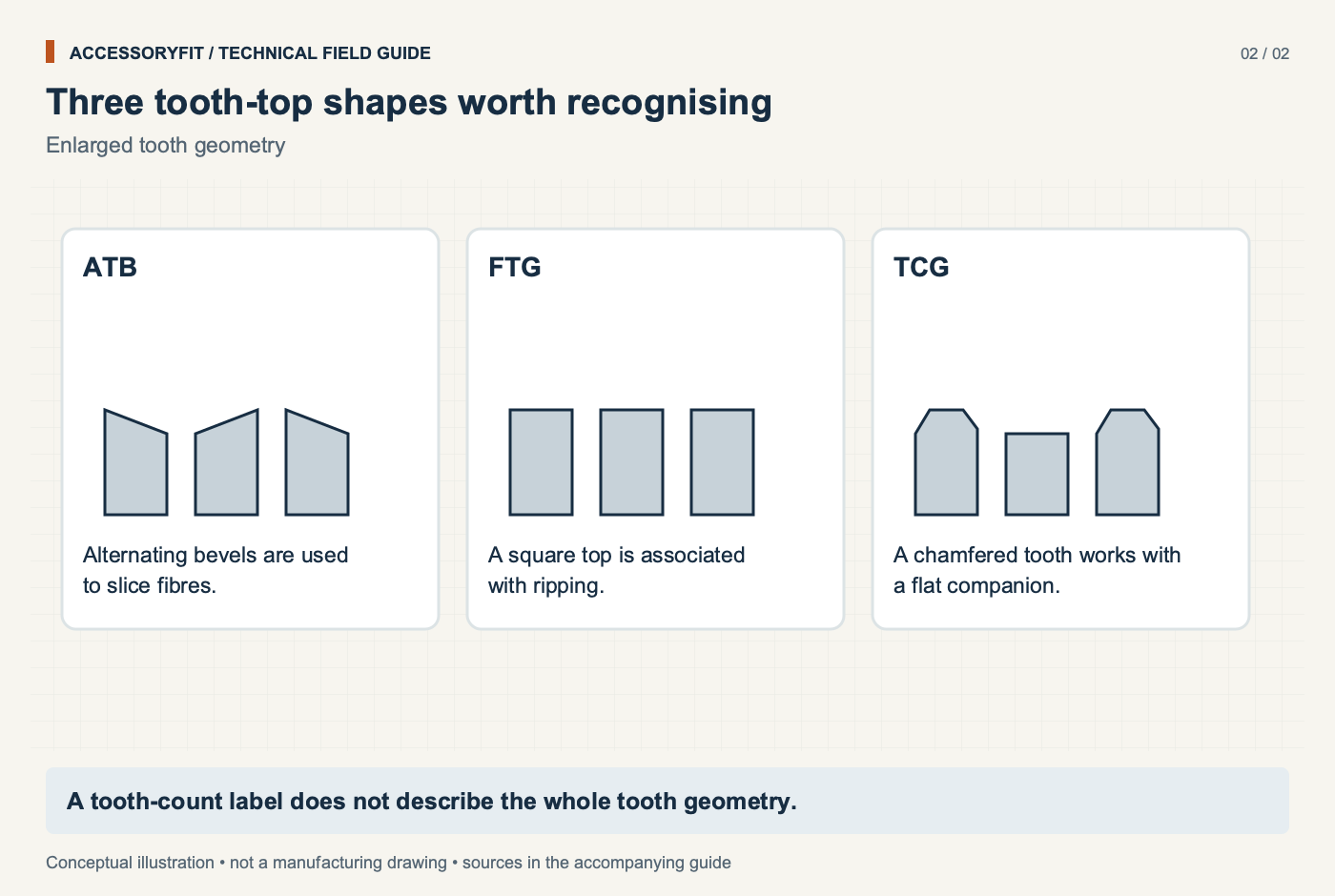
The grind names the tooth shape. ATB teeth are bevelled alternately left and right to slice fibres, FTG teeth are square across the top for ripping, and TCG teeth alternate a chamfered tooth with a flat raker for laminate, plastics and non-ferrous metal. Hook angle sets how hard the tooth bites: positive hooks of 10 to 22 degrees feed fast, while negative hooks of -2 to -6 degrees reduce climbing on sliding miter saws. Makers disagree on the hook for the same task, so treat the ranges as typical rather than fixed.
The guide on how to choose a circular saw blade covers teeth, grind, hook and kerf for each kind of cut, from ripping to sheet goods and non-ferrous metal.
What does TPI tell you about a straight or band saw blade?
Teeth per inch (TPI) sets how fine the cut is and how thick a material the blade suits: low TPI cuts thick wood fast and rough, high TPI cuts thin metal slowly and smoothly. Jigsaw blades for wood are typically 6–10 TPI, and metal blades 14–36 TPI, finer for thinner sheet. Reciprocating blades follow the same logic, from about 5–7 TPI for nail-embedded wood to 18–24 TPI for thin sheet.
The working rule is to keep several teeth in the material at once. Lenox advises 2–3 teeth in the material at all times for jigsaw blades, and band saw makers set a minimum of 3 teeth in the workpiece. Too few teeth and the blade snags and judders; too many and the gullets clog. Higher TPI is not always better, which is the misconception the guide that explains teeth per inch sets out to correct, along with why blades bend.
How do grit and grain work together on abrasives?
Grit sets the scratch size and grain sets what the abrasive cuts well; you choose both. Grit numbers come on two scales, the US CAMI scale with plain numbers and the European FEPA scale with a P prefix, and they match closely up to about 220 grit before diverging. Work up through the grits without skipping more than one, and stop around 180–220 grit before staining wood.
The grain is the mineral. Aluminium oxide is the general-purpose grain for wood and most metals, silicon carbide suits finishing, paint and non-metals, and zirconia and ceramic suit heavy removal on steel but need pressure to self-sharpen. The guide to aluminium oxide, zirconia and ceramic abrasives gives grit progressions by project and pairs each grain with its jobs.
How do you read drill bit sizes and choose a bit type?
Read the size system first, then pick the point for the material. Drill sizes come in fractional inches in 1/64 in steps, metric millimetres, number sizes and letter sizes, and number sizes run backwards, with a higher number being a smaller drill. Number and letter drills exist to fill the gaps between fractional sizes, which is why they appear on tap drill charts. The guide on number and letter drill sizes explains each series with examples.
For the bit itself, twist bits with a point angle of 118 degrees are the general-purpose choice; brad-point bits keep their line in wood; masonry bits carry a carbide tip; and step bits drill many sizes in sheet. The overview of the main kinds of drill bits covers each one, and the comparison of Forstner, spade and auger bits settles which wood-boring bit to use for a large hole.
How do router profiles and wheel type numbers work?
A router profile is the shape the bit leaves, and a wheel type number is the shape of the wheel itself, which in turn decides its job and its guard. Router bits are named for their profile, such as straight, round-over, cove, chamfer or ogee, and most edge bits carry a bearing that rides the edge; flush trim bits have the bearing at the tip and pattern bits on the shank side. The guide to router bit profiles matches each one to the edge or joint it makes.
Cut-off wheels are flat Type 1/41 or depressed-centre Type 27/42; both cut with their rim only and must not be used for side grinding. Thin metal-cutting wheels are commonly 0.045 in thick in the US and 1.0 mm in Europe. The guide to cut-off wheel types explains the numbers, thicknesses and the guard each needs.
Which common beliefs do these guides correct?
Several rules of thumb that circulate in shops and forums do not survive a look at the makers' own guidance. Each guide takes these on with sources:
- Burning always means a dull blade. Baked-on pitch often causes burning while the teeth are still sharp, so clean the blade first.
- Higher TPI is always better. More teeth cut smoother but slower, and the right TPI follows the material's thickness.
- Two fine sheets with the same grit number are the same grade. Above about 220 grit, CAMI and FEPA grades with the same number differ, so check for the P prefix.
- Pressing harder makes a random orbital sander work faster. Extra pressure slows the pad and leaves swirls.
- A bigger number drill is a bigger drill. The number series runs the other way.
- Any spiral router bit leaves a clean top edge. Up-cut spirals leave more tear-out on the near face.
Where do you go after choosing?
To a buyer guide if you want current products that meet the spec, or to a troubleshooting guide if the accessory you have is not cutting as it should. The buyer guides compare products against each job's requirements on published specs, and the troubleshooting guides work through burning, wandering, swirls, chipping, breakage and vibration by cause.
All how-to guides
- How to choose a circular saw bladeTeeth, grind and kerf
- How to pick a jigsaw bladeTPI, material and bent blades
- Sandpaper grit guideProgressions and abrasive types
- How to read drill bit sizesFractional, metric, number, letter
- Drill bit typesTwist, brad-point, spade, Forstner, step and more
- Forstner vs spade vs auger bitsWhich wood bit to use
- Router bit profilesBits for edges and joints
- Cut-off wheel typesType 1, Type 27 and Type 41
Questions readers ask
What is the difference between a rip blade and a crosscut blade?
Tooth count and grind. Rip blades have few flat-topped teeth for fast cuts along the grain; crosscut blades have many bevelled teeth for clean cuts across it. On a 10 in blade that is about 24 teeth against 60 to 80 teeth.
What TPI should I use for wood?
For general wood cutting with a jigsaw, typically 6–10 TPI; finer blades give a smoother finish but cut more slowly.
Which grit should I finish with before staining?
About 180–220 grit. Sanding much finer closes the wood's pores and stops stain soaking in evenly.
What does Type 27 mean on a grinding wheel?
It is the depressed-centre wheel shape used for grinding, fitted under the grinder's open guard. Flat Type 1/41 wheels are for cutting and need the closed cutting guard.
Where to go next
- How to choose a circular saw bladeThe most-read choice guide: teeth, grind, hook and kerf.
- Sandpaper grit guideGrit progressions and which grain to use.
- Size charts and referencesThe reference tables behind these guides.
References 207 documents, 47 publishers
- Acme Tools: JET 708115K JWBS-14CS 14 in Closed Stand Bandsaw specifications
- AmesWeb: Decimal Equivalents of Fractional, Wire and Letter Drill Sizes
- Bosch: U-Shank Jig Saw Blades Pro for Wood; U-Shank Jig Saw Blades Pro for Metal; U-Shank Jig Saw Blades Basic for Metal; T-Shank Jig Saw Blade Sets; T-Shank Jig Saw Blades for Wood; T-Shank Jig Saw Blades Pro for All Purpose; T 101 BR Clean for Wood Jigsaw Blade; T 118 A Basic for Metal Jigsaw Blade; U 234 X Progressor for Wood Jigsaw Blades; Bosch Accessories catalogue: Jigsawing, sabre sawing, multi-cutters, holesawing (1619A00Y1X, GB edition, 2016); T-Shank Jig Saw Blades Pro for Plastic (set 43925); EXPERT Thin Tough Metal S922EHM Blade; EXPERT Thick Tough Metal S1155CHC Blade; Reciprocating Saw Blades (category page); Bits for drilling tiles (tile drilling guide); CYL-9 Soft Ceramic drill bit set 2 608 587 169; 1617/1618 router operating/safety instructions (2610051825); High-Speed Steel Single-Flute Straight Bits (Canada product page); PRO Stainless Steel and Metal Bonded Cutting Disc, bore 22.23 mm (2 608 600 549); PRO Metal Bonded Cutting Disc for Chop Saws, bore 25.4 mm (2 608 600 543); GWS 12-125 / GWS 12-125 S original instructions 1 609 92A D3M (21.10.2025); GWS 12-125 angle grinder (UK); Premium Turbo Rim Diamond Abrasive Blades; EXPERT Hard Ceramic Diamond Cutting Disc (X-LOCK); X-LOCK system page (GB); Bosch X-LOCK - The ultimate changing system for grinders (news)
- Burns Tools: Amana HSS1640 HSS double flute aluminium bit 5/16 in listing
- California DIR (Cal/OSHA): Title 8 §3575 Scope and Definitions (abrasive wheels)
- Crescent Electric Supply (retailer): Milwaukee 2829-20 compact band saw listing (35-3/8 in L blade)
- DeWalt: DWE7491RS 10-In. Jobsite Table Saw and Rolling Stand product page; DWE7491RS Instruction Manual N531890; DWE575 circular saw instruction manual (Recommended Blade Types); DWS535B worm drive saw instruction manual (blade table); DWA271424 7-1/4 in 24T circular saw blade; DWAW71440 Elite Series 7-1/4 in 40T circular saw blade; DWA271460 7-1/4 in (184 mm) 60T circular saw blade; DWA261240 6-1/2 in 40T circular saw blade; DCS334/DCS335 20V MAX cordless jig saw instruction manual (N577652); DWE305 12 Amp Corded Reciprocating Saw; DWE305 reciprocating saw instruction manual (N392518); DCS389B 60V MAX Brushless Cordless Reciprocating Saw; DWM120 Deep Cut Band Saw; DWP611 compact router instruction manual (N336740); DW8062 High Performance 4-1/2 in x .045 in x 7/8 in Metal Cut-Off Wheel; DW8080 HP 4-1/2 in x 3/32 in x 7/8 in T1 Cutting/Notching Wheel (Stainless); DWE402 4-1/2 in (115 mm) paddle switch small angle grinder; DW402G angle grinder instruction manual; DW4719 7 x 1/4 x 7/8 in High Performance Metal Grinding Wheel; DWE402/DWE402N/DWE402G/DWE4222N Instruction Manual NA190466
- DGUV Institute for Occupational Safety and Health (IFA): Ageing of resinoid bonded grinding wheels (project BIA 6055)
- Engineering ToolBox: Hardwood and Softwoods - Recommended Drill Bit Speeds
- Family Handyman: 10 Tips for Mastering the Random Orbit Sander
- Fine Woodworking (Taunton Press): True Grit, by Mark Schofield (Fine Woodworking #176); Full Grit Chart (English), PDF
- FLEX (Chervon North America): Safety Warnings and Guidelines for Users of Portable Grinding, Cutting and Flap-Disc Wheels (10/2023)
- Freud and Diablo: LU87R010 10 in Thin Kerf Rip Blade (product specs); D1024X 10 in x 24T Ripping Saw Blade (product specs); LU72R010 10 in General Purpose Blade (product specs); LU84R011 10 in Combination Blade (product specs); D1040X 10 in x 40T General Purpose Saw Blade (product specs); D1050X 10 in x 50T Combination Saw Blade (product specs); LU73R010 10 in Cabinetmaker's Crosscut Blade (product specs); D1060X 10 in x 60T Fine Finish Saw Blade (product specs); D1080X 10 in x 80T Ultra Finish Saw Blade (product specs); Frequently Asked Questions; LU91R010 10 in Thin Kerf Sliding Compound Miter Saw Blade (product specs); LU97R010 10 in Double Sided Laminate/Melamine Blade (product specs); LU79R010 10 in Thin Kerf Ultimate Plywood and Melamine Blade (product specs); LU80R010 10 in Ultimate Plywood and Melamine Blade (product specs); LU88R010 10 in Thin Kerf Fine Finish Crosscut Blade (product specs); D1060S 10 in x 60T Fine Finish Saw Blade (product specs); D0724A product page (framing family listing incl. D0624A, D0620X, D0824X); D0740A product page (finish family listing incl. D0641A, D0840X); D0760A product page (ultra finish family listing incl. D0660A); D1280X product page (fine finish family listing incl. D0860X); D12100X 12 in x 100T Ultimate Polished Finish blade - tech specs; D1244X 12 in x 44T General Purpose blade - tech specs; D0770F product page (thin metal family listing incl. D0756F, D1490CF); D1472CF product page (medium metal family listing incl. D0748CFA); LM72R012 12 in Heavy-Duty Rip Blade - tech specs; LU84R012 12 in Combination Blade - tech specs; LU85R012 12 in Ultimate Cut-Off blade - tech specs; DS0606CWS 6 in 5/7 TPI Demo Demon Carbide Teeth Reciprocating Saw Blade for Nail-Embedded Wood; DS0908CF 9 in 8 TPI Steel Demon Carbide Teeth Reciprocating Saw Blade for Thick Metal; DS0614BF 6 in 14/18 TPI Bi-Metal Reciprocating Saw Blade for Medium Metal; DS0914BF 9 in 14/18 TPI Bi-Metal Reciprocating Saw Blade for Medium Metal; DS0610CF 6 in 10 TPI Steel Demon Carbide Teeth Reciprocating Saw Blade for Medium Metal; DS0903CP product page (pruning/clean wood carbide family incl. DS0603CP, DS1203CP); Get the most out of your Freud bits by routing at ideal feed rates and speeds (CNC feed and speed sheet)
- General Finishes: What is the best sandpaper or abrasive to use for finish sanding?; What Grit Should I Use for Prep Sanding Raw Wood?; Exterior 450 Instructions, PDF
- Hardwood Floors magazine (NWFA): Abrasive Grain Technology
- HAZET: User information for grinding wheels, cut-off wheels, flap discs (multilingual safety leaflet)
- HomElectrical: Irwin 1/2 in Reduced Shank Silver & Deming HSS Drill Bits
- IMC Clains (specialist retailer): Stone, Belt, Paper, Film and Compound Grit Comparison, PDF
- Infinity Cutting Tools: How to choose solid carbide spiral router bits
- Klingspor: Grit Grading Systems (Coated Abrasives Basics); Coated Abrasives Basics; Finishing column, April 2022: skipping grits in the sanding sequence; Grain types (Lowdown on grinding); Specific Material Recommendations; Klingspor Kronenflex A 60 Extra cut-off wheel 125 x 22.23 x 1 mm, 12200 RPM; Klingspor Kronenflex A 36 TZ Special cutting disc 180 x 2 x 22.23 mm; Maximum operating speed (Lowdown on grinding); Klingspor Kronenflex A 46 TZ Special cutting disc 115 x 1.6 x 22.23 mm; Klingspor Kronenflex A 24 Extra cutting disc 150 x 2.5 x 22.23 mm, depressed; Klingspor Kronenflex A 46 TZ Special cutting disc 230 x 1.9 x 22.23 mm
- Laguna Tools: Bandsaw Blade Education
- Little Machine Shop: Letter Drill Sizes; Number Drill Sizes
- Makita: JR3070CT reciprocating saw instruction manual (EU); B-68959 1/4 in x 4 in Glass and Tile Bit, 3 Flat Shank; RP1800/RP1801F/RP2301FC plunge router instruction manual; RP0910/RP1110C electronic router instruction manual (Makita Czech catalogue file); GA5030R 125 mm angle grinder; Diamond Blades new accessory overview (PDF); T-03903 X-LOCK 4-1/2 in 60 Grit Type 29 Flap Disc product page
- Mallory Safety and Supply (retailer): Milwaukee 48-40-4505 14 in 72T blade listing
- McMaster-Carr: Starrett 117A center punch (marking punches); Cutoff wheels catalogue page (contaminant-free wheels for stainless steel)
- Milwaukee Tool: 48-40-4235 7-1/4 in 48T metal cutting circular saw blade; 48-40-4505 14 in 72T metal cutting circular saw blade; 48-00-5027 12 in 5 TPI AX SAWZALL Blade for Wood with Nails; 49-22-1129 SAWZALL 12PC Demolition Blade Set; 2821-20 M18 FUEL SAWZALL Recip Saw; 48-00-1301 9 in 5 TPI Pruning SAWZALL blade (5 pk); 48-00-5332 9 in 3 TPI AX carbide pruning SAWZALL blade; 48-00-1303 12 in 5 TPI Pruning SAWZALL blade (5 pk); 48-39-0560 44-7/8 in 14/18 TPI Standard / Deep Cut Band Saw Blade; 48-39-0510 44-7/8 in 14 TPI Standard / Deep Cut Band Saw Blade; 2829-20 M18 FUEL Compact Band Saw product page; 1/4 in SHOCKWAVE Impact Duty RED HELIX Titanium Drill Bit 48-89-4613; 4PC Ceramic Tile & Glass Bit Set 48-20-8988; M18 FUEL compact router 2723-20 operator's manual (58-14-0194d1); Guard for Type 1 Grinding Discs 4-1/2 in (49-12-0361); 7 in x 1/16 in x 7/8 in Metal Cut Off Wheel - Type 1 (49-94-0033); 6 in x .045 in x 7/8 in Metal Cut Off Wheel - Type 1 (49-94-0023); M18 FUEL 4-1/2 in / 5 in Braking Grinder, Paddle Switch No-Lock (2880-20); 9 in x 1/4 in x 5/8-11 Grinding Wheel (Type 27) 49-94-9735 (discontinued listing)
- Mirka: Get the most out of your abrasives with Mirka's problem-solving abrasives; Galaxy abrasive leaflet (English), PDF
- Olson Saw: Olson catalogue January 2025 (fit charts pp.12-14; How-To's for all Band Saw Blades pp.15-16); FAQs: What size blade does my band saw or scroll saw take?
- OSHA: 29 CFR 1910.215 Abrasive wheel machinery; 29 CFR 1926.303 Abrasive wheels and tools
- PACE Technologies: Grit Size Converter
- PFERD: Ceramic oxide grain fibre disc dia. 125 mm CO-COOL80 for cool grinding on stainless steel, PDF; Safety notes, fine grinding and polishing tools (PDF, v1.0 14.01.2026)
- Popular Woodworking: Random-Orbit Sanders
- Rockler: Table Saw Blades: A Complete Guide; Saw Blade Glossary; How to Clean and Maintain Your Saw Blades; Rockler Pattern Flush Trim Router Bits - 1/2" Shank; Rockler Piloted Flush Trim Router Bits - 1/2" Shank
- Saint-Gobain Abrasives (Norton): NOVIPRO thin cutting discs Technical Data Sheet (03.11.2022)
- Stanley Black & Decker (IRWIN, LENOX): LENOX Tool Catalog 2024: Power Tool Accessories, Hand Tools; Reciprocating Saw Blades (product range page); IRWIN 29-pc Cobalt M-35 Metal Index Drill Bit Set 3018002; Left-hand mechanics length cobalt alloy high speed steel drill bit sets
- Starrett: Starrett Band Saw Blades catalogue (Choosing the Correct Blade, pp.14-15; installation guidelines); Saws & Hand Tools Catalogue 71E (hole saws, arbors, drill bits)
- Surface Prep: Flap Discs: The Differences Between Type 27 and Type 29
- ToolsToday: Saw Blade Tooth Geometry: The Secret to a Perfect Cut; Jigsaw Blades - Not So Scary; Is a flush trim bit the same as a pattern bit? (Q&A); Why Your CNC Router Bit Is Burning Wood (And Why Slowing Down Might Make It Worse)
- United Abrasives / SAIT: 2025-2026 Product Catalog (English); How to Read a Wheel Label & Safety Icon Library; The Ultimate Cut product family page
- University of Illinois Library, Engineering standards list: ANSI B74.12 entry
- Weiler Abrasives: Flap Disc Brochure WC117 (2026)
- WEN Products: WEN BA3959 2.8-Amp 9-Inch Benchtop Band Saw; WEN BA3962 3.5-Amp 10-Inch Two-Speed Band Saw
- Whiteside Machine Co.: 2016 roundover bit; 2210 roman ogee bit; 2310 45 degree chamfer bit; 3212 cove and bead bit; 1566 120 degree V-groove bit; D14-75 14 degree dovetail bit; RU7306 up cut spiral; RD7306 down cut spiral; UD7202 up/down cut (compression) spiral; 2415 flush trim bit; 6002 ogee stile and rail set; 5920B raised panel bit with back cutter; 1984 small pilot roundover; SC01 carbide straight bit; 1952 multi-rabbet bit set; 1074 straight bit
- Wikipedia: Jigsaw (tool); Sandpaper; Drill bit sizes; Drill bit; High-speed steel
- Woodcraft: Burn-Free Table Saw Cuts (Robert J. Settich); RIKON 14 in Deluxe Bandsaw Model 10-326; Timber Wolf Bandsaw Blade 111 x 3/16 in x 10 TPI Raker; Timber Wolf Bandsaw Blade 82 x 3/16 in x 10 TPI Raker; Sanding Basics; Freud 32-522 4 piece rabbeting router bit set with bearings, 1/2" shank; Freud 99-522 Quadra-Cut raised panel router bit, bevel, 1/2" shank
- Woodsmith: Secrets for Smooth Surfaces
- Woodworker's Journal: Bosch Jigsaws, Then and Now (Chris Marshall, 2010); Router Speed Settings
Accessed .