
Reference chart · Abrasives
Sandpaper grit chart: CAMI (US) and FEPA P-grade (Europe) equivalents in microns
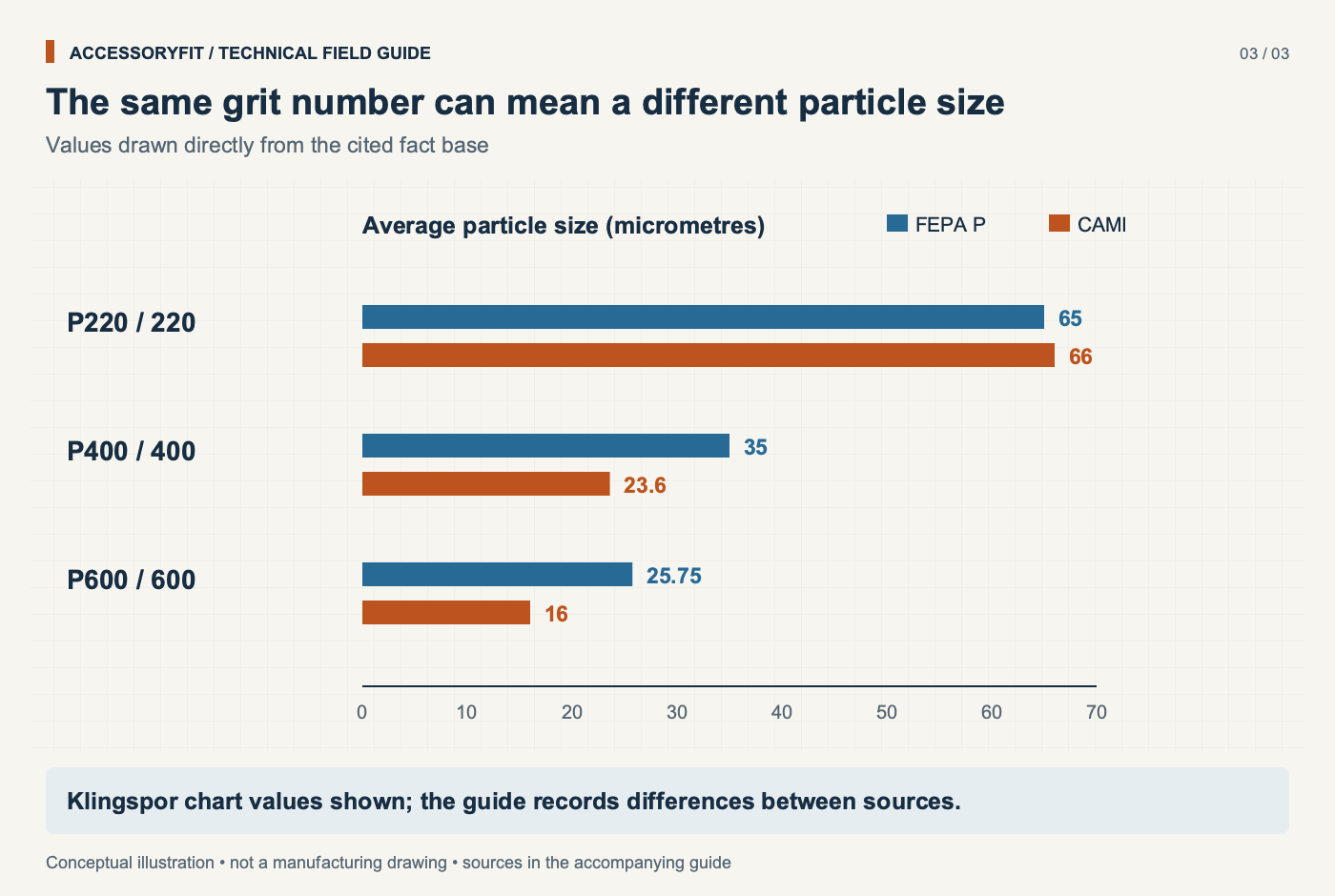
This chart converts US CAMI grit numbers to European FEPA P-grades by average particle size in microns. The two scales track each other closely up to about 220 grit, so P180 and CAMI 180 are interchangeable. Above that they drift apart: P400 averages 35 µm, which puts it beside CAMI 320, not CAMI 400, and CAMI 600 corresponds to P1000 to P1200. Use the micron columns, not the printed numbers, whenever you mix US and European paper.
By AccessoryFit editors · Checked
On this page
- What do CAMI and FEPA grit numbers describe?
- CAMI to FEPA conversion chart
- How many microns is each FEPA P-grade?
- How many microns is each CAMI grade?
- How do you read the chart when switching between US and European paper?
- Why can't you swap CAMI and P numbers above 220?
- How are the very finest abrasives graded?
- When does a grit chart give the wrong answer?
- Does the abrasive grain change the grade?
- How does the grit chart connect to choosing a sequence?
What do CAMI and FEPA grit numbers describe?
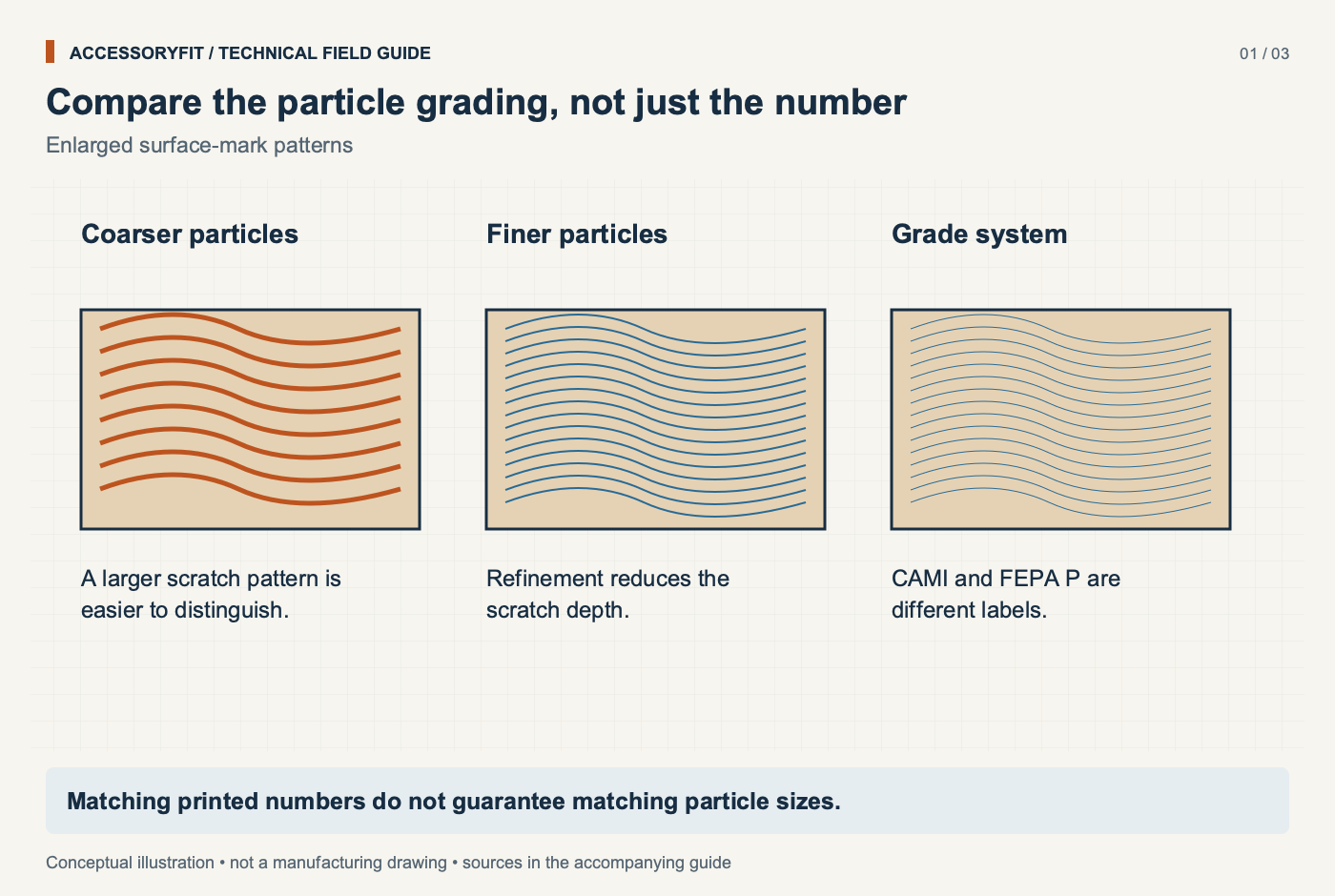
The converter at the top of this page does the lookup for a single grade; the sections below explain the numbers behind it. A one-page CAMI and FEPA comparison is also among the printable sandpaper grit charts. Both scales describe the average size of the abrasive particles bonded to the backing, so a micron figure is the common unit that lets you translate one into the other. CAMI is the grading scale used in the United States and prints a bare number. FEPA is the European scale; its coated-abrasive grades carry a P in front of the number, and that P series is the basis of ISO 6344. On the American side, the grain-size document most often cited is ANSI B74.12, which the University of Illinois standards list titles Specification for the Size of Abrasive Grain and dates to a 2018 edition; its scope is grinding wheels, polishing and general industrial uses rather than sandpaper alone.
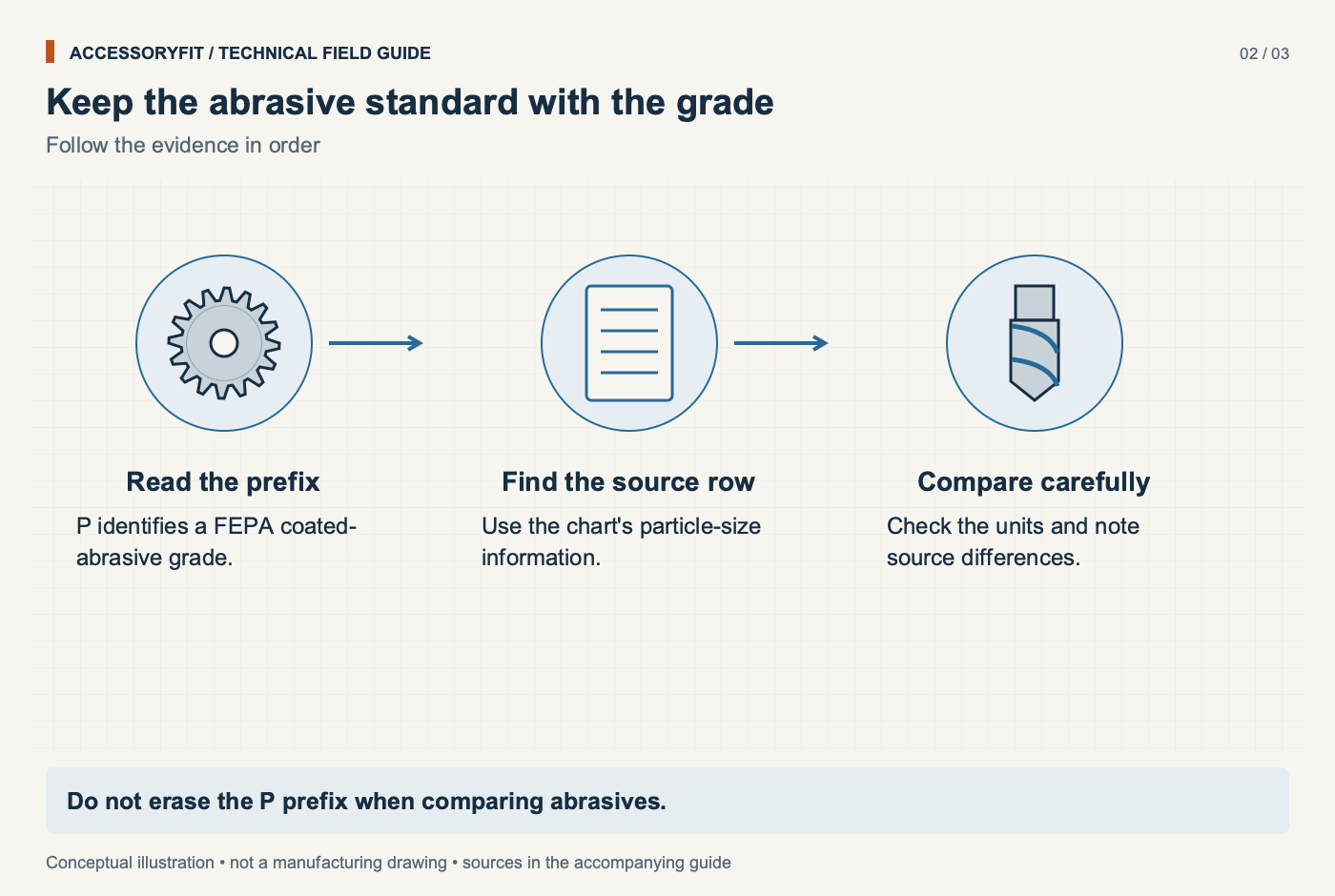
The letter is the whole key to reading a label. A sheet marked 400 with no letter is a CAMI grade; a sheet marked P400 is a FEPA grade, and the two are not the same paper. FEPA also runs a separate F series, with grades such as F230 and F240, for loose grain and bonded products like grinding wheels. F grades are not a third sandpaper scale and do not belong in this chart, which covers coated abrasives only.
CAMI to FEPA conversion chart
The table pairs each CAMI grade with the FEPA P-grade whose average particle size sits closest, using Klingspor's micron figures for both columns. Where one CAMI grade falls between two P-grades, both are listed with both averages, so you can see which side it leans towards. The pairs are approximate by nature: they match the nearest average, not the full spread of particle sizes on the sheet.
| CAMI grade | CAMI avg (um) | Nearest FEPA grade | FEPA avg (um) |
|---|---|---|---|
| 60 | 268 | P60 | 260 |
| 80 | 192 | P80 | 197 |
| 100 | 141 | P100/P120 | 156/127 |
| 120 | 116 | P120 | 127 |
| 150 | 93 | P150 | 97 |
| 180 | 78 | P180 | 78 |
| 220 | 66 | P220 | 65 |
| 240 | 53.5 | P280 | 52.5 |
| 320 | 36 | P400 | 35.0 |
| 360 | 28.8 | P500 | 30.2 |
| 400 | 23.6 | P600/P800 | 25.75/21.8 |
| 500 | 19.7 | P1000 | 18.3 |
| 600 | 16.0 | P1200 | 15.3 |
| 800 | 12.3 | P1500 | 12.3 |
| 1000 | 9.5 | P2000 | 9.5 |
Pairs are matched by closest micron value from the Klingspor table. They are approximate, especially above 220. Where two FEPA grades bracket a CAMI value, both are shown.
How many microns is each FEPA P-grade?
The FEPA table below gives the average particle size for every P-grade from P60 to P2500 as three different publishers list it: Klingspor, the chart printed by Fine Woodworking, and the specialist retailer IMC Clains. From P240 to P1200 all three agree to within a fraction of a micron, which makes that range the most dependable part of any grit chart.
The coarse grades are where the sources part. Klingspor and IMC give P180 as 78 µm and P220 as 65 µm, while the Fine Woodworking chart lists slightly larger figures for every grade from P60 to P220. The difference is a few microns, small next to the gap between neighbouring grades, so it does not change which grade you would buy. At the very fine end the disagreement is about layout rather than size: Klingspor folds P1500 and P2000 into the rows it shares with CAMI 800 and CAMI 1000 and gives one micron value per row, while the other two sources list P2000 at 10.3 µm and P2500 at 8.4 µm. Klingspor does not list P2500 at all.
| FEPA grade | Klingspor (um) | Fine Woodworking chart (um) | IMC Clains chart (um) |
|---|---|---|---|
| P60 | 260 | 269 | 260 |
| P80 | 197 | 201 | 195 |
| P100 | 156 | 162 | 156 |
| P120 | 127 | 125 | 127 |
| P150 | 97 | 100 | 97 |
| P180 | 78 | 82 | 78 |
| P220 | 65 | 68 | 65 |
| P240 | 58.5 | 58.5 | 58 |
| P280 | 52.5 | 52.2 | 53 |
| P320 | 46.2 | 46.2 | 46 |
| P360 | 40.5 | 40.5 | 40 |
| P400 | 35.0 | 35 | 35 |
| P500 | 30.2 | 30.2 | 30 |
| P600 | 25.75 | 26 | 25.8 |
| P800 | 21.8 | 21.8 | 22 |
| P1000 | 18.3 | 18.3 | 18 |
| P1200 | 15.3 | 15.3 | 15 |
| P1500 | 12.3 (row shared with CAMI 800) | 12.6 | 12.6 |
| P2000 | 9.5 (row shared with CAMI 1000) | 10.3 | 10.3 |
| P2500 | not listed | 8.4 | 8.4 (variance chart) |
Values agree from P240 to P1200. Coarser grades differ by a few microns between sources. Klingspor puts P1500 and P2000 in the same rows as CAMI 800 and 1000 with one micron value each; the other two sources list 12.6 and 10.3. IMC states its FEPA figures come from a LECO grit comparison sheet.
How many microns is each CAMI grade?
For CAMI grades, Klingspor and the Fine Woodworking chart give the same or nearly the same micron value for almost every grade, from 60 grit up to 1000. CAMI 220, for example, averages 66 µm in both. That close agreement is why this page uses those two sources for the conversion chart above.
The third column comes from IMC Clains, which says its ANSI figures are taken from a Washington Mills grit chart. Those values run consistently finer than the other two, by a wide margin at some coarse grades, and IMC leaves several grades blank. The column is shown so you can see the disagreement for yourself; if a supplier quotes CAMI micron figures that look small, check whether they are working from the same Washington Mills source.
| CAMI grade | Klingspor (um) | Fine Woodworking chart (um) | IMC Clains chart (um) |
|---|---|---|---|
| 60 | 268 | 268 | 254 |
| 80 | 192 | 192 | 165 |
| 100 | 141 | 141 | 122 |
| 120 | 116 | 116 | 102 |
| 150 | 93 | 93 | 89 |
| 180 | 78 | 78 | 76 |
| 220 | 66 | 66 | 63 |
| 240 | 53.5 | 53.5 | 50 |
| 280 | not listed | 44 | 39 |
| 320 | 36 | 36 | 31 |
| 360 | 28.8 | 28.8 | not listed |
| 400 | 23.6 | 23.6 | 22 |
| 500 | 19.7 | 19.7 | 19 |
| 600 | 16.0 | 16 | 16 |
| 800 | 12.3 | 12.2 | 12 |
| 1000 | 9.5 | 9.2 | not listed |
| 1200 | not listed | 6.5 | not listed |
Klingspor and Fine Woodworking agree on almost every CAMI value. IMC's ANSI column, which it says comes from a Washington Mills ANSI grit chart, runs consistently finer.
How do you read the chart when switching between US and European paper?
Find the grade you know in its own table, read its micron value, then look across for the nearest value in the other system. Three examples show how it works in practice.
A European schedule on US paper. A finishing schedule written for P-grades calls for P400. The FEPA table gives P400 as 35 µm. In the CAMI table, the grade with the nearest average is CAMI 320, so a US-labelled 320 sheet does the same job. Buying US 400 instead would mean sanding with a noticeably finer grit than the schedule intends.
A US schedule on European paper. A US instruction sheet says to finish with 600. Fine Woodworking states that matching it takes P1000 to P1200 paper, and the nearest-size pairing in the conversion table agrees. A P600 sheet would be considerably coarser than intended.
A mixed progression at wood-sanding grades. Stepping from a P-grade disc to a CAMI sheet in the middle of a bare-wood sequence causes no trouble: below 220 grit the paired grades in the conversion table share a number and the micron values sit close together. Fine Woodworking does note that at these grades FEPA papers are slightly coarser and cut a little faster than CAMI papers with the same number, so a P-grade disc in a CAMI sequence removes material a touch more quickly.
Why can't you swap CAMI and P numbers above 220?
Because the same number stands for a different particle size once you pass about 220 grit, and from there equivalents can only be approximate. Read down the conversion table and the drift grows with every row above that point, until CAMI 800 corresponds to P1500. In each of those rows the P number is higher than the CAMI number for the same scratch, never lower.
The scales also differ in how tightly the particles cluster around the stated size. Fine Woodworking describes FEPA-graded paper as having a narrower size distribution, with more of its particles close to the nominal size, so its scratch pattern tends to be more uniform. That is a statement about consistency, not coarseness; it does not move the averages in the tables, but it is one reason fine finishing paper is often sold in P-grades.
How are the very finest abrasives graded?
At the finest end, many abrasives drop grit numbers altogether and are micron-graded directly, with the average particle size printed on the product instead of a CAMI or P number. When you meet a micron-graded film or pad, the micron columns in the tables above are the bridge: find the P-grade or CAMI grade with the nearest average and treat the micron product as its neighbour. The finest P-grade in the FEPA table, P2500, averages 8.4 µm; none of the sources consulted lists a CAMI equivalent for it, so that row has no CAMI pair.
When does a grit chart give the wrong answer?
A grit chart only works for coated abrasives graded on one of the two scales. It misleads in four situations:
- Foam pads and sponges. General Finishes gives the equivalence as 220 pad = 400 paper, and pad naming varies between brands. Pad grit numbers cannot be read across this chart; use the pad maker's own equivalence.
- Bonded wheels and loose grain. These use the FEPA F series, a different set of grades from the P series in this chart.
- Labels with no system marked. A bare number on imported paper is usually CAMI, but not always. If the pack does not say, compare the scratch with a sheet you know rather than trusting the number.
- Grain and coating differences. Two sheets with the same grade can cut very differently if one uses a different grain or an anti-loading coat. The chart matches particle size only.
The most common error is treating P-grades and CAMI grades as one-for-one swaps at fine grits. At CAMI 600 the matching P-grade is P1000 to P1200, a gap of hundreds of grit numbers, and finishing schedules built on the wrong system end up a full step or two coarser or finer than intended.
Does the abrasive grain change the grade?
No, the grade describes particle size only, whatever mineral the particles are made of. A P180 disc averages the same size whether it carries aluminium oxide, silicon carbide, zirconia or ceramic grain. What the grain changes is how the particles cut and wear: aluminium oxide is the general-purpose grain for bare wood and most metals, silicon carbide is used mainly for finishing and for paint, lacquer, plastics and glass, and zirconia and ceramic grains suit heavy stock removal at the coarse end of the scale.
Colour is not a guide to either grain or grade. Klingspor points out that makers dye the size coat and that stearate coatings change the colour, so read the printed grade and grain rather than judging a disc by eye.
How does the grit chart connect to choosing a sequence?
The chart tells you what each grade is; the companion guide on which grit to use covers which grades to string together and where to stop before stain or finish. Discs are sold in both systems, so the buyer guide to sanding discs for random orbital sanders notes the grading each product uses. If your sander leaves loops even with the right grade, the page on swirl marks from a random orbit sander goes through the other causes.
For everything else abrasive, the hub for sanding and grinding accessories groups discs, flap discs and pads by tool. The size charts section holds this site's other reference tables, and the accessory finder shows which disc sizes and fittings your sander takes.
Questions readers ask
What CAMI grit is P1500?
CAMI 800 is the closest match: P1500 and CAMI 800 have nearly the same average particle size in Klingspor and Fine Woodworking's figures.
How many microns is 220 grit sandpaper?
About 66 µm for CAMI 220 and 65 µm for P220, so at this grade the US and European papers are effectively interchangeable.
What does the P mean on sandpaper?
It marks a FEPA grade, the European coated-abrasive scale that underlies ISO 6344. A number without the P is normally a US CAMI grade.
Is FEPA F240 the same as P240?
No. The F series grades loose and bonded grain, such as grinding wheels, and is separate from the P series used on sandpaper and discs.
How fine is P2500 sandpaper?
P2500 averages about 8.4 µm in the Fine Woodworking and IMC Clains charts. Klingspor's table stops before it, and no source consulted gives a CAMI equivalent.
Where to go next
- Sandpaper grit guideWhich grits to use in sequence and where to stop before finishing.
- Sanding discs for random orbital sandersDisc choices compared by grain, grading and hole pattern.
- Sanding disc sizes and hole patternsMake sure the disc fits the pad before choosing the grade.
References 15 documents, 10 publishers
- Fine Woodworking (Taunton Press): True Grit, by Mark Schofield (Fine Woodworking #176); Full Grit Chart (English), PDF
- General Finishes: What is the best sandpaper or abrasive to use for finish sanding?
- Hardwood Floors magazine (NWFA): Abrasive Grain Technology
- IMC Clains (specialist retailer): Stone, Belt, Paper, Film and Compound Grit Comparison, PDF
- Klingspor: Grit Grading Systems (Coated Abrasives Basics); Grain types (Lowdown on grinding); Coated Abrasives Basics; Specific Material Recommendations
- Mirka: Galaxy abrasive leaflet (English), PDF; Get the most out of your abrasives with Mirka's problem-solving abrasives
- PACE Technologies: Grit Size Converter
- PFERD: Ceramic oxide grain fibre disc dia. 125 mm CO-COOL80 for cool grinding on stainless steel, PDF
- University of Illinois Library, Engineering standards list: ANSI B74.12 entry
- Wikipedia: Sandpaper
Accessed .