
Troubleshooting · Grinder discs
Why an angle grinder disc vibrates, and the safety checks to make
Stop grinding as soon as a disc vibrates or wobbles. The usual causes are a damaged or out-of-date wheel, or a wheel mounted badly: forced onto the spindle, clamped between dirty or mismatched flanges, or fitted with a centre hole that does not match. Unplug the grinder, inspect and ring-test the wheel, check its speed rating against the grinder, and remount it with clean flanges and the right guard. Discard any cracked, dropped or expired wheel. If a new, correctly mounted wheel still vibrates, have the grinder checked.
By AccessoryFit editors · Checked
On this page
- Why does an angle grinder disc vibrate?
- Is it safe to keep using a disc that vibrates?
- Does grinder vibration affect your hands as well as the wheel?
- How do you check a wheel for cracks?
- Is the disc mounted correctly?
- Does the disc's speed rating matter?
- Why do wire cup brushes need a separate speed check?
- Can an old or badly stored disc cause problems?
- Can using the wrong disc for the job cause vibration?
- Does the guard have to match the disc?
- When should you replace the disc or have the grinder checked?
- What related grinder problems often appear with vibration?
Why does an angle grinder disc vibrate?
A grinder disc vibrates when it is not running true and balanced on the spindle, and the causes the safety standards and wheel makers address are damage, poor mounting, a mismatched centre hole, ageing and misuse. OSHA's abrasive wheel rules, the FLEX and HAZET safety leaflets and United Abrasives' catalogue all build their checks around these points. The list below orders them from the checks to make every time to the less frequent ones.
- A damaged wheel: a crack, chip or a wheel that has been dropped.
- A wheel forced or clamped badly: pushed onto the spindle, or held by dirty, damaged or unequal flanges.
- A centre hole or thread that does not match: a wheel adapted, reamed or threaded onto the wrong spindle. DeWalt's and Bosch's grinder manuals both say an accessory whose hole or thread does not match the flange or spindle runs out of balance, vibrates excessively and can cause loss of control.
- A worn wheel from a larger grinder: DeWalt and Bosch both say not to fit a worn-down wheel from a bigger tool to a smaller one, because it is not rated for the smaller tool's higher speed and may burst.
- An expired or badly stored wheel: resin-bonded wheels age, and damp or heat speeds that up.
- Misuse: side grinding with a cut-off wheel, or twisting and jamming a wheel in the cut.
- The grinder itself: the sources behind this page do not cover spindle or bearing faults, so if a new wheel still vibrates after correct mounting, the tool needs a service check.
Disc size and fit come first; the which discs fit your grinder guide lists sizes, holes and threads by market.
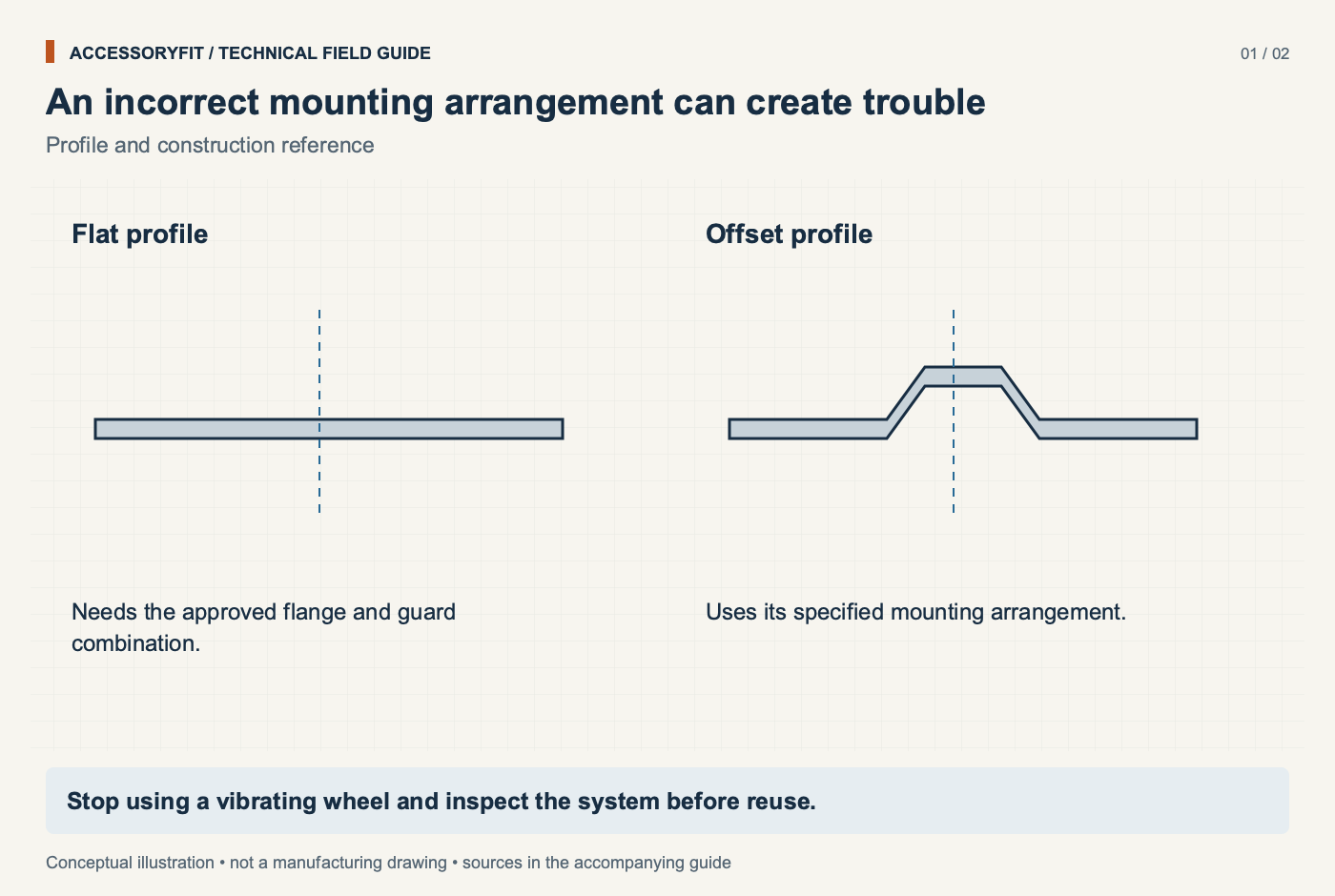
Is it safe to keep using a disc that vibrates?
No. Bosch's GWS 12-125 manual says plainly not to use any accessory that is damaged, runs untrue or vibrates, and both Bosch and DeWalt call for a no-load run of at least 1 minute with every newly fitted wheel so that a bad one shows itself before it touches the work. Vibration is a warning that the wheel is damaged, badly mounted or running outside what it was made for, and each of those can end with the wheel breaking. The safe response is to stop, inspect and remount, and to discard the wheel if any doubt remains. OSHA requires wheels to be inspected and ring-tested before mounting, and the wheel makers' leaflets tell users to discard any wheel that has been dropped.
Wear eye protection whenever you use an abrasive wheel. Makita's grinder manual lists a face shield, safety goggles or glasses depending on the job, plus dust mask, hearing protection, gloves and an apron as appropriate, and OSHA requires eye protection for anyone using abrasive wheels. For sound figures by tool type, see the power tool noise measurements.
Does grinder vibration affect your hands as well as the wheel?
Yes. Even a sound, well-mounted wheel passes vibration into the hands, and an out-of-balance one adds to it. UK HSE's 2019 hand-arm vibration guidance (L140) tells employers to assume 7 m/s² for 100-180 mm angle grinders when they have no better in-use data, and says a typical grinder at that level takes a user past the daily exposure action value after roughly 1 hour of trigger time, with the exposure limit value reached after about four hours. To total your own trigger time across tools, use the vibration exposure calculator.
The figure in the manual is not a reliable guide to this. In HSE research report RR717 (Health and Safety Laboratory, 2009), still HSE's most recent published evaluation of the grinder vibration test code, manufacturers' declared values understated in-use vibration risk for 5 of 5 grinders tested. A wheel that shakes more than it should pushes exposure up further, which is one more reason to stop and fix it rather than grind on.
Both hands take the load, and studies disagree on which takes more. NIOSH's power tools database (2011, its last edition) found the side-handle reading higher than the body grip on every grinder it tested under load, reaching 23.4 m/s² (highest left-hand reading). A 2026 Brazilian field study of welders using angle grinders in 2025 found the opposite, with the rear trigger handle higher in every sample and a top normalised daily value of 10.5 m/s² (highest rear-handle reading); every reading in that study was over the daily action value. The methods and handle layouts differ, so treat both hands as exposed and keep the side handle fitted and gripped.
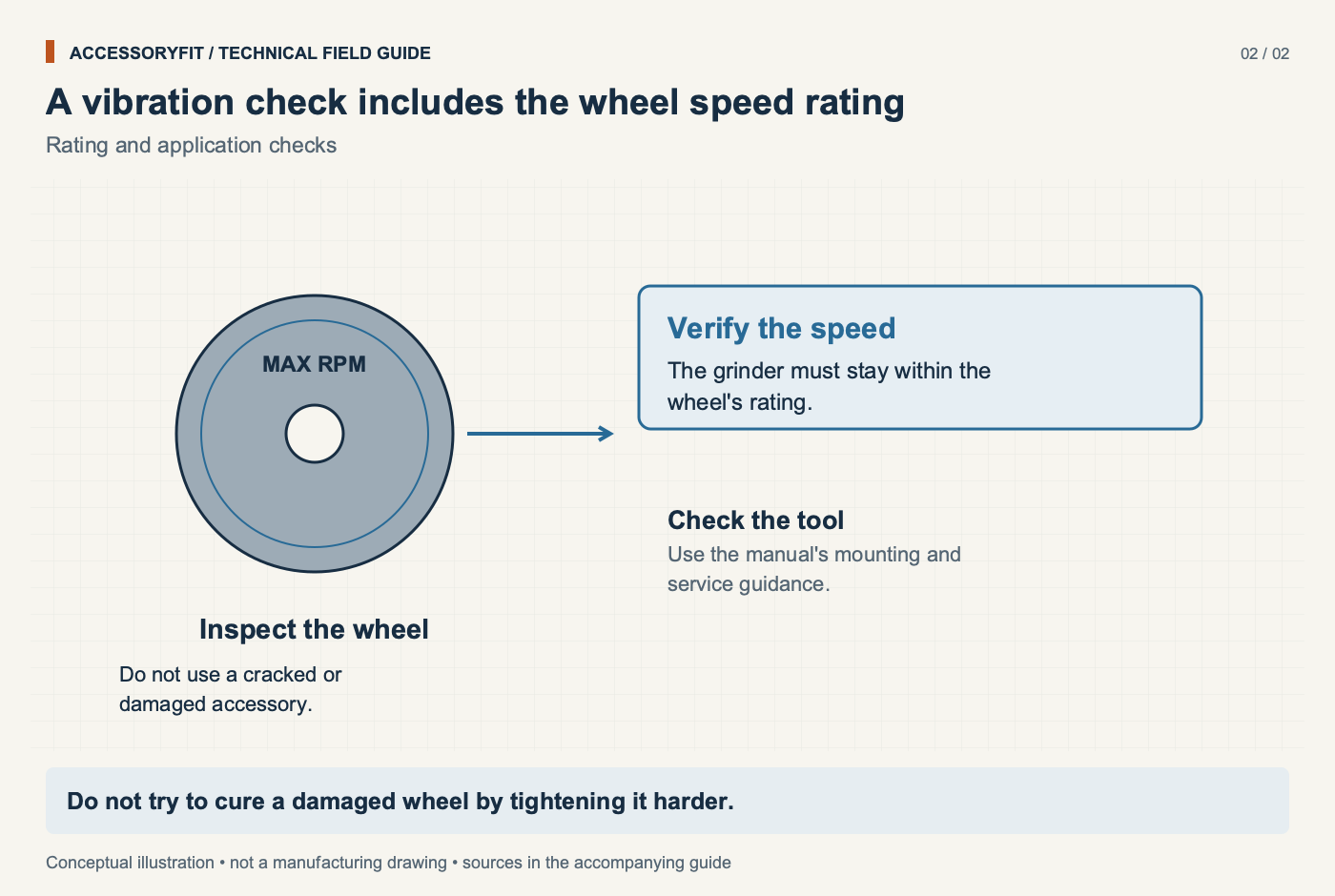
How do you check a wheel for cracks?
Look at both faces and the rim, then ring-test the wheel before mounting it. OSHA requires wheels to be inspected and ring-tested before mounting: a sound wheel gives a clear ring when tapped lightly, while a cracked wheel gives a dead sound.
How do you ring-test a wheel?
Tap the wheel lightly and listen: a clear ring means no crack was detected, a dead sound means the wheel must not be used. OSHA notes two limits: the wheel must be dry, and resin (organic) bonded wheels, which include the thin resin-bonded cut-off discs used on angle grinders, do not give the same clear metallic ring as vitrified wheels. A dull note on a thin resin disc is therefore less conclusive than on a vitrified wheel, so a visible crack, chip or a known drop is reason enough to discard it.
What should you do with a damaged wheel?
Discard it, and do not keep a dropped wheel for later use. The safety leaflets make no exception for a wheel that looks only slightly damaged.
Is the disc mounted correctly?
A wheel must slide freely onto the spindle without being forced, sit between clean, flat, undamaged flanges of the same diameter, and be held by a nut tightened only enough to hold it. Those are the mounting rules in OSHA's regulations and the FLEX and HAZET leaflets, and a wheel that breaks any of them can run out of true.
How do you check the flanges?
Remove the wheel and look at both flanges. Wipe off grit and debris, and check that the bearing faces are flat and not burred or bent. Both flanges must have the same diameter and bearing surface, so do not pair a flange from another grinder or a worn spare with the original.
Does the centre hole match the spindle?
Plain-hole wheels for angle grinders share one bore across markets: 7/8 in in the US and 22.23 mm in Europe, which are the same size. Threaded (hubbed) accessories differ: US grinders use a 5/8–11 UNC spindle thread and European grinders use M14, so a hubbed disc made for one will not fit the other. That corrects the belief that US and European discs are interchangeable in every respect. Never ream out or adapt a wheel's centre hole to make it fit a different spindle; use a wheel whose hole or thread matches the grinder.
Does the disc's speed rating matter?
Yes, critically. The maximum operating speed marked on the wheel must be at least the grinder's spindle speed, and it must be checked before the wheel is mounted. An accessory run faster than its rated speed can break and fly apart. A common belief is that a wheel which fits the spindle must be fine; the speed rating is a separate check, and larger wheels are rated well below the speed of a small grinder.
Typical ratings for reinforced wheels are 13,300 RPM for 4-1/2 in wheels and 12,200 RPM for 125 mm wheels. The grinders in our data run at up to 11000 rpm for the Bosch GWS 12-125 and Makita GA5030R, while Milwaukee lists 8500 rpm for its 2880-20. Larger wheels are rated lower again: United Abrasives, Milwaukee, Weiler and Klingspor agree on 10,200 RPM for the middle size in the maker table below, and United Abrasives, Milwaukee and Klingspor on 6,600 RPM for the largest. At 7 in they differ: United Abrasives and Klingspor print 8,500 RPM, while Milwaukee, Weiler and DeWalt print slightly higher figures on their own wheels. A worn-down wheel from one of those big grinders keeps its low rating even when it has shrunk to a small grinder's size. Read the wheel's own label rather than assuming a typical figure, and never fit a wheel made for a larger, slower grinder.
| Tool | Disc | Spindle thread | No-load speed |
|---|---|---|---|
| Bosch GWS 12-125 Professional | 125 mm | M14 | 11000 rpm |
| DeWalt DWE402 | 4-1/2 in one source | 5/8–11 | 11000 rpm |
| Makita GA5030R | 125 mm | M14 | 11000 rpm |
| Milwaukee 2880-20 | 4-1/2 / 5 in | 5/8–11 | 8500 rpm |
Values marked one source appear in a single manufacturer document; check the tool's manual or rating plate before buying.
| Size | United Abrasives (T27 / cut-off) | Other maker figure | Source of other figure |
|---|---|---|---|
| 4-1/2 in | 13,300 | 13,300 / 13,000 | DeWalt DW8080 cut-off; Weiler flap discs |
| 5 in | 12,200 | 12,200 / 12,000 | Klingspor 125 mm; Weiler flap discs |
| 6 in | 10,200 | 10,200 | Milwaukee 49-94-0023; Weiler flap discs |
| 7 in | 8,500 | 8,600 / 8,700 | Milwaukee 49-94-0033 and Weiler flap discs; DeWalt DW4719 |
| 9 in | 6,600 | 6,600 | Milwaukee 49-94-9735 |
Limits differ by maker and product, especially at 7 in. The binding figure is the one printed on the wheel.
Why do wire cup brushes need a separate speed check?
Threaded wire cup brushes often carry lower speed ratings than abrasive wheels of a similar size, so a cup that threads onto the spindle may still be rated below the grinder's speed. The ratings in United Abrasives' range, shown below, sit under the no-load speed of several grinders in the table above. Check the cup's marked maximum against the grinder before fitting it, as with any accessory.
Wire brushes need the guard too. DeWalt's grinder manual says to use the guard when wire brushing and to keep the brush from touching it, because wire wheels and cups can grow in diameter in use.
| Diameter | Wire size | Arbor | Style | Max RPM |
|---|---|---|---|---|
| 4 in | .020 in | 5/8-11 | crimped | 9,000 |
| 4 in | .020 in | 5/8-11 | knot | 9,000 |
| 5 in | .020 in | 5/8-11 | crimped | 8,000 |
| 6 in | .020 in | 5/8-11 | knot | 6,600 or 6,000 (by product) |
| 6 in | .035 in | 5/8-11 | knot | 6,600 or 6,000 (by product) |
UA catalog p.118. Knot wire: aggressive; crimped: more flexible for light cleaning. M14 wire cups for EU grinders not sourced.
Can an old or badly stored disc cause problems?
Yes. Hand-held reinforced grinding and cut-off wheels carry an expiry date, usually a month and year printed on the metal ring, and must not be used after it. Resin-bonded wheels should also not be used after storage in damp or hot conditions.
The idea that abrasive wheels last forever in storage is wrong, though normal storage is less of a worry than heat and damp. German accident-insurance research (DGUV) found that warm, damp storage can lower a resin wheel's bursting speed within months, while normal dry storage did not cause a safety-critical loss. Keep wheels dry and away from heat, and use the oldest first.
Can using the wrong disc for the job cause vibration?
Yes, and some misuse can make the wheel fail outright. Cut-off wheels cut with their rim only: never side-grind or deburr with one, and cut in straight lines without twisting, bending or jamming the wheel. That applies to thin depressed-centre cutting wheels too, which look like grinding wheels but are cutting-only. Loading a cutting wheel on its face is exactly the misuse the safety leaflets say can make it fail.
Each wheel type has its own shape, working angle and guard. Depressed-centre grinding wheels are used at a shallow angle, and flap discs at 0–15 degrees for flat ones or 15–25 degrees for conical ones. The table below summarises the types, and our guide to Type 1 and Type 27 wheels explains them in more depth.
| Type | Shape | Use | Guard | Working angle |
|---|---|---|---|---|
| Type 1 / Type 41 | Flat (straight) | Cutting only, on the rim; maximum depth of cut | Closed Type 1 cutting guard, ≥180° both sides and rim | 90° to work |
| Type 27 / Type 42 (cutting) | Depressed centre, thin | Cutting; allows flush cuts, nut recessed | Type 1/41 guard per FLEX guide | 90° to work |
| Type 27 (grinding) | Depressed centre, flat rim | Side grinding; notching | Type 27 guard | about 30° |
| Type 28 | Depressed centre, saucer-shaped | Grinding large flat surfaces | Type 27-style guard with lip (HAZET) | about 15° |
| Type 29 (flap / flexible) | Conical | Stock removal, contours, edges | Type 27-style guard with lip (HAZET) | 15-25° (flap discs) |
| Type 27 (flap) | Flat | Finishing, blending, flat surfaces | Type 27 guard | 0-15° |
| Type 6 / 11 | Straight / flaring cup | Rim grinding | Cup guard with adjustable skirt | n/a |
Angles: UA wheel-label proper-use icons (Type 27 ~30°, Type 28 ~15°, cutting 90°); flap angles UA catalog p.60 and Surface Prep. Type 28 saucer shape: Cal/OSHA §3575(b)(C).
Does the guard have to match the disc?
Yes. Flat cut-off and diamond wheels need a closed cutting guard that covers at least 180 degrees of both wheel sides and the rim, while the open guard supplied for depressed-centre grinding wheels is meant for those wheels only. The belief that any guard supplied with the grinder will do for cutting is wrong, and some grinders, such as the Bosch GWS 12-125, ship with a separate clip-on cutting guard for this reason.
The guard does not cause vibration, but it is the part that contains a wheel that breaks, which is why it matters most when a wheel is behaving badly. Sources differ on thin depressed-centre cutting wheels: United Abrasives says its own can be used on all angle grinders under ANSI B7.1, while FLEX pairs them with the cutting guard. The safer course is to fit the cutting guard for any cutting.
How do you remount and test a disc safely, step by step?
The sequence below follows OSHA's mounting rules and the FLEX and HAZET safety leaflets. Do it every time a wheel vibrates, and every time you fit a new one.
- Disconnect the grinder Unplug it or remove the battery, and let the wheel stop fully.
- Inspect the wheel Check both faces and the rim for cracks and chips. Discard any damaged or dropped wheel.
- Ring-test it Tap the dry wheel lightly and listen for a clear ring; a dead sound means a crack. Resin wheels ring less clearly.
- Check the label Confirm the maximum RPM is at least the grinder's no-load speed and the expiry date has not passed.
- Check the hole or thread Confirm the bore or hub matches the spindle. Never ream or adapt a centre hole.
- Clean the flanges Wipe both flanges, check they are flat and undamaged, and use a matched pair of the same diameter.
- Mount without force Slide the wheel freely onto the spindle and tighten the nut only enough to hold it.
- Fit the right guard Use the closed cutting guard for cut-off and diamond wheels, and the depressed-centre guard for grinding wheels.
- Make a trial run Stand out of line with the wheel and run it at operating speed for at least a minute with the guard on.
- Decide If the wheel runs smoothly, carry on. If it still vibrates, retire the wheel; if a second new wheel also vibrates, stop using the grinder and have it checked.
When should you replace the disc or have the grinder checked?
Replace the wheel when it is cracked, chipped, dropped, past its expiry date, stored damp or hot, or used in a way it is not made for, such as side grinding with a cut-off wheel. Replace it too if it still vibrates after a careful remount with clean flanges and a correct hole match; Bosch's manual says not to use any accessory that runs untrue or vibrates. Have the grinder checked when a new, undamaged and correctly mounted wheel of the right rating also vibrates: the fact base behind this page contains no manufacturer guidance on diagnosing spindles or bearings, so that is a job for the tool's service centre.
In Europe, HAZET's leaflet says bonded wheels follow EN 12413, diamond cut-off wheels EN 13236 and coated abrasives such as flap discs EN 13743; in the US, OSHA and the wheel makers refer to ANSI B7.1. Buying wheels marked to the standard for your market is the simplest way to be sure the rating and markings are there to check.
Questions readers ask
Why does my new grinder disc wobble?
Check the mounting first: a wheel forced onto the spindle, dirty or mismatched flanges, or a hole that does not match the spindle can all make a new wheel run out of true. Remount it with clean, matched flanges, then make a trial run at operating speed, standing out of line.
What is a ring test on a grinding wheel?
A light tap on the dry wheel while listening. A sound wheel rings clearly; a cracked one sounds dead. OSHA requires it before mounting and notes that resin-bonded wheels ring less clearly than vitrified ones.
Can I use a cut-off wheel to clean up the burr after a cut?
No. Cut-off wheels are for cutting only, and side grinding or deburring with them can make them fail. Use a grinding wheel or flap disc instead.
Do grinding discs expire?
Yes. Hand-held reinforced grinding and cut-off wheels carry an expiry date, often printed on the metal ring, and must not be used after it.
Will a bigger wheel fit my grinder if I take the guard off?
Never do this. A larger wheel is rated for a lower speed than a small grinder runs at, and the guard must stay on. Fit only the wheel size and type your grinder is made for.
Where to go next
- Angle grinder disc sizesCheck diameter, bore, thread and speed before buying wheels.
- Cut-off wheel typesWhich wheel type does what, and which guard it needs.
- Best flap discs for metalFinishing discs compared by published specs.
References 69 documents, 25 publishers
- Bosch: 1617/1618 router operating/safety instructions (2610051825); GWS 12-125 angle grinder (UK); PRO Stainless Steel and Metal Bonded Cutting Disc, bore 22.23 mm (2 608 600 549); PRO Metal Bonded Cutting Disc for Chop Saws, bore 25.4 mm (2 608 600 543); GWS 12-125 / GWS 12-125 S original instructions 1 609 92A D3M (21.10.2025); Premium Turbo Rim Diamond Abrasive Blades; EXPERT Hard Ceramic Diamond Cutting Disc (X-LOCK); X-LOCK system page (GB); Bosch X-LOCK - The ultimate changing system for grinders (news)
- California DIR (Cal/OSHA): Title 8 §3575 Scope and Definitions (abrasive wheels)
- DeWalt: DWE575 circular saw instruction manual (N786997); DWE402 4-1/2 in (115 mm) paddle switch small angle grinder; DW402G angle grinder instruction manual; DW8062 High Performance 4-1/2 in x .045 in x 7/8 in Metal Cut-Off Wheel; DW4719 7 x 1/4 x 7/8 in High Performance Metal Grinding Wheel; DW8080 HP 4-1/2 in x 3/32 in x 7/8 in T1 Cutting/Notching Wheel (Stainless); DWE402/DWE402N/DWE402G/DWE4222N Instruction Manual NA190466; DWE402 4-1/2 in (115 mm) Small Angle Grinder product page
- DGUV Institute for Occupational Safety and Health (IFA): Ageing of resinoid bonded grinding wheels (project BIA 6055)
- FLEX (Chervon North America): Safety Warnings and Guidelines for Users of Portable Grinding, Cutting and Flap-Disc Wheels (10/2023)
- Freud and Diablo: Get the most out of your Freud bits by routing at ideal feed rates and speeds
- HAZET: User information for grinding wheels, cut-off wheels, flap discs (multilingual safety leaflet)
- Health and Safety Executive (UK): Hand-arm vibration at work: The Control of Vibration at Work Regulations 2005. Guidance on Regulations (L140, second edition); RR717 - Evaluation of EN 60745 test codes: BS EN 60745-2-3:2007 angle grinders
- İstanbul Medical Journal: Angle Grinder Injuries in the Upper Extremity: An Epidemiological Study
- Journal of Trauma and Injury: Severity of grinder injuries and related factors compared with other high-rotation cutting tool injuries: a multicenter retrospective study from 2011 to 2018
- Klingspor: Klingspor Kronenflex A 60 Extra cut-off wheel 125 x 22.23 x 1 mm, 12200 RPM; Klingspor Kronenflex A 46 TZ Special cutting disc 115 x 1.6 x 22.23 mm; Klingspor Kronenflex A 24 Extra cutting disc 150 x 2.5 x 22.23 mm, depressed; Klingspor Kronenflex A 36 TZ Special cutting disc 180 x 2 x 22.23 mm; Klingspor Kronenflex A 46 TZ Special cutting disc 230 x 1.9 x 22.23 mm; Maximum operating speed (Lowdown on grinding)
- Makita: 9557PB angle grinder instruction manual; 5007F 7-1/4 in circular saw instruction manual; GA5030R 125 mm angle grinder; Diamond Blades new accessory overview (PDF); T-03903 X-LOCK 4-1/2 in 60 Grit Type 29 Flap Disc product page; E-23335 7 in Diamond Blade, Segmented Turbo, General Purpose product page; GA5030R Angle Grinder product page; GA4030R/GA4530R/GA5030R instruction manual (EU)
- McMaster-Carr: Grinders: manufacturer model number DWE402; Cutoff wheels catalogue page (contaminant-free wheels for stainless steel)
- Milwaukee Tool: M18 FUEL oscillating multi-tool 2836-20 operator's manual (58-14-0217d1); Guard for Type 1 Grinding Discs 4-1/2 in (49-12-0361); M18 FUEL 4-1/2 in / 5 in Braking Grinder, Paddle Switch No-Lock (2880-20); 6 in x .045 in x 7/8 in Metal Cut Off Wheel - Type 1 (49-94-0023); 9 in x 1/4 in x 5/8-11 Grinding Wheel (Type 27) 49-94-9735 (discontinued listing); 7 in x 1/16 in x 7/8 in Metal Cut Off Wheel - Type 1 (49-94-0033); 2880-20 M18 FUEL 4-1/2 in / 5 in Grinder Paddle Switch, No-Lock product page; Operator's manual 58-14-0243D2 (Cat. No. 2880-20)
- NIOSH: Power Tool Database (PDF dated August 2006; catalogued by CDC Stacks 1 October 2011)
- OSHA: 29 CFR 1910.215 Abrasive wheel machinery; 29 CFR 1910.243 Guarding of portable powered tools; 29 CFR 1926.303 Abrasive wheels and tools; 29 CFR 1926.300 General requirements (Tools, hand and power); 29 CFR 1926.304 Woodworking tools
- PFERD: Safety notes, fine grinding and polishing tools (PDF, v1.0 14.01.2026)
- Revista Brasileira de Medicina do Trabalho (via PubMed Central): Laterality of hand-arm vibration exposure during grinding operations: a field study in industrial settings
- Revista de la Asociación Argentina de Ortopedia y Traumatología: Traumatic Injuries to the Hand From the Use of an Angle Grinder. A Problem in Our Field
- Saint-Gobain Abrasives (Norton): NOVIPRO thin cutting discs Technical Data Sheet (03.11.2022)
- Surface Prep: Flap Discs: The Differences Between Type 27 and Type 29
- U.S. Consumer Product Safety Commission: NEISS 2024 data file (neiss2024.xlsx), with NEISS_FMT code formats
- United Abrasives / SAIT: 2025-2026 Product Catalog (English); How to Read a Wheel Label & Safety Icon Library; The Ultimate Cut product family page
- US Department of Energy, Office of Environment, Safety and Health: Operating Experience Summary 2002-25
- Weiler Abrasives: Flap Disc Brochure WC117 (2026)
Accessed .