Sandpaper grit guide: progressions by project and abrasive type
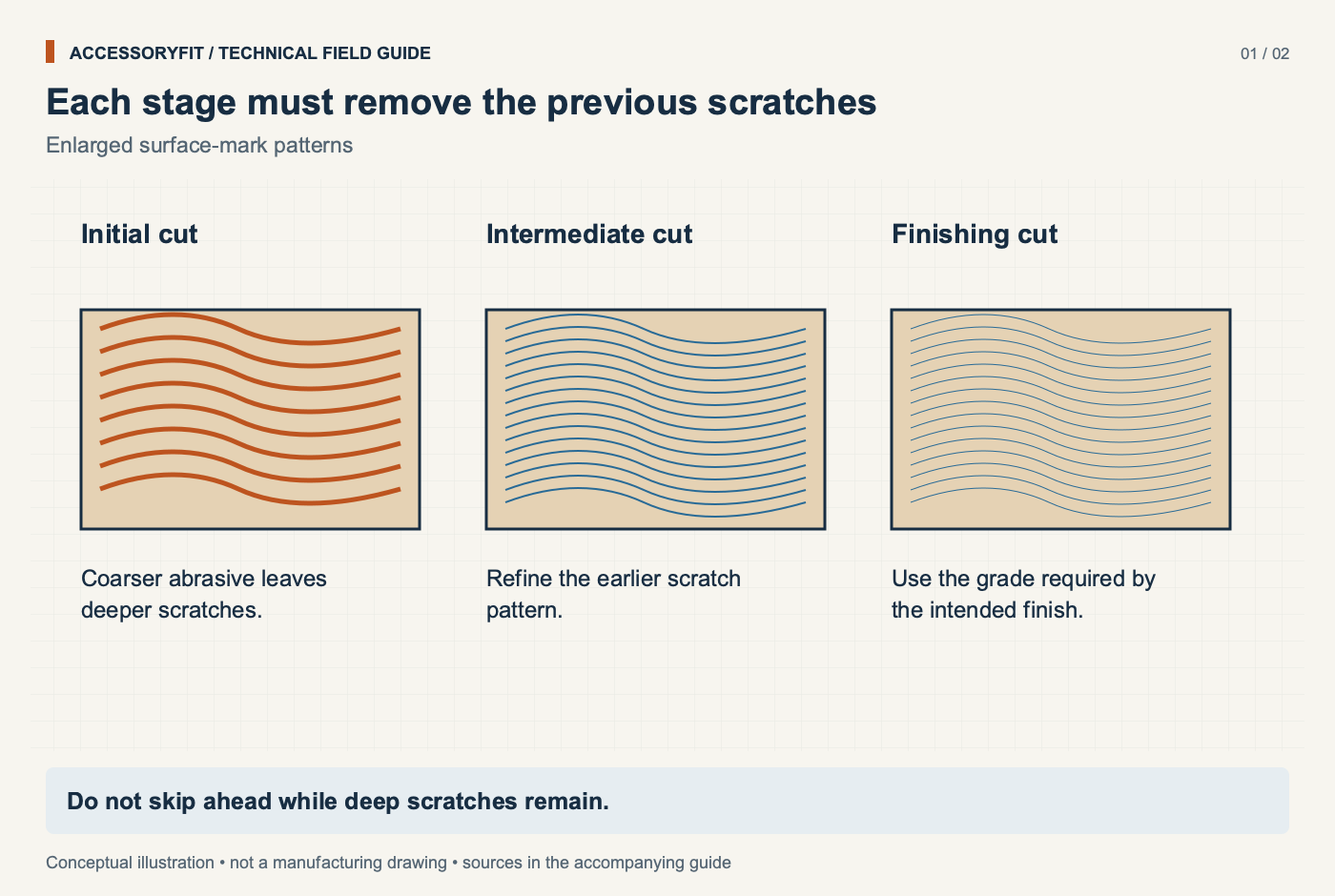
Start with the finest grit that removes the defects, then work up the standard wood sequence (60, 80, 100, 120, 150, 180, 220 grit, as Woodcraft lists it) without skipping grits, and stop at 180–220 grit before staining. Each grit only has to remove the scratches of the one before it. Numbers without a letter are US CAMI grades; numbers with a P prefix are European FEPA grades, and the two scales match closely only up to about 220 grit. For bare wood, aluminium oxide is the general-purpose grain.
A grit number describes the average size of the abrasive particles on the paper or disc: the higher the number, the smaller the particles and the finer the scratch they leave. Two grading scales are in common use on coated abrasives. CAMI is the United States scale and uses plain numbers. FEPA is the European scale, and its grades carry a P prefix to tell them apart from CAMI grades. The FEPA P-grade scale is also the basis of ISO 6344. American grain sizing is published by ANSI: the University of Illinois engineering standards list records ANSI B74.12 as the Specification for the Size of Abrasive Grain for grinding wheels, polishing and general industrial uses, with a 2018 edition. That title covers bonded and polishing grain; the separate US grading standard for coated abrasives could not be confirmed from a fetched page, so it is not named here.
Because both scales describe particle size, a micron figure is the reliable way to compare them. At the grades most people use on wood they line up well: P180 and CAMI 180 both average about 78 µm. A full side-by-side table lives on the CAMI to FEPA grit conversion chart, and the CAMI and FEPA section further down this page covers where the two scales part company.
Grit is one of three choices on any sanding disc. The other two are the abrasive grain, which decides how the particles cut and wear, and the backing and attachment, which decide whether the disc fits the sander. This guide covers the first two; disc sizes and hole patterns are covered in the guide to sanding disc sizes and hole patterns.
Do not skip ahead while deep scratches remain.
02What grit sequence should you use on bare wood?
On bare wood, start at the finest grit that removes the defects and work up through the sequence 60, 80, 100, 120, 150, 180, 220 grit, which Woodcraft gives as the standard wood progression. Woodcraft's advice is to work through every grit level. Klingspor's guidance is a little more lenient, allowing a skip of no more than 1 grit step. This guide follows both: take every grit where you can, and never skip more than Klingspor allows.
The starting grit depends on the surface, not on habit: Woodcraft's rule is to start at the finest grit that removes the defects. Starting coarser than necessary only adds scratches that every later grit then has to remove. The stopping grit depends on the finish, covered in the next section.
The table below sets out the sequences and stopping points that Woodcraft, General Finishes and Klingspor publish for common wood jobs.
Grit sequences and stopping grits by task, from Woodcraft, General Finishes and Klingspor
Task
Sequence or stopping grit
Source
General bare-wood sanding
60, 80, 100, 120, 150, 180, 220; start at the finest grit that removes defects
220-320 foam sanding pad (a 220 pad is about 400 paper)
General Finishes
Heavy stock removal / rough shaping
Coarse removal grits 24-60 (zirconia or ceramic gives best value there)
Klingspor
General Finishes values are for its own finishes but are generic grit advice. No fetched manufacturer source gave a grit sequence for stripping an old finish; Klingspor recommends zirconia for rough paint stripping and silicon carbide after that.
03How do you sand through a grit progression, step by step?
The steps below follow a typical bare-wood progression with a random orbital sander, from first grit to the last pass before finish. Speeds and pressures come from Family Handyman, Popular Woodworking and Woodsmith.
Pick the starting grit. Choose the finest grit in the 60, 80, 100, 120, 150, 180, 220 grit sequence that will remove the worst mark on the surface.
Fit the disc cleanly. Clean the pad, centre the disc and line its holes up with the pad's dust ports so extraction works. Connect a vacuum if the sander takes one.
Sand slowly and lightly. Move the sander at about 1 in per second with light pressure of about 2–4 lb, roughly the weight of your arm. Family Handyman suggests overlapping each pass by about 50% on large surfaces.
Keep the pad flat. Do not tilt the sander to chase a scratch with the pad edge; tilting leaves gouges and rounded edges.
Clean the surface between grits. Vacuum or wipe the work before changing grit, so loose coarse particles are not dragged around under the finer disc.
Move up one grit and repeat. Sand until the previous grit's scratches are gone, then change to the next grit in the sequence.
Stop at the grit your finish needs. Stop at about 180–220 grit before stain, or follow the finish maker's figure, then remove the dust before finishing.
04Which grit should you stop at before stain or finish?
Stop at about 180–220 grit before staining, because finer sanding closes the wood pores and stops stain soaking in evenly. Woodcraft and General Finishes both give that range.
A common belief is that sanding bare wood to a very fine grit always gives a better finish. It does not: sanding too fine closes the grain, so stain and some finishes cannot soak in evenly, and the right stopping point depends on the product. General Finishes gives these figures for its own finishes, which work as general grit advice:
Before an oil-based stain: 120 then 150 grit.
Before a water-based clear topcoat on raw wood: 120 then 150 or 220 grit.
Before an oil-based clear topcoat: up to 150 grit.
Between topcoats: a fine foam sanding pad of 220–320 grit, then remove the dust.
General Finishes also separates closed-grain woods such as cherry, maple and pine from open-grain woods such as oak and ash for water-based stains, with the open-grain woods taken a grit further; the table above gives both sequences.
Foam pads carry their own labels. General Finishes says a pad's grit does not match a paper's: by its account, 220 pad = 400 paper, and pad names and grits differ between brands. When sanding between coats of paint or lacquer, a stearated abrasive is usually the best choice, because the coating resists clogging.
05What happens if you skip grits?
Skipping grits leaves deep scratches that the finer grit cannot easily remove, and those scratches show up once stain or lacquer goes on: stain collects in them and looks darker. Mirka and a Klingspor column in Wood Shop News both describe the same effect.
The time saving is also false. Klingspor's example is a jump from the coarse end of the sequence straight to 220 grit: it uses about double the 220 paper that a full sequence would need, plus extra sanding time, because a fine grit is not designed to remove a coarse scratch. Skipping saves no abrasive and still risks visible lines.
Skipped grits are the first cause listed in the guide to sander swirl marks, ahead of too much pressure, moving too fast and a worn pad. If marks appear only after finishing, the progression is the first thing to check.
06How do CAMI and FEPA grits compare?
CAMI and FEPA numbers match closely up to about 220 grit; above that, the scales diverge and equivalents are only approximate. Fine Woodworking and PACE Technologies both put the split at that grade.
In the coarse-to-medium range used on bare wood, FEPA papers are slightly coarser and cut a little faster than CAMI papers of the same number, according to Fine Woodworking and Klingspor's micron tables. At 220 grit the two are nearly identical: P220 averages about 65 µm and CAMI 220 about 66 µm.
Above that point a common mistake is to treat the numbers as interchangeable. P400 averages 35 µm, which is close to CAMI 320, not CAMI 400. At the fine end, matching CAMI 600 takes P1000 to P1200 paper, and CAMI 800 is close to P1500. Fine Woodworking adds that FEPA paper has a greater share of particles close to the stated size, so its scratch pattern tends to be more uniform. Very fine abrasives are often graded directly in microns instead.
The practical rule is to read the prefix. Mirka's Abranet discs, for example, are sold in P-grades such as P120, while Diablo and Bosch list plain grit numbers. The difference is small at wood-sanding grades but matters once a progression goes finer, where the conversion table is needed. The table below pairs each CAMI grade with its nearest FEPA grade by average particle size.
CAMI grade and nearest FEPA P-grade by average particle size (Klingspor values)
CAMI grade
CAMI avg (um)
Nearest FEPA grade
FEPA avg (um)
60
268
P60
260
80
192
P80
197
100
141
P100/P120
156/127
120
116
P120
127
150
93
P150
97
180
78
P180
78
220
66
P220
65
240
53.5
P280
52.5
320
36
P400
35.0
360
28.8
P500
30.2
400
23.6
P600/P800
25.75/21.8
500
19.7
P1000
18.3
600
16.0
P1200
15.3
800
12.3
P1500
12.3
1000
9.5
P2000
9.5
Pairs are matched by closest micron value from the Klingspor table. They are approximate, especially above 220. Where two FEPA grades bracket a CAMI value, both are shown.
07Which abrasive grain should you choose?
For bare wood and most steel, choose aluminium oxide, the general-purpose grain; switch grains only for heavy stock removal, finishing coats, or hard and unusual materials. Coated abrasives use 4 grain types: aluminium oxide, silicon carbide, zirconia alumina and ceramic aluminium oxide.
Aluminium oxide has blocky grains with sharp edges that leave a fine, even scratch, which suits low-pressure orbital discs and hand sheets.
Silicon carbide is very hard but brittle and wears quickly. It is mainly used for finishing and for sanding paint, varnish, lacquer, sealers, glass, plastics and stone.
Zirconia alumina is tough and self-sharpening, but only under machine pressure. With too little pressure it glazes and its life drops, so it suits heavy removal and stainless steel rather than light finish sanding.
Ceramic aluminium oxide is micro-crystalline and keeps exposing new sharp edges. It was developed for aggressive grinding on metal and gives the most value in removal grits.
Garnet is a natural grain used for final finish sanding of wood and end grain, though Klingspor notes natural grains are now rarely used.
A frequent misreading is that the hardest grain must be the best. Silicon carbide is the hardest of the four but brittle, and the tougher engineered grains last longer in heavy removal. Colour is no guide either: Klingspor warns that makers dye the size coat and that stearates hide the grain colour, so choose by the grain named on the label.
Abrasive grain properties and typical uses
Grain
Hardness / toughness (Klingspor)
Wear behaviour
Mohs (Norton engineer)
Typical uses
Aluminium oxide
hard / tough
blocky grain, even wear
9
General purpose: bare wood, steel and most metals; orbital discs and hand sheets
Silicon carbide
very hard / less tough
sharp-edged, brittle, highly friable
9.5
Finishing, sanding paint and lacquer, glass, plastic, stone, rubber
Zirconia alumina
hard / very tough
micro-wear, self-sharpening under machine pressure
8.5
Heavy stock removal, stainless and hard steels, wood dimensioning
Ceramic aluminium oxide
hard / very tough
micro-crystalline, micro-wear, self-sharpening
9.4
Aggressive grinding on metal including stainless; long-life removal grits
Garnet (natural)
not listed
very sharp, fractures quickly
not listed
Final finish sanding of wood, end grain
Hardness/toughness and wear columns come from Klingspor's grain-type table (garnet from Klingspor's glossary). Mohs values come from one Norton/Saint-Gobain engineer article. Norton describes aluminium oxide as highly friable, but Klingspor calls it tough; see conflicts.
08Do stearate and open coat matter for grit choice?
Yes, on materials that clog paper. Stearate, usually zinc stearate, is an anti-loading coating, not an abrasive: it stops clogging when sanding finishes, paint, sealer coats, resinous softwoods and soft metals. Open-coat paper leaves space between the grains so dust can clear, which prevents early clogging on wood; closed coat suits harder materials. Grain coverage is graded as closed, semi-open or open.
Most modern abrasives also use resin bonds, which protect the grain from heat and extend its life; older glue bonds soften when hot. When a disc loads up quickly, a stearated or open-coat product in the same grit addresses the clogging directly, without changing the progression.
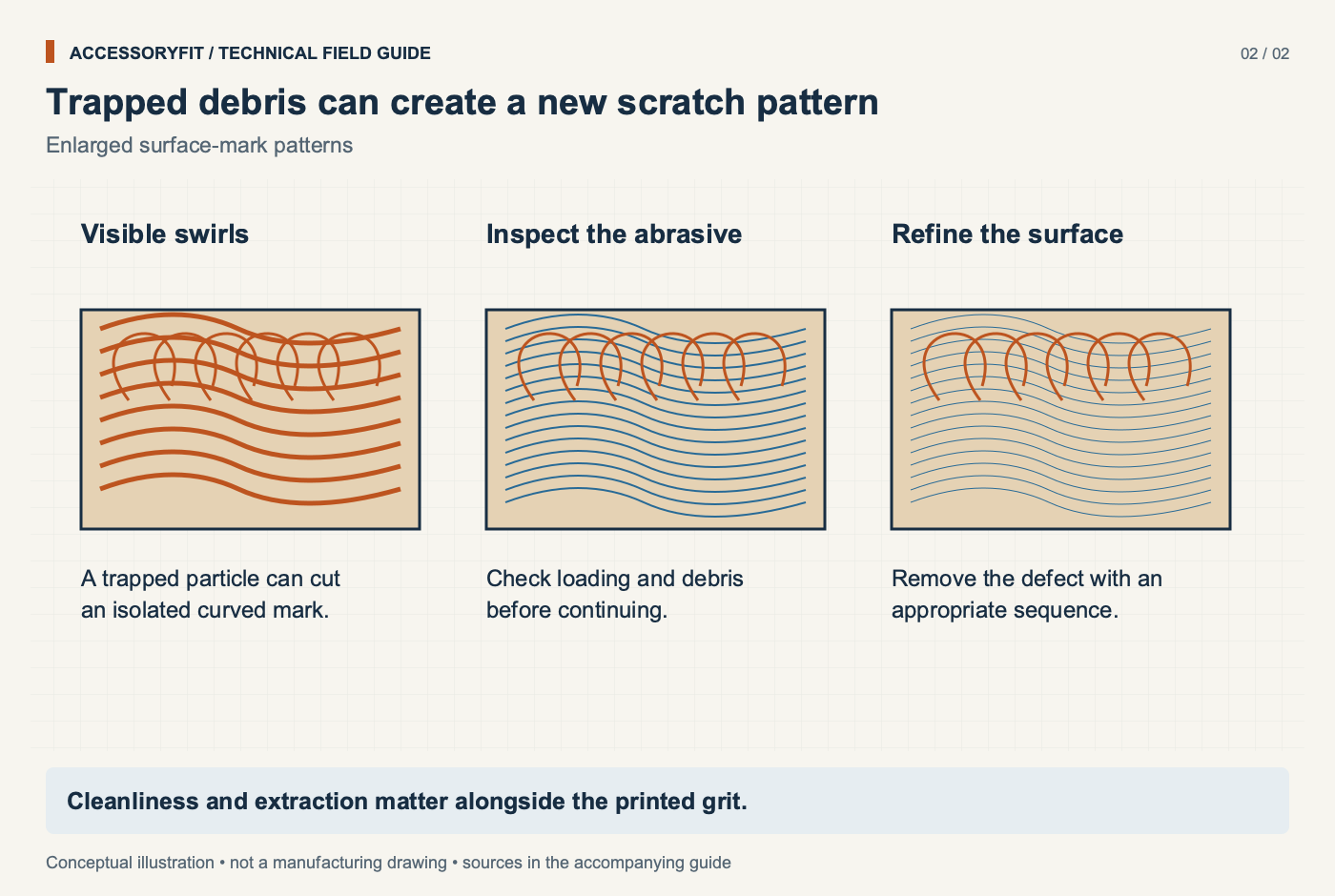
Cleanliness and extraction matter alongside the printed grit.
09Which grain suits metal, paint and plastic?
Metal, paint and plastic each have a different preferred grain, and Klingspor publishes a recommendation for each. Zirconia alumina or aluminium oxide handle carbon and stainless steel; silicon carbide is the usual choice for finishing paint and almost the only choice for plastic and glass. Klingspor recommends zirconia for rough paint stripping and silicon carbide after that, but no manufacturer source in the AccessoryFit fact base gives a full grit sequence for stripping an old finish, so none is given here.
Klingspor grain recommendations by workpiece material
Material
Rough grinding
Intermediate / finishing
Carbon steel
Zirconia alumina or aluminium oxide
Zirconia alumina or aluminium oxide
Stainless steel
Zirconia alumina or aluminium oxide
Silicon carbide sometimes for a more consistent final scratch
Aluminium
Zirconia alumina
Aluminium oxide; silicon carbide in some machining and deburring
Cast iron
Zirconia alumina
Aluminium oxide; silicon carbide for chilled or grey iron
Titanium
Zirconia alumina
Silicon carbide; aluminium oxide may react chemically with titanium
Paint
Zirconia alumina for rough stripping
Silicon carbide usually recommended
Plastic
Zirconia alumina sometimes, usually wet
Silicon carbide almost exclusively
Glass
Silicon carbide (zirconia occasionally on flat stock)
Silicon carbide, usually ground wet
Stone / granite
Silicon carbide, ground wet
Silicon carbide
Taken from Klingspor's 'Specific Material Recommendations' page. Wood is not covered there; for bare wood Klingspor's basics page recommends aluminium oxide.
10When does a grit progression fail?
A correct progression still fails when technique, the pad or the disc undermines it. These are the failure points that woodworking guides and abrasive makers describe:
Too much pressure. Pressing hard slows the pad's rotation and leaves swirls and dished areas. Pressing harder does not make the sander work faster.
Moving too fast. Fast passes leave uneven loops; aim for about 1 in per second.
Debris under the disc. A trapped chip makes a high spot, and loose coarse grit scratches the surface on the next grit.
A disc that will not stay on. A worn or crushed hook face, dust on the pad, poor alignment or worn loop backing are the usual causes. Clean the hook face first, then replace the pad if clean discs still come off.
Zirconia used at light pressure. The grain glazes instead of self-sharpening.
A large-orbit sander for the last grit. Popular Woodworking says sanders with small orbits (orbits under 1/8 in) are for finishing, while large orbits leave larger, more visible swirls.
Heavy pressure also crushes the hooks on a hook-and-loop pad and builds heat, so a dull disc should be changed rather than pushed harder.
11Which sanding discs cover a full grit progression?
Product links go to Amazon. As an Amazon Associate I earn from qualifying purchases. How links are chosen.
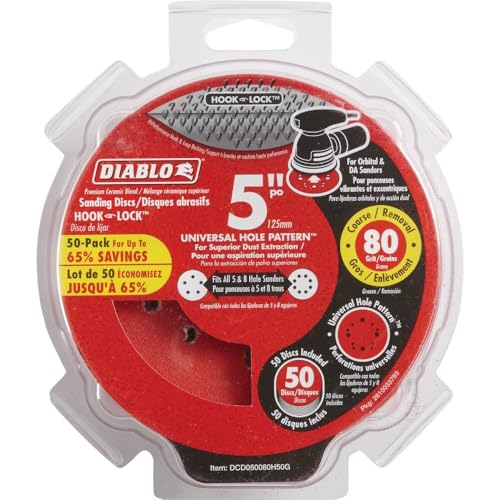
The four discs below cover the start, middle and full range of a typical wood progression on a 5 in random orbital sander, drawn from manufacturer specifications. Two are single grits sold in bulk; two are mixed-grit packs. The Mirka discs are P-graded, so read their numbers on the FEPA scale. For a wider shortlist, see the guide to sanding discs for random orbital sanders.
For the exact micron figures behind every grade, the sandpaper grit chart lists CAMI and FEPA values from three sources. If you are unsure which discs your sander takes, the accessory finder looks up pad size and hole pattern by model. Pads for corner and detail sanders follow different shapes, covered in the guide to detail sander pad shapes.
Is a P120 disc the same as a CAMI disc with the same number?
Close but not identical. In the wood-sanding range FEPA papers are slightly coarser than CAMI papers of the same number. The two scales match closely up to about 220 grit and diverge above it.
What grit should you sand to before staining wood?
About 180–220 grit, according to Woodcraft and General Finishes. For an oil-based stain, General Finishes recommends 120 then 150 grit.
Can you go straight from a coarse grit to a fine one?
It is slower and more wasteful. Klingspor says a jump from the coarse end straight to 220 grit uses about double the 220 paper that a full sequence needs, and the coarse scratches can show under stain.
What grit do you use between coats of finish?
General Finishes recommends a fine 220–320 grit foam sanding pad, then removing the dust.
Is a fine grit number the same on US and European paper?
No, not above about 220 grit. For example, P400 averages 35 µm, close to CAMI 320. Check for the P prefix.
Axminster Tools: Festool Multi-Jetstream2 Pad for ETS150 Sander; Mirka Interface Pad 125mm 953284
Benchmark Abrasives: Sanding Discs Buying Guide: PSA vs Hook & Loop vs Fiber
Bosch: EXPERT C470 Sandpaper with 8 holes for Random Orbital Sanders; ROS20VSC 5 in Random Orbit Sander product page; Hook & Loop Sanding Discs for Wood product family page
Colorado State University and Montana Technological University, Annals of Work Exposures and Health 67(5): The Evaluation of Worker Exposure to Airborne Silica Dust During Five OSHA Table I Construction Tasks
DeWalt: DWE6423 5 in variable speed random orbit sander with hook and loop pad; DWE402/DWE402N/DWE402G/DWE4222N Instruction Manual NA190466; DWE6420/DWE6421/DWE6423 Random Orbit Palm Sanders instruction manual N412818
European Parliament, Legislative Observatory (procedure 2016/0130(COD), final act summary): Protection of workers from exposure to carcinogens or mutagens at work: exposure limit values - Directive (EU) 2017/2398, final act
Family Handyman: 10 Tips for Mastering the Random Orbit Sander
Festool: ETS EC 150/3 EQ and ETS EC 150/5 EQ original instructions (PDF)
Fine Woodworking (Taunton Press): Full Grit Chart (English), PDF; True Grit, by Mark Schofield (Fine Woodworking #176)
General Finishes: What is the best sandpaper or abrasive to use for finish sanding?; What Grit Should I Use for Prep Sanding Raw Wood?; Exterior 450 Instructions, PDF
Health and Safety Executive (UK): Wood dust exposures in manufacturing industries; EH40/2005 Workplace exposure limits (Fourth Edition 2020)
Hemlock Hardware (Diablo listing): Diablo 6 In. 60-Grit 6-Hole Pattern Vented Sanding Disc with Hook and Lock Backing
HookandLoop.com: Replacing sanding discs with hook and loop
IMC Clains (specialist retailer): Stone, Belt, Paper, Film and Compound Grit Comparison, PDF
Klingspor: Grit Grading Systems (Coated Abrasives Basics); Coated Abrasives Basics; Finishing column, April 2022: skipping grits in the sanding sequence; Grain types (Lowdown on grinding); Specific Material Recommendations; Hole pattern for abrasives (Lowdown on grinding); Self-fastening disc (Lowdown on grinding)
Makita: BO6050 Random Orbit Sander instruction manual; BO6050J 6 in Random Orbit Sander product page; BO5041 5 in Random Orbit Sander product page
Mirka: Get the most out of your abrasives with Mirka's problem-solving abrasives; ABRANET 5 in Grip product page (US); Galaxy abrasive leaflet (English), PDF; Technical Data Sheet - Abranet abrasives
National Toxicology Program, US Department of Health and Human Services: Report on Carcinogens, Fifteenth Edition: Wood Dust
NIOSH: Comprehensive Report: Laboratory Evaluation of Saw Blades for Cutting Fiber-Cement Siding; Hazard Controls: Control of Wood Dust from Random Orbital Hand Sanders and Orbital Hand Sanders
OSHA: Occupational Exposure to Respirable Crystalline Silica; Final Rule (29 CFR Parts 1910, 1915, and 1926)
PACE Technologies: Grit Size Converter
PFERD: Ceramic oxide grain fibre disc dia. 125 mm CO-COOL80 for cool grinding on stainless steel, PDF
Popular Woodworking: Random-Orbit Sanders
Purdue University, Journal of Occupational and Environmental Hygiene: Evaluation of Cut-Off Saw Exposure Control Methods for Respirable Dust and Crystalline Silica in Roadway Construction
Technical University in Zvolen, MM Science Journal: Effect of Selected Factors on Mass Concentration of Airborne Dust During Wood Sanding
Tool Nut: Diablo DCD060100H10G 6 in Sandpaper Hook & Loop; Festool 202458 Multi JetStream2 150mm Soft Pad for ETS/ETSC 150; Festool 203348 6 in StickFix Multi Jetstream2 Interface Pad 150mm; Mirka Abranet 5 in 150 Grit Mesh Sanding Disc 9A-232-150; Mirka Abranet 6 in P150 Hook and Loop Sanding Discs 9A-241-150RP
United Abrasives / SAIT: 2025-2026 Product Catalog (English)
University of California, Berkeley, Journal of Occupational and Environmental Hygiene 16(5): Effect of hollow bit local exhaust ventilation on respirable quartz dust concentrations during concrete drilling
University of Illinois Library, Engineering standards list: ANSI B74.12 entry
University of Massachusetts Lowell, Journal of Occupational and Environmental Hygiene: Reducing Silica and Dust Exposures in Construction During Use of Powered Concrete-Cutting Hand Tools: Efficacy of Local Exhaust Ventilation on Hammer Drills
US Government Publishing Office, Electronic Code of Federal Regulations: 29 CFR 1926.1153 Respirable crystalline silica (current eCFR text)
Virginia Tech, Annals of Work Exposures and Health 69(3): Silica exposure controls usage in masonry and concrete trades: before and after enactment of the OSHA Silica Construction Rule (1926.1153)
Weiler Abrasives: Flap Disc Brochure WC117 (2026)
Wikipedia: Sandpaper
Woodcraft: Sanding Basics
Woodsmith: Secrets for Smooth Surfaces
Woodworker's Journal: What Ruined My Sander's Hook-and-loop Pad?; Pointers on Sanding Discs?