
Fit guide · Angle grinders
Angle grinder disc sizes and arbor compatibility
An angle grinder disc fits when three things match the grinder: the diameter its guard is made for, the centre hole or thread, and a marked maximum speed at or above the grinder's no-load speed. Plain-hole discs share one hole size worldwide, 7/8 in or 22.23 mm. Threaded (hubbed) accessories do not: US grinders use a 5/8–11 UNC spindle and European grinders M14. The disc's type number then decides which guard it needs.
By AccessoryFit editors · Checked
On this page
- How does a disc fit an angle grinder?
- What disc sizes do angle grinders take?
- Which discs fit popular grinders?
- Is a disc safe at your grinder's speed?
- Why do disc speed ratings differ between makers and markets?
- Which disc types are there, and which guard does each need?
- Can you put a saw blade on an angle grinder?
- Which grinder disc cuts tile?
- Which grinder discs are made for metal?
- Can an adapter make a disc fit a different grinder?
- Do X-LOCK discs fit a standard grinder, and the other way round?
- When does a disc fail even though it fits?
- How do US and European grinder disc rules compare?
- Where do you go next?
How does a disc fit an angle grinder?
A grinder disc fits by diameter and by centre: either a plain hole clamped between two flanges by the lock nut, or a threaded hub that screws straight onto the spindle. United Abrasives and DeWalt give the plain hole on US wheels as 7/8 in, and Bosch, Makita UK and Klingspor give the European bore as 22.23 mm, the same hole in metric terms.
Threaded accessories are where the two markets part. Milwaukee and United Abrasives list a 5/8–11 UNC spindle on US grinders, which also takes hubbed wheels, hubbed flap discs and wire cups. Bosch and Makita UK list M14 on European grinders. A plain-hole disc therefore crosses the Atlantic without trouble, while a threaded wire cup or hubbed wheel does not.
A common belief is that US and European grinder discs are interchangeable in every respect. That holds for plain-hole discs only; the threads differ, and the speed rating printed on each disc still has to suit the grinder it goes on. Diameter is the third check, because the guard and the flanges are sized for one disc diameter.
What disc sizes do angle grinders take?
Angle grinder discs come in five common sizes, from the small 4-1/2 in class up to large two-handed grinders, each sold in an inch size in the US and a nearest metric size in Europe. The table pairs them. The pairs are market equivalents rather than exact conversions, so the inch disc and its metric partner are not quite the same true diameter, as the table's note shows for the second size.
The typical maximum speed falls as the disc gets larger, which is the most important pattern in the table. Reinforced 4-1/2 in wheels are typically rated 13,300 RPM, according to United Abrasives and Saint-Gobain, and the next size up is typically rated 12,200 RPM, according to United Abrasives and Klingspor. For the middle size in the table, United Abrasives, Milwaukee, Weiler and Klingspor agree on 10,200 RPM, and for the largest wheels United Abrasives, Milwaukee and Klingspor agree on 6,600 RPM. The 7 in size is where makers part: United Abrasives and Klingspor print 8,500 RPM, while Milwaukee, Weiler and DeWalt print slightly higher figures on their own wheels, as the maker-by-maker table further down shows. The figure printed on the actual wheel always takes priority over a typical value.
| US nominal size | Nearest EU size | Plain centre hole | Threaded (hubbed) version | Typical max RPM (US wheel) | EU disc max RPM seen |
|---|---|---|---|---|---|
| 4-1/2 in | 115 mm | 7/8 in (22.23 mm) | 5/8-11 (US); M14 (EU) | 13,300 | 13,300 (115 mm, Saint-Gobain) |
| 5 in | 125 mm | 7/8 in (22.23 mm) | 5/8-11 (US); M14 (EU) | 12,200 | 12,200 (125 mm, Klingspor) |
| 6 in | 150 mm | 7/8 in (22.23 mm) | 5/8-11 (US); M14 (EU) | 10,200 | 10,200 (150 mm, Klingspor) |
| 7 in | 180 mm | 7/8 in (22.23 mm) | 5/8-11 (US); M14 (EU) | 8,500 | 8,500 (180 mm, Klingspor) |
| 9 in | 230 mm | 7/8 in (22.23 mm) | 5/8-11 (US); M14 (EU) | 6,600 | 6,600 (230 mm, Klingspor) |
US/EU size pairs are nominal market equivalents, not exact conversions (5 in = 127 mm vs 125 mm). US RPMs from United Abrasives catalog pp.9-12, 31. EU sizes: Bosch PRO disc lists 115/125/150 mm; Makita lists an M14 lock nut for 180-230 mm. Always use the RPM printed on the actual wheel. EU 150/180/230 mm figures from Klingspor Kronenflex listings (80 m/s).
Which discs fit popular grinders?
Each grinder's maker states the disc diameter, spindle thread and no-load speed, and those three figures decide which discs fit. The table lists them for the grinders in the AccessoryFit tool database. The Bosch GWS 12-125 Professional and Makita GA5030R are European models with an M14 spindle; the DeWalt DWE402 and Milwaukee 2880-20 are US models with a 5/8–11 spindle. The DeWalt thread appears in only one DeWalt document on file, so it is flagged in the table.
The Milwaukee lists two disc sizes, 4-1/2 / 5 in, so Milwaukee specifies it for either size. Its no-load speed of 8500 rpm sits below the typical rating of both sizes. The corded DeWalt and both European grinders run at 11000 rpm, which is still below the typical rating for their own disc size but well above the ratings of larger wheels. For a model not listed here, you can look up what fits your tool by brand and model.
| Tool | Disc | Spindle thread | No-load speed |
|---|---|---|---|
| Bosch GWS 12-125 Professional | 125 mm | M14 | 11000 rpm |
| DeWalt DWE402 | 4-1/2 in one source | 5/8–11 | 11000 rpm |
| Makita GA5030R | 125 mm | M14 | 11000 rpm |
| Milwaukee 2880-20 | 4-1/2 / 5 in | 5/8–11 | 8500 rpm |
Values marked one source appear in a single manufacturer document; check the tool's manual or rating plate before buying.
Is a disc safe at your grinder's speed?
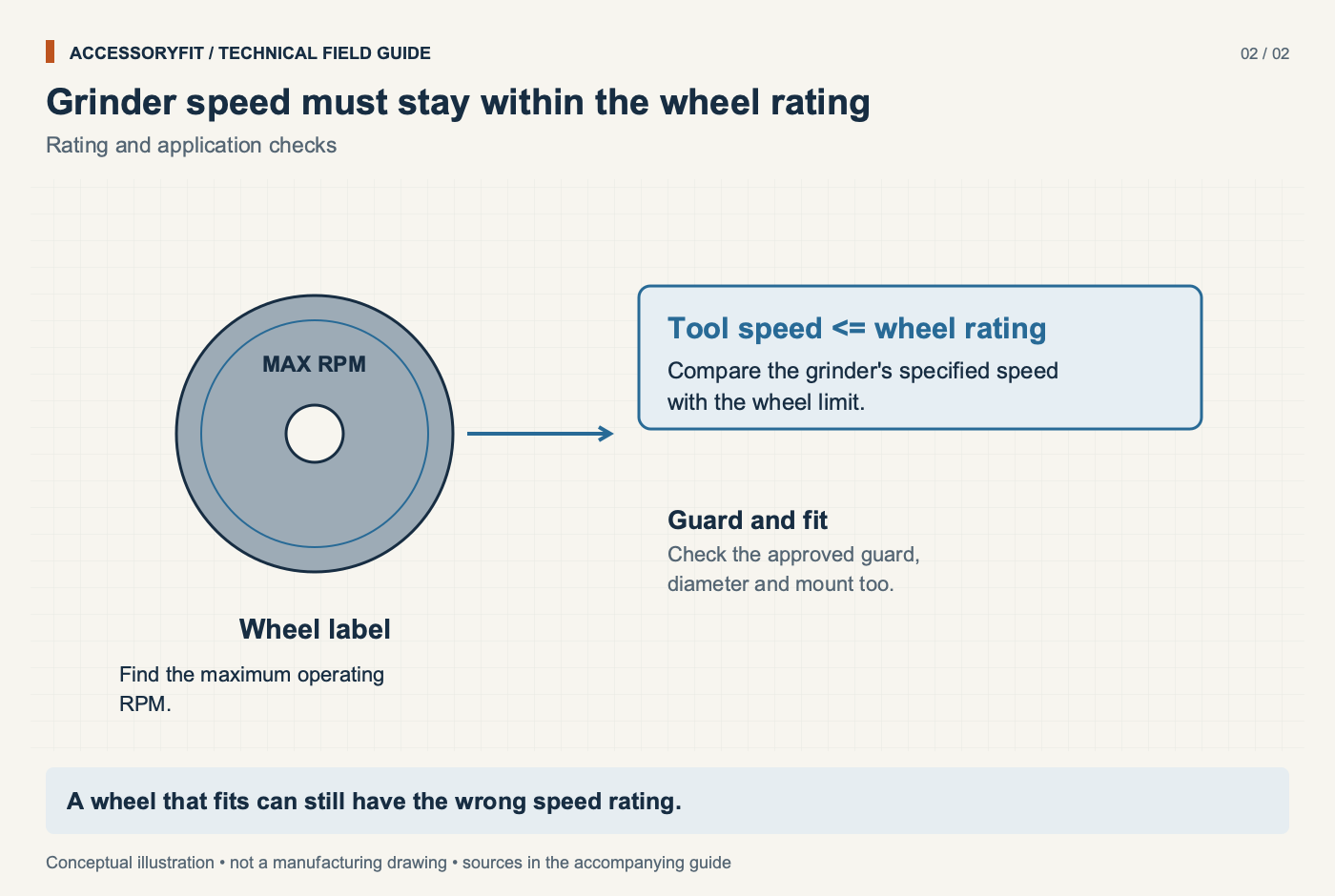
A disc is safe for speed only when the maximum RPM marked on it is at least the grinder's no-load speed. OSHA, FLEX, HAZET and DeWalt all state the rule, and OSHA requires the spindle speed to be checked before a wheel is mounted. A common belief is that a wheel which fits the spindle is fine whatever its rating; the manufacturer sources say the rating is the check that matters most.
The danger case is a larger wheel on a smaller grinder. United Abrasives rates its largest wheels at 6,600 RPM, while a small grinder such as the DeWalt DWE402 runs at 11000 rpm. A larger wheel would also be too big for the small grinder's guard. Makita's general warning applies: an accessory's outside diameter and thickness must be within the tool's capacity rating, because a wrongly sized accessory cannot be guarded or controlled.
A documented failure shows what the speed check prevents. A 2002 US Department of Energy incident summary describes a cup stone that burst at the Hanford Site in 1999 on a pneumatic grinder that ran faster than the stone was rated for, with the stone's rating and the grinder's speed at 6,000 vs 7,700 rpm; the guard deflected the pieces. It is an older case, kept as the clearest documented example of the mismatch this section describes. Grinder injuries in general are common: CPSC's NEISS emergency department data for 2024 put injuries involving workshop grinders, buffers and polishers at about 40,000 emergency department visits in US hospitals, an AccessoryFit estimate from the public case file that groups angle and bench grinders and does not record the cause. Which body parts are hurt most often is set out in the angle grinder injury statistics.
A new wheel also needs a trial run. FLEX and HAZET say to run it at operating speed with the guard fitted for at least 1 minute, standing out of line with the wheel, and OSHA requires wheels to be inspected and ring-tested before mounting.
Why do disc speed ratings differ between makers and markets?
Because the speed limit is set at the rim, not at the spindle. In Europe, bonded discs and flap and fibre discs for hand-held angle grinders are rated for a maximum peripheral speed of 80 m/s, a figure Klingspor, PFERD and Bosch's grinder manual all give. A bigger disc reaches that rim speed at fewer revolutions, which is why the permitted RPM falls as diameter rises. Klingspor's listings convert the one limit into a speed for each diameter, shown in the first table below.
Some discs still carry a coloured stripe for the speed class. Klingspor's speed page decodes them as blue 50 / yellow 63 / red 80 / green 100 m/s and notes that the stripes are no longer mandatory, so a disc without one is not unmarked; read the printed RPM instead.
US makers print an RPM straight onto the label, and the second table shows that the same nominal size can carry different figures. Weiler, for example, rates its flap discs at 13,000 / 12,000 / 10,200 / 8,600 RPM across its four sizes, slightly different from the bonded-wheel figures for the same diameters. At the 7 in size, United Abrasives and Klingspor give 8,500 RPM, Milwaukee and Weiler a slightly higher figure and DeWalt a higher one again. None of these differences changes the rule: the speed on the disc you are holding is the one that binds.
| Disc diameter | Nearest US size | Max speed (rpm) | Speed class |
|---|---|---|---|
| 115 mm | 4-1/2 in | 13,300 | 80 m/s |
| 125 mm | 5 in | 12,200 | 80 m/s |
| 150 mm | 6 in | 10,200 | 80 m/s |
| 180 mm | 7 in | 8,500 | 80 m/s |
| 230 mm | 9 in | 6,600 | 80 m/s |
Rpm from Klingspor product listings at distributors (115, 150, 180, 230 mm via eHorst; 125 mm via Fabory). Saint-Gobain NOVIPRO also gives 115 mm = 13,300. 80 m/s class from Klingspor; 150 and 180 mm listings print 80 m/s directly.
| Size | United Abrasives (T27 / cut-off) | Other maker figure | Source of other figure |
|---|---|---|---|
| 4-1/2 in | 13,300 | 13,300 / 13,000 | DeWalt DW8080 cut-off; Weiler flap discs |
| 5 in | 12,200 | 12,200 / 12,000 | Klingspor 125 mm; Weiler flap discs |
| 6 in | 10,200 | 10,200 | Milwaukee 49-94-0023; Weiler flap discs |
| 7 in | 8,500 | 8,600 / 8,700 | Milwaukee 49-94-0033 and Weiler flap discs; DeWalt DW4719 |
| 9 in | 6,600 | 6,600 | Milwaukee 49-94-9735 |
Limits differ by maker and product, especially at 7 in. The binding figure is the one printed on the wheel.
Which disc types are there, and which guard does each need?
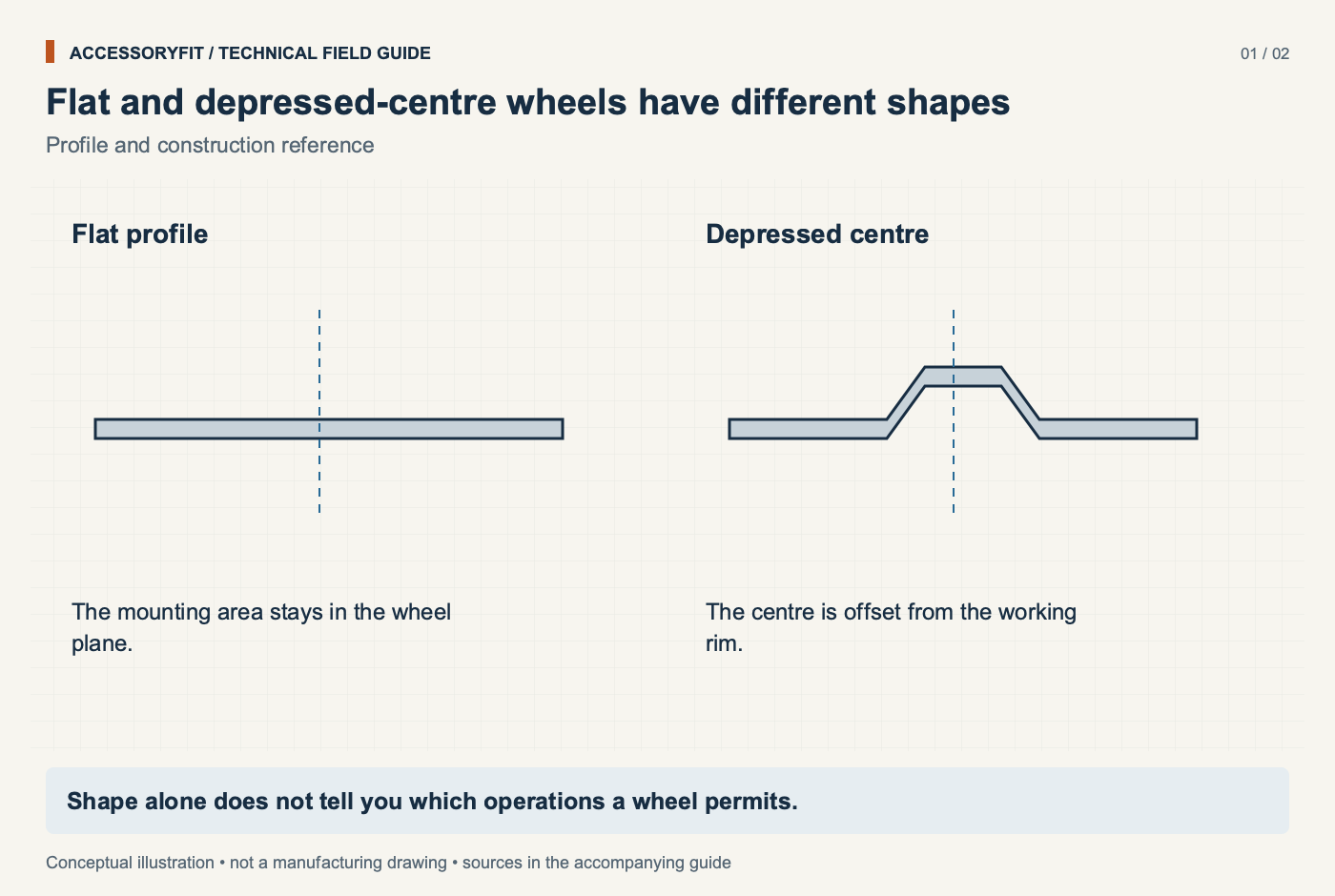
Grinder discs are identified by a type number for their shape, and the type decides the guard. Flat Type 1 and Type 41 cut-off wheels and diamond blades need a closed Type 1 cutting guard covering at least 180 degrees of both wheel sides and the rim. Depressed-centre Type 27 grinding wheels and Type 28 and Type 29 wheels use the open Type 27 guard with an inward-curled lip.
A common mistake is to assume the guard that came with the grinder suits cut-off wheels. The supplied open guard is normally the Type 27 grinding guard. Bosch, for example, supplies its Bosch GWS 12-125 Professional with a separate clip-on cutting guard for that reason. The sources disagree on one point: United Abrasives says its thin Type 27 and Type 42 cutting wheels can be used on all angle grinders under ANSI B7.1, while the FLEX wheel and guard guide pairs those cutting wheels with the Type 1 guard. This page follows FLEX: fit the cutting guard for any cutting.
Working angles differ by type too. Flat Type 27 flap discs work at 0–15 degrees, and conical Type 29 flap discs at 15–25 degrees, according to United Abrasives and Surface Prep. The shapes and thicknesses of cutting wheels are covered in depth in the guide to cut-off wheel types.
| Type | Shape | Use | Guard | Working angle |
|---|---|---|---|---|
| Type 1 / Type 41 | Flat (straight) | Cutting only, on the rim; maximum depth of cut | Closed Type 1 cutting guard, ≥180° both sides and rim | 90° to work |
| Type 27 / Type 42 (cutting) | Depressed centre, thin | Cutting; allows flush cuts, nut recessed | Type 1/41 guard per FLEX guide | 90° to work |
| Type 27 (grinding) | Depressed centre, flat rim | Side grinding; notching | Type 27 guard | about 30° |
| Type 28 | Depressed centre, saucer-shaped | Grinding large flat surfaces | Type 27-style guard with lip (HAZET) | about 15° |
| Type 29 (flap / flexible) | Conical | Stock removal, contours, edges | Type 27-style guard with lip (HAZET) | 15-25° (flap discs) |
| Type 27 (flap) | Flat | Finishing, blending, flat surfaces | Type 27 guard | 0-15° |
| Type 6 / 11 | Straight / flaring cup | Rim grinding | Cup guard with adjustable skirt | n/a |
Angles: UA wheel-label proper-use icons (Type 27 ~30°, Type 28 ~15°, cutting 90°); flap angles UA catalog p.60 and Surface Prep. Type 28 saucer shape: Cal/OSHA §3575(b)(C).
Can you put a saw blade on an angle grinder?
Not a circular saw blade. The speed rule alone rules it out: Diablo marks its 7-1/4 in wood blades for a maximum of 8000 rpm, while the DeWalt DWE402 runs at 11000 rpm. The blade is also far larger than the grinder's guard, and saw blades are made for a 5/8 in saw arbor rather than a grinder's flanges. Makita warns that an accessory attaching to a tool does not make it safe.
The blades that do belong on a grinder are small diamond blades. United Abrasives says small diamond blades with a 7/8 in arbor are for angle grinders, while versions with a smaller hole are for circular saws. They need the closed cutting guard and should be used only on the materials listed on the blade. For concrete and masonry, the shortlist of diamond blades for concrete applies these rules to specific products, and for wood the right tool is a saw, with fit rules in the guide to arbor and bore sizes for circular saws.
What about grinder discs for wood?
The grinder makers rule out the toothed kind. The DeWalt DWE402 and Bosch GWS 12-125 manuals both say not to fit a saw-chain woodcarving blade or a toothed saw blade to an angle grinder, because such blades cause frequent kickback and loss of control. That covers the chain discs and toothed carving wheels sold for shaping wood on a grinder. No grinder or abrasive maker in the AccessoryFit sources names a disc for wood shaping on a grinder, so this page recommends none; sanding wood belongs on a sander, with discs covered in the guide to which discs fit a random orbital sander.
Hospital records show how often grinders end up on wood anyway. In one Argentine hospital series of 928 patients treated for angle grinder hand injuries in 2016 to 2020, published in 2022 by the Argentine orthopaedic association's journal, 84.5% were cutting wood or firewood when they were hurt, and the authors put part of the blame on how easy unsuitable discs are to get. It is a single-hospital study rather than a national figure, but it points the same way as the grinder manuals.
Which grinder disc cuts tile?
A continuous-rim diamond blade. Makita, United Abrasives and Bosch recommend the continuous rim for ceramic and porcelain tile, marble and granite: it cuts the slowest of the diamond rim styles but leaves the cleanest, chip-free edge. Segmented and turbo rims are made for concrete and masonry and chip a glazed face.
A tile blade fits the grinder like any other disc, by hole and speed. United Abrasives' continuous-rim tile blades for small grinders are rated 13,300 RPM, according to its catalogue, which clears the 11000 rpm of the DeWalt DWE402. Diamond blades are cutting wheels, so DeWalt's manual and the FLEX guide both call for the closed, two-sided cutting guard rather than the open grinding guard.
Should tile be cut wet or dry on a grinder?
The blade makers and the grinder makers give different answers, so both views matter. Makita and United Abrasives rate continuous-rim blades for wet or dry use. DeWalt's and Bosch's grinder manuals forbid water or any other liquid coolant on an electric angle grinder because of the risk of electric shock, and Bosch's own tile disc page says electric angle grinders are not suitable for wet cutting. The blade's wet rating does not override the tool: on an electric grinder, cut tile dry.
Holes in tile are a drilling job rather than a grinder job, and the bits made for drilling glazed tile cover that.
| Rim | Described use | Wet/dry |
|---|---|---|
| Continuous rim | Slowest but cleanest cut; tile, porcelain, marble, granite (UA: .060 in thin) | wet or dry |
| Serrated continuous rim | Fast, cool cutting of most aggregate materials | wet or dry |
| Segmented rim | Cool cutting of concrete, brick, block, stone | wet or dry (some premium lines dry) |
| Turbo rim | Constant contact, smoother cut than segmented in block, pavers, brick, concrete | wet or dry (blade rating) |
UA catalog p.54; Makita diamond blade overview; Bosch turbo and EXPERT Hard Ceramic pages. Wet rating is the blade's; electric angle grinder manuals (DeWalt, Bosch) forbid liquid coolant. Use only on materials listed on the blade label (HAZET).
Which grinder discs are made for metal?
Four kinds: thin cut-off wheels for cutting, depressed-centre wheels for heavy grinding, flap discs for grinding and blending, and resin fibre discs on a backing pad for surface work. Wire brushes add a fifth job, cleaning off rust and scale. Each has its own guard and working angle, listed in the type table above.
For cutting, the standard thin US wheel is 0.045 in and the common European disc 1.0 mm; wheels of 0.090-3/32 in are sold for cutting and notching. For stainless, a contaminant-free wheel keeps iron, chlorine and sulphur below 0.1 percent combined, according to United Abrasives and McMaster-Carr listings.
For grinding and finishing, the grain matters more than the disc colour. United Abrasives and Weiler describe zirconia as the grain for aggressive removal on steel and stainless and ceramic as the longest-lasting, coolest-cutting choice for stainless and hard alloys, with a grinding-aid top coat helping on heat-sensitive metals. A resin fibre disc needs a backing pad and clamp nut, while a flap disc mounts on its own. The shortlist of flap discs for metal compares specific discs, and the guide to cut-off wheel types covers cutting wheels.
Wire cup brushes need their own speed check, because many are rated below a small grinder's speed. DeWalt's manual adds that the guard stays on for wire brushing, with the brush kept clear of it, because wire wheels can grow in diameter in use.
| Diameter | Wire size | Arbor | Style | Max RPM |
|---|---|---|---|---|
| 4 in | .020 in | 5/8-11 | crimped | 9,000 |
| 4 in | .020 in | 5/8-11 | knot | 9,000 |
| 5 in | .020 in | 5/8-11 | crimped | 8,000 |
| 6 in | .020 in | 5/8-11 | knot | 6,600 or 6,000 (by product) |
| 6 in | .035 in | 5/8-11 | knot | 6,600 or 6,000 (by product) |
UA catalog p.118. Knot wire: aggressive; crimped: more flexible for light cleaning. M14 wire cups for EU grinders not sourced.
Can an adapter make a disc fit a different grinder?
Only where the grinder maker allows it, and never by altering the disc. The sources disagree here. United Abrasives sells a reusable 5/8–11 UNC adapter that lets plain-hole reinforced cut-off wheels up to 5 in be threaded on, within a stated thickness range. Bosch's GWS 12-125 manual says the opposite for its grinder: the disc hole must match the mounting flange, and no adapter or reducer is to be used. Follow your grinder's own manual; where it forbids adapters, the abrasive maker's adapter does not override it.
The hard rule runs the other way. HAZET's guidance is never to ream out or adapt a wheel's centre hole to fit a different spindle; use a wheel whose hole or thread matches the grinder instead. OSHA adds that a wheel must slide freely onto the spindle and must not be forced, and that both mounting flanges must be clean, flat, undamaged and of the same diameter. DeWalt and Bosch add the reason: an accessory whose hole or thread does not match the flange or spindle runs out of balance, vibrates excessively and can cause loss of control.
Do X-LOCK discs fit a standard grinder, and the other way round?
X-LOCK discs mostly fit standard grinders; standard discs do not fit X-LOCK grinders. Bosch's UK and Australian X-LOCK pages and Makita's X-LOCK flap disc listing say that almost all X-LOCK cutting, grinding and flap discs also mount on ordinary 7/8 in plain-hole grinders with the usual flange and nut. The Makita T-03903 X-LOCK 4-1/2 in 60-grit Type 29 flap disc, for example, lists an X-LOCK and 7/8 in arbor.
The exceptions are threaded X-LOCK accessories. Bosch names wire cup brushes, backing pads and diamond core bits as X-LOCK items that do not fit a standard grinder. In the other direction, Bosch's UK X-LOCK page says an X-LOCK grinder takes only X-LOCK accessories, so neither plain-hole discs nor threaded M14 or 5/8–11 UNC accessories fit it. On an X-LOCK grinder, Bosch says an accessory is locked when it clicks into place; without the click, it is not secured.
When does a disc fail even though it fits?
A disc that fits the spindle still fails when its rating, age, storage or use is wrong. The cases the manufacturer and regulatory sources describe are these:
- Speed rating below the grinder. The single most important check, and the reason larger wheels never go on smaller grinders.
- Expired resin-bonded wheels. Reinforced cutting and grinding wheels carry an expiry date, printed as month and year; Saint-Gobain sets it 3 years after manufacture.
- Damp or hot storage. Resin-bonded wheels stored that way should not be used, and the belief that wheels last forever on the shelf is wrong.
- Cut-off wheels used for grinding. Thin wheels are cutting-only and can fail if used flat.
- A wrong or missing guard. The guard must match the disc type.
- A worn wheel from a larger grinder. DeWalt and Bosch both say not to fit a worn-down wheel from a bigger tool to a smaller one: it is not rated for the smaller grinder's higher speed and may burst.
- A disallowed wheel type. The DeWalt DW402G manual forbids flaring cup wheels; check your own manual.
Vibration after mounting is a warning sign worth acting on before the disc is used; the guide on grinder disc vibration covers the causes.
How do US and European grinder disc rules compare?
The fit checks are the same in both markets, but the standards and markings differ. US wheels follow ANSI B7.1, which OSHA rules reference, while HAZET lists the European standards as EN 12413 / EN 13236 / EN 13743, covering bonded wheels, diamond cut-off wheels and coated abrasives such as flap discs.
European cut-off discs are often marked with a diameter, thickness, bore and type code such as T41, while US wheels list the inch size and type. Thin European metal discs are commonly 1.0 mm thick, against 0.045 in for the standard thin US wheel. Plain-hole discs from either market share the same bore, so the thread is the only part of fit that changes when a grinder crosses the Atlantic.
How do you check a disc against your grinder?
Five checks confirm that a disc fits a grinder and can run safely on it.
- Disconnect power. Unplug the grinder or remove its battery before changing the disc.
- Read the grinder's disc size, thread and no-load speed. All three are on the nameplate or in the manual's specifications.
- Read the disc label. Check the diameter, the hole or thread, the type number, the maximum RPM and the expiry date.
- Fit the guard for the disc type. Cutting guard for flat cutting wheels and diamond blades; Type 27 guard for depressed-centre grinding wheels.
- Inspect, mount and test. Check the disc for cracks, mount it on clean flanges without forcing it, then run it at speed with the guard on, standing out of line.
Where do you go next?
For finishing and blending metal, the shortlist of flap discs for metal applies these size and speed checks to specific products. Sanders use a different fitting system altogether, covered in the guide to sanding disc sizes and hole patterns, and the round-up of sanding discs for random orbital sanders lists hook-and-loop options.
Bench saws follow the same speed-rating logic with bigger blades: the guides to table saw blade bore and adapters and 10-inch versus 12-inch miter saws cover them. Every abrasive and grinding accessory is grouped under sanding and grinding accessories, and the rest of the fit rules sit in the compatibility guides.
Questions readers ask
Do European grinder discs fit US grinders?
Plain-hole discs do, because both markets use the same 22.23 mm bore. Threaded accessories do not: European ones are M14 and US ones 5/8–11 UNC.
Can I use a larger disc if I take the guard off?
No. A disc must be within the grinder's capacity and run under its guard, and larger discs carry lower speed ratings than small grinders run at. OSHA limits wheel exposure on portable grinders to 180 degrees.
What does Type 27 mean on a grinder disc?
It is a depressed-centre wheel. As a grinding wheel it uses the open Type 27 guard; thin Type 27 cutting wheels should be fitted with the cutting guard.
Do grinder discs expire?
Resin-bonded reinforced cutting and grinding wheels do. The expiry month and year are printed on the wheel, usually on the metal ring, and the wheel should not be used after it.
Will an X-LOCK disc fit my ordinary grinder?
Most do. Makita lists its X-LOCK flap discs with an X-LOCK and 7/8 in arbor, and Bosch says almost all X-LOCK cutting, grinding and flap discs fit standard grinders. Threaded X-LOCK items such as wire cup brushes, backing pads and core bits do not.
Where to go next
- Cut-off wheel typesType 1, 41, 27 and 42 cutting wheels compared.
- Flap discs for metalProducts that pass these fit checks.
- Angle grinder disc vibrationWhat to do when a fitted disc shakes.
References 139 documents, 34 publishers
- Axminster Tools: Festool Multi-Jetstream2 Pad for ETS150 Sander; Mirka Interface Pad 125mm 953284
- Benchmark Abrasives: Sanding Discs Buying Guide: PSA vs Hook & Loop vs Fiber
- Bosch: GWS 12-125 angle grinder (UK); PRO Stainless Steel and Metal Bonded Cutting Disc, bore 22.23 mm (2 608 600 549); PRO Metal Bonded Cutting Disc for Chop Saws, bore 25.4 mm (2 608 600 543); GWS 12-125 / GWS 12-125 S original instructions 1 609 92A D3M (21.10.2025); Premium Turbo Rim Diamond Abrasive Blades; EXPERT Hard Ceramic Diamond Cutting Disc (X-LOCK); X-LOCK system page (GB); Bosch X-LOCK - The ultimate changing system for grinders (news); 1617/1618 router operating/safety instructions (2610051825); GKS 190 Professional Hand-Held Circular Saw - technical data; GCM 12 SDE Professional Mitre Saw - technical data; GTS 254 Professional Table Saw - technical data; EXPERT C470 Sandpaper with 8 holes for Random Orbital Sanders; ROS20VSC 5 in Random Orbit Sander product page
- California DIR (Cal/OSHA): Title 8 §3575 Scope and Definitions (abrasive wheels)
- Carbatec: Festool Granat Abrasive Disc 150mm 48 Hole P80
- DeWalt: DW8062 High Performance 4-1/2 in x .045 in x 7/8 in Metal Cut-Off Wheel; DWE402 4-1/2 in (115 mm) paddle switch small angle grinder; DW402G angle grinder instruction manual; DW4719 7 x 1/4 x 7/8 in High Performance Metal Grinding Wheel; DW8080 HP 4-1/2 in x 3/32 in x 7/8 in T1 Cutting/Notching Wheel (Stainless); DWE402/DWE402N/DWE402G/DWE4222N Instruction Manual NA190466; DWE402 4-1/2 in (115 mm) Small Angle Grinder product page; DWE575 7-1/4 in Circular Saw instruction manual (N786997); DWA271424 7-1/4 in 24T Circular Saw Blade; DW3508 6-1/2 in x 1/8 in x 5/8 in Diamond Drive Metal Cutting Blade; DWS535B 7-1/4 in Worm Drive Circular Saw instruction manual (N512189); DWE7491RS 10 in Job Site Table Saw instruction manual (N531890); DWS713 10 in Compound Miter Saw instruction manual (NA379757); DWS780 12 in Double Bevel Sliding Compound Miter Saw instruction manual (N466020); DWA110CMB 10 in (254 mm) 40T and 60T saw blades 2-pack; DWE6423 5 in variable speed random orbit sander with hook and loop pad; DWE6420/DWE6421/DWE6423 Random Orbit Palm Sanders instruction manual N412818
- DGUV Institute for Occupational Safety and Health (IFA): Ageing of resinoid bonded grinding wheels (project BIA 6055)
- Festool: ETS EC 150/3 EQ and ETS EC 150/5 EQ original instructions (PDF)
- FLEX (Chervon North America): Safety Warnings and Guidelines for Users of Portable Grinding, Cutting and Flap-Disc Wheels (10/2023)
- Freud and Diablo: Get the most out of your Freud bits by routing at ideal feed rates and speeds; D0740A 7-1/4 in x 40T Finish Saw Blade - tech specs; D0524X 5-3/8 in x 24T Framing Saw Blade - tech specs; D0624A 6-1/2 in x 24T Framing Saw Blade - tech specs; D0660A 6-1/2 in x 60T Ultra Finish Saw Blade - tech specs; D0824X 8-1/4 in x 24T Framing Saw Blade - tech specs; D1040X 10 in x 40T General Purpose Saw Blade - tech specs; D1244X 12 in x 44T General Purpose Saw Blade - tech specs; D0724A product page (framing family listing incl. D0620X 6 in); D1472CF 14 in x 72T Steel Demon Cermet II - tech specs
- HAZET: User information for grinding wheels, cut-off wheels, flap discs (multilingual safety leaflet)
- Health and Safety Executive (UK): Hand-arm vibration at work: The Control of Vibration at Work Regulations 2005. Guidance on Regulations (L140, second edition); RR717 - Evaluation of EN 60745 test codes: BS EN 60745-2-3:2007 angle grinders
- Hemlock Hardware (Diablo listing): Diablo 6 In. 60-Grit 6-Hole Pattern Vented Sanding Disc with Hook and Lock Backing
- HookandLoop.com: Replacing sanding discs with hook and loop
- İstanbul Medical Journal: Angle Grinder Injuries in the Upper Extremity: An Epidemiological Study
- Journal of Trauma and Injury: Severity of grinder injuries and related factors compared with other high-rotation cutting tool injuries: a multicenter retrospective study from 2011 to 2018
- Klingspor: Klingspor Kronenflex A 60 Extra cut-off wheel 125 x 22.23 x 1 mm, 12200 RPM; Klingspor Kronenflex A 46 TZ Special cutting disc 115 x 1.6 x 22.23 mm; Klingspor Kronenflex A 24 Extra cutting disc 150 x 2.5 x 22.23 mm, depressed; Klingspor Kronenflex A 36 TZ Special cutting disc 180 x 2 x 22.23 mm; Klingspor Kronenflex A 46 TZ Special cutting disc 230 x 1.9 x 22.23 mm; Maximum operating speed (Lowdown on grinding); Hole pattern for abrasives (Lowdown on grinding); Self-fastening disc (Lowdown on grinding)
- Makita: GA5030R 125 mm angle grinder; Diamond Blades new accessory overview (PDF); T-03903 X-LOCK 4-1/2 in 60 Grit Type 29 Flap Disc product page; E-23335 7 in Diamond Blade, Segmented Turbo, General Purpose product page; GA5030R Angle Grinder product page; GA4030R/GA4530R/GA5030R instruction manual (EU); 9557PB angle grinder instruction manual; 5007F 7-1/4 in circular saw instruction manual; 5007F 7-1/4" Circular Saw product page; 5007MG 7-1/4 in Magnesium Circular Saw - specs; XSS02Z 18V LXT 6-1/2 in Circular Saw - specs; SP6000J 6-1/2 in Plunge Circular Saw - specs; XPS01Z 36V (18V X2) 6-1/2 in Plunge Circular Saw - specs; LS1019L 10 in Dual-Bevel Sliding Compound Miter Saw - specs; LS1040 10 in Compound Miter Saw - specs; LS1219L 12 in Dual-Bevel Sliding Compound Miter Saw - specs; 5007MG/5007MGA Circular Saw instruction manual; 5377MG 7-1/4 in Hypoid Saw instruction manual; LS1019/LS1019L Slide Compound Miter Saw instruction manual; HS7611 Circular Saw instruction manual (EU); HS7611 190 mm Circular Saw - specification; HS6601 165 mm Circular Saw - specification; LS0815FL 216 mm Slide Compound Mitre Saw - specification; 5903R 235 mm Circular Saw - specification; LS1019L 260 mm Slide Compound Mitre Saw - specification; LS1040 260 mm Mitre Saw - specification; MLT100N 260 mm Table Saw - specification; 2704N 260 mm Table Saw - specification; LS1219 305 mm Slide Compound Mitre Saw - specification; BO6050 Random Orbit Sander instruction manual; BO6050J 6 in Random Orbit Sander product page; BO5041 5 in Random Orbit Sander product page; X-LOCK Flap Discs new accessory overview (PDF)
- McMaster-Carr: Grinders: manufacturer model number DWE402; Cutoff wheels catalogue page (contaminant-free wheels for stainless steel)
- Milwaukee Tool: M18 FUEL 4-1/2 in / 5 in Braking Grinder, Paddle Switch No-Lock (2880-20); Guard for Type 1 Grinding Discs 4-1/2 in (49-12-0361); 6 in x .045 in x 7/8 in Metal Cut Off Wheel - Type 1 (49-94-0023); 9 in x 1/4 in x 5/8-11 Grinding Wheel (Type 27) 49-94-9735 (discontinued listing); 7 in x 1/16 in x 7/8 in Metal Cut Off Wheel - Type 1 (49-94-0033); 2880-20 M18 FUEL 4-1/2 in / 5 in Grinder Paddle Switch, No-Lock product page; Operator's manual 58-14-0243D2 (Cat. No. 2880-20); M18 FUEL oscillating multi-tool 2836-20 operator's manual (58-14-0217d1); M18 FUEL 7-1/4 in Circular Saw 2732-20 - specifications; M12 FUEL 5-3/8 in Circular Saw 2530-20 - specifications; M18 FUEL 8-1/4 in Table Saw 2736-20 - specifications; 48-40-4505 14 in metal cutting circular saw blade
- NIOSH: Power Tool Database (PDF dated August 2006; catalogued by CDC Stacks 1 October 2011)
- OSHA: 29 CFR 1926.303 Abrasive wheels and tools; 29 CFR 1910.215 Abrasive wheel machinery; 29 CFR 1910.243 Guarding of portable powered tools; 29 CFR 1926.300 General requirements (Tools, hand and power); 29 CFR 1926.304 Woodworking tools; 29 CFR 1910.213 Woodworking machinery requirements
- PFERD: Safety notes, fine grinding and polishing tools (PDF, v1.0 14.01.2026)
- Revista Brasileira de Medicina do Trabalho (via PubMed Central): Laterality of hand-arm vibration exposure during grinding operations: a field study in industrial settings
- Revista de la Asociación Argentina de Ortopedia y Traumatología: Traumatic Injuries to the Hand From the Use of an Angle Grinder. A Problem in Our Field
- Saint-Gobain Abrasives (Norton): NOVIPRO thin cutting discs Technical Data Sheet (03.11.2022)
- SKIL: 7-1/4 in Lightweight Worm Drive SKILSAW SPT77WML-01
- Surface Prep: Flap Discs: The Differences Between Type 27 and Type 29
- Tool Nut: Diablo DCD060100H10G 6 in Sandpaper Hook & Loop; Festool 202458 Multi JetStream2 150mm Soft Pad for ETS/ETSC 150; Festool 203348 6 in StickFix Multi Jetstream2 Interface Pad 150mm; Mirka Abranet 5 in 150 Grit Mesh Sanding Disc 9A-232-150; Mirka Abranet 6 in P150 Hook and Loop Sanding Discs 9A-241-150RP
- U.S. Consumer Product Safety Commission: NEISS 2024 data file (neiss2024.xlsx), with NEISS_FMT code formats
- United Abrasives / SAIT: 2025-2026 Product Catalog (English); How to Read a Wheel Label & Safety Icon Library; The Ultimate Cut product family page
- US Department of Energy, Office of Environment, Safety and Health: Operating Experience Summary 2002-25
- Weiler Abrasives: Flap Disc Brochure WC117 (2026)
- Woodworker's Journal: What Ruined My Sander's Hook-and-loop Pad?; Pointers on Sanding Discs?
Accessed .