
Fit guide · Random orbital sanders
Sanding disc sizes and hole patterns: matching discs to your orbital sander
A sanding disc fits a random orbital sander when three things agree with the pad: diameter, attachment and hole pattern. Most US sanders take 5 in discs, sold in Europe as 125 mm, with a 8-hole pattern and hook-and-loop backing. The larger class is 150 mm, where several patterns compete, from 6 and 8 holes to Festool's 48-hole layout. Mesh discs and multi-hole universal discs sidestep the pattern question, but not the diameter.
By AccessoryFit editors · Checked
On this page
- What decides whether a sanding disc fits a random orbital sander?
- What sizes do random orbital sanding discs come in?
- Which hole patterns are used on each disc size?
- How do you match a disc's holes to your sander's pad?
- Do universal multi-hole and mesh discs fit every sander?
- Hook-and-loop vs PSA: which attachment does your sander use?
- What does an interface pad change?
- Does a sander's orbit diameter change which disc fits?
- How do US and European disc sizes compare?
- When does a sanding disc not fit or not hold?
- Do these discs fit drills or angle grinders?
- What should you check next?
What decides whether a sanding disc fits a random orbital sander?
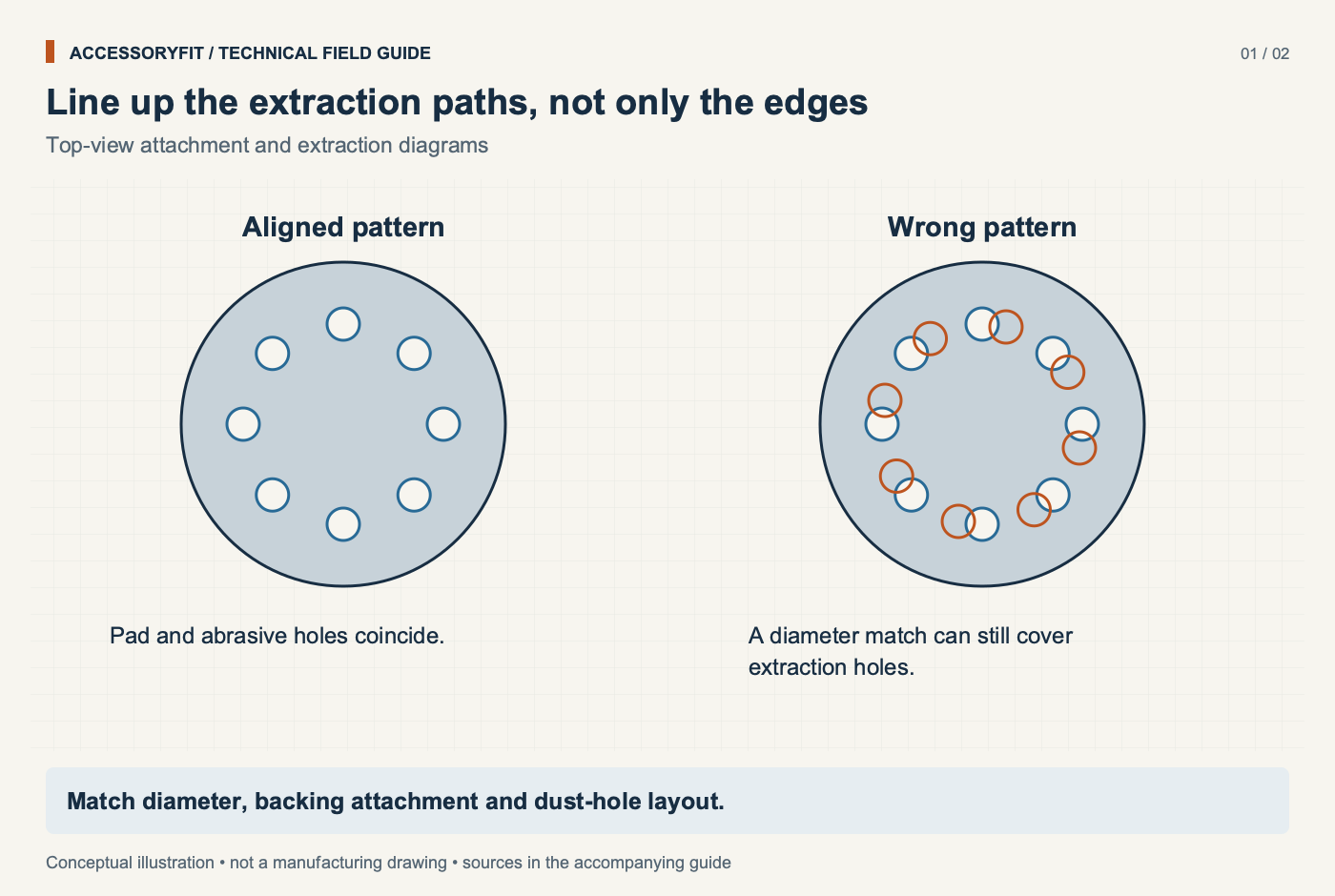
Diameter, attachment type and hole pattern decide fit, in that order of importance. A disc must be the same diameter as the sander's pad, it must use the same attachment system as the pad face, and its dust holes should sit over the pad's extraction holes. Get the first two wrong and the disc will not mount properly; get the third wrong and the sander still runs, but dust extraction mostly stops working.
Klingspor and Benchmark Abrasives describe the holes as the route the vacuum uses to pull dust off the work face, and Klingspor says that with matching holes and an extractor attached, abrasive service life is considerably extended. The pattern therefore matters most to anyone who sands with a shop vacuum or dust extractor connected, which is how Festool, Bosch, Makita and DeWalt all design their sanders to be used. The pad behind those holes makes a large difference as well. NIOSH reported in 1999 that a random orbital sander given added exhaust and curved slots in its pad released about 90% less wood dust than the same sander with a standard perforated pad and aspirator. It remains NIOSH's most recent published control test of its kind, and it shows how much a disc that blocks the pad's ports gives away. Extraction is not universal in practice either. Among the hand-held power sanders UK HSE observed in woodworking firms between 2014 and 2017 (report published 2024), it counted 9 of 16 sanders connected to extraction, with the rest on a dust bag or no control, and it noted that capture fell away on edges and curves where the disc was not flat to the work.
This page covers round discs for random orbital sanders only. Triangle and rectangle sheets for detail sanders follow different shapes and are covered in the guide to detail sander pad shapes. Abrasive grit is a separate choice again and does not change fit.
What sizes do random orbital sanding discs come in?
Random orbital discs come mainly in two sizes: 5 in in the US, sold as 125 mm in Europe, and a larger class sold as 150 mm. The smaller size dominates palm-grip sanders for home workshops; the larger one appears on Festool's ETS and RO ranges, Makita's BO6050J and many professional sanders.
The inch and metric labels describe the same class of pad, so a 125 mm disc from a European brand such as Bosch or Klingspor goes on a US sander with a 5 in pad. Bosch, for example, sells its EXPERT C470 8-hole paper in 125 mm for the same sanders that US buyers know by the inch size. Disc diameters must still match the pad exactly: a smaller disc leaves the pad edge bare, and a larger one overhangs it.
The table below lists the sanders in the AccessoryFit tool database with their pad sizes and attachment as each maker publishes them. Where a maker does not state a figure, the table says so.
| Tool | Pad | Pad holes | Pad attachment | No-load speed |
|---|---|---|---|---|
| Bosch ROS20VSC | 5 in | not stated | hook-and-loop | 12000 opm one source |
| DeWalt DWE6423 | 5 in | 8 one source | hook-and-loop | 12000 opm |
| Festool ETS EC 150/3 EQ-Plus | 150 mm | not stated | StickFix one source | 10000 opm |
| Makita BO5041 | 5 in | 8 one source | hook-and-loop one source | not stated |
| Makita BO6050J | 150 mm | not stated | hook-and-loop | not stated |
Values marked one source appear in a single manufacturer document; check the tool's manual or rating plate before buying.
Which hole patterns are used on each disc size?
The smaller disc size has one dominant pattern, 8 holes, while the larger size has no single standard. Klingspor's GLS 5 layout places those 8 holes on a ring near the middle of the disc, Bosch sells its 125 mm discs with 8 holes, and DeWalt lists 8-hole hook-and-loop paper for its DeWalt DWE6423. Makita's published figure for the Makita BO5041 is also 8 holes.
On 150 mm discs, a 6-hole pattern and an 8-hole pattern with a centre hole are both common, and they put their holes on different rings. Festool goes its own way with the MULTI-JETSTREAM 2 layout of 48 holes on its STF D150/48 discs, made for Festool's ETS 150, ETS EC 150, RO 150, LEX 150 sanders. Retailers sell further multi-hole layouts for larger sanders, but no source in the AccessoryFit fact base names which sanders use them, so they are left out of the guidance here.
Klingspor's own catalogue shows how many layouts exist. Its pattern codes cover several arrangements on each diameter, and the table that follows reproduces them. Klingspor does not say which sander brand each code is meant for, so treat the codes as a way to compare a disc's layout with your pad rather than as a brand list.
| Disc size | Pattern | Typical use / fit | Sources |
|---|---|---|---|
| 5 in (125 mm) | 8-hole | most 5 in random orbital sanders (Bosch, DeWalt 8-hole paper) | Bosch C470; DeWalt; Klingspor GLS 5 |
| 6 in (150 mm) | 6-hole | 6-hole 150 mm sanders; Diablo universal disc fits 6- and 8-hole | Klingspor GLS 3; Diablo |
| 6 in (150 mm) | 8-hole + centre | 8-hole 150 mm sanders | Klingspor GLS 1; Diablo |
| 6 in (150 mm) | 15-hole multi (8+6+centre) | multi-hole 150 mm pads | Klingspor GLS 47 |
| 6 in (150 mm) | Festool MULTI-JETSTREAM 2 (48 holes) | Festool ETS 150, ETS EC 150, RO 150, LEX 150 | Carbatec; Tool Nut |
| 5 in / 6 in | Mirka net (Abranet) mesh | any hook-and-loop sander of that size; dust drawn through whole face | Tool Nut Abranet pages |
A 17-hole 6 in pattern is sold by some brands; Klingspor GLS 51 totals 17 holes, but no source fetched names a specific 17-hole sander.
| Pattern code | Disc diameter | Holes | Notes |
|---|---|---|---|
| GLS 5 | 125 mm (5 in) | 8 x 10 mm on 65 mm circle | common 8-hole |
| GLS 11 | 125 mm | 4 x 10 mm on 40 mm circle | |
| GLS 12 | 125 mm | 3 x 10 mm on 68 mm + 3 x 10 mm on 86 mm | |
| GLS 18 | 125 mm | 8 x 10 mm on 65 mm circle | |
| GLS 19 | 125 mm | 5 x 10 mm on 72 mm circle | |
| GLS 27 | 125 mm | 8 x 10 mm on 90 mm circle + 10 mm centre hole | 9 holes total |
| GLS 58 | 125 mm | 5 x 10 mm on 70 mm circle | |
| GLS 1 | 150 mm (6 in) | 8 x 10 mm on 120 mm circle + 17 mm centre hole | 9 holes total |
| GLS 2 | 150 mm | 8 x 10 mm on 65 mm circle | |
| GLS 3 | 150 mm | 6 x 10 mm on 80 mm circle | common 6-hole |
| GLS 6 | 150 mm | 6 x 10 mm on 80 mm + 8 x 10 mm on 118 mm | 14 holes |
| GLS 7 | 150 mm | 8 x 10 mm on 65 mm + 8 x 10 mm on 116 mm | 16 holes |
| GLS 8 | 150 mm | 8 x 10 mm on 120 mm circle | |
| GLS 10 | 150 mm | 4 x 10 mm on 65 mm circle | |
| GLS 47 | 150 mm | 8 x 9 mm on 120 mm + 6 x 9 mm on 80 mm + 17 mm centre hole | 15 holes |
| GLS 51 | 150 mm | 8 x 10 mm on 120 mm + 8 x 8 mm on 65 mm + 10 mm centre hole | 17 holes |
| GLS 56 | 150 mm | 6 x 6 mm on 44 mm + 6 x 9 mm on 80 mm + 8 x 9 mm on 120 mm | 20 holes |
| GLS 74 | 150 mm | 8 x 9.5 mm + 16 x 6 mm on 119 mm, 8 x 7 mm on 95 mm, 8 x 8.5 mm on 65 mm, 8 x 6 mm on 39 mm + 10 mm centre | 49 holes |
Hole totals in the Notes column are counts of the holes Klingspor lists for each pattern. Klingspor does not say which sander brand each code is for, so do not map codes to brands from this table.
How do you match a disc's holes to your sander's pad?
Count the holes on the pad and note how far they sit from the centre, then choose a disc whose holes fall on the same ring. Hole count alone can mislead: Klingspor's GLS 2 and GLS 8 are both 8-hole layouts on the same disc diameter, but one ring sits close to the centre and the other near the edge. A disc with the right count on the wrong ring covers every extraction port.
Once the pattern matches, fitting is a matter of alignment. HookandLoop.com advises centring the disc and lining its openings up with the pad's dust ports before pressing it down, and Diablo describes its universal layout as designed for the same precise alignment. If the sander has no extraction at all, hole pattern stops mattering for fit, though a solid disc on a vented pad still traps dust under the abrasive.
Do universal multi-hole and mesh discs fit every sander?
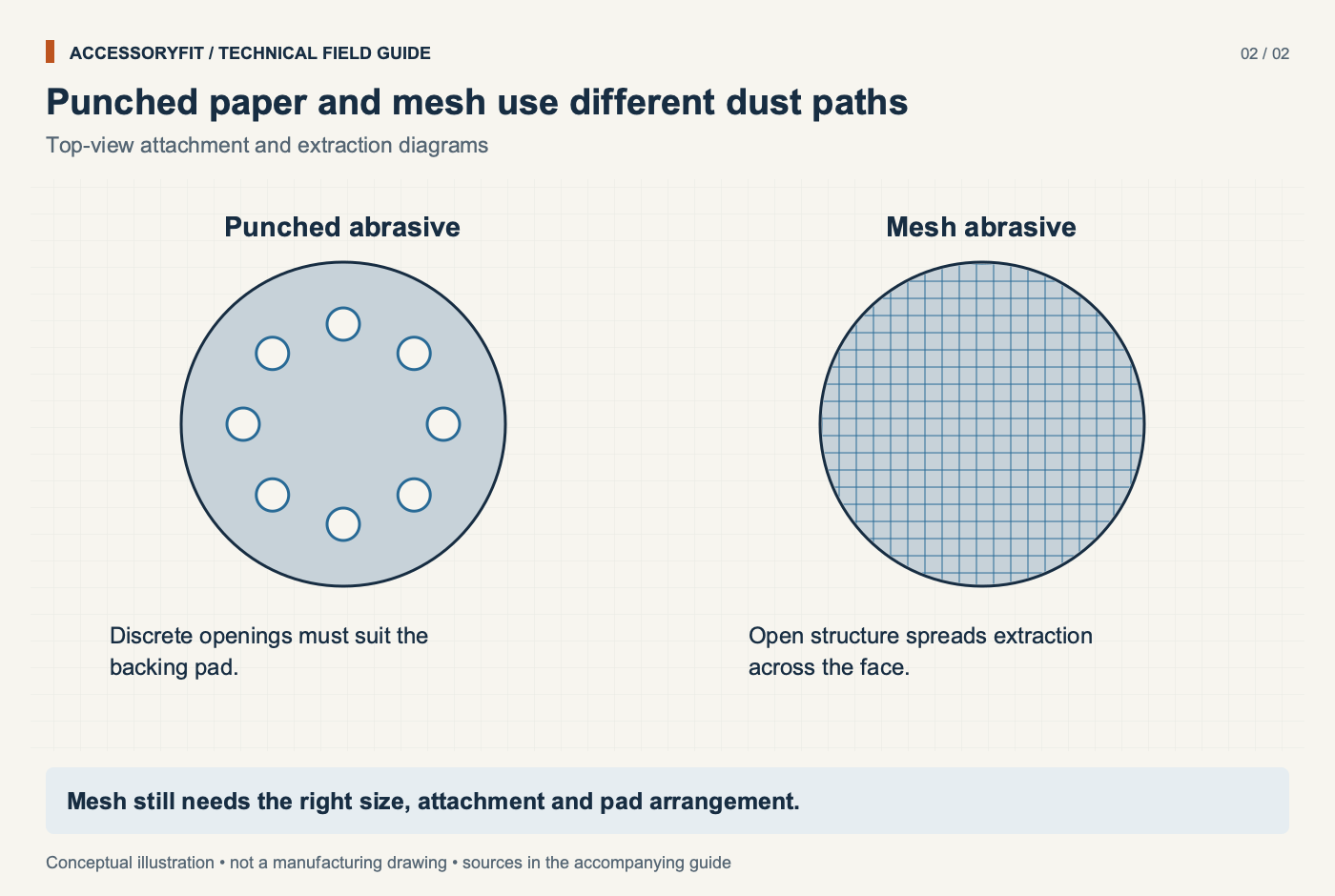
They fit every hole pattern of their own diameter and attachment type, which is the main reason to buy them. Diablo describes the hole pattern of its 5 in Hook & Lock discs as 12-hole universal (fits 5- and 8-hole sanders), and says its larger universal disc fits both 6-hole and 8-hole sanders. Multi-ring patterns in Klingspor's chart do the same job by stacking two or three hole rings on one disc.
Mesh discs go further. Mirka Abranet is a net abrasive that draws dust through the whole face of the disc instead of through a few punched holes, so there is no pattern to line up. Mirka describes the pattern of its 5 in Abranet Grip discs as net (open mesh, fits any hole pattern), on a loop backing it calls Grip. Diablo's SandNET discs are a related idea with their own twist: Diablo lists the pattern as universal open net (fits 5- and 8-hole sanders), and the discs attach through a connection pad supplied with them.
Neither type escapes the other two fit rules. A mesh disc for a 125 mm pad does not fit a 150 mm pad, and a hook-backed mesh disc will not stay on a PSA pad. For specific disc recommendations, the shortlist of orbital sander disc picks compares these products by their published specifications.
Hook-and-loop vs PSA: which attachment does your sander use?
Most current random orbital sanders use hook-and-loop, which DeWalt, Bosch and Makita list for the sanders in the table above; PSA (pressure-sensitive adhesive) pads are the other system. Festool's version of hook-and-loop is branded StickFix, and Diablo's is Hook & Lock, but both are hook-and-loop. The disc's backing must match the pad face: loop-backed discs go on hook pads, and adhesive discs go on smooth PSA pads.
The two systems suit different work. Woodworker's Journal notes that hook-and-loop discs can come off and go back on several times, which suits stepping through a grit sequence and keeping part-used discs for later, while production shops tend to discard a PSA disc once it is removed. PSA is usually the cheaper system, and Benchmark Abrasives says its stiff bond is better for keeping a surface flat without rounding edges. Hook-and-loop sheds heat a little better, though heavy pressure can crush the pad's hooks.
A common belief is that PSA is always the better attachment. The sources point the other way: PSA wins on cost and flatness, hook-and-loop wins on reuse and quick grit changes, and the right choice depends on the job. Grit selection within either system is covered in the guide to grit progressions.
What does an interface pad change?
An interface pad is a thin foam layer that sits between the sander's pad and the disc, softening contact on contours and taking the wear instead of the sanding pad itself. Axminster describes Mirka's multi-hole interface pads in those terms, and Tool Nut describes Festool's StickFix MJ2 interface pad as a damping layer between disc and pad.
For fit, an interface pad adds one more surface that has to agree with everything else. Its diameter must match the sander, its holes must line up with both the pad below and the disc above, and it needs hooks on its outer face so loop-backed discs still grip. Festool's 150 mm pads also come in hard, soft and super-soft versions for edges, general work and curved surfaces respectively.
Mirka adds one maintenance point for mesh discs: when sanding continuously, it advises a pad saver between the net disc and the backing pad to extend pad life. That is a recommendation for heavy use, not a requirement for the disc to fit.
Does a sander's orbit diameter change which disc fits?
No. Orbit diameter, also called stroke, sets how far the pad swings off centre and how coarse the scratch pattern is, but disc fit still depends only on pad diameter, attachment and holes. Festool shows this plainly: its manual gives the ETS EC 150/3 and ETS EC 150/5 strokes of 3.0 / 5.0 mm respectively, yet both run on the same 150 mm pad and take the same MULTI-JETSTREAM 2 discs listed for the ETS EC 150.
The table below gathers the orbit and speed figures that Festool, Bosch and Makita publish for their sanders. Read it as a guide to what each sander does with a disc, not to which disc it takes. A large orbit removes stock faster and a small one leaves a finer scratch, which is why the same disc can give a different surface on two sanders of the same pad size. The causes of loops in the finish, orbit size among them, are set out in the guide to sander swirl marks.
| Sander | Pad | Orbit diameter | Speed range |
|---|---|---|---|
| Festool ETS EC 150/3 | 150 mm (6 in) | 3.0 mm (1/8 in) | 6,000-10,000 /min |
| Festool ETS EC 150/5 | 150 mm (6 in) | 5.0 mm (3/16 in) | 6,000-10,000 /min |
| Bosch ROS20VSC | 5 in | 3/32 in (2.5 mm) | 7,500-12,000 OPM |
| Makita BO5041 | 5 in | 1/8 in (3.2 mm) | 4,000-12,000 OPM |
| Makita BO6050J | 6 in | 7/32 in (5.6 mm) | 1,600-6,800 OPM |
One maker source per model. Metric/imperial conversions for Makita are arithmetic. DeWalt does not publish an orbit size for the DWE6423.
How do US and European disc sizes compare?
They describe the same two pad classes: US 5 in discs correspond to European 125 mm discs, and the larger US class corresponds to 150 mm. Klingspor, a German abrasives maker, publishes all of its random orbital patterns in millimetres, while Diablo and DeWalt sell in inches. Tool Nut, a US retailer, describes Festool's larger pad in both inches and as 150 mm, which shows how freely the two labels are used for one size.
The bigger regional difference is grit marking rather than size. European discs are usually graded on the FEPA P scale, and US discs often use CAMI numbers, so a disc with the same number can differ in coarseness. The CAMI to FEPA grit conversion chart lines the two scales up. Hole patterns, by contrast, are not regional: Festool's 48-hole layout is the same on both sides of the Atlantic.
When does a sanding disc not fit or not hold?
A disc fails to fit when its diameter or attachment differs from the pad, and it fails to hold when the hook face or loop backing is worn or dirty. These are the failure cases the sources on this page describe:
- Wrong diameter. A 150 mm disc overhangs a 125 mm pad, and the reverse leaves the pad edge bare.
- Wrong attachment. Loop-backed discs do not grip a PSA pad, and adhesive discs do not belong on a hook face.
- Holes on the wrong ring. The sander runs, but extraction is blocked and the abrasive clogs sooner.
- Worn or crushed hooks. HookandLoop.com and Woodworker's Journal name worn hooks, dust on the pad, poor alignment and worn loop backing as the usual reasons a disc flies off.
- Heavy pressure. Pressing down hard crushes the hooks and builds heat, which shortens both the pad and the disc.
The fix order is the same in every source: clean the hook face first, and if clean discs still detach, replace the hook surface or the sanding pad. Another myth worth correcting is that mesh discs such as Abranet ruin hook-and-loop pads. Woodworker's Journal points out that Abranet uses a standard loop backing, and that pad damage is more likely from pressing too hard or from debris trapped in the hooks. Uneven scratch patterns are a separate problem from fit; the guide to sander swirl marks covers those.
How do you check disc fit on a sander not listed here?
Four checks, using the sander's manual and a look at its pad, confirm which discs fit before you buy a pack.
- Read the pad diameter. The manual or the product page gives the pad size in inches or millimetres; treat the inch and metric labels of the two common classes as the same size.
- Identify the attachment. A rough hook face takes loop-backed discs; a smooth face takes PSA. Note any brand name, such as StickFix or Hook & Lock, which are hook-and-loop systems.
- Count the pad's holes and note their ring. Record the number of holes and how far out they sit. Match both, or choose a multi-hole or mesh disc of the same size.
- Fit and align the disc. With the sander unplugged, centre the disc, line its holes up with the pad's dust ports and press it flat across its whole face.
Do these discs fit drills or angle grinders?
Random orbital discs are made for the pad of a random orbital sander, and the manufacturer sources on this page describe them only in that use. Hook-and-loop discs can be used on a drill only through a separate backing pad that provides the hook face and a shank, and the AccessoryFit fact base holds no manufacturer data on those drill-mounted pads, so their sizes and speed limits are not covered here.
Angle grinders use a different family of abrasives, such as flap discs and fibre discs, which mount on the grinder's spindle thread and carry their own speed ratings. Resin fibre discs for metal go on a grinder only with a backing pad and clamp nut, while flap discs need no backing pad. DeWalt's manual for its DeWalt DWE402 grinder adds that sanding paper must never be larger than the backing pad, because the overhang can cut the user and can snag or tear. Those sizes and threads are covered in the guide to which discs fit your grinder, and the whole abrasives range sits under sanding discs and grinder wheels.
What should you check next?
With size, attachment and pattern confirmed, the next decisions are grit sequence and abrasive grain. To see which discs and pads match a particular sander model, enter it into the accessory finder, and for fit rules covering saws, bits and grinders, browse the other compatibility guides.
Questions readers ask
Will a 125 mm disc fit a 5 in random orbital sander?
Yes. The two labels describe the same pad class: Bosch sells 125 mm discs for the sanders US buyers know by the inch size. Match the hole pattern and attachment as well.
Can an 8-hole disc go on a 6-hole sander?
It will attach if the diameter and backing match, but the holes will not line up, so extraction suffers. A universal multi-hole disc, such as Diablo's, which Diablo says fits both 6-hole and 8-hole sanders, or a mesh disc avoids the mismatch.
Why does my hook-and-loop disc keep flying off?
The usual causes are a worn or crushed hook face, dust on the pad, poor alignment or worn loop backing on the disc. Clean the pad first, and replace the hook surface or pad if clean discs still detach.
Do Festool sanders need Festool discs?
Festool's 48-hole MULTI-JETSTREAM 2 discs are made to line up with its pads, and mesh discs with loop backing also attach to its StickFix hook face. A disc with a different hole layout will attach but will not line up with the extraction holes.
Is PSA or hook-and-loop better for flattening a surface?
Benchmark Abrasives says PSA's stiff bond is better for keeping a surface flat without rounding edges, while hook-and-loop is easier to swap between grits.
Where to go next
- Sanding discs for random orbital sandersDisc picks compared by published specs.
- Sandpaper grit guideWhich grits to use, in which order.
- Detail sander pad shapesTriangle and rectangle sheets for small pads.
- Why a sander leaves swirl marksWhen the disc fits but the finish is wrong.
References 59 documents, 29 publishers
- Axminster Tools: Festool Multi-Jetstream2 Pad for ETS150 Sander; Mirka Interface Pad 125mm 953284
- Benchmark Abrasives: Sanding Discs Buying Guide: PSA vs Hook & Loop vs Fiber
- Bosch: EXPERT C470 Sandpaper with 8 holes for Random Orbital Sanders; ROS20VSC 5 in Random Orbit Sander product page; ROS10/ROS20VS operating/safety instructions 2610051955; 1617/1618 router operating/safety instructions (2610051825)
- Carbatec: Festool Granat Abrasive Disc 150mm 48 Hole P80
- Colorado State University and Montana Technological University, Annals of Work Exposures and Health 67(5): The Evaluation of Worker Exposure to Airborne Silica Dust During Five OSHA Table I Construction Tasks
- DeWalt: DWE6423 5 in Variable-Speed Random Orbit Sander product page; DWE6420/DWE6421/DWE6423 Instruction Manual N412818; DWE6423 5 in variable speed random orbit sander with hook and loop pad; DWE402/DWE402N/DWE402G/DWE4222N Instruction Manual NA190466; DWE575 circular saw instruction manual (N786997)
- European Parliament, Legislative Observatory (procedure 2016/0130(COD), final act summary): Protection of workers from exposure to carcinogens or mutagens at work: exposure limit values - Directive (EU) 2017/2398, final act
- Festool: ETS EC 150/3 EQ and ETS EC 150/5 EQ original instructions (PDF); Random Orbital Sander ETS EC150/3 EQ-Plus (576326) product page
- Freud and Diablo: DCD050080H50G ROS Hook & Lock Discs product page; DND050120H10I SandNET Discs product page; Get the most out of your Freud bits by routing at ideal feed rates and speeds
- Health and Safety Executive (UK): Wood dust exposures in manufacturing industries; EH40/2005 Workplace exposure limits (Fourth Edition 2020)
- Hemlock Hardware (Diablo listing): Diablo 6 In. 60-Grit 6-Hole Pattern Vented Sanding Disc with Hook and Lock Backing
- HookandLoop.com: Replacing sanding discs with hook and loop
- Klingspor: Hole pattern for abrasives (Lowdown on grinding); Self-fastening disc (Lowdown on grinding)
- Makita: BO6050 Random Orbit Sander instruction manual; BO6050J 6 in Random Orbit Sander product page; BO5041 5 in Random Orbit Sander product page; BO5040/BO5041 instruction manual; BO6050 Random Orbit Sander product page; 9557PB angle grinder instruction manual; 5007F 7-1/4 in circular saw instruction manual
- Milwaukee Tool: M18 FUEL oscillating multi-tool 2836-20 operator's manual (58-14-0217d1)
- Mirka: ABRANET 5 in Grip product page (US)
- National Toxicology Program, US Department of Health and Human Services: Report on Carcinogens, Fifteenth Edition: Wood Dust
- NIOSH: Hazard Controls: Control of Wood Dust from Random Orbital Hand Sanders and Orbital Hand Sanders; Comprehensive Report: Laboratory Evaluation of Saw Blades for Cutting Fiber-Cement Siding
- OSHA: Occupational Exposure to Respirable Crystalline Silica; Final Rule (29 CFR Parts 1910, 1915, and 1926); 29 CFR 1910.215 Abrasive wheel machinery; 29 CFR 1910.243 Guarding of portable powered tools; 29 CFR 1926.303 Abrasive wheels and tools; 29 CFR 1926.300 General requirements (Tools, hand and power); 29 CFR 1926.304 Woodworking tools
- Purdue University, Journal of Occupational and Environmental Hygiene: Evaluation of Cut-Off Saw Exposure Control Methods for Respirable Dust and Crystalline Silica in Roadway Construction
- Technical University in Zvolen, MM Science Journal: Effect of Selected Factors on Mass Concentration of Airborne Dust During Wood Sanding
- Tool Nut: Festool 203348 6 in StickFix Multi Jetstream2 Interface Pad 150mm; Diablo DCD060100H10G 6 in Sandpaper Hook & Loop; Festool 202458 Multi JetStream2 150mm Soft Pad for ETS/ETSC 150; Mirka Abranet 5 in 150 Grit Mesh Sanding Disc 9A-232-150; Mirka Abranet 6 in P150 Hook and Loop Sanding Discs 9A-241-150RP
- United Abrasives / SAIT: 2025-2026 Product Catalog (English)
- University of California, Berkeley, Journal of Occupational and Environmental Hygiene 16(5): Effect of hollow bit local exhaust ventilation on respirable quartz dust concentrations during concrete drilling
- University of Massachusetts Lowell, Journal of Occupational and Environmental Hygiene: Reducing Silica and Dust Exposures in Construction During Use of Powered Concrete-Cutting Hand Tools: Efficacy of Local Exhaust Ventilation on Hammer Drills
- US Government Publishing Office, Electronic Code of Federal Regulations: 29 CFR 1926.1153 Respirable crystalline silica (current eCFR text)
- Virginia Tech, Annals of Work Exposures and Health 69(3): Silica exposure controls usage in masonry and concrete trades: before and after enactment of the OSHA Silica Construction Rule (1926.1153)
- Weiler Abrasives: Flap Disc Brochure WC117 (2026)
- Woodworker's Journal: What Ruined My Sander's Hook-and-loop Pad?; Pointers on Sanding Discs?
Accessed .