
Research · Noise
How loud are power tools? Noise levels by tool (dB)
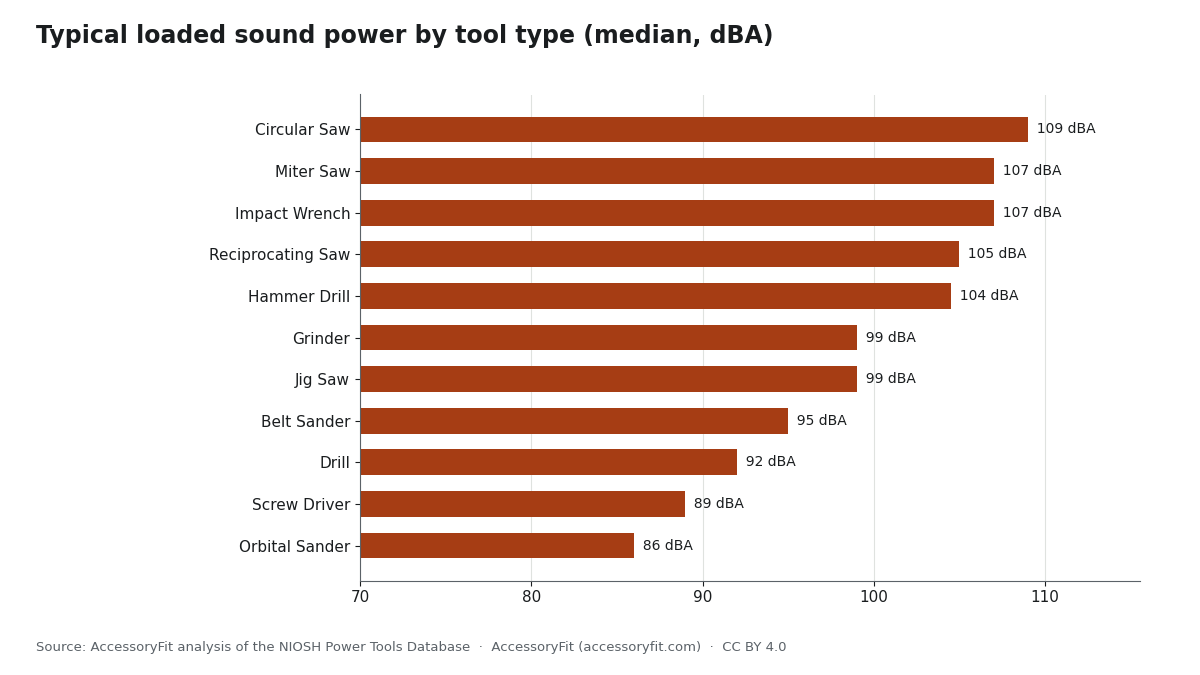
Circular saws were the loudest common power tool in the NIOSH Power Tools Database, at a typical 109 dBA sound power (median, loaded), followed by miter saws, reciprocating saws and hammer drills; orbital sanders were the quietest. These are US government laboratory measurements of corded tools made before 2014, and they are sound power levels, a property of the tool, not the level at your ear. Workplace limits apply to the level at the ear over a day: OSHA's US action level is 85 dBA (8-hour TWA), and the UK and EU lower action value is 80 dB(A) daily or weekly exposure.
By AccessoryFit editors · Checked
On this page
- What are the key findings?
- How loud are power tools?
- Which power tools are the loudest?
- How loud is a circular saw?
- How loud is an angle grinder?
- How loud is a drill or hammer drill?
- Why can't these dB figures be compared with exposure limits?
- What noise limits apply in the US?
- How long can you work at a given noise level?
- What noise limits apply in the UK and EU?
- Does the blade, bit or disc change how loud a tool is?
- How was this data produced?
- How should you cite this data?
What are the key findings?
- Circular saws had the highest typical noise output in the NIOSH Power Tools Database, at 109 dBA sound power (median, loaded), in an AccessoryFit analysis of the 143 tool models NIOSH measured, all corded (database PDF dated August 2006, plus archived 2013 online results).
- Miter saws measured 107 dBA sound power (median, loaded), reciprocating saws 105 dBA sound power (median, loaded) and hammer drills 104.5 dBA sound power (median, loaded) in the same NIOSH laboratory tests.
- Angle grinders measured 99 dBA sound power (median, loaded), standard drills 92 dBA sound power (median, loaded) and orbital sanders 86 dBA sound power (median, loaded), the quietest tool type in the database.
- Saws in the NIOSH tests were mostly louder while cutting than while idling, but none of the orbital or belt sanders was louder sanding than running free.
- NIOSH's recommended exposure limit is 85 dBA (8-hour TWA) with a 3 dB exchange rate, so the allowed time halves with each step; OSHA's legal limit in the US is 90 dBA (8-hour).
- In the UK, employers must act at 80 dB(A) daily or weekly exposure, and the exposure limit value is 87 dB(A) daily or weekly exposure (Control of Noise at Work Regulations 2005); EU Directive 2003/10/EC sets the same exposure levels.
- A 2026 Brazilian field study measured 84.4–101.0 dB(A) daily noise exposure for welders using angle grinders in 2025, with mean exposures above the exposure limit the study applied.
How loud are power tools?
Typical working noise runs from 86 dBA sound power (median, loaded) for orbital sanders to 109 dBA sound power (median, loaded) for circular saws, according to NIOSH's laboratory measurements of corded tools. The table below gives the typical (median) level for each tool type while cutting or working a piece, the range across the models measured, and the idling figure. A sound power figure describes how much noise the tool itself emits; the level a user hears is lower and depends on distance and the room, which is explained further down.
| Tool type | Models (n) | Loaded median (dBA) | Loaded range (dBA) | Unloaded median (dBA) | Unloaded range (dBA) | Left-hand vibration median (m/s²) |
|---|---|---|---|---|---|---|
| Circular Saw | 31 | 109 | 102-113 | 102 | 95-109 | 3.6 (n=31) |
| Miter Saw | 6 | 107 | 103-113 | 100.5 | 100-102 | not measured |
| Impact Wrench | 7 | 107 | 101-110 | 96 | 88-104 | 21 (n=6) |
| Reciprocating Saw | 19 | 105 | 102-112 | 100 | 96-105 | 32.6 (n=19) |
| Hammer Drill | 12 | 104.5 | 101-116 | 93.5 | 89-97 | 27.2 (n=1) |
| Grinder | 21 | 99 | 95-107 | 97 | 91-103 | 14.4 (n=21) |
| Jig Saw | 5 | 99 | 97-102 | 96 | 92-98 | 11.3 (n=5) |
| Belt Sander | 7 | 95 | 87-98 | 97 | 93-102 | 3.3 (n=6) |
| Drill | 14 | 92 | 87-94 | 91 | 89-98 | 4.8 (n=14) |
| Screw Driver | 4 | 89 | 85-91 | 91.5 | 90-93 | 11.05 (n=4) |
| Orbital Sander | 17 | 86 | 74-93 | 91 | 74-97 | not measured |
AccessoryFit analysis of NIOSH Power Tools Database, 143 models: 120 from the 2006 PDF excerpt plus 23 models shown only on the archived 2013 online results pages (first page of results per tool type; later pages and the hammer drill page were not archived). Values are A-weighted SOUND POWER (ANSI S12.15 / ISO 3744), which is higher than the sound pressure an operator hears; do not compare them directly with the 85/90 dBA exposure limits. Loaded = tool working a workpiece; unloaded = suspended and idling at full speed. Impact wrench row includes 3 pneumatic tools. Left-hand reading is the side or front handle (Accel 2). Hammer drill vibration n=1. Tools are corded models tested before 2006-2013.
Which power tools are the loudest?
Saws are the loudest group: circular saws had the highest typical level in the NIOSH database, ahead of miter saws and reciprocating saws, as the table above shows. Impact wrenches sit level with miter saws in the table, though some of those measured were air tools rather than electric ones. The single loudest model was a Bosch 11235EVS hammer drill, which pushed the hammer drill range to the top of the table even though the typical hammer drill was quieter than a circular saw.
At the quiet end sit standard drills, screwdrivers and orbital sanders. A lower sound power figure does not make a tool safe to use unprotected: NIOSH's advice on hearing protection is based on the level at the ear, explained below.
How loud is a circular saw?
A circular saw typically emits 109 dBA sound power (median, loaded) while cutting, according to NIOSH's measurements of corded models, and idles several decibels quieter. Almost every saw in the sample was louder under load than running free, so the cut, not the motor alone, drives the noise. NIOSH did not record which blade each saw carried or what it was cutting, so the data cannot say how much blade choice changes the level. For injuries rather than noise, see the power tool injury statistics.
How loud is an angle grinder?
An angle grinder typically emits 99 dBA sound power (median, loaded) while working, based on the NIOSH grinder measurements, with only a small rise over idling. That is the tool's sound power, measured in a laboratory. For what a grinder user is actually exposed to over a shift, a 2026 Brazilian field study of welders is the closest current figure: it measured 84.4–101.0 dB(A) daily noise exposure at the worker, normalised to a working day, with mean exposures above the exposure limit the study applied. It was a small study of large grinders in industrial work, so it shows what is possible rather than what a typical DIY user receives. The angle grinder injury figures cover the other main risks of the tool.
How loud is a drill or hammer drill?
A standard drill typically emits 92 dBA sound power (median, loaded) while drilling, while a hammer drill emits 104.5 dBA sound power (median, loaded), according to NIOSH's measurements. The hammer action makes the difference: hammer drills were much louder working than idling, while standard drills changed little. Drilling masonry also produces silica dust, covered in the silica dust figures for cutting and drilling.
Why can't these dB figures be compared with exposure limits?
Because they measure different things. NIOSH lists A-weighted sound power (measured to ANSI S12.15 and ISO 3744), which is the total noise a tool emits and does not change with distance or room. Exposure limits apply to sound pressure: the level at the worker's ear, averaged over a shift. Sound pressure at the operator is lower than the tool's sound power figure, and how much lower depends on how close the ear is, whether the room is reflective, and what else is running.
So a circular saw's 109 dBA sound power (median, loaded) does not mean the user hears that level, and a sander's lower figure does not mean it is safe. NIOSH's own advice is to wear hearing protection for any tool above 85 dBA sound pressure at the ear, and to use the greater of the loaded and idling sound power figures when choosing protection. The Brazilian grinder study above is a sound pressure exposure measurement, which is why it can be set against an exposure limit and the NIOSH table cannot.
What noise limits apply in the US?
Two limits apply in the US, and they differ. OSHA's legal permissible exposure limit under 29 CFR 1910.95 is 90 dBA (8-hour), and employers must run a hearing conservation program once a worker's exposure reaches the action level of 85 dBA (8-hour TWA). NIOSH's recommended exposure limit, set in its 1998 criteria document and still current, is stricter at 85 dBA (8-hour TWA), with exposures at or above it considered hazardous. Both cap impulsive noise, the sharp peak from a nailer or hammer action, at 140 dB peak.
These limits are written for workplaces. They do not bind someone working in their own garage, but they are a common yardstick for how much noise a day of tool use can safely involve.
How long can you work at a given noise level?
Not long at saw and grinder levels: under NIOSH's limit the allowed time halves with every step of its 3 dB exchange rate, so a full day at the recommended limit shrinks to minutes a few steps above it. OSHA's legal limit uses a 5 dB exchange rate, so its allowed times fall more slowly and are longer at every level, as the table below shows. The levels here are sound pressure at the ear over the working day, not the sound power figures in the tool table above.
| Sound level (dBA) | NIOSH REL (3 dB exchange) | OSHA PEL (5 dB exchange) |
|---|---|---|
| 85 | 8 h | 16 h (reference duration, Table G-16a) |
| 88 | 4 h | not tabulated |
| 90 | not tabulated | 8 h |
| 91 | 2 h | not tabulated |
| 94 | 1 h | not tabulated |
| 95 | not tabulated | 4 h |
| 97 | 30 min | 3 h |
| 100 | 15 min | 2 h |
| 105 | not tabulated | 1 h |
| 110 | not tabulated | 30 min |
| 115 | not tabulated | 15 min or less |
NIOSH values from 98-126 Table 1-1; OSHA values from 1910.95 Table G-16 (90-115 dBA) and Table G-16a (85 dBA). 'Not tabulated' means the source table has no row at that level; both formulas would give a value.
What noise limits apply in the UK and EU?
The UK and EU use three thresholds: a lower exposure action value of 80 dB(A) daily or weekly exposure, an upper exposure action value of 85 dB(A) daily or weekly exposure, and an exposure limit value of 87 dB(A) daily or weekly exposure. They are set by the UK Control of Noise at Work Regulations 2005 and EU Directive 2003/10/EC. The action values are judged without hearing protection; only the limit value allows for the protection the employer provides. The UK expresses peak limits in dB(C) and the EU directive in pascals.
| Level | Daily or weekly exposure | Peak sound pressure (UK) | Peak sound pressure (EU) |
|---|---|---|---|
| Lower exposure action value | 80 dB(A) | 135 dB(C) | 112 Pa |
| Upper exposure action value | 85 dB(A) | 137 dB(C) | 140 Pa |
| Exposure limit value | 87 dB(A) | 140 dB(C) | 200 Pa |
UK: SI 2005/1643 regulation 4. EU: Directive 2003/10/EC Article 3 expresses peaks in pascals. Only the limit value takes hearing protection into account.
Does the blade, bit or disc change how loud a tool is?
It can, but only a few measurements isolate the accessory. In a 2017 bench study published in the Annals of Work Exposures and Health, hammer drilling with a worn masonry bit raised mean noise to 114.4 dBA, a statistically significant rise over the same bit when sharp. Replacing worn bits is therefore one of the few accessory choices with measured noise evidence; the guide to SDS-plus and SDS-max bits covers which masonry bits fit which hammer.
For grinders, the lowest readings in the Brazilian field study came from the one task done with a flap disc, though a single task in a small study is not enough to rank disc types. The flap discs for metal guide and the overview of cut-off wheel types explain where each disc is used. A wobbling disc is covered from the vibration side in the grinder disc vibration fixes.
Load matters too. Saws in the NIOSH tests got louder when cutting, while none of the orbital or belt sanders was louder sanding than idling, so a sander running free is its noisiest state. The common belief that every tool gets louder under load does not hold for sanders.
How was this data produced?
The tool figures are an AccessoryFit analysis of the NIOSH Power Tools Database, a set of laboratory measurements of noise and hand-arm vibration on powered hand tools made by the US National Institute for Occupational Safety and Health. Two sources were combined: the database excerpt PDF dated August 2006 (catalogued by CDC in 2011), and the archived December 2013 copy of NIOSH's online results pages, which added models not in the PDF. The PDF is the last edition; NIOSH no longer updates the database. Together they give 143 tool models, with the count per tool type shown in the tool table.
Definitions: values are A-weighted sound power levels (SWLA) measured to ANSI S12.15 and ISO 3744. Loaded means the tool was working a piece; unloaded means it was suspended and idling at full speed. For each tool type AccessoryFit took the median and range of the per-model values. The impact wrench row includes a few pneumatic tools.
Where sources conflict: the 2013 online pages differ from the 2006 PDF for three models (a DeWalt impact wrench, a DeWalt jigsaw and a Porter Cable grinder); the PDF values are used.
Limitations: every tool measured is a corded model tested before 2014, so cordless and brushless tools are not represented, and individual test dates are not given. Some online results pages, including the hammer drill page, were not archived, so those tool types rely on the PDF alone. Sound pressure at the operator's ear per model was not retrievable. Small groups, such as the screwdriver and jigsaw rows, rest on a handful of models. Medians describe the models NIOSH chose to measure, not the tools on sale today. The CSV also carries the database's hand-arm vibration readings; to turn a vibration figure into a daily dose, use the hand-arm vibration calculator.
The exposure limits are taken from the current text of 29 CFR 1910.95, NIOSH publication 98-126, the UK Control of Noise at Work Regulations 2005 with HSE guidance L108, and Directive 2003/10/EC. The Brazilian grinder study and the 2017 drill bit study are quoted as published.
How should you cite this data?
Please cite AccessoryFit as the source of the tool-type analysis and link to this page. A suggested citation:
AccessoryFit, "How loud are power tools? Noise levels by tool (dB)", updated 22 October 2026, https://accessoryfit.com/research/power-tool-noise-levels/
The tables, chart and CSV are free to reuse under the Creative Commons Attribution 4.0 licence (CC BY 4.0), provided you credit AccessoryFit and link to this page. The underlying measurements are NIOSH's; name NIOSH as the original source where space allows. Related datasets on injuries, battery recalls and dust are collected on the research and data hub.
Download the data
The CSV has one row per tool model and condition (loaded or unloaded), with tool type, brand, model, rated power and speed, sound power in dBA, hand-arm vibration readings where measured, and the source URL. Free to reuse under CC BY 4.0 with a link to this page.
- Power tool noise and vibration by model, NIOSH database (CSV) Per-model sound power, loaded and unloaded; AccessoryFit compilation of the NIOSH Power Tools Database.
- Chart: sound power by tool type (PNG, 1200 × 675) Median loaded sound power for each tool type, with source line.
Questions readers ask
Is a circular saw louder than an angle grinder?
In NIOSH's laboratory measurements, yes. Circular saws typically emitted 109 dBA sound power (median, loaded) against 99 dBA sound power (median, loaded) for grinders.
Are cordless power tools quieter than corded ones?
The NIOSH database cannot answer this, because every tool it measured was corded. Check the noise figure declared in the manual of the specific cordless tool, and treat sawing, grinding and hammer drilling as needing hearing protection either way.
Why is the dB figure in a tool manual different from the level at my ear?
Manuals and the NIOSH database often give sound power, which describes the tool. The level at your ear is sound pressure, which is lower and depends on distance and the room. Exposure limits such as OSHA's 90 dBA (8-hour) apply to sound pressure at the ear.
Does hearing protection count towards the UK noise limits?
Only for the top threshold. Under the Control of Noise at Work Regulations 2005, the exposure limit value of 87 dB(A) daily or weekly exposure is assessed after allowing for the hearing protection the employer provides, while the two action values are judged without it.
Where to go next
- Vibration exposure calculatorDaily hand-arm vibration dose from the same NIOSH database.
- Angle grinder injury statisticsInjury, vibration and noise research on grinders.
- Power tool research and dataAll AccessoryFit datasets and downloads.
References 9 documents, 7 publishers
- Annals of Work Exposures and Health: The Effects of Bit Wear on Respirable Silica Dust, Noise and Productivity: A Hammer Drill Bench Study
- European Parliament and Council of the European Union: Directive 2003/10/EC on the minimum health and safety requirements regarding the exposure of workers to the risks arising from physical agents (noise)
- Health and Safety Executive (UK): Controlling noise at work. The Control of Noise at Work Regulations 2005. Guidance on Regulations (L108, third edition)
- NIOSH: NIOSH Power Tools Database: sound power levels and hand-arm vibration of powered hand tools (database excerpt, Tool_Summary_L_vs_U) (PDF dated August 2006; catalogued by CDC Stacks 1 October 2011); CDC - Powertools Database - NIOSH - Search Results (online database results pages by tool type, Internet Archive copy of 14 December 2013); Criteria for a Recommended Standard: Occupational Noise Exposure, Revised Criteria 1998 (DHHS (NIOSH) Publication No. 98-126)
- Revista Brasileira de Medicina do Trabalho (via PubMed Central): Laterality of hand-arm vibration exposure during grinding operations: a field study in industrial settings
- UK Government, legislation.gov.uk (The National Archives): The Control of Noise at Work Regulations 2005 (SI 2005/1643), regulation 4: Exposure limit values and action values
- US Occupational Safety and Health Administration: 29 CFR 1910.95 Occupational noise exposure (eCFR current text)
Accessed .