Best diamond blades for concrete: picks by rim style, size and tool
For concrete, brick and block, choose a segmented or segmented-turbo diamond blade sized for your tool, rated at or above its speed, and fitted under a closed cutting guard. On a 4-1/2 in grinder, the Diablo DMADST0450 and Bosch DBSX04502 are made for the job; for 7 in grinders and saws, the Diablo DMADST0700 and Makita E-23335 and B-69624 are. Each maker lists concrete or masonry as the intended material. These picks compare published specifications; nothing was tested by us.
A diamond blade for concrete should have a rim made for cool cutting of aggregate, a diameter and arbor that suit the tool, a speed rating at or above the tool's no-load speed, and a maker label that names concrete or masonry. A diamond blade does not cut with teeth: industrial diamond grit held in the rim grinds through hard, abrasive material, which is why the same blade handles concrete, brick, block and pavers.
Rim style: segmented for concrete
Small diamond blades come with three published rim styles. Continuous rims are thin and smooth for precise tile and ceramic cuts; serrated continuous rims cut most aggregate fast and cool; segmented rims, with gaps between blocks of diamond, are described for cool cutting of concrete, brick, block and stone. Makita rates segmented rims as the faster, cooler cut of the two main concrete styles. Turbo rims keep constant contact with the material, and Makita and Bosch both say they give a smoother cut than segmented blades in concrete, block, brick and pavers. Segmented-turbo rims, which Diablo and Makita both use on their concrete blades, combine segments with a turbo profile. One limit applies on Bosch grinders: Bosch's GWS 12-125 manual forbids segmented diamond wheels whose gaps between segments are wider than 10 mm, because of kickback.
Diameter and arbor: matched to the tool
Diamond blades are sold in grinder sizes and saw sizes. United Abrasives says small diamond blades with a 7/8 in arbor are for angle grinders, while versions with a smaller hole are for circular saws. Diablo includes arbor bushings with both of its blades so they fit either tool, and Makita lists the E-23335 for 7/8 and 5/8 in arbors. Bosch's and Makita's arbor statements for the DBSX04502 and B-69624 rest on one maker page each, so check the marking on those blades before fitting them.
Speed rating: never below the tool
Every diamond blade carries a maximum speed, and it must be at least the no-load speed of the tool. Larger blades are rated slower: United Abrasives rates its wheels of the 7 in class at 8,500 RPM, far below the speed of a small grinder. That is why a blade for a big grinder must never go on a small one.
Wet or dry use
The four picks that state it are sold for wet or dry cutting, but the tool decides. DeWalt's and Bosch's angle grinder manuals forbid water or any other liquid coolant on an electric angle grinder because of the risk of electric shock, so on an electric grinder these blades cut dry, whatever the blade's rating. Wet cutting belongs to tools made for it. Use only on the materials listed on the blade label; HAZET's guidance is explicit that a diamond blade's listed materials define its safe use.
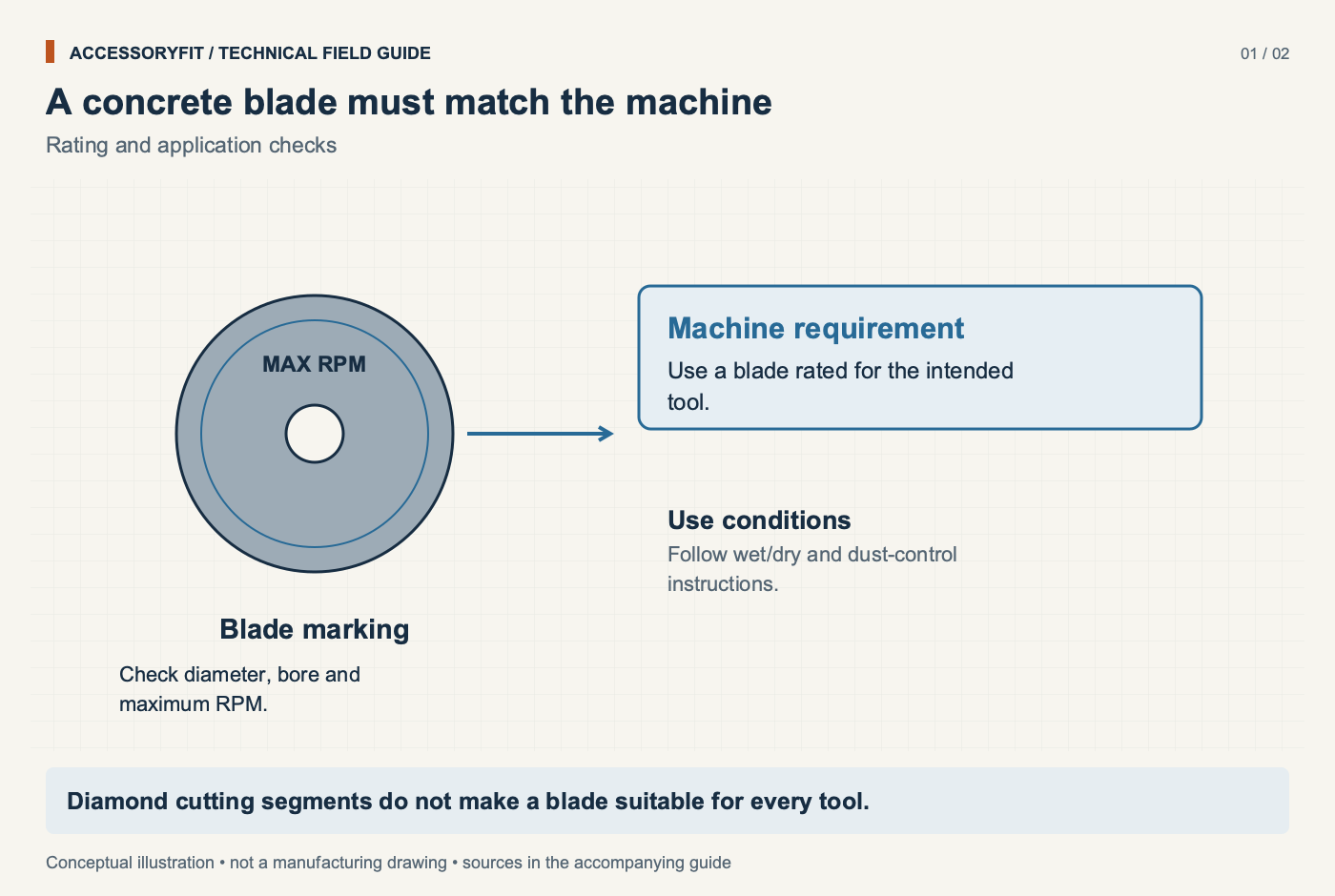
Diamond cutting segments do not make a blade suitable for every tool.
Small-diameter diamond blade rim styles and their published uses
Rim
Described use
Wet/dry
Continuous rim
Slowest but cleanest cut; tile, porcelain, marble, granite (UA: .060 in thin)
wet or dry
Serrated continuous rim
Fast, cool cutting of most aggregate materials
wet or dry
Segmented rim
Cool cutting of concrete, brick, block, stone
wet or dry (some premium lines dry)
Turbo rim
Constant contact, smoother cut than segmented in block, pavers, brick, concrete
wet or dry (blade rating)
UA catalog p.54; Makita diamond blade overview; Bosch turbo and EXPERT Hard Ceramic pages. Wet rating is the blade's; electric angle grinder manuals (DeWalt, Bosch) forbid liquid coolant. Use only on materials listed on the blade label (HAZET).
02Which tool should run a diamond blade for concrete?
An angle grinder with the closed cutting guard, or a circular saw the blade maker lists, can run these blades, as long as the blade's size and speed rating suit that tool. The choice depends on cut depth and how much control you need.
A small grinder in the 4-1/2 in class suits shallower cuts in slabs, block and pavers. Grinders of this size list high no-load speeds: DeWalt DWE402 lists 11000 rpm, and the European Bosch GWS 12-125 Professional lists 11000 rpm. A small reinforced wheel is typically rated 13,300 RPM, comfortably above those speeds. Diablo rates the DMADST0450 at 13280 rpm, which also clears those speeds.
A 7 in blade cuts deeper and suits a large grinder or a circular saw the maker lists. Diablo lists both tools for the DMADST0700, and Makita lists angle grinders for both of its blades, adds cut-off and masonry saws for the B-69624, and names circular saws too. Common 7-1/4 in circular saws list no-load speeds such as 5500 rpm on DeWalt DCS570 and 5800 rpm on Makita 5007F. Diablo rates the DMADST0700 at 8450 rpm and Makita rates the E-23335 at 8700 rpm; Makita's figure for the B-69624 comes from one Makita page only, so read it from the blade. In every case the speed printed on the blade governs. Check that your saw's manual permits an abrasive or diamond blade before fitting one. For arbor, thread and size tables by grinder, see our page on grinder arbor and thread sizes, or look your tool up in the tool accessory lookup.
03Which diamond blades suit concrete, brick and block?
Product links go to Amazon. As an Amazon Associate I earn from qualifying purchases. How links are chosen.
These five blades are the diamond blades in our catalogue whose makers list concrete or masonry as the intended material. They are grouped by diameter, small grinder blades first, and not ranked. Specs come from each maker's product page. Arbor and speed figures that rest on a single maker page are left out of the spec lists; read them from the blade before you buy.
Small-grinder turbo blade for slabs with rebar
Diablo DMADST0450 4-1/2 in diamond segmented turbo masonry cut-off blade
Diameter
4-1/2 in
Rim
segmented turbo
Kerf
2.4 mm
Max speed
13280 rpm
Use
wet or dry
Suits Owners of small angle grinders cutting concrete, concrete with rebar, brick and cinder block, including chases and pavers.
Skip it if Tile and porcelain where a continuous rim is the published choice, and any grinder without a closed cutting guard.
Segmented turbo rim for concrete, brick and block
Diablo lists concrete with rebar
Thin 2.4 mm kerf
Wet or dry cutting
Small diameter limits cut depth
Its wet rating does not apply on an electric grinder, which must cut dry
Published specs of the diamond blade picks (manufacturer data)
Blade
Diameter
Rim
Kerf
Wet or dry
Diablo DMADST0450 4-1/2 in diamond segmented turbo masonry cut-off blade
4-1/2 in
segmented turbo
2.4 mm
wet or dry
Bosch DBSX04502 4-1/2 in X-LOCK premium segmented rim diamond blade
4-1/2 in
segmented
not stated
not stated
Diablo DMADST0700 7 in diamond segmented turbo masonry cut-off blade
7 in
segmented turbo
2.6 mm
wet or dry
Makita E-23335 7 in segmented turbo general purpose diamond blade
7 in
segmented turbo
0.09 in
wet or dry
Makita B-69624 7 in segmented rim general purpose diamond blade
7 in
segmented
0.087 in
wet or dry
04How do the diamond blade picks differ?
The picks split by diameter first, because diameter decides the tool, and then by rim style and kerf. Two are small grinder blades and three are larger blades for big grinders and saws.
Diablo DMADST0450 vs Bosch DBSX04502: which small blade?
Both suit small grinders and both name concrete, brick and masonry. The Diablo uses a segmented turbo rim, publishes a 2.4 mm kerf and lists concrete with rebar. The Bosch uses a plain segmented rim and an X-LOCK mount, and Bosch says it also fits standard locking-nut small grinders. If you own an X-LOCK grinder, the Bosch blade changes without a wrench; if you cut slabs with steel reinforcement, the Diablo is the one whose maker names rebar.
Turbo or plain segments on the larger blades?
The Diablo DMADST0700 and Makita E-23335 use segmented turbo rims, and the Makita B-69624 uses plain segments. Plain segmented rims are the style the rim table describes for cool cutting of concrete, brick, block and stone. Turbo-segmented rims are what both Diablo and Makita chose for their general concrete blades, and Diablo additionally lists rebar. Makita's own description sets the trade-off: plain segments cut faster and cooler, turbo profiles leave a smoother edge. For rough cuts in block that will be hidden, plain segments suit; for pavers or visible edges, a turbo rim does. The material list on each blade still comes first.
Does kerf matter?
Kerf is the width of the cut. Among the larger blades, Makita's B-69624 cuts 0.087 in and its E-23335 0.09 in, against 2.6 mm for the Diablo. A narrower kerf removes less material per pass, which matters most on a lower-powered tool or a long cut. The difference across these blades is small, so the tool list and material list should decide first.
05Which grinder discs and sanding discs work on concrete?
For cutting, the grinder disc for concrete is a segmented or turbo diamond blade under the closed cutting guard; DeWalt's manual and the FLEX guide both require that two-sided guard for diamond cutting wheels. The abrasive alternative is a cut-off wheel with silicon carbide grain, which United Abrasives uses for masonry, concrete and stone. It mounts and is guarded the same way.
For sanding and smoothing, the sources point to silicon carbide. Klingspor recommends silicon carbide grain for stone and granite, and lists it for stone among its main uses; United Abrasives places its silicon carbide fibre discs on marble, ceramic and similar hard, brittle materials rather than steel. Klingspor grinds stone wet, and that is the catch on an electric grinder: DeWalt and Bosch forbid water on electric angle grinders, so any sanding of concrete with one has to be dry, with dust protection. None of the grinder or abrasive makers in the AccessoryFit sources publishes guidance on diamond cup wheels for levelling a slab, so this page does not cover surface grinding of floors.
Steel fixings set into concrete are a different job: a metal cut-off wheel or, to clean up the stub, one of the zirconia flap discs for steel.
06When is a diamond blade the wrong choice?
A diamond blade is the wrong choice for drilling holes, for side grinding, for materials it does not list, and for any tool it is not rated or guarded for. These are the limits that the makers and safety sources set out.
Holes for anchors and fixings. A blade cuts slots and lines; round holes in concrete come from a rotary hammer and carbide bits. Our guide to carbide masonry bit picks covers the bits, and the page on SDS-Plus versus SDS-Max explains which shank your hammer takes.
Grinding or levelling a surface. Never side-grind with a cutting blade; cut in straight lines only, without twisting, bending or jamming it.
Tile and porcelain. The rim table pairs continuous rims with smooth, precise tile cuts. A segmented rim is not the style published for that work.
A small grinder with a large blade. The large blades here are rated far below a small grinder's speed. This mismatch is the overspeed case the safety note warns against.
A tool with only a grinding guard. Diamond wheels need the closed cutting guard; the guard that came with the grinder may be the open Type 27 grinding guard.
An abrasive alternative exists for masonry: silicon carbide cut-off wheels, which United Abrasives lists for masonry, concrete and stone. For the difference between cut-off wheel shapes, see the cut-off wheel types explainer.
One common belief is that if a blade fits the spindle, its speed rating does not matter. The safety sources say the reverse: the blade's marked maximum speed must be at least the tool's spindle speed, whatever the fit. Another is that a thicker blade is always safer. For cutting wheels, safety depends on the speed rating, the correct guard and cutting-only use, not thickness.
07How do you get clean, safe cuts in concrete with a diamond blade?
Mark the line, let the blade reach full speed, and feed it straight along the line without forcing or twisting it. A few habits from the grinder and abrasive makers help the blade cut cool and last.
Inspect before mounting. Check the blade for cracks or damage, and discard any blade that has been dropped.
Fit it freely. The blade must slide freely onto the spindle; tighten the nut only enough to hold it, on clean, flat flanges of the same diameter.
Run it in. After mounting, run it for 1 minute at operating speed with the guard on before cutting.
Keep the line straight. Steering a cut puts side loads on the blade, which the safety sources prohibit.
Protect yourself. Makita lists a face shield or safety goggles, a dust mask, hearing protection, gloves and an apron as appropriate for grinder work.
If the blade shakes or the grinder vibrates, stop and check the mounting and blade before continuing. Every grinding and cutting guide on the site is grouped under sanding and grinding accessories, and the buyer guides section lists the other product comparisons.
08Why does dust control matter when cutting concrete?
Because cutting concrete, brick and block releases respirable crystalline silica, and the legal limit for it is low. OSHA's 2016 silica final rule set a single permissible exposure limit for every industry, and the current text of the construction standard still holds it at 50 µg/m³ as an 8-hour average. The same rule estimated that about 2.3 million US workers are exposed, most of them in construction, where cutting and drilling concrete create the dust; that 2016 count is still OSHA's most recent estimate.
Water and extraction help, but they are not the whole answer. In a 2023 Colorado State University field study of construction silica samples taken in 2020, 29.4% of workers would still have gone over the OSHA limit across an 8-hour shift even with the controls in OSHA's Table 1 in use, and grinding was the worst task measured. That study covered several construction tasks rather than one blade. On an electric angle grinder water is ruled out altogether, as the safety note above says, so a dry grinder cut leans entirely on dust extraction and respiratory protection, and keeping cuts short and straight reduces how much dust each one makes. The wider figures are collected in the silica exposure data.
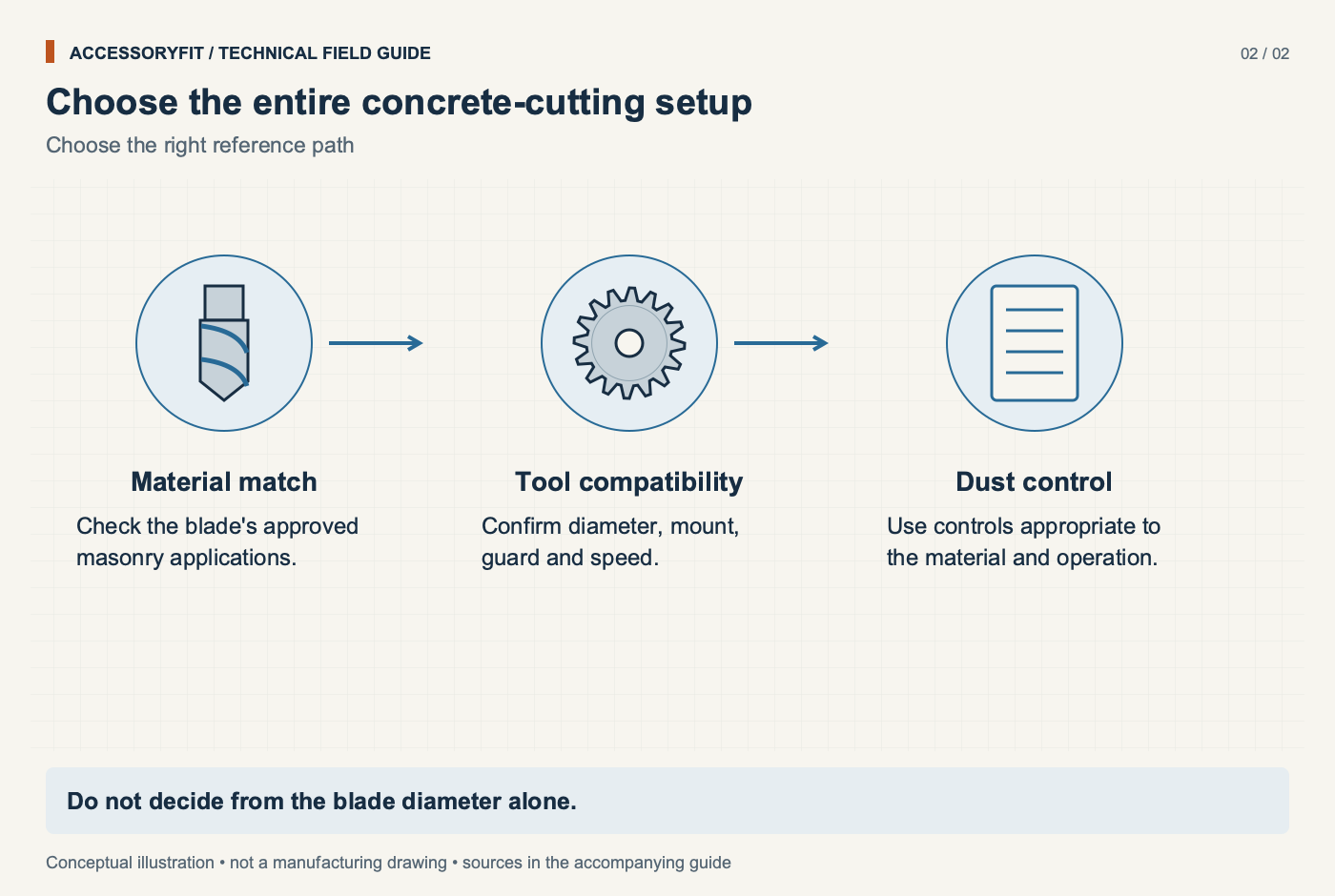
Do not decide from the blade diameter alone.
09Questions readers ask
Can I use a 7 in diamond blade on a 4-1/2 in angle grinder?
No. A larger blade is rated for a lower speed than a small grinder runs. Fit only a blade whose marked speed is at least the grinder's no-load speed, in the diameter the grinder's manual specifies.
Will a diamond blade cut concrete with rebar?
Diablo lists concrete with rebar for both its DMADST0450 and DMADST0700 blades. Makita and Bosch do not name rebar on the pages behind these picks, so check the blade label before cutting reinforced slabs.
Which guard does a diamond blade need on an angle grinder?
The closed Type 1 cutting guard, covering both sides and the rim. The open Type 27 guard is for depressed-centre grinding wheels and is not the guard specified for cutting wheels.
Is a segmented or continuous rim better for concrete?
Segmented. The rim-style table describes segmented rims for cool cutting of concrete, brick, block and stone, and continuous rims for smooth, precise tile and ceramic cuts.
Can I cut concrete wet with these blades?
Not on an electric angle grinder. The blade makers rate four of the picks for wet or dry cutting, but DeWalt's and Bosch's grinder manuals forbid water or other liquid coolant on electric angle grinders because of the risk of electric shock.
Axminster Tools: Festool Multi-Jetstream2 Pad for ETS150 Sander; Mirka Interface Pad 125mm 953284
Benchmark Abrasives: Sanding Discs Buying Guide: PSA vs Hook & Loop vs Fiber
Bosch: GWS 12-125 angle grinder (UK); PRO Stainless Steel and Metal Bonded Cutting Disc, bore 22.23 mm (2 608 600 549); PRO Metal Bonded Cutting Disc for Chop Saws, bore 25.4 mm (2 608 600 543); GWS 12-125 / GWS 12-125 S original instructions 1 609 92A D3M (21.10.2025); Premium Turbo Rim Diamond Abrasive Blades; EXPERT Hard Ceramic Diamond Cutting Disc (X-LOCK); X-LOCK system page (GB); Bosch X-LOCK - The ultimate changing system for grinders (news); 1617/1618 router operating/safety instructions (2610051825); X-LOCK Diamond Blades (DBSX04502 variant listing); EXPERT C470 Sandpaper with 8 holes for Random Orbital Sanders; ROS20VSC 5 in Random Orbit Sander product page
Colorado State University and Montana Technological University, Annals of Work Exposures and Health 67(5): The Evaluation of Worker Exposure to Airborne Silica Dust During Five OSHA Table I Construction Tasks
DeWalt: DWE402 4-1/2 in (115 mm) paddle switch small angle grinder; DW402G angle grinder instruction manual; DW8062 High Performance 4-1/2 in x .045 in x 7/8 in Metal Cut-Off Wheel; DW4719 7 x 1/4 x 7/8 in High Performance Metal Grinding Wheel; DW8080 HP 4-1/2 in x 3/32 in x 7/8 in T1 Cutting/Notching Wheel (Stainless); DWE402/DWE402N/DWE402G/DWE4222N Instruction Manual NA190466; DWE402 4-1/2 in (115 mm) Small Angle Grinder product page; DCS570P1 20V MAX* XR 7-1/4 in. Brushless Circular Saw Kit product page; DCS570 Instruction Manual NA517038 (Type 3); DWE575 circular saw instruction manual (N786997); DWE6423 5 in variable speed random orbit sander with hook and loop pad; DWE6420/DWE6421/DWE6423 Random Orbit Palm Sanders instruction manual N412818
DGUV Institute for Occupational Safety and Health (IFA): Ageing of resinoid bonded grinding wheels (project BIA 6055)
European Parliament, Legislative Observatory (procedure 2016/0130(COD), final act summary): Protection of workers from exposure to carcinogens or mutagens at work: exposure limit values - Directive (EU) 2017/2398, final act
Festool: ETS EC 150/3 EQ and ETS EC 150/5 EQ original instructions (PDF)
FLEX (Chervon North America): Safety Warnings and Guidelines for Users of Portable Grinding, Cutting and Flap-Disc Wheels (10/2023)
Freud and Diablo: DMADST0700 7 in Diamond Segmented Turbo Masonry Cut-Off Blade product page; DMADST0450 4-1/2 in Diamond Segmented Turbo Masonry Cut-Off Blade product page; Get the most out of your Freud bits by routing at ideal feed rates and speeds
HAZET: User information for grinding wheels, cut-off wheels, flap discs (multilingual safety leaflet)
Health and Safety Executive (UK): Wood dust exposures in manufacturing industries; EH40/2005 Workplace exposure limits (Fourth Edition 2020)
Hemlock Hardware (Diablo listing): Diablo 6 In. 60-Grit 6-Hole Pattern Vented Sanding Disc with Hook and Lock Backing
HookandLoop.com: Replacing sanding discs with hook and loop
Klingspor: Klingspor Kronenflex A 60 Extra cut-off wheel 125 x 22.23 x 1 mm, 12200 RPM; Klingspor Kronenflex A 46 TZ Special cutting disc 115 x 1.6 x 22.23 mm; Klingspor Kronenflex A 24 Extra cutting disc 150 x 2.5 x 22.23 mm, depressed; Klingspor Kronenflex A 36 TZ Special cutting disc 180 x 2 x 22.23 mm; Klingspor Kronenflex A 46 TZ Special cutting disc 230 x 1.9 x 22.23 mm; Maximum operating speed (Lowdown on grinding); Grain types (Lowdown on grinding); Coated Abrasives Basics; Specific Material Recommendations; Hole pattern for abrasives (Lowdown on grinding); Self-fastening disc (Lowdown on grinding)
Makita: GA5030R 125 mm angle grinder; Diamond Blades new accessory overview (PDF); T-03903 X-LOCK 4-1/2 in 60 Grit Type 29 Flap Disc product page; E-23335 7 in Diamond Blade, Segmented Turbo, General Purpose product page; 5007F 7-1/4" Circular Saw product page; 5007F 7-1/4 in circular saw instruction manual; 5007F product flyer; 9557PB angle grinder instruction manual; B-69624 7 in Diamond Blade, Segmented, General Purpose product page; BO6050 Random Orbit Sander instruction manual; BO6050J 6 in Random Orbit Sander product page; BO5041 5 in Random Orbit Sander product page
McMaster-Carr: Cutoff wheels catalogue page (contaminant-free wheels for stainless steel)
Milwaukee Tool: Guard for Type 1 Grinding Discs 4-1/2 in (49-12-0361); M18 FUEL 4-1/2 in / 5 in Braking Grinder, Paddle Switch No-Lock (2880-20); 6 in x .045 in x 7/8 in Metal Cut Off Wheel - Type 1 (49-94-0023); 9 in x 1/4 in x 5/8-11 Grinding Wheel (Type 27) 49-94-9735 (discontinued listing); 7 in x 1/16 in x 7/8 in Metal Cut Off Wheel - Type 1 (49-94-0033); M18 FUEL oscillating multi-tool 2836-20 operator's manual (58-14-0217d1)
Mirka: Galaxy abrasive leaflet (English), PDF; Get the most out of your abrasives with Mirka's problem-solving abrasives
National Toxicology Program, US Department of Health and Human Services: Report on Carcinogens, Fifteenth Edition: Wood Dust
NIOSH: Comprehensive Report: Laboratory Evaluation of Saw Blades for Cutting Fiber-Cement Siding; Hazard Controls: Control of Wood Dust from Random Orbital Hand Sanders and Orbital Hand Sanders
OSHA: 29 CFR 1910.215 Abrasive wheel machinery; 29 CFR 1926.303 Abrasive wheels and tools; 29 CFR 1910.243 Guarding of portable powered tools; 29 CFR 1926.300 General requirements (Tools, hand and power); 29 CFR 1926.304 Woodworking tools; Occupational Exposure to Respirable Crystalline Silica; Final Rule (29 CFR Parts 1910, 1915, and 1926)
PACE Technologies: Grit Size Converter (Common Abrasive Types)
PFERD: Safety notes, fine grinding and polishing tools (PDF, v1.0 14.01.2026); Ceramic oxide grain fibre disc dia. 125 mm CO-COOL80 for cool grinding on stainless steel, PDF
Purdue University, Journal of Occupational and Environmental Hygiene: Evaluation of Cut-Off Saw Exposure Control Methods for Respirable Dust and Crystalline Silica in Roadway Construction
Surface Prep: Flap Discs: The Differences Between Type 27 and Type 29
Technical University in Zvolen, MM Science Journal: Effect of Selected Factors on Mass Concentration of Airborne Dust During Wood Sanding
Tool Nut: Diablo DCD060100H10G 6 in Sandpaper Hook & Loop; Festool 202458 Multi JetStream2 150mm Soft Pad for ETS/ETSC 150; Festool 203348 6 in StickFix Multi Jetstream2 Interface Pad 150mm; Mirka Abranet 5 in 150 Grit Mesh Sanding Disc 9A-232-150; Mirka Abranet 6 in P150 Hook and Loop Sanding Discs 9A-241-150RP
United Abrasives / SAIT: 2025-2026 Product Catalog (English); How to Read a Wheel Label & Safety Icon Library; The Ultimate Cut product family page
University of California, Berkeley, Journal of Occupational and Environmental Hygiene 16(5): Effect of hollow bit local exhaust ventilation on respirable quartz dust concentrations during concrete drilling
University of Massachusetts Lowell, Journal of Occupational and Environmental Hygiene: Reducing Silica and Dust Exposures in Construction During Use of Powered Concrete-Cutting Hand Tools: Efficacy of Local Exhaust Ventilation on Hammer Drills
US Government Publishing Office, Electronic Code of Federal Regulations: 29 CFR 1926.1153 Respirable crystalline silica (current eCFR text)
Virginia Tech, Annals of Work Exposures and Health 69(3): Silica exposure controls usage in masonry and concrete trades: before and after enactment of the OSHA Silica Construction Rule (1926.1153)
Weiler Abrasives: Flap Disc Brochure WC117 (2026)
Wikipedia: Sandpaper
Woodworker's Journal: What Ruined My Sander's Hook-and-loop Pad?; Pointers on Sanding Discs?