Cut-off wheel types: Type 1, 41, 27 and 42 compared, with guards and speed limits
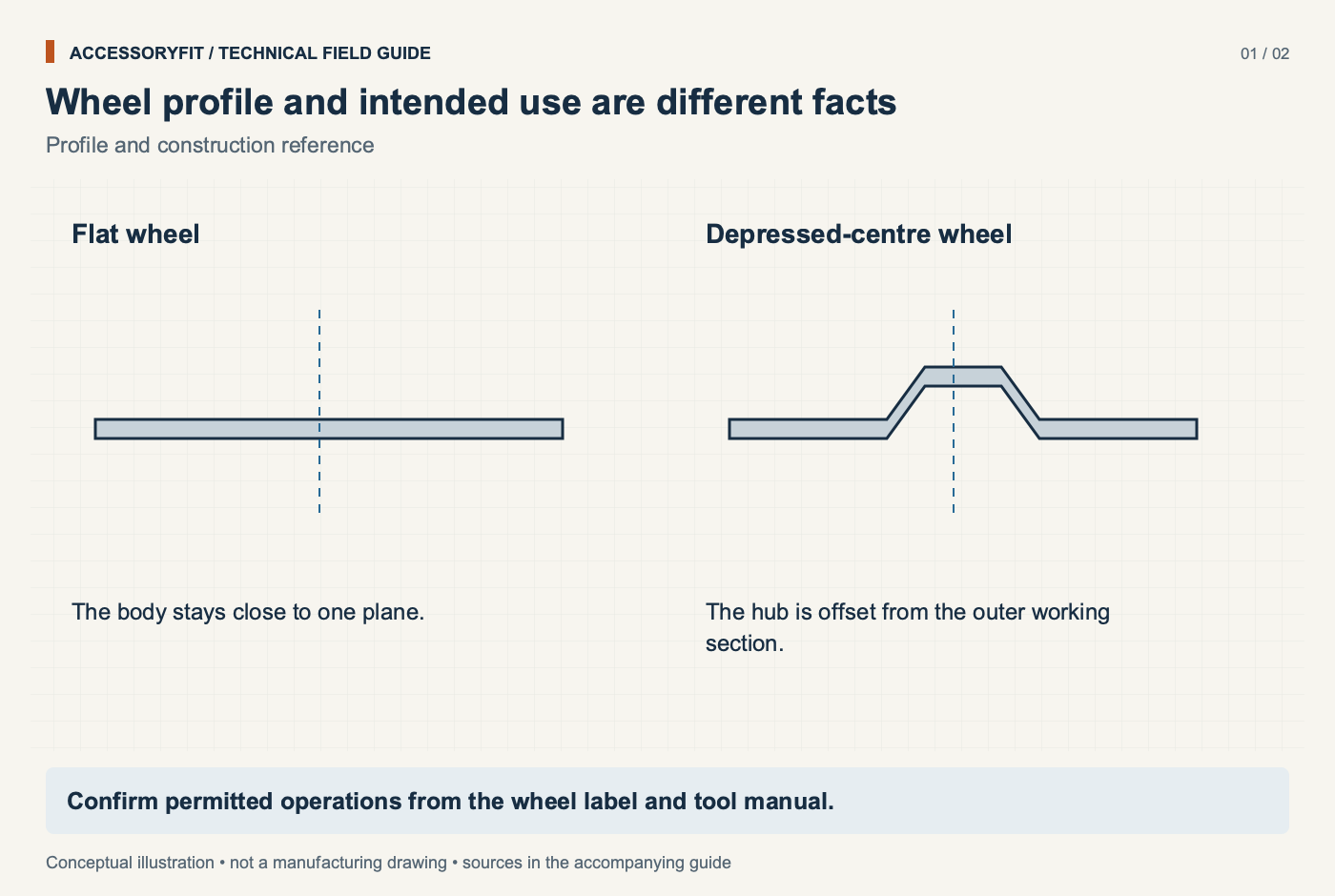
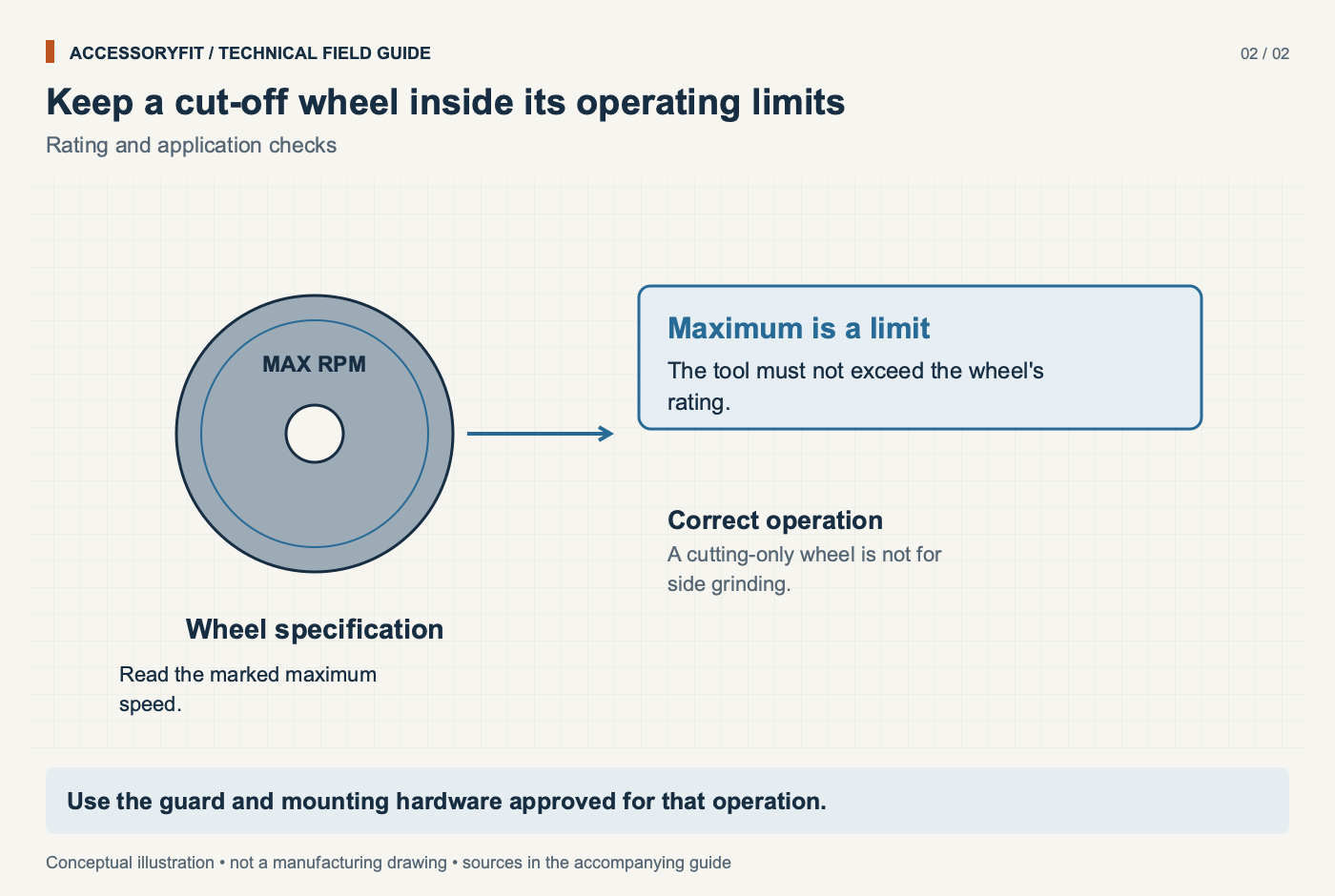
Type 1 and Type 41 are the same flat cut-off wheel under US and European names; Type 27 and Type 42 are cutting wheels with a depressed centre that lets you cut closer to a surface. All four cut with the rim only and must never be used for side grinding. On an angle grinder, fit the closed cutting guard for any cut-off wheel, and check the speed printed on the wheel is at least the grinder's no-load speed: 13,300 RPM is the usual rating for a 4-1/2 in wheel.
A cut-off wheel is a thin abrasive wheel, bonded with resin and reinforced with fibreglass, that cuts metal, stone or masonry with its rim. It does not grind with its face: Cal/OSHA, HAZET and FLEX all state that cutting wheels cut with the periphery only and must not be used for side grinding.
Cut-off wheels come in two families by machine. Angle grinder wheels have a 7/8 in centre hole in the US, the same bore European makers give as 22.23 mm, or a threaded hub. Larger chop saw wheels fit a 1 in arbor and run on a dedicated abrasive saw. This page deals mainly with grinder wheels, and covers chop saw wheels where the two meet.
Three attributes decide whether a wheel is right: its type number, which sets the shape and therefore the guard; its maximum speed, which must match the grinder; and its thickness and grain, which suit the material. The sanding discs and grinder wheels hub sets cut-off wheels alongside flap discs, grinding wheels and sanding discs.
Confirm permitted operations from the wheel label and tool manual.
02What do the type numbers on a cut-off wheel mean?
The type number describes the wheel's shape. Type 1 and Type 41 are flat; Type 27 and Type 42 have a depressed centre; Type 27A is a depressed-centre wheel for large cutting-off machines. The number is printed on the label and decides which guard and flanges the wheel needs.
The overlap of names causes most of the confusion. US catalogues group Type 1 and Type 41 as one flat cutting-wheel shape, and European discs are often simply marked T41 alongside their size, thickness and bore. So the belief that a Type 41 is a different wheel from a Type 1 is wrong in practice: they are the same flat profile under two naming systems. The same applies to Type 27 and Type 42 cutting wheels. Bosch even labels one of its wheels Type 1A with the ISO equivalent of 41 in brackets.
Cut-off wheel type numbers, shapes and mounting, from OSHA, Cal/OSHA and abrasive makers
Type
Profile
Mounting
Notes
Type 1
Flat
Between relieved flanges (OSHA); 7/8 in hole on grinders
Same profile as Type 41 in US catalogues; needs closed cutting guard
Type 41
Flat
7/8 in (22.23 mm) hole
EU marking for flat cutting discs (e.g. 115x1.0x22.2-T41)
Type 27 / Type 42 (cutting)
Depressed centre
7/8 in hole or 5/8-11 hub
Flush cutting, recessed nut; thin wheel
Type 27A
Depressed centre (cutting-off machines)
Flat, unrelieved flanges ≥1/4 diameter
Usually 16 in and larger, for cutting-off machines (Cal/OSHA)
OSHA 1910.215(c)(1): Type 1 between relieved flanges ≥1/4 diameter; Type 27A on flat flanges. Cal/OSHA §3575(b)(D) for Type 27A.
03Type 1 or Type 27: which cut-off wheel shape should you use?
Use a flat Type 1 or Type 41 wheel for the deepest, squarest cut, and a depressed-centre Type 27 or Type 42 wheel when you need to cut flush against a surface. United Abrasives and Saint-Gobain (Norton) say the flat shape gives the maximum depth of cut and square, burr-free cuts.
The depressed centre exists for clearance. United Abrasives explains that the raised hub lets the lock nut sit below the face of the wheel, so the wheel can cut closer to an adjoining surface and you can see the cut better. That makes Type 27 and Type 42 cutting wheels popular for trimming bolts and brackets flush to a wall. The trade-off is a little less cutting depth, because the hub takes up part of the radius.
A Type 27 cutting wheel looks like a Type 27 grinding wheel, and that resemblance leads people to grind with it. It is still a thin cutting-only wheel. Using it to deburr or grind can make it fail, whatever its shape.
04Which guard does each wheel type need?
A flat Type 1 or Type 41 cut-off wheel needs the closed cutting guard, often called the Type 1 guard, which encloses both sides and the rim. HAZET, Milwaukee and FLEX all say the open Type 27 grinding guard supplied with most grinders is not enough for a cutting wheel. On any portable grinder, OSHA and HAZET limit the exposed part of the wheel to 180 degrees.
Depressed-centre grinding wheels, Type 28 saucer wheels and Type 29 flap discs take a Type 27-style guard with an inward-curled lip. Cup wheels need a cup guard with an adjustable skirt. The table below lists each type with its guard and the working angle the makers' labels show.
The sources disagree on one point. United Abrasives says its thin Type 27 and Type 42 cutting wheels can be used on all angle grinders under ANSI B7.1, while FLEX's wheel and guard guide pairs those wheels with the Type 1 cutting guard. Because the cutting guard covers more of the wheel, this page follows FLEX: fit the cutting guard for any cut. Some grinders come with one; Bosch, for example, supplies its GWS 12-125 with a separate clip-on cutting guard. The belief that whatever guard came on the grinder will do for cutting is the most common guard mistake.
Use the guard and mounting hardware approved for that operation.
Grinder wheel and disc types with the guard and working angle each needs, from HAZET, FLEX, Cal/OSHA and United Abrasives
Type
Shape
Use
Guard
Working angle
Type 1 / Type 41
Flat (straight)
Cutting only, on the rim; maximum depth of cut
Closed Type 1 cutting guard, ≥180° both sides and rim
90° to work
Type 27 / Type 42 (cutting)
Depressed centre, thin
Cutting; allows flush cuts, nut recessed
Type 1/41 guard per FLEX guide
90° to work
Type 27 (grinding)
Depressed centre, flat rim
Side grinding; notching
Type 27 guard
about 30°
Type 28
Depressed centre, saucer-shaped
Grinding large flat surfaces
Type 27-style guard with lip (HAZET)
about 15°
Type 29 (flap / flexible)
Conical
Stock removal, contours, edges
Type 27-style guard with lip (HAZET)
15-25° (flap discs)
Type 27 (flap)
Flat
Finishing, blending, flat surfaces
Type 27 guard
0-15°
Type 6 / 11
Straight / flaring cup
Rim grinding
Cup guard with adjustable skirt
n/a
Angles: UA wheel-label proper-use icons (Type 27 ~30°, Type 28 ~15°, cutting 90°); flap angles UA catalog p.60 and Surface Prep. Type 28 saucer shape: Cal/OSHA §3575(b)(C).
05How fast can a cut-off wheel safely spin?
No faster than the maximum speed printed on the wheel, and that figure must be at least the grinder's no-load speed. OSHA, FLEX, HAZET and DeWalt all set the check this way round: the wheel's rating must equal or exceed the spindle speed before the wheel goes on.
Smaller wheels carry higher speed ratings than larger ones. United Abrasives and Saint-Gobain rate 4-1/2 in (115 mm) cut-off wheels at 13,300 RPM, and United Abrasives and Klingspor rate 125 mm wheels at 12,200 RPM. For the next size up, United Abrasives and Milwaukee both give 10,200 RPM. At 7 in the makers differ slightly: United Abrasives and Klingspor give 8,500 RPM, while Milwaukee's thin wheel of that size carries a higher figure, shown with the other makers' numbers in the second table below. That spread is why the wheel's own label is what counts. DeWalt's thicker cutting and notching wheel follows the same pattern as thin wheels: DeWalt rates its 4-1/2 in notching wheel at 13,300 RPM, matching United Abrasives' thin wheels of that size, so the thicker wheel carries the same rating here.
European discs are rated by rim speed rather than revolutions. Klingspor and Bosch's grinder manual give 80 m/s as the maximum peripheral speed for cutting discs on hand-held angle grinders, and the RPM on the label is that speed converted for the disc's diameter; it must not be exceeded. The size table below gives the US and European pairs side by side.
The danger is a large wheel on a small, fast grinder. A wheel that fits the spindle is not therefore safe on it: a large wheel rated for a big, slow grinder would run far beyond its rating on a small, fast one. The table below lists the disc size, spindle thread and no-load speed makers publish for grinders in our tool base, so you can compare them with a wheel's label.
Grinder disc sizes, centre holes and typical maximum wheel speeds, US and EU
US nominal size
Nearest EU size
Plain centre hole
Threaded (hubbed) version
Typical max RPM (US wheel)
EU disc max RPM seen
4-1/2 in
115 mm
7/8 in (22.23 mm)
5/8-11 (US); M14 (EU)
13,300
13,300 (115 mm, Saint-Gobain)
5 in
125 mm
7/8 in (22.23 mm)
5/8-11 (US); M14 (EU)
12,200
12,200 (125 mm, Klingspor)
6 in
150 mm
7/8 in (22.23 mm)
5/8-11 (US); M14 (EU)
10,200
10,200 (150 mm, Klingspor)
7 in
180 mm
7/8 in (22.23 mm)
5/8-11 (US); M14 (EU)
8,500
8,500 (180 mm, Klingspor)
9 in
230 mm
7/8 in (22.23 mm)
5/8-11 (US); M14 (EU)
6,600
6,600 (230 mm, Klingspor)
US/EU size pairs are nominal market equivalents, not exact conversions (5 in = 127 mm vs 125 mm). US RPMs from United Abrasives catalog pp.9-12, 31. EU sizes: Bosch PRO disc lists 115/125/150 mm; Makita lists an M14 lock nut for 180-230 mm. Always use the RPM printed on the actual wheel. EU 150/180/230 mm figures from Klingspor Kronenflex listings (80 m/s).
Maximum RPM printed by different makers for the same nominal wheel size
Size
United Abrasives (T27 / cut-off)
Other maker figure
Source of other figure
4-1/2 in
13,300
13,300 / 13,000
DeWalt DW8080 cut-off; Weiler flap discs
5 in
12,200
12,200 / 12,000
Klingspor 125 mm; Weiler flap discs
6 in
10,200
10,200
Milwaukee 49-94-0023; Weiler flap discs
7 in
8,500
8,600 / 8,700
Milwaukee 49-94-0033 and Weiler flap discs; DeWalt DW4719
9 in
6,600
6,600
Milwaukee 49-94-9735
Limits differ by maker and product, especially at 7 in. The binding figure is the one printed on the wheel.
Disc size, spindle thread and no-load speed of selected angle grinders, from manufacturer specifications
Tool
Disc
Spindle thread
No-load speed
Bosch GWS 12-125 Professional
125 mm
M14
11000 rpm
DeWalt DWE402
4-1/2 in one source
5/8–11
11000 rpm
Makita GA5030R
125 mm
M14
11000 rpm
Milwaukee 2880-20
4-1/2 / 5 in
5/8–11
8500 rpm
Values marked one source appear in a single manufacturer document; check the tool's manual or rating plate before buying.
06How thick should a cut-off wheel be?
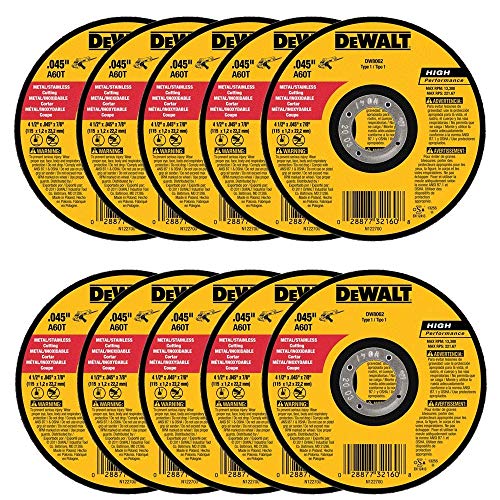
Thin enough to cut fast, thick enough for the job: 0.045 in is the standard thin metal cut-off wheel for US grinder wheels, and 1.0 mm is the common thin cutting disc for small European grinders.
Thicker wheels exist for different work, not for extra safety. United Abrasives and DeWalt sell wheels of about 0.090-3/32 in for cutting and notching metal, and United Abrasives lists thicker combination wheels that can also deburr and lightly grind; those combination wheels are marked for that use, which ordinary cut-off wheels are not. For stainless, United Abrasives lists 1/16 in contaminant-free wheels. Cal/OSHA sets an upper limit of 3/16 in for the smaller cutting-off wheels used on hand-held grinders, and says the centre hole should be no larger than 1/4 of diameter.
The belief that a thicker wheel is always safer is wrong. Safety comes from the speed rating, the right guard and using the wheel only for cutting. Thickness should be matched to the task.
Cut-off wheel thickness and typical use, from United Abrasives, DeWalt, Saint-Gobain, Klingspor and Bosch
Thickness
Metric approx.
Typical use
Source note
.045 in
1.1 mm
Fast thin cuts in steel and stainless sheet, tube, bar
UA p.31; DeWalt DW8062
1.0 mm
0.04 in
EU thin cutting discs for metal and stainless
Saint-Gobain NOVIPRO; Klingspor A 60 Extra
1/16 in
1.6 mm
Contaminant-free stainless cutting
UA p.33 XA46R
.090 in
2.3 mm
Cutting and notching metal
UA p.29
.095 in
2.4 mm
Combo: cut, notch, deburr, light grind
UA p.29
3/32 in
2.4 mm
Masonry (C24R) and general cutting; 12-16 in chop saw wheels
UA p.38, p.44
3.0 mm
0.12 in
355 mm chop saw discs
Bosch PRO chop saw disc
Metric/imperial conversions are arithmetic. Cal/OSHA: max 3/16 in for cutting wheels 6 in and smaller.
07Which cut-off wheel suits steel, stainless, aluminium or masonry?
Choose the grain and formulation the wheel maker lists for the material: aluminium oxide, zirconia or ceramic for carbon steel, a contaminant-free (INOX) wheel for stainless, an anti-loading aluminium formula for non-ferrous metals, and silicon carbide or a diamond blade for masonry, concrete and stone.
Aluminium oxide is the most common cutting grain and has the lowest initial cost, according to United Abrasives, DeWalt and Bosch. United Abrasives adds that ceramic wheels last a long time, cut fast and run cooler with less discolouration. For stainless, a contaminant-free wheel keeps iron, chlorine and sulphur out of the cut; United Abrasives sets its limit at 0.1 percent combined. European makers often mark these wheels INOX.
For masonry, United Abrasives uses silicon carbide grain in its abrasive wheels. Diamond blades are the other route and are mounted the same way on a grinder, but HAZET says they should be used only on the materials listed on the blade label. The guide to diamond blades for concrete compares rim styles for block, brick and slab.
The grain list above has no entry for wood, and none of the wheel makers behind this page lists a cut-off wheel for it. A 2022 study from one Argentine hospital, covering 928 patients with angle grinder hand injuries treated in 2016 to 2020, shows the cost of ignoring that: most had been cutting wood or firewood, and 15.5% of those injuries ended in finger amputation.
Choosing a cut-off wheel by material, from United Abrasives product lines
Material
Wheel/grain
Note
Carbon steel
Aluminium oxide, zirconia or ceramic
Ceramic: longest life, cooler
Stainless steel
INOX / contaminant-free (Fe+Cl+S < 0.1%)
Avoids contaminating stainless
Aluminium / non-ferrous
A46N-type aluminium formulation
Resists loading
Masonry, concrete, stone
Silicon carbide (C24R) or diamond blade
Diamond blades: use only on listed materials
Product-line specific; follow the wheel label.
08Do chop saw wheels fit an angle grinder?
No. Chop saw abrasive wheels have a 1 in arbor and are far larger and slower-rated than grinder wheels, so they belong only on the abrasive saw they are made for. The common large chop saw wheel is about 3/32 in / 3.0 mm thick, and United Abrasives rates its own at 4,400 RPM.
The table below lists United Abrasives' chop saw wheels by diameter. Bosch's 355 mm disc confirms the same arbor size, though Bosch's speed rating was not shown on the page fetched. Very large Type 27A wheels for cutting-off machines are a separate class again, mounted on flat flanges.
Chop saw abrasive wheels by diameter, from the United Abrasives catalogue
Diameter
Thickness
Arbor
Max RPM
12 in
3/32 in
1 in
5,100
14 in (355 mm)
3/32 in
1 in (25.4 mm)
4,400
16 in
3/32 in
1 in
3,700
RPMs: UA catalog p.44 (single manufacturer). Bosch 355 mm x 25.4 mm bore x 3.0 mm confirms the 14 in / 1 in fit; Bosch RPM was not shown.
09How do you choose and fit a cut-off wheel, step by step?
These steps follow the checks OSHA, FLEX, HAZET and the grinder makers set out for mounting a wheel.
Disconnect the grinder. Unplug it or remove the battery before changing anything.
Match diameter, hole and speed. Pick a wheel of the grinder's rated size with a matching centre hole or thread, and a printed maximum speed at least the grinder's no-load speed.
Check the wheel. Look for cracks and chips, read the expiry date on the metal ring, and discard any wheel that has been dropped. OSHA calls for a ring test before mounting.
Fit the right guard. Swap the grinding guard for the closed cutting guard before fitting a Type 1 or Type 41 wheel.
Mount on clean flanges. Use clean, flat, undamaged flanges of matching diameter. The wheel should slide on freely; tighten the nut only enough to hold it.
Run it before cutting. Stand out of line and run the wheel at operating speed with the guard on for at least 1 minute.
Cut straight. Cut in a straight line with the rim, without twisting, bending or jamming the wheel, and never grind with its face.
10Why do cut-off wheels break or wear out early?
Cut-off wheels most often fail through side loading: twisting the wheel in the cut, jamming it, bending it, or using its face to grind or deburr. Cal/OSHA, HAZET and FLEX all prohibit side grinding with a cutting wheel, and United Abrasives says to cut straight without twisting or jamming.
Age and storage also count. Resin-bonded discs carry a use-by date on the metal ring, and Saint-Gobain sets it 3 years after manufacture. Wheels do not last forever on the shelf: DGUV tests found that warm, damp storage can reduce bursting speed within months, while normal dry storage does not cause a safety-critical loss. Store wheels flat, dry and away from heat.
Other failures trace back to setup: a wheel run above its speed rating, a hole reamed out to fit a different spindle, dirty or mismatched flanges, or a wheel that was dropped and cracked. If a new wheel vibrates or wobbles, stop and check the mounting before cutting; the guide to grinder disc vibration covers the checks. To clean the burr after a cut, switch to a flap disc rather than turning the cut-off wheel on its side.
Twisting or jamming a wheel is also how kickback starts, and grinder kickback tends to throw the tool towards the face. A wheel that breaks up throws fragments the same way. US emergency department records show where that ends: of the injuries involving workshop grinders, buffers and polishers in CPSC's NEISS emergency department data for 2024, a category that counts angle and bench grinders together, about 48% were eye injuries, by AccessoryFit's estimate from the public case file, and foreign bodies were a frequent diagnosis. That is the case for a full face shield over safety glasses whenever a cut-off wheel is running.
11Which thin cut-off wheels match these types?
Product links go to Amazon. As an Amazon Associate I earn from qualifying purchases. How links are chosen.
These four wheels are the 4-1/2 in cutting products in our catalogue: three flat abrasive wheels for metal and one diamond blade for masonry. They are grouped by job, not ranked, and the specs come from each maker's product page. Where a maker's speed rating or type could not be confirmed by a second source it is left out here, so read it from the wheel's label before fitting.
Flat Type 1 wheel for steel and stainless
Diablo DBD045040101F 4-1/2 in Type 1 metal cut-off disc
Diameter
4-1/2 in
Type
Type 1
Thickness
0.040 in
Grain
aluminum oxide blend
Max speed
13280 rpm
Suits Cutting rebar, cast iron, steel bar, stainless, angle iron, tubing, threaded rod and strut on a grinder of matching size with a cutting guard.
Skip it if Masonry, grinding and deburring, and any grinder faster than the wheel's rating.
Thin 0.040 in wheel for fast cuts
aluminum oxide blend grain
Rated 13280 rpm, at or above the no-load speed of the small grinders in our tool base
Sold on Amazon as a multi-pack
Diablo's arbor size was confirmed by only one source: check the label
Fit comes before type, so if you are unsure whether a wheel suits your grinder's spindle, the guide to grinder spindle and arbor fit covers bore sizes, threads and US-to-EU equivalents. For blending welds and cleaning up cut edges, flap discs for metal are the accessory makers intend for that work. Finer surface preparation moves to a sander, and the orbital sander disc picks cover that step. To see every accessory listed for one grinder model, use the tool accessory lookup, and the other technique guides explain saw blades, bits and abrasives.
13Questions readers ask
Can a Type 27 cutting wheel go on a grinder with the Type 27 guard?
The sources disagree. United Abrasives says its thin Type 27 and 42 cutting wheels can be used on all angle grinders under ANSI B7.1, while FLEX pairs them with the closed Type 1 cutting guard. The safer choice is the cutting guard.
Is a T41 marking on a European disc the same as Type 1?
Yes, for practical purposes. US catalogues group Type 1 and Type 41 as one flat cutting-wheel shape, and European discs commonly carry the T41 marking with their size, thickness and bore.
Why does a cut-off wheel have a date on the metal ring?
It is the expiry date, printed as a month and year. HAZET, Saint-Gobain and FLEX all say hand-held reinforced cutting and grinding wheels must not be used once it has passed, even if the wheel looks unused.
Do European and US cut-off wheels fit the same grinders?
Plain-hole wheels do: both use a 7/8 in bore. Threaded hub wheels differ, because US grinders use a 5/8–11 UNC spindle and European grinders use M14.
Which cut-off wheel should be used on stainless steel?
A contaminant-free wheel, often marked INOX, which keeps iron, chlorine and sulphur out of the cut so the stainless is not contaminated.
Bosch: PRO Stainless Steel and Metal Bonded Cutting Disc, bore 22.23 mm (2 608 600 549); PRO Metal Bonded Cutting Disc for Chop Saws, bore 25.4 mm (2 608 600 543); GWS 12-125 / GWS 12-125 S original instructions 1 609 92A D3M (21.10.2025); GWS 12-125 angle grinder (UK); Premium Turbo Rim Diamond Abrasive Blades; EXPERT Hard Ceramic Diamond Cutting Disc (X-LOCK); X-LOCK system page (GB); Bosch X-LOCK - The ultimate changing system for grinders (news); 1617/1618 router operating/safety instructions (2610051825); Thin Cutting Wheels For Angle Grinders / Rapido Type 1A (TCW1S450 variant)
California DIR (Cal/OSHA): Title 8 §3575 Scope and Definitions (abrasive wheels)
DeWalt: DW8062 High Performance 4-1/2 in x .045 in x 7/8 in Metal Cut-Off Wheel; DW8080 HP 4-1/2 in x 3/32 in x 7/8 in T1 Cutting/Notching Wheel (Stainless); DWE402 4-1/2 in (115 mm) paddle switch small angle grinder; DW402G angle grinder instruction manual; DW4719 7 x 1/4 x 7/8 in High Performance Metal Grinding Wheel; DWE402/DWE402N/DWE402G/DWE4222N Instruction Manual NA190466; DW8062 High Performance 4-1/2 in x .045 in x 7/8 in Metal Cut-Off Wheel product page; DWE402 4-1/2 in (115 mm) Small Angle Grinder product page; DWE575 circular saw instruction manual (N786997)
DGUV Institute for Occupational Safety and Health (IFA): Ageing of resinoid bonded grinding wheels (project BIA 6055)
FLEX (Chervon North America): Safety Warnings and Guidelines for Users of Portable Grinding, Cutting and Flap-Disc Wheels (10/2023)
Freud and Diablo: DMADST0700 7 in Diamond Segmented Turbo Masonry Cut-Off Blade product page; Get the most out of your Freud bits by routing at ideal feed rates and speeds; DBD045040101F 4-1/2 in Metal Cut-Off Disc product page; DMADST0450 4-1/2 in Diamond Segmented Turbo Masonry Cut-Off Blade product page
HAZET: User information for grinding wheels, cut-off wheels, flap discs (multilingual safety leaflet)
Health and Safety Executive (UK): Hand-arm vibration at work: The Control of Vibration at Work Regulations 2005. Guidance on Regulations (L140, second edition); RR717 - Evaluation of EN 60745 test codes: BS EN 60745-2-3:2007 angle grinders
İstanbul Medical Journal: Angle Grinder Injuries in the Upper Extremity: An Epidemiological Study
Journal of Trauma and Injury: Severity of grinder injuries and related factors compared with other high-rotation cutting tool injuries: a multicenter retrospective study from 2011 to 2018
Klingspor: Klingspor Kronenflex A 60 Extra cut-off wheel 125 x 22.23 x 1 mm, 12200 RPM; Klingspor Kronenflex A 36 TZ Special cutting disc 180 x 2 x 22.23 mm; Maximum operating speed (Lowdown on grinding); Klingspor Kronenflex A 46 TZ Special cutting disc 115 x 1.6 x 22.23 mm; Klingspor Kronenflex A 24 Extra cutting disc 150 x 2.5 x 22.23 mm, depressed; Klingspor Kronenflex A 46 TZ Special cutting disc 230 x 1.9 x 22.23 mm
Makita: GA5030R 125 mm angle grinder; Diamond Blades new accessory overview (PDF); T-03903 X-LOCK 4-1/2 in 60 Grit Type 29 Flap Disc product page; GA5030R Angle Grinder product page; GA4030R/GA4530R/GA5030R instruction manual (EU); 9557PB angle grinder instruction manual; 5007F 7-1/4 in circular saw instruction manual
McMaster-Carr: Cutoff wheels catalogue page (contaminant-free wheels for stainless steel); Grinders: manufacturer model number DWE402
Milwaukee Tool: Guard for Type 1 Grinding Discs 4-1/2 in (49-12-0361); 7 in x 1/16 in x 7/8 in Metal Cut Off Wheel - Type 1 (49-94-0033); 6 in x .045 in x 7/8 in Metal Cut Off Wheel - Type 1 (49-94-0023); M18 FUEL 4-1/2 in / 5 in Braking Grinder, Paddle Switch No-Lock (2880-20); 9 in x 1/4 in x 5/8-11 Grinding Wheel (Type 27) 49-94-9735 (discontinued listing); 2880-20 M18 FUEL 4-1/2 in / 5 in Grinder Paddle Switch, No-Lock product page; Operator's manual 58-14-0243D2 (Cat. No. 2880-20); M18 FUEL oscillating multi-tool 2836-20 operator's manual (58-14-0217d1)
NIOSH: Power Tool Database (PDF dated August 2006; catalogued by CDC Stacks 1 October 2011)
OSHA: 29 CFR 1910.215 Abrasive wheel machinery; 29 CFR 1926.303 Abrasive wheels and tools; 29 CFR 1910.243 Guarding of portable powered tools; 29 CFR 1926.300 General requirements (Tools, hand and power); 29 CFR 1926.304 Woodworking tools
PFERD: Safety notes, fine grinding and polishing tools (PDF, v1.0 14.01.2026)
Revista Brasileira de Medicina do Trabalho (via PubMed Central): Laterality of hand-arm vibration exposure during grinding operations: a field study in industrial settings
Revista de la Asociación Argentina de Ortopedia y Traumatología: Traumatic Injuries to the Hand From the Use of an Angle Grinder. A Problem in Our Field