Best flap discs for metal: picks by disc type, grain and mount
For metal, choose a zirconia flap disc in a coarse-to-medium grit, in the shape that suits the work: conical Type 29 for weld beads, edges and heavy removal, flat Type 27 for blending broad faces. The disc must match your grinder's arbor or thread, and its rated speed must equal or exceed the grinder's no-load speed. The four picks here are all 4-1/2 in, 60-grit zirconia discs from Bosch, Makita and Diablo. They were chosen by comparing published maker specifications; none was tested by us.
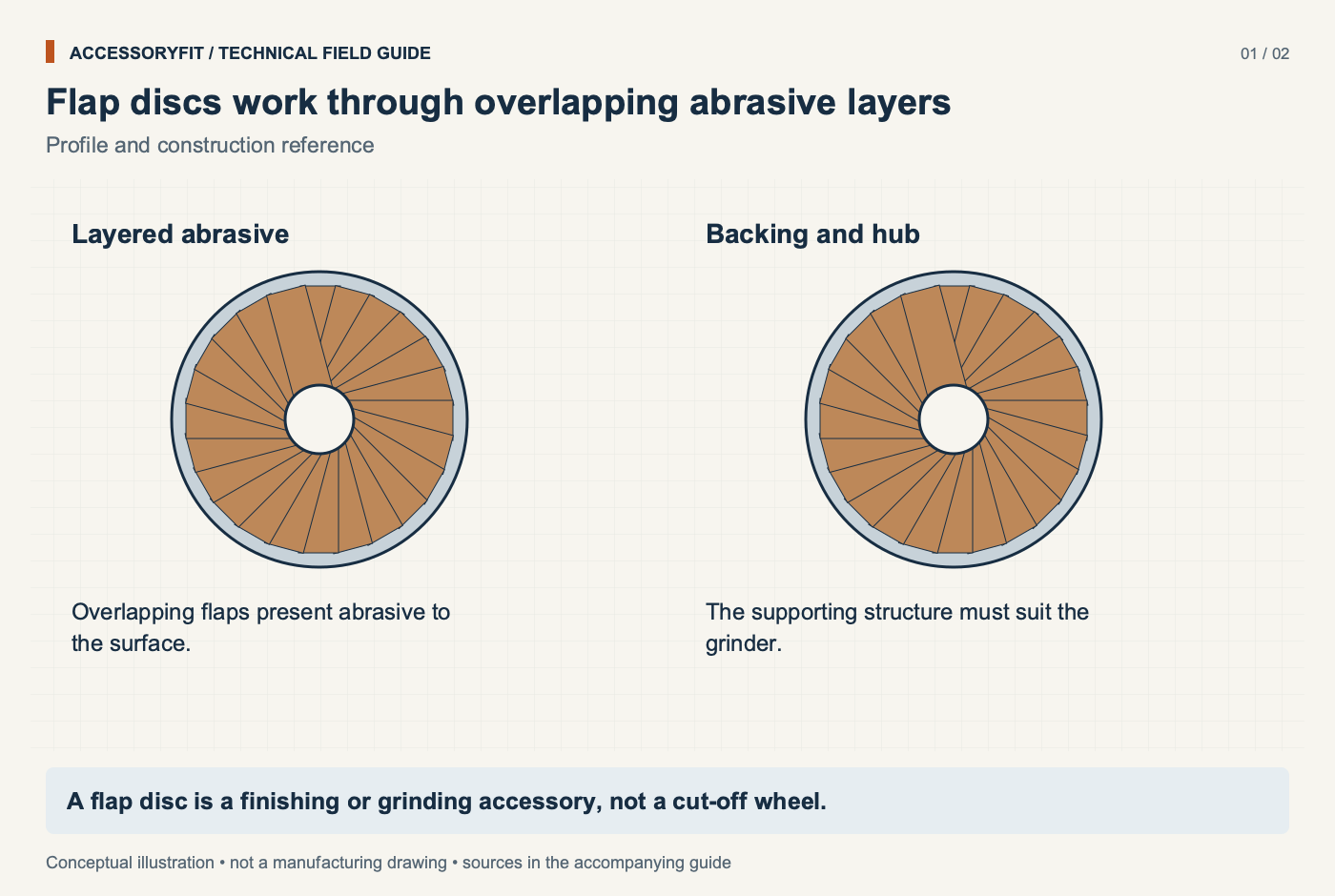
A flap disc for metal should have a tough, self-sharpening grain, a grit matched to the stage of the job, a shape matched to the working angle, and a mount and speed rating that suit the grinder. A flap disc is a coated abrasive: overlapping flaps of cloth-backed abrasive glued around a hub, which wear away to expose fresh grain. For anyone searching for sanding discs for an angle grinder, this is the product the grinder makers intend. For Europe, HAZET names the relevant standards as EN 12413 / EN 13236 / EN 13743, covering bonded wheels, diamond cut-off wheels and coated abrasives such as flap discs, in that order.
Grain: zirconia or ceramic for steel
Zirconia alumina is tough and self-sharpening, and it is the grain sold for heavy stock removal on carbon steel, stainless and other hard steels. Ceramic aluminium oxide was developed for aggressive grinding on metal and keeps exposing new sharp edges as it breaks down. Aluminium oxide is the general-purpose grain with a lower starting cost. All four picks use zirconia or a zirconia blend. Klingspor says zirconia gives its best value in the coarse removal grits of 24–60 grit, which brackets the picks here.
Grit: coarse for removal, finer for blending
Flap discs in the United Abrasives range come in grits from coarse to fine, as the table below shows. A 60-grit disc sits in the middle: Diablo calls its 60-grit Steel Demon coarse, and makers sell this grade for grinding, blending and deburring. Go coarser for heavy weld removal and finer to refine the scratch before paint or polish. Grit numbers on US flap discs follow the CAMI scale; European discs carry a P prefix, and the two scales match closely in this coarse range.
Shape: Type 29 or Type 27
Type 29 discs are conical and work at about 15–25 degrees to the surface, for heavier stock removal and contours. Type 27 discs are flat and work at about 0–15 degrees, mainly for finishing flat surfaces and edges. The conical shape puts more flap edge on the work at a steep angle; the flat shape keeps more of the face in contact when the grinder is held nearly flat.
Density
Flap discs come in standard and high density. United Abrasives and Weiler describe high-density discs as having more flaps or more abrasive, which gives a thicker disc that conforms to curved and irregular surfaces and lasts longer; United Abrasives puts the extra material at about 40 percent. Standard density is the lighter, quicker-cutting option for flat work. None of the four makers below states a density class, so this attribute cannot be compared across the picks.
Working angle: where the sources differ
The angle figures above come from United Abrasives and Surface Prep. Weiler gives a wider range for its conical discs, up to a steeper angle, and DeWalt's grinder manual recommends a much shallower angle for flap disc sanding: its table reads grinding 20–30 / flap 5–10 / backing pad 5–15 / wire 5–10 degrees. Start inside the disc maker's range and flatten the angle for a finer finish.
A flap disc is a finishing or grinding accessory, not a cut-off wheel.
Flap disc diameters, arbors, grits and grains in the United Abrasives range (single manufacturer)
Diameter
Arbor
Grits offered
Max RPM
Grains in range
4-1/2 in
7/8 in or 5/8-11
36, 40, 60, 80, 120
13,300
zirconium, ceramic, aluminium oxide with grinding aid
5 in
7/8 in or 5/8-11
36, 40, 60, 80, 120
12,200
zirconium, ceramic, aluminium oxide with grinding aid
6 in
7/8 in or 5/8-11
36, 40, 60, 80, 120
10,200
zirconium, ceramic
7 in
7/8 in
36 (and others)
8,500
zirconium, ceramic
UA catalog pp.62-63. Not every grit exists in every grain/shape. Single manufacturer.
02Will the flap disc fit your grinder and run at a safe speed?
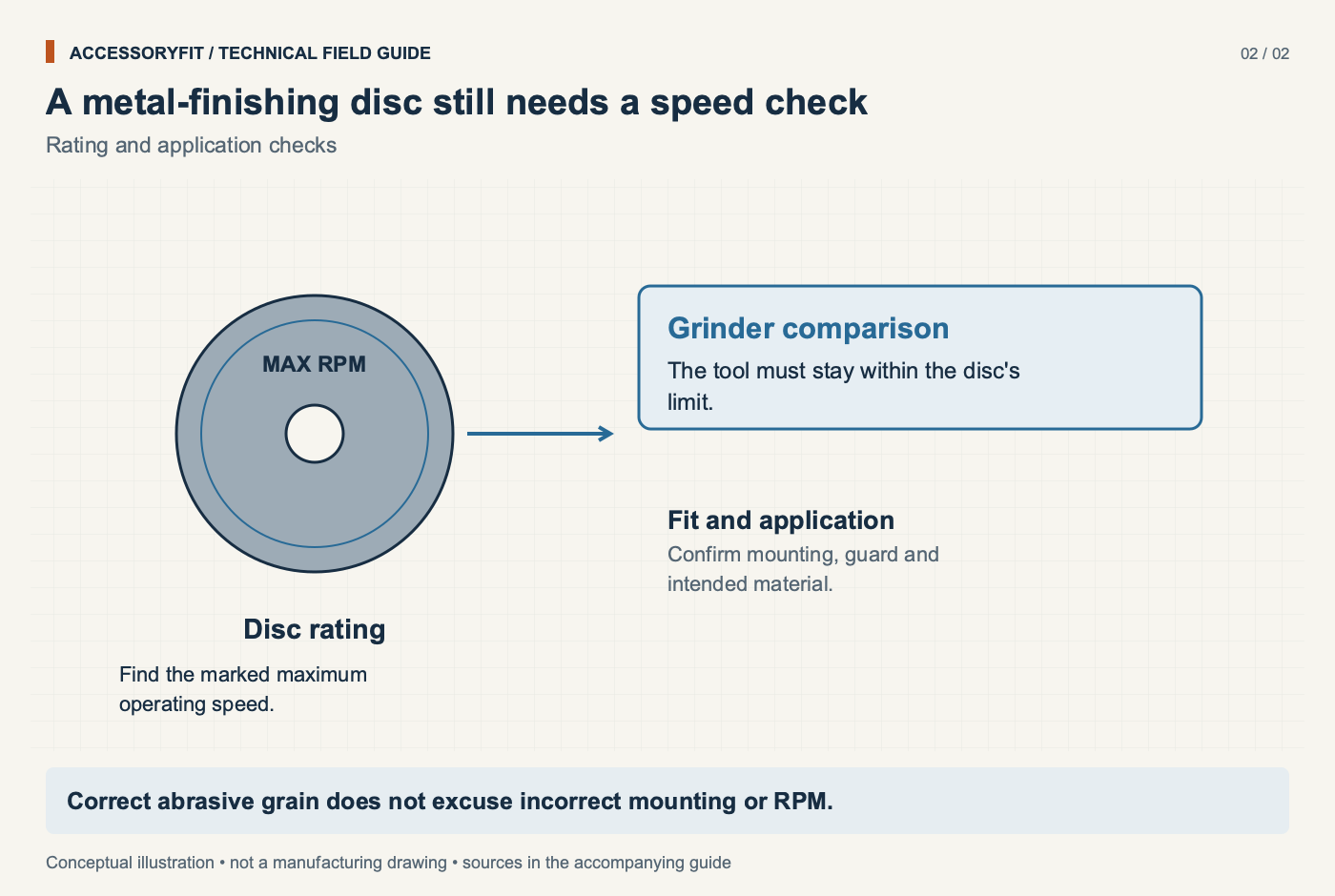
A flap disc fits if its centre hole or thread matches the spindle and its marked maximum speed is at least the grinder's no-load speed. Plain-hole discs sold in the US have a 7/8 in centre hole, the same as the 22.23 mm bore used in Europe, so plain-hole discs cross the Atlantic. Threaded accessories do not: US grinders use a 5/8–11 UNC spindle and European grinders use M14. Our guide on which discs fit your grinder gives the full size and thread table.
Speed is the second check. A 4-1/2 in reinforced wheel is typically rated 13,300 RPM. Grinders in this class list no-load speeds below that: DeWalt DWE402 lists 11000 rpm and Milwaukee 2880-20 lists 8500 rpm. European models such as Bosch GWS 12-125 Professional list 11000 rpm on an M14 spindle thread. Makita rates its conical X-LOCK disc at 13300 rpm, and Diablo rates the Steel Demon at 12000 rpm. Flap disc limits are not uniform across makers: Weiler rates its own flap discs at 13,000 / 12,000 / 10,200 / 8,600 RPM by size, slightly different from the bonded-wheel figures. Bosch's product page for the FD2945060 does not state a speed, so read the speed printed on any disc before fitting it.
Do not put a larger disc on a smaller, faster grinder. In the United Abrasives range, larger wheels carry lower ratings, down to 6,600 RPM for its biggest grinding wheels, well below the speed of a small grinder. To look up your own tool's published speed and spindle, use the accessory finder.
Correct abrasive grain does not excuse incorrect mounting or RPM.
03Which flap discs suit metal grinding and finishing?
Product links go to Amazon. As an Amazon Associate I earn from qualifying purchases. How links are chosen.
These four discs are the flap discs in our catalogue whose makers list metal grinding, blending or finishing. They are grouped by shape and mount, not ranked. Specs come from each maker's product page; where a maker's arbor or speed figure is unconfirmed, it is left out of the spec list, so check the disc marking. The Bosch FD2945060 is sold on Amazon as a multi-pack, while Bosch's page describes a single disc.
Conical aluminium-zirconium disc for weld and edge blending
Bosch FD2945060 4-1/2 in Type 29 60-grit flap disc
Diameter
4-1/2 in
Shape
Type 29
Grit
60
Grain
aluminum zirconium
Suits Owners of small angle grinders with a standard locking nut who blend welds and remove stock on uneven steel surfaces.
Skip it if X-LOCK-only grinders, threaded-hub setups, and fine finishing where a flat disc or finer grit is the published choice.
Type 29 conical shape for stock removal on uneven surfaces
Aluminium-zirconium grain
Bosch lists blending and grinding as its uses
Made for small grinders with the standard locking nut
Bosch's page does not state a maximum speed
Arbor size is unconfirmed on the maker's page: check the disc
Threaded-hub conical disc for rebar, angle iron and cast iron
Diablo DCX045060B01F 4-1/2 in 60-grit Steel Demon flap disc with Speed Hub
Diameter
4-1/2 in
Mount
5/8–11 Speed Hub in
Shape
Type 29
Grit
60
Grain
zirconium grain blend
Max speed
12000 rpm
Suits US grinder owners who change discs often and want a disc that spins straight onto the spindle without a flange nut, for structural steel and cast iron.
Skip it if European M14 grinders, and X-LOCK grinders, unless the disc marking confirms a matching mount.
Speed Hub threads onto the spindle, so no separate flange nut is needed
Zirconium grain blend
Diablo lists rebar, angle iron, cast iron, steel bar and painted surfaces
Type 29 conical shape for heavy removal
Its 5/8–11 Speed Hub in hub does not thread onto a European M14 spindle
Published specs of the flap disc picks (manufacturer data)
Disc
Diameter
Shape
Grit
Grain
Mount (maker statement)
Bosch FD2945060 4-1/2 in Type 29 60-grit flap disc
4-1/2 in
Type 29
60
aluminum zirconium
standard locking nut (size unconfirmed)
Makita T-03903 X-LOCK 4-1/2 in 60-grit Type 29 flap disc
4-1/2 in
Type 29
60
zirconium
X-LOCK and 7/8 in
Diablo DCX045060B01F 4-1/2 in 60-grit Steel Demon flap disc with Speed Hub
4-1/2 in
Type 29
60
zirconium grain blend
5/8–11 Speed Hub in
Makita T-03931 X-LOCK 4-1/2 in 60-grit Type 27 flat flap disc
4-1/2 in
Type 27
60
zirconium
X-LOCK and 7/8 in
04How do the flap disc picks differ from each other?
With diameter and grit the same across all four, the picks differ by shape and by how they mount. Three are conical Type 29 discs and one is a flat Type 27 disc; two use Makita's X-LOCK, one uses a threaded hub and one uses the standard flange nut.
Makita T-03903 vs T-03931: conical or flat?
The two Makita discs share grain, grit, diameter and mount, and differ only in shape. Makita sells the conical T-03903 for angle work and corners, and the flat T-03931 for blending and finishing flat surfaces. Used together they cover a typical weld job: the conical disc takes the bead down at a steeper angle, then the flat disc evens the surface at a shallow one.
Flange nut, X-LOCK or threaded hub?
The mount decides how the disc fits and how fast you can change it. The Bosch disc clamps between the grinder's flanges with the standard locking nut. Makita's X-LOCK discs lock onto X-LOCK grinders without a nut and, per Makita, are backward compatible with standard 7/8 in arbor grinders. Diablo's Speed Hub disc threads straight onto the spindle. A threaded hub only fits the thread it was made for, which matters if you own a European grinder with an M14 spindle.
Which grain is tougher?
All four use zirconia or a zirconia blend, and Bosch calls its grain aluminium zirconium. The makers do not publish comparable grain grades, so grain alone does not separate them. The published applications differ more: Makita names stainless and non-ferrous metal, while Diablo names rebar, angle iron and cast iron.
Klingspor grain recommendations by workpiece material
Material
Rough grinding
Intermediate / finishing
Carbon steel
Zirconia alumina or aluminium oxide
Zirconia alumina or aluminium oxide
Stainless steel
Zirconia alumina or aluminium oxide
Silicon carbide sometimes for a more consistent final scratch
Aluminium
Zirconia alumina
Aluminium oxide; silicon carbide in some machining and deburring
Cast iron
Zirconia alumina
Aluminium oxide; silicon carbide for chilled or grey iron
Titanium
Zirconia alumina
Silicon carbide; aluminium oxide may react chemically with titanium
Paint
Zirconia alumina for rough stripping
Silicon carbide usually recommended
Plastic
Zirconia alumina sometimes, usually wet
Silicon carbide almost exclusively
Glass
Silicon carbide (zirconia occasionally on flat stock)
Silicon carbide, usually ground wet
Stone / granite
Silicon carbide, ground wet
Silicon carbide
Taken from Klingspor's 'Specific Material Recommendations' page. Wood is not covered there; for bare wood Klingspor's basics page recommends aluminium oxide.
05Which sanding discs for metal fit a grinder besides flap discs?
Resin fibre discs. These are flat sanding discs for metal with abrasive on a stiff vulcanised fibre backing, and unlike a flap disc they cannot run on their own: DeWalt's grinder manual and United Abrasives both say a fibre disc goes on an angle grinder with a backing pad and clamp nut, while a flap disc needs no pad.
Which grain for which metal?
The grain choice follows the same logic as for flap discs. United Abrasives describes aluminium oxide fibre discs as the economical, general-purpose choice for ferrous and non-ferrous metal. United Abrasives and Weiler describe zirconia for aggressive stock removal on steel and stainless, lasting longer than aluminium oxide under heavy pressure, and ceramic as the top choice for carbon steel, stainless and hard-to-grind alloys, cutting cooler and lasting longest. For stainless and other heat-sensitive metals, both recommend a disc with a grinding-aid top coat, which reduces heat and loading. United Abrasives places silicon carbide fibre discs on glass, marble, ceramic, hard cast iron and non-ferrous work rather than general steel.
Fibre disc or flap disc?
A fibre disc on a pad cuts flat and aggressively, and suits surface preparation on broad faces; a flap disc wears down evenly as its flaps expose new grain and blends edges and welds without a separate pad. United Abrasives advises choosing a flap disc one grit coarser than the fibre disc you would use for the same job, except at the coarsest grade.
How do you hold a backing pad?
DeWalt's grinder manual says to hold a backing pad at 5–15 degrees to the work and keep it moving in a straight line, which avoids burning and swirl marks. DeWalt also warns against fitting sanding paper larger than the backing pad, because the overhang can cut you and can snag or tear. Sanders use a different fitting system entirely, covered in the guide to hook-and-loop and PSA disc sizes.
06When is a flap disc the wrong choice for metal?
A flap disc is the wrong tool for cutting, for very light pressure work, and for any grinder whose speed or spindle it does not match. It removes and blends; it does not slice.
Cutting bar, tube or sheet. Use a thin cut-off wheel with the closed cutting guard. Our explainer on Type 1 and Type 27 wheels sets out which shape does what. A cut-off wheel must never be used flat to clean up the burr afterwards; that is the flap disc's job.
Light pressure on a small grinder. Zirconia needs machine pressure to fracture and self-sharpen. With too little pressure the grain glazes and its life drops. If the disc stops cutting while it still has flap left, more steady pressure, not more speed, is the usual fix.
Titanium. Klingspor warns that aluminium oxide may react with titanium and recommends zirconia or silicon carbide instead.
A mismatched spindle. A threaded-hub disc does not fit a grinder with a different thread, and an X-LOCK-only disc does not fit a flange-nut grinder unless the maker says so.
A common belief is that the colour of a disc tells you the grain. Makers dye the backing any colour, so read the grain stated on the label. Another is that any guard supplied with the grinder suits every disc. Flap discs use the standard grinding guard, but the same grinder needs the closed cutting guard before a cut-off or diamond wheel goes on.
07How do you get a clean finish on steel with a flap disc?
Hold the disc at the angle its shape is made for, keep it moving, and step down in grit as the surface comes up. These points come from the abrasive and grinder makers behind this page.
Match the angle to the disc. Work a Type 29 disc at about 15–25 degrees and a Type 27 disc at about 0–15 degrees.
Apply steady pressure. Zirconia and ceramic grains self-sharpen under pressure; too little pressure glazes them.
Step down in grit. Remove with a coarse grade, then refine with a finer one, as the grit table above shows.
Watch for vibration. A disc that shakes may be damaged, mounted badly or worn unevenly. Stop and check before carrying on; our page on grinder disc vibration lists the checks.
Keep stainless clean. Klingspor notes that silicon carbide is sometimes used on stainless for a more consistent final scratch.
Choosing a flap disc for blending also eases the load on your hands. UK HSE's 2019 hand-arm vibration guidance (L140) gives 100 mm and 125 mm grinders fitted with flap discs a recommended initial value for exposure planning of 4 m/s², below its figure for angle grinders in general. It is an estimate drawn from tools in real use, not a rating of any disc on this page, but on long weld-dressing jobs it points towards a flap disc wherever a bonded grinding wheel is not strictly needed. Noise points the same way. A 2026 Brazilian field study of welders using larger angle grinders in 2025 recorded 84.4–101.0 dB(A) daily noise exposure across the tasks it measured, with average exposure over the occupational limit, and its quietest reading came from the one task done with a flap disc. It is a small field sample, so wear hearing protection whatever disc is fitted.
Is a Type 27 or Type 29 flap disc better for weld beads?
Type 29. Its conical shape works at about 15–25 degrees for heavier stock removal and contours, while the flat Type 27 works at about 0–15 degrees and suits finishing flat surfaces.
What grit flap disc should I use on steel?
A 60-grit disc is a common middle grade for grinding and blending. Go coarser for heavy removal and finer before paint. Klingspor says zirconia gives its best value in the 24–60 grit range.
Do Makita X-LOCK flap discs fit a DeWalt or Milwaukee grinder?
Makita says its X-LOCK flap discs are backward compatible with grinders that take a standard 7/8 in arbor, so they mount with the usual flange and nut.
Can I use US flap discs on a European angle grinder?
Plain-hole discs, yes: the 7/8 in hole matches the European 22.23 mm bore. Threaded-hub discs made for 5/8–11 UNC will not fit an M14 spindle.
Which guard does a flap disc need?
The standard grinding guard used for Type 27, 28 and 29 wheels, which covers the operator-side face and has an inward lip. The closed cutting guard is for cut-off and diamond wheels.
Axminster Tools: Festool Multi-Jetstream2 Pad for ETS150 Sander; Mirka Interface Pad 125mm 953284
Benchmark Abrasives: Sanding Discs Buying Guide: PSA vs Hook & Loop vs Fiber
Bosch: PRO Stainless Steel and Metal Bonded Cutting Disc, bore 22.23 mm (2 608 600 549); GWS 12-125 angle grinder (UK); GWS 12-125 / GWS 12-125 S original instructions 1 609 92A D3M (21.10.2025); PRO Metal Bonded Cutting Disc for Chop Saws, bore 25.4 mm (2 608 600 543); Premium Turbo Rim Diamond Abrasive Blades; EXPERT Hard Ceramic Diamond Cutting Disc (X-LOCK); X-LOCK system page (GB); Bosch X-LOCK - The ultimate changing system for grinders (news); 1617/1618 router operating/safety instructions (2610051825); Type 29 Flap Discs (FD2945060 variant listing); EXPERT C470 Sandpaper with 8 holes for Random Orbital Sanders; ROS20VSC 5 in Random Orbit Sander product page
DeWalt: DWE402/DWE402N/DWE402G/DWE4222N Instruction Manual NA190466; DW8062 High Performance 4-1/2 in x .045 in x 7/8 in Metal Cut-Off Wheel; DWE402 4-1/2 in (115 mm) Small Angle Grinder product page; DWE402 4-1/2 in (115 mm) paddle switch small angle grinder; DW402G angle grinder instruction manual; DW4719 7 x 1/4 x 7/8 in High Performance Metal Grinding Wheel; DW8080 HP 4-1/2 in x 3/32 in x 7/8 in T1 Cutting/Notching Wheel (Stainless); DWE575 circular saw instruction manual (N786997); DWE6423 5 in variable speed random orbit sander with hook and loop pad; DWE6420/DWE6421/DWE6423 Random Orbit Palm Sanders instruction manual N412818
DGUV Institute for Occupational Safety and Health (IFA): Ageing of resinoid bonded grinding wheels (project BIA 6055)
Festool: ETS EC 150/3 EQ and ETS EC 150/5 EQ original instructions (PDF)
Fine Woodworking (Taunton Press): Full Grit Chart (English), PDF; True Grit, by Mark Schofield (Fine Woodworking #176)
FLEX (Chervon North America): Safety Warnings and Guidelines for Users of Portable Grinding, Cutting and Flap-Disc Wheels (10/2023)
Freud and Diablo: DCX045060B01F 4-1/2 in 60-Grit Steel Demon Flap Disc for Metal product page; Get the most out of your Freud bits by routing at ideal feed rates and speeds
General Finishes: What is the best sandpaper or abrasive to use for finish sanding?
HAZET: User information for grinding wheels, cut-off wheels, flap discs (multilingual safety leaflet)
Health and Safety Executive (UK): Hand-arm vibration at work: The Control of Vibration at Work Regulations 2005. Guidance on Regulations (L140, second edition); RR717 - Evaluation of EN 60745 test codes: BS EN 60745-2-3:2007 angle grinders
Hemlock Hardware (Diablo listing): Diablo 6 In. 60-Grit 6-Hole Pattern Vented Sanding Disc with Hook and Lock Backing
HookandLoop.com: Replacing sanding discs with hook and loop
IMC Clains (specialist retailer): Stone, Belt, Paper, Film and Compound Grit Comparison, PDF
İstanbul Medical Journal: Angle Grinder Injuries in the Upper Extremity: An Epidemiological Study
Journal of Trauma and Injury: Severity of grinder injuries and related factors compared with other high-rotation cutting tool injuries: a multicenter retrospective study from 2011 to 2018
Klingspor: Grain types (Lowdown on grinding); Coated Abrasives Basics; Specific Material Recommendations; Grit Grading Systems (Coated Abrasives Basics); Klingspor Kronenflex A 60 Extra cut-off wheel 125 x 22.23 x 1 mm, 12200 RPM; Klingspor Kronenflex A 46 TZ Special cutting disc 230 x 1.9 x 22.23 mm; Klingspor Kronenflex A 46 TZ Special cutting disc 115 x 1.6 x 22.23 mm; Klingspor Kronenflex A 24 Extra cutting disc 150 x 2.5 x 22.23 mm, depressed; Klingspor Kronenflex A 36 TZ Special cutting disc 180 x 2 x 22.23 mm; Maximum operating speed (Lowdown on grinding); Hole pattern for abrasives (Lowdown on grinding); Self-fastening disc (Lowdown on grinding)
Makita: T-03903 X-LOCK 4-1/2 in 60 Grit Type 29 Flap Disc product page; X-LOCK Flap Discs new accessory overview (PDF); GA5030R 125 mm angle grinder; Diamond Blades new accessory overview (PDF); 9557PB angle grinder instruction manual; 5007F 7-1/4 in circular saw instruction manual; T-03931 X-LOCK 4-1/2 in 60 Grit Type 27 Flap Disc product page; BO6050 Random Orbit Sander instruction manual; BO6050J 6 in Random Orbit Sander product page; BO5041 5 in Random Orbit Sander product page
Milwaukee Tool: M18 FUEL 4-1/2 in / 5 in Braking Grinder, Paddle Switch No-Lock (2880-20); 2880-20 M18 FUEL 4-1/2 in / 5 in Grinder Paddle Switch, No-Lock product page; Operator's manual 58-14-0243D2 (Cat. No. 2880-20); 9 in x 1/4 in x 5/8-11 Grinding Wheel (Type 27) 49-94-9735 (discontinued listing); Guard for Type 1 Grinding Discs 4-1/2 in (49-12-0361); 6 in x .045 in x 7/8 in Metal Cut Off Wheel - Type 1 (49-94-0023); 7 in x 1/16 in x 7/8 in Metal Cut Off Wheel - Type 1 (49-94-0033); M18 FUEL oscillating multi-tool 2836-20 operator's manual (58-14-0217d1)
Mirka: Galaxy abrasive leaflet (English), PDF; Get the most out of your abrasives with Mirka's problem-solving abrasives
NIOSH: Power Tool Database (PDF dated August 2006; catalogued by CDC Stacks 1 October 2011)
OSHA: 29 CFR 1910.215 Abrasive wheel machinery; 29 CFR 1926.303 Abrasive wheels and tools; 29 CFR 1910.243 Guarding of portable powered tools; 29 CFR 1926.300 General requirements (Tools, hand and power); 29 CFR 1926.304 Woodworking tools
PACE Technologies: Grit Size Converter (Common Abrasive Types)
PFERD: Ceramic oxide grain fibre disc dia. 125 mm CO-COOL80 for cool grinding on stainless steel, PDF; Safety notes, fine grinding and polishing tools (PDF, v1.0 14.01.2026)
Revista Brasileira de Medicina do Trabalho (via PubMed Central): Laterality of hand-arm vibration exposure during grinding operations: a field study in industrial settings
Revista de la Asociación Argentina de Ortopedia y Traumatología: Traumatic Injuries to the Hand From the Use of an Angle Grinder. A Problem in Our Field