
Research · Grinders and abrasive wheels
Angle grinder injury statistics
An estimated 40,000 injuries involving workshop grinders, buffers and polishers were treated in US hospital emergency departments in 2024, according to AccessoryFit's analysis of the Consumer Product Safety Commission's NEISS sample (95% confidence interval 31,899 to 48,047 injuries). That federal category covers bench grinders as well as angle grinders, so it is not a pure angle grinder count. Eyes were the body part hurt in 48.3% of cases; amputations are rare in the US data but much more common in hand-surgery studies of angle grinders used to cut wood.
By AccessoryFit editors · Checked
On this page
- What are the key findings?
- How many angle grinder injuries happen each year in the US?
- Are grinder injuries increasing?
- What share of grinder injuries are eye injuries?
- Why do grinders hurt eyes and heads so often?
- How common are amputations from angle grinders?
- What are people doing when an angle grinder injures them?
- Who gets hurt by grinders?
- How much does an angle grinder vibrate?
- Do declared vibration figures match real use?
- How loud is an angle grinder?
- Which disc, guard and speed checks prevent which grinder injury?
- When do these figures not apply?
- How was this data produced?
- How should you cite this data?
What are the key findings?
- About 40,000 injuries involving workshop grinders, buffers and polishers (a category that includes bench grinders, not only angle grinders) were treated in US emergency departments in 2024, with a 95% confidence interval of 31,899 to 48,047 injuries (CPSC NEISS).
- That is the highest point estimate of any power tool group in the 2024 NEISS data (about 195,900 injuries across all power tools), though its interval overlaps chain saws and table saws.
- Eyes come first: in the 2024 NEISS grinder, buffer and polisher data, 48% were eye injuries (injuries to the eyeball), and foreign bodies were the second most common diagnosis after cuts.
- Amputations were rare in the US emergency department data for this category, at 0.3% of 2024 injuries against 4.2% for all power tools, and that grinder figure rests on very few sampled cases.
- In a 2022 study of 928 angle grinder hand-injury patients at an Argentine hospital (2016 to 2020), 84.5% were cutting wood or firewood when hurt and 15.5% lost part of a finger.
- In a 2023 Korean multicentre emergency department study (2011 to 2018), 23.0% of grinder injuries were to the head, more than double the share for other high-speed cutting tools.
- The UK Health and Safety Executive tells employers to assume about 7 m/s² of hand-arm vibration for a 100 to 180 mm angle grinder, enough to pass the UK daily exposure action value after roughly 1 hour of trigger time.
- The 2024 US estimate is up on 2023, but the two years' confidence intervals overlap and NEISS changed its hospital sample around 2024, so the data do not show a confirmed rise.
How many angle grinder injuries happen each year in the US?
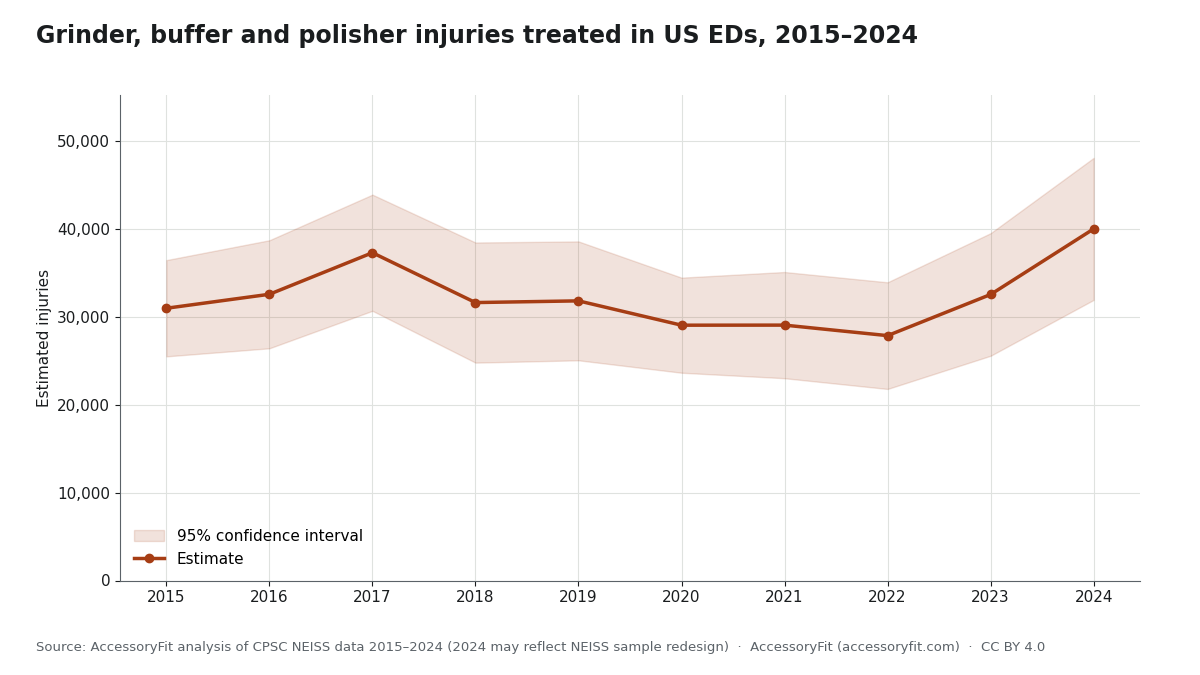
US hospital emergency departments treated an estimated 40,000 injuries involving workshop grinders, buffers and polishers in 2024, according to the National Electronic Injury Surveillance System (NEISS), a weighted sample of US hospitals run by the Consumer Product Safety Commission (CPSC). Yearly estimates from 2015 are in the table below.
NEISS has no separate code for angle grinders. Codes 897, 898 and 899 together cover workshop grinders, buffers and polishers, which takes in bench grinders and polishing tools as well as hand-held angle grinders. Quote the figure as "injuries involving workshop grinders, buffers and polishers"; in a headline, "grinder injuries" is safer than "angle grinder injuries".
| Year | Estimated injuries | 95% confidence interval | Amputation share | Reliability |
|---|---|---|---|---|
| 2015 | 30,953 | 25,482–36,424 | 0.0% | reliable |
| 2016 | 32,541 | 26,400–38,682 | 0.2% | reliable |
| 2017 | 37,265 | 30,662–43,868 | 0.2% | reliable |
| 2018 | 31,599 | 24,770–38,427 | 0.0% | reliable |
| 2019 | 31,792 | 25,035–38,549 | 0.6% | reliable |
| 2020 | 29,026 | 23,622–34,431 | 0.1% | reliable |
| 2021 | 29,035 | 22,998–35,072 | 0.2% | reliable |
| 2022 | 27,840 | 21,777–33,902 | 0.3% | reliable |
| 2023 | 32,518 | 25,549–39,486 | 0.4% | reliable |
| 2024 | 39,973 | 31,899–48,047 | 0.3% | reliable |
CPSC's 2021 notice says NEISS was moving to a redesigned hospital sample, with 2024 estimates possibly the first from the new sample, so treat the 2023-to-2024 change with care.
Are grinder injuries increasing?
The data do not show a clear rise: the 2024 estimate is the highest in the ten-year series, but its confidence interval overlaps 2023's and those of most earlier years. CPSC also announced in 2021 that NEISS was moving to a redesigned hospital sample, with 2024 possibly the first year estimated from it, and earlier years are not recalculated, so part of any 2023 to 2024 change may reflect the sample itself. A fair summary is that grinder-related emergency visits have run at a broadly similar level for a decade, with 2024 at the top of that range. "Grinder injuries surged in 2024" is not supported by these figures.
What share of grinder injuries are eye injuries?
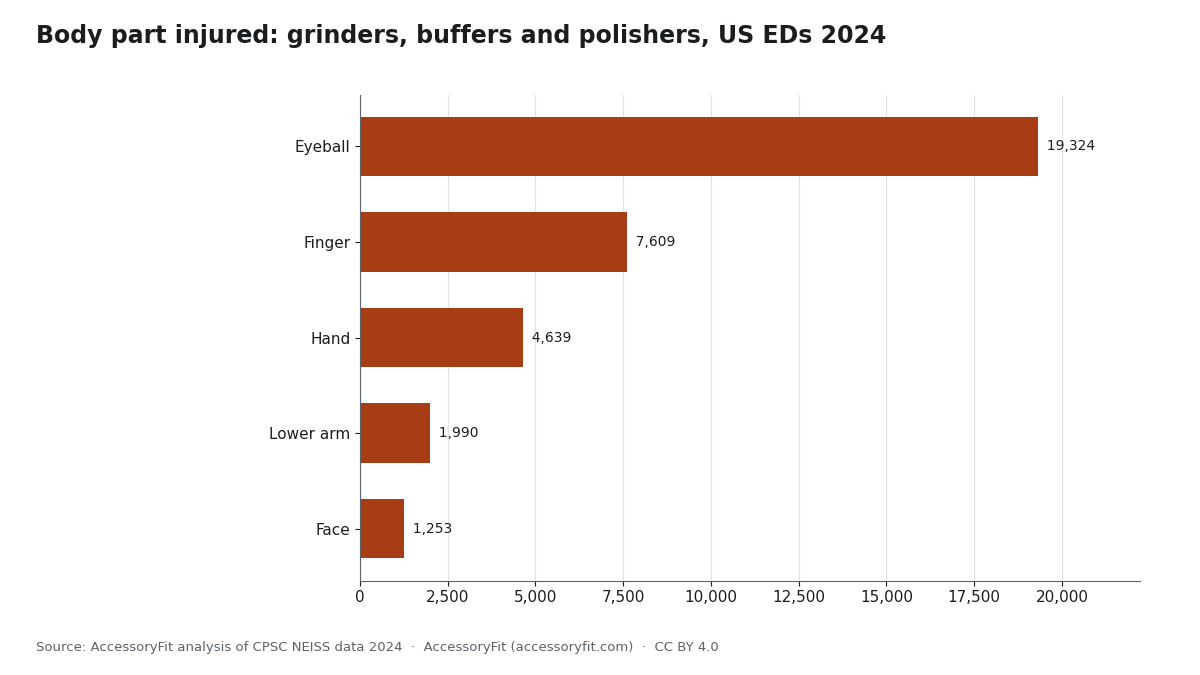
Almost half: in the 2024 NEISS data for workshop grinders, buffers and polishers, 48% were eye injuries (coded as the eyeball), far ahead of fingers and hands. Cuts were the most common diagnosis and foreign bodies, mostly grit, metal or wheel fragments in the eye, came second.
Why do grinders hurt eyes and heads so often?
Grinders throw material: sparks, grit, scale, wire from brushes and, when a wheel fails, pieces of the wheel. The pattern shows up outside the US too. In a 2023 Journal of Trauma and Injury study of 8,697 Korean emergency department visits for high-speed cutting tool injuries (2011 to 2018), 23.0% of grinder injuries were to the head, against 10.2% for other cutting tools.
On the accessory side, the guard on a portable grinder may leave no more than 180 degrees of the wheel exposed, and it must suit the disc: an open Type 27 guard for depressed-centre grinding wheels, a closed two-sided guard for cut-off and diamond wheels, and the guard kept on for wire brushes. The guide to choosing cut-off wheels shows which wheel takes which guard. Eye protection covers what the guard cannot, on bench grinders as much as angle grinders.
How common are amputations from angle grinders?
In US emergency department data, amputations are a small part of grinder injuries: 0.3% of the 2024 estimate for workshop grinders, buffers and polishers, against 4.2% across all power tools. That grinder share rests on a handful of sampled cases, below CPSC's reliability thresholds, so read it as "rare in this category" rather than a precise rate; bench grinders and buffers, which rarely sever fingers, also dilute it.
Hospital studies of angle grinders alone look at patients sent to hand surgeons, and find much more severe injuries:
- Argentina, 928 angle grinder hand-injury patients at one hospital, 2016 to 2020 (published 2022): traumatic finger amputations made up 15.5% of cases.
- Turkey, 79 hand and forearm injuries from angle grinders treated in 2020 to 2022 (Istanbul Medical Journal, 2024): for working patients, 7.13 weeks average off work.
These describe specialist-centre patients, not all grinder users.
What are people doing when an angle grinder injures them?
In the Argentine study of 928 angle grinder hand-injury patients (2016 to 2020), 84.5% were cutting wood or firewood when hurt, and only 12.1% were cutting metal, the job the tool is made for. Only 22.4% wore protective equipment, which the study defined as gloves. NEISS does not code the task in a countable way, so there is no matching US figure.
Cutting wood on a grinder usually means fitting a toothed saw blade or a chain-type carving disc. Grinder makers forbid both because they snatch and kick back, pulling the tool toward the hand steadying the work. For timber, use a saw; the guide to angle grinder disc sizes lists what a grinder is designed to take.
Who gets hurt by grinders?
Grinder injuries in the 2024 US data are spread across adult age groups, with people aged 35 to 54 the largest group (35.3%). Men made up 98.5% of the injured. Home was the most common recorded location (30.4%), but most records do not state one, so the home and workplace split cannot be estimated with confidence.
How much does an angle grinder vibrate?
The UK Health and Safety Executive (HSE) advises employers to assume about 7 m/s² for a 100 to 180 mm angle grinder in real use when they have no better data, and about 4 m/s² for a 100 or 125 mm grinder fitted with a flap disc. At the general grinder value, HSE says a user passes the UK daily exposure action value after roughly 1 hour of trigger time. Vibration exposure is a long-term health risk (hand-arm vibration syndrome) rather than an emergency department injury, so it does not appear in the NEISS figures above.
| Tool and accessory | 10th percentile | 90th percentile | Recommended initial value (75th percentile) |
|---|---|---|---|
| Angle grinder, 100-180 mm | 3 m/s² | 10 m/s² | 7 m/s² |
| Angle grinder, 100 and 125 mm with flap disc | 2 m/s² | 5 m/s² | 4 m/s² |
| Angle grinder, 220-300 mm | 4 m/s² | 11 m/s² | 9 m/s² |
| Die grinder | 5 m/s² | 10 m/s² | 8 m/s² |
| Straight grinder | 4 m/s² | 9 m/s² | 8 m/s² |
HSE notes that pressing too hard can make large discs lobe and raise vibration, and that the right abrasive grade reduces the force needed. Values are for initial risk assessment, not a model rating.
Do declared vibration figures match real use?
Not reliably. In HSE research report RR717 (Health and Safety Laboratory, 2009), manufacturers' declared values underestimated the in-use vibration risk for 5 of 5 grinders tested. Sources also disagree on which handle is worse: the NIOSH Power Tool Database (PDF dated 2006, catalogued by CDC in 2011; no longer updated) found the side handle higher on every grinder, peaking at 23.4 m/s² (highest left-hand reading), while a 2026 Brazilian field study of six welders in 2025 found readings up to 10.5 m/s² (highest rear-handle reading). Methods differ, so treat both handles as able to exceed limits.
The accessory matters too. A disc whose hole or thread does not match the spindle runs out of balance, and any accessory that runs untrue or vibrates should not be used; see grinder disc vibration troubleshooting. The lower HSE value for flap discs is one reason to finish with flap discs for metal where the job allows. To turn a vibration value and trigger time into a daily dose, use the hand-arm vibration exposure calculator.
How loud is an angle grinder?
Loud enough to need hearing protection: the NIOSH Power Tool Database (2006 data, catalogued in 2011) lists 95–107 dB(A) sound power, loaded, for 18 corded angle grinders. Sound power describes what the tool emits, not the level at your ear, so it is not directly comparable with hearing-protection limits. The 2026 Brazilian field study measured welders' actual exposure in 2025 at 84.4–101.0 dB(A) daily noise exposure, with the lowest reading from the one task done with a flap disc. The power tool noise data compare grinders with other tools.
Which disc, guard and speed checks prevent which grinder injury?
Five checks before the trigger is pulled cover most accessory-related grinder failures. The rules come from OSHA, ANSI-based maker guidance and grinder manuals.
| Check | Rule | Injury it addresses |
|---|---|---|
| Wheel speed rating | wheel max RPM >= grinder no-load RPM; for example, wheels for the largest grinders are typically rated 6,600 RPM, far below a small grinder's speed | Wheel bursting; fragments to the eyes, face and head |
| Guard type | Closed two-sided guard for cut-off and diamond wheels; open Type 27 guard for depressed-centre grinding wheels; no more than 180 degrees of the wheel exposed | Contact with the wheel; fragments if a wheel breaks |
| Accessory type | No toothed saw blades or saw-chain carving discs on an angle grinder | Kickback and deep hand cuts or finger amputation |
| Wheel condition | Ring-test and inspect before mounting; respect the expiry date; run a new wheel for 1 minute with the guard on, standing out of line | Hidden cracks failing at speed |
| Mount fit | Hole or thread must match the spindle and flange; never force, ream or adapt a wheel | Out-of-balance vibration and loss of control |
When do these figures not apply?
A common misreading is that "40,000 injuries a year are caused by angle grinders". The NEISS figure counts emergency department visits involving any workshop grinder, buffer or polisher, bench grinders included, and leaves out injuries treated at urgent care, workplace clinics or a doctor's office. It is neither an angle grinder count nor a count of all grinder injuries.
- A NEISS product code records that a product was involved, not that it caused the injury or that an accessory failed.
- NEISS covers the United States only. The Argentine, Korean and Turkish figures describe particular hospital patient groups.
- Small breakdowns, such as amputations, often fall below CPSC reliability thresholds and are flagged in the CSV.
- Vibration and noise figures come from different methods (declared, laboratory and field) and should be quoted with their source.
For saws, drills and nail guns, see the power tool injury statistics.
How was this data produced?
US injury estimates. AccessoryFit downloaded CPSC's public NEISS case files for 2015 to 2024 and selected cases with product codes 897, 898 or 899 (workshop grinders, buffers and polishers). Summing each sampled case's weight gives the national estimate, the method CPSC uses. The 95% confidence intervals use a with-replacement variance estimate across NEISS strata and hospital sampling units. Following CPSC's publication thresholds, figures based on fewer than 20 sampled cases, an estimate under 1,200, or a coefficient of variation over 33% are marked unreliable; they stay in the CSV with a flag but are left out of the charts and tables here. Body part, diagnosis, age and location are NEISS's own coded fields.
Comparability. CPSC's 2021 Federal Register notice described a redesigned hospital sample, with 2024 possibly the first year based on it. Earlier years are not recalculated, so compare 2024 with them cautiously.
Other studies. Argentine, Korean, Turkish and Brazilian figures are taken from the published results; where a paper's abstract and results disagreed (severity splits, an odds ratio, a glove-use share), the figure was left out. Vibration values come from HSE guidance L140 (2019) and report RR717 (2009); noise and laboratory vibration values from the NIOSH Power Tool Database (PDF dated 2006, catalogued by CDC in 2011). AccessoryFit did not test or measure any tool.
How should you cite this data?
Suggested citation: AccessoryFit, "Angle grinder injury statistics", updated 22 October 2026, https://accessoryfit.com/research/angle-grinder-injury-statistics/
The data, tables and charts on this page are free to reuse under the Creative Commons Attribution 4.0 licence (CC BY 4.0) with a link to this page. When quoting the US figure, keep the wording "workshop grinders, buffers and polishers" or note that it includes bench grinders. The underlying NEISS data belong to the US Consumer Product Safety Commission. More datasets are in the power tool research and data section.
Download the data
The CSV files hold every year, tool group and breakdown used here, including rows flagged as unreliable, sample case counts and confidence intervals. Grinder rows are labelled "Workshop grinders, buffers and polishers".
- US power tool injury estimates, 2015 to 2024 (CSV) Yearly NEISS estimates by tool group with codes, sample cases, amputation estimates, confidence intervals and reliability flags.
- 2024 injury breakdowns by tool group (CSV) Body part, diagnosis, disposition, location, sex and age band for each tool group, with reliability flags.
- Chart: grinder injury trend, 2015 to 2024 (PNG) Line chart with 95% confidence band, 1200 by 675 px.
- Chart: grinder injuries by body part, 2024 (PNG) Bar chart of reliable body-part categories, 1200 by 675 px.
Questions readers ask
Does the NEISS grinder figure count only angle grinders?
No. NEISS codes 897, 898 and 899 cover workshop grinders, buffers and polishers, so bench grinders and polishing tools are included alongside angle grinders. There is no reliable public split between the two kinds of grinder.
Why do hand-surgery studies report far more grinder amputations than the US emergency data?
They study different people. NEISS counts everyone seen in a sample of US emergency departments, including many minor eye and skin injuries from bench and angle grinders. Hand-surgery studies, such as the Argentine series of 928 patients, include only serious hand injuries from angle grinders.
Are grinder injuries at work included in the US figure?
Only if the person went to a hospital emergency department in the NEISS sample. Workplace clinics, urgent care and doctors' offices are not counted.
Can I use the grinder injury charts in an article or training slides?
Yes. The charts, tables and CSV files are licensed CC BY 4.0: reuse them freely with a link to this page as the credit.
Where to go next
- Power tool injury statisticsThe same NEISS analysis for every power tool group, with the overall trend.
- Angle grinder disc sizesDisc diameters, arbors and speed ratings that match each grinder.
- Angle grinder disc vibrationCauses of a wobbling disc and the checks before you keep cutting.
References 60 documents, 23 publishers
- Bosch: GWS 12-125 angle grinder (UK); PRO Stainless Steel and Metal Bonded Cutting Disc, bore 22.23 mm (2 608 600 549); PRO Metal Bonded Cutting Disc for Chop Saws, bore 25.4 mm (2 608 600 543); GWS 12-125 / GWS 12-125 S original instructions 1 609 92A D3M (21.10.2025); Premium Turbo Rim Diamond Abrasive Blades; EXPERT Hard Ceramic Diamond Cutting Disc (X-LOCK); X-LOCK system page (GB); Bosch X-LOCK - The ultimate changing system for grinders (news)
- California DIR (Cal/OSHA): Title 8 §3575 Scope and Definitions (abrasive wheels)
- DeWalt: DWE402 4-1/2 in (115 mm) paddle switch small angle grinder; DW402G angle grinder instruction manual; DW8062 High Performance 4-1/2 in x .045 in x 7/8 in Metal Cut-Off Wheel; DW4719 7 x 1/4 x 7/8 in High Performance Metal Grinding Wheel; DW8080 HP 4-1/2 in x 3/32 in x 7/8 in T1 Cutting/Notching Wheel (Stainless); DWE402/DWE402N/DWE402G/DWE4222N Instruction Manual NA190466
- DGUV Institute for Occupational Safety and Health (IFA): Ageing of resinoid bonded grinding wheels (project BIA 6055)
- FLEX (Chervon North America): Safety Warnings and Guidelines for Users of Portable Grinding, Cutting and Flap-Disc Wheels (10/2023)
- HAZET: User information for grinding wheels, cut-off wheels, flap discs (multilingual safety leaflet)
- Health and Safety Executive (UK): Hand-arm vibration at work: The Control of Vibration at Work Regulations 2005. Guidance on Regulations (L140, second edition); RR717 - Evaluation of EN 60745 test codes: BS EN 60745-2-3:2007 angle grinders
- İstanbul Medical Journal: Angle Grinder Injuries in the Upper Extremity: An Epidemiological Study
- Journal of Trauma and Injury: Severity of grinder injuries and related factors compared with other high-rotation cutting tool injuries: a multicenter retrospective study from 2011 to 2018
- Klingspor: Klingspor Kronenflex A 60 Extra cut-off wheel 125 x 22.23 x 1 mm, 12200 RPM; Klingspor Kronenflex A 46 TZ Special cutting disc 115 x 1.6 x 22.23 mm; Klingspor Kronenflex A 24 Extra cutting disc 150 x 2.5 x 22.23 mm, depressed; Klingspor Kronenflex A 36 TZ Special cutting disc 180 x 2 x 22.23 mm; Klingspor Kronenflex A 46 TZ Special cutting disc 230 x 1.9 x 22.23 mm; Maximum operating speed (Lowdown on grinding)
- Makita: GA5030R 125 mm angle grinder; Diamond Blades new accessory overview (PDF); T-03903 X-LOCK 4-1/2 in 60 Grit Type 29 Flap Disc product page
- Milwaukee Tool: Guard for Type 1 Grinding Discs 4-1/2 in (49-12-0361); M18 FUEL 4-1/2 in / 5 in Braking Grinder, Paddle Switch No-Lock (2880-20); 6 in x .045 in x 7/8 in Metal Cut Off Wheel - Type 1 (49-94-0023); 9 in x 1/4 in x 5/8-11 Grinding Wheel (Type 27) 49-94-9735 (discontinued listing); 7 in x 1/16 in x 7/8 in Metal Cut Off Wheel - Type 1 (49-94-0033)
- NIOSH: Power Tool Database (PDF dated August 2006; catalogued by CDC Stacks 1 October 2011)
- OSHA: 29 CFR 1926.303 Abrasive wheels and tools; 29 CFR 1910.215 Abrasive wheel machinery
- PFERD: Safety notes, fine grinding and polishing tools (PDF, v1.0 14.01.2026)
- Revista Brasileira de Medicina do Trabalho (via PubMed Central): Laterality of hand-arm vibration exposure during grinding operations: a field study in industrial settings
- Revista de la Asociación Argentina de Ortopedia y Traumatología: Traumatic Injuries to the Hand From the Use of an Angle Grinder. A Problem in Our Field
- Saint-Gobain Abrasives (Norton): NOVIPRO thin cutting discs Technical Data Sheet (03.11.2022)
- Surface Prep: Flap Discs: The Differences Between Type 27 and Type 29
- U.S. Consumer Product Safety Commission: NEISS 2024 data file (neiss2024.xlsx); NEISS 2015 data file (neiss2015.xlsx); NEISS 2016 data file (neiss2016.xlsx); NEISS 2017 data file (neiss2017.xlsx); NEISS 2018 data file (neiss2018.xlsx); NEISS 2019 data file (neiss2019.xlsx); NEISS 2020 data file (neiss2020.xlsx); NEISS 2021 data file (neiss2021.xlsx); NEISS 2022 data file (neiss2022.xlsx); NEISS 2023 data file (neiss2023.xlsx); Agency Information Collection Activities; Follow-Up Activities for Product-Related Injuries Including NEISS (Docket CPSC-2009-0102), FR Doc. 2021-23302
- United Abrasives / SAIT: 2025-2026 Product Catalog (English); How to Read a Wheel Label & Safety Icon Library; The Ultimate Cut product family page
- US Department of Energy, Office of Environment, Safety and Health: Operating Experience Summary 2002-25
- Weiler Abrasives: Flap Disc Brochure WC117 (2026)
Accessed .