
Fit guide · Routers
Router collet sizes: 1/4 in, 1/2 in, 6 mm and 8 mm shanks and which routers take them
A router bit fits only a collet whose bore matches its shank exactly. Compact trim routers from DeWalt, Milwaukee and Makita ship with a 1/4 in collet, and mid-size and full-size US routers typically ship with both 1/4 and 1/2 in collets. European routers add metric sizes: Bosch supplies its POF 1400 ACE with 6 mm, 8 mm, 1/4 in collets. Inch and metric shanks are not interchangeable, even where the sizes look close, and the bit's rated speed must be at least the router's maximum.
By AccessoryFit editors · Checked
On this page
- What is a router collet, and why must it match the shank?
- Which collet sizes do common routers take?
- Can an 8 mm bit go in a 1/4 in collet?
- Should you choose 1/2 in or 1/4 in shank bits?
- Can you use a reducer sleeve in a router collet?
- How far should a bit go into the collet?
- Is a bit safe at your router's speed?
- When does a bit that fits the collet still fail?
- Where do you go next?
What is a router collet, and why must it match the shank?
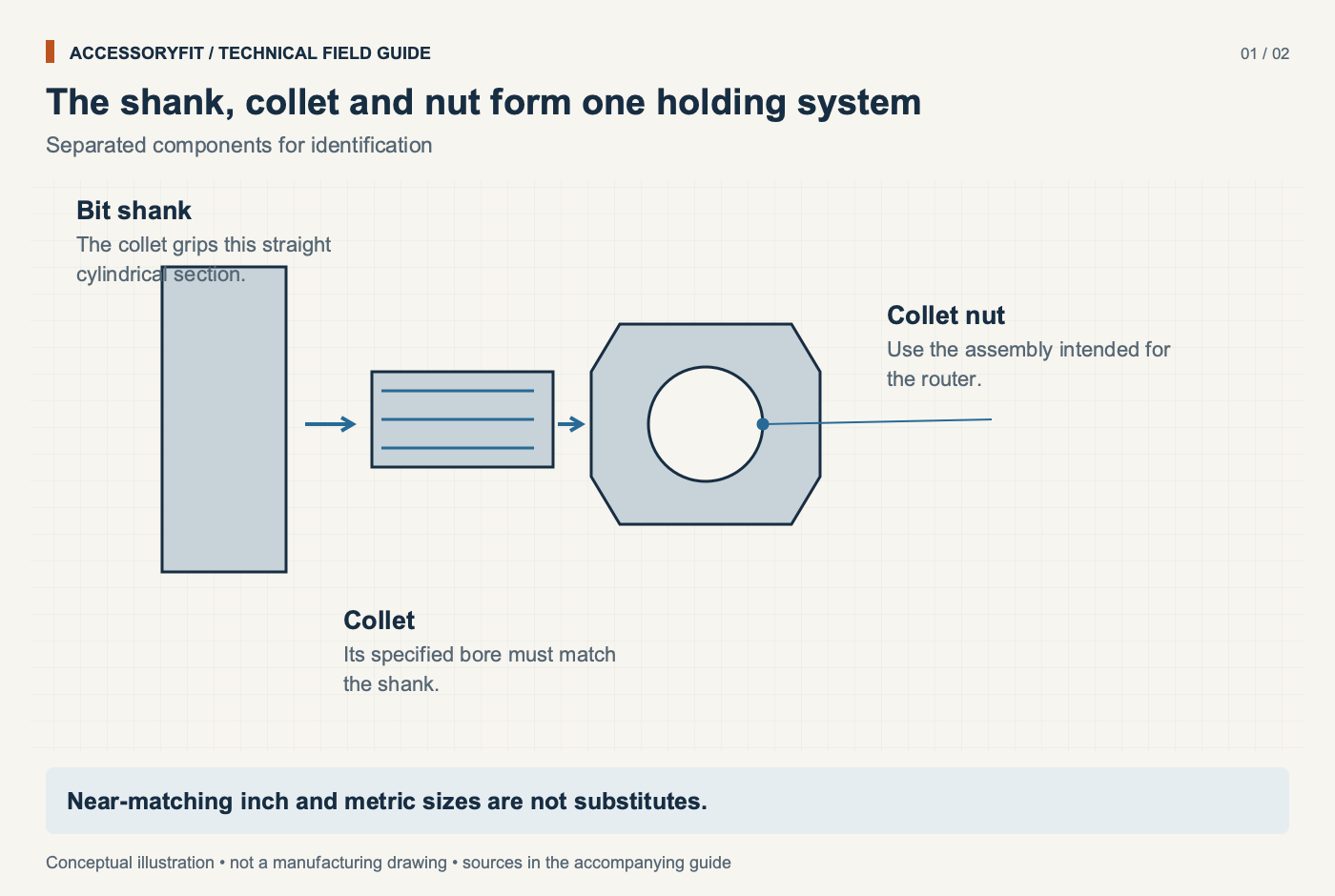
A router collet is the split sleeve and nut on the router spindle that squeezes around the round shank of a bit, and it only grips properly when its bore matches the shank diameter. Bosch, Milwaukee and Makita all say to use a collet whose bore matches the bit's shank, and they warn that a mismatched collet can fail to grip or can break.
Router makers specify one collet per shank size rather than one holder for a range of shanks, which is why routers are sold with two or more collets, or with maker-specified sleeves. Buying a bit therefore means checking the shank size first and the cutter second.
Router bit shanks are plain and round, so the collet's grip on the shank is what holds the bit in the spindle. Other accessories work differently: rotary hammer bits use slotted shanks that slide in the holder, as the guide to SDS-Plus versus SDS-Max explains, and reciprocating saw blades lock into a shared clamp, as covered under reciprocating saw blade shank fit.
Which collet sizes do common routers take?
Compact routers take one inch-size collet, mid-size and full-size routers take two or more, and European routers add metric collets. DeWalt's DWP611, Milwaukee's M18 FUEL 2723 and Makita's RT0701C ship with a 1/4 in collet. Milwaukee's 5616-24 and Makita's RP2301FC include both 1/4 and 1/2 in collets, and Bosch lists the capacities of its 1617 family as 1/4 in, 3/8 in, 1/2 in, 8 mm.
The Makita RT0701C is a case where sources on file disagree. Makita's US product page lists only one collet in the box, while the manual's specification table gives a second capacity as well, so the table below shows both. Supplied collets also vary by kit and country, so the kit label matters more than the model number.
Makita's RP1800, RP1801F and RP2301FC list a collet capacity of 12 mm or 1/2 in, with Makita's own collet sleeves for smaller shanks. Bosch's GOF 1600 CE Professional accepts shanks from 8 – 12.7 mm, and its UK kit ships with two inch collets.
Two European pro routers are listed only by retailers so far, so treat these as kit listings rather than maker statements. The Power Tool Store lists the Festool OF 1400 EQ-F-Plus with three collets in the box, 1/4 in, 8 mm, 1/2 in, which covers both inch sizes and the common metric one. Anglia Tool Centre lists the Trend T11EK with a 1/2 in collet and says Trend sells other collet sizes for it, metric included. For either router, check the kit label before buying bits. The searchable version of these records is in the tool accessory lookup.
| Router | Market | Class | Collets / capacity | No-load speed |
|---|---|---|---|---|
| DeWalt DWP611 | US | Compact (trim) | 1/4 in (6.35 mm) | 16,000-27,000 rpm |
| Milwaukee M18 FUEL 2723-20 | US | Compact (trim), cordless | 1/4 in (6.35 mm) | 10,000-31,000 rpm |
| Makita RT0701C | US | Compact (trim) | Supplied: 1/4 in; manual capacity: 1/4 in, 3/8 in | 10,000-30,000 rpm |
| Bosch 1617EVSPK | US/Canada | Mid-size | 1/4 in, 3/8 in, 1/2 in, 8 mm (capacity) | 8,000-25,000 rpm |
| Milwaukee 5616-24 | US | Mid-size | 1/4 in and 1/2 in supplied | 10,000-24,000 rpm |
| Makita RP2301FC | US | Full-size plunge | Supplied: 1/4 in and 1/2 in; capacity 12 mm or 1/2 in with 3/8 in and 1/4 in collet sleeves | 9,000-22,000 rpm |
| Bosch POF 1400 ACE | EU/UK | Mid-size (DIY) | 6 mm, 8 mm, 1/4 in supplied | 11,000-28,000 rpm |
| Bosch GOF 1600 CE Professional | UK | Full-size | Bit holder 8-12.7 mm; UK kit: 1/4 in and 1/2 in collets | 10,000-25,000 rpm |
| Festool OF 900 / OF 1000 / OF 1010 / OF 1010 R | EU | Mid-size | 8 mm collet SZ-D 8 available | not recorded |
| Festool OF 1400 EQ-F-Plus | US/EU | Mid-size | Supplied: 1/4 in, 8 mm, 1/2 in (retailer listing) | 10,000-22,500 rpm |
| Trend T11EK | UK | Full-size | Supplied: 1/2 in; 6-12 mm collets sold separately (retailer listing) | 8,000-20,000 rpm |
Supplied collets vary by kit and country; always check the specific kit. Festool speeds were not fetched (Festool site blocked automated access). Makita RT0701C: product page lists only a 1/4 in collet in the box, while the manual spec table gives 1/4 in and 3/8 in capacity. Festool OF 1400 and Trend T11EK rows come from retailer listings only, because the makers' sites blocked automated access.
| Tool | Collets | No-load speed |
|---|---|---|
| Bosch 1617EVS | 1/4, 3/8, 1/2, 8 mm in | 25000 rpm one source |
| Bosch PR20EVS | 1/4 in | 35000 rpm |
| DeWalt DW618 | 1/4, 1/2 in one source | 24000 rpm |
| DeWalt DWP611 | 1/4 in | 27000 rpm |
| Makita RT0701C | 1/4 in; 3/8 in | 30000 rpm |
Values marked one source appear in a single manufacturer document; check the tool's manual or rating plate before buying.
Can an 8 mm bit go in a 1/4 in collet?
No. An 8 mm shank and a 1/4 in shank are different sizes, and manufacturers require the collet to match the shank, otherwise it may not grip or may break. The belief that the two are close enough to swap is common, especially among owners of European bits and US routers or the reverse.
The same applies at the larger end. Makita lists a capacity of 12 mm or 1/2 in for its full-size plunge routers, meaning the router has a collet for each size, not one collet that takes both. Owners in Europe who buy bits with metric shanks need the matching metric collet. Festool, for example, sells an 8 mm collet (SZ-D 8) for metric-shank cutters that fits its OF 900, OF 1000, OF 1010 and related routers.
The practical rule for mixed collections is simple: keep metric and inch bits apart, label the collets, and read the shank size printed on each bit or its packaging before fitting it.
Should you choose 1/2 in or 1/4 in shank bits?
Choose 1/2 in shank bits whenever the router accepts them. Bosch and Timbecon both say larger shanks give more stability and less vibration than smaller ones.
The smaller shank still has a place. Compact routers take nothing larger, and many starter sets are sold in both shank sizes: Freud's Freud 88-100 9 Piece Basic Bit Set (1/4 in shank) uses a 1/4 in shank, while its Freud 91-100 13 Piece Super Bit Set (1/2 in shank) uses a 1/2 in shank. Buyers choosing between sets should start from the collets their router has, and the round-up of router bit sets for beginners notes the shank size of each set.
Bit size is limited by the router as well as the shank. DeWalt says not to use bits larger than 1-3/8 in in diameter in the DWP611, and Milwaukee lists a maximum bit size of 1-1/2 in for its M18 FUEL 2723-20. These are limits for those tools, not a general rule for every small-shank bit, and the table below lists them with Bosch's rule for the 1617 series.
| Router | Limit | Condition |
|---|---|---|
| DeWalt DWP611 | 1-3/8 in (34.9 mm) | Any use in this tool |
| Milwaukee M18 FUEL 2723-20 | 1-1/2 in (38.1 mm) | Maximum bit size in spec table |
| Bosch 1617 series | 2 in (50.8 mm) | With the templet guide adapter removed, larger bits will not pass through the sub-base |
| Bosch 1617 series | At least 1/4 in (6.4 mm) smaller than the base opening | General rule for any cutter |
These are tool limits, not a general rule for 1/4 in shank bits.
Can you use a reducer sleeve in a router collet?
Only the sleeve your router maker specifies, used as its manual describes. Makita sells its own collet sleeves for smaller shanks in its 12 mm or 1/2 in collet, and Makita says small-shank bits must be fitted with the appropriate sleeve, because fitting them without one can break the collet cone.
Bit makers sell reducers too. Whiteside, for example, sells reducer bushings that slip inside the router's own collet. No router manual on file explicitly forbids third-party sleeves, but none approves them either, and the general manufacturer instruction is to match the collet to the shank. The belief that any reducer sleeve is fine in any router is not supported by the sources; the safe reading is to use the sleeve your router maker names, and otherwise a collet of the correct size.
How far should a bit go into the collet?
Insert the shank fully, then back it out slightly so it does not bottom out; the exact gap differs by maker. Bosch, DeWalt and Milwaukee all give this instruction, and Bosch adds that the shank must go in at least 5/8 in for proper grip and low run-out.
The figures disagree in detail. DeWalt's DWP611 manual says to pull the bit out a short distance after it bottoms; Milwaukee's 2723 manual says to leave a gap between the collet assembly and the start of the cutter radius and not to clamp on the fluted section; IGM's safety sheet asks for most of the shank to be inside the collet; and Makita's RP2301FC manual says to insert the bit all the way and tighten, without mentioning a back-off. The table sets out each source's wording. The router's own manual is the one to follow.
A European bit maker adds a rule based on the EN 847 standard. CMT tells users to insert a bit at least to the minimum clamping length marked on its shank, or, citing EN 847, to these minimums: >= 20 mm (shank up to 10 mm); >= 2 x shank (10–25 mm). CMT also says to leave a gap at the bottom of the collet, which agrees with the back-off instruction in the US manuals. Where a bit carries a clamping mark, that mark is the floor.
Pushing the bit hard to the bottom for extra grip is a common habit that the Bosch, DeWalt and Milwaukee manuals all advise against.
| Source | Instruction |
|---|---|
| Bosch (1617 manual) | Insert fully, back out until cutters are about 1/8-1/4 in (3.2-6.4 mm) from the collet nut face; shank must be inserted at least 5/8 in (15.9 mm) |
| DeWalt (DWP611 manual) | Insert as far as it will go, then pull out about 1/16 in (1.6 mm) |
| Milwaukee (2723 manual) | Insert fully, back out slightly; leave at least 1/16 in (1.6 mm) between the collet assembly and the start of the cutter radius; do not clamp on the fluted section |
| Makita (RP2301FC manual) | Insert the bit all the way into the collet cone, then tighten |
| IGM (bit maker safety sheet) | At least 75% of the shank inside the collet; do not force the shank to the bottom, leave about 3.2 mm (1/8 in) |
| ToolsToday (retailer guide) | Insert fully, then back out about 1/8 in (3.2 mm), or to the stop line if marked |
Instructions differ between makers; follow the router's own manual. Makita's wording does not mention backing the bit out.
Is a bit safe at your router's speed?
A bit is safe for speed only when its rated maximum is at least the router's maximum no-load speed. Bosch, Makita and Freud all state this, and bits run above their rating can break and fly apart. Manuals and bit makers also tie speed to diameter: larger bits need lower speeds.
The figures show how much ratings vary. Whiteside's product pages rate its smallest bits at a maximum close to the top speed of a mid-size router, and its largest raised-panel and roundover bits at about half that, as the first table below shows; several routers in the table above run faster than those large-bit ratings, so the speed dial has to come down before such a bit goes in. IGM publishes a chart of maximum speed by bit diameter, shown second; its figures are one bit maker's guide, and the maximum etched on the bit or printed in its documentation takes priority. CMT, another bit maker, describes the same pattern: it says a bit's maximum speed depends on its diameter and application, publishes a chart in which the maximum falls as diameter rises, and says the speed marked on the bit or its packaging governs. Large bits such as raised-panel cutters are meant for router-table use at reduced speed.
Burning and chipping often trace back to speed set wrong for the bit diameter, and the guide on router bit burning and chipping works through that and the other causes.
| Bit (Whiteside part) | Shank | Large/cutting diameter | Recommended rpm | Max rpm |
|---|---|---|---|---|
| Carbide straight SC01 | 1/4 in | 1/16 in (1.6 mm) | 18,000-20,000 | 24,000 |
| Straight bit 1074 | 1/2 in | 17/32 in (13.5 mm) | 16,000-18,000 | 24,000 |
| Flush trim 2415 | 1/2 in | 7/8 in (22.2 mm) | 14,000-16,000 | 18,000 |
| Cove & bead 3212 | 1/2 in | 1-5/16 in (33.3 mm) | 14,000-16,000 | 18,000 |
| 120 deg V-groove 1566 | 1/2 in | 1-1/2 in (38.1 mm) | 14,000-16,000 | 18,000 |
| Roman ogee 2210 | 1/2 in | 2 in (50.8 mm) | 10,000-12,000 | 12,000 |
| 45 deg chamfer 2310 | 1/2 in | 2-5/8 in (66.7 mm) | 10,000-12,000 | 12,000 |
| Raised panel with back cutter 5920B | 1/2 in | 3-1/4 in (82.6 mm) | 10,000-12,000 | 12,000 |
| Roundover 2016 (1-1/2 in radius) | 1/2 in | 3-3/4 in (95.3 mm) | 10,000-12,000 | 12,000 |
Per-bit ratings from Whiteside product pages; other bits of the same diameter may carry different ratings.
| Bit diameter | Maximum rpm |
|---|---|
| 2-25 mm (about 1/16-1 in) | 24,000 |
| 25-50 mm (about 1-2 in) | 18,000 |
| 50-75 mm (about 2-3 in) | 16,000 |
| 75-90 mm (about 3-3-1/2 in) | 12,000 |
Single manufacturer chart. The maximum rpm etched on the bit or printed in its documentation always takes priority. Inch values are conversions.
When does a bit that fits the collet still fail?
A bit with the right shank still fails when it is fitted badly, run too fast or used in a router too small for it. The cases manufacturers describe are these:
- Bottomed-out shank. Most manuals say to back the bit out slightly after inserting it.
- Too little shank in the collet. Bosch gives a minimum insertion depth for grip and low run-out.
- Collet clamped on the flutes. Milwaukee warns against it; the collet belongs on the solid shank.
- A sleeve the router maker did not specify. Makita warns its collet cone can break without the right sleeve.
- Bit larger than the tool limit. DeWalt and Milwaukee set maximum bit diameters for their compact routers.
- Speed too high for the bit. Large bits carry lower ratings than small ones.
- An empty collet tightened. All four router makers on file warn this can damage the collet.
Profile choice matters as much as fit once the bit is in; the guide to router bit profiles covers what each cutter shape is for.
How do you fit a router bit correctly?
Five steps, drawn from the Bosch, DeWalt, Milwaukee and Makita manuals, cover fitting a bit to a router.
- Disconnect power. Unplug the router or remove the battery.
- Match the collet to the shank. Read the shank size on the bit and fit the collet of the same size, or the maker's own sleeve where the manual calls for one.
- Insert the bit. Push the shank fully in, then back it out by the amount your router's manual gives, keeping the collet on the solid shank.
- Tighten the nut. Use the wrenches or spindle lock the manual describes, and never tighten the nut on an empty collet.
- Set the speed. Check the bit's rated maximum and set the router at or below it, lower for larger diameters.
Where do you go next?
Router bits of every profile and shank size are grouped under the router bit guides, and fit rules for saws, drills, grinders and sanders sit together in the section on what fits which tool.
Questions readers ask
Does a full-size router take small-shank bits?
Yes, if it has a collet of the small size or the maker's own sleeve. Most mid-size US routers ship with both 1/4 and 1/2 in collets.
Can I use metric-shank bits in a US router?
Only with a collet of that size. Bosch supplies its EU POF 1400 ACE with 6 mm, 8 mm, 1/4 in collets, but most US kits on file ship with inch collets only.
Why did my collet crack?
Router makers name two causes: tightening the nut with no bit in the collet, and fitting a small shank in a larger collet without the maker's sleeve. Both are warned against in Bosch, DeWalt, Milwaukee and Makita manuals.
Do any routers take shanks between the two common inch sizes?
Yes. An intermediate inch size appears in the collet capacities Bosch lists for its 1617 family and in Makita's collet sleeves, so some routers take it, but most US kits on file ship only with the two common inch sizes.
Where to go next
- Router bit sets for beginnersSets by shank size.
- Router bit burning and chippingSpeed, feed and bit problems.
- Router bit profilesWhat each cutter shape does.
References 56 documents, 17 publishers
- Anglia Tool Centre (retailer): Trend T11EK 1/2 in router listing
- Bosch: 1617/1618 router operating/safety instructions (2610051825); 1617EVSPK combination plunge and fixed-base router (Canada product page); GOF 1600 CE Professional router (UK product page); POF 1400 ACE router (Bosch DIY UK product page); POF 1400 ACE Oberfräse (Bosch DIY Germany product page); GOF 1600 CE Professional router (Colombia product page); PR10E/PR20EVS palm router operating/safety instructions 2610021461; 1617EVS 2.25 HP VS Fixed-Base Router product page; PR20EVS Colt Electronic Variable-Speed Palm Router product page; PR20EVS Colt palm router (Canada product page)
- CMT Orange Tools (C.M.T. Utensili): Router bits and drill bits safety recommendations (2025)
- DeWalt: DWP611 compact router instruction manual (N336740); DWP611 1.25 HP max torque variable speed compact router with LED; DWE575 circular saw instruction manual (N786997), general power tool safety; DW616/DW618 Instruction Manual N384518; DW618 2-1/4 HP EVS Fixed Base Router With Soft Start product page; DWP611 1-1/4 HP Max Torque Variable Speed Compact Router product page
- Festool: Collet SZ-D 8/OF 1010 (488755)
- Freud and Diablo: Get the most out of your Freud bits by routing at ideal feed rates and speeds (CNC feed and speed sheet); 88-100 9 Piece Basic Bit Set product page; 91-100 13 Piece Super Bit Set product page
- IGM Tools & Machinery: GPSR router bits safety instructions (2024-12-17)
- Makita: RT0701C 1-1/4 HP compact router product page; RP1800/RP1801F/RP2301FC plunge router instruction manual; RT0701C compact router instruction manual; RP2301FC 3-1/4 HP plunge router product page; RP2301FC router data sheet (Ficha técnica); RP0910/RP1110C electronic router instruction manual (Makita Czech catalogue file); 9557PB angle grinder instruction manual; 5007F 7-1/4 in circular saw instruction manual
- Milwaukee Tool: M18 FUEL compact router 2723-20 operator's manual (58-14-0194d1); M18 FUEL compact router 2723-20 product page; 2-1/4 Max HP EVS multi-base router kit 5616-24; M18 FUEL oscillating multi-tool 2836-20 operator's manual (58-14-0217d1)
- Multitronic (retailer): Bosch POF 1400 ACE router listing
- OSHA: 29 CFR 1910.215 Abrasive wheel machinery; 29 CFR 1910.243 Guarding of portable powered tools; 29 CFR 1926.303 Abrasive wheels and tools; 29 CFR 1926.300 General requirements (Tools, hand and power); 29 CFR 1926.304 Woodworking tools
- Power Tool Centre (retailer): Festool 488755 collet SZ-D 8/OF 1010 listing
- The Power Tool Store (retailer): Festool OF 1400 EQ-F-Plus router 578951 listing
- Timbecon: Freud 1/2in shank router bits (collection page)
- ToolsToday: Router Safety: Best Practices for Safe, Precise, & Efficient Routing
- Whiteside Machine Co.: Steel router collet / reducer bushing 6400x10; 5920B raised panel bit with back cutter; SC01 carbide straight bit; 1074 straight bit; 2415 flush trim bit; 2210 roman ogee bit; 2310 45 degree chamfer bit; 3212 cove and bead bit; 1566 120 degree V-groove bit; 2016 roundover bit
- Woodworker's Journal: Router Speed Settings
Accessed .