
Research · Cordless batteries
Power tool battery fire statistics: recalls, fire records and EU rules
No US or EU agency publishes a national count of fires caused by power tool batteries. What does exist is recall and local data. From 2015 to 2025 the US Consumer Product Safety Commission (CPSC) announced 9 recalls of cordless power tools, battery-platform outdoor tools or tool battery packs for fire, burn or overheating hazards, covering about 2.18 million units sold in the US, according to an AccessoryFit analysis of all 3,231 CPSC recall notices from those years.
By AccessoryFit editors · Checked
On this page
- What are the key findings?
- How often do power tool batteries cause fires?
- What do regulators outside Phoenix report?
- How many power tool battery recalls have there been in the US?
- Are power tool battery recalls increasing?
- Which brands and products have been recalled for battery fire hazards?
- Is it the battery or the tool that overheats?
- What do the EU battery rules change for cordless tool packs?
- How should you charge, store and dispose of tool batteries?
- How was this data produced?
- How should you cite this data?
What are the key findings?
- CPSC announced 9 recalls in the US for fire, burn or overheating hazards in cordless power tools, battery-platform outdoor tools and tool battery packs between 2015 and 2025, covering about 2.18 million units (AccessoryFit analysis of CPSC recall notices).
- One recall, Harbor Freight's December 2015 recall of Drill Master 18V cordless drills with switches that could stick on and overheat, accounts for 78% of all US units in those recalls.
- Across the same recalls, firms told CPSC of 272 incident reports of overheating, smoke, melting, sparks or fire, and 16 injuries, mostly minor burns.
- The battery itself overheated in 33% of the 2015–2025 recalls; in the rest, CPSC notices blamed the tool's own electronics, such as a switch, circuit board, connector or motor controller.
- AccessoryFit found 0 recalls of a battery pack or charger for a handheld cordless tool platform in US recall notices from 2015 to 2025; 7 of 9 recalls involved outdoor equipment such as mowers, a chainsaw and a sprayer.
- The Phoenix Fire Department in Arizona linked 19 fires to power tool batteries in 2024, up from 11 fires in 2023 and second only to micromobility devices, and 16 of 72 lithium-ion battery fires in 2025.
- In July 2026, Greenworks Tools recalled about 554,780 units of Kobalt 24V and 48V yard tools after 34 incident reports of their USB-C batteries smoking, sparking or catching fire while charging, according to CPSC.
- Under the EU Batteries Regulation, products sold in the EU with portable batteries, which includes cordless tool packs, must let the end user remove and replace the battery from 18 February 2027.
How often do power tool batteries cause fires?
Nobody knows the national figure: AccessoryFit found no US, UK or EU agency that publishes a count of fires started by power tool batteries. What the record does contain is local fire investigation data, regulator incident reports and recall notices, and each answers a narrower question.
The most specific local figures come from the Phoenix Fire Department's lithium-ion battery fire investigations. Phoenix investigators attributed 19 fires in 2024 to power tool batteries, second only to micromobility devices such as e-bikes and scooters. In 2025 power tool batteries accounted for 16 of 72 lithium-ion battery fires the department investigated (a year-to-date count from its December 2025 release).
| Device type | 2023 | 2024 | 2025 |
|---|---|---|---|
| Power tools | 11 | 19 | 16 |
| Micromobility | 17 | 21 | 15 |
| Portable electronics | 5 | 12 | 12 |
| Other/multiple devices | 13 | 5 | 17 |
| Electric vehicle | 12 | 6 | 8 |
| Remote powered | 2 | 5 | 4 |
| Energy storage system | 4 | 3 | 1 |
2025 column is the year-to-date figure in the December 2025 release (72 fires investigated); category counts read from the bar chart labels.
What do regulators outside Phoenix report?
Regulator data show tool batteries as a minority of lithium-ion battery incidents, but a regular one. Australia's consumer regulator, the ACCC, reported in December 2022 that power tools made up 6% of the lithium-ion battery incident reports received by Australian state and territory consumer-law regulators between January 2017 and August 2022. Its October 2023 report covered 231 lithium-ion product safety reports received from April 2017 to March 2023 and named power tools among higher-energy products whose incidents were trending upward, but it gave no separate power-tool count.
Discarded batteries are a separate problem. The US Environmental Protection Agency identified 245 fires at 64 waste facilities between 2013 and 2020 that were caused or likely caused by lithium batteries, and said such fires are severely underreported. That 2021 report covers lithium batteries of every kind, not tool packs alone, and remains the agency's most recent analysis of its kind.
Read together, these figures say tool packs turn up regularly in battery fire records. They do not give a rate per battery sold, and they do not say whether a fire involved a genuine pack, a third-party pack or an incompatible charger, so they cannot be used to compare brands or to calculate the risk of any one battery.
How many power tool battery recalls have there been in the US?
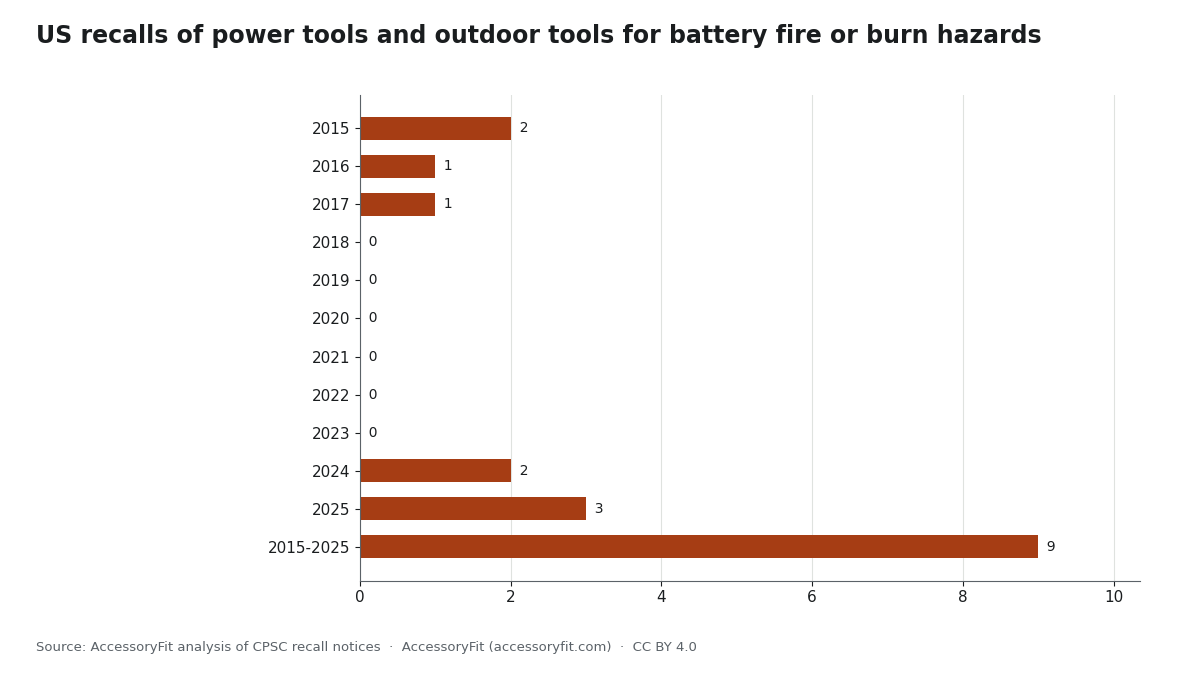
CPSC announced 9 recalls of this kind from 2015 to 2025, found by an AccessoryFit review of all 3,231 CPSC recall notices published in those eleven years. The pattern is uneven: recalls in 2015, 2016 and 2017, none from 2018 to 2023, then a cluster in 2024 and 2025.
| Year | Recalls | US units recalled | Incident reports stated | Injuries stated | Recalls (number: product) |
|---|---|---|---|---|---|
| 2015 | 2 | 1,793,000 | 31 | 6 | 15227: Dremel MICRO 8050 rotary tool with 8V lithium-ion battery; 16050: Drill Master 18V cordless drills (items 68239 and 68287) |
| 2016 | 1 | 300 | 2 | 0 | 16151: Ryobi 40V brushless snow blowers |
| 2017 | 1 | 28,000 | 12 | 0 | 17168: Kobalt and Greenworks 40V max cordless walk-behind mowers |
| 2018 | 0 | 0 | 0 | 0 | none |
| 2019 | 0 | 0 | 0 | 0 | none |
| 2020 | 0 | 0 | 0 | 0 | none |
| 2021 | 0 | 0 | 0 | 0 | none |
| 2022 | 0 | 0 | 0 | 0 | none |
| 2023 | 0 | 0 | 0 | 0 | none |
| 2024 | 2 | 116,000 | 108 | 8 | 25027: Bauer 20V cordless 4-gallon backpack sprayer (item 58671); 25071: SKIL 40V 5.0Ah lithium-ion battery BY8708-00 (PWRCORE 40) |
| 2025 | 3 | 237,880 | 119 | 2 | 25127: RYOBI 40V HP brushless 21 in cordless walk-behind mowers; 25323: DR Pulse 62V battery-powered chainsaws; 25355: DR Power LiPRO 62V 5.0Ah lithium-ion battery packs (model 414240) |
| 2015-2025 | 9 | 2,175,180 | 272 | 16 | all |
Year is the CPSC recall date (some notices carry a recall number from the next fiscal year). Units are US units as stated; Canadian units excluded. Incident and injury counts are as stated by the firm in each notice at the time of recall.
Are power tool battery recalls increasing?
Recalls have been more frequent recently, but the numbers are too small to call it a trend: 5 of 9 recalls from 2015 to 2025 were announced in 2024 or 2025, after none from 2018 to 2023. A difference of a few recalls a year can come from one manufacturer's decisions. All of the 2024 and 2025 recalls also involved outdoor equipment such as mowers, a sprayer and a chainsaw, or their packs, rather than handheld tools.
A recall count also measures something different from a fire count. The recalls in this dataset stated 272 incident reports and 16 injuries at the time of recall, but those are the firms' own figures, not national totals.
The pattern has continued into 2026. In July 2026, Greenworks Tools recalled about 554,780 units of Kobalt 24V and 48V yard tools whose 24V batteries could smoke, spark or catch fire while charging through their USB-C port inside the tool. The firm had received 34 incident reports and reported no injuries. That one recall covers more units than any recall in the 2015–2025 set apart from the Drill Master drills. It sits outside the 2015–2025 window, so it is not in the totals, the chart or the download.
Which brands and products have been recalled for battery fire hazards?
The 2015–2025 recalls cover Dremel, Drill Master (Harbor Freight), Ryobi and RYOBI outdoor, Kobalt and Greenworks, Bauer (Harbor Freight), SKIL and DR Power products. In recall-date order they are:
- Dremel MICRO 8050 rotary tool with an 8V lithium-ion battery (2015): circuit board could overheat and melt the enclosure.
- Drill Master 18V cordless drills, items 68239 and 68287 (2015): internal switch could stick on and overheat.
- Ryobi 40V brushless snow blowers (2016): the notice says the unit overheats but does not name the part.
- Kobalt and Greenworks 40V max cordless walk-behind mowers (2017): circuit board could short and catch fire.
- Bauer 20V cordless 4-gallon backpack sprayer, item 58671 (2024): leaking chemicals could reach the battery compartment and make the 20V battery overheat.
- SKIL 40V 5.0Ah PWRCORE 40 battery BY8708-00 (2024): the battery pack could overheat.
- RYOBI 40V HP brushless 21 in cordless walk-behind mowers (2025): a push-on connector inside the powerhead could overheat.
- DR Pulse 62V battery-powered chainsaws (2025): motor controller could overheat.
- DR Power LiPRO 62V 5.0Ah battery packs, model 414240 (2025): packs could short-circuit and ignite.
The unit count, firm, incident and injury figures and the CPSC notice link for each recall are in the CSV download below. The list contains no packs or chargers for the big handheld platforms, such as DeWalt 20V MAX, Milwaukee M18, Makita 18V LXT or Bosch 18V. That is a statement about US recalls only, not about how often those packs are involved in fires.
Is it the battery or the tool that overheats?
Usually the tool: the battery itself overheated in 33% of the 2015–2025 recalls, and CPSC notices blamed the tool's electronics in the rest. Only 2 recalls were for a battery pack on its own, the SKIL 40V pack and the DR Power LiPRO 62V pack, both used on outdoor equipment. The third battery case was the Bauer sprayer, where a pump leak let chemicals reach the battery.
For an owner, the point is that a hot or smoking tool on a sound battery is still a fire risk: in most of these recalls the fault was in the tool, not the pack. The 2026 Kobalt recall is a battery case again, linked to charging through a USB-C port on the pack.
What do the EU battery rules change for cordless tool packs?
The EU Batteries Regulation (EU) 2023/1542 changes two things a cordless tool owner will notice: removable batteries and collection. From 18 February 2027, products sold in the EU with portable batteries must have batteries the end user can readily remove and replace, and from the same date all batteries must carry a QR code. A portable battery under the regulation is a sealed battery weighing 5 kg or less that is not designed for industrial use, a definition that covers cordless tool packs. Slide-on tool packs are already designed to be removed by the user, so the change bears mainly on products with built-in cells.
The regulation also sets rising collection targets for waste portable batteries, which producers must meet: at least 45% by the end of 2023, then 63% by 2027, 73% by 2030.
UK rules are separate from the EU regulation and are not covered by this page.
How should you charge, store and dispose of tool batteries?
The sourced guidance is short: charge each pack only on the charger its maker specifies, use it only in the tools its maker designates, keep metal away from its terminals, and never put a lithium-ion pack in the household bin. The makers' rule is designated packs only: DeWalt, Milwaukee and Makita manuals all say to use a tool only with its designated battery packs and to charge only with the specified charger, because other packs or chargers can cause injury or fire. DeWalt warns that a pack modified to fit a charger or tool it was not made for may rupture, and that a short circuit across the terminals can cause burns or fire.
Which packs and chargers count as designated depends on the platform, and alliances such as AMPShare and CAS change the answer for some brands. The battery platform cross-reference lists which packs the makers say fit which tools, and what Makita and Milwaukee say about non-genuine batteries and warranties.
For disposal, the 2025 DR Power recall notices told owners of the recalled packs not to put lithium-ion batteries in household trash, curbside recycling or store battery-recycling boxes, but to follow the recall's own instructions. For packs that are not recalled, the EPA's waste facility fire figures are the reason to use a battery take-back point rather than the bin.
The sources on this page do not give storage temperatures or a recommended storage charge level, so check the manual for your pack; those figures vary by maker.
How was this data produced?
The recall dataset is original AccessoryFit work built from US Consumer Product Safety Commission recall notices. All 3,231 CPSC recall notices dated 1 January 2015 to 31 December 2025 were downloaded from CPSC's Recalls REST API in year-by-year queries. The notices were screened by keyword on title, product name, hazard and incident text, and each candidate notice's description and hazard were then read in full.
Included: cordless power tools, outdoor tools on rechargeable tool-battery platforms (mowers, snow blowers, chainsaws, sprayers), and tool battery packs or chargers, where the stated hazard was fire, burn or overheating.
Excluded: e-bikes, scooters, phones, laptops, power banks, toys, vapes, robotic mowers and portable power stations; corded tools with fire hazards; cordless tools recalled for other hazards, such as lacerations; and borderline cases such as sprayers with their own non-platform battery packs and a gas pressure washer's starter battery.
Definitions: the year is the CPSC recall date. Units are the US units stated in each notice; Canadian units are excluded. Incident and injury counts are those the firm reported in the notice at the time of recall. The Ryobi snow blower notice does not name the failing part, so it is counted as a tool-side failure with the component not stated.
Limitations: no US, UK or EU agency publishes a national count of fires caused by tool batteries, so this page cannot give a fire rate. Recalls are a record of defects that led to action, not a measure of how often tool batteries cause fires. Firm-reported incident counts are incomplete and stop at the recall date. Recalls by other national regulators, such as in the UK, EU or Canada, are not included. CPSC's web pages blocked automated access, so figures were read from CPSC's own API, which carries the same notice text. The 2026 Kobalt recall is reported separately because it falls outside the 2015–2025 window.
The fire figures are third-party data. Phoenix's 2025 figures are from the department's December 2025 public summary, a year-to-date count, and category counts were read from the bar-chart labels in that release. The ACCC and EPA figures are quoted as published. For how AccessoryFit handles sources generally, see the AccessoryFit research methods page.
How should you cite this data?
Please cite AccessoryFit as the source of the recall analysis and link to this page. A suggested citation:
AccessoryFit, "Power tool battery fire statistics: recalls, fire records and EU rules", updated 22 October 2026, https://accessoryfit.com/research/power-tool-battery-fire-statistics/
The recall dataset, tables and chart on this page are free to reuse under the Creative Commons Attribution 4.0 licence (CC BY 4.0), provided you credit AccessoryFit and link to this page. The Phoenix, ACCC, EPA and EU figures belong to those bodies; cite them directly where you use them. More datasets on tool injuries, noise and dust are collected on the AccessoryFit research and data hub, including US emergency department figures for power tool injuries and noise levels measured for common power tools.
Download the data
The CSV has one row per recall, with the recall number, date, firm and brand, product, US units, hazard, incident and injury counts, CPSC notice link, segment and failing component. Free to reuse under CC BY 4.0 with a link to this page.
- US power tool battery fire recalls, 2015–2025 (CSV) One row per CPSC recall; AccessoryFit analysis of CPSC recall notices.
- Chart: recalls by year (PNG, 1200 × 675) Bar chart of recalls per year, 2015–2025, with source line.
Questions readers ask
Are power tool batteries more dangerous than e-bike batteries?
The data cannot say. Phoenix fire investigators found power tool batteries in 19 fires in 2024, close behind micromobility devices, but no source gives fires per battery in service for either product. Counts without that denominator do not measure risk per battery.
Have DeWalt, Milwaukee or Makita batteries been recalled for fire risk in the US?
Not between 2015 and 2025. AccessoryFit found 0 recalls of a battery pack or charger for any handheld cordless tool platform in CPSC notices from those years; the battery-pack recalls were for SKIL and DR Power outdoor-equipment packs. This covers US recalls only.
Can a dead tool battery go in the household trash?
No. CPSC recall notices for the 2025 DR Power packs told owners not to put lithium-ion batteries in household trash or curbside recycling, and the US EPA has linked lithium batteries to 245 fires at 64 waste facilities between 2013 and 2020. In the EU, producers must meet rising collection targets for waste portable batteries under Regulation (EU) 2023/1542.
Where to go next
- Battery platform cross-referenceWhich packs and chargers each maker designates for its tools.
- Power tool injury statisticsUS emergency department estimates by tool type.
- Power tool research and dataAll AccessoryFit datasets and downloads.
References 10 documents, 8 publishers
- Australian Competition and Consumer Commission: Lithium-ion Batteries Issues Paper; Lithium-ion batteries and consumer product safety (Report, October 2023)
- DeWalt: DCS356 20V MAX XR oscillating multi-tool instruction manual (N682755)
- European Parliament and Council of the European Union (EUR-Lex): Regulation (EU) 2023/1542 concerning batteries and waste batteries
- Makita: XMT04 cordless multi tool instruction manual (885866-944)
- Milwaukee Tool: M18 FUEL compact router 2723-20 operator's manual (58-14-0194d1)
- Phoenix Fire Department, Fire Investigations Task Force: Lithium-Ion Battery Fire Investigations, December 2025 (Public Release Summary)
- U.S. Consumer Product Safety Commission: CPSC Recalls Retrieval Web Services (Recalls REST API), recalls dated 2015-01-01 to 2025-12-31, JSON responses; Greenworks Tools Recalls 24V and 48V Kobalt Yard Power Tools with USB-C Batteries Due to Risk of Serious Injury from Fire Hazard (recall 26611)
- US Environmental Protection Agency, Office of Resource Conservation and Recovery: An Analysis of Lithium-ion Battery Fires in Waste Management and Recycling (EPA 530-R-21-002)
Accessed .